2022 in Review — What a Year for Travel!

It’s hard to imagine a more eventful year for travel than 2022. Reflecting on the last 12 months, I’m astonished at how much has happened in the world of travel — and in my own travels. It was a year of returning to the road despite COVID, yes…but also the invasion of Ukraine, the death of the Queen,  and so very much more. I’m not usually in the habit of quoting communist despots, but this saying from Vladimir Lenin suits our kitchen-sink times: “There are decades where nothing happens, and there are weeks where decades happen.”

And so, here’s a recap of my 2022 travels. I hope it serves as a snapshot of the “state of travel in 2022” — one of the wildest, fastest-changing years I can remember. If you’ve been to Europe this year, you may find some of this relatable. If you haven’t, it may be illuminating. And mixed in are some personal travel stories I hope you can enjoy vicariously.

Fair warning: This recap is long. (I’m trying to tell you — a lot happened in 2022!) Bear with me and feel free to skim. If you’d like more information on any of these topics, I’ve linked to posts on my blog or on my Facebook page, where I was very busy this year, tracking my travels. (If you aren’t on Facebook, you may not be able to read some of those posts.) I plan to continue my frequent, real-time travel updates as I hit the road again in 2023. If you’d like to follow along, be sure to subscribe to my blog and follow me on Facebook.

Late 2021: Omicron Rising

One year ago, in the mellow days after Thanksgiving 2021, news broke of a scary new COVID variant that was spreading rapidly around the globe. For a brief moment, Omicron was, frankly, terrifying; some hardy travelers (including both Rick and I) had made tentative first forays back to Europe in 2021, and we were looking forward to “post-COVID” European trips in 2022. Our bus tours were nearly sold out, and we’d already started booking some guidebook-research trips. Omicron tapped the brakes on all those travel dreams. But gradually, it became clear that the new variant was more virulent, but less deadly that the original; rather than being a harbinger of more lockdowns in 2022, it marked a pivot toward travelers learning to live with COVID as we got on with our lives.

We pride ourselves on updating our Rick Steves guidebooks in person, typically every two years. But the global pandemic interrupted that routine, and we wound up taking an extra two-year hiatus on all of our titles. Rick, our managing editor Jennifer Davis, our publisher Avalon, and the rest of us at Rick Steves’ Europe knew it would be a massive project to get those books fully up to date, post-COVID. To get as many books out as possible by the end of 2022, we’d have to hit the ground running, do more research than we’d ever done in a single year, and compress our production timeline to do it faster than ever, to boot. Jennifer moved mountains to come up with a smart plan, and we spent most of the winter making research assignments and booking trips.

We were ready to hit the road.

Early 2022: Back to Europe!

When I took off for London in mid-February of 2022, I was the first one out — leading the vanguard of a team of 20 co-authors and researchers who would fan out across Europe to whip those books into shape. (Rick followed just a few weeks behind, hitting 10 cities on a 40-day research trip of his own.)

As a sign of the times, three things happened during my first week in London: A few days before I took off, Buckingham Palace announced that Queen Elizabeth had contracted COVID. Around the time I landed, Boris Johnson announced the end of all COVID restrictions for the UK. (Both would be gone, in very different ways, by year’s end.) And a couple of days into my trip, Russia invaded Ukraine. (More on that later.)

For more than 20 years, I’ve spent three months of each year in Europe, mainly updating our guidebooks. At first, the forced break of COVID was, frankly, welcome: I’d been getting burned out, even jaded, and I didn’t mind having a rest. But after two long years, I was champing at the bit to get back to guidebook work. I was excited, and nervous.

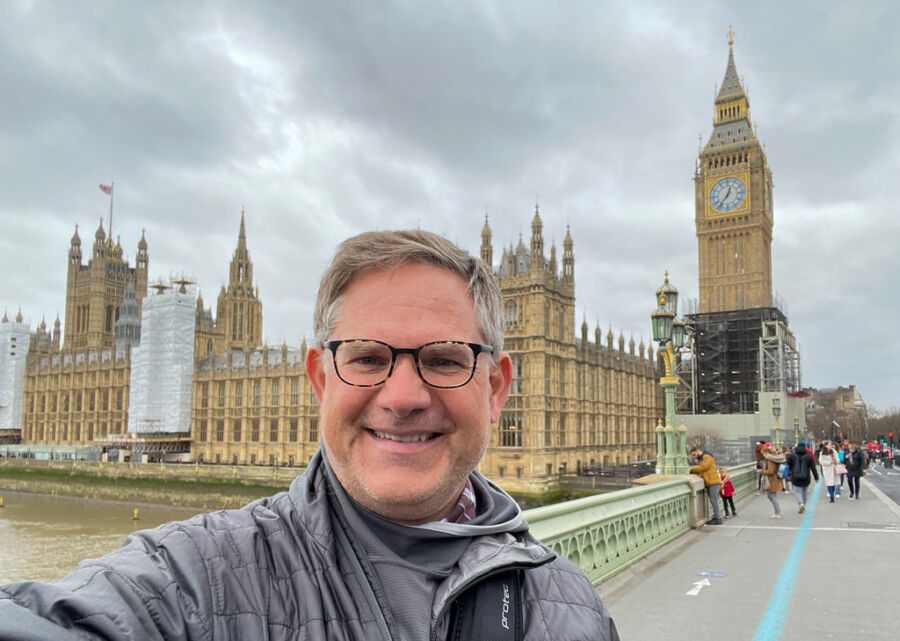
That first morning, I woke up and surveyed my list: I had about 12 days to update our 600-page Rick Steves London guidebook. I had to start somewhere. So why not Westminster Abbey? I rode the bus to England’s top church and, before stepping inside, I snapped a photo to commemorate the occasion and posted it on Facebook.

One hour later, I came back outside with loads of handwritten updates scrawled into the margins of that book. One section down; hundreds more to go.  By the way, that Facebook photo wound up being by far my biggest ever — more than 11,000 people “liked” it. It was clear that I wasn’t the only traveler excited to be tiptoeing back to normal after such a long delay.

I worked hard in London — visiting, as I always do, virtually every single hotel, restaurant, museum, shop, and so on to personally check in with each business owner and to update their listing. I was very happy to confirm that the vast majority of our favorite small businesses — the mom-and-pop hotels and restaurants that are the cornerstone of our guidebooks, and of our style of travel — had survived the pandemic. I did notice another trend, however: Life changes. There were more divorces, retirements, and ownership changes than ever before. Some people call the COVID era “The Great Reshuffle.” Anecdotally, it’s clear to me that anyone who was contemplating a lifestyle change took a hint from the pandemic.

I also made a point to slow down and enjoy being back on the road — a pledge I’d made to myself during those many, many long months without travel. After many trips to London, I’d never actually been to Abbey Road. My Beatles fandom recently re-ignited thanks to Peter Jackson’s Get Back documentary, I decided it was time to change that — and made a point to add a 30-minute detour to that famous crosswalk at the end of a busy day of research.

On my day off, I headed to Kew Gardens to update our guidebook listing. And then I realized I was just a short bus ride from Richmond, the setting of Ted Lasso (a TV show which, like many people, I’d found much solace in during those dark pandemic nights). I managed to find Ted’s “local” and his apartment, and sat on a bench on Richmond Green watching dogs chase tennis balls for 30 minutes — which, strangely enough, may be my favorite travel memory for all of 2022.

From London, I flew to Rome, where I had another 10 days to update another 600-page guidebook. Whereas in London, it had struck me that most people were “over” COVID (with very few precautions and little masking), Italy was still behaving very cautiously: You still had to show your up-to-date vaccination card to enter a museum or restaurant, and masking was near-universal.

In Rome, too, I made a point to linger and enjoy. At one of my favorite sights in the Eternal City — the Protestant Cemetery — I enjoyed getting to know the local cats who hang out at the nearby cat hospice. But there was plenty of hard work to be done; on one gloomy day, I hit the pavement in the streets surrounding Termini train station, and updated 47 hotels in a single day.

While that was grueling, it was a treat simply checking out with our many hoteliers and restauranteurs, who take such good care of our readers (and, often, also our tour groups) that they feel like part of the extended “Rick Steves family.” Everyone was ramping up for what they hoped would be a busy year, but expressed concern that customers weren’t bouncing back as quickly as expected. In those early months of 2022, the one-two punch of Omicron and the Ukraine invasion had scared off many travelers. Roman hoteliers told me that they’d seen a flurry of cancellations.

In both cities, I noticed a big trend: During the pandemic, technology had been adopted in a big way. This makes sense: Before COVID, how many of us had ordered groceries through an app, or connected with friends and coworkers via video chat? In Europe, more and more museums allowed (or even required) prebooking tickets online, and many did away with borrowable audioguides in favor of apps you download to your own device.

One of the biggest changes was the rapid adoption of “contactless” or “tap” payment — by credit card, smartphone, or smartwatch. Upon boarding a public bus, instead of rummaging around in your pocket for loose change, you can now simply tap your card or phone against the pay pad. I love this system, which makes paying for everything so much easier.

While still on the road, I submitted both London and Rome — the full guidebook text files, plus dozens upon dozens of virtually marked-up maps. Back in the home office, our amazing editorial and cartographic team began the heroic effort of tidying up and finalizing those chapters to send to our publisher. I wrapped up with more research in Naples and Tuscany (Siena, Pisa, Lucca) before heading home.

Home Interlude: The Temporary European

I was back home for just a few weeks before returning to Europe on a second trip. This quick interlude was a blur, but it coincided with the promotion of my new travel memoir. Back in 2020, when it became clear I’d be grounded for a while, I took a sabbatical from my office work to collect many years’ worth of blog posts and turn them into a cohesive book. It turned out to be a beautiful opportunity to reflect on my two decades of traveling and working with Rick Steves. As I refined and filled in gaps, it became clear that all of those stories had the same theme: traveling as a temporary European.
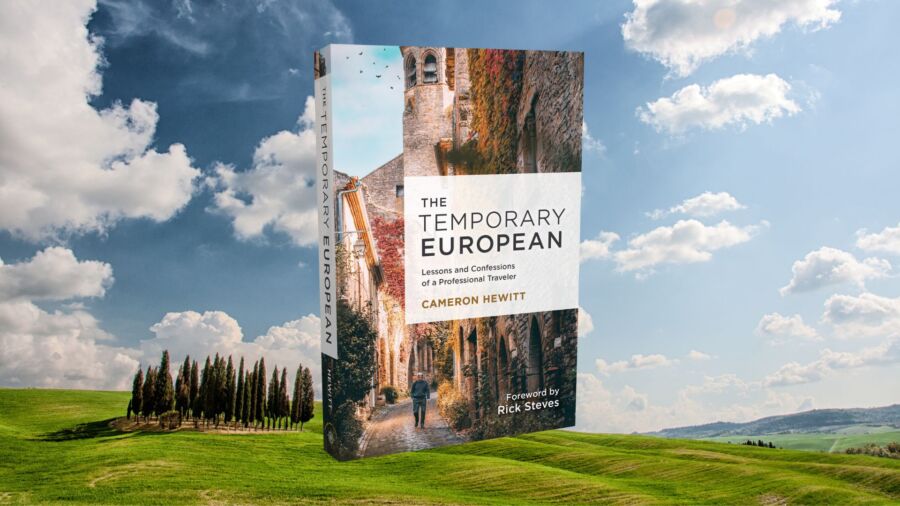
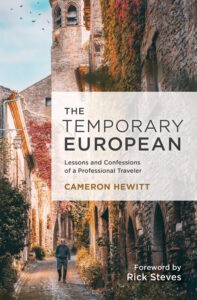
The Temporary European: Lessons and Confessions of a Professional Traveler came out in early 2022. It’s a collection of my favorite travel tales, plus behind-the-scenes chapters about what it’s like to work with Rick Steves, write guidebooks, lead bus tours, and make travel television. It also gave me a chance to introduce the world to my wife’s well-traveled Great-Great Aunt Mildred, whose personal travel motto I’ve appropriated as my own: Jams are fun!

Early 2022 was a strange time to come out with a book. Bookstores weren’t really doing in-person author appearances, and virtual ones were already kind of passé. So, while the book was well-received, I didn’t quite get the “book tour” of my wildest dreams. That said, my publisher, Travelers Tales, set up several book readings over the late spring and summer where I had the chance to connect with my fellow travelers in person. It’s been just wonderful meeting many of you at cool independent bookstores — from Seattle to San Francisco to Columbus, Ohio — and hearing about your travels.

(Gratuitous plug: If you enjoy my approach to travel — or know someone who might, and need a stocking stuffer — you can get The Temporary European for 30% off through the end of the year on Ricksteves.com, as part of our Holiday Sale. And Amazon.com has the Kindle edition priced at an incredibly low $1.99 through December 4. Get yours now!)

Before long, it was time to head back to Europe. Next up: Poland!

The Ukraine Invasion…and Touring Poland

Back in 2020, we were all ready to run the inaugural departure of a brand-new Best of Poland in 10 Days tour, which I’d helped design (with the multitalented Robyn Stencil from our Tour Operations team). In fact, I was going to come out of “tour guide retirement” after many years of focusing on guidebook research to lead that tour myself — with a team of talented, mostly newly hired Polish tour guides.

Like so many other travel dreams, that got scrapped…but only temporarily. And in early May, I flew to Gdańsk — on Poland’s Baltic Coast — to meet Robyn, those four Polish guides, and our intrepid group to begin the tour.

It was a tall order: Not only had I not led a tour in many years, but it was a brand-new tour, and I’d be mentoring some talented guides who — fantastic though they were — had mostly not been on a full Rick Steves tour before. Plus, we had some complicated COVID restrictions to carefully implement: Testing all the guides and tour members before the tour, checking vaccination cards at the first night’s meeting, and ensuring that everyone remained safely masked on the bus.

All of that would have been complicated enough. But we were also leading a tour in a country whose neighbor, Ukraine, had recently been invaded by a hostile empire.

Russia’s February invasion of Ukraine is one of the most impactful geopolitical events in Europe in recent memory. I was fortunate enough to travel in Ukraine back in the fall of 2018; I learned a lot about the complicated historical “brotherhood” between Ukraine and Russia, and about the military standoff that was already happening in the country’s east. With this in mind, as Putin’s threats escalated over the winter, I had a very bad feeling that he was not bluffing.

The war in Ukraine — which has already cost somewhere on the order of 100,000 Ukrainian lives, and 100,000 Russian ones — has been somehow both shocking and utterly predictable.

Throughout Europe, I’ve seen Ukrainian flags and demonstrations of solidarity everywhere. While we in North America have (mostly) been cheering on President Volodymyr Zelenskyy and his ragtag resistance form afar, Europeans understand that the stakes are very high. For one thing, many Europeans are fundamentally pacifistic — a painfully hard-learned lesson from two devastating world wars. My sense is that they’re simply horrified at the thought of such atrocities happening anywhere on European soil.

On a more pragmatic basis, Europe still gets much of its oil from Russia. They want to stand up to Putin, which means boycotting (as much as possible) Russian oil exports. And that means scrambling for alternatives (whether it’s keeping open nuclear power plants that were slated to be decommissioned, as in Germany, or doubling down on coal, as in Greece). It also means that energy prices this winter will be extremely high, causing great anxiety and leaving Europeans scrambling to cut heating costs. (On a recent visit to a heated outdoor pool in Switzerland, a sign politely informed swimmers that they’d lowered the temperature by one degree Celsius. Every little bit helps!)

Of course, in Poland — as Ukraine’s neighbor, and a place with a history of unpleasant relations with Russia — the stakes are higher still. Something like two million Ukrainian refugees had crossed into Poland by the time our tour began in early May. I think many of us visitors were expecting to see tent cities and shantytowns filled with refugees…but we were surprised, and impressed, at how constructively Poland has absorbed all of these new arrivals into their society.

One day, I was having lunch with our Polish guides in the red-brick downtown of Gdańsk, and one of them pointed out a handsome old building across the street. “That was an underutilized dorm and activity center for Scouts,” one of them told me. “That sign with the Ukrainian flag by the door explains that now it’s housing refugees.”

In the context of all of this, our new Poland tour seems incredibly insignificant. But it was a fascinating case study in how the situation in Ukraine has (or hasn’t) affected travel. A few of our tour members told us they’d considered cancelling the tour after the war broke out, but decided to stick with it.

As soon as our tour members arrived in Poland and took a walk, they realized that it was a perfectly safe and stable place to be. It helps that Poland is in NATO; Putin understands that messing with Poland would have extreme consequences (which we saw recently, when a couple of missiles — apparently accidentally — crossed that border, and briefly put the world on high alert).

Long story short: The tour was a huge success. The itinerary came off without a hitch, even though it was the first time we’d done it. (Our biggest “problem” was that we kept arriving at the next town faster than our conservative estimates.) Those new guides were wonderful, and each of them has gone on to lead the tour on their own, to great acclaim. And our tour members — about half of whom, like me, have Polish ancestry — were thrilled they’d joined us.

It was a special treat for me to share some of my favorite places and experiences with the group. Particularly memorable was the chance to attend an outdoor Chopin concert in Warsaw’s huge Łazienki Park. This important custom, which dates back more than six decades, was suspended for three years due to COVID. It was a very special treat that we happened to be there for the first concert of the season. The park was filled with Varsovians who were thrilled just to be together again, appreciating the music of their beloved composer.

If anything, what was happening in Ukraine enhanced the educational value of the tour, allowing our tour members to better understand all of the complexities of what was going on next door.

One of our favorite moments came on a night when we’d planned a fairly conventional dinner for the group. Our hotelier, Jarek — a longtime friend to Rick Steves travelers who use our guidebooks — mentioned that he’d hired several Ukrainians to work in his restaurant. We had a brainstorm: Rather than cooking Polish dishes, as they normally do, how would those Ukrainian chefs like to cook us a traditional Ukrainian meal, to celebrate their home culture? They jumped at the chance and served us a delicious and unforgettable menu of their favorite flavors from back home. And Jarek invited a musician to serenade us on the traditional Ukrainian stringed instrument called a bandura, to boot.

If that’s not great travel…I don’t know what is.

Summer in Europe: Travel Gains Momentum

From Poland, I flew to Amsterdam, where I did more guidebook research in the Netherlands (updating five cities in five days), then Belgium (where Antwerp bucked the trend of small businesses surviving the pandemic — I had to scramble to replace nearly half of our listings).  And then it was on to Scotland.

Things everywhere had already changed dramatically even since the spring. Most COVID restrictions had gone by the wayside. Masking had become rare. And the crowds — who, back in March, had seemed to be tentatively dipping a toe in the water — were full-on diving back into Europe.

In June, I spent three weeks traveling all over Scotland, updating a guidebook whose first edition I’d pioneered back in 2015. In the intervening years, other researchers had passed through to put their touches on it. Discovering all the wonderful fixes and additions that happen to a guidebook over time is one of my favorite things about my work.

I enjoyed being in sunny Edinburgh during the Queen’s Platinum Jubilee, then rented a car and did a two-week road trip through the Highlands. This was a good old-fashioned European road trip, with loads of castles, moody glens, and delightful encounters. I watched a thrilling sheepdog demonstration in the cold drizzle, listened to some top-notch traditional music in an Inverness pub, and set sail to the Isle of Iona. I was thrilled to pull over for a perfect roadside encounter with a “hairy coo” (shaggy Highland cattle). And then, following up on one of the many great leads my fellow travelers suggested on my Facebook page, I discovered a wonderful up-close-and-personal hairy coo experience at a remote ranch. I didn’t even mind when I got drenched with rain for three days on Skye. (Well…maybe a little.)

Even just since my previous visit, Outlander has come to play a huge role in driving Scottish tourism. While it’d be easy to be cynical about the Outlander-ization of Scotland, I’m on board for two reasons: First, the novels and TV show are meticulously researched and — despite being a time-travel fantasy — do a great job of actually educating people about Scotland. And second, I saw firsthand that many people may come “for” Outlander, but once here, they wind up excited about Scotland in its own right. If a TV show, or a movie, or a book, gets people to a place that deserves to be on itineraries on its own merits…then I’m all for it.

Another big theme in Scotland this summer — likely driven, at least in part, by all those Outlander fans — was that the whole country was stuffed to bursting. Especially in smaller communities (such as the Isle of Skye), staffing levels remained inconsistent, and there simply weren’t enough B&B beds or restaurant tables to go around. I had trouble booking rooms for my June trip, even though I started looking way back in February; many of our top-rated B&Bs told me that even in January, they were sold out through the entire summer. And restaurants were booked out days, weeks, even months in advance. If you didn’t reserve well ahead in certain places, you’d wind up dining on groceries or takeout fish-and-chips. If you’re heading to Scotland anytime near summer, book as far ahead as you can.

Nessiegate

I was on a travel high one morning as I left Inverness and headed across the middle of Scotland to the Isle of Skye. My route took me right past the touristy north shore of Loch Ness, so I pulled over at the heavily hyped tourist zone along the lakeshore to check some details for our book.

And then…something inside me just snapped.

Immersed in one of the tackiest tourist traps in Europe, surrounded by greedy and crass roadside attractions, I felt an almost physical revulsion. I found myself feeling very sorry for all those unwitting travelers who’d come to this place, at a great investment of time and money, to stare out over an empty loch, then buy some overpriced trinkets.

On the rest of my journey to Skye, I occupied myself by mentally composing a Roger Ebert-type takedown of Loch Ness. That night, settled into my B&B, I had an absolute hoot writing up my little Nessie rant. It was a critique of the crassness of the Loch Ness tourist machine, yes. But more than that, it was intended as practical advice for the travelers who look to me for advice: Skip Loch Ness, because your limited time is better spent elsewhere. (You can read the complete rant here. Much fun as I hope this is to read, the Comments are even more entertaining.)

I chuckled myself to sleep and woke up to a predominantly positive response from my followers, on the order of “Thanks for the warning!” To be honest, I forgot all about Loch Ness.

But then, a Glasgow-based tabloid newspaper saw my post and published an article about it. (With everything going on in the world these days, I can’t fathom why a reporter would spend time scouring my paltry social media presence for material. But I digress.)

The story got picked up by another tabloid. Then another. Then another. I knew things had gotten a bit out of hand when I received a message from BBC Scotland, asking if I’d like to appear on their primetime news broadcast to “elaborate” on my thoughts about Loch Ness.

It was fascinating to have a firsthand experience with a British tabloid news cycle. For a very short while, I was the bane of the Highlands. One Inverness paper even  posted a “person on the street” video of several people telling me, one after another, how wrong I was:

All of that I could take in stride. But I also heard from Scottish individuals — some of whom lived along the shores of Loch Ness — who were, understandably, hurt and offended that I’d be so dismissive. It was an important lesson: My intended audience was North American travelers planning a Scottish itinerary. But when something “crosses over” to an unintended audience — in this case, the Scottish public — it just hits different.

I couldn’t blame these people for being offended. I actually corresponded with some of them, most notably Toby from Loch Ness Living, who made some great points — including that it’s not really fair to judge a place based on such a quick visit.  The general sentiment was this: If you’d spent a day or two here, had gotten off the beaten path, really explored and settled in, you’d come to appreciate the full beauty of Loch Ness. And on that point, I cannot disagree.

(Others were more succinct. One private message I received on Facebook read simply: “You boring yank twat.”)

In the end, I feel a lot of empathy for people who work in the Loch Ness tourist industry. But I’m not the only one who let them down. The fact is, to a traveler, “Loch Ness” is that insanely tacky and touristy strip that I drove along that day. The local tourist industry is designed to steer passersby to that version of Loch Ness, and only that version of Loch Ness.

As all of this played out over the next few days, I had plenty of time to consider what, exactly, had triggered me so grievously to begin with. In a funny way, my Loch Ness takedown was a direct result of the pandemic. During those two long years of not being able to travel — and especially when I was writing my memoir — I gave a lot of thought to why I travel to begin with, and how I could travel better going forward. It helped me better draw the line between my idea of “good travel” and “bad travel.” And I pledged to rededicate myself to “good travel” when I was able to hit the road again.

Literally everything else I did in Scotland ticked the box for “good travel.” But then I came to Loch Ness. And it was the antithesis of everything I love about travel: It’s designed to exploit an entirely fabricated legend about an imaginary sea monster. It was a slap in the face. This is what I — what all of us — have waited two years for? Have we learned nothing?

Here’s what gets my goat about the Loch Ness Monster: It tells you absolutely nothing real or authentic or insightful about Scotland. Scotland has more than its share of clichés, which it aggressively exploits to stoke tourism: kilts, bagpipes, golf, whisky, haggis, castles, hairy coos, Outlander, and the list goes on. But the crucial difference between all those things and Nessie is this: All of those things have something real to teach you about Scotland.

The people who work in tourism at Loch Ness deserve better. Scotland deserves better. If they’re angry with me, perhaps they should redirect their anger at a tourism machine that spends all of its resources promoting a fake monster, and very little celebrating the natural and cultural wonders of Loch Ness.

Coming Down with COVID: To Fly or Not to Fly?

Surely “Nessigate” was more than enough drama for one trip to Scotland. But no! Scotland was not through with me. (Call it “Nessie’s Revenge.”)

At the end of my seven-week trip (which began all the way back in Poland), I was pretty wiped out and ready to head home for the summer. On my last day of research, in Glasgow, I felt run-down. I chalked that up to simply working too hard. But as I drifted off to sleep that last night, I felt a tickle in my throat.

I woke up feeling rotten, and as I  finished packing for my afternoon flight home, I weighed my decision. Two weeks earlier, the US government had waived the COVID testing requirement to enter the country. I could very well have just gone to the airport and hopped on my plane, shedding virus all the way. But if I had COVID, I didn’t want to expose my fellow passengers on the nine-hour flight home.

So I took a test. And it was positive.

I had a few hours before my flight, so I called my wife (who’d just gone to sleep back home) and talked through my options. I decided to stay in Scotland.

There were two main reasons: First, I was feeling worse by the minute, and I wasn’t up for taking such a long flight in this condition. And second, throughout the pandemic I’ve been preaching the importance of looking out for each other. I believe that one of the main lessons of COVID should be that if everyone does their part — getting vaccinated, wearing masks, avoiding contact when you’re sick — we all get through. This was an unwanted opportunity to live my values.

So, I rebooked my flight and spent several extra days in Glasgow, recuperating in my little but cozy hotel room.

That makes it sound simple. But these things are complicated — even when you’re “sure” you’ve made the right choice. At one point, I realized that if I hustled, I could still make it to my original flight in time. But then I asked myself: Would I want to be sitting next to me on a plane right now? Would I want my parents to be sitting next to that person?

That first night — at exactly the time I’d have been boarding my nine-hour flight — my fever peaked. I was glad to be in bed and not strapped into a seat. Fortunately, I was fully vaccinated and boosted, so I had a full and swift recovery; my fever lasted about a day, and the rest of the time felt like I was just recovering from a mild cold. When I finally made it to Seattle, I was grateful to be home — but also satisfied that I’d made the right choice, both for my fellow travelers and for myself.

September in Switzerland and Italy: No Matterhorn? No Matter!

In September, after a restful summer back home, I flew to Switzerland for more guidebook updates. (As an indication of how quickly our guidebook team was cranking out titles this year, the London and Rome books I’d updated in the spring had already hit my desk by the time I took off in September.)

On my previous visit to Zermatt — way back 15 years ago — the weather was so bad, I never even got to see the Matterhorn. But this time, I was determined to hang on to my post-pandemic optimism — to count my blessings at being able to travel at all. That first morning, I rode gondolas and cable cars up to the highest lift station in Europe, at a place called Klein Matterhorn. The weather was glorious, with deep-blue skies. You could see almost everything, in every direction…with one small exception: The Matterhorn itself was socked in. I just shrugged and said, “No Matterhorn? No matter! I’m still on a Swiss mountaintop.” (And I’m happy to report I did see the Matterhorn, several times, later in the trip.)

One afternoon, hiking high in the mountains with a Matterhorn view, feeling far from civilization, someone called my name: fans of Monday Night Travel who were using the same guidebook I was updating. Because much of my work at Rick Steves’ Europe is behind the scenes, I rarely get recognized when I’m in Europe. But throughout my travels this year, I bumped into more and more fans of “MNT” (as we call it).

Rick and a team of moderators (Gabe, Julianne, Lisa, and Ben) started doing Monday Night Travel during the pandemic, to offer a little “armchair travel” and a weekly pep talk from Rick. (I’ve appeared as a guest or co-host six times so far, most recently to talk about Romania.) Our hunch was that frustrated travelers appreciated having a weekly outlet for their wanderlust.

But now that we’re back traveling again, people are still watching — and I’ve bumped into many of them in Europe. From Edinburgh to Scotland, and throughout Croatia, MNT fans told me how much those weekly Zooms helped keep them going. In fact, every one of them used the same word: it was a “lifeline” while they were unable to travel.  (If you haven’t checked out MNT, you should! You can see the schedule and sign up on the Monday Night Travel website — and it’s always free. My next MNT appearance will be some Poland talk in March…stay tuned.)

While most of my travels this year were return visits to old favorites, one of my post-pandemic resolutions is to keep on exploring — there are always new places to be discovered. In September 2021, on my first trip back to Europe, I made a point to check out Italy’s Emilia-Romagna region (staying in wonderful Modena) and the town of Treviso; in both cases, I was very glad that I’d sampled something new. That trip inspired me to keep going down my list of “new-to-me” Italian destinations. So, upon wrapping up my work in Switzerland, my wife and I took a few days off to explore the Piedmont region in northern Italy. And then, after she flew home, I stopped off briefly in Trieste on my way to Croatia.

Especially for a traveler who sometimes feel like I’ve “seen it all,” there’s a special joy in exploring something new. In Piedmont, we stayed at B&B in the Langue region just south of Alba and did some side-trips to the bustling city of Cuneo, the famous wine villages of Barolo and Barbaresco, and plenty of bucolic joyrides. Part of the adventure here was renting an EV (electric vehicle) — and being extremely steep on the learning curve when it comes to using an electric car for a European road trip. I suspect this is the wave of the future; if you’d like to learn from my mistakes, rather than your own, check out my post on EVs in Europe.

In Trieste — an utterly fascinating port city at the northeastern tip of Italy, completely surrounded by Slovenia — I was so captivated by the history that I broke my personal rule to not do any sightseeing on a day off. As an aficionado of Central Europe, it was thrilling to be in the primary Mediterranean port for the sprawling Habsburg Empire — facing the sunny Adriatic, but filled with grand buildings that would seem more at home in Vienna or Budapest. And as a James Joyce fan, I appreciated the modest museum about his time in Trieste, when he wandered the city as he wrote his masterwork Ulysses.
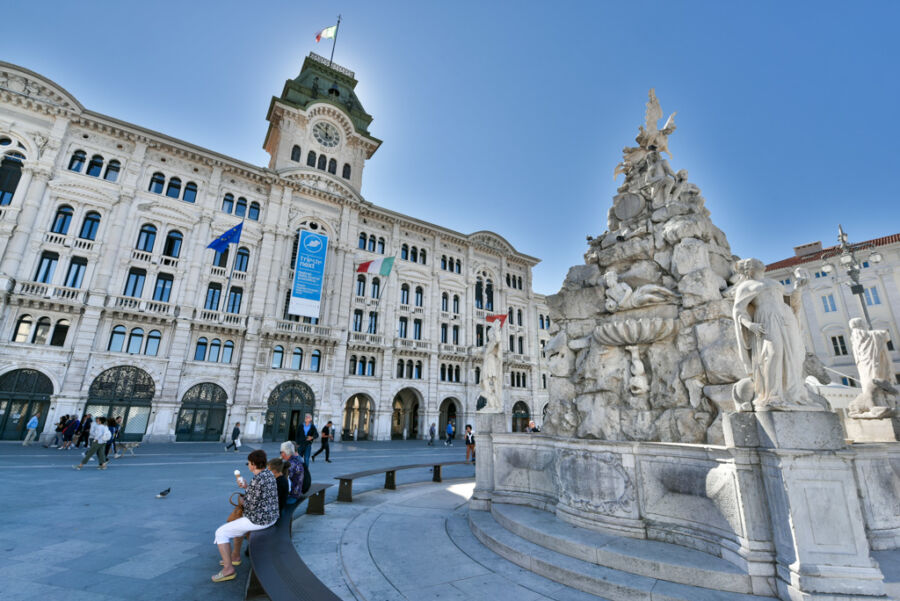
Trieste also reminded me that it pays to do your homework. For years, I’ve heard raves from fellow history buffs for Jan Morris’ book Trieste and the Meaning of Nowhere. I read it over the summer in anticipation of my visit, and practically used it as a guidebook once in town to track down fascinating little details. I would have enjoyed Trieste without it — but it definitely enhanced my time there. (What book have you read that transformed your appreciation of a place?)

I must admit, however: Much as I love Italy, I’ll never quite get used to the Italian airport experience.

October in Croatia: Changes Are Coming and the Saltshakers Are Empty

From Trieste, it was a short journey to this year’s final assignment: Updating our Rick Steves Croatia & Slovenia guidebook (which also includes highlights in Bosnia-Herzegovina and Montenegro). As the co-author of this book, and a tour guide emeritus on our Adriatic tours, I’ve been to these places more times than I can count. But for most of them, it had been five long years — so this trip was all about reconnecting with wonderful old friends, and reacquainting myself with favorite places.

No matter how many times you return somewhere, there’s always something new to discover. For example, just this summer Croatia opened its new Pelješac Bridge, which means that traffic on the main road between Dubrovnik and the rest of the country no longer has to pass through a tiny stretch of Bosnian coastline (which used to require two border checkpoints). It was interesting hearing from locals all the ways — both expected and unexpected — about how this bridge was transforming travel.

Avoiding those borders is more important now than ever, because in just a few weeks — on January 1, 2023 — Croatia joins the Schengen open-borders zone. On the same day, they’ll retire their traditional currency, the kuna, and adopt the euro. It was fun to learn about the new Croatian euro coins, but I must admit that this complicates my work: Between the staggering inflation across Europe (and especially in Croatia), and this new currency conversion, it’s nearly impossible to predict exactly what things will cost for my book next year. If a museum charged 55 kunas in 2022, the official exchange will be €7.30. Of course, it’s more likely that they’ll round it up to €7.50 or even €8 in 2023. Or — as many Croatians fear — they may just take this chance to make the jump to €10.

If you think you’re exhausted from reading this recap, just imagine how wiped out people must be who work in the tourist industry. As September turned to October, I heard the same thing again and again from my Croatian friends: We love travelers. We are thrilled they’re back. But, frankly, we’re exhausted. I began to notice that many saltshakers were empty; the season was winding down and they weren’t being refiled. It stuck me that the Croatian people were in a similar situation: all too ready for a winter replenishment.

Grand Finale: A Slovenian Youth Hockey Match

I wrapped up these many months of travel back “home” in Slovenia — my favorite country, and the place in all of Europe where I feel the most comfortable. I never tire of this wonderful place.

I said earlier that my favorite travel moment of 2022 was sitting on a bench on a sunny Saturday on Richmond Green, just outside London. I realize now that was my second-favorite. My favorite was going to a youth hockey game in Ljubljana.

My good friend and fellow tour guide, Tina Hiti, was in town between tours when I was in Ljubljana. She was busy, trying to pack in several family obligations, and it was tricky to find time to meet up. “Unless…” she said. “You wouldn’t want to come to Anže’s hockey game, would you?”

Until that moment, I never would’ve imagined how much it would appeal to me to attend a kids’ hockey match. But hearing it now, I practically jumped to my feet. “YES!!!” I said. “Just tell me when and where.”

I have a special relationship with Tina’s family (whom I write about in The Temporary European). She and I are close friends, having started out as tour guides together more than 20 years ago, and I’ve watched her two sons grow up. Her dad, Gorazd, is also a tour guide, who takes visiting travelers on day-trips around the stunning Slovenian landscape. Only once they’re well into their day does Gorazd sheepishly tell them that he used to be a hockey player. In fact, he was a star of the Yugoslav Olympic hockey team, and is one of the most respected hockey coaches in Slovenia. And, of course, he coaches his grandsons’ teams.

Tina picked me up and drove me a half-hour out into the outskirts of Ljubljana, where we pulled into the parking lot of a nondescript arena. Going inside, Tina greeted all the other parents and we took our positions on the bench. We spent the next two delightful hours catching up between cheers for her son, the defender, and her dad, the coach. They were squaring off against a team that had beaten them soundly the previous year. Expectations were low, and Tina explained that her dad’s coaching style wasn’t about winning or losing — it was about teaching the skills, and more important, the values that go into being a great athlete. Win or lose, it’s an opportunity to learn.

As we watched the game, Tina told me about the various players, pointed out their parents, discussed their relative strengths and weaknesses on the ice. As expected, the team fell behind early. And then, in the third period, they began to catch up. Ever so gradually, Tina and the other parents nudged toward the edge of their seats. Winning may not matter…but in this case, it sure would be a nice boost for the kids. I found myself getting caught up in the action, too. While I’m not a huge hockey fan, I’ve been to a few games. But I’ve never been as invested in one like this.

“Our” team managed to catch up in the final minutes…and the game went into overtime. By this point, the air was electric as we watched these 10- and 12-year-olds zipping around the ice, playing their hearts out. And then — goooooal! Victory!

After the match, we headed downstairs to the little café under the stands. There was much beaming, laughing, and congratulatory back-slapping. Even Gorazd’s gentle smile came with a special twinkle in his eye.

Sitting there, nursing a hot cup of tea in a grubby ice rink café, celebrating with Tina and Gorazd, I remembered once again — for the hundredth, maybe thousandth time this year — what it really means to be a Temporary European.

I saw some incredible sights in 2022. Westminster Abbey, the Tower of London, the British Museum. St. Peter’s Basilica, the Sistine Chapel, the Colosseum. The Madonna of Częstochowa, the Ghent Altarpiece, Edinburgh Castle. The hill towns of Tuscany, the canals of Amsterdam, the Scottish Highlands, the Matterhorn in the Swiss Alps. All of those are great sights, yes, and very memorable. But none of them will stick with me quite like that Saturday in the park just outside Ted Lasso’s apartment, that first Chopin concert of the summer in Łazienki Park, or that youth hockey game in Ljubljana.

For me, that’s the overarching theme of 2022. And I hope it’s also the theme of 2023, 2024, and all the years to come: Let us never forget what a privilege it is to be able to travel. Let’s make sure to savor it — to count our blessings, to live every moment to the fullest, and to always be present in our explorations of this beautiful planet. Our mission, as travelers, is to watch for those opportunities where we can stow our cameras and our guidebooks, and just melt into Europe…even if just for a few precious moments.


Thanks for sticking with me through this long recap of an incredible year of travels. I’d love it if you want to join in the conversation in the Comments — what were your most vivid memories and lessons of 2022? What’s on your agenda for 2023?

If these stories resonated with you, consider picking up my travel memoir, The Temporary European: Lessons and Confessions of a Professional Traveler. In a way, this post is a sort of “postscript” for that book — a new chapter for those of you who’ve joined me on that journey. If you haven’t read it yet, take advantage of our 30% Holiday Sale, get it for your Kindle (where it’s just $1.99 through December 4), or pick it up at your favorite local bookshop. And thanks to all of you who’ve supported me in 2022 by buying a copy — it means a lot!

If you’d like to get your hands on those freshly updated guidebooks, about 20 titles are already out, with the rest rolling out in the coming weeks and months. All of our books — including all those new editions — are part of that 30% off Holiday Sale right now.

And if you’re intrigued by our Poland tour — or any other tour — consider taking advantage of our Seasons Givings event, going on through the end of 2022. Every tour is $100 off, and for each seat booked, we’ll also donate $100 to your choice of four major charities.

Happy travels in 2023!
Spring 2022 Trip Report: What It’s Like Traveling in Europe Right Now

I recently returned from a five-week guidebook research trip in England and Italy. And now that I’m home, everyone’s asking the same question: What’s it like traveling right now, as Europe emerges from the pandemic? By sheer coincidence, I wound up visiting perhaps the least restrictive part of Europe (England), then the most restrictive (Italy) — offering a taste of the full spectrum you might encounter, if you’re hitting the road anytime soon. This trip really was a tale of two COVIDs.

When it comes to traveling during COVID, the only thing that’s constant is change. So I’ll stress that this information is accurate as of my recent visit, from late February through late March. (In fact, Italy partially relaxed its restrictions just a few days ago, even since I got home.) If you’re hitting the road anytime in 2022, check local restrictions closer to your departure date.

London Is Over COVID (Even if COVID Isn’t Over)

Around the time I took off for London, the Queen contracted COVID. Also around that same time, Prime Minster Boris Johnson declared that all remaining pandemic restrictions would be lifted. On February 24 — a few days after my arrival — England celebrated what some cheekily called “Freedom Day”…even as their sovereign still had the sniffles. (Tellingly, this was already the second “Freedom Day” in as many years.)

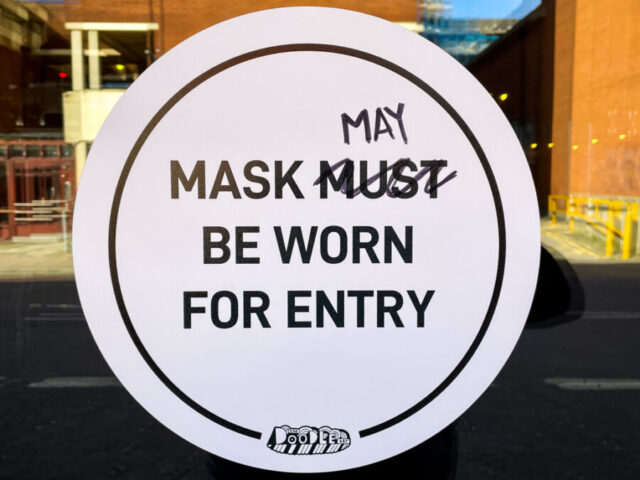
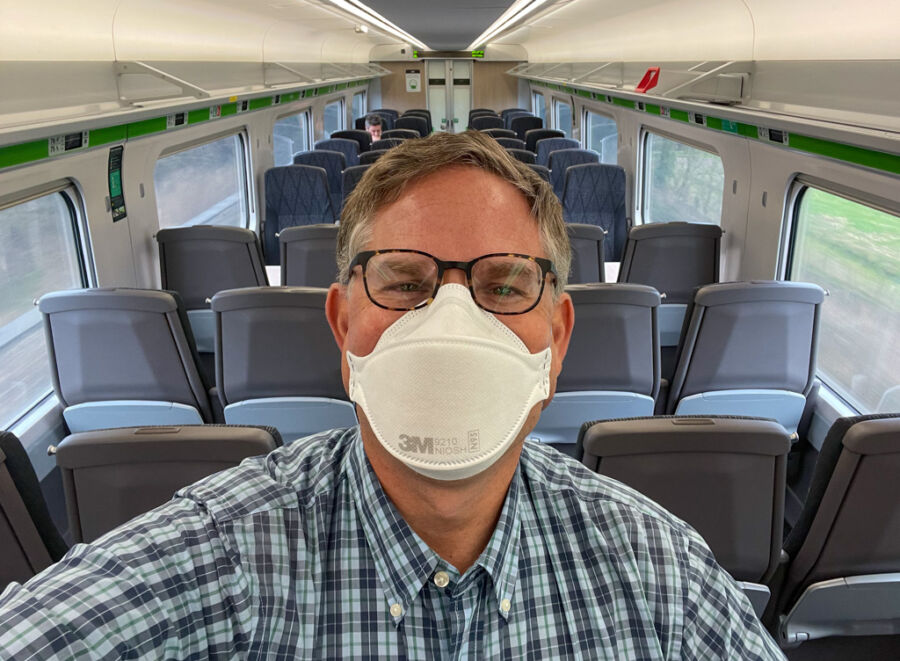
Coming from cautious Seattle, where indoor masking was still required, I was shocked by how few masks I saw on arrival in London. “Masks are mandatory” signs, still posted everywhere, were flagrantly disregarded by Londoners who knew that the rules had changed. In many indoor situations — for example, waiting in line at a café to order a takeaway latte — I was the only person who wore a mask.

On the Tube and on public buses, I’d estimate that one-quarter to one-third of passengers wore masks. This figure seemed to go up and down depending on which part of town I was in (perhaps the highest ratio was on a day trip to Cambridge). One Londoner I talked to, who lives in an outlying bedroom community, told me the majority of people on his Tube ride into central London were masked, but once downtown, that number would plummet. (I was too busy updating guidebooks to conduct a reliable sociological survey…but the results would have been fascinating.)

It was an exciting, slightly scary time to be in London. On the one hand, I enjoyed feeling the momentum of a society that is finally restarting. Museums and restaurants were open (though in a few cases, hours were still somewhat reduced). People were out and about, walking the streets, riding the Tube, and mixing and mingling just like old times. It felt good to feel so normal.

On the other hand, I was just starting out on a five-week trip — 5,000 miles from home, and with piles of work to do. I did not want to contract COVID, if only because the editorial team back at the home office was patiently waiting for my guidebook files to kick-start our 2022 season. So while the people around me were celebrating “Freedom,” I was still dutifully wearing my mask and rubbing sanitizer on my hands.

During this strange transition period, I’ve been trying to be what I think of as a “non-judgmental masker.” I choose to wear a mask in most indoor situations, simply because my understanding of the science leads me to believe that wearing a mask is safer both for me and for those I come into contact with. (And I will say, trying to be careful for my own sake brought me a lot of empathy for immunocompromised people — who must feel terribly alienated from society right now.)

That said, I’ve overcome my instinct to criticize or shame someone near me who chooses not to wear a mask, if it’s in accordance with local regulations. That’s your choice; this is mine. One caveat: If you’re actively sneezing, coughing, and wheezing, well then…yes, I am going to get up and move elsewhere. And I will try not to shoot you a dirty look. (But I’m only human.)

Being cautious was not easy, I’ll admit. It was chilly in London, so every time I strapped on a mask to step into a hotel lobby and quiz the receptionist on their latest details for our book, my glasses became opaque with dense fog. (Stupidly, it took me well over a week to buy some spray-on defogger, which worked wonders.)

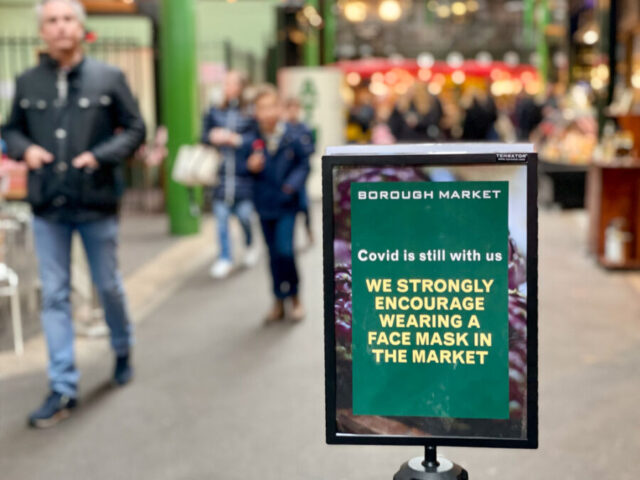
I also skipped one of my absolute favorite London activities: eating in its many amazing restaurants. I just love the food scene here, and normally I spend each evening in a trendy new hotspot in Soho or Shoreditch, to “try it out for the book.” But given my current risk-aversion, I mostly skipped indoor dining (especially when a place was crowded — which the best places always are). London’s many outdoor (or semi-outdoor) street markets, such as the wonderful Borough Market, offered high cuisine in a safer environment.

Even though I was being cautious, having a good N95 mask bought me peace of mind. For instance, I did not want to miss another one of my favorite London experiences, watching a play at Shakespeare’s Globe (specifically, their wonderful indoor venue, the Sam Wanamaker Playhouse). Wearing a medical-grade mask gave me peace of mind, even if about half of my fellow theater-goers were unmasked.

I believe my caution paid off. Other than indoor dining, I still did everything I would have done in pre-pandemic times, but with a good mask on. I still toured every museum, inspected every hotel, reconnected with old friends, and interacted with dozens of people each day. And after five very busy weeks of traveling in Europe, I never had any symptoms, and I never tested positive for COVID.

In Italy, COVID Remains a Part of Life: Vaccines, Boosters, and Masking

Imagine the culture shock of flying from England to Italy, which occupies the opposite end of the COVID precautions spectrum. Italians remain as vigilant and strict as London is loose. This began the moment I arrived in Naples, when I had to go through a time-consuming airport screening to ensure that my paperwork (vaccine card and passenger locator form) was fully up to snuff.

In two weeks in London, not a soul asked to see my proof of vaccination (except when I checked in for my flight in Seattle). But on my first day in Italy, I was repeatedly asked to show it — to enter restaurants, museums, and so on. It’s worth talking about the specifics here, because this will come up if you’re traveling in a country that still requires proof of vaccination.

In Europe, fully vaccinated means boosted as well. Italians (adorably) refer to this as “super-vaccinated.” Italians prove their vaccination status with a “super green pass,” a QR code on their phone that gets scanned when they enter a building.

For American visitors, you only need to show them your printed vaccination card from the CDC (or a photocopy — I kept my original safe in my money belt). However — crucially — your vaccination card needs to list all three shots, including the booster. (I was surprised how many times they actually counted — Uno, due, tre! Ees O.K.!) In my case, for reasons I will never understand, each of my three shots was issued on a separate card. Fortunately, I had contacted my HMO a few weeks before my trip, and they sent me a new card that listed all three. That turned out to save me a lot of hassle — I hate to imagine trying to explain the three-card system, in Italian, several times each day.

(One important side note: On April 1 — just a few days after I flew home — Italy relaxed some of its regulations for showing proof of vaccination. You no longer need to show your CDC card to enter a museum or public transit, but you still do in order to dine indoors…at least, through the end of April. Again, wherever you are traveling to, do some homework so you know what to expect as of the time of your visit.)

Italy also had remarkably high, virtually 100 percent masking compliance. I almost never found myself in an indoor space — museum, church, restaurant, bus, train — where I saw a single unmasked person. Even outdoors — where masks are not required — I’d estimate about 20 to 30 percent of pedestrians were masked anyway (a higher ratio than what I typically saw indoors in London).

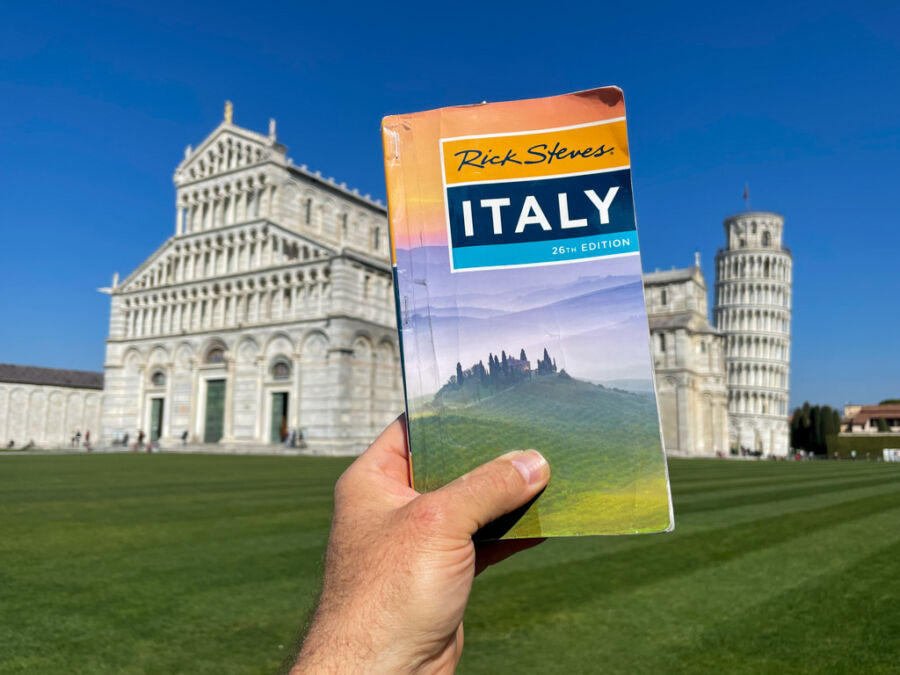
When dining indoors, Italians diligently masked up any time they weren’t sitting and actively eating. Even in huge, cavernous churches, this is taken seriously. Inside Pisa’s Duomo, which was nearly empty of visitors, I spotted two elderly tourists who apparently forgot to don their masks. No sooner had I noticed this than an attendant went rushing over to remind them. I got so used to this, I didn’t even notice that I was wearing my mask. And St. Peter’s is just as spectacular when you’re masked.

Keep in mind that in Italy, a mask must be medical grade. They call this “FFP2,” but it’s equivalent to N95, KN95, and KF94 masks widely available in the US. It must be worn over the nose and mouth, and cloth masks are not acceptable substitutes.

By the way, Italians don’t wear masks because they enjoy it. I promise you — as much as you hate wearing masks, Italians hate it more. Italians are deeply social creatures, keenly tapped into nonverbal cues. For them, removing half of the face is a massive hardship; you might as well cut off their tongue or poke out their ears. But they do it anyway, with pride, for the greater good.

This was the case even in my first stop in Italy, Naples. Naples! A city synonymous with chaos and disorder. This is a place where flagrant disregard for rules is a hobby passionately pursued, and where any authority is viewed with deep suspicion. And yet, there I was, walking down the Spaccanapoli, surrounded by carefully masked Neapolitans.

Wearing my anthropologist’s hat, I asked around as to why Italians were taking this stuff so seriously. One hotelier — who is clearly a bit fed up with all of this — described the Brits as coraggiosi (courageous) for simply moving on with life. Others reminded me that northern Italy was devastated by the very first wave of COVID, back in February of 2020. Night after night, Italians watched news of the rising death count. They still feel the personal pain from that loss — and all of the losses since — and are not yet willing to give up on making small, reasonable changes to their behavior if it means saving a few more lives.

Anecdotally, I was told that masking compliance and vaccination rates were both higher in the South, and diminished as you moved toward the North. Based purely on my Naples-to-Florence itinerary, there may be a speck of truth to this; or it may simply be another salvo in the age-old North-South rivalry.

Testing

As yet another indication of how fast things are changing, a couple of weeks before my flight to London, I believed I would be required to show a negative test before getting on the plane. But the UK waived this requirement just days before my departure. And then, for my trip from London to Naples, Italy also changed the rule just days before I flew. In the end, I wasn’t required to get a single COVID test until the day before I flew home.

Speaking of which: Right now, you are still required to get a negative COVID test the day before you re-enter the United States. This sounds troublesome and time-consuming. But fortunately, they accept a rapid antigen test (which only takes about 15 minutes), as long as it’s administered by an official provider. And testing is affordable and widely available in most of Europe, making it less of a hassle than you might think.

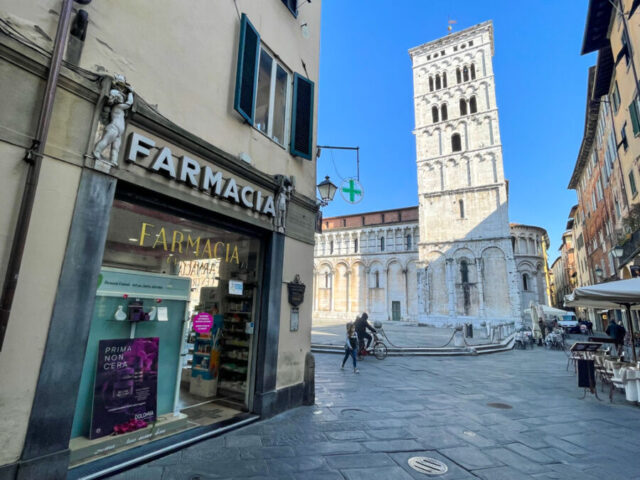
In my case, I was flying home very early from Florence. The day before that, I rode the train from Lucca to Florence. And the evening before that, I was hanging out in Lucca, wondering where I should get my COVID test. I did a quick search on my phone and found a pharmacy right on the main square that administered the test. I dropped by, and they penciled me in for an appointment the next morning.

When I woke up, I packed my bag, checked out of my B&B, and headed through lovely Lucca to the train station — making a slight detour to the main square for my appointment. They instructed me to drop my bags in the corner, swabbed my nose, and asked me to wait outside for 15 minutes. It was actually an enjoyable experience to stand in front of that pharmacy, listening to the church bells clang, watching small-town Tuscany wake up. After what felt like just a few moments, they called me in, handed me an official-looking paper with my test results, charged me €15, and sent me on my way. I made it to the train station with 20 minutes to spare. I can only hope red tape is always so delightful.

What Else Is New?

In the coming weeks, I’ll be sharing lots more observations about my return to Europe. (If you haven’t yet, be sure to follow my Facebook page to get all the latest updates.) But here’s a quick rundown of what else is new in Europe for 2022:

I was struck by how rapidly new technology has been adopted through COVID. For instance, London has gone practically cashless. Every purchase now uses “contactless” technology: a credit card, smartphone, or watch that you tap against a pay pad. (You probably already have a “contactless” credit card, even if you don’t realize it — check your card for four curved lines — or you can easily set this up on your phone.) The same technology is now common throughout Europe, though in Italy, I found cash was still more widely used.

Another change: Most museums have “temporarily” done away with audioguides, for obvious reasons. (Who wants to spend two hours pressing your face against a device that was just pressing against someone else’s face?) But now that they’re gone, I have a suspicion audioguides may not be back. Instead, museums encourage visitors to download apps so they can follow the tour on their own device. (Better yet, download the Rick Steves Audio Europe app, with heaps of entirely free, self-guided museum tours and city walks.)

For the major sights, it’s more important than ever to do your homework and reserve ahead. Many museums — even minor ones — have introduced online reservation systems. Initially this was a crowd-control measure due to COVID restrictions. But now that they’re in place, these reservations systems will probably stick around.

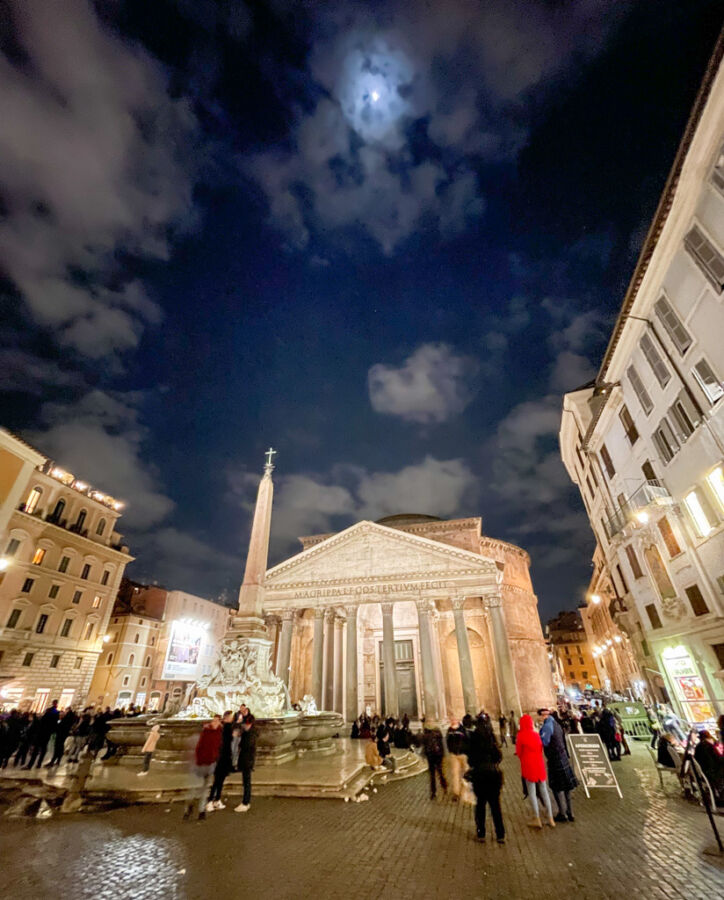
And some major sights (including Rome’s Colosseum) now require reservations, instead of just recommending them (as previously). If you want to visit the Colosseum, you must prebook a time slot online. This is serious. On my visit, they didn’t even have any in-person ticket windows open at all; if you just show up, you’ll wind up standing around outside the turnstiles, booking a ticket on your smartphone. Also in Rome, the Pantheon had a long line out front of people waiting to get in. On weekends, they now require reservations to enter; on weekdays, you don’t need a reservation; and either way, you’ll stand in the same line. If you’re going to any major sight, spend a few minutes reviewing their website a few weeks before your trip to figure out the latest.

The other major issue on this visit, of course, was Russia’s invasion of Ukraine. Chatting with Londoners and Italians, it was clear that this was weighing very heavily on many hearts. Personally, I don’t consider the war a “safety issue” for travel (including in Poland, where I’ll be in just a few weeks). However, it has certainly dampened spirits at a time when many were just getting excited for the “return to normal.” When I’d ask people, “How have you been?”, Ukraine was often the very first thing they wanted to talk about.

It’s simply unnerving and tragic for Europeans — many of whom are quite pacifistic — knowing that a terrible war is raging, and so many people are suffering, on their own continent. Everywhere I went, I saw vigils, flags, and signs demonstrating in solidarity with Ukraine.

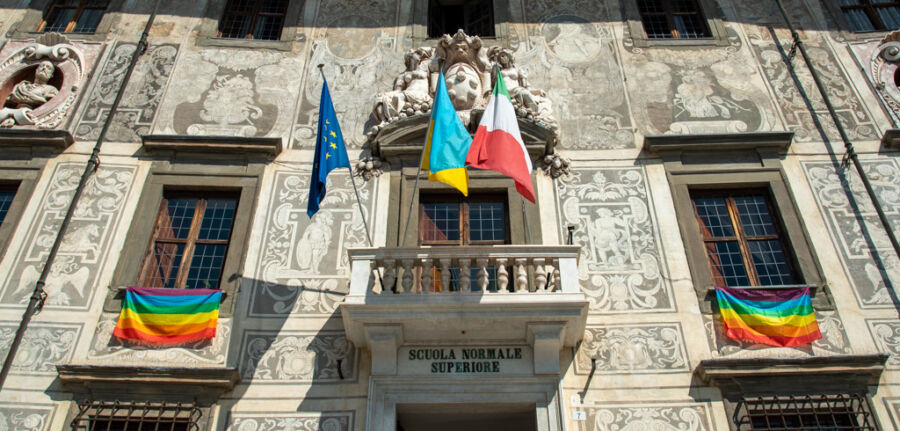
In Pisa, one of the main civic buildings flew three flags: the European Union, Italy, and — not Pisa — but Ukraine. Nearby flew two rainbow flags, an Italian symbol for PACE (“peace”).

Anecdotally, I learned that the one-two punch of Omicron and the Ukraine invasion has led many travelers to book trips more last-minute than before. A hotelier in Rome explained, “Usually we see people booking many months ahead. This year, it feels like people are taking a more ‘wait-and-see’ approach, and are booking only a few weeks ahead.” If you wait too long to book, you may find that you’re trying to jump into a pool jammed with others doing the same…and miss out.

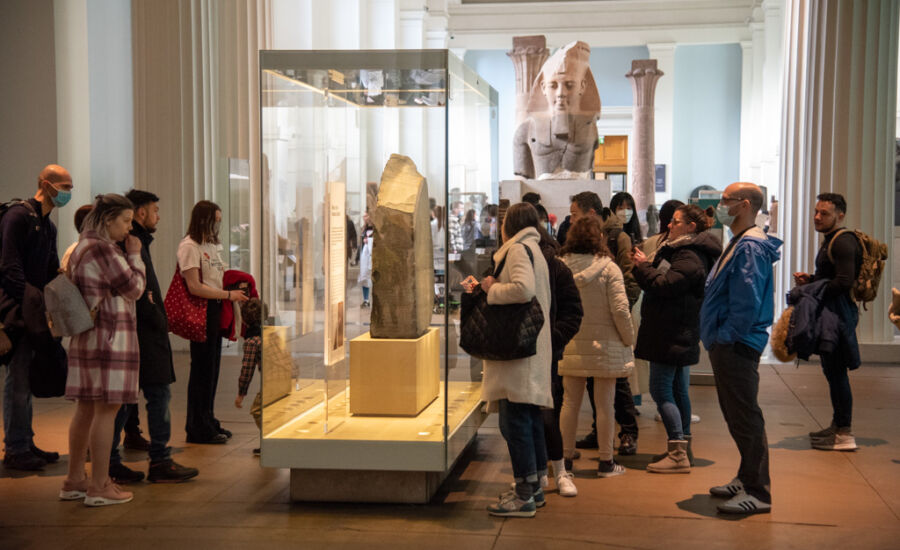
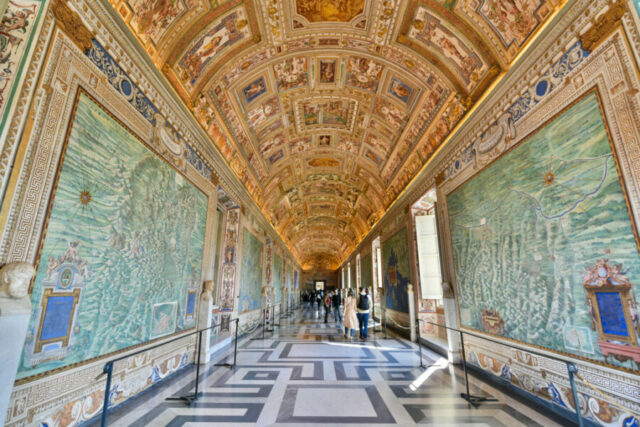
What about crowds? It’s very early in the season, but even so, in London and Rome, things were not nearly up to their overwhelming 2019 numbers. Things are definitely returning to normal; lines were forming in front of major sights like the British Museum, National Gallery, Pantheon, and St. Peter’s. And yet, in the Vatican Museums, the Map Gallery was as empty as I’ve ever seen it.

I found smaller cities much quieter. Cambridge, Pisa, Siena, Lucca — these places felt borderline-deserted. I’ve never seen Pisa’s Field of Miracles so empty, and my Lucca B&B told me that I was the only person staying there for those three nights. (On the other hand, on Friday and Saturday night, all of the best Siena restaurants were fully booked.) Of course, smaller towns and cities like these will ramp up and become busy again — but it may take longer than in the big cities.

As for those guidebooks: I’ve already turned in my updated files and maps for the Rick Steves London and Rome books, and other researchers (including Rick) are currently updating every corner of Europe. Our guidebook department is working at a heroically accelerated pace this year to churn out new, post-COVID editions as quickly as possible. The first new books (including London and Rome) will hit bookshelves as early as August, so if you’re heading to Europe this fall, keep an eye out for the latest.

In the meantime, while much has changed, I found our guidebooks fundamentally sound. The best sightseeing advice, the self-guided museum tours and walks, the lists of our favorite restaurants and hotels…while each of these has been slightly adjusted, the current edition is still as up-to-date as anything you’ll find in print for assembling a dream return trip to Europe.

The Final (?) Word

I’ll stress again that this is a very small sample size: one traveler, two countries, five weeks. And it represents just a snapshot in time; this blog post will go stale remarkably fast. But I hope it offers some insight and encouragement about wading back into international travel at this moment.

What’s the situation in France, or Germany, or Spain, or Prague, or Greece? Honestly…I have no idea. But I imagine it’s somewhere between the two extremes of London and Italy. And if anyone out there wants to give us their own trip report here in the Comments, we’d all appreciate it.

In the end, this was one of my favorite, most successful trips in years. It felt wonderful simply being back; the weather was unseasonably pleasant; and I must admit, I didn’t miss the crowds. Most of all, I came away with a confidence that you can have a safe and enjoyable trip in 2022, even as COVID sputters on. Just be prepared: Before you hit the road, think carefully about how much risk you’re willing to take on, then adapt as needed — even if that means skipping indoor dining or wearing an N95 mask for that performance you’ve been dreaming of. Be aware that each place you visit may have their own restrictions, and be conscientious about following them. Check back frequently to understand any red tape you might need to sort through. But most of all, simply enjoy being back in Europe.


During the pandemic, I took some time off to write a travel memoir, The Temporary European: Lessons and Confessions of a Professional Traveler. It’s a collection of my favorite travel tales from my 20-plus years working with Rick Steves, plus inside looks at what it’s like to write guidebooks, make travel TV, and guide tours. You can order it from your favorite local bookseller; get it at the Rick Steves’ Europe Travel Store; or buy a copy at Amazon.com (paperback or Kindle edition).
10 European Discoveries for 2021

On the horizon, there is light. The sun hasn’t risen yet, but it’s coming. Although it has never been more important (or harder) to continue staying home, limiting contact with others, wearing masks, and so on, it’s beginning to feel like 2021 may bring the “return to normal” — and the return to travel — that we all crave. It’s too early to begin planning trips, but it’s never too early to dream. So…where to?

The last several years, my New Year tradition has been to assemble a list of 10 European Discoveries. As we reach the end of a year of hardship, and face a new year of further uncertainty, I almost bailed on this idea. But we will return to Europe. It’s just a question of when. So I’ll keep with tradition — but with a new spin.

I believe that in the post-pandemic world, travelers will look for something different. Before COVID-19, we had gotten so busy, and so stressed by the crowds, that we forgot to slow down and hear the church bells — to savor those beautiful everyday moments of European life. (If I have a post-pandemic resolution, it’s to not make this mistake again.) Having renewed our appreciation for the incredible privilege of being able to go anywhere we want, we’ll seek opportunities to settle in, slow down, and be fully present in Europe. We’ll choose places just outside the mainstream, ones that reward patience and contemplation.

And that’s the theme of my 2021 European Discoveries: 10 places where you might want to settle in for a week, or a few, and really get to know a fascinating corner of our planet. I haven’t set foot in Europe in well over a year — with, I assume, several more months yet to go. It has afforded me ample opportunity to reflect on my 20-plus years of exploring Europe. And looking back on all of it, these are the places the burn brightest in my mind.

Where are you hoping to slow down and savor our world in 2021?


Soča Valley, Slovenia

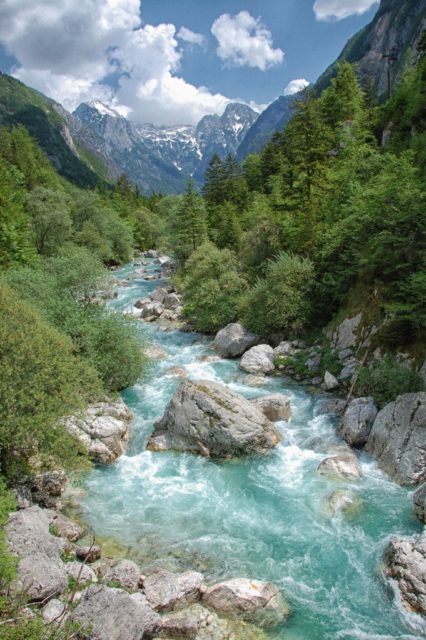
I can think of few places I’ve missed more in 2020 than Slovenia. And for me, the most beautiful place in this incredibly beautiful country is the Soča Valley, where a turquoise river cuts a gorge deep into soaring alpine cliffs, just a few miles from the borders with Austria and Italy. Historians know the Soča Valley for its fierce mountaintop battles during World War I (this is where Ernest Hemingway was wounded while driving an ambulance). And contemporary travelers know it as an adventure-sports capital (whitewater rafting, canyoning, paragliding) and home to the restaurant of Ana Roš, the world’s best female chef. You can get a taste of the Soča Valley on a very busy one-day side-trip from Lake Bled or Ljubljana. But why not settle in for several days? Sleep at a tourist farm on a high-mountain pasture, wake up each day to the sun peeking over snowcapped mountains, and spend your breakfast (of farm-fresh eggs) deciding which breathtaking hike or scenic drive to do today.


The Markets of Provence

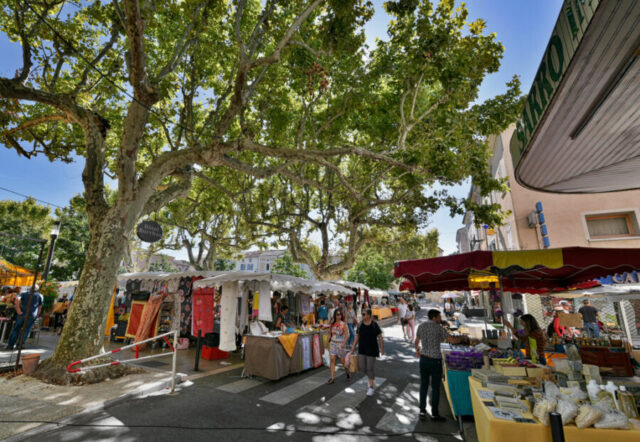
In September of 2019, my wife and I had a full week to unwind anywhere in Europe. Already exhausted from a packed and fast-paced year of travel, we opted for a quiet weeklong break in the South of France. Why? We wanted to savor the delightful market days (jours de marché) that hop from place to place around the bucolic Provençal countryside. In one week, we sampled seven different markets, each with its own personality. Yes, Provence is packed with other attractions: great sights and wine-tastings and gourmet meals and scenic hikes and hot-air balloon rides. But the markets are precisely the type of sensory super-experience we’re all desperate for after a 2020 spent very close to home. After living through a time when going to the corner grocery store feels like high adventure, imagine the thrill of strolling a lively town square, generously shaded by plane trees, as you choose a little wheel of cheese for your picnic from a mound of fragrant options, browse for just the right produce for a home-cooked Provençal feast, and bite into a strawberry that truly, intensely tastes like strawberry.


Budapest

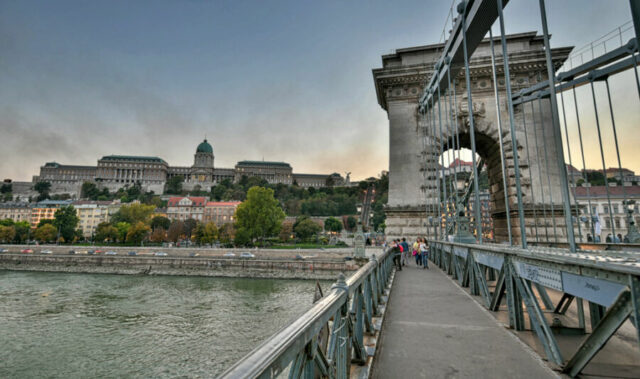
I wrote the book on Budapest…literally. And yet, even after 20-some visits, I still can’t get enough of this grand city on the Danube. With each weeklong visit to update my guidebook, the list of things I’d still like to see and do gets longer, not shorter. The melting pot and de facto capital of Central Europe, Budapest’s unique urban culture mixes a respect for tradition with a cosmopolitan openness to creativity and innovation. It wins my vote for the hands-down best restaurant and nightlife scene in Europe. And yet it also has a stately elegance, with ornate turn-of-the-century buildings, inviting tree-lined plazas, and wooded hills ideal for nature hikes. (And don’t get me started on the thermal baths.) Last March, I had already booked my tickets for yet another visit to Budapest, and I couldn’t wait. That trip, of course, never happened. And by the time I finally get back there, the anticipation will be unbearable. I never know precisely what I’ll see, do, and learn in Budapest. But I know it’ll create lasting memories.


Iceland’s Ring Road

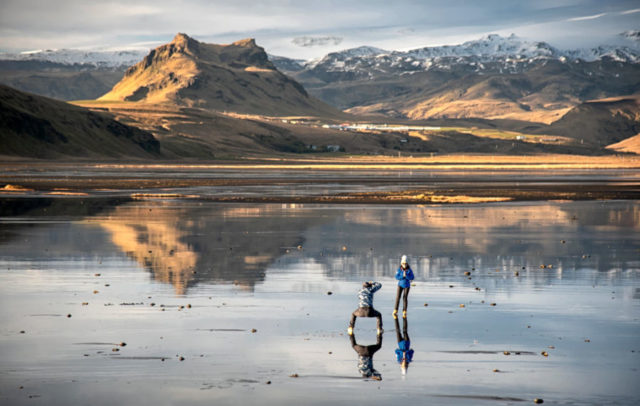
When we produced our Rick Steves Iceland guidebook, we included a “how to” chapter on Europe’s ultimate road trip: driving 800 miles on Highway 1 around the perimeter of Iceland, connecting astonishing scenery, geothermal hotspots, glaciers and icebergs, charming fjordside settlements, and warm and wonderful Icelanders. We covered the Ring Road generously in our book, even though we figured very few people would devote the full week required to do this trip justice. But maybe we were wrong. The pandemic has made National Lampoon’s Vacation-style road trips all the rage again. There’s never been a better time to rack up some serious miles through cinematic landscapes and have an honest-to-goodness adventure. And Iceland is made to order for “social distancing” as we tiptoe into the post-pandemic future. My Ring Road post covers the basics; if the photos and places intrigue you, forget about that “48-hour Icelandic layover” you’ve been contemplating…go all-in on the full Ring Road.


North Wales

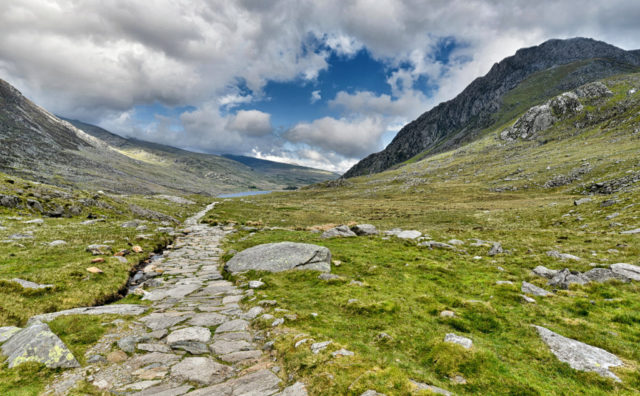
Recently I had the joyful experience of driving around North Wales (roughly the triangle formed by Conwy, Caernarfon, and Ruthin) for several days to update our Rick Steves Great Britain guidebook. I adore Europe’s plucky, off-the-beaten-path cultural eddies, and North Wales tops the list. Along with offering a fascinating crash course in Welsh culture and language, this region is studded with towering stone castles that make you feel like a kid again, a rugged landscape of craggy mountains and slate rooftops, and cheery red dragons laughing down from every flagpole. And it’s compact, making it easy to see a lot from any one of a number of charming home bases. While less known than the Scottish Highlands or Ireland’s Dingle Peninsula, North Wales is every bit as fun, scenic, and culturally rich.


Maramureș, Romania

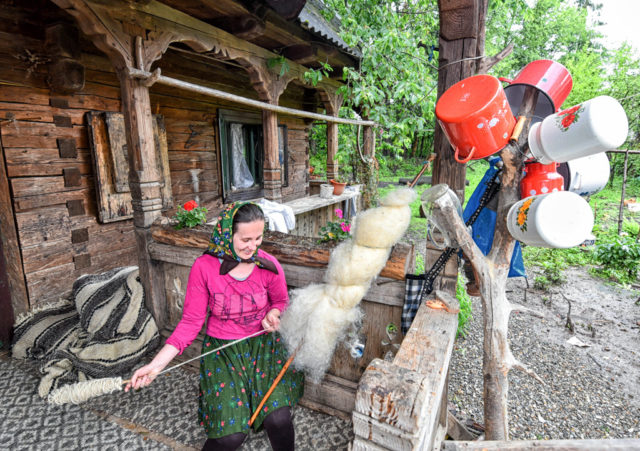
Years ago, my Dad and I went on a road trip through Romania, seeking traditional culture. When we came to Maramureș — ten long, potholed hours of driving north of Bucharest — we felt like anthropologists stumbling upon a place that time forgot. The rolling green hillsides are dotted with giant, tipsy haystacks. Rustic villages with mud roads — and more horse carts than cars — are lined with elaborate wooden churches and ceremonial gateways. Shepherds living in split-wood shacks make cheese like medieval peasants. And riverside settlements bustle with industry dating back to biblical times, from carpet-washers to fulling mills to to weaving looms to moonshine stills. This is not an “open-air folk museum” — it’s the real deal, Europe’s Amish Country. As our world changes at a dizzying pace — which only accelerated in 2020 — there’s no guarantee that Maramureș traditions will survive for much longer. (Teo Ivanciuc, an excellent local guide who helped us film our TV segment in Maramures, would love to show you around.)


Camino de Santiago, Spain

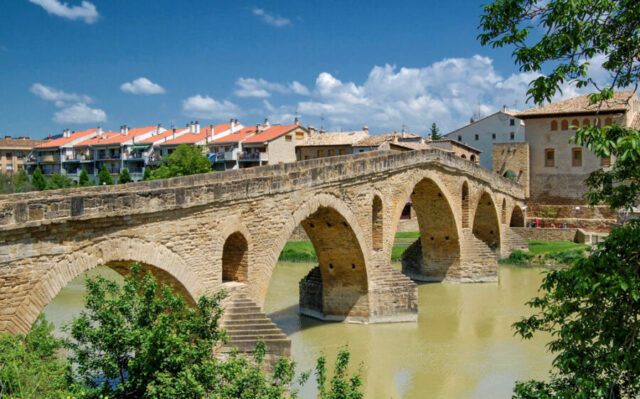
In the Middle Ages, pilgrims walked from all over Europe to venerate the bones of St. James in Santiago de Compostela, at the northwest corner of Iberia. This route — the Camino de Santiago — was largely forgotten over the centuries, only to be rediscovered in our own lifetime by travelers seeking an escape from modern life. After a year of deep soul-searching, there’s nothing like a four-week hike to clear the mind, synthesize all we’ve learned, and contemplate where to go from here. Begin in the green Pyrenees foothills of Basque Country, then walk across the arid plains of northern Spain, through villages and cities and across stone bridges from Roman times, before finally passing trough the wilds of lush, green, and rocky Galícia — all along the way, sleeping in rustic pilgrims’ hostels and following scallop shells through the wilderness. I’ve hiked bits of the Camino here and there (and I drove the entire route, end to end, to write a “how to” chapter in our Rick Steves Spain guidebook). But I’ve never been so tempted to do the full Camino the old-fashioned way.


Lofoten Islands, Norway

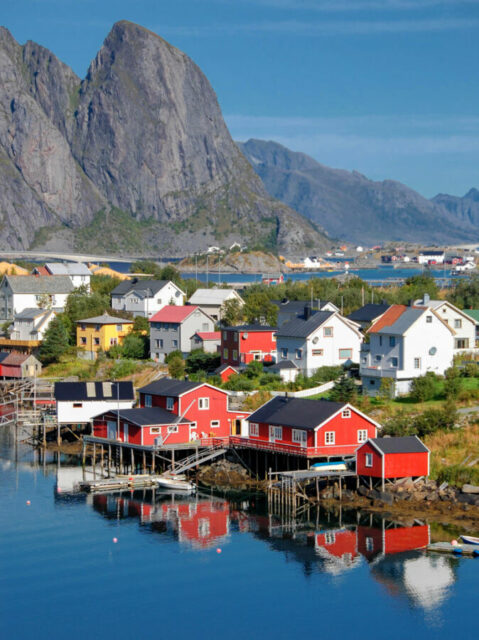
All my life, I’d seen this magical place in postcards and coffee-table books: soulful fjords with cut-glass mountains rising high above serene, deep waters, speckled with red cottages and almost no people. My wife and I decided we simply had to see this scene for ourselves. And when we finally made it to the Lofoten Islands — above the Arctic Circle and chilly even in August — we found it even more stunning than the photos. Getting to the Lofoten requires some effort (from Oslo, fly due north for an hour and a half), so you might as well settle in. The rugged Norwegians who’ve carved out a hardy life up here, hanging cod to dry on rickety wooden frames, are adept at introducing visitors to traditional lifestyles. Rent a rorbu (cheery cottage perched on stilts over the fjord) and spend a few days just tooling around, from the “capital city” village of Svolvær to the end-of-the-road cod-fishing settlement called Å. We home-based in Reine, perched on a flat rock in the middle of a fjord with the most stunning views in all of the Lofoten, and from there we ventured out to see everything the archipelago has to offer.


New Zealand

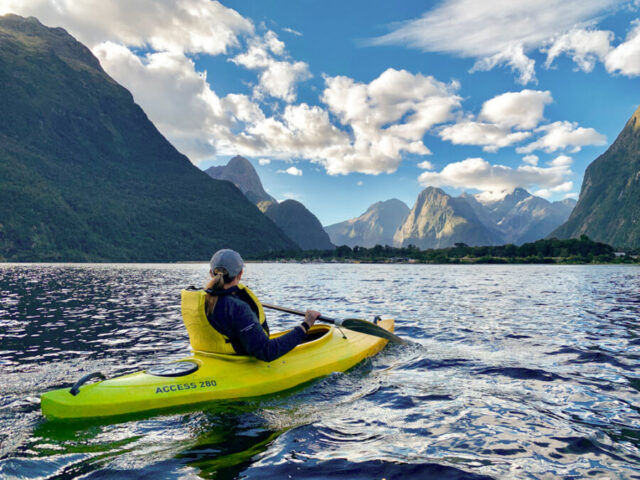
Sure, it’s not “European” in geographical terms. But for anyone who loves Europe, New Zealand feels strikingly familiar…yet excitingly different. (One afternoon, you’re punting the River Avon in Christchurch, as if you were in an English country garden; the next day, you’re swimming with dolphins at Kaikoura.) After years of hearing from our well-traveled friends about this seemingly too-good-to-be-true land, my wife and I finally spent a few weeks here in early 2019. And we fell instantly, hopelessly in love. Yes, the scenery is gobsmacking, and Lord of the Rings fans are in heaven. But New Zealand is so much more: a melding of Europe and Polynesia set amidst an entertaining landscape, where majestic glaciers rise high above steamy groves of ferns and palm trees. We loved sampling the local wine, craft beer, and third-wave coffee culture; learning about the indigenous Māori culture; and getting to know the wonderful Kiwis, who somehow manage to be well-organized and ceaselessly competent while remaining low-key and easygoing. Even before we came home, we’d already started Googling “How do I emigrate to New Zealand?” Now that the Kiwis (under the steady and compassionate leadership of Jacinda Ardern) have managed the pandemic better than anyone, this little island nation is sure to be flooded soon with more than its share of tourists…and transplants. Why not finally get down there soon,  ahead of the crowds? As soon as they open up to outsiders, New Zealand is at the top of our list of post-pandemic dreams.


Agriturismo Cretaiole, Tuscany

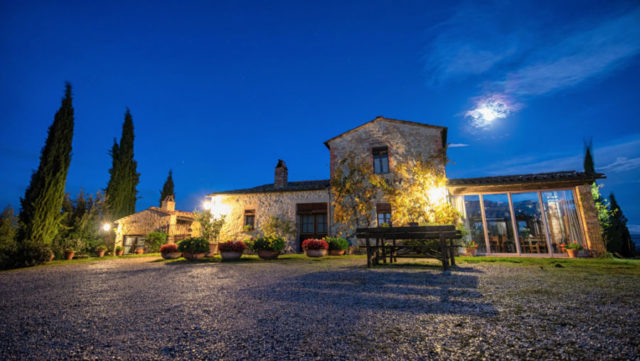
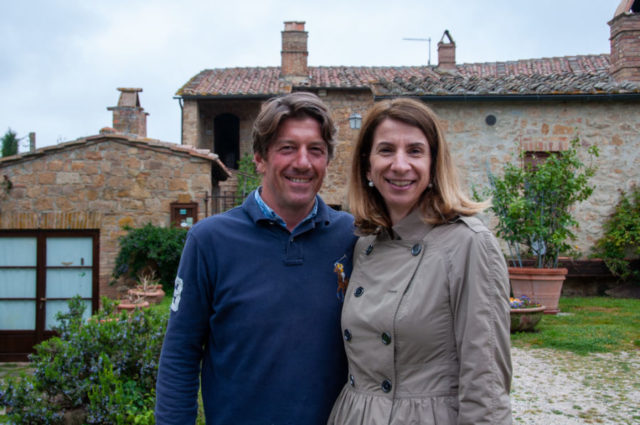
For years I’ve been singing the praises of a very special place to stay in the most beautiful corner of Tuscany. On a wooded ridge just outside Pienza, city mouse Isabella married country mouse Carlo and, together, they converted a traditional Tuscan farm into the best possible expression of an agriturismo — where visitors experience rural Italian culture and cuisine with modern comforts. With each visit, this place impresses me even more — and especially the vivid, perfectly orchestrated Tuscan experiences that Isabella creates for her guests: truffle hunts, pasta-rolling parties, olive oil appreciation classes, wine tastings, deeply meaningful nature hikes, and on and on. When I close my eyes and picture the one place I’d love to get back to as soon as I can, it’s spending a week — or more — at Cretaiole.

On my most recent visit to Tuscany, a few months before COVID-19 hit, Isabella showed me around her gorgeous new boutique hotel (La Moscadella), offering a similar Tuscan cultural experience with more luxury. But now that fine hotel, and the original farmhouse, sit mostly empty — one more tragedy in this year full of them. Whether it’s Cretaiole or some other perfect place you’ve discovered in your travels, small businesses are hurting right now. If you have the means to travel, as soon as it’s safe, consider booking a return visit. Helping to jump-start these businesses is the least we can do, considering all of the joy people like Isabella and Carlo have brought to our lives over the years.

I’m hoping that 2021 brings good fortune and a return to what we love, both for us travelers and for the people we meet on the road. Like all things, this too shall pass. And a year from now, if all goes well, we’ll be comparing notes about a whole new slew of discoveries for a new age of travel.

Want to Avoid the Crowds? Europe’s “Third-Rate” Towns Are Truly First-Rate

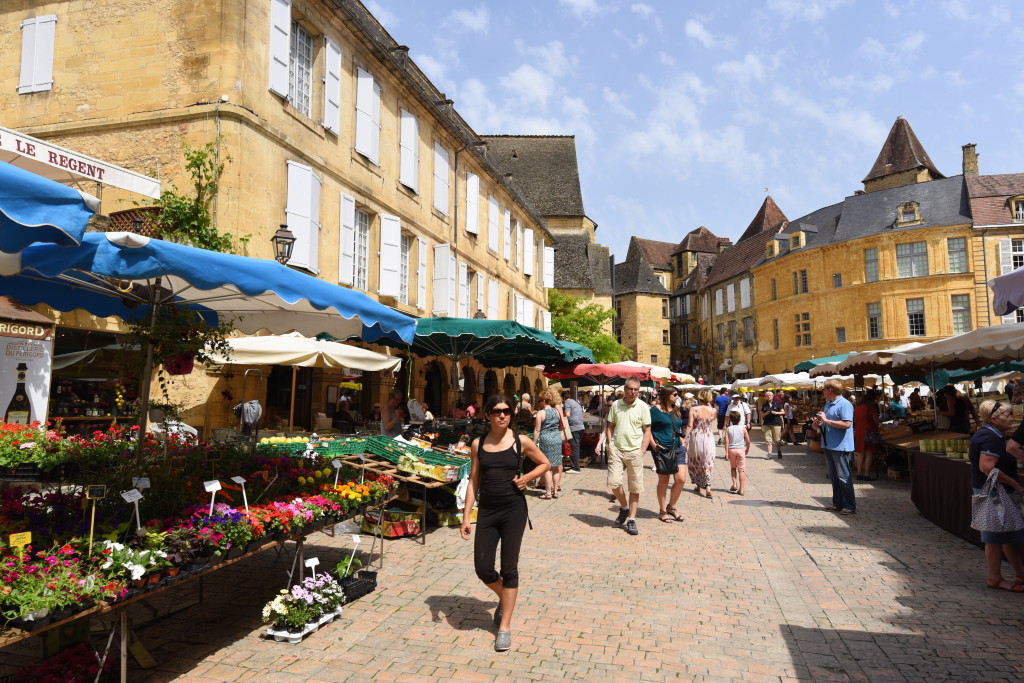
Europe is crowded — especially its big, famous sights. As you plan your 2020 travels, you may be looking to escape your fellow travelers. Here’s an idea: Consider going easy on Europe’s top-tier destinations, and instead check out some lesser-known places. Last year, I made a swing through what I think of as The Big Three: London, Paris, and Rome. But I also mixed in some smaller towns, including ones few travelers have heard of: Arezzo. Canterbury. Sarlat. And you know something? The experiences I had in Europe’s “third-rate” towns were truly first-rate.

Virtually everyone visiting Italy wants to go to the “first-rate” cities: Rome, Florence, and Venice. With more time, they add some “second-rate” destinations: Pisa, Assisi, Siena, Milan, and so on. But even once you get beyond those top tiers, Italy is rich with rewarding destinations.

I had this revelation when I spent a sleepy, rainy Saturday in the Tuscan town of Arezzo. It’s a midsize town that’s not included in our Rick Steves’ Italy guidebook — even with 1,250 pages of coverage, Arezzo doesn’t make the cut. I was here on the recommendation of an Italian friend, specifically to take a day off from the busy tourist towns I was visiting elsewhere in Italy: Assisi, Rome, and so on.  And I got exactly what I was looking for.

I love the endearing way that smaller cities have their own idiosyncratic claims to fame, which swell their residents’ pride. Arezzo has two: It’s home to a thriving weekend antiques market; and its Basilica of San Francesco is slathered with colorful frescoes by Piero della Francesca. I enjoyed those aspects of Arezzo. But mostly, I savored simply being alone in Italy…wandering all by myself through colorful and cobbled back lanes; having a memorable lunch at the town’s foodie splurge restaurant, just dropping in without a reservation; discovering a world-class neighborhood gelato shop; and browsing antiques alongside Tuscans furnishing their homes rather than tourists seeking souvenirs. I left Arezzo re-energized — and ready to plunge into Rome.

In England, everyone wants to go to “first-rate” London. With more time, they add some “second-rate” destinations — Bath, York, the Cotswolds, and so on. But there’s a steep drop-off in traffic when it comes to a town like Canterbury, where I retreated after two exhausting weeks of guidebook research in London. And, much as I love London, this trip reminded me that Canterbury is one of my favorite places in the UK.

Canterbury is best known for two things: First, its cathedral is the seat of the Archbishop of Canterbury, who leads the Church of England. And second, English majors know the town for its role in Geoffrey Chaucer’s 14th-century Canterbury Tales, in which a ragtag assortment of pilgrims swap tall tales and parables on their journey to that famous church.

Of course, Canterbury is not entirely “undiscovered.” The knot of half-timbered streets ringing its cathedral and its bustling High Street are packed with visitors. But many of them are day trippers, and most never leave that compact core of town. I loved simply wandering Canterbury’s back streets, following its idyllic river, discovering lush parks, ogling its tidy brick row houses mixed in with tipsy Tudor black-and-white half-timbered homes. Even just a few steps off High Street took me to areas that have never seen a tourist.

Near Canterbury, I also spent time hiking along Beachy Head and the Seven Sisters (a less famous but drastically more pleasurable stretch of white cliffs than Dover’s); explored the characteristic Sissinghurst Gardens; took a day off in the English beach resort of Brighton; and toured the sprawling and fascinating Hampton Court Palace, infused with vivid memories of Henry VIII. I also visited far-better-known Cambridge, Oxford, and Windsor, where the oppressive crowds left me exasperated. But thinking back on my little swing through southeast England fills me with a happy glow…even though it was socked-in and drizzling the entire time.

In France, Paris is the first-rate, world-class “must.” Second-rate destinations include Provence, Nice and the French Riviera, Mont-St-Michel, and Normandy. But my personal favorite slice of France is third-rate: the Dordogne, huddled deep in the southwest, and its lovely market town of Sarlat.

Built of a lemony sandstone that seems to suck in the warmth and glow of the sun, Sarlat looks like a film set. It’s a town that celebrates geese: A bronze statue of two proud waterfowl honors the importance of foie gras in the local cuisine (and commerce). Twice a week, one of France’s best street markets (and that’s saying something) curls through Sarlat’s interlocking squares. On market day, Sarlat is one of the most engaging places in all of France…a feast for all the senses. On other days, it’s still an utter delight, exuding a “let’s-retire-here” serenity that has tourists checking their 401(k) balances.

Italy is richer with life-alteringly-wonderful “third-rate” towns than perhaps any country in Europe. In addition to Arezzo, many of my favorites are in Tuscany, Umbria, and other parts of Central Italy: LuccaVolterraMontepulciano,  Orvieto… the list goes on.

And then there’s Sorrento, perched over a serene bay just south of Naples, offering a genteel springboard for exploring the Amalfi Coast. And up north, a short train ride from Venice leads to the thriving university town of Padua, Romeo and Juliet’s hometown of Verona, and alpine Bolzano — so close to Austria you can practically hear the yodeling.

This is a fun game to play. In Germany, I love Berlin, Munich, Rothenburg, and the Rhine Valley — but Dresden, Erfurt, and Freiburg caught me off guard and captured my heart.

In Poland, Kraków is an all-star, but Gdańsk is an overlooked gem.

In Belgium, Brussels and Bruges are at the top of every traveler’s list, but Ghent and Antwerp are delightful discoveries that feel more authentic.

In Portugal, Lisbon is the undisputed champ, and Porto is the up-and-coming second city, but the sleepy university town of Coimbra is an unheralded joy.

In Croatia, everyone flocks to Dubrovnik and Split. Why not check out Slovenia’s Piran, just up the coast?

In Iceland, Reykjavík, the Golden Circle, and the Blue Lagoon get all of the attention. But my favorite corners of Iceland are the Westfjords, Lake Mývatn, and Seyðisfjörður on the Eastfjords.

In Hungary, Budapest is top dog, but Eger and Pécs are woefully underrated.

In Spain, it’s hard to resist the pull of Madrid, Barcelona, Sevilla, Granada, and Toledo. But my favorite Spanish memories take place in Salamanca, Bilbao, Arcos de la Frontera, and Santiago de Compostela.

I’m not (necessarily) saying to skip those world-class destinations entirely. If you’ve never been to Paris…then go to Paris. But consider changing it up by also visiting a smaller city or town that isn’t a household name back home. If nothing else, see Europe’s “third-rate” towns as an antidote to the crowds.

By the way, reviewing these photos, I notice two things: Gorgeous places…with virtually no people. I mean, just look at all of those empty cobbles. If you want Europe to yourself, go third-rate.

What are some of your favorite “third-rate” towns in Europe, and why?


For more ideas of lesser-known places to visit, check out my recent list of 10 European Discoveries for 2020…and my Discoveries for 2019 and 2018, too.

For more details on all of the destinations mentioned here, check out our Rick Steves guidebook series, which includes coverage of the biggies along with the “third-rate” alternatives.

10 European Discoveries for 2020

In 2020, Europe will be more crowded than ever. Fortunately, there are still plenty of undiscovered alternatives: A sweet little beach town in Portugal. The quieter sides of London and Tuscany. The thriving tapas scene in an underrated Basque city. Street markets in Ljubljana and Provence. Switzerland’s capital and Bulgaria’s cultural capital. The wilds of northwest Iceland. The Tuscan island where Napoleon rallied for his final stand. And even a pilgrimage to a newly trendy nuclear meltdown site. These are my 10 European discoveries for 2020.

In 2019, my travels took me to London, Paris, and Rome; to Tuscany, Provence, and the Swiss Alps; and to the fjords of Iceland, the Julian Alps of Slovenia, and the white cliffs of England’s South Coast. And yet, reflecting on a  very busy year, I’m struck by how many of my fondest memories were forged not in the big-name destinations, but in out-of-the-way places. Continuing my annual tradition (check out my discoveries for 2018 and 2019), I’ve collected this list of Europe’s lesser-known highlights. You’ll notice a theme: Most of these are close to extremely famous — and extremely overrun — European biggies. It’s striking how, with a little effort, you can discover a little corner of Europe all to yourself.


The Westfjords, Iceland

About nine in ten visitors to Iceland hew close to the capital, Reykjavík, making speedy day trips to the Golden Circle, South Coast, and Blue Lagoon. That’s efficient and satisfying, if time is short. But to strike out on your own, head north — way north — to the Westfjords. Up here, just shy of the Arctic Circle, you’ll find boundless fjordland vistas, thundering bridal-veil waterfalls (including one of Iceland’s best, Dynjandi), plucky and kind locals, and one of the world’s top bird cliffs, a magical place called Látrabjarg. If you’ve made brief “layover” forays into Iceland and are ready to invest a few days in getting way off the beaten path…the Westfjords are for you. My trip to the Westfjords in September of 2019 — to write a brand-new chapter for the second edition of our Rick Steves Iceland guidebook (coming soon) — ranks as one of my all-time favorite road trips.


Untouristy London

London is a world in itself — endlessly, relentlessly, exhaustingly engaging. For some, it can be too much. When visiting London, hit the big sights, sure. (Ideally equipped with some smart crowd-beating tips.) But make a point to also break out of the tourist rut and become a temporary Londoner. During my two weeks in London in 2019, I cycled through “Little Venice” along the Regent’s Canal, explored hipster street markets (my favorite is Maltby Street Rope Walk Market), hiked across the urban wilderness of Hampstead Heath, explored the Shoreditch street-art-and-foodie neighborhood, checked out the food halls of Brixton, and rode a commuter train to the lovely suburban neighborhood of Dullwich. London is one of Europe’s most satisfying cities to explore. So…explore.

By the way, this approach also works like a charm in other overcrowded cities. For example, in Rome, consider skipping the Sistine Chapel and the Colosseum and heading to some exponentially less overrun alternatives. (I love Rome’s Monti neighborhood, across the street from the Ancient Forum.)


Bern, Switzerland

Switzerland’s seat of government is also its most appealing urban playground. Livable Bern is tucked quietly between some of Switzerland’s most heavily trafficked destinations — namely, the Berner Oberland and Lake Luzern. And yet, it’s one of the only European capitals where locals complain about how few tourists visit, rather than how many. Updating our Rick Steves Switzerland guidebook in Bern this fall, I enjoyed the city’s pristine arcaded streets, playful fountains, engaging museums, super-scenic bridges, warm sandstone townhouses, low-key students-and-politicians pace of life, and convivial park huddled under its towering church steeple. One Friday evening at sunset, I hiked up to a tranquil rose garden where everyone was just hanging out, peering out over the handsome cityscape, and waiting for the sun to go down. It was — in a most unexpected place — one of my favorite travel memories of 2019. (Our Best of Switzerland Tour ends with a night in this fine little city.)


Ljubljana’s “Open Kitchen,” Slovenia

Speaking of underrated capitals, Ljubljana has long been my favorite little city in Europe. And it just keeps getting better. While Ljubljana is inviting anytime, do your best to visit on a Friday (from mid-March through mid-October, weather permitting). That’s when the market square plays host to the wonderful Open Kitchen, one of my favorite food events in Europe. Each of the several dozen stalls is operated by a brick-and-mortar restaurant, from internationally recognized chefs to hole-in-the-wall dives. And the variety is bewildering: During my visit in early October, I saw vegan burgers, huge simmering pans of paella, Argentinian steaks, ribs and pulled pork, Indian dosas, Belgian waffles, poke bowls, Slovenian microbrews, Chinese noodles, hearty sausages and čevapčići, delicate macarons, and an entire roast pig on a spit. People settle into big shared tables or grab a seat on the cathedral steps to graze and socialize. It’s a melting pot of culinary Slovenia — home to one of Europe’s most underappreciated food scenes.


Salema, Portugal

Of the many things that Rick and I agree on, this tops the list: Salema — a tiny town on Portugal’s Algarve Coast — may be the best beach town in Europe. It’s just down the coast from big, glitzy resorts (like Lagos, Abufeira, and Portimão). But Salema feels like an idyllic, Old World hideaway. Visiting recently to update the Algarve chapter for our Rick Steves Portugal guidebook, I was utterly charmed by Salema. It doesn’t have enough hotels, and the ones it has are past their prime (or humble-by-design). Sunbathers share the beach with fishing boats, pulled just beyond the reach of the tide. Grizzled fisherfolk grab the shade at a beachfront café near the communal tractor they use to hoist those boats up onto the sand. The cobbled main drag climbs up through a whitewashed world of simple homes. And Salema’s beach — with powdery yellow sand, just the right amount of surf, vivid-yellow cliffs, and beach bars happy to rent you a thatched umbrella and a lounger — is made to order for a day of sunbathing and splashing.


Chernobyl, Ukraine

Yes, really. Chernobyl — a two-hour drive north of the Ukrainian capital, Kyiv — is a compelling, moving, and (if science is to be believed) safe place to visit. I went to Chernobyl in late 2018 (before it was “cool”) and found the experience captivating. With the smash success of HBO’s award-winning Chernobyl miniseries in 2019, the site of humankind’s worst nuclear accident is becoming known as a travel destination. Why visit? Touring Chernobyl offers an unforgettable lesson in radiation, and its capacity for both technological achievement and destruction. It lets you walk through a trapped-in-time, Cold War-era Soviet workers’ town, and witness the power of nature to reclaim abandoned civilization. And, most importantly, it shares the poignant stories of the brave men and women who sacrificed their lives to contain the meltdown, saving Ukraine — and, likely, much of Europe — from a horrifying fate. It’s hard to imagine a more memorable day out, anywhere in Europe, than Chernobyl.


Lesser-Known Markets of Provence, France

In the fall of 2019, my wife and I spent a week in Provence, making a point to visit a different market each day. We enjoyed the biggies (like the ones in l’Isle-sur-la-Sorgue, Aix-en-Provence, and Uzès). But our favorites were the lesser-known alternatives. On Tuesday in Vaison-la-Romaine, we browsed the floral soaps and lavender sachets that were piled on rickety tables between Roman ruins. On Friday in Lourmarin, we strolled into town along a plane tree-shaded boulevard, lined on both sides with stacks of colorful, plump produce and mounds of glistening olives. And on Sunday in Coustellet, at a lowbrow market filling the crossroad village’s dusty parking lot, we picked up a droopy bouquet of sunflowers, plus some smoked meats and mountain cheese for a picnic. The fact is, every day of the week,  a variety of markets enliven no-name towns all over Provence. Figure out which one’s nearest to you (listed in our Rick Steves Provence & the French Riviera guidebook)… and check it out.


Plovdiv, Bulgaria

Bulgaria remains one of Europe’s most underrated destinations. And if I had to pick one place to visit in Bulgaria, it’d be Plovdiv. This small city of 340,000 has a modern bustle, with a pedestrian-friendly shopping boulevard slathered in vivid street art. It has a funky hipster zone — nicknamed “The Mousetrap” — where communist-kitsch posters laugh down over diners feasting on upmarket Bulgarian fare. And draped over a hillside above the modern city, the atmospheric old town has a remarkably well-preserved Roman amphitheater, colorful traditional homes in the Bulgarian National Revival style, and one of Europe’s very best “hidden gem” art museums, featuring the works of Zlatyu Boyadzhiev —  the “Bulgarian Van Gogh,” who taught himself to paint left-handed after a stroke. If more people knew about Plovdiv, it’d be a tourist mecca. But they don’t…so for now, it’s all yours.

Plovdiv is one of the highlights on our Best of Bulgaria Tour; for a sneak preview, check out this segment from our Bulgaria TV show.


Bilbao Tapas Scene, Spain

The Basque Country is one of Spain’s culinary hotspots, and the genteel beach town of San Sebastián hogs much of the attention. But don’t overlook the bigger urban center of Bilbao, just an hour’s drive to the west. On a recent visit to Bilbao, I arrived late on a Friday evening. From my little B&B in the heart of the old town, I stepped out into a commotion of thriving bars and restaurants, each one with a creative array of tapas proudly lined up on the counter. Facing the Atlantic, Bilbao’s tapas bars come with more than their share of mysterious seafood — mounted on a crunchy little disc of baguette or skewered with a toothpick. As a bonus, you can go for an after-dinner stroll along the serene embankment, culminating in a floodlit view of Frank Gehry’s iconic Guggenheim Bilbao. (Our Basque Country Tour ends with two nights in Bilbao.)

If you’re headed out on a tapas crawl, and want to increase your odds of getting ostras (oysters) instead of orejas (pig’s ears), consider these tapas tips.


The Isle of Elba, Tuscany, Italy

This island is best known as the place where Napoleon was sent into exile. Turns out, it’s also ideal for a beach break from a busy Tuscan itinerary. Connected to mainland Tuscany by an easy one-hour ferry ride, Elba comes with a textbook “salty Mediterranean harbor,” a couple of evocatively faded Napoleonic palaces, scenic drives to secluded beaches, and an unforgettable gondola ride to the island’s rocky summit in an open-air cage that had me feeling like a parakeet going for the ride of its life. The designers of our brand-new Best of Tuscany Tour deserve the credit for this one: After they included Elba on the tour route, I went there to add it to the newly released 19th edition of our Rick Steves Florence & Tuscany guidebook… and I was hooked. (Check out my full report on Elba.)  In fact, I’ll be returning to Elba in 2020 as a tour member on that new Tuscany tour. And I can’t wait.


How about you? What are your favorite European discoveries? Where are you most excited to visit in 2020?


Need more inspiration? My “discoveries” lists for both 2018 and 2019 are still great choices in 2020.

I’ll be posting more about several of these discoveries — including Iceland’s Westfjords, the markets of Provence, and Switzerland’s underrated cities — in the next few weeks. To make sure you don’t miss anything, “like” me on Facebook.

Wherever you’re going in 2020…happy travels!