On my recent guidebook research trip in Andalucía, I was continually reminded how traveling in Europe’s traditional corners — especially this southern slice of Spain — comes with a certain “dramatic tension”: between old ways and new, between adhering to tradition and being open to outsiders, between staying relaxed and sticking to a schedule, and between welcoming the tourist dollar while holding those tourists at arm’s length.
The day before we drive into the pueblo blanco of Arcos de la Frontera, my phone vibrates with a WhatsApp from our B&B: “We are looking forward to your stay. Here is some advice on how to arrive.”
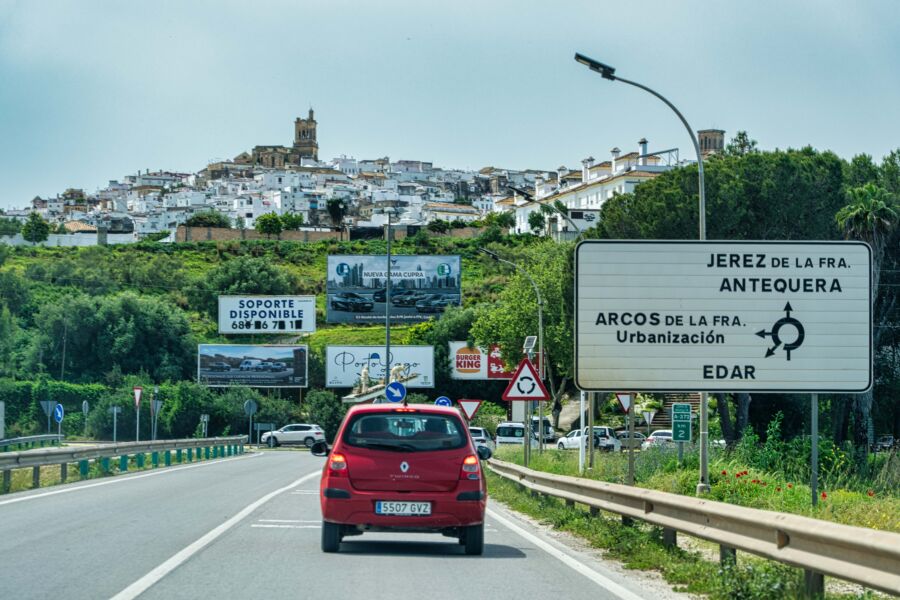
We already know that it’ll be impossible to navigate our rental car through the twisty lanes of Arcos’ historic hilltop old town. So we appreciate the guidance to park instead at the large underground lot down below, in the new town.
“There are three possibilities to come to the hotel: by foot (light luggage better), by taxi (it costs 6€ approximately), or by bus.”
Hoping to avoid a steep uphill hike with our bags, we plan to take a taxi. From the parking garage, we head up to street level and survey our options. It’s about 3:30 in the afternoon, and even this normally bustling lower town — the commercial heart of Arcos — is deserted. Shops are shuttered; sidewalk tables sit empty; the only signs of life are a few sleepy seniors on shaded benches. All that’s missing are a few literal tumbleweeds whispering down the street.
In its more urban corners, today’s Spain has largely moved on from its siesta ways. So it’s refreshing to find it still practiced so zealously in places like Arcos. There’s something that just feels right about small-town Spain taking a nap on a hot afternoon.
This happy sentiment lingers precisely as long as it takes us to walk a couple of blocks to the taxi stand… where not a single taxi stands. The cabbies of Arcos, it turns out, are also proud practitioners of the siesta.
I call our B&B host. “Well, of course there are no taxis there,” she says (as if oblivious to the instructions she texted us 24 hours ago). “But I will try calling for one.”
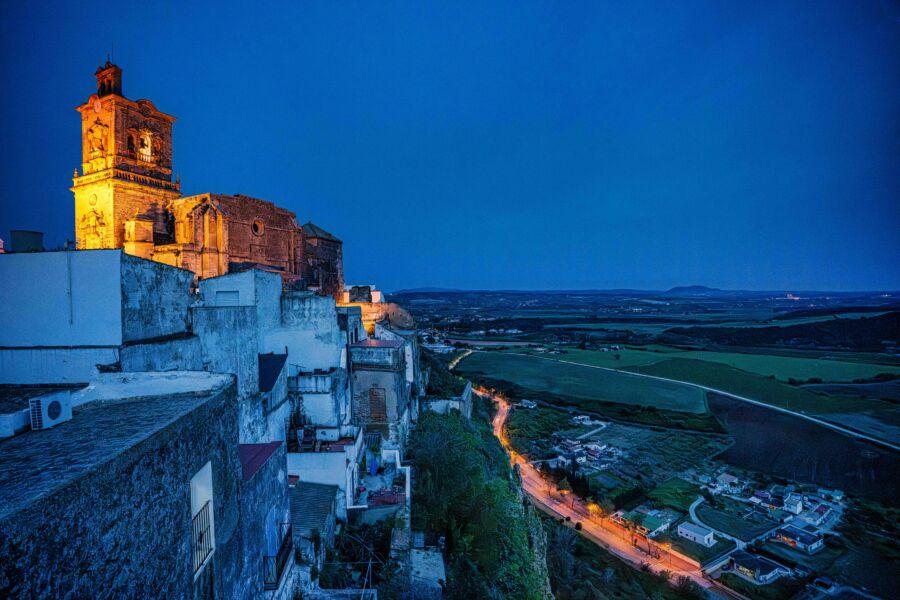
Eventually the taxi appears, we hop in, and we twist up, up, up — higher and higher — to the scalp of town. He drops us off next to a small church and gestures vaguely toward the tangle of lanes just beyond — a left, then a right, then a left, and a little luck should lead us to our destination. He drives off, we’re swallowed up by the whitewashed lanes, and soon enough we’re warmly welcomed by our B&B host and shown to our room — which she treats as an afterthought to the stunning rooftop deck, perched (like so much of Arcos’ old center) along the sheer ledge of a cliff that plunges 500 feet straight down, to a flat plain stretching, like a cat following a nap, toward a sleepy lake and distant mountains.
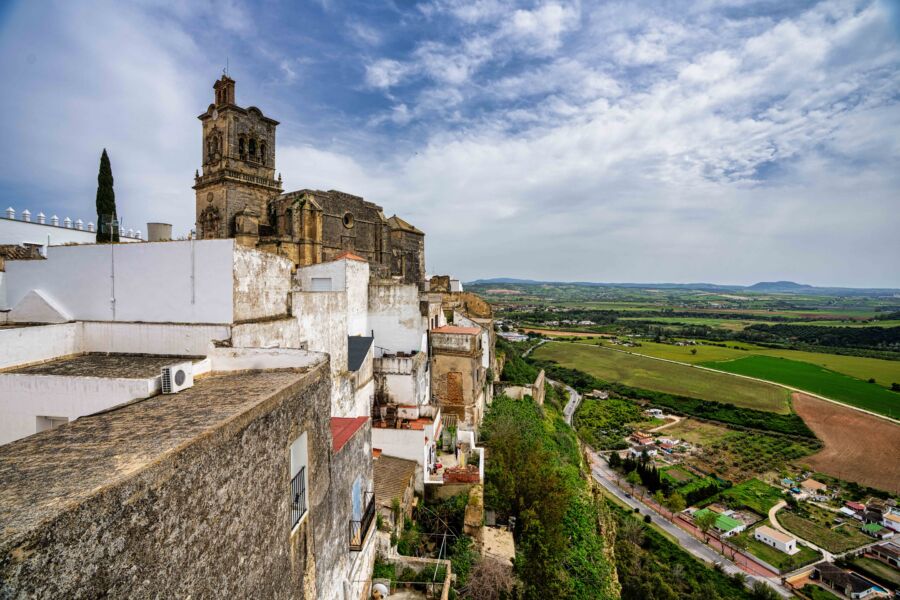
Arcos “de la Frontera” (so named for its long-ago status as a bastion against the Moors) has been one of Rick Steves’ classic Back Doors for eons. And today, there’s no doubt it retains that quintessential-Andalucía charm. Its squinting-bright white lanes are as pristine as they are narrow, with well-worn cobbles underfoot.
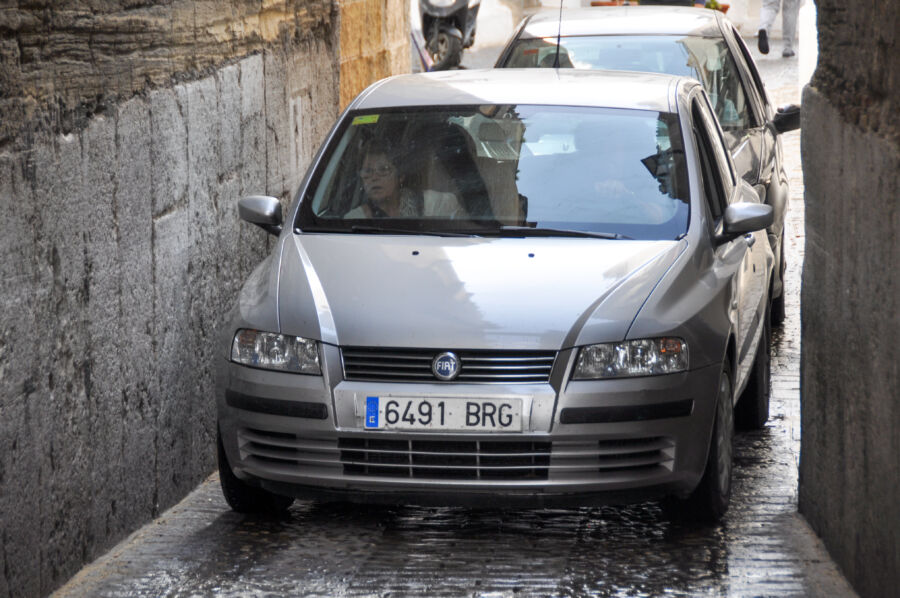
Hustling through town to update our guidebook coverage, I enjoy excuses to stop and chat with locals, and to dip into shops and restaurants that are gradually, reluctantly reopening after the siesta. Deep gouges in the centuries-old walls are a chronicle of overconfident drivers who misjudged the width of their car, or the street, or both. Hearing a car approach, I press myself against the wall, tuck in my toes, and suck in my gut — not wanting to receive a similar scar as a souvenir of my visit to Arcos.
There’s a magic to Arcos, to be sure, but not much “sightseeing.” Bellying up to a balustrade overlooking that 500-foot drop (any balustrade, take your pick) is town’s top activity. Two too-big, stark-sandstone churches loom like bookends of the old town, each lording over a desolate plaza-turned-neighborhood-soccer pitch and a spectacular view.
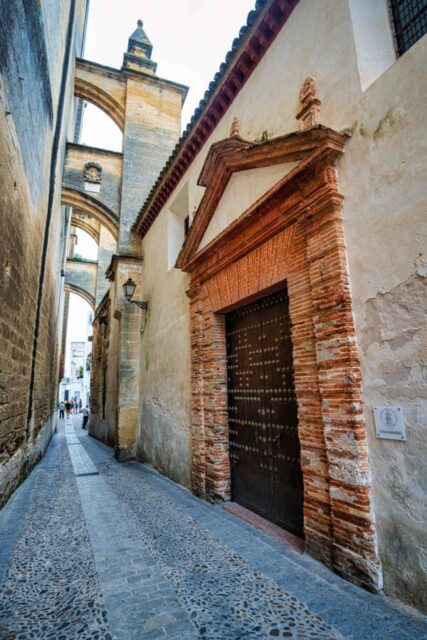
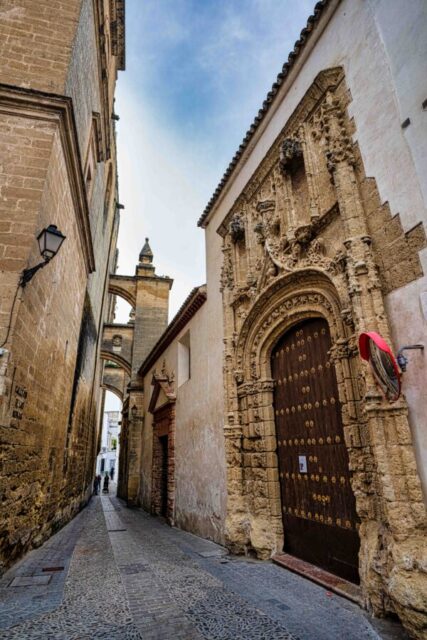
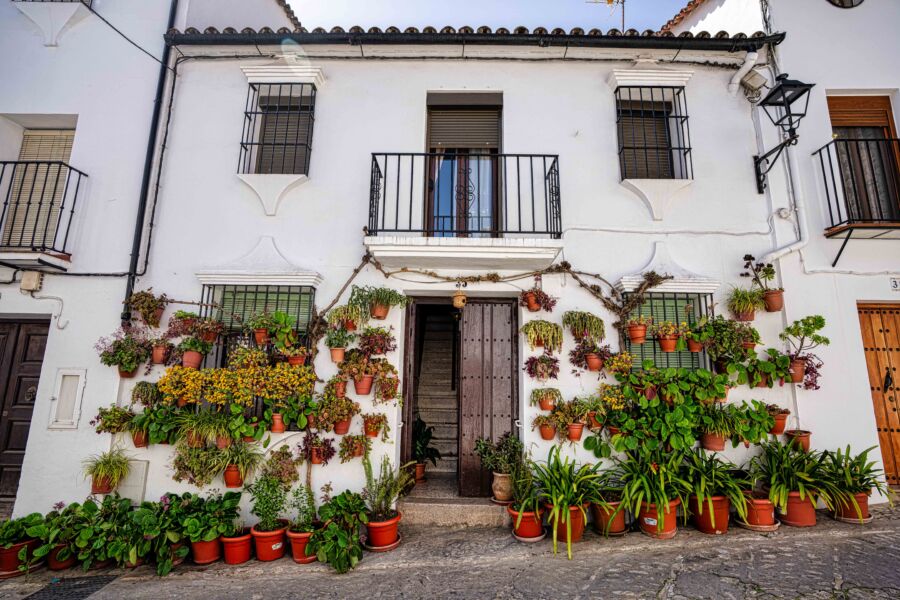
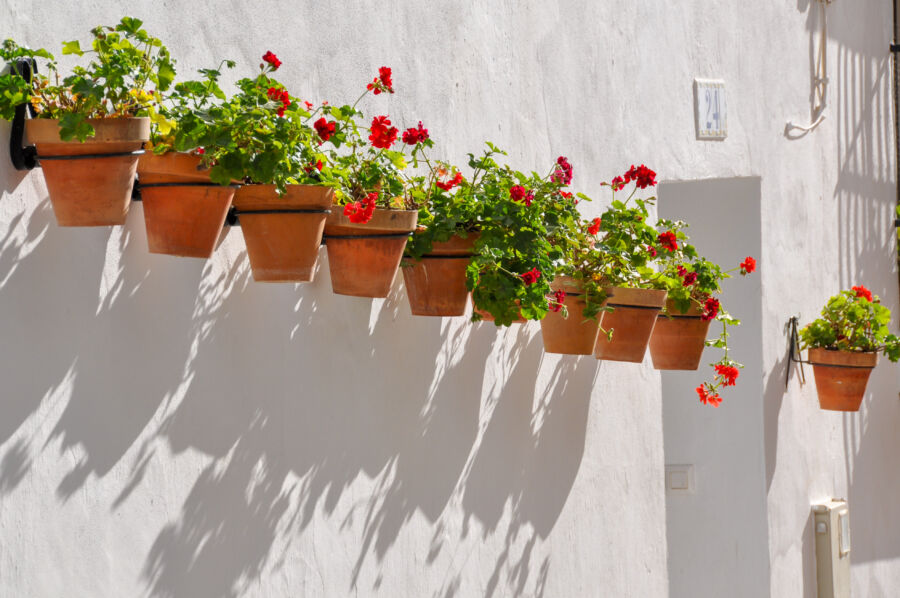
On the skinny streets connecting those churches, long stretches of scuffed whitewash are punctuated by heavily grilled windows and over-the-top-ornate doorways of stacked brick and lovingly hewn stone. Wavy terra cotta rooflines — overlapping half-pipes forming an endless yin-and-yang pattern that seems to evoke that precise Islamic aesthetic that Arcos is famous for resisting — are echoed by rows of terra cotta flowerpots lashed to railings and fastened firmly to the white walls.
I dip into a hole-in-the-wall bakery, where the clerk — who has been yelling at her colleague (husband?) so loudly that her amplified fury bouces up and down the surrounding lanes — turns suddenly sicky-sweet. In addition to the basic almond cookie I’ve been eyeing, she talks me into the local pastry, roscos de Arcos — then proceeds to charge me several times what seems fair. It’s a rare business that’s open during these siesta hours, and I imagine I’m paying a “tourist tax” for the privilege. Farther along, I pass by a tiny window at a convent where you can buy boxes of cookies from unseen nuns, using a little turntable to exchange cash for sweets — and regret that I didn’t wait for this opportunity.
Stopping by the tourist office to run through my list of questions, I find a polite if listless clerk who speaks very little English. Switching to my rusty Spanish, I find that language is not the barrier to getting the answers I seek.
“Is it correct that the bus to the lower town runs twice an hour — at :20 and :50 past the hour?”
She wrinkles her nose. Shrugs. “No. Sometimes. Not exactly. Maybe you should check with the bus company.”
Fair enough. “OK, thank you. And is the ticket for the bus one euro?”
Another wrinkled nose. Another shrug. “I don’t know for sure. Did I mention you could ask the bus company?”
It turns out, this office — tasked with informing tourists — has a tenuous grasp on the bus that virtually every arriving tourist is likely to take. This fact might have surprised me. But I’ve found it typical of my travels around small-town Andalucía. Nice as the staffers may be, the dearth of information at tourist “information” depots is as comprehensive as it is unapologetic.
After doing my best to update those details by shuffling through brochures and scanning materials pinned and taped to the walls, I head back out into the stage-set lanes of Arcos. Returning to my B&B, I notice that — at a moment when most Spanish towns spring back to life with the siesta’s happy counterpart, a convivial evening paseo — the streets are still empty. I can’t shake the feeling that this time-passed village is slipping away: During busy times, Arco’s old center is flooded with visitors, who trundle up and down the hill on that shuttle bus to spend a little money, snap some photos, then move on. But in the evening, Arcos’ metabolism flatlines. Passing several se alquila and se vende signs marking unoccupied properties seeking a new owner or tenant, and ringing doorbells at multiple recommended B&Bs where nobody’s home, it becomes clear that Arcos is sliding toward becoming a ghost town that exists almost solely for tourists.
Ideally, for small towns like this one, tourism can be a win-win: It empowers a historic, beautiful, otherwise modest community to thrive — providing a steady flow of outside income that creates meaningful and lucrative employment to locals, as well as an incentive to retain and even enhance its traditional character and culture. I’ve seen many such success stories.
But sometimes, that equilibrium is elusive — set off-kilter by any number of factors. (Too much tourism? Too little local engagement? Greed? Disinterest?) In these cases, the town’s architecture and charm survive, even as its soul slowly fades. And these days, Arcos’ old town appears to be slipping toward the wrong side of that balancing act. (I’ve observed this phenomenon in similar towns across Europe — most notably, Italy’s Civita de Bagnoregio, where almost nobody actually lives in the town itself anymore, having converted their residences into souvenir shops, gelato stands, and restaurants.)
Arcos remains, no doubt, a gorgeous place to visit. But it’s losing the real, authentic character(s) that once made it so special. As a travel writer, it makes me wonder, and it makes me worry: How can a town like Arcos reestablish that balance — and is there anything I can do to help?
§ § §
Spain — far beyond just Arcos — is struggling with how to handle its dizzying number of tourists. International arrivals, especially post-pandemic, are soaring: from around 70 million visitors in 2022, to more than 80 million in 2023, to a record 94 million in 2024, and with 2025 seemingly on pace to crest 100 million… an astonishing increase for a country of less than 50 million inhabitants.
News about Spain’s “anti-tourism” protests have made international headlines. And based on conversations I’ve had, concerns about tourism are a constant theme on Spain’s sensationalistic local and national news — keeping it front-of-mind.
“Overtourism” is a troubling trend in much of Europe. So why is Spain, in particular, becoming its poster child? I think it’s because Spain is desirable on many levels: You have top-quality “cultural sightseeing” that brings so many travelers to Europe, to ogle castles and cathedrals, to visit wineries and artisanal farm producers, and to enjoy the acclaimed culinary scene. And then, on top of that, you have a layer of mass-market beach tourism — Spain’s longstanding status among British and Northern European holiday-makers is only growing, especially with the rowdy party set. (Imagine combining Miami Beach and Boston into one place.)
And there’s another wrinkle in Spain — one that I’ve observed over many visits, dating back to my semester abroad studying in Salamanca back in 1996. On that first trip, and on many return visits since, I’ve learned that Spain has an idiosyncratic understanding of “hospitality” — at least, compared to the way it’s understood in much of Europe.
Spain has always been a place apart from Europe — separated by geography (the Pyrenees), history (Andalucía, in particular, was Moorish-controlled for centuries), and modern politics (36 years of fascist rule under Francisco Franco). I was taught — and I observed firsthand — how Spaniards are proud, self-assured, perhaps a touch culturally chauvinistic, and somewhat skeptical regarding outsiders.
A lot has changed since my earliest visits to Spain, of course, and I’ve seen how the country has not only opened up, but in many regards has leapfrogged other parts of Europe in its progressive politics and openness to new ideas. (For example, in 2005, this very Catholic country — which embraces deep and durable traditions, from bullfighting to the siesta — became one of Europe’s first to legalize same-sex marriage.)
And yet, as a visitor in Andalucía, I find that Spain retains a certain suspicion and stubbornness when it comes to us travelers. It’s notable that, while many communities around Europe — from Reykjavík to Lisbon, and from Amsterdam to Venice — are also struggling with increased tourism, only in Spain are a few of those tourists being spritzed with water pistols. (This phenomenon has been exaggerated — after all, we’re talking about just a few dozen of those 100 million visitors — but there have been zero such reports in other places.)
It’s understandable that many Spaniards are exhausted and alarmed. Frankly, I don’t blame them one bit for asking difficult questions about how to ensure that the dizzying growth of the tourism sector is sustainable. Perhaps a more strategic approach to tourism could save towns like Arcos from becoming soulless theme parks.
At the same time, while tourists bring headaches, they also bring money — lots and lots of money. Tourism is helping make Spain wealthy (representing more than 12 cents on every euro spent). But the reluctance to make things easy on visitors feels almost passive-aggressive.
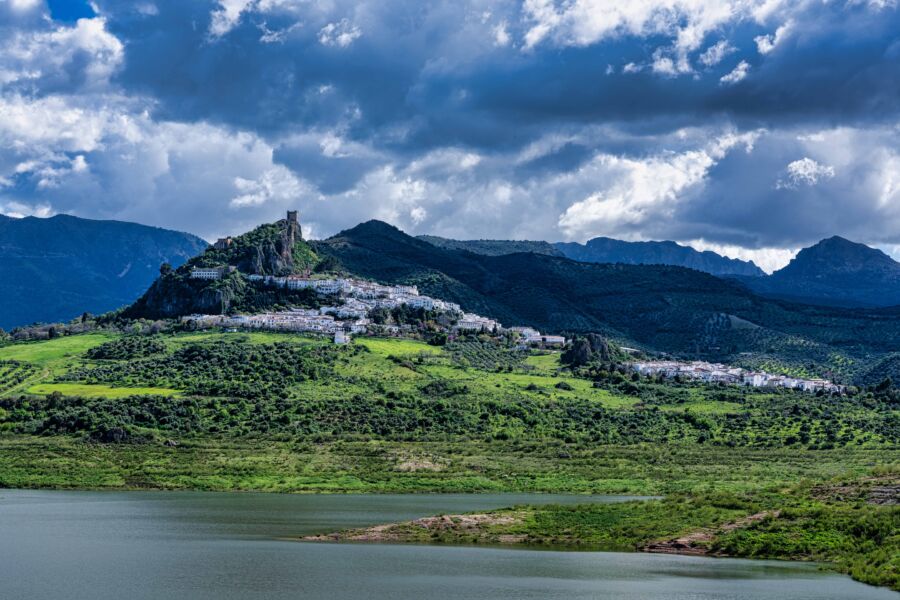
On the way to Arcos, I stopped off at a few famous pueblos blancos — Zahara, Grazalema, Setenil de las Bodegas — postcard-perfect white hill towns that are, at busy times, swarming with visitors. In each one, I was struck by the near-complete absence of basic signage to help approaching travelers get their bearings: Where are the nearest parking lots? Which streets can I drive on, and which not? How do I get into town? ¡Buena suerte!
At one village, we obediently followed signs to a giant garage at the edge of town (not wanting to contribute to the over-congested streets). But when we surfaced, we found zero direction on how to get to the town center. After spinning in circles with my phone — trying to get the compass on my GPS to align with our target — I finally sorted it out. Additional visitors surfaced and were busy scratching their heads and pointing quizzically in different directions, upon arriving in a town where they were about to spend their hard-earned money. Is it asking too much to put up a sign to help them find the place to spend it?
As a travel writer, I feel caught in the middle. On the one hand, I have empathy of the many Spaniards who believe “enough is enough” and want to curb tourism. (I like to think I’m helping to encourage the “right kinds of travelers” — respectful, curious, well-behaved — while also educating them to be smarter and less disruptive visitors.) On the other hand, Spain is profiting royally from all those tourists that they so relish complaining about… and surely, all that income must come at some cost.
To be fair, my understanding of those “anti-tourism” protests is that they’re actually “anti-overtourism” — focused not on the tourist, but on policies that aren’t equitable in spreading around both the burden and the income.
I respect Spain’s efforts to curb the worst side effects of tourism — and to regulate, in thoughtful ways, a trend that could threaten both fragile and pristine places like Arcos and sprawling, congested cities like Barcelona. At the same time, as someone who’s observed many other places grapple with this same issue, I know there are nuanced, constructive ways to foster a healthy approach to tourism while still greeting visitors with hospitality rather than with indifference and water pistols — seeking that elusive “win-win” by providing value to the traveler while also preserving and celebrating your culture.
In the end, we still had a wonderful visit to Andalucía, with its remarkable history, epic sightseeing, grand landscapes, balmy weather, and outstanding cuisine. And if I were a typical tourist — here to simply “be on vacation” rather than on an information-gathering guidebook-research mission — I wouldn’t have much to grumble about. But ultimately, I was reminded that if you’re coming to Spain, you should expect to take Spain on Spain terms.
§ § §
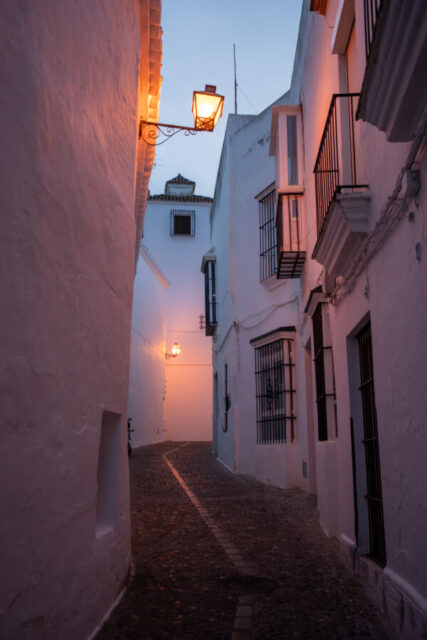
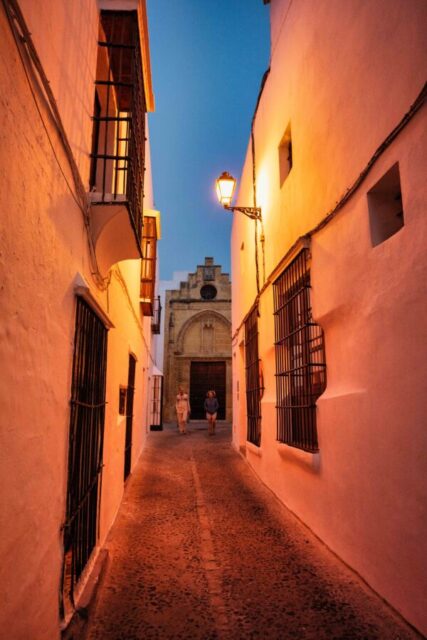
It’s getting late in Arcos. Antique lanterns twinkle on as twilight swallows up the broad Andalusian sky — painting the whitewash with deep, fleeting pinks and surprise purples and electric oranges and soothing robin’s-egg-blues. And those Crayola lanes are all mine: The sleepy time warp of a town is nearly empty.
Returning to the B&B after dinner, we explain to our host that we have a busy day planned tomorrow: We’re heading to Jerez (also “de la Frontera”), a modern industrial burg sprawling through the valley just below Arcos. Jerez is famous for two things — its sherry bodegas and its equestrian performances — and we’ve plotted out our day to fit in both. But this requires arriving at the sherry bodega in time for the 10:00 tour. To allow plenty of time for the 30-minute drive, we’re hoping to leave the hotel by 9:00.
“Hm,” our host says. “But breakfast begins at 9:00. Earlier is not possible.”
We’re willing to skip breakfast, if we must. But she quickly adjusts: “Well, if you come just a few minutes early, we can serve you right away, and you can still get underway quickly.”
We note that we’ll also need a taxi to get back down to our car — saving us the time it’d take to walk. Should we arrange one tonight?
“No, that is not necessary. We can call you one when you get to breakfast. It will be no problem.”
Grateful for their flexibility, we turn in — glancing out one last time over that stunning view.
The next morning, we report to breakfast promptly at 8:55 — packed bags in tow. The breakfast attendant greets us, shows us to a beautiful table in the tranquil tiled patio, and disappears into the kitchen. We wait. And wait. And wait.
At a certain point, I get up to peek in at the reception desk — hoping yesterday’s host might be able to order us that taxi. Nobody is there. So, returning to the breakfast patio, all we can do is continue waiting for the breakfast attendant — and hope that she’ll be willing to call for us. (In retrospect, I wished I’d gotten that taxi number myself!)
We realize that — once again — we are experiencing that “dramatic tension” that so often comes when traveling in Spain. We woke up in old, traditional Andalucía, perched on its ancient hilltop with time stretching out as endlessly and unhurriedly as the plain yawning below us. In this version of Andalucía, long famous for its mañana attitude, time means little. Breakfast begins at 9:00…ish. Nobody rushes, as if timepieces were never invented.
And yet, filling the valley below — literally within sight of our castaway hilltop — bustles Jerez, a commercial hub for 21st-century Andalucía. This is a time-is-money place where timepieces are old news and schedules are sacrosanct.
I can travel, very happily, in both types of destinations. There’s something to be said for going somewhere — like Arcos — where you can remove your watch, allow yourself to truly lose track of time, wander aimlessly, nurse endless cups of coffee or glasses of sangría at a shaded sidewalk table, and feel your pulse slow. And I can also enjoy time-is-money places — like Jerez — that are closer to my home life, where an appointment is a commitment to be kept, and where being organized maximizes your cultural takeaways.
The challenge comes when you cross that frontera between old Andalucía and new Andalucía. When the clash of cultures occurs midway through a 30-minute drive. And when, as traveler, you find yourself trapped in the time warp of a beautiful, easygoing breakfast on a chirpy patio… while at the same time, feeling the minutes tick down as you get closer and closer to the daisy-chain of precisely timed commitments that await you in the next town over.
Eventually, the attendant emerges with a fantastic breakfast. And, between serving our table and the next one — with an American family that seems to multiply each time we glance over, as more and more kids wake up and stumble down the stairs, filling four, five, six, and eventually seven chairs — she calls our taxi.
We thank her, hustle out the door, and practically run up those winding lanes to find our taxi. Time is very tight; making our 10:00 bodega visit will require some luck and no further unexpected delays.
We hop in, and our cabbie begins down the hill — but then takes an abrupt turn, zigging where I expect him to zag. Soon it becomes clear that his path to the parking garage is anything but direct. He could just head straight down the hill (I confirm this by following the route on my map); instead, he appears to be leaving town entirely. Soon we’re down in the valley below, passing farm fields and big box stores, circling Arcos from the outside. Finally, after getting a distant view of our old town B&B from far below, we begin to loop back up — eventually coming up the main road we came in on yesterday.
Pulling up to the garage entrance, our cabbie proudly points to the meter. Yesterday, this ride cost €6. Because of the inexplicable Rube Goldberg detour he has devised, today’s ride is €8. Instantly, it becomes clear: He has wasted at least 10 additional minutes of our already tight time on the “scenic route”… simply to gouge us for an extra €2. (Had I known, I’d have tipped him double that for the express route… or just walked.)
Finally on the freeway, I call the sherry bodega to apologize profusely and plead our case. Of course, he gets it: “Don’t worry. Just arrive when you can.” After negotiating the maze of streets and finding what we think is a legal parking spot a couple of blocks from the bodega, we arrive about 15 minutes late, hopping on the already-in-progress tour with a pack of visiting Norwegians.
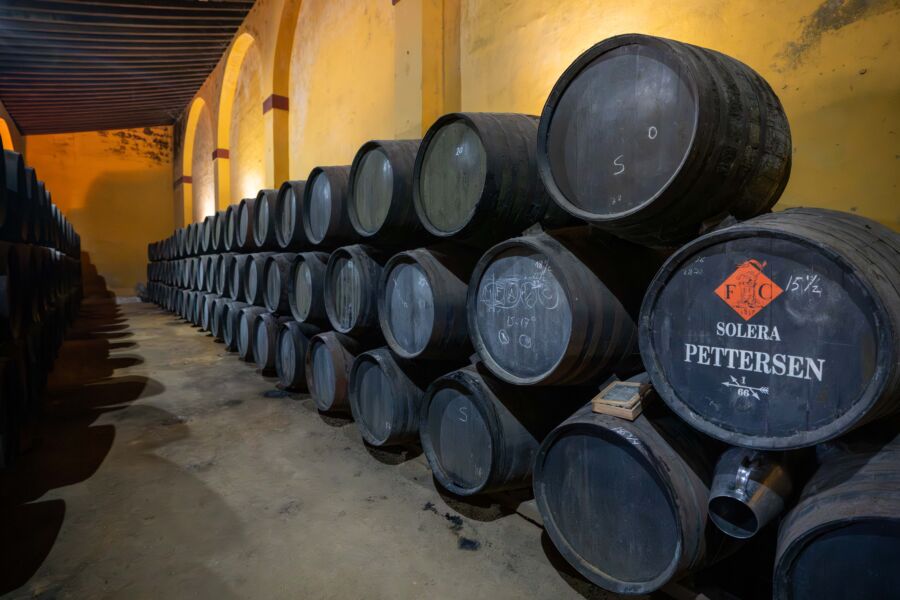
In the end it, it all worked out — as these things always do, one way or another. But I’m having trouble paying attention to the talk of yeast crust and oak barrels, of amontillado, oloroso, and Pedro Ximénez.
Instead, my mind is whirring with all of the contrasts we’re encountering on this visit to Andalucía — a place of dramatic tensions across the frontera. It’s a land where they appreciate tourist income…. but are iffy on the tourists. A land where optimistic, WhatsApp-ed instructions are subverted by the persistence of the siesta. A land where your time’s value is unimportant… except for what’s shown on the taxi meter. A land where tradition overrules modernity, until it doesn’t. A land that time forgot… until it remembers.
Arcos de Frontera was the highlight of my trip to Spain this summer.
I did notice the absence of others in the evening and the confusion stemming from the lack of directional signs when driving through the area.
But the only evening sounds coming from the practicing of a local band was just what I wanted after the hustle and bustle of Spain’s larger cities.
Sounds like a sign I saw on the Oregon California border back in the 70s. Keep Oregon green send money only.
I did a women’s soccer tournament, Mujer Futbol, in Jerez de la Frontera the summer of 2022 and it was tremendous! Though we did stay in a resort – maybe a Barcelo? The hotel arranged the tours – sherry tours, Arabic baths, flamenco dancing, white washed villages and a trip to Cadiz which I attended in between playing soccer. I did also notice the dearth of people, other than tourists in many places. That saddens me because this is a beautiful area. My husband joined on the last day and we went to Sevilla, Madrid and Barcelona. All three were spectacular and wonderful, but definitely vibrant cities. We would go back again!
I look forward to your articles each month, Cameron. They are always extremely well-written and thoughtful. This time your article about Spain and tourism hit a home run, pulling our heart strings and logic equally.
I was reminded of James Michener’s book Iberia (published in 1968) in which the author discussed the culture of Spain as much as the cities he visited. I graduated from college in the year it was published with a degree in Spanish. It whetted my appetite for a trip there, which eventually occurred almost 10 years later. I’ve subsequently visited Spain many times, most recently going to Andalucia in March of 2022. Your article was right on the money.
On that trip we were unaware that daylight savings was going to start on Sunday, the day we were taking the train to Madrid. Nobody in the small b&b where we stayed mentioned the time change when we asked for a cab to the train station located in a town 20 miles away the Saturday night before our departure. There were no signs or notices.
The cab arrived on time, but our clocks were an hour off. The proprietor was banging on our door. We closed the suitcases and dashed to the cab without breakfast and fortunately made it to the train. Another memory.
Stayed at the Parador in Arcos night before last …love the place…can also recommend Ubeda where we are right now. ….
We took the Rick Steves’ Best of Andalucia tour in 2024, we were so glad we had a tour guide who spoke Spanish. We had a very good driver experience in Madrid. We booked a driver to take us to our hotel from the airport in the middle of the night, he asked us if we wanted a ride to our train station in 2 days. He told us there was a marathon near our hotel and it would be impossible to get a cab on the street. He was correct and had to park blocks away to pick us up. So every cab driver isn’t out to “get the tourist”.
Thank you, Cameron.
That really brings alive, with such specific detail, the news stories I’ve read.
I appreciate that you don’t come to firm conclusions, just more questions.
Excellent observing and writing!
Lost a visit to Tangier this spring when 70 mph winds were forecast there. So the ship offered a sherry tour to Jerez on our extra day in Cadiz. Because Tio Pepe is closed to drop in tourists on Mondays our small group had the place and guide to ourselves — so many black barrels in vaulted cathedrals of wine, one after another. Then, as we sipped our samples of fino, oloroso, PX with olives, and almonds, the lights went out in the bodega and all over Spain and Portugal.
Having just been to Oliva, Spain where good friends from Belgium bought their retirement home, I welcomed the casual atmosphere, reading on the terrace and enjoyed the best tasting fresh squeezed orange juice from their tree every morning we were there. We also toured several larger cities including Granada, Seville, Cordoba and Malaga where the Botanical Garden stole the show. Not sure why Rick was never enamoured by this city. It was a favorite. I also had a taxi driver to the garden from our hotel who was so interested in my experience and my whereabouts while visiting. Our excellent tapas at a place that had already enough people so no need to advertise their name. However, their dessert of Spanish-style French toast was something we will not soon forget. In fact we will try to replicate it. We were touring in January into February so never did the crowds seem overwhelming. Never did I feel marginalized as a tourist and felt welcomed. We, to me, in the US are overly sign happy and impatient always in a rush. So why not have an adventure and figure things out. Most of us are there for a vacation. Although Cameron you are a great travel writer and understand you have places to be and set imes to be places. Tourism and over tourism is a hard issue to tackle, but we “keep on travelling”, and show kindness and respect. I will be returning to Spain in January and February 2026 and taking Spanish classes with a language school PuntEdu in Dénia that was a dream to work with and I am feeling very welcomed. Gracias to Sara for all her kindnesses and Alba in still trying to find me a one bedroom apartment reasonably priced and within walking distance or biking. I will not have a car:-).
We are on our way to Andalucía in October. On our first post-retirement trip in 2018, weeks already noticed anti-gentrification leaflets and graffiti on a trip to Porto, and we read articles about historic city centers being emptied of their residents. Because of that, everywhere we are going we will stay in a small hotel or a Spanish “hostal”.
If you go on a booking site it’s surprising to see the dozens of apartments for rent as short term tourist rentals. And we should know this and not support it because it is affecting the availability and cost of rental space in our cities in the US as well.
So please don’t support short term rentals.
We’re staying strictly at centrally located hotels in Spain on our upcoming trip for precisely this reason.
I lived in Andalucía for 10 months from the beginning of September 2024 until the end of June 2025. This article is spot on about the Spanish mentality. As a tourist I am sure people may find the “mañana” attitude frustrating, but I really feel the Spaniards attitude is much more healthy. I have now been back in the USA rat race for two months and am truly missing the much more relaxed attitude.
I lived in Andalucia for 7 years. Moved there with hubby and daughter when my daughter was 20 months old. We initially found the pace and lack of urgency extremely frustrating. Now that we’re back in the US we deeply miss it.
I see the same thing that you see, James: AirBnB’s are choking out the locals, especially in these old town centers. (On a recent trip to Rovinj, Croatia, my AirBnB host took me on a tour of 3 of his flats that he rents in the center of town–it really changed how I feel about supporting this type of lodging.)
amazing summary of the spanish “no pasa nada” culture. I’ve been to Andalucia for 3 week the last two years and it’s been sooo good for me to learn to stop rushing and just let things be. I try my best to live by that mentality here in the U.S. but it is soo much harder to do when our schedules are so regimented. My experience in Andalucia was not at all like the unwelcome tourism protests in Barcelona- I’ve always met the most friendly people there and felt so welcome- it helps that I speak pretty good spanish- but their cultural outlook also opened my eyes to how rude our culture can be when it comes to needing things by a certain deadline or demanding things be a certain way. Zahara de la Sierra and Sentenil de las Bodegas are gorgeous, and I was lucky to have hired a local guide to take me around because I figured there was no way I’d be able to drive myself and figure out where I was supposed to park. I haven’t made it to Arcos yet.