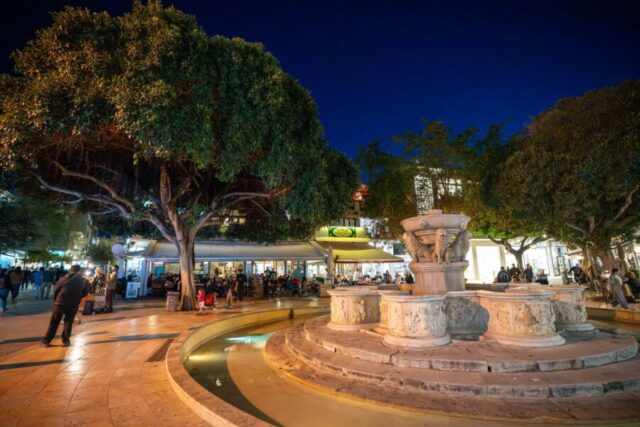
I was sitting on the lovely and lively Lions Square in Heraklion, the capital of Crete, with my new local friend Elpida. She had found us a prime seat at a pastry café (cleverly called PhylloSophies — a rare pun that works in two languages) and ordered us a bougatsa. This beloved pastry, with filling delicately sandwiched between paper-thin, crispy sheets of phyllo dough, comes in two types: sweet (with semolina cream) and tangy (with local mizithra cheese). Both are generously dusted with cinnamon and sugar. And Elpida had thoughtfully ordered both to sample.
Thoroughly enjoying this fine view, snack, and wonderful company, I found myself liking Heraklion for the first time.
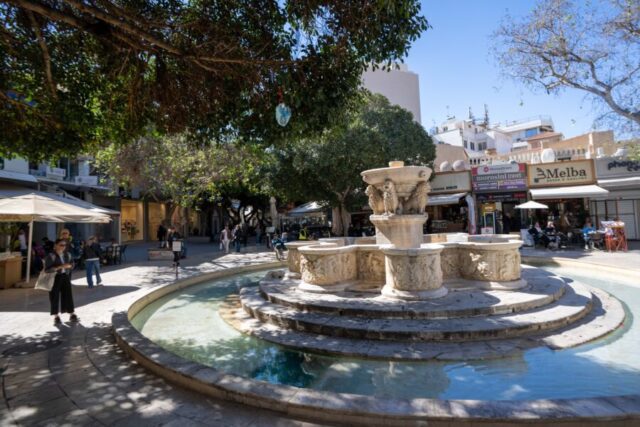
I was here very briefly about 15 years ago (on a cruise) and found the city center congested, chaotic, conventionally quite “ugly” — as unappealing as its archaeological museum is spectacular.
On my current visit, I had already been in Heraklion for 36 hours; in fact, this was my final evening before a morning flight to Athens. I arrived in the city with a chip on my shoulder, and Heraklion did little to dislodge it. While I was again wowed by the museum, and I’d discovered a wonderful spot for the previous night’s dinner, in most other regards I found Heraklion a case study in ramshackle six-story Greek urban blight… quite gritty and far from romantic. (It didn’t help that I had just come from a few days in gorgeous Chania and charming Rethymno, both much smaller Cretan coastal towns with intact historic quarters evoking the Venetian gentility of this island’s complicated past.)
Elpida, with a disarming directness, leveled me with her gaze: “Heraklion does have its problems. Believe me, I know it has its problems. I see them too. But this city also has a fascinating history and some wonderful places and people. Let me show you.”
I was taken aback. I had, of course, been extremely careful not to say anything unkind about her shambolic home city. But I didn’t have to say a word. Elpida is smart. She knows what most visitors think when they come here: “Ugh. When’s the next boat/bus/flight out?”
In our age of effortless jetsetting, it’s easy to forget what a privilege it is to visit a place — any place. And the more you travel, the more you run the risk of growing jaded, cynical, picky, even offhandedly cruel when it comes to a destination that doesn’t pass your personal sniff test.
But Elpida’s protectiveness of Heraklion made me realize that even in the most seemingly “unpleasant” place is also a place that many people call home and have plenty of reasons to love, imperfect though it may be.
And it reminded me of a moment from earlier on this same trip, when I was comparing notes about favorite beyond-the-mainstream travels with an American expat friend of mine in Berlin. We began to one-up each other with more and more seemingly miserable places we’d each fallen for. (“If you thought Baku was a pit, you should see Prishtinë! But wait — have you been to Belgrade?”) At one point, he said to me, laughing, “What can I say? I really like sh*tholes!”
That shocking word, so easy to toss around, in this case came with great affection. Seasoned travelers learn that the cities whose obscurity, quirks, and ruggedness keep away the hordes of casual tourists are, in their own way, deeply rewarding. In fact, those very features, when viewed from a different vantage point, become some of its best assets — especially with help from a local.
I thought of some other initially “unlovable” cities that I eventually came to see through new eyes:
On my early visits to the Slovak capital, Bratislava, in the early 2000s, I struggled to find much to like about the place. But Martin Sloboda had a vision for the city’s place in the past, present, and future of Central Europe — and over years of persistent visits, I’ve gained an affinity for it. (In this case, it helps that the city itself has improved dramatically.)
Bucharest used to leave me cold. But walking through the hulking Romanian capital with guide Ana Adamoae made it personal and human.
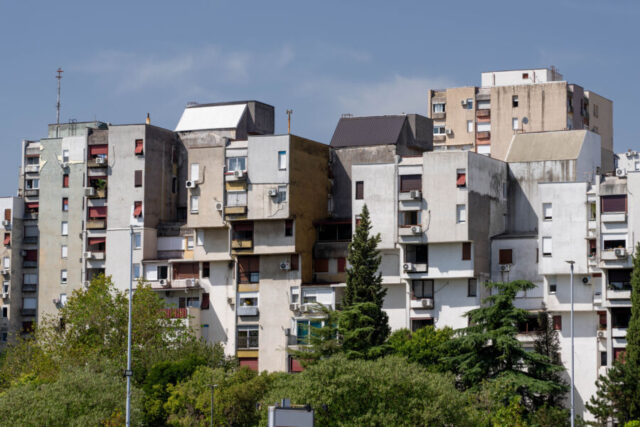
Montenegro is famed for its dramatic mountains and glittering coastline; it took until my tenth or twelfth visit to finally get to its often-derided capital, Podgorica. My local guide Rajan acknowledged that his hometown has a reputation as Europe’s ugliest capital. But then he achieved the improbable: With a short and insightful walk through town, he provided me with the context I needed to understand the city’s story on its own terms. By the end of the walk, Rajan and I were conspiring about how to get more travelers to give Podgorica a chance.
That said, I’ll admit that I’ve often been guilty of thoughtlessly dismissing unlovable places. Just like it’s fun to read a movie critic really tear into a film that they hated, hated, hated, there’s also a special schadenfreude as a travel writer in teeing off about that place that let you down. But the more I mature as a traveler, the more I realize that a place isn’t just a punchline — it’s someone’s home.
And sometimes I get a taste of my own medicine: Earlier on this trip, I was chatting with a fellow American (another expat Berliner) who offhandedly insulted Ohio as a stand-in for bland, generic Middle America. (In fact, in Gen Z slang, “Ohio” means “weird and cringeworthy.”) While I didn’t take this personally, I did get a smidge defensive… because I’m very proud that I grew up in Ohio. The Buckeye State isn’t perfect. (What place is?) But there’s a lot to love about it, including a large percentage of the best human beings I’ve ever known.
Every place deserves a chance. You don’t have to personally like everywhere you go. Every traveler has their “favorites” and “least favorites,” and that’s OK. But you should try to respect any place. Even unlovable cities like Heraklion.
Still… Elpida had her work cut out for her.
§ § §
Appreciating an “unlovable” city starts with understanding what makes it that way. Elpida explained that Heraklion has been utterly leveled at least three times in its long history: First, when the Ottomans laid siege to Venetian-held Crete, Heraklion was the final, lone holdout; after 21 bruising years, the Venetians finally gave up, took their archives and relics, and scrammed back up the Adriatic in 1669. Then, after the Ottomans had rebuilt the city, a devastating 1856 earthquake flattened it all again. (“Locals say only 18 buildings remained standing,” Elpida said, and in fact, two other locals had already told me this exact figure.) And finally, Heraklion again played hero in 1941 as it fended off a massive Nazi paratrooper attack in the Battle of Crete, which again obliterated the city.
If modern Heraklion seems a bit “meh,” this triple-whammy — siege, quake, Nazis — explains why. History punishes heroics, and fluke natural disasters cut many great civilizations short. On my first visit to Warsaw (another unlovable city), my Polish friend said to me — apologetically — “Warsaw is ugly because its history is so beautiful.” This sentiment could easily apply to Heraklion, too.
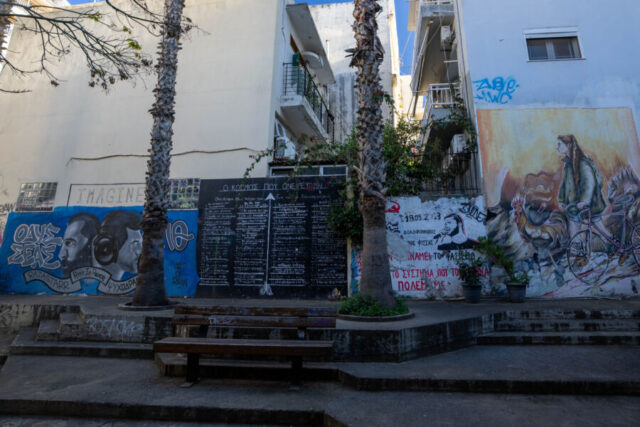
After we polished off our bougatsa, Elpida led me on a walk past the city’s scant few great monuments. Every single one dates from that 465 years of Venetian rule, though all of them have been further shaped by the many twists and turns of history. For example, St. Mark’s Basilica was turned into a mosque (you can still see the stubby base of its minaret), and now it’s the municipal art gallery.
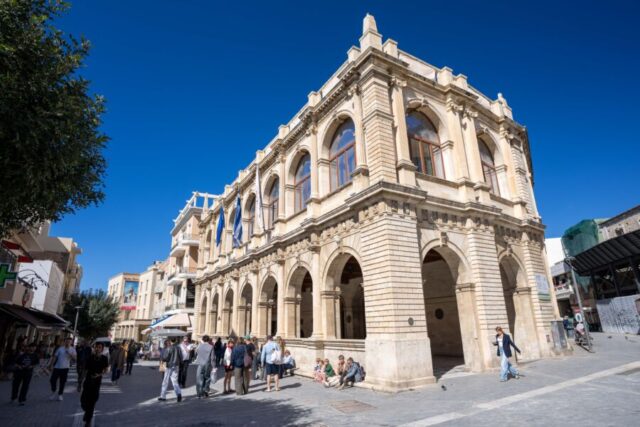
The finest building in town, by a wide margin, is a pristine reconstruction of the (destroyed) Venetian assembly building — re-created using archives from Venice itself — now the city hall.
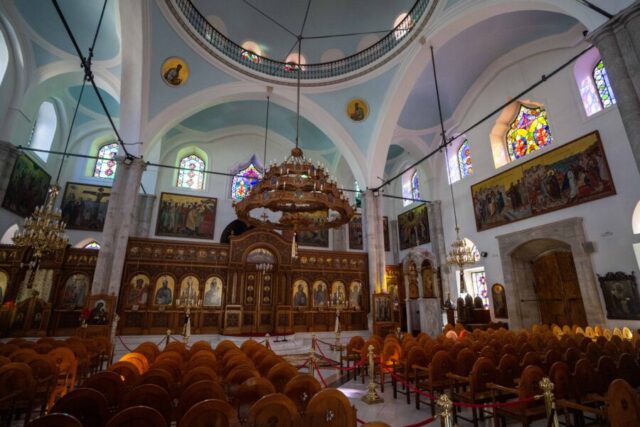
And just down the main drag, we came upon the oddly shaped Orthodox Church of St. Titus, which looks like a box with a very shallow silver dome. “Of course,” Elpida said, “you can see this was not built as a church; it has a classic mosque structure. It was destroyed in that terrible earthquake, and the pasha ordered it rebuilt from scratch.” Stepping into the incense-heavy interior, with its wood-carved iconostasis and chandelier, its present church-ness offers no hint at its previous mosque-ness.
Back out on the street, we saw the Gulf of Heraklion glittering at the end of the wide pedestrian street. While the port here is called the “Venetian Harbor,” that’s misleading; other than the faint brick outlines of a few arsenale buildings and a boxy fortress on the breakwater, Heraklion’s harbor feels entirely modern.
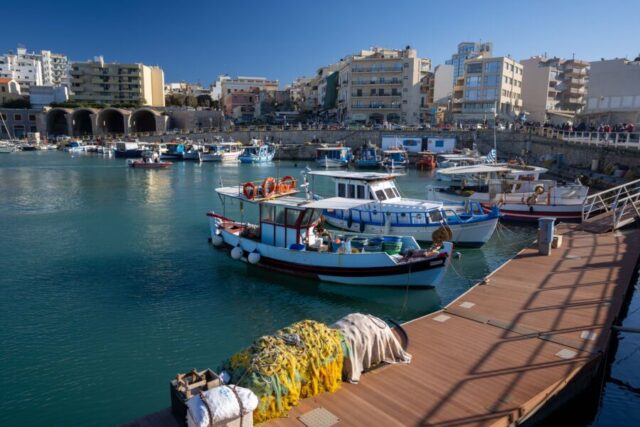
Stretching beyond that fortress is Heraklion’s very long breakwater, lined with a waterfront footpath. “Locals call this Bypass Lane,” Elpida explained.
“Ah,” I said. “Because it passes by the fortress?”
With a funny expression, Elpida said, “Hm, I never thought of that. No, it’s because cardiac doctors prescribe long walks here to their heart patients.”
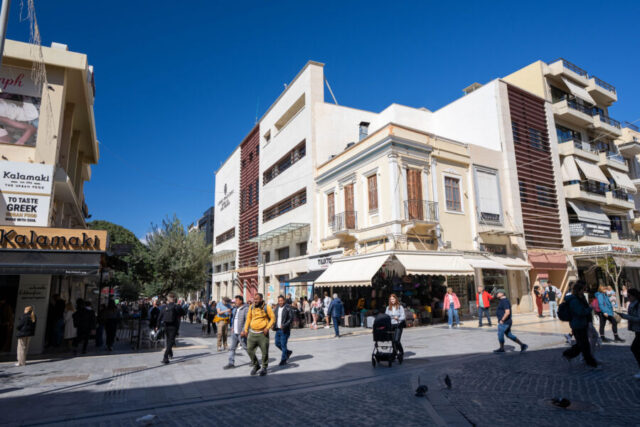
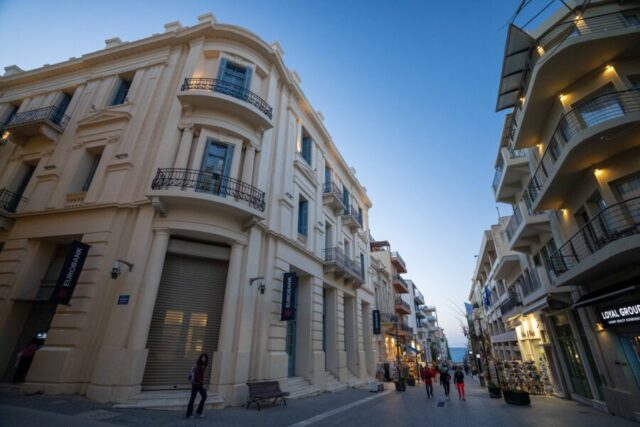
Heraklion’s main drag (“The Street of August 25th,” a nod to yet another horrifying incident from city lore) is a mishmash of fine old Neoclassical facades and some questionable modern architecture. Still, the overall impression is that it is (or, perhaps, was) the finest street in town.
This idea brought a twinkle to Elpida’s eye: “Ah, but you know what they used to call this? Planis — the Road of Illusion. It was designed to impress visitors arriving at the old port, on their way up to Lions Square. But it was all a sham, because the streets all around are a confusing maze.” Here in Heraklion, even locals — with a world-weary but realistic cynicism — understand that beauty is an illusion… a Potemkin village of lovability.
§ § §
Of course, a city is more than its architecture, and next Elpida began “the main event”: a delightful cultural scavenger hunt through the market zone just above Lions Square. She was eager to introduce me to the people who make Heraklion lovable, where buildings and urban planning fail. And she wanted to illustrate how, even in the very heart of this metropolis of a quarter-million people, Crete’s distinctive culture finds vivid and authentic expression — rooted directly in the high-altitude villages of the remote mountain interior.
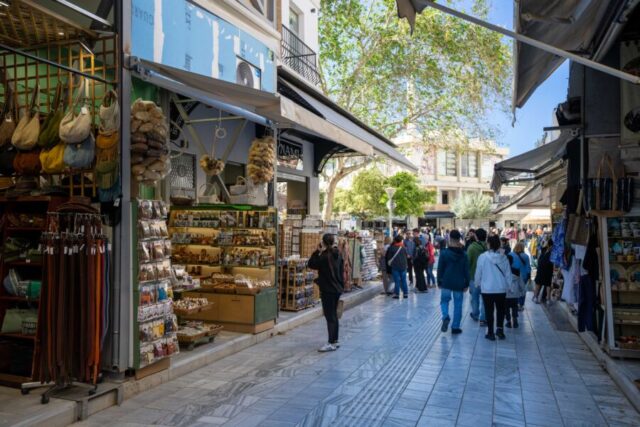
Walking to an olive-oil shop, she explained: “This island has more than 30 million olive trees, many of them centuries old. Virtually every family owns a small grove here and there. From November through about January, we harvest our olives and take them to a communal press. We get enough for our family’s own use for the whole year, and if there’s a surplus, we sell it back to the cooperative to bottle and sell.”
Inside the Grelia shop, we were warmly greeted by Renata, who began a well-practiced monologue extolling the virtues of Cretan olive oil — which, thanks to its high levels of polyphenols, many Cretans take as a supplement, like cod liver oil or a multivitamin. Renata explained that the different types of oils mostly come from the same koroneiki olives; the difference is how early or late they’re harvested.
“You have heard of the Blue Zone,” Renata said hopefully, more as a statement than a question.
“Ummm, I don’t think so.” Renata was momentarily, uncharacteristically speechless, and she and Elpida shot each other a look as if I just admitted I’d never heard of the Beatles.
“It’s a band of societies around the world where people live a very long time because of healthy diet,” Renata began, and I realized I had heard of this concept… just not the term. It was a reminder that things that are simply common sense in one place can be a piece of remote trivia in another. It’s understandable that Renata was proud of Crete’s status as part of the Blue Zone, where people live well into their 80s, 90s, even 100s.
Elpida and I continued along the market to a sweet shop called Pediaditakis. From the tiny entrance, a sprawling Willy Wonka world opened up, with bin after bin of candies and other sweets available in bulk. Elpida began to explain the significance of each candy — for example, the white sugar-covered almonds called koufeta, handed out at weddings, baptisms, and other celebrations.
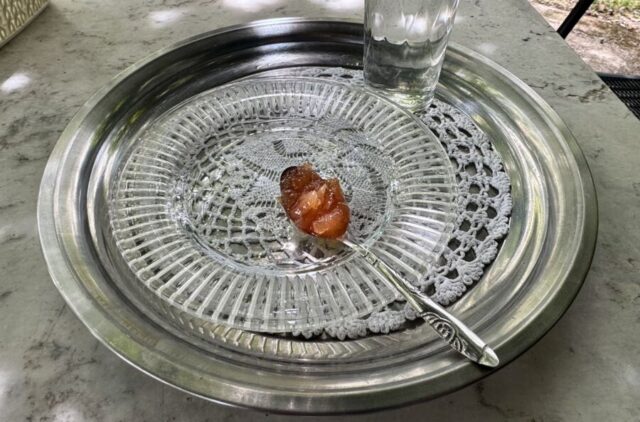
We paused at a large display of candied fruits in syrup. “These are spoon sweets. Very important. You know, we Greeks have a culture of hospitality. When someone comes for a visit, you must greet them with a sweet. We pick fruit in the fall and preserve it in sugar. That way, we always have something special for an unexpected guest.” She winked: “It goes very well with raki.” Sure enough, a few days later at the opposite end of Greece, I paid a visit to a farm… and was greeted with a simple spoonful of candied quince on a tray.
Passing a fragrant coffee roaster, Elpida explained: “You never serve coffee at a wedding.”
“Why not?”
“Because coffee is only for funerals. Same with fish. Only for funerals, not weddings.”
Probing the “why” of it all, I quickly understood the answer. As so with many traditions: just… because.
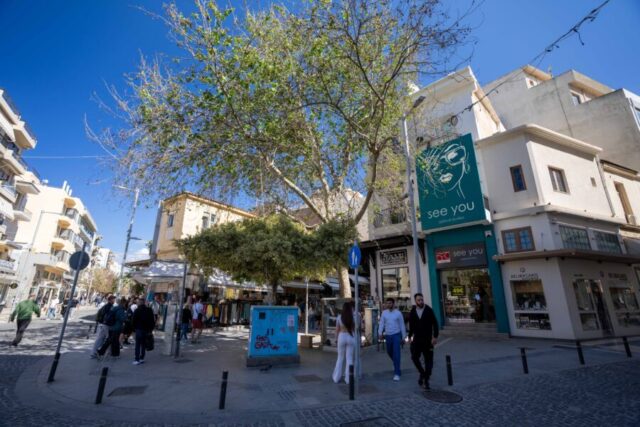
Next, we stopped a shop selling miniature deep-fried savory pies filled with Cretan greens and cheeses. She explained, “I remember my Grandma, on the farm, would prepare these and stick them in the pockets of her petticoat so she’d always have a snack while away from home. And these traditions, they continue until today: I often pack some of these very pies for my daughters when they go to school.”
Then Elpida explained the importance of herbs in Cretan cooking and culture. In this mountainous land, with its many microclimates and unique patches of terrain, locals have mastered the use of each and every plant that springs from the earth.
To prove her point, we stopped by Vassiliki’s herb shop (votanopoleio). He greeted us with a big smile and a pot of herbal tea, offering us a sample. Vassiliki showed us a black-and-white photograph of his grandmother, who taught him everything he knows and still forages herbs for his shop.
But Vassiliki has leveraged this centuries-old practice with modern entrepreneurship, stocking packets of teas, infusions, and tinctures that are neatly labeled in English with what they’re good for, from diabetes to constipation to insomnia. One herb was called malotira — literally “evil goes out.” Another, dictamus, is instinctively sought out by animals with an upset tummy. Another was a mix of forty different healthy herbs.
“Forty is a very symbolic number,” Elpida explained. “Lent has forty days. Forty days after a baby is born, it’s ready to interact with people outside the immediate family. And a memorial service takes place forty days after someone’s death.”
Next up: Maria’s honey shop, Melopolis. Like olive oil, honey is a Greek staple dating back to the ancients. And like olive oil, it comes in countless varieties. Beekeepers take their hives to different vegetation in order to infuse their honey with completely different flavor profiles. I sampled thyme (the gold standard for all-around-delicious honey), orange blossom, and even the bark of fir trees, each with its own distinct texture and flavor.
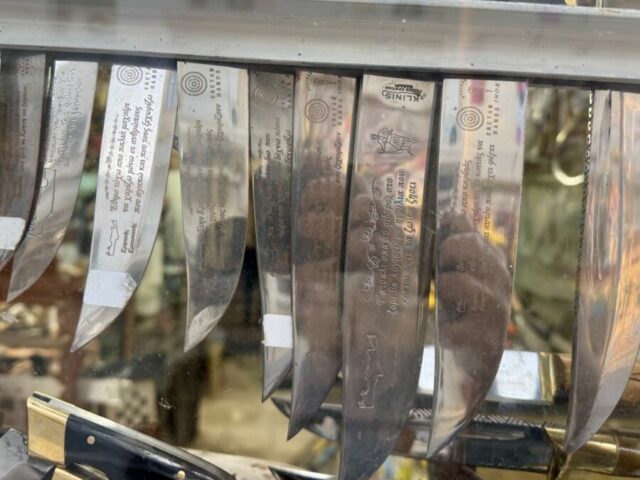
The evening went on like this. Each shop and each vendor, no matter how mundane, came with deep insights into Greek and Cretan culture. Jewelers abound, because jewelry is such a popular gift for special occasions — especially between new in-laws at a wedding. Produce stands featured wads of local greens called stamnagathi, an ever-present side dish on Cretan menus. Cretan knives are renowned; many have blades inscribed with a unique form of four-verse, fifteen-syllable poem (called mantinada, sort of the Cretan answer to a haiku) exploring themes of love, loss, and honor.
One thing Elpida never had to explain was the subtext of her tour: Yes, by outward appearances Heraklion is a rough place. But it’s populated by wonderful people — many of whom grew up all over the island, and for various reasons wound up here in this congested urban maze. And each one brings their own threads to the tapestry of the city.
And another thing happened: The sun had begun to set, the sky was light and soft, and the people of Heraklion were all out enjoying their hometown. Like Elpida, they know this place isn’t a conventional beauty. But its true majesty is that it’s a fine space, shaped by a hard history, that they all share together.
Circling back to Lions Square to say our goodbyes, we came across a street performer enacting an elaborate puppet show with Cretan folk characters. Everyone present — from toddlers to those Blue Zone octogenarians and nonagenarians — laughed and clapped and cheered and sang along.
I came away from this magical experience feeling something surprising about Heraklion: Suddenly, I was smitten with one of Greece’s most unlovable cities.
§ § §
At the evening’s end, Elpida asked me point-blank for my candid impression of Heraklion. And, honestly, I was impressed. But I knew that was largely because I had her help. And it’s a fine needle to thread for a travel writer: Part of my job is sifting through options and giving frank guidance about the relative worthiness of a place.
I told her what I’d advise a Crete-bound traveler: If you’re limited on time, you’re better off focusing your trip on Chania or Rethymno, where you’ll find much more of the Old World charm and conventional beauty than in Heraklion. This city is ideal as a brief stopoff — for its museum, nearby Knossos Palace, and yes, for an eye-opening walk through the chaotic center — but not necessarily a place to linger.
That said, thanks to Elpida, Heraklion had jumped up several notches in both my personal estimation and my professional opinion. Travelers often say that they want an “authentic” look at local life. But then they choose to go somewhere that’s heavily skewed toward pleasing tourists. If you really want a look at “the real Crete,” and if you enjoy gritty and fascinating cities as I do, Heraklion deserves a chance. (And you should definitely hire Elpida for a personal tour: email her at elpida.syngelaki@gmail.com, or WhatsApp her at +30 69727 20645.)
In the end, Elpida reminded me of one of the first rules of a seasoned traveler: The more you know about a place — any place — the more you like it. I used to dismiss places I didn’t like without guilt. But these days, while I still try to give clear-eyed advice for travelers, it has become harder to simply say: “Skip it.” While there’s a reality that people have limited time and money, the more I travel, the more I realize that no place is truly “skippable” (a favorite word in our guidebooks)… if you have the benefit of a local friend like Elpida to show you around.
Whether it’s Heraklion, Podgorica, or Ohio, every place has a proud local culture, its share of wonderful people, and a story that makes it special. As a traveler, you don’t have to like the results of that story. But shouldn’t you respect it — and try to understand it?
I was traveling in Crete to research an all-new chapter for the upcoming ninth edition of our Rick Steves Greece guidebook (coming in 2027). In the meantime, the current eighth edition covers the rest of Greece with this same degree of TLC, cultural insight, and hard opinions.
I’m heading out for my next trip soon, with stops in Austria, Italy, and Slovenia. If you’d like to follow along for more updates and insights like these, join me on Facebook and Instagram.
And for yet more thoughtful takes on European travel, check out my memoir, The Temporary European: Lessons and Confessions from a Professional Traveler.
Such a great lesson here, to give places a second (third/forth?) chance. I will certainly bear that in mind during our future travels!
Also, I didn’t know you were from Ohio! I grew up in Hudson, and after decades away in SoCal and NYC, I moved back here a few years ago and now own a home with my partner in Cuyahoga Falls, an Akron suburb. And we love it!
I was on a Turkey and Greece tour back in 2013 with students. To get from the west coast of Anatolia to Athens we took a cruise ship. The first stop was Heraklion. Instead of taking the tour three of us chose to just walk off the ship to explore the town. We were there fairly early in the morning, and didn’t have a lot of time, but we liked what we saw and wished we’d had more time to explore. We thought that it was quite charming!
I forgot to mention that the tour the others were on was to Knossos. They enjoyed it, but we were happy to just have a leisurely ramble through town.
Slovenia! I just came back from Lake Bohinj there, and wondered to myself:do people who live where they can see the Julian Alps every day realize how lucky they are??
Don’t miss the glass Stations of the Cross in the Cathedral of St George in Piran (they’re remarkable.)
Havala!
—djs
Thanks for such a beautifully written article. I would definitely visit Heraklion!
My travel options are limited right now, but I’m very much looking forward to attending the local Greek Festival here in San Diego that is coming soon on June 13-14. I’ve been attending the festival yearly since the mid 1990s, and you’ve added to my knowledge and appreciation of Greek culture.
Well written and informative. I agree, Heraklion (or Iraklion) is not the prettiest of the north coast cities. Your description of Chania and Rethymnon are spot on. My first visit to Iraklion (my preferred spelling because it orients one to pronounce it correctly) was in February 1969. I stayed for 21 month as a U.S. Air Force officer stationed at the Iraklion Air Station (now closed). I left but didn’t get far before returning to marry the love of my life. We were married there 55 years ago. I am familiar with the places Elpida showed you. There are other places in Iraklion that you can walk through, if you really like walking through different paths through town, some a bit “seedy” but IMHO safe, that are even more interesting. I know; I have explored the entire town all by myself — just me and my camera over the years as we return often. For example, there is a Venetian wall that surrounds the city. You can mount that wall at several points and take an elevated walk around, literally around, town.
Like Stefanie, above, I should have added, while I like Chania and Rethymnon, and the south coast, I LOVE Iraklion.
I travel solo and always set my basic itinerary from the one in each country’s Rick Steves book–but when I went to Crete last October I had to rely on the Rough Guide, Lonely Planet and last but not least–the fantastic recommendations of those who post on the Rick Steves community forums. I spent nine nights and am determined to return. This island has everything: outstanding archaeological sites; beautiful churches and monasteries; best-in-the-world beaches; fantastic museums; impressive fortresses, great food and incredibly friendly people. I have one suggestion: try hiking the Imbros Gorge instead of the Samaria Gorge. I was concerned that descending 3,000 feet in the first hour would make the next day(s) of sightseeing too painful–so I took the advice of three adventurous 80-year-old Italian women I met in Heraklion who I could tell knew their business. The Imbros Gorge is the route the Allied troops took when they had to evacuate the island after the Battle of Crete–and others I met who had hiked both gorges said they thought the scenery at Imbros was better (and takes half the time). Crete warrants more than one chapter!
The archaeological museum in Heraklion is simply fantastic. Should not be missed.
As far as Bratislava goes, I found Kosice to be more interesting.
I recognized that fountain in Heraklion immediately! My son and I wandered the city after our Knossos tour and thoroughly enjoyed it. I remember giving some euros to a girl playing an instrument at the fountain and having fantastic gyros nearby. One of the most relaxed ports on our cruise, without the crush of people of Santorini.
Thanks for this wonderful writing. We visited Crete last year and had a couple nights in Heraklion, primarily to see the museum and Knossos. If/When we get back to Crete (we loved it so much) we’ll plan on more time in Heraklion. Always appreciate the guide recommendations in the RS books, have used several and they have never let us down.
I often read your posts Cameron, and this one was your finest. I too have a passion for selecting and savoring flea-bag destinations (and hotels, but that’s another story).
As I read, I was reminded of an overnight stay I spent in Kalamata in the Peloponnese peninsula, which is almost enviable if you are busing from Olympia to Kardamyll and over to Monemasia, esp. in the off season. It seems Kalamata seems to be at the center of a spoke and wheel bus system.
It was not a pretty place, but it was a real place and had a local energy that I was forced to respect.
I understand the ouch feeling when someone dismisses Ohio. We’re from KS, and even on RS Tours, our tour mates have given an eye roll about Kansas (“There’s nothing there”). It’s ironic that we’re all traveling to widen our horizons about Europe while being close-minded about the Midwest.
Well said!
I think Crete must be a fascinating island! Cameron and others, have you read “Natural Born Heroes” by Christopher MacDougall? He writes about exercise science and history. He tells the story of the Cretan Resistance in WWII. Rural peasants decimated Nazi airborne troops, parachutes tangled in olive groves. Orthodox priests carried submachine guns in their robes. The Cretans had an endurance superpower that let them run messages a marathon distance in the mountains – and back. They – with the help of British special forces – kidnapped the German commanding General and spirited him away on a submarine. He takes a deep dive into the ancient Minoans. What secrets were passed on to the present day?