Welcome to the USA! We’re very glad that you’re here.
I’m a travel writer who’s explored Europe for over 25 years. But this summer, the USA has become the destination — and many of you are here for the first time. So, as the USA co-hosts the World Cup with our neighbors Canada and Mexico, I thought I’d turn my lens inward and offer some insights on my own country:

Americans are good people, mostly. I genuinely believe this, and my European friends often compliment American visitors on our positive attributes: We are friendly, open, and eager to connect; we are upbeat and relentlessly optimistic; we are idealistic and proud.
Each of these, of course, is a double-edged sword: We can come on too strong; we can be naive, with a capacity to disregard facts that make us uncomfortable; and our patriotism sometimes emboldens us to dangerous extremes.
Please forgive us — we are a very young nation. In fact, at the very moment we’re co-hosting the World Cup, we’re also celebrating our 250th birthday. If you’re from a culture dating back millennia, perhaps you can understand that we’re still in our overconfident adolescence.
The United States is huge — so massive, it’s hard to wrap your mind around it. From Seattle, near the USA’s northwest corner, to Miami, near its southeast corner, is a distance of 3,300 miles (5,300 kilometers). That’s several days’ drive, or six hours on a plane, or more than double the entire length of the Danube River.
As a practical matter, don’t underestimate distances here. You might notice that Americans explain journeys in terms of “hours driving” rather than distance: “L.A. is six hours from San Francisco… depending on traffic.” (And there is much traffic.)
As the saying goes: In the United States, 100 years is a long time; in Europe, 100 kilometers is a long distance.
Oh, and about those strange units of measurement: About 50 years ago, an effort to get Americans comfortable with the metric system failed spectacularly. We still cling to our archaic, arbitrary units: We measure distances in feet and miles; temperatures in Fahrenheit; weight in pounds and ounces; liquids, confusingly, also in ounces, unless we decide to use pints and gallons, or occasionally liters; and so on.
§ § §
This big country also has a big variety of landscapes and lifestyles. I live in Seattle, which is closer to Vancouver, Canada, than to any major American city. We have very long, dark, wet winters and brief, gorgeous, green summers; our city sits upon Puget Sound, flanked by two ranges of snowcapped mountains.

At the opposite end of the country, Miami is balmy and bright year-round, with broad sandy beaches, toothy alligators, and a vibrant cultural influence from Latin America, especially Cuba — which is a short sail across the Caribbean.

Most World Cup matches are being held in big, coastal cities: New York, Boston, and Philadelphia on the East Coast; Los Angeles, San Francisco, and Seattle on the West Coast. Cities like these are the economic and cultural engines of our country; in fact, four out of every ten Americans live close to the coast.
But I do hope you also make it to the middle of our country. Frankly, American culture is overfocused on its coastal cities; many who live there dismiss everything else as “flyover country.” But this in-between is where you’ll find so much of the beauty, natural wonders, and kindness that characterize the USA. (If I sound defensive, it’s because I grew up in “flyover country,” in the state of Ohio. Like many Americans, I’m a transplant — an internal immigrant.)
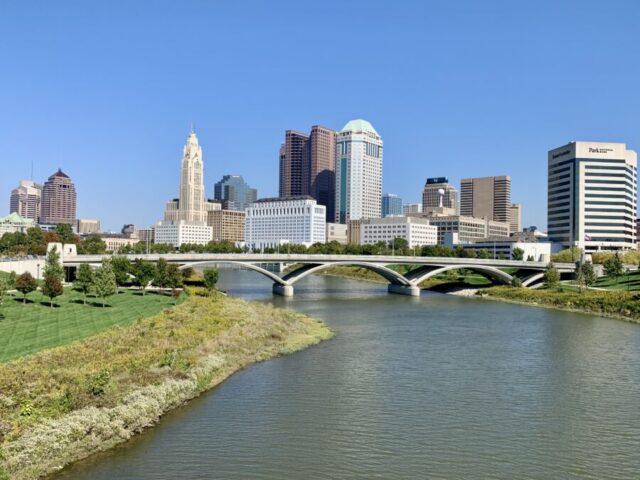
If you attend matches in the middle of the country — in Kansas City or Dallas, for example — you may notice that the local metabolism runs a little slower and with less self-importance. But the people may be among the friendliest and most welcoming you’ve met anywhere on earth.
Between all of these cities are thousand-kilometer tracts of the USA that are flat and undistinguished — endless farmland of corn and soybeans and wheat and potatoes and cotton. (This is where I grew up.) And there are also some breathtaking landscapes of soaring mountains, deep valleys, massive lakes, thick forests, wild prairies, impenetrable swamps, jagged fjords, lonesome lagoons, vast and hauntingly beautiful deserts.

Get used to American car culture: Most cities, and certainly the suburban sprawl that surrounds them, are designed for automobiles rather than pedestrians. Many of the stadiums hosting World Cup matches are on the distant outskirts of the “host city” — often in a different municipality entirely. Some are easily reachable by train or bus, but most are surrounded by parking lots with a far larger footprint than the stadium itself. (There are exceptions; in Seattle, where I live, the stadium is a short walk from the central business district, next to a major train station. But if you’re heading to a match in “Boston” or “San Francisco” or “Dallas” or “New York City”… good luck!)
Yes, the United States is a gigantic country, with significant regional differences in cuisine, politics, and accents. And yet, the American monoculture is strikingly dominant from sea to sea. When I’m in Europe, I’m struck by how people in one mountain valley can have entirely different dialects, cuisines, and customs from the next mountain valley. Meanwhile, an American from Bend, Oregon, or Barstow, California, still finds things far more familiar than different thousands of kilometers away, in Bangor, Maine, or Birmingham, Alabama. In the USA, we are 340 million people who speak the same language, watch the same TV shows, shop at the same stores, and eat at the same restaurants.
§ § §
But you’re here mainly for the football! A few pointers on American sports culture:
First, you likely already know that we insist on calling football “soccer,” except for a few in-the-know American fanatics. What we call “football” is, by a huge margin, the most popular sport in the USA: a homegrown invention in which gigantic men viciously collide with each other at top speed, take a short rest, then do it again and again, often resulting in grievous injury. It is essentially a simulation of medieval warfare with real human stakes. Inexplicably, moments where a foot touches a ball are exceedingly rare — it happens maybe 12 or 15 times during a three-hour match, almost always as an afterthought to the primary action. Also inexplicably, this bizarre and brutal sport can be magnificent, if you give it a chance. In short, it is supremely American.
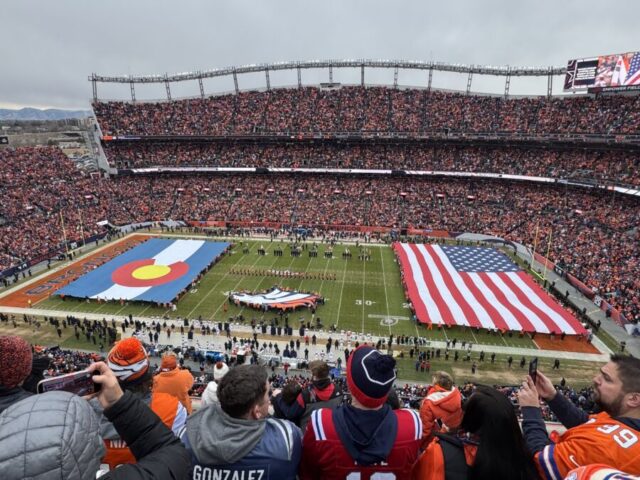
The other leading sports here are baseball (another American invention, which makes even less sense to outsiders, and is even more beautiful); basketball (invented by a Canadian — but please don’t mention this fact to American sports fans); and hockey (also invented by Canadians).
Football — or “soccer” — ranks a distant fifth, even though it’s the top sport for virtually the entire rest of the planet. Most Americans’ interactions with The Beautiful Game begin and end in childhood, when many of us play it recreationally. But then, for reasons I’ve never understood, upon entering adulthood we leave it behind, like teddy bears and Legos. Over the last decade or two, “soccer” fandom has increased markedly but still lags far behind the others.
Our stadiums, and our country itself, are not the only things that are big. Everything here is big. The cars are big. The streets are big. The houses are big. The stores are big — so big, it’s easy to get completely lost if you pop into a Wal-Mart or a Target looking for a particular item. (Leave some breadcrumbs to help you retrace the route to the entrance.) And don’t get me started on Costco.
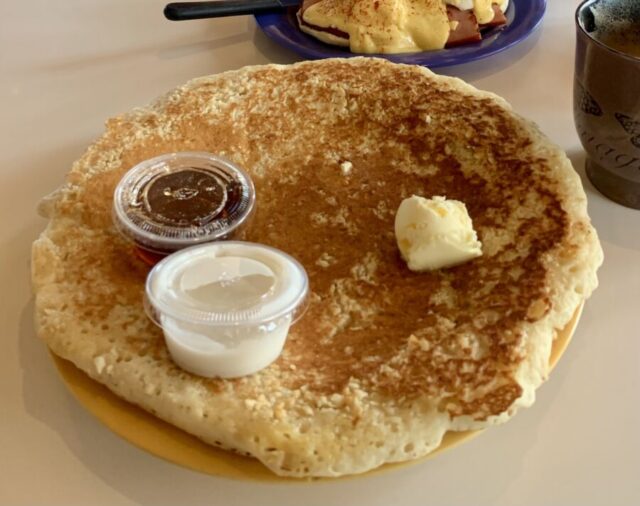
These things are big in the cities, and bigger in the suburbs, and even bigger still the farther you roam from the population centers. A German who toured the USA on his bicycle once explained to me his theory that pancakes get thicker the farther you are from a major city.
(Pancakes with butter and maple syrup is a must-try American breakfast, composed entirely of carbohydrates, sugar, and saturated fats.)
§ § §
Another thing that’s big is the American ego. We are very proud of the role that we played in 20th-century world affairs — buoyed by the idea (however oversimplified) that we rescued humanity from evil on three separate occasions: World War I, World War II, and the Cold War.
But more than 80 years have passed since D-Day, and more than 30 years since the fall of the Berlin Wall. And, as we approach our 250th birthday, we’re having something of an identity crisis.
Americans are extremely divided. We can look at a single issue — whether it’s an immigrant working hard to make a living, a homeless person sleeping on the sidewalk, or the color of a reflecting pool — and react with entirely different opinions, emotions, even realities. For example, some believe that travel (and football) should just be fun, period, with no politics; others believe that travel is a political act… including when you’re the destination.
And when we are confronted with opposing viewpoints, we’ve lost the ability to respectfully say, simply, “I disagree with you.” Rather, we lash out with extreme insults, calling each other “deranged” or “problematic.”
This will be an interesting puzzle for you to sort out: We Americans are so darned friendly, and I truly believe we’re fundamentally good people. We’re kind and welcoming and fun-loving. You’re already experiencing how much we enjoy having you here, drinking all our beer and teaching us your cheers. And yet, we have so much deep anger toward one another.
One clue may be our complicated origin story — or, more accurately, origin stories. Remember: Unlike many of the places you come from, the USA is a nation of (mostly) immigrants, made up of people from a wide variety of backgrounds, all mixed up together into one big melting pot (or, as some prefer to describe it, tossed salad). This is why the USA’s official national motto is E pluribus unum: “Out of many, one.” But these days, we can’t even seem to agree on the definition of “many,” much less “one.”
Speaking of D-Day: On a recent visit to Berchtesgaden, Germany, a local tour guide told me that he once guided an American GI who was part of Easy Company (of the 101st Airborne). He had landed on Normandy Beach, fought and suffered his way through France and Belgium and Germany, and was among the Allied forces that liberated Hitler’s alpine stronghold at the end of the war. The guide took this veteran up to Hitler’s Eagle’s Nest, where they stood in front of an elaborate marble fireplace that had been chipped away after the war by souvenir-seeking American troops. The veteran was sheepish, explaining that they’d been told that the Eagle’s Nest was slated to be destroyed — otherwise they’d never have defaced the fireplace. And then he reached into his pocket and pulled out a hunk of marble he’d saved for all those decades. He’d brought it all the way back to Berchtesgaden so he could offer to return it.

This is the USA that we Americans like to think that we are — the reason for that big ego and big patriotism: noble, heroic, sacrificing ourselves for the greater good, unscrupulously principled. I think most of us still believe in those things, even if we don’t always exhibit them… especially to one another.
But maybe this World Cup, playing host to our fellow members of the family of nations, can help nudge us back on track. There’s still time… we’re just 250 years young. Progress can be slow. And remember: In the USA, 100 years is a long time.
So, while you’re here, do your best to be patient with us. We’re going through a lot. But we love sports, we love to talk, we love to learn about where you’re from, and (mostly) we love to tell you all about the USA. Feel free to ask us whatever you like. And if things get uncomfortable, just change the subject: Try asking about our favorite American football team.
I say again: Welcome to the United States of America! This is a very strange place, but a wonderful one, if you give us a chance and try to appreciate us on our own terms. Have fun cheering your national squad to victory in our stadiums. Make a point to connect with the American people. Don’t underestimate the distance (and the traffic) from place to place. Try to visit a national park or two, while you’re here. And be sure to have some pancakes.
Welcome to the U.S.. If there is anything that you like take it back with you. Been to Europe a few times and always ignored their misconceptions of the people in the U.S. Now you can see for yourselves one way or the other. There is much to enjoy.
What? No love for Atlanta? And we actually have a huge futbol fan base here…
Agree! Futbol is alive and well in the A-T-L!
Great essay!
I hope it gets into every newspaper, magazine, social media site and more.
And thank you for being such a valuable member of Rick’s team.
Happy Travels,
Ricknick #1 / Tampa Twin
Thank you for your heartwarming and hopeful words and for sharing your love of people, places, adventures, and decency.
Ditto ot Jeff Boatright . .no mention of Atlanta?
I love this essay, so eloquently written with humor, honesty and hope! Thank you ☺️
This letter should be translated in many languages for those visitors who are not fluent in English.
Thank you, Steve for writing it.
His name is Cameron.
Fabuous essay!
What about our latest states added to the Union January and August 1959? Yes, the contiguous states are spread across a huge land mass. That is remarkable in and of itself.
However, if you consider the distance from the northern most point of Alaska to Miami or a point on the northwestern shore of Kauai, Hawaiian Island main chain, the travel (by air only unless you decide to drive once you arrive on the west coast of the USA continent) you will travel nearly 16 hours from Alaska and over 12 hours from Kauai. Alaska is greater than 663 thousand square miles. Individually each Hawaiian island is relatively small. BUT, the entire island chain is about 1,500 miles distance between east to northwestern points.
Perhaps visitors from other countries can only imagine a combined land mass of this size and wonder how one Government could oversee and protect such a diverse set of people, natural resources, commerce, and, in general, regional needs. “United States” says a lot about this country’s vision.
Loved this article! It’s been heartwarming to see visitors enjoy some of the American experience during World Cup, while they cheer on their home teams.
Cameron, as many have said “amazing article balanced with humor and love!” However my all time favorite article that you have written is the one on “ “An Ode to the Cats of Greece!” Of anyone I will always read your works from beginning to end! Thank you for the joy you bring from the tip of your pen!
Great Open On better to our visitors. Makes us who live here think again on what is important, appreciating all we have and sharing with others. Thank you.
Excellent blog for our foreign visitors to the USA. Your writing style is engaging, warm and funny. You know how to be fair and principled. Thanks for a great read.
Wonderful timely essay! Thank you for being you, Rick!
Sound advice, Cameron!
Well said. Thank you.
Houston is one of the hosts of this World Cup. It isin the south and on the GULF COAST. It is also a huge pot of many cultures and their foods. Be sure to visit Houston, a different side pf Texas.
I pen this after the smashing success of the World Cup coming to America. Reflected on our TV screens, social media posts, etc. – was a feeling of pure joy as politics took a much needed vacation. You echoed Peggy Noonan’s wonderful article about how our guests were able to move beyond the coasts and headed into the Heartland, to discover a different America. So, I’m at a loss why you would use this open letter to focus, at times, on the negative. “Be patient with us…”. “…and yet we have so much deep anger towards each other”. Thankfully, our visitors choose instead to embrace our hospitality, our openness, our fast food, and well, us. Lets stop the self-flagelation, and instead celebrate that we just had fun.
Not a word wasted. Thank you, Cameron, for sharing your take on all aspects of our country.
Great essay. It made me feel better. Americans should read it too. Thank you.
This is a thoughtful reminder that visiting the United States during the World Cup is about understanding the country as much as enjoying the matches. Last time I traveled for World Cup games, I used Pro Ride Luxury Limousine while getting around the city. Planning for long travel distances and local customs can make the experience much more enjoyable.
I was surprised to learn how many World Cup stadiums end up on the outskirts with massive parking lots – it really highlights how car‑centric the U. S.
https://lastlicense.com/resources/hosting-license-governance-checklist