Just below the old town center of Kyiv, where golden onion domes shimmer in the sun, a leafy park blankets a natural shelf overlooking the Dnieper River. Wandering these wooded slopes, at one particularly dramatic spot, you emerge from a tree-lined path and come upon a gigantic metallic arch.
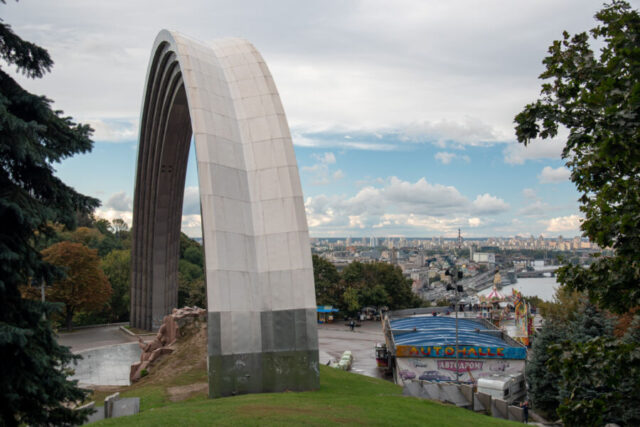
This is the People’s Friendship Arch, a gift from Moscow to the people of Ukraine. It was erected in 1982 to celebrate the 1,500th anniversary of the founding of Kyiv — and also, more importantly for its donors, the 60th anniversary of the USSR. The arch is a perfect half-circle that, if it completed itself underground, would have a diameter of more than 160 feet. It’s wrapped in a silver cladding that glints and glitters on sunny days, like the St. Louis Gateway Arch.
After Ukraine became independent from the USSR, just nine years after it went up, the arch was nearly taken down. Inter-soviet “friendship” was out of vogue. But ultimately it remained — one of those persistent landmarks that people grow so accustomed to that it becomes unmoored from its origins. Occasionally, controversy bubbles up anew — as in 2017, when, for the Eurovision Song Contest, the arch was painted as a rainbow to celebrate diversity; or, a year later, when a giant, jagged crack was affixed to the highest span of the arch, as a protest on behalf of political prisoners being held by Russia. But through it all, the arch still arches.
When I visited Kyiv — wandering these lovely hillsides on a sunny evening in early October — what captured my attention wasn’t the arch itself, but the bronze statue that stood directly underneath it. The statue depicts two workers: one Russian, the other Ukrainian. They each raise one arm, together holding up the Order of Friendship of Peoples, which celebrates the fraternity among the USSR’s various ethnicities. They are united, equals in friendship.
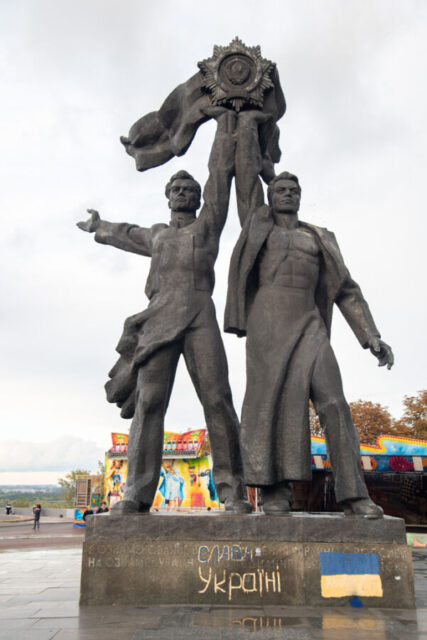
Or are they? What really struck me was how different the two workers are. It was painfully obvious which “friend” was which.
One stands firmly grounded, rooted like a mighty oak. Above his worker’s apron, his jacket hangs open to reveal the flowing musculature of a Greek god; abs and pecs stand at attention, and a sinewy neck supports a strong jaw, clenched determinedly as he looks, unwavering, to destiny.
The other “friend” stands awkwardly with his legs a half-step too far apart, as if trying — but failing — to match the balanced dynamism of his counterpart. His worker’s apron billows behind him, revealing the physique of a mousy, undernourished peasant. His trunk lacks any definition; his neck feels too skinny to support a giant head with sunken cheeks — creating a subconscious impression of malnourishment. And his right arm — the one not supporting the weight of the medallion of fraternity — is thrown backwards, in a gesture which from some angles looks enthusiastic, but from others could be a desperate flailing for help — wishing someone would rescue him.
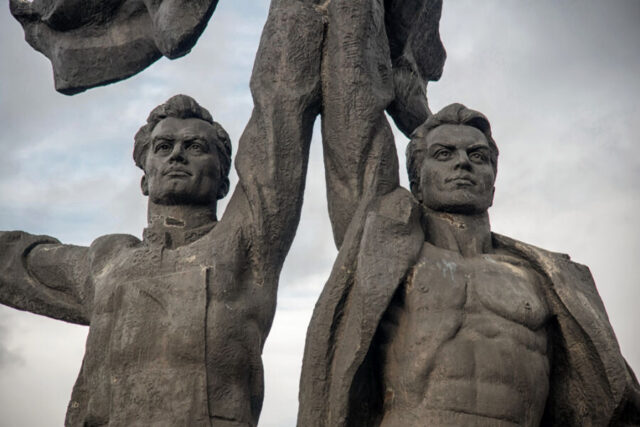
One of these friends is unmistakably the alpha in this relationship. Worse, the gaunt appearance of the Ukrainian worker brings to mind untold millions of citizens who starved to death during the great famine called Holodomor in 1932 and 1933. While this was a difficult time for the entire Soviet Union, some believe that Ukraine’s particularly heavy toll was engineered — or at least manipulated — by Josef Stalin to keep his Ukrainian subjects in their place.
So then, I take the statue as an insult. And, like many insults, it’s rooted in insecurity. After all, this statue represents Moscow’s congratulations to Kyiv on its 1,500th birthday. Back when St. Petersburg was a swamp with a log cabin and Moscow was a backwater village with mud streets, Kyiv was the thriving cradle of Slavic civilization. This “gift” went a long way toward busting Ukraine down a peg.
Extrapolating so much from a single statue is, I’ll admit, risky business. I may well be projecting some of my own baggage onto those two figures. (If you’d like to know more about the arch, from a real expert, here’s a more in-depth analysis.)
And yet…statues mean things. They’re designed to invite interpretation. That’s why they tend to become flashpoints for social change. And this statue can be read as a metaphor for how the Ukrainian-Russian relationship is fraught, unequal, and never fully satisfying for both parties.
Within the Soviet Union, the Ukrainians were second-class citizens — considered wannabe Russians who felt compelled to assimilate (for example, Brezhnev was a closet Ukrainian). Since its voluntary liberation from the USSR in 1991, Ukraine has weathered not one, but two revolutions to suppress perennially rising pro-Russia factions. And now, in 2022, here we are again — turning the page on yet another chapter.
I stood under the People’s Friendship Arch in Kyiv in 2018. For 20 years, I’d been traveling in and writing about countries just to Ukraine’s west (such as Poland, Hungary, Slovakia, and Romania). And I’ve traveled a few times to its giant neighbor to the east, Russia — each visit more fascinating, and perplexing, than the last. But Ukraine represented a giant hole on my mental map of this part of Europe.
So I went. My friend and fellow Slavophile Ben joined me for a quick spin through Ukraine in the fall of 2018. After that visit, I wrote up my experiences in Lviv (the cultural capital in the far-west of Ukraine) and in Chernobyl (the site of humanity’s worst nuclear accident). And ever since, I’ve wanted to complete my “cycle” of Ukraine, by writing about its capital, Kyiv. My little black notebook marked Ukraine has been perched there next to my computer, just waiting. But every time I crack it open and flip through it, I don’t know where to begin.
If there’s ever a time to dust off that notebook, clearly that time is now. With each news report I see about Russian troops amassed on Ukraine’s borders, I flash back on that statue of the two seeming “friends,” now deathly enemies, currently on the brink of pulling all of Europe into what could be the defining military conflict of our time.
With so much going on in the world lately, it’s been easy to miss that Ukraine has already long since been invaded — twice! — by Putin or his surrogates. Crimea, a historically Russian naval outpost that dangles off the bottom of Ukraine into the Black Sea, was “annexed” by Putin in February of 2014. Soon after, Russian separatists — militias backed by Putin — began fighting in the Donbas region, in the far-eastern fringe of Ukraine. The Donbas conflict has been going on ever since. But how many Americans have even been aware of an eight-year war, involving our most historically volatile rival, taking place on European for soil all this time? I was ignorant about it, too, before I visited. But being in Ukraine, the country was clearly on a war footing, and had been for quite some time.
Ben and I began our trip in Lviv, which is, in every sense, Ukraine’s most western city. It simply feels closer to Europe than to Russia; closing my eyes, then opening them again, I could be in Poland, or maybe even Germany. Lviv is a lovely city that deserves more tourism than it gets. But between its beautiful churches and cobbled streets, we observed how the looming threat of Russia is a constant source of anxiety and defiance.

Ukraine is a huge country — the largest fully in continental Europe, nearly as big as Texas — which helps Lviv feel very far from any conflict in the east. And yet, even here, as we walked through a peaceful, densely forested park, we suddenly heard the synchronous footfalls of combat boots approaching in the distance. Over the rise came a squad of camouflaged Ukrainian troops, jogging in formation, which swiftly approached, then passed us. We were the only people in the park who seemed at all interested in this sight; for the Ukrainians around us, it appeared to be in no way notable.
At one point, we followed a tour guide’s instructions to knock on an anonymous door and say the password: Slava Ukrayini! — “Glory to Ukraine!” The door opened and we stepped into a bar steeped in anti-Russian propaganda. One room had one of those big photo dioramas where you can stick your head through a hole to become part of the picture. By doing so, your face became the face of a Ukrainian soldier holding up the near-lifeless body of a Russian invader that you had trounced in battle.
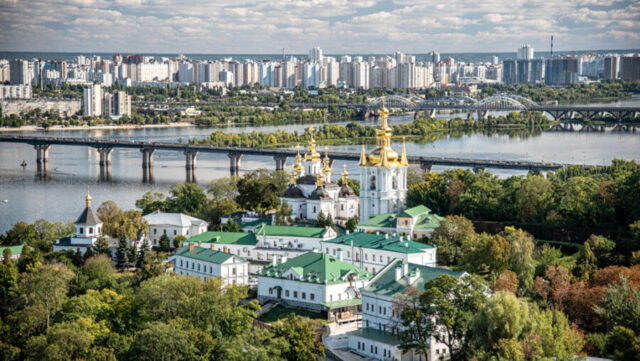
As an indication of the vast size of Ukraine, for our trip from Lviv to Kyiv — less than halfway across the country — we opted for a cheap and fast flight over the seven-hour express train. Arriving in Kyiv, we found a city that was big and intense, but also lovely and livable. Glittering golden Orthodox domes and icon-slathered church interiors, hazy with incense. Well-tended parks filled with people enjoying life. Colorful turn-of-the-century townhouses. A thriving old market hall. And, all told, a notably easygoing joie-de-vivre for the capital of a country that felt the need to stage military drills in its parks.
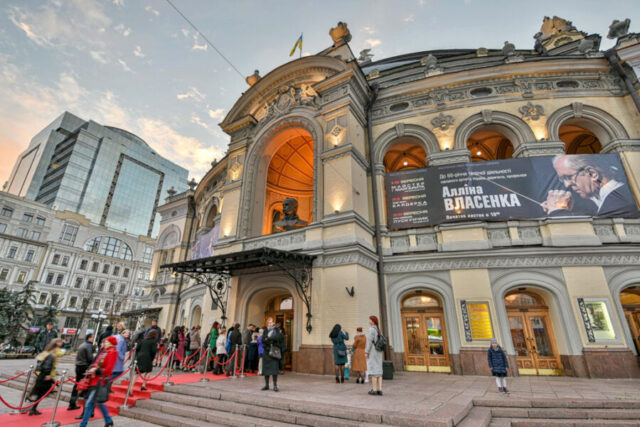
When in Kyiv, you’re drawn to the wide, boulevard-like main drag, Khreshchatyk. Walking here — even on a weekend, when it’s closed to traffic — you feel very, very small. And that was precisely the point. In 1941, Khreshchatyk was blown to smithereens by the Russian Army (with no regard for Kyiv’s architectural heritage) to make things just that much harder for the advancing Nazi war machine. After that war, the boulevard was rebuilt in a stern and stately Stalinist style that demands compliance. The locals we spoke to wanted to make sure we understood that they still resented what had been done here.
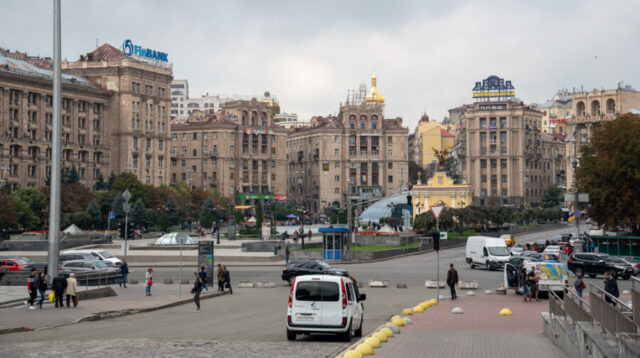
Khreshchatyk leads to the main square of Kyiv — and all of Ukraine — called Maidan Nezalezhnosti, “Independence Square,” or simply the Maidan for short. Watching the news these last few weeks, I see Ukrainians being interviewed on the Maidan and feel deja vu. The space is familiar, as are the people: Strong. Smart. With a wicked sense of humor. And unbending in the face of external pressure. They are people who have simply had enough of Russia’s BS…dating back to those insulting statue “gifts.”
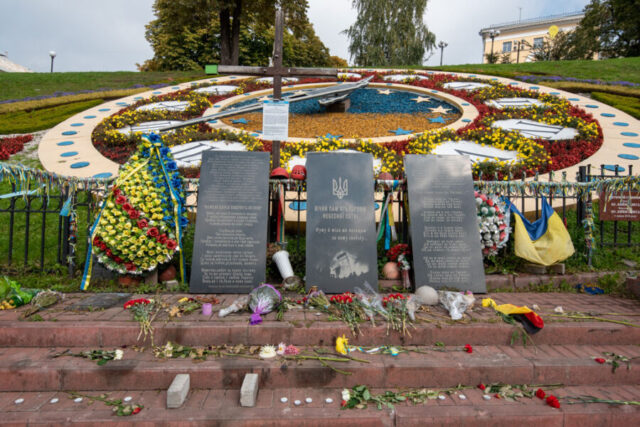
On one side of the Maidan, our local tour guide, Asya, walked us along a memorial to the people who had been killed in Ukraine’s 2014 revolution — at that point, just four years earlier. The monument seemed improvised, almost makeshift, with stacks of stones and engraved images of those who had been killed.
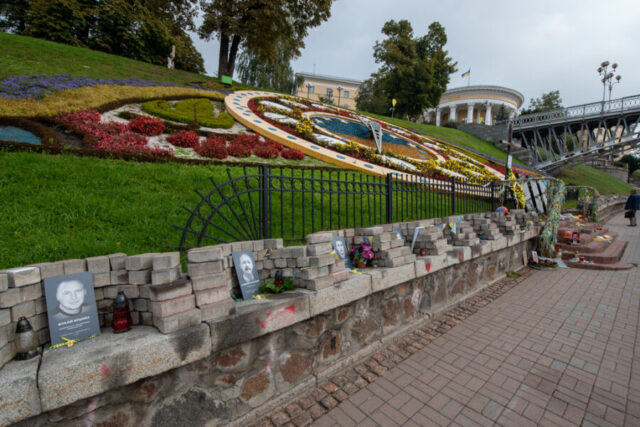
I nodded my head with appropriate sympathy as Asya spoke of the dozens of freedom fighters who had died — many of them slaughtered in these very streets by snipers from the rooftops of government buildings. She described hiding out in her apartment with her toddler daughter just a few blocks away, hearing distant explosions and gunfire, worrying for their safety and for the future of Ukraine.
But deep down, I was embarrassed. Because if I’m being honest, I didn’t know Ukraine had even had a revolution so recently.
You may be thinking (as I did): “Ukrainian revolution? Oh yes — everybody wore orange and the good guy got disfigured by some mysterious radiation poisoning.” Except…that’s not the revolution Asya was describing. That was the Orange Revolution, in 2005, which elected Viktor Yushchenko to the presidency and set Ukraine on a democratic path (and on a path divergent from Putin).
What happened in 2014 was a different revolution — the forceful ouster of a very Russia-cozy megalomaniac, Viktor Yanukovych, who refused to accept the results of the fair and free election that defeated him. (History may not repeat itself, but sometimes it rhymes.) Yanukovych was succeeded at first by a chocolate company magnate, and now by the current president, Volodymyr Zelensky, who in a previous life worked as a stand-up comedian, and who was on the other end of a fateful, coercive phone call that led to Donald Trump’s first impeachment. (Sometimes history doesn’t rhyme at all; sometimes, about history, you can only say, “You can’t make this stuff up.”)
The fact that Ukraine has had not one, but two different revolutions against Russian interference, just since the early 2000s, says plenty about how we got where we are today. It was the 2014 revolution — and the sacrifice of the freedom fighters honored by this monument — that brought about the cultural sea change that so infuriates Putin today. For perhaps the first time, Ukrainians began to take pride in a truly Ukrainian national identity. After 2014, they grew more inclined toward greater integration with the European Union and NATO — which was one of the precipitating events of the current crisis.
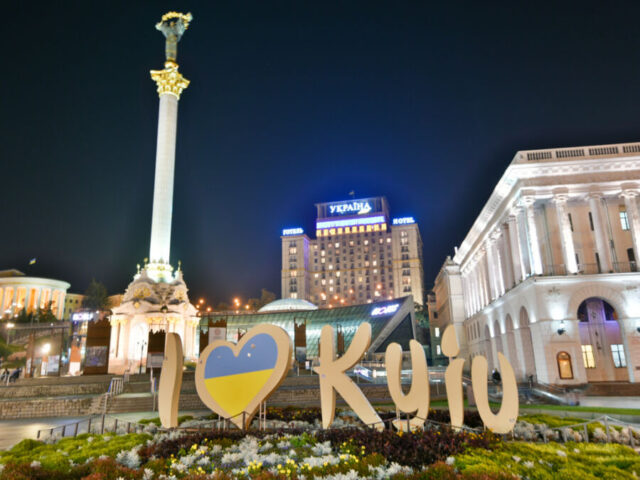
Ben (who speaks Russian) had been trying to sort out the interplay ofUkraine’s two official languages —Ukrainian and Russian — in contemporary society. Asya explained that, from the time she was growing up all the way essentially to 2014, the two languages were used in Kyiv almost interchangeably, with Russian’s slight supremacy being a natural outgrowth of its dominance before 1991. But with that watershed year of 2014 — Crimea, Donbas, and revolution — things changed. Especially here in Kyiv, and in places farther west, speaking Ukrainian became patriotic. Friends might chide each other for slipping into Russian, even if everyone understood them just fine.
For example, with this latest round of news, you may have noticed that the city we used to call “Kiev” (kee-EHV) is now being called Kyiv (“keev”). When a place’s name changes, the rest of the world tends roll their eyes in frustration at having to relearn a name they thought they’d already mastered. But calling it Kyiv rather than Kiev — in other words, the Ukrainian name rather than the Russian name — matters a great deal. It’s an acknowledgement that Ukraine’s capital has changed, growing into its own language for the first time, and that the country deserves the true independence that it aspires to.
On our last day in Kyiv, we went to see another statue, this one mind-bogglingly immense. The Motherland Monument — another “gift” from Moscow — looms 335 feet high above the southern end of the city center, eclipsing the golden domes of the Kyiv Pechersk Lavra monastery complex. To describe the Motherland Monument as “roughly the same size as the Statue of Liberty” isn’t quite right: In fact, it’s just barely taller enough (by 30 feet) so as to almost certainly have been intentional. And, as if to drive home its point, the Motherland Monument raises not one arm but both — holding a sword in one hand, and a shield with a hammer and sickle in the other. Signaling a touchdown for the righteousness of socialism.
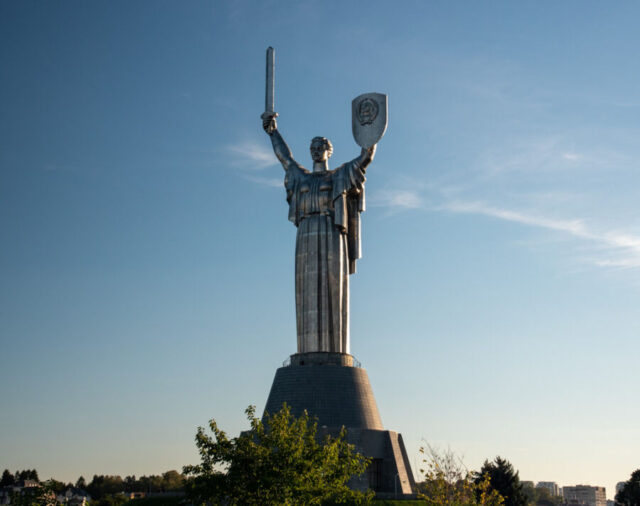
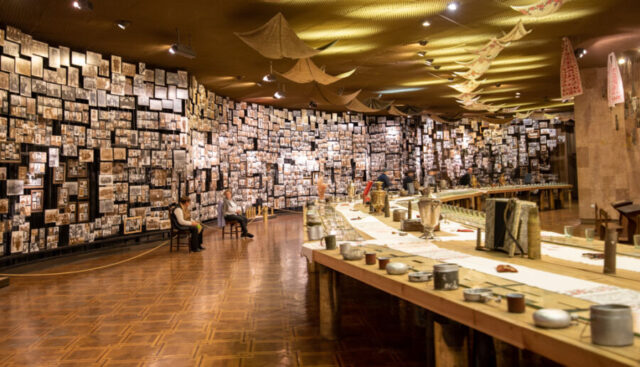
After ogling the towering statue, we made our way into the museum that fills its cavernous stone base. The museum tells the story of World War II in Ukraine. But the lobby was filled with another, even more fascinating exhibit, celebrating the Ukrainians who were fighting Russian separatist forces in the eastern Donbas region. An entire wall was strewn with literally war-torn Ukrainian flags — bringing to mind “The Star-Spangled Banner,” but in blue and yellow — all of which had flown at some point over Donbas. TV screens played gruesome footage of the fighting…confronting us two Americans, for the first time, with the war that had been wracking eastern Ukraine, without our notice, for years.

Then, we toured the original WWII museum. This was also fascinating. Most of the exhibit remains trapped in Soviet times, telling the story of what Russians call “The Great Patriotic War” with a shameless bias toward USSR mythmaking. Russians feel rightly proud for the staggering sacrifice they contributed to toppling Hitler’s army and liberating Eastern Europe from tyranny. And walking through this museum, I felt a strange respect, even excitement, for that narrative. Even if the exhibits were faded and cobwebbed — and the whole place smelled very old and vaguely industrial — it was a story deftly told. Say what you will about the Russians; their propaganda game is on point.
Then we came to the final room: the aftermath of the war. Surely the original exhibit had trumpeted the glorious new world forged by the USSR’s great victory, and the harmonious fraternity of happily socialistic states that rose from the ashes of war. But this was the one part of the exhibit that the Ukrainians had changed. The new exhibit dared to ponder the human cost of war. Casualties weren’t just collateral damage; each human life was precious. It was a dark room filled with one very long table, set with dishes representing every walk of Ukrainian life, from fine china to simple, wooden peasant plates. And on the walls were grainy, black-and-white photographs of the very Ukrainians who might have eaten from those dishes. It was genuinely touching. Viewing this from a contemporary sensibility, I was impressed by how the Ukrainians had beaten the Soviets at their own game.
Leaving the museum, I found myself putting my hand on a door handle shaped like a hammer and sickle. The door opened into the entry hall where those tattered blue-and-yellow flags bore witness to the war currently raging between Ukraine and Russia in Donbas.
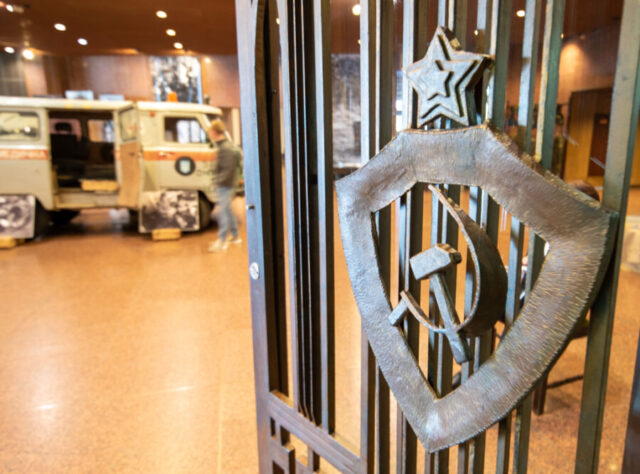
This juxtaposition stopped me cold. It said far more than an entire museum ever could about Ukraine’s struggle to reconcile the baggage of its Russian past against its wished-for future.
Here the Ukrainians were fighting a war — lacking the support, or even the awareness, of much of the world — against their powerful neighbor. Somehow they’d found the wherewithal to bring artifacts from that war back to their capital city, to display in their most important historical museum, to make sure that story was told. And yet, for whatever reason — politics, funding, apathy, exhaustion — they couldn’t find a way to remove the symbology of the enemy they are fighting, from the very building where they displayed those artifacts.
A fledgling country like Ukraine never has quite enough resources; if they’re lucky, through hard work and pluck, they can begin to make their own way. But the headwinds are fierce, and determination only gets you so far. I’ve seen this story play out, again and again, in other parts of Eastern Europe. But Ukraine‘s bid for independence feels especially tenuous. I left the museum — and the country — wondering if Ukraine will ever really be able to escape the gravity of its gigantic neighbor.
Today, I feel very fortunate to have gotten to know Ukraine in more peaceful times. Statues mean things, and seeing monuments to “Friendship” and “Motherland” in person forced me to grapple with their complicated legacy. Having talked to Ukrainians, in Ukraine, who were just trying to figure out the puzzle of going about their 21st-century lives while distracted by the ugly business of keeping their independent state independent, I watch the news with a deeper understanding, and with a special pain in my heart. I worry about whether Asya and her daughter — and so many other good, decent people — might once again be huddling in their Kyiv apartment, their world shaking with distant explosions.
In Ukraine, it seems, conflict springs eternal. And yet, based on the people I spoke to there — and their excruciatingly slow but steady progress toward defining Ukrainian nationhood — so does hope. It’s a cruel fact of history that it only takes one megalomaniac to screw everything up for a lot of good people. And yet, having been in Ukraine, I can’t shake a confidence that Putin has overplayed his hand and underestimated the spine of the Ukrainians. They may not be the scrawny “lesser partner” that Russia has always considered them.
There’s one thing that tyrants never seem to understand: Once a place gets a taste for freedom, there’s no turning back. If Putin is annoyed by Ukraine’s stubborn drive for self-determination, well, he’s the one who set it in motion eight years ago. And now, struggle as he might, Ukraine will still be Ukraine.
Epilogue (April 27, 2022): In the more than two months since I wrote this post, my worst fears have come to pass. Except that the Russian invasion of Ukraine has been even more vicious and brutal than anyone expected. The other thing that many didn’t expect: The ferocity of Ukrainians’ defense of their homeland. By standing up to Goliath, this Eastern European David has already avoided the quick conquering of Kyiv that many observers were expecting.
Today I learned that the people of Kyiv removed the statue that I described in this post. My first, and really only, response was: What took them so long?
There will come a day in the future — who knows how far off? — when travelers will return to Kyiv, as the capital of a free and peaceful Ukraine. They will have the opportunity to witness firsthand the results of Putin’s aggression. (I have visited a few other places not long after a war, and it’s one of the most poignant experiences you can have on the road.) However, there’s one thing they won’t see: a monument, under a glittering metallic arch, celebrating Russian and Ukrainian “friendship.” That chapter of history — if it ever really existed — has closed forever.
Beautifully written Cameron. Thanks for highlighting the struggle of Ukraine through your visit and the arts.
Totally agree with your comment about Cameron’s reflecting on Ukraine.
Wonderfully done
Thank you so much for enlightening me. My prayers are with you. ❤️ God bless you!
Now we can watch the news with a deeper understanding, too. Thank you for your important and necessary view inside this complex country.
This was powerful and insightful. Thank you for sharing your thoughts and historical context with us. We are praying for Ukraine.
This well-written article is thoughtful and very enlightening. I now know far more about the long association and conflict between the 2 nations.
Thank you, Cameron! Excellently written and full of both information and understanding that far too many of us lack.
Merci Cameron. Now I even understand the pronunciation change for the city! What an insightful article. I am so glad you took the time to write it and include your photos.
Very heartfelt story, Cameran! My family/relatives in Lithuania were enslaved by Communist Russia for over 50 years. But Lithuania tasted independence between WWIand WWII, and that helped them break away in 1991. Ukrainians deserve to keep their freedom too.
So appreciative for all the enlightening things we learn from the Rick Steves’ crew. Should you guys convince Ben to come back to Seattle?
Loved the article and history lesson, I hope the Ukrainian people can keep their country independent of Russia.
Very enlightening article. I certainly hope that Rick Steve cancels all tours to Russia.
Rick did cancel all 2022 tours that visit Russia earlier this week.
No wonder the city of Lviv looks not-so-Slavic — it was Lemberg and Lwów and Leopoldstadt when it was part of Poland and the Austro-Hungarian Empire and so on. The borders of Ukraine and Poland and the Germanic influences thereon have swept back and forth for millennia.
Thank you, thank you! Being engulfed in the news as we are right now, you’ve given an excellent perspective to the history and heartbreak of the situation. I applaud you!
What a wonderful article that sheds a lot of light on the issues today. Thank you so much for helping us understand.
Excellent article. Praying for All in Ukraine
Thank you.
Thank your insight. Pray for Ukraine. What else can we do at this terrible time?
Thank you for sharing so we all may be more knowledgeable.
This is an amazing essay. I hope to share with friends.
Thanks for a very informative bit of history!
Wow! Thank you Cameron for sharing your insight from your travels in the Ukraine. It is a history lesson that has helped me to better understand Ukraine’s struggle, and Putin’s unprovoked invasion. I pray your message of hope for the Ukraine people lives on.
Thank you for giving us a glimpse into the complicated relationships of countries. It will make watching the news more personal. ❤️
Thank you for sharing this very well thought out point of view. It has been informative for me. I have been in the same shadow of ignorance about their struggles. My prayers are now with the Ukrainians and hope their future finds the freedom they deserve.
Thank you so much for this very impressive history lesson. My husband and I had planned on an Eastern Europe Rick Steve’s tour in October but with all the covid issues and my husband’s concerns on what has and is going on, we decided to cancel, but I have been dreaming of visiting this area and will still do once all settles down. My heart goes out to these people and pray this will be over soon and in s humane manner
Thank you, Cameron, for your insights. Truly spot on! Would love to share this with my friends so that they may better understand.
Great informative article sharing the history of Ukraine and the attempts by Russia to steal the freedom of the Ukrainian people
Thanks for the terrific article and history lesson. My son and I visited Kyiv in the spring of 2019 on our way to Chernobyl, and happened upon a rally in Independence Square commemorating the 5 year anniversary of the revolution (which, sadly, we hadn’t been aware of). We left Ukraine feeling a bit awestruck by that country and its people, and eager to return. today is heartbreaking.
Kudos. Thanks for posting.
Thanks for sharing your insights, Cameron. We couldn’t ask for a better demonstration of the value of travel, seeing the world from other cultures perspective.
As Rick says, travel changes people, both hearts and minds.
Thank you for sharing, have become more aware of the history involved.
Thank you for sharing your knowledge of this complex part of our world with us. My heart breaks for the Ukrainian people and I pray for the madness to end. If anyone knows of a good group to donate to that will get aid to those hurting from this nightmare, please share.
While reading my interest was held buy the history you were reporting but you left me doubting the validity when it went to Trump coercing Zelensky in a phone call. Zelensky even said there was no coercion. You could have said Trump was accused of coercion that would have been more correct. You let your politics shine through but besides that it was a very touching story.
Your writing is supurb and has given us a vantage point most would never have. Your word pictures took me down cobbled street and guided me through a country of beautiful people I will be praying for with a much more feeling of attachment.
Thank you for this amazing insight!
Thank you, Cameron, for this incredible history lesson, educating those of us who know too little about this lovely country and its many conflicts and triumphs. I now have a much better appreciation for what they are facing. I, too, wondered whether Ben would be coming back stateside.
Very well done. It’s a great example of what travel can bring you. I’ve always say that once you travel to a country you never look at it the same way.
Thank you for this thoughtful and touching essay about Ukraine and it’s people and history. Beautiful! Blessings to the Ukrainian people as they struggle once more with Russian imperialism. Blessings to the Russian people who have risked their lives to stand up to Putin to oppose the war.
Thank you so much, Mr. Hewitt, for bringing Ukraine and its people to life so vividly. Your gifts of prose and keen observation affected me more than anything else I’ve read and seen about the horrifying situation in Ukraine. Thank you.
Thank you for sharing your reflection’s and history of a beautiful country. My heart goes out to the people who will have to endure the aftermath.
I had just heard of the Dombas area this weekend from a Polish friend. Now reading this really gives an understanding to Ukraine and the conflict. Thank you
Thanks for sharing what you witnessed. It’s helpful to have some history while we await the world’s response to the actions taken by Russia.
Slava Ukrayini! Well done article. We were lucky to have travelled through Croatia with Ben a few years back and loved hearing you mention him.
Слава Україні!
Героям слава!
Thank you, great insight.
Netflix has a great documentary on the 2013 protests, igniting a revolution, you can see through the Ukrainians eyes.
WINTER ON FIRE.
What an education you’ve just given me! I appreciate so much your writing, the content and yes the eloquence of your writing.
My thanks
This incredibly informative, well-written article provided me with a much-needed background of Ukraine’s history. Unfortunately, I was unaware of what, exactly, was going on in 2014, and how it continued until Putin’s madness brought it to the attention of the world by his unprovoked invasion. Your beautiful photos had me weeping; as I looked carefully at each one, I wondered if a building was still standing; if the People’s Friendship Arch has been bombed into oblivion; if the people sitting at outdoor tables, or in line outside a theater were still alive – and if so, had they fled from their beloved country, or were they sheltering in a subway, or above ground fighting with every bit of courage and determination that these people seem to have in unbelievable abundance. Watching the daily news sickens me, but I cannot not watch because I feel I must stand witness to the unmitigated horror caused by one man and, more importantly, to support the fierce resolve, patriotism, and strength of the Ukrainian people. God bless them, every one, and may they prevail in their mighty battle. Thank you so very much for sharing your knowledge and photos.
Thank you! ❤️
I’m Ukrainian, I lived in Kyiv 47 years, since my birth. I was reading your article crying and with shaking hands! So much truth in it and so much warmth! One day in December 2021, we spoke with my friend about ukrainians and about the war rumours, she said: we are not warriors, we are farmers. But now, we ARE warriors and we will win. Ukrainians have got older for many years during last two months, but we’ve got wiser for hundreds.
Thank you again!
Glory to Ukraine!
Thank you for this informative article. I learned so much about the history of the relationship between Ukraine and Russia.
We continue to say “Slava Ukrayini!”