Palermo, Sicily: Italy’s Street Food Mecca

In the midst of a chaotic market bustle, on a gritty back street of Palermo, Marco is an anchor of calm. “Now let’s begin,” he says, with a twinkle in his eye. “Do we have any volunteers?”

Marco, who runs Streaty food tours, has spotted an opportunity to get his group precipitously high on the Sicilian-street-food learning curve. Following his gaze, I spot it, too. It’s a little, wheeled cart — about two centuries old, from the looks of it — topped by a big wok, filled with mystery meat.

Being a “volunteer” on a street food tour is high-risk, high-reward. But I’m in Sicily to experience Sicily. (And to work on our new Rick Steves Sicily guidebook, helping out Rick and co-author Sarah Murdoch.) And today, it’s all about weird foods. So I raise my hand.

The vendor grabs my upraised hand, flips it over, and lays a little square of tissue paper in my palm. He proceeds to pile it with hot, gelatinous…something. It’s from an animal — presumably deep, deep inside the animal — but beyond that, I’d hate to guess. My stomach sends a few trembles down my arm to my hand, jiggling the mystery meat as the vendor spritzes it with fresh lemon juice.

And then I taste it. And…it’s not bad! It’s nice and salty, generously seasoned with pepper and bay leaf, and goosed with the zip of lemon juice. The seasoning makes it. The texture…not so much. It’s like chewing on sauteed gristle.

“This is frittula,” Marco says. “It’s basically the leftover parts of veal — cartilage, intestines, little bits of bone — all chopped up and fried together. What do you think?” The members of our group bold enough to sample it nod in agreement. The others look a little green.

A gregarious Palermitano, Marco has a knack for making this challenging city appetizing for visitors. And now that he’s lined our guts with a baby cow’s, we’re about to plunge into the street market.

“This is one of three big outdoor markets in central Palermo,” Marco explains. “It’s been here for one thousand two hundred years. And it has not really changed in all that time.”

We walk past tables piled high with the sea’s bounty: big fish, small fish, tiny fish, shellfish. Occasionally, guys circle around and fling handfuls of water from cheap plastic buckets onto the styrofoam containers.

But it’s the soundtrack that really marks this experience as Palermo. The fishmongers shout about the freshness of their wares with a singsong cadence that’s a holdover from the Arabs who turned Palermo from a  humble village into a thriving metropolis. Walking down the narrow aisles, being nudged aside by vintage Vespas, it’s a cacophony of sales pitches: “Tutta fresca! Tutta fresca! Tutta freeeeeeeesssss-caaaaa!” one of them shouts in my ear as I walk past. “Prego-prego-prego-prego-prego-prego-preeeeeeeGO!”

Marco explains that there are three ways to buy your fish: You can buy it whole, and process it yourself. You can ask the fishmonger to prep it for you, to suit the recipe you’re planning. Or, if you’re short on time, some fishmongers will shop around for you, buying all of the ingredients you need for your recipe. Just call ahead, then drop by later to pick it up. It’s sort of a low-tech, Sicilian Blue Apron.

For this reason, people prize their relationship with their fishmonger. They become extremely loyal — close friends. And if you get sick, your longtime fishmonger may even deliver to your home. Marco says, “My mamma has told me she’s going to leave me two things when she passes on: Her house. And her list of market vendors.”

We walk past a marble slab with a gigantic half-fish, lying on its side, exposing a tree-stump-sized cross-section of vivid-red flesh. “Aha! Tuna season has just begun.”

Little bunches of mint lie next to the fish. Marco explains that the mint — a fresh, young, tender spring herb — indicates that it’s the very beginning of tuna season. Later in the season, when the tuna is almost finished, they’ll put out chrysanthemums — a sign to shoppers that their time for fresh tuna is running out.

Fresh tuna is a huge deal in Sicily. “Freshness is important, because we like to eat it almost raw. You know bistecca alla fiorentina?” Marco asks, referring to the famously super-rare Tuscan T-bone. “This is like tonno alla fiorentina — sear it just 30 seconds on one side, 30 seconds on the other, and finito!”

“But it’s not just the steaks. We think of tuna as the ‘pork of the sea,’ because we use every part…except the fins. The heads are used to make fish soup. We even dry out the roe, and then sprinkle it on pasta — that’s called alla botarga.”

Next to the tuna is strung up a swordfish — its head suspended from the canopy, to make it clear what a fearsome beast the fishermen have managed to pull from the deep. Standing over the tuna and swordfish cadavers, the fishmongers sharpen their comically oversized knives with the ear-piercing sound of metal on metal…and a glimmer in their eye as if daring me to take their picture.

Greengrocers have their own top-of-their-lungs sales pitches to brag about how their produce is both incredibly fresh and, somehow, also incredibly cheap. Tectonically speaking, Sicily has one foot in Africa — and it grows tropical fruits that thrive in few other corners of Europe. Sicilians love to brag about their domestic mangoes.

And even for more conventional produce, Sicily is the garden patch of Italy. The market bursts with bright-purple eggplants, plump tomatoes, and distinctly Sicilian zucchinis, three feet long. I watch a prospective zucchini buyer pick up the vegetable and swing it around a bit, demonstrating how floppy it is. “Eh, terrible quality. I’ll pay half!”

Someone asks Marco whether vendors here are honest. His answer threads the needle delicately. “Sicilians have a…special way of interacting with each other. First of all, we don’t just speak Italian — we speak Sicilian. We learn Sicilian not in school, but in the streets. So if you talk to someone in Sicilian, they’ll give you the local price. If you talk to them in Italian, or in English, you get a special price. Maybe a euro more.” When he explains it so matter-of-factly, somehow it just makes sense.

“And there’s a kind of…what I would call ‘gamesmanship’ at the market. Not just with tourists or outsiders, but among Sicilians. Sure, sometimes maybe a vendor will try to cheat you in some way. It’s almost expected. But if you figure it out and come back to confront him, then he respects you for it. He’ll give you something free to make up for it. Even some Sicilians really don’t like this way of operating. I have relatives who won’t come to the market — it’s exhausting for them. For others, it’s fun. Kind of a game, a challenge.”

Marco points out a sign, where the 9’s have tiny little tails. “From a distance, those look like zeroes — oh, just €1.00 for a kilo! Not bad. Only when you get close do you see it’s double — €1.99.”

We reach our next snacking stop: giant deep-fried rice balls. “What do you call this?” Marco asks. I’m one of the know-it-alls who blurt out the answer: arancino, of course! Marco clucks his tongue and jerks his chin up sharply — a definitive, Sicilian no. “In Catania,” he says, practically spitting on the ground as he mentions Palermo’s rival city on the east coast, “they call it arancino. Here in Palermo, we call it arancina — feminine.”

The Catania-style arancino— similar to what you’ll find in most of mainland Italy — is rice, tomato, veal ragú (meat sauce), mozzarella, and peas. But here in Palermo, they do it differently: Instead of tomato, an arancina is flavored with bright-yellow saffron…yet another artifact of the Arabs who built Palermo.

Slicing into a steaming arancina, the bright color pops. This is one of those foods — like croissants piping hot out of the oven — that’s infinitely better when fresh. I’ve had a lot of forgettable arancini that were cold or microwaved. But there’s nothing in Italy more delicious than a hot arancino (ahem, arancina): burn-your-fingertips, crispy outer shell; soft, warm, and gooey rice inside.

Next up: Another classic Palermo street food, two deep-fried treats that are usually served together: panelle e cazzilli. We stop at a characteristic stand, where the two vendors — colorful as cartoon characters — are engaged in a neverending banter with their clients and passing tourists.

Marco gets his plate of panelle e cazzilli and gathers us around for a lesson. Panelle are flat chickpea fritters. With some imagination, a panella is shaped roughly like a fish fillet — to stoke the fantasies of the poor Palermitani who ate these to fill their bellies when they couldn’t afford actual fish. Biting into a panella, I can really imagine pretending this is fish-and-chips.

“Well, the one thing that poor people could afford,” he clarifies, “was sardines. And not fresh ones — the poorer you were, the longer you had to wait to buy the sardines…as the price dropped. So by the time you got them, they were already nearly spoiled. That’s why a very traditional Sicilian dish is pasta con le sarde — pasta topped with sardines, pine nuts, fennel, and raisins…to aid digestion.”

“And of course, pasta con le sarde is sprinkled with breadcrumbs. Anything in Sicily that’s prepared alla Palermitana comes with breadcrumbs. This also comes from poverty: Poor people could never afford to grate fancy cheeses over their pasta. But they could sprinkle on salty breadcrumbs from yesterday’s leftover bread.” One century’s hardship food is the next century’s defining culinary style.

Back to the other half of the deep-fried dish: cazzilli, which is a slang term for the male anatomy. These little elongated croquettes are filled with mashed potato, mint, and parsley. Because of their respective shapes, and because they’re often eaten together, panelle e cazzilli are sometimes called “husbands and wives.”

Leaving the market and wandering through town, we come upon a pretty square in front of a Baroque church, with another nondescript food cart out front. Inside the glass case are stacked sickly-looking hunks of french bread with a pinkish topping.

“These are sfincioni — sometimes called ‘Sicilian pizza.’ It comes from an Arabic word for ‘sponge.’ The traditional one does not have cheese or other toppings — just tomato, and one onion. Then they sprinkle it with black pepper and oregano. That’s all. Simple.”

Noticing our skeptical looks, Marco says, “I know, I know. These do not look appetizing. But what you don’t realize is that he has a little oven inside the cart, where he can grill up the sfincioni before serving them. And that makes all the difference.”

We watch the vendor stick his sfincioni into the cart, wait a couple of minutes, then pull out a deliciously toasted snack. It’s flavorful, with a nice oregano zip, a little char on the bottom, and just the right amount of oily. Who knew? (Marco knew.)

Continuing down the tight lane into another market area, called Vucciria, we pop out at an impossibly ramshackle piazza, ringed with food carts. This part of town, close to the port, was decimated in World War II bombings, and some buildings were never rebuilt. Still, the area hosted a thriving street market…until recently.

As more Sicilians are doing their shopping at modern supermarkets, some traditional markets — like this one — are struggling. However, this area is enjoying a new life as a hotspot for food stalls and after-hours cocktail bars. Little “for sale” signs hang from apartment balconies — like flags of surrender flown by homeowners ready to vacate their newly rowdy neighborhood.

One little stand serves octopus. That’s it — just octopus. A small octopus (not much larger than your hand) is boiled in salty water, blackened by ink. When ready to eat, the critter is fished out with a hook, roughly chopped into little chunks of tentacles, and spritzed with a wedge of lemon. And that’s polpo bollito…boiled octopus. The name says it all. If you like the taste of octopus, and savor the flavor of the sea, it’s heavenly. If not…skip it.

At another vendor, a glass display case shows off all manner of meat strung out on skewers. Nearby, a hissing grill kicks up a rich and flavorful smoke. The vendor is chopping up juicy wands of spring onion, then wrapping them in thick strips of bacon. It’s called mangia e bevi: “eat and drink.” Tossed on the grill, the smell is heavenly. I suddenly realize that summer barbecue season is just kicking off back home, and I’ve got a new recipe to try… (However, I’ll pass on the other variation, stigghiola, which is intestines wrapped around spring onion.)

But the star of the show is the stall that sells Palermo’s ultimate “gross street food”: pani ca’ meusa — spleen sandwich. Marco introduces us to the vendor, who has served this grease bomb to an illustrious array of celebrity chefs and travel TV personalities from around the world. He fires up his big wok, drops in a hunk of lard, and then stirs in chunks of organ meat.

“They call it ‘spleen,'” Marco explains. “But actually, it’s mostly lung.” Marco, you’re not helping.

“Not everybody likes the taste. It does taste like organ meat. If you don’t like liver, you may not like it. However, it’s not as strong as liver. But for many Palermitani — including me — this is the most delicious street food we will try today.”

The vendor lays strips of sizzling organ meat onto the pillowy bun, spritzes it with lemon, and hands the sandwiches around. Now, I have a rule that I am willing to try any food…once. And so, swallowing hard, I take a bite. And…

It’s just as Marco described: A milder version of liver. It’s deliciously salty and pleasingly greasy — which helps it slide down. Some bites feel like thinly-sliced, gristly meat. Others are more chewy and sinewy. And, after about half a sandwich, I’m equal parts pleased with myself for giving it a go…and ready to call it quits.

Looking around the busy Vucciria market, it strikes me that this is one of those rare spots where grizzled locals and adventurous tourists coexist harmoniously. Here stands a little scrum of curious street foodies. And across the square are a pack of Palermitani just hanging out, like they do every day. A big guy pulls up on a little moped and idles while he chats, spewing exhaust onto the tourists nursing drinks at their plastic tables. He greets the grillmaster with a long handshake and a tender kiss on the cheek. They wave their arms in conversation, before he buzzes off down a grimy street, and his friend returns to his grill full of guts.

Only one thing’s left on this food tour: dessert. And there are few more enticing places for dessert than Sicily.

On my trip to Sicily, I’ve quickly become a connoisseur of granita — a sweet, refreshing, icy slush that suits this hot climate perfectly. In mainland Italy, gelaterie sometimes have one or two flavors of granita on the side. But here in Sicily, things get more creative. They have limone, of course, but also maondorla (almond), pistacchio, gelsi (mulberry), fragola (strawberry), and many, many others.

My favorite is caffè. A robust, dark-brown granita di caffè, with a few little bits of coffee beans mixed in, is my go-to alternative to an afternoon cup of coffee. Insanely refreshing. Pay an extra €0.50, and you can get it con panna — with whipped cream — turning it into something resembling a frozen latte. (For the record, my favorite granita di caffè in Palermo is at Lucchese, a venerable old-time café and pasticceria facing the square of San Domenico.)

Sicilians enjoy granita for breakfast, often stuffed into a brioche bun. But I like mine straight. If a place has constantly spinning granita machines, skip it. The best granite is kept in metal bins with lids, so the vendor has to stir it around and scoop it out. If you get real granita — which has a thicker consistency — you can even combine flavors. If you order pistacchio and caffè, a savvy clerk will layer the powerful coffee flavor on the bottom, to avoid overwhelming the more delicate pistacchio.

On Marco’s tour, however, he’s chosen to give the people what they want: cannoli. To reward us for all the offal we’ve been consuming, he takes us to a spot that has his favorite cannoli in town.

There are two secrets to a good cannolo: First, you don’t fill the deep-fried pastry tube until you’re ready to serve it. If you fill it earlier in the day, then stick it in a display case, the pastry casing gets soggy and loses the textural contrast that makes this treat special.

Second, the cannolo has to be filled with quality ricotta cheese. You’ll see them made with all sorts of tourist-pleasing variations (pistachio creme, chocolate creme, vanilla custard, Nutella, and so on). But a pure cannolo has a sweet yet tangy filling of fresh ricotta. The cannolo is dusted with powdered sugar, and sometimes they throw in some candied fruit, nuts, or chocolate chips.
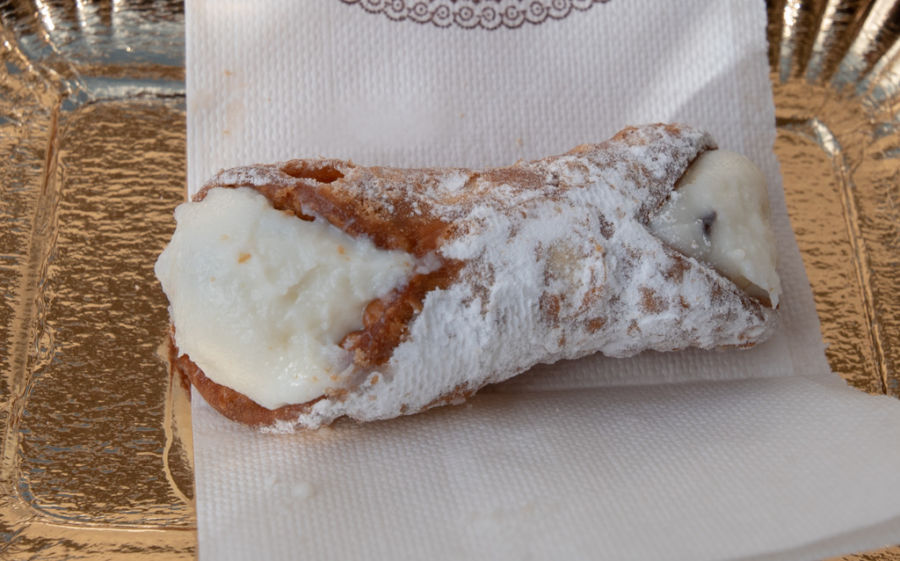
Eating this cannolo in the shadow of Palermo’s cathedral is like eating cannolo for the very first time. It’s just one of many delicious memories I’ll pack home from this journey through Sicily…and my trip is just getting started.


Our new Sicily guidebook — with all of the details about Palermo street food, and much, much more — is available now.

In other blog posts, I wrote about my top 10 tips for traveling in Sicily, the challenge of driving in Sicily, and a stop-by-stop rundown of the ultimate Sicilian road trip.

We also have a wealth of free Sicily content on our website, including a recommended itinerary, links to two new episodes of Rick’s public television series about Sicily, several interviews from Rick’s public radio show about Sicily, more gorgeous photographs, recommended books and movies about Sicily, and much more.

And if you’d like to visit Sicily — but would love it if someone else did all the driving, took care of the hotels and half of the meals, and explained it all to you — well, then, we have a great 11-day tour for you.

Madrid: A Paradise of Tapas

The crock of gambas al ajillo is still sizzling when it hits my table. The tiny pink shrimp, hazy with the aroma of garlic, spit little flecks of oil. It smells like heaven. But on past visits to Madrid, I’ve learned my lesson the hard way: If you dig right in, you’ll scald the roof of your mouth…leaving your taste buds tenderized for the rest of your trip. So I wait, patiently, until it’s cooled off. Suddenly I hear a sharp sizzle. Under the monstrous copper flame hood in the corner, a row of squid shimmy on the griddle.

Finally, my shrimp have cooled enough — but even then, I’m careful of the second hazard of gambas al ajillo: a shirt spotted with garlicky oil, a stain you’ll never get out (or stop smelling). Careful as I am, somehow I still manage to drizzle a stripe of oil on my shirt. I try, fruitlessly, to wipe it away with the tissue-paper napkins, which I toss into the marble trough at the base of the bar. Oh well. Sometimes you have to sacrifice a shirt for a good meal. This may be only my first bite, but already I know that — on this trip to update our Rick Steves’ Spain guidebook — I’m going to really enjoy Madrid’s tapas scene.

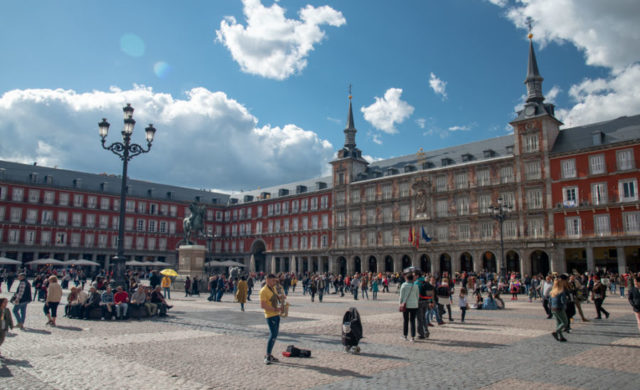
The Spanish capital is also the melting pot of Spanish cooking. Within a few steps of Madrid’s Plaza Mayor, you’ll find eateries showcasing jamón from Castile, manchego from La Mancha, sardines from Santander, paella from Valencia, gazpacho from Andalucía, octopus and sprightly white wine from Galícia, mar i muntanya (“surf & turf”) dishes from Catalunya, and wildly creative Basque-style pintxos — each one perched on a slice of rustic bread. Madrid may not be Spain’s best culinary destination (that title would go either to the Basque Country or Catalunya). But it’s certainly a handy one-stop-shop for sampling everything Spain has to offer.

Let’s begin with a touristy extreme. Dropping into Rick’s favorite bullfighting bar — La Torre del Oro Bar Andalú, right on the Plaza Mayor — I belly up to the bar and order a beer…basically as a cover charge to hang out and take pictures of the grotesque bullfighting decor. The actual bulls’ heads might haunt a vegetarian’s dreams, but the many photographs of too-bold matadors being graphically gored make it clear that Spain’s national pastime has no real winners.

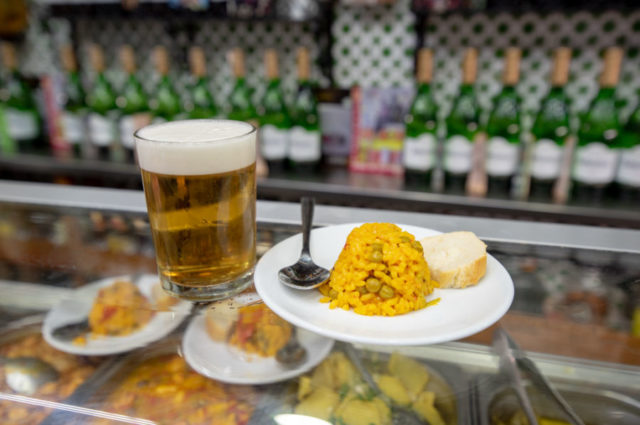
When my beer comes, it arrives with a tidy little pile of paella on a saucer. Always suspicious of tourist-gouging tricks, I confirm that it’s free. It is indeed. They’re staying true to the spirit of the “tapa,” which originated as a free bite of food to accompany a drink. (The little plate the bite comes on can act as a tapa — a “lid” on top of your drink.) A good paella is hard to come by; most restaurants serve microwaved portions with dreary, muted flavors. But this one seems fresh: it’s a shellfish risotto, richly flavored and colored with intense yellow saffron, tasting unmistakably of the sea.

I’m tempted to order another drink just to get the other free tapa I notice them handing out: a mini-mug of the garlicky cold tomato soup, gazpacho. But I’ve got other places to be, and I’ve had my fill of the bulls’ glassy stares (and the vintage photos of bulls’ horns piercing madators’ groins and chins). When I ask for the bill, I’m charged a total of €2…so much for ripping off tourists.

A few steps away, I see a cluster of Madrileños lined up at Café Rúa — famous for its bocadillo de calamares. This simple street food — Madrid’s answer to a Chicago hot dog or a Naples pizza — is a hunk of French bread filled with hot, greasy, crispy, fried calamari. Less than €3, this squid-wich is sold all over town — but Café Rúa is a classic.

These are all touristy choices…handy for people exploring Madrid’s compact core, looking for a bite between posing with colorful statues of flamenco dancers. But the Rick Steves Spain guidebook also recommends some areas with a more appealing mix of Madrileños and outsiders. And I find these much more fun to check out.

Over near the Prado runs Calle de Jesús, where — in one three-block stretch — you can take your pick of a dozen different tapas bars. I have the good (or bad?) fortune to reach Calle de Jesús at prime tapas time: Saturday night, 10 p.m. Each bar is overstuffed, with would-be patrons outside peering into foggy windows, waiting for someone to leave, in the hopes of bushwhacking a path to the bar.

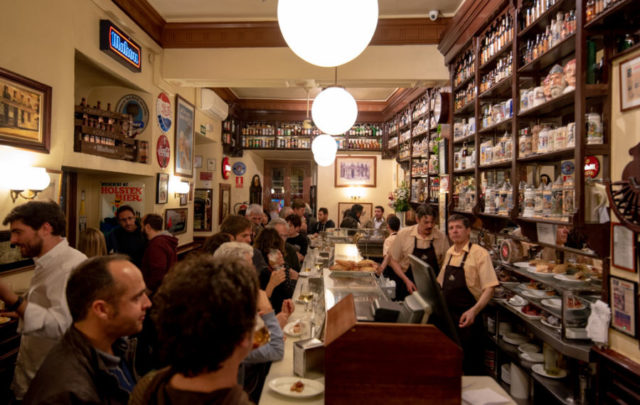
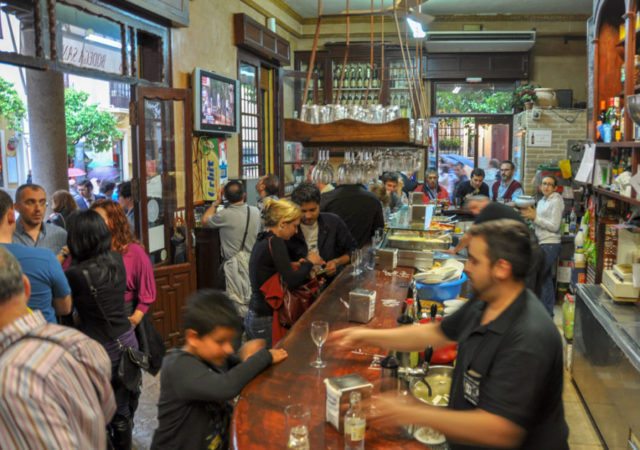
Surveying my options, I’m drawn in by one in particular. Inside, an excited weekend hubbub bounces off the colorfully tiled walls. Madrileños stand in little clusters, precariously perching their plates and glasses on narrow counters, waving their arms in conversation…it’s a miracle glassware isn’t flying everywhere.

Behind the bar, five uniformed bartenders scurry to and fro. It’s peak-of-peak, and they’re in the weeds, but they are a well-oiled machine. They’re remarkably well-coordinated and efficient, shouting instructions to each other as they toss plates like frisbees to hungry diners. Just watching one bartender expertly fling two ice cubes each into four glasses held in one hand, in a matter of seconds, is like watching a pitcher land a split-fingered fastball at the bottom crease of the strike zone. If you’re an indecisive diner who appreciates when the server helps explain your choices…well, then, Jesús help you on Saturday night in Madrid.

As somebody leaves, I make my move to squeeze in the door and shimmy along the bar to the far end, hoping to find a spot to claim for my own. I never do, but the procedure allows me to survey the complete lineup of canapés (little sandwiches) under glass and make my selection. I wave my arm until the bartender takes note. He points me all the way back down to the other end of the bar, where he’s spotted a space that just opened up.

Once positioned, he gives me a quizzical look — a “whaddaya want?!” sneer, pulling back his top lip to reveal questioning teeth — and I rattle off my order: open-face salmon sandwich and a banderilla. Named for the fancy stakes the bullfighter jabs into the fleshy neck of his victim, this is simply a variety of pickled items pierced with a toothpick. But it turns out I’ve upset the delicate order of things: There are two kinds of banderillas under that counter, each with a subtly different type of preserved fish peeking out between chunks of pickle and pepper. Which one do I want, for God’s sake? We don’t have all night here! I point to one at random, and within moments my food is before me.

It’s delicious. The salmon is incredibly tender. And the banderilla is an explosive pop of vinegar and salt, with a slight anchovy finish. It’s so good, I order a second.

Surveying the hubbub, I think of some of my friends back home who would love this…and even more who would absolutely hate it. Tapas are a full-contact sport, and not for everyone. You’re diving headlong, as a rank beginner, into a very specific culture that you can’t possibly understand.

Checking out dozens of Madrid tapas bars for our guidebook, a few things become clear: All of them are supremely tempting. But not one of them is what you’d call user-friendly. Posted menus are rare, and ones in English are almost nonexistent. You can survey the few items they have ready to go, under glass at the bar. But then, after you order, you’ll notice delicious, piping-hot, and (frankly) much better-looking plates coming out of the kitchen…ordered by in-the-know locals who understand that what’s at the bar is only the tip of the iceberg. A menu?! How were you to know there was a menu?

My best tips: Be patient. Don’t expect attentive service. It’s nobody’s job to make things easy on you. Do a little homework — be aware of what each bar is known for (especially if it’s something you have to order from a menu). And while you’re getting up to speed, don’t be afraid to show up early with the rest of the tourists, at around 8 p.m., when things are still quiet. If you wait until 10 p.m., like the Spaniards, you’ll be swimming with sharks. (For even more tips, see my post on “The Trouble with Tapas.”)

Another great strip of tapas bars — hitting that elusive sweet spot between touristy and local — runs a couple of blocks south of the Plaza Mayor, along Calle Cava Baja. While the bars on Calle de Jesús run to more traditional choices, Calle Cava Baja mixes in some boldly innovative variations.

This is a great strip for checking out trendy Basque-style tapas bars, which many first-timers find more enticing and accessible than the old-school ones. In a Basque bar, the counters are lined with eye-catching, typically wildly creative bites — making it easier to understand exactly what you’re getting. Along Calle Cava Baja, Txakolina Pintxoteca Madrileña (at #26) is a great example of this.

But this trip’s best Madrid tapas experience took place just beyond the far end of Calle Cava Baja, where the bar called Juana la Loca overlooks a lonely square. Named “Juana the Mad” (for the 16th-century Spanish queen), it feels like a more sophisticated, more civilized alternative to the standard tapas bar. It’s crowded, but not crazy. Like at most tapas bars, you can try to show up a little earlier to snag a table, or stake your place at the counter and peruse your options — which, here, run to creative, updated Spanish classics and experimental “fusion” dishes.

Their signature dish — and the best €4 value in Madrid — is a tortilla de patatas. It’s a creative variation on the typical tortilla española (egg and potato omelet), but it’s jammed full of heavenly caramelized onions — giving it a sweet, slightly bitter, intensely satisfying flavor.

Ultimately, the Madrid tapas scene is like Spanish cuisine generally: It’s not delicate, and it’s not subtle.

Spanish cooking is Spanish culture — bullfighting and flamenco and Picasso — on a plate: Bold. Uncompromising. Unrelenting. Aggressive. Spanish food is about choosing a flavor profile, then doubling and tripling down on it. The chef wants to slap the eater across the face with flavor…challenging them to turn away. If French cuisine is about technique and nuance and subtlety and surprises, Spanish cuisine is the opposite. It’s a firehose of flavor. (I like to half-joke that a Spanish chef never met a vegetable he didn’t want to submerge in olive oil and garlic. And maybe sauté, too.) For this reason, Spanish cooking could be accused — not unfairly — of being one-note. But there’s no question it’s flavor-forward.

Personally, it can overwhelm my palate. After a few days in Spain, I need to detox my taste buds with something different. But for now…I might just have to circle back for another portion of gambas al ajillo.


Every single tapas place mentioned here is recommended in the Rick Steves Spain guidebook. I wrote this post in 2018 while I was in Madrid updating that book — but I found that I couldn’t improve on Rick’s great picks.

The tapas scene is intimidating. And that’s why, after a previous trip to Spain, I wrote a blog post all about the procedure for making the most of Spanish tapas, rather than being overwhelmed by it.

While in Madrid, I also bumped into a few Rick Steves’ Europe Tours in Spain…who were navigating Spain’s culinary scene with the expertise of a top-notch guide. It made me a little jealous, I must admit. We make things so easy on our tour members…

What to Eat in Iceland

 Iceland has great food. There, I said it. In working on the new Rick Steves Iceland guidebook, co-author Ian Watson and I were determined to get our readers past the clichés about Icelandic cuisine. This post (from my Iceland blog series) offers an introduction to Icelandic cuisine, followed by my 10 favorite restaurant finds for the book.

What Do Icelanders Eat?

It’s the rotted shark that you always hear about. Which is a shame.

Not that there’s no such thing as rotted shark. Hákarl really does exist, and its preparation really does involve fermenting a chunk of Greenland shark meat (traditionally by burying it underground for several months), then cutting it into little cubes that taste like a mélange of dead fish, ammonia, and the stinkiest cheese you can imagine. (You can buy tiny tubs of it at Reykjavík’s weekend flea market. I promise, you will never eat even close to that much.)

And that’s just the tip of the “weird foods” iceberg. Icelanders are also notorious for their penchant for fish jerky (harðfiskur), and for tucking into an entire lamb’s head on a plate (called svið; the cheeks are nice and tender…the eyes and tongue are optional). To be fair, it’s hard to blame those early settlers for making the absolute most out of anything edible. Icelanders even have a word for their hardship meats: þorramatur (“winter food”).

However — now that we’ve got that out of the way — there’s so much more to Icelandic cuisine than those infamous hardship foods. These days, most Icelanders would only eat those dishes out of nostalgia, or — like tourists — on a dare.

The truth is, Iceland has a surprisingly dynamic, delicious, and fun-to-explore food scene. Iceland has a long history of absorbing cultural influences from across the sea. And now that the country is trendy with upwardly mobile young people from the United States, Icelandic chefs are masterfully melding their own traditions with world-class know-how.

Icelandic cooking has two main protein staples: fish and lamb. Haddock, cod, and plaice are caught in the North Sea, while salmon and arctic char are farmed. Fish is prepared in a variety of creative ways: pan-seared, smoked, fish-and-chips, cheesy potato-fish casserole (plokkfiskur), fish fritters, fish sandwiches, fish soups and stews, even sushi. For a splurge, look for humar — langoustine (somewhere between a prawn and a lobster). They’re delectable, but expensive. (But, I say again, delectable.)

Icelandic lamb — which you’ll see free-ranging through the countryside — is renowned for its tenderness and its succulent flavor. Every Icelandic grandma has her own recipe for kjötsúpa — lamb soup.

And then there’s whale. When considering the food chain, many otherwise-omnivores decide to draw the line just below whales. And, controversially, Iceland is a rare country where whale is still legally hunted and eaten. Those who support Icelanders’ right to whale point out that they only hunt minke whale, which is in no way endangered. And it seems shortsighted to judge Icelanders’ historical need to harvest whatever protein they could from the North Sea, as a matter of survival. On the other hand, very few contemporary Icelanders eat whale — the majority of whale caught here is sold to curious tourists (or exported to Japan). You could make a very strong case that today, whaling is kept alive not by Icelanders, but by tourists. Whether to sample whale is an individual choice; if you do, expect a flavor somewhere between elk and ahi tuna — gamey red meat, but unmistakably of the sea.

(Personally, I have a harder time eating puffins — which thrive in abundance in Iceland, and are eaten both as meat and as eggs. Puffin tastes like chicken…but cuter.)

If Americans know anything about Icelandic food — other than rotted shark — it may be skyr. This Greek-yogurt-like dairy product is all the rage in upmarket American grocery stores. While skyr is touted for its low fat content, Icelanders usually mix in sugar and fruit, making it less healthy than it initially seems. While it’s trendy today, skyr has a long tradition — going all the way back to the Viking Age. The byproduct of skyr-making, sour whey, was used to preserve foodstuffs during the lean Settlement Age. And these days, whey (mysa) is also newly popular as a probiotic drink (think kombucha). Side note: Beware of tiresome foodies who eagerly food-splain, “Actually, skyr is not technically a yogurt…it’s a cheese.” (Whatever. If it looks like yogurt and quacks like yogurt…)

Another Icelandic treat worth seeking out is licorice. Like other Scandinavians, Icelanders enjoy mixing licorice with salt or with chocolate. Strolling the candy aisle reveals a world of tempting Icelandic candy bars — most of them a mix of licorice and milk chocolate. And, unlike all those made-in-China stuffed puffins, these candy bars are an authentically Icelandic (and very affordable) souvenir. On my last day in Iceland, I like to stock up for the folks back home.

Iceland has a young but thriving microbrew scene that resembles the one Stateside. Several pubs in Reykjavik offer an education in Icelandic brewers (good choices include the mellow, serious Skúli Craft Bar and the more touristy MicroBar; two other microbrew spots — Mikkeller & Friends and Ölverk — are recommended below). But be ready for very high alcohol prices. I was tempted to try a flight of five little Icelandic beers, until I did the math and realized it cost $30. Many budget-conscious tourists stock up on macrobrews at the airport’s duty-free store on arrival in Iceland. Most bars have happy hours, when, instead of paying $15 for a pint of microbrew, you might pay $10 or less.

Most restaurants you’ll encounter serve Icelandic fare that’s updated rather than purely traditional. And high-end restaurants aspire to the New Nordic model of their Scandinavian cousins, mixing locally sourced ingredients, traditional influences, and cutting-edge culinary techniques. At the cheaper end of the spectrum is an abundance of low-end “international cuisine” (read: junk food). Like visitors, Icelanders find food prices staggeringly high; pizza, hot dogs, Subway sandwiches, and the IKEA cafeteria are just as popular in suburban Reykjavík as they are in suburban Raleigh.

In short, expect high-quality food, at very high prices. And consider this very counter-intuitive tip: In a land where $30 buys you a totally forgettable dinner in a nondescript eatery…why not step up to $50 for a really memorable dinner? While this “in for a penny, in for a pound” philosophy will somewhat increase the price of your trip, it also boosts your culinary memories. Foodie friends have told me they were disappointed by Iceland’s food scene…then confess that they mostly ate hot dogs, Thai carryout, and groceries. Look, I get it: Iceland is expensive, and if you can’t afford to splurge, you can’t afford to splurge. There’s no shame in filling the tank cheaply (which, here, means $15-20 per person). But if you really care about food, consider it part of the Icelandic experience to invest in one or two meals at good restaurants that truly represent Icelandic cuisine today.

To facilitate this, my favorite budget tip is to frequent top-end restaurants at lunchtime, when almost every eatery offers a high-quality “fish of the day” or lunch special in the $20 to $30 range (compared to $50 for a dinner entree). Then, at dinnertime, you can economize by grabbing a pizza or a hot dog, or assembling a picnic. And by the way, don’t be mesmerized by the colorful convenience stores that line major streets, which mark up food prices dramatically. To save, stock up at one of Iceland’s budget grocery chains, Bónus or Krónan.

To fight the sticker shock, remind yourself that prices include tax. And Icelanders never tip — so you shouldn’t, either. What you see is what you pay.

By being aware of some of these key budget tips, and strategically mixing and matching picnic/fast food and splurge meals, you can return from an Iceland trip with some good food experiences under your belt, and a few krónur left in your pocket.

Top 10 Favorite Icelandic Food Discoveries

Scouring Iceland for three weeks for our new Rick Steves Iceland guidebook, I was on a mission to come up with as many great edible discoveries as possible. A few of these stick in my mind as personal favorites. These 10 favorites — a variety of trendy hotspots and traditional standbys, listed in no particular order — are the places I’ll be sure to head back to on my next trip. Thanks to our co-author, Ian Watson, for recommending many of these. And thanks to my blog readers, who suggested others when I solicited their tips before my trip.

Reykjavík’s “Hipster Corner.” This colorful little corner of Reykjavík, just a few steps up from the Laugavegur pedestrian drag, is made-to-order for a memorable coffee break. Reykjavík Roasters painstakingly brews top-end, third-wave coffee, literally weighing each portion of grounds to ensure a perfect pull. There can be a line, but while you wait, you can relax in the mismatched-furniture interior and play DJ with the record collection. Just a few steps downhill, a wildly colorful, graffiti-slathered storefront hosts Brauð & Co, a fantastic bakery with some of the best cinnamon rolls and other sweet pastries I’ve had. These two shops provide my favorite breakfast (and, let’s be honest, also my favorite afternoon snack) in Iceland.

Tasting Menu at Grillmarkaðurinn, Reykjavík. On my first evening in Reykjavík, I splurged on dinner at this fine downtown eatery — which is trendy, rustic, upscale, and unpretentious at the same time. And three weeks later, on my last night in Iceland, I couldn’t resist going back to repeat the experience for a trip-capping blowout dinner. Once I’m convinced that I’m dealing with a quality restaurant, I’m willing to really commit money and stomach space to a serious experience. So I splurged on the $110 tasting menu — and it was worth every króna. For a memorable blowout meal in the capital, this is my top pick.

Pizza, Cocktails, and Microbrews at the Mysteriously Hip Old House at Hverfisgata 12, Reykjavík. This classic old house, on a corner just a few steps from the main drag, hides several options for eating and drinking. From street level, go up the stairs and let yourself inside. You’ll find a cocktail bar in the basement; in the middle of the building is a proudly no-name pizza place with tasty wood-fired pies; and upstairs is the beer-snob haven called Mikkeller & Friends, specializing in Scandinavian microbrews. If you’re exploring the cozy, rustic, wood-paneled rooms and find yourself confused about which seating goes with which business…so is everyone else, so don’t be afraid to ask. Once settled in, dining or drinking here feels like hanging out at your Icelandic cousin’s house. To cap it all off, just around the corner (but in the same building) is Dill, a high-end New Icelandic restaurant that owns the country’s only Michelin star (reserve months in advance).

Meatless Burgers at Kaffi Vínyl, Reykjavík. For a combination of mellow hangout and vegan sandwiches so good you’ll never miss what’s missing, drop by Kaffi Vínyl, just a block off of the main Laugavegur pedestrian drag. Choose from a chalkboard menu of enticing hot sandwiches, with the option of upgrading with some tasty “Oumph!” meat substitute. Wednesdays through Saturdays after 8 p.m., DJs spin hangout tunes, creating a vibe that makes you want to throw your itinerary in the harbor. If I were an Icelandic hipster (oh don’t I wish)…I’d hang out here.

Kaffihús Vesturbæjar, après-pool drinks in suburban Reykjavík. Most of these “discoveries” are smack-dab in the middle of Reykjavík’s touristy core. To escape into the suburbs, where you’ll be surrounded by more Icelanders than travelers, go for a dip at Vesturbæjarlaug — one of the capital region’s most appealing municipal thermal swimming pools. And before or after your pool visit, grab a drink or a bite at Kaffihús Vesturbæjar, an inviting and local-feeling neighborhood café across the street. They serve good breakfasts and lunches from a small menu chalked on the board. This is the kind of place where you hide your guidebook, melt into the convivial scene, and pretend you live here.

Ölverk Microbrewery/Pizzeria, Hveragerði. About 45 minutes outside of Reykjavík, where the lunar plateau called Hellisheiði gives way to a steaming valley, sits the workaday little town of Hveragerði. And a couple of blocks in from the main road, facing a potholed strip-mall parking lot, is this delightful, family-friendly brewpub/pizzeria. Tipped off by a beer lover at the other end of the country, I wandered into Ölverk just days after it had opened…and my travel writer’s “spidey sense” went haywire. This place is a find. The beer — which, they brag, is made with natural geothermal power harnessed from the hazy hillsides all around — is top-quality. And the busy wood-fired oven fills the place with the mouthwatering promise of delicious pizza, with an emphasis on creative toppings. Ölverk is ideally located on the way back home to Reykjavík from a South Coast or Golden Circle day trip — but be prepared to wait at busy times.

Slippurinn Restaurant, Westman Islands. One of the best meals I had in Iceland (and that’s saying something) was at this delightful restaurant filling the upper floor of an industrial-mod former machine shop, overlooking the picturesque harbor in Heimaey. After launching a successful restaurant in Reykjavík, chef Gísli Matthías Auðunsson brought his know-how back home to the Westman Islands and opened a top-quality eatery. The space is bright, cheery, and filled with flowers. And the food — emphasizing Icelandic tradition, but with an accessible modern approach — is delicious, ranging from halibut soup to delectable lamb. You’ll enjoy Reykjavík-quality food at Reykjavík prices, but it’s more affordable at lunch — and definitely worth reserving ahead if you’re doing a day trip to the islands.

Norð Austur Sushi Restaurant, Seyðisfjörður. When I first heard about this restaurant — in a tiny village at the far-northeast corner of Iceland, a 10-hour drive from Reykjavík —  I thought, “Sushi in rural Iceland? Really? Really. Really?!” But I gave it a try…and enjoyed some of the best sushi I’ve ever had. Sitting in the rustic, cozy upstairs dining room, it dawned on me that Iceland — which specializes in fish that doesn’t get any fresher — is a perfect match for sushi. This created perhaps the best of many happy-reward-at-the-end-of-a-long-day meals I enjoyed along the Ring Road.

Klausturkaffi Lunch Buffet, Skriðuklaustur, East Iceland. The only part of Iceland I found underwhelming was the long, skinny, fjord-like lake called Lagarfljót — famous for its legends of a Nessie-like sea monster, and little else. It’s not worth the two-hour detour between Egilsstaðir and the Southeast. That said, for those with ample time, it could be worth the trip simply to gorge yourself at one of the best lunches in all of Iceland: the buffet at Klasturkaffi, in the basement a famous writer’s former home. Stepping into the country-cozy dining room, you’re warmly greeted by a mother-and-daughter team who lay out a delectable spread of farm-to-table Icelandic classics — strictly traditional and utterly delicious. This is Nordic comfort food at its very best; if I had an Icelandic granny, I could only hope she’d cook like this. For $35, you can eat all you like — but be sure it’s open before making the trip (lunch only, April-mid-Oct daily 12:00-14:30, tel. 471-2992, coffee-and-cake buffet in the afternoon).

Hafnarbuðin Diner, Höfn. The little town of Höfn, bullied between glaciers and the frigid North Atlantic in Southeast Iceland, is famous for its humar — a local langoustine that’s served up in many different ways. Höfn’s little harborfront has a half-dozen restaurants slinging humar dishes at a premium. But I like Hafnarbuðin for its relatively reasonable price tag and its likeably lowbrow aesthetic. Stepping into what feels like Iceland’s version of a quayside New England diner, you’ll order at the counter, then wait for a table to open up. Soon you’re digging into a $20 “humar baguette” — the local answer to a lobster roll.

How to Find Italy’s Best Gelato: Tips from an Expert

Like just about anyone who’s ever visited Italy, I fancy myself a gelato aficionado. But I never really understood gelato until my Italian friend gave me a lesson I’ll never forget — including tips for how to find the best gelato anywhere you go.

On a visit to Florence, I was working on updating our Rick Steves Italy book with Chiara — a fellow guidebook researcher and tour guide for Rick Steves’ Europe Tours. One evening, I mentioned that I always wanted to learn more about gelato. “Of course!” Chiara said. “Let’s go.”

As we tiptoed between Renaissance balustrades and double-parked motor scooters, Chiara explained that she once dated someone while he was opening his own gelateria — so she understood the business side of gelato, along with the culinary side. If I really wanted to understand gelato, it seemed, I’d found the perfect teacher.

I asked Chiara something that I had never really understood: How, exactly, does gelato differ from American ice cream? “American ice cream has a higher butterfat content,” Chiara explained. “That makes the texture very rich and sultry. However, the butterfat coats your tongue, dulling your taste buds. Some people say that gelato has stronger flavors. That’s not necessarily true — rather, your taste buds are better able to fully appreciate those flavors. Gelato is also churned differently from ice cream, incorporating less air. That makes it harder in texture, and a little more concentrated.”

Strolling through the atmospheric urban core of Florence on Via dei Calzaiuoli toward the main square, we passed a row of seemingly interchangeable gelaterie. So, how do you know which one is best? “The vast majority of gelato places use the exact same powdered or paste-like mixes,” Chiara said. “That’s why you should look for words like artigianale — artisanal; or fatto in casa — homemade. You want a place that makes all of their gelato fresh, on the premises, ideally that same day. But be careful, eh? Some places advertise these words even though they use the same mixes as everyone else. Let me show you a few things to look for.”

Pausing at a display case with vividly striped mountains of gelato, Chiara whispered, “See there? That is not good gelato. The big piles and the bright colors are designed to attract children. At the best gelaterie, you don’t actually see the gelato — rather, you read the flavors. The gelato is kept in stainless-steel covered tubs, until someone orders it. It’s fresh, and they want to keep it that way.”

“Another sign of good gelato is muted colors. Natural colors. If you see a color that does not occur in nature, it’s artificial. Think about it: What color is the part of the banana that you eat? Not neon-yellow. It’s sort of off-white, with a hint of yellow. So, logically, a good, artisanal banana gelato will be closer to white than to yellow.”

We stepped into Florence’s majestic Piazza della Signoria. At this moment, late in the day, it felt like the city’s living room. We lingered in a quiet corner of the square, peering over at a gaudy gelateria.

“The other thing to be careful about with these tourist-trap gelaterie,” Chiara continued, “is to be very specific when ordering, to avoid getting ripped off. At irreputable places, if you ask for a cone of gelato, they might pick the most expensive, chocolate-and-candy-dipped waffle cone, pile it with five or six scoops, and charge you fifteen euros. Be specific. When I order, I say something like, ‘a three-euro cone with two flavors.’ Of course, you don’t need to be so paranoid at friendly neighborhood places — just the tourist traps.”

As if to punctuate this tip, just then a pack of ragazzi kicked their soccer ball against the peeling plaster wall next to us. They were gearing up for a game…and we were in the way. We decided to surrender the pitch and carry on across the Ponte Vecchio. The languid evening light draped the famous bridge in a gauzy glow.

As we left the bridge behind and made our way up a sleepy Oltrarno back street, Chiara explained the business end of making gelato. “A gelateria has many flavors, but only a few machines. So obviously they make all of their gelato on the same machines. Every gelato begins with the same, neutral, sweet-cream base: fior di latte. As they work through their batches, they make progressively more complex flavors, with darker dyes. The last batch of the day is the dark chocolate flavor. That’s why, if someone has a nut allergy, they should be careful. Some shops carefully clean their machines between batches, but not all do. If you order a darker-colored gelato, several other flavors have been processed before that one — including one that may contain nuts.”

Finally we came upon a gelateria that passed Chiara’s protocol: promising gelato artigianale, from covered metal bins, with muted colors. “But even then,” she said, “the only way to know for sure is to taste.”

Surveying our options, Chiara reminded me, “It’s perfectly fine to ask for un assaggio — a taste. And, while Americans are accustomed to combining whichever random flavors strike their fancy, Italians believe that some flavors go together better than others. It’s like pairing wine and food: Ideally, you want to find a combination that’s mutually enhancing. In fact, if a gelateria takes it craft very seriously, they might politely refuse to pair two flavors that don’t go well together. For example, if you ask for chocolate and lemon, you might get a funny ‘are you sure about that?’ look. Or even a curt shake of the head and a click of the tongue. For Italians, mixing lemon and chocolate gelato is like putting cheese on seafood, or drinking milk after lunchtime.”

“If you are adventurous,” Chiara continued, “you can put yourself in the expert’s hands and ask them what marries well — which flavors go well together. Sometimes they can suggest some surprising and delicious pairings.” Trying this approach, I asked the clerk what he recommended with one of my favorites, cannella (cinnamon), and he topped it with pera (pear). Delizioso. Chiara ordered pistacchio.

As we licked our cones, Chiara said, “My choice of flavor was strategic. If you really want to gauge the quality of a gelateria, you try the pistacchio. Here’s why: Did you ever notice that every gelato flavor costs the same to buy? But, of course, they cost different amounts to produce. There’s a huge profit margin for fior di latte, crema, vaniglia, and other basic flavors. Meanwhile, the most expensive flavor to produce — if it’s done correctly, with real nuts — is pistacchio. Only the rare gelateria uses real pistachios in its pistacchio. Places that are cutting corners will just make almond gelato, and throw in some artificial pistachio flavoring and green food coloring. You can sometimes tell this because the green is just too bright. But if the pistacchio is real pistacchio, it’s a very good sign that the gelateria owner is committed to making quality gelato, even at the expense of potential profits.” Taking a satisfied bite, Chiara concluded, “Mmmm. This one is real pistacchio. You can taste the difference.”

After that walk through Florence with Chiara, every time I step into an Italian gelateria, I can survey my options with confidence — knowing that I can tell the difference between run-of-the-mill gelato and top-shelf gelato. And, as a budding gelato snob, I now make a point of asking for a sample of pistacchio as my first barometer of quality.

So, after all that…what’s my favorite gelato? When working on our Rick Steves guidebooks in Italy, I take very seriously the sober responsibility of recommending at least one top-quality gelateria in each town. Unfortunately, after much (delicious) trial and error, I’ve learned that some cities — even biggies like Venice and Florence — have plenty of perfectly good gelaterie, but no head-and-shoulders “best” choice. (And believe me, the competition can be fierce…especially in small towns. But that’s another blog post.)

That said, I do have several personal favorites that I would consider traveling halfway across the country for. My all-around favorite gelato in Italy is at a small chain called De’ Coltelli, with branches in Lucca and Pisa. On one trip, I made a point to take an extra day off in Lucca…I must admit, at least partly to fit in another couple of gelato cones at De’Coltelli. Another Tuscan favorite, in the tiny town of Pienza, is Buon Gusto. Slaves to tradition, Nicola and Giuseppe make just a few batches each morning, scheduled to be ready just after lunch. But don’t wait too long. Once they’re gone…they’re gone. Rome has a variety of creative gelaterie serving unusual flavors (which I have an affinity for); I’ve had memorable gelato at Fatamorgana, with locations in the Monti and Trastevere neighborhoods, and elsewhere.

And finally, I must admit, even as it has expanded to the point of self-parody (including branches Stateside), the Grom chain still churns out reliably good gelato. Yes, Grom is the Starbucks of gelato. But if I’m in a smaller town or a neighborhood where my only choices are a Grom and a suspiciously touristy-seeming gelateria…I’ll stick with Grom. And I’m rarely disappointed.

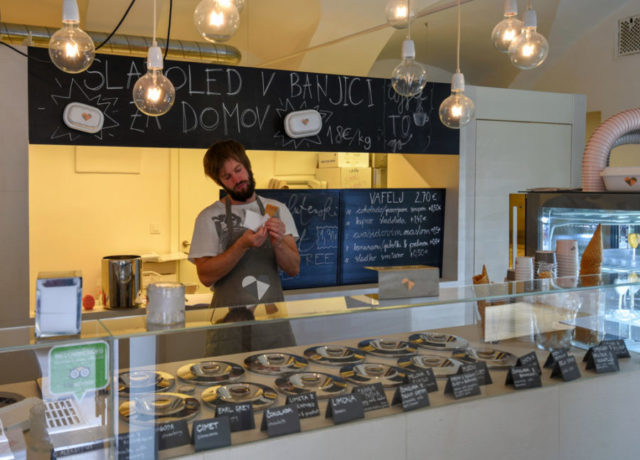
Finally — while this may be appalling to purists — some of my favorite gelato isn’t even in Italy. Ljubljana, the delightful Slovenian capital (and just an hour’s drive from Italy), has a burgeoning artisanal gelato scene. My favorite spot is Romantica, with delicious, creative flavors that highlight Slovenian ingredients and Italian know-how. Other great choices in Ljubljana include Rustika (a small chain that also produces excellent chocolate truffles), Fétiche Patisserie (along the river, with Asian-inflected flavors), and Zvezda Kavarna (a local institution with rich, decadent flavors).

Where’s your favorite gelato in Europe?

Buon gelato!


My favorite gelato-related travel anecdote was the time I became embroiled in a fierce war between rival Cinque Terre gelaterie. Some people take gelato very seriously.

My favorite Ljubljana gelateria, Romantica, was included in my blog post about how to eat well on a budget in the Slovenian capital.

Over on Rick’s blog, he interviewed one of my favorites, Buon Gusto in Pienza.

And, of course, all of our favorite gelaterie are listed in our Rick Steves guidebooks. Or you can join Chiara (or one of our other top-notch tour guides) in person on a Rick Steves’ Europe Tour.

10 European Discoveries for 2018

My Christmas tree is out at the curb, which means it’s time to start planning 2018 travels. This year, I hope to visit some big-name destinations — maybe Madrid, maybe Amsterdam, maybe Prague? But as I reflect on recent trips, I’m struck by how many favorite travel memories have taken place in Europe’s underappreciated corners. As your travel dreams take shape for 2018, consider peppering your itinerary with a few off-the-beaten-path discoveries — the sorts of places that Rick Steves, decades ago, dubbed “Back Doors.” Here are 10 of my current favorites.


Lake Mývatn Area, Iceland

Driving around the perimeter of Iceland on the 800-mile Ring Road this summer (working on our upcoming Rick Steves Iceland guidebook), I binged on an unceasing stream of cinematic landscapes. But what sticks with me most vividly is the region surrounding Lake Mývatn, a geological hotspot that straddles the European and North American tectonic plates. Birds love this dreamy lake, as do the swarms of microscopic midges (for whom the lake is named) that invade the nostrils and mouths of summertime visitors. But the bugs are easy enough to ignore as you explore the lakeshore’s volcanic terrain — from the “pseudocraters” (gigantic burst bubbles of molten rock) at Skútustaðir, to the forest of jagged lava pillars at Dimmuborgir, to the climbable volcanic cone at Hverfjall. And the thermal fun crescendos just to the east: the delightful Mývatn Thermal Baths (the lowbrow, half-price alternative to the famous Blue Lagoon), the volcanic valley at Kralfa (with a steaming geothermal power plant), and the bubbling, hissing field at Námafjall (pictured above). Stepping out of my car at Námafjall, I plugged my nose against the suffocating sulfur vapors and wandered, slack-jawed, across an otherworldly landscape of vivid-yellow sands, bubbling gray ponds, and piles of rocks steaming like furious teakettles. Many visitors drop into Iceland for just a few days, and stick close to Reykjavik — which is a good plan, if you’re in a rush. But the opportunity to linger in Mývatn (about a six-hour drive from Reykjavík) may be reason enough to extend your trip by a few days…and turn your stopover into a full-blown road trip.
 

Sarlat Market Day, Dordogne, France

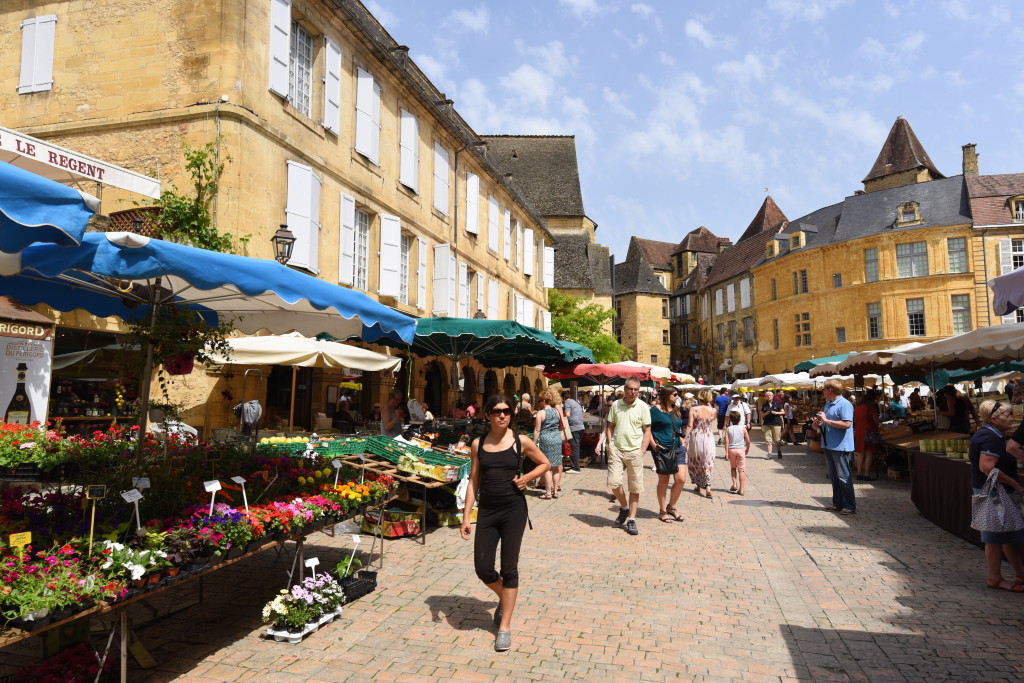
Of all the delightful activities I’ve enjoyed in France, my favorite remains the lazy Saturday morning I spent wandering the market stalls in the town of Sarlat. Rickety tables groaned with oversized wheels of mountain cheese, tidy little stacks of salamis, cans of foie gras and duck confit, and a cornucopia of fresh produce. Market day in rural and small-town France isn’t just a chance to stock up — it’s a social institution, where neighbors mix and mingle, and where consumers forge lasting relationships with their favorite producers. And when the market wraps up, even before the sales kiosks are folded up and stowed, al fresco café tables overflow with weary shoppers catching up with their friends. While Sarlat is my favorite market (and my favorite little town in France), you can have a similar experience anywhere in the country; I’ve also enjoyed memorable market days in Uzès (Provence), Beaune (Burgundy), St-Jean-de-Luz (Basque Country), and even in Paris. Just research the local jour de marché schedule, wherever you’re going in France, and make time for one or two. And when you get there…. Actually. Slow. Down. Throw away your itinerary for a morning. Become a French villager with an affinity for quality ingredients. Browse the goods. Get picky. And assemble the French picnic of your dreams.
 

Ruin Pubs, Budapest, Hungary

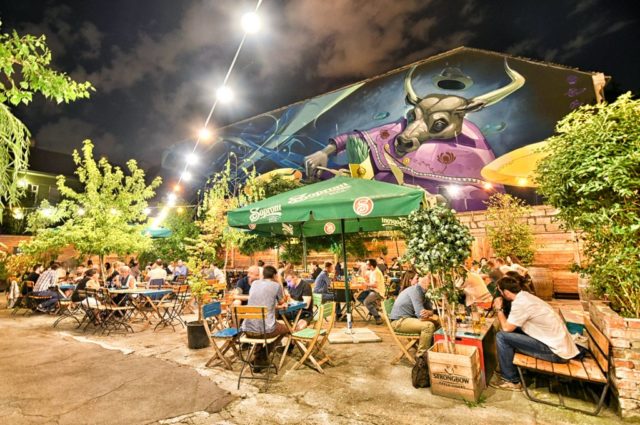
I must admit, I’m not really a “nightlife guy.” But when I’m in Budapest, I budget extra time to simply wander the lively streets of the Seventh District — just behind the Great Synagogue, in the heart of the city — and drop into a variety of “ruin pubs.” A ruin pub is a uniquely Budapest invention (though these days, it’s been copied by hipster entrepreneurs everywhere): Find a ramshackle, crumbling, borderline-condemned old building. Fill its courtyard with mismatched furniture and twinkle lights. And serve up a fun variety of drinks, from basic beers to twee cocktails to communist-kitsch sodas for nostalgic fortysomethings. The Seventh District — the former Jewish Quarter, and for decades a wasteland of dilapidated townhouses — gave root to ruin pubs several years back. And today, tucked between the synagogues and kosher shops are dozens of ruin pubs, each one with its own personality. While you could link up a variety of the big-name ruin pubs (and my self-guided “Ruin Pub Crawl” in the Rick Steves Budapest guidebook does exactly that), the best plan may simply be to explore Kazinczy street and find the place that suits your mood.


Julian Alps, Slovenia

This gorgeous corner of my favorite country has always been high on my personal “must list.” It’s a little slice of heaven: Cut-glass alpine peaks tower over fine little Baroque-steepled towns, all laced together by an eerily turquoise river. While this place should be overrun with crowds, on my latest visit — in late September — I had the place nearly to myself. A few A+ travelers have begun to find their way to the “sunny side of the Alps”: Rafters, kayakers, and adventure sports fanatics are drawn to the sparkling waters of the Soča River. Historians peruse the well-curated array of outdoor museums and cemeteries from World War I’s Isonzo Front, where Ernest Hemingway famously drove an ambulance. Skiers gape up at the 660-foot-tall jump at Planica, home to the world championships of ski flying (for daredevils who consider ski jumping for wimps). And foodies make a pilgrimage to Hiša Franko, the world-class restaurant of Ana Roš — a self-trained Slovenian chef who was profiled on Netflix’s Chef’s Table, and was named the World’s Best Female Chef 2017. (I recently enjoyed a fantastic dinner at Hiša Franko, and was tickled to be greeted by Ana herself, who took my coat and showed me to my table.) As a bonus, the Julian Alps pair perfectly with a visit to northern Italy: On my latest trip, I spent the morning hiking on alpine trails and exploring antique WWI trenches carved into the limestone cliffs, had lunch immersed in the pastoral beauty of Slovenia’s Goriška Brda wine region (also egregiously overlooked), then hopped on the freeway and was cruising the canals of Venice well before dinnertime.


Vigeland Park, Oslo, Norway

My favorite piece of art in Europe isn’t a painting, and it isn’t in a museum. It’s a park — a grassy canvas where a single artist, the early-20th-century sculptor Gustav Vigeland, was given carte blanche to design and decorate as he saw fit. The city of Oslo gave Vigeland a big studio, and turned him loose in the adjoining park for 20 years. He filled that space with a sprawling yet harmonious ensemble of 600 bronze and granite figures, representing every emotion and rite of passage in the human experience, all frozen in silent conversation with each other — and with the steady stream of Oslo urbanites and tourists who flow through Vigeland’s masterpiece. The naked figures (which might provoke giggles among prudish Americans) reinforce the sense of timelessness and universality: They belong not to any one time or place, but to every time and every place — from Adam and Eve to contemporary Norway. Over the last decade and a half, I’ve been to Vigeland Park three times. Each time, I was in a totally different state of mind. And each time, the statues spoke to me like old friends — sometimes with the same old message, and sometimes with new insights. With all due respect to da Vinci, Van Gogh, and Picasso, no single artistic experience in Europe is more meaningful or impactful to me than Vigeland Park.
 

Sarajevo, Bosnia-Herzegovina

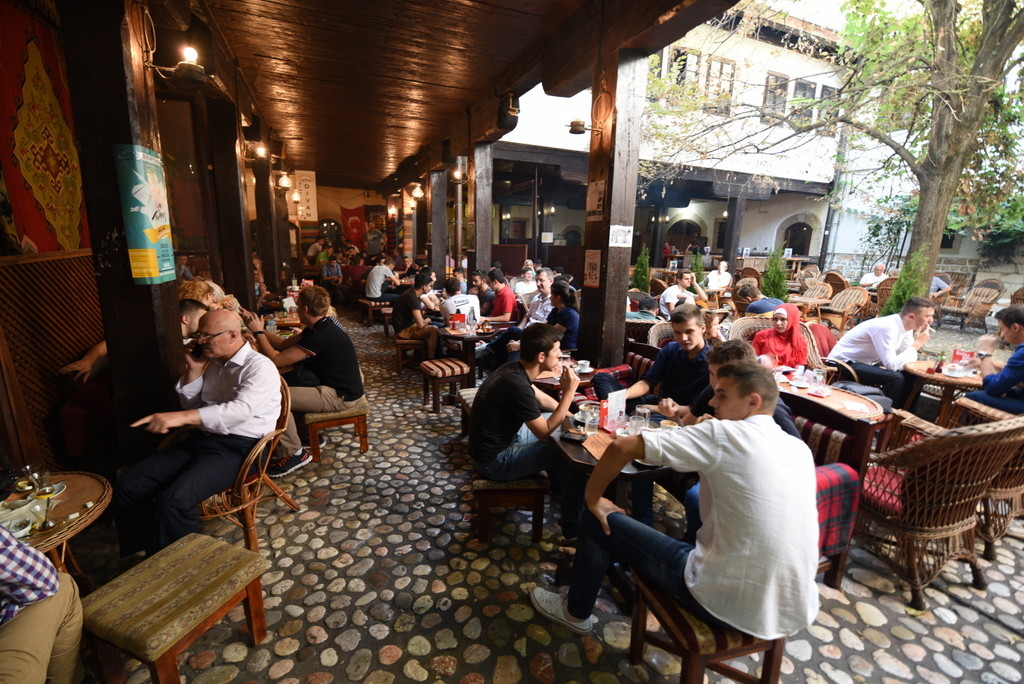
Sarači #16 is the most interesting address in downtown Sarajevo. Facing east — toward the Ottoman-era old town, Baščaršija — you’re transported to medieval Turkey: a bustling bazaar with slate-roofed houses, chunky river-stone cobbles, the tap-tap-tap of coppersmiths’ hammers, and a pungent haze of hookah smoke and grilled meats. Then, turning to the west, you’re peering down Ferhadija, the main thoroughfare of Habsburg Sarajevo. This could be a Vienna suburb, where stern, genteel Baroque facades look down over cafés teeming with urbanites. Within a few short blocks of this spot stand the city’s historic synagogue, its oldest Serbian Orthodox church, its Catholic cathedral, and its showcase mosque. Few places on earth are so layered with history. And then there’s the latest chapter: the poignant story of the Siege of Sarajevo in the mid-1990s, when the town was surrounded by snipers for more than 1,400 days — connected to the outside world only by a muck-filled tunnel and a steep mountain ascent. Proud Sarajevans you’ll meet are often willing, or even eager, to share their stories of living a horrific reality that we experienced only through the Nightly News. And if you’re lucky, they’ll invite you for a cup of Bosnian coffee — and explain why it’s integral to their worldview and their social life. Many travelers do a strategic side-trip from Croatia to the town of Mostar — a good first taste of Bosnia, but what I consider “Bosnia with training wheels.” But for the full Bosnian experience, I’d invest another day or two and delve a couple of hours deeper into the country…to Sarajevo.


Val d’Orcia, Tuscany, Italy

Of all of Tuscany’s appealing corners, the Val d’Orcia (“val dor-chah”) is — for me — the most enchanting. While just a short drive from the tourist throngs in Florence, San Gimignano, Siena, or the Chianti region, the Val d’Orcia — bookended by the charming towns of Montepulciano and Montalcino (both synonymous with fine Tuscan wine) — feels like a peaceful, overlooked eddy of rural life. This strip of land is where most of the iconic “Tuscany scenery” photographs are taken: Winding, cypress-lined driveways; vibrant-green, rolling farm fields that look like a circa-2000 screensaver; and lonely chapels perched on verdant ridges. And it’s the backdrop for famous scenes in everything from The English Patient to Gladiator to Master of None. And yet, the area has no “major sights” — no sculptures by Michelangelo, no paintings by da Vinci, no leaning towers — which, mercifully, keeps it just beyond the itineraries of whistle-stop, bucket-list tourists. I have savored several visits — including a particularly memorable Thanksgiving week with family — settling into my favorite agriturismo, Cretaiole, in the heart of the Val d’Orica. And every moment of every trip lives on as a mental postcard: Making fresh pasta. Sawing into a deliciously rare slab of Chianina beef T-bone. Following a truffle-hunting dog as it sniffs its way through an oak forest. And on and on. If you have a day to spare between Rome and Florence, don’t go to the Val d’Orcia. But if you have several days to really delve into the best of Tuscany…let’s talk.


Psyrri Neighborhood, Athens, Greece

A few years removed from the depths of its economic crisis, Athens has re-emerged as a red-hot destination. Revisiting the city a few months ago, I was struck by how many tourists I saw — and by how many of them refused to venture beyond the cutesy, crowded Plaka zone that rings the base of the Acropolis. And that’s a shame, because literally across the street  from the Plaka’s central square, Monastiraki, is one of Athens’ most colorful and fun-to-explore neighborhoods: Psyrri (“psee-ree”). Not long ago, this was a deserted and dangerous slum. But recently, Psyrri has emerged as a trendy dining and nightlife zone. Its graffiti-slathered apartment blocks now blossom with freshly remodeled Airbnb rentals. This still-gritty area may feel a little foreboding at first, but if you can get past the street art, grime, and motorbikes parked on potholed sidewalks, it’s easy to enjoy the hipster soul of the neighborhood that’s leading many to dub Athens “The New Berlin.” For the upcoming fifth edition of our Rick Steves Greece guidebook, Psyrri inspired me to write a brand-new, food-and-street-art-themed self-guided walk chapter. In just a few blocks, between the Plaka and the thriving Central Market, you can stop in for nibbles and sips of sesame-encrusted dough rings (koulouri), delicate phyllo-custard pastry (bougatsa), deep-fried donuts (loukoumades), anise-flavored ouzo liquor, and unfiltered “Greek coffee.” If you’re going to Athens, break free of the Plaka rut, walk five minutes away from the hovering Parthenon, and sample this accessible, authentic slice of urban Greek life.


Moscow, Russia

On my last visit to Moscow, in the summer of 2014, Russia was in the news: military action in Crimea and eastern Ukraine, Putin’s brutal crackdown on homosexuality and punk-rock protesters Pussy Riot, and the recently completed Sochi Olympics. Of course, since then, the headlines have changed, but Russia is in the news more than ever. That’s why I consider Moscow to be Europe’s most fascinating — and challenging — destination. People back home shake their heads and wonder: How can these people support Putin, who (to us) is so clearly a demagogue? I take that not as a rhetorical question, but as a genuine one that deserves a real answer. And a thoughtful visit to Moscow — even “just” as a casual tourist — can offer some insights. Designed-to-intimidate Red Square and the Kremlin fill onlookers with awe and respect. The still-standing headstone of Josef Stalin — tucked along the Kremlin Wall, just behind Lenin’s Tomb and its waxy occupant — seems to suggest that the Russian appetite for absolute rulers is nothing new. But mostly, I’m struck by the improvements I see in Moscow with each return visit. On my first trip, in the early 2000s, the famous Gorky Park was a ramshackle, potholed mess, and the Cathedral of Christ the Savior — which had been demolished by communist authorities — was still being rebuilt. But today, Gorky Park is a lush, pristine, manicured people zone, and the sunshine glitters off the cathedral’s rebuilt golden dome. Just up the river, a Shanghai-style forest of futuristic skyscrapers rises up from a onetime industrial wasteland. In short, the Russian capital — which has always been interesting — is now actually a pleasant place to travel. Finding myself really enjoying Moscow, for the first time, makes it easier to imagine how many Russians might be convinced that Putin is Making Russia Great Again.
 

Orkney Islands, Scotland

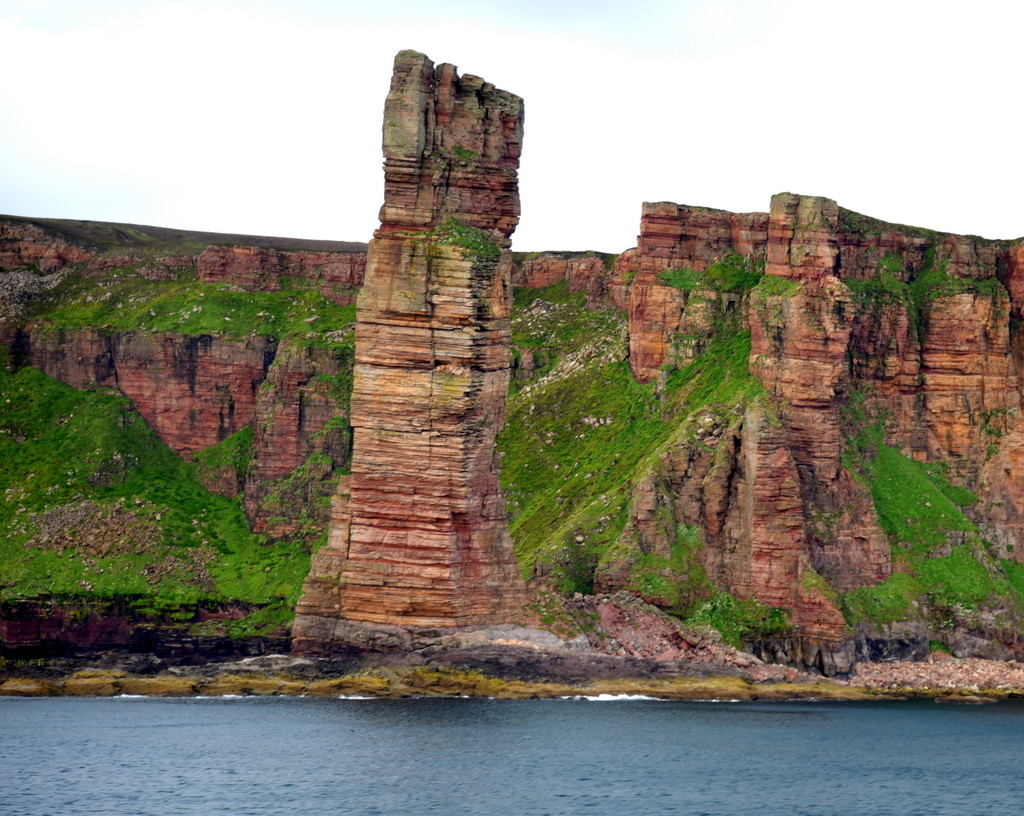
Cameron Scotland Orkney Old Man of HoyI traveled all over Scotland a couple of summers ago, working on the Rick Steves Scotland guidebook. And the most intriguing place I visited had nothing to do with kilts, bagpipes, or moody glens: the archipelago of Orkney, barely visible from Britain’s northernmost point at John o’ Groats. This flat, mossy island feels far from what I think of as “Scotland.” For most of its history, it was a Norse trading outpost, rather than a clan stronghold. And today it remains a world apart. Five-thousand-year-old stone circles and rows point the way to prehistoric subterranean settlements. The main town, Kirkwall, has a quirky tradition for a no-holds-barred, town-wide annual rugby match, and a fascinating-to-tour church. And you can still drive across the “Churchill Barriers,” installed by Sir Winston after a Nazi U-Boat snuck into the famous harbor called Scapa Flow and blew up a British warship. But my favorite sight is the Italian Chapel: a drab wartime hut transformed into a delicate, ethereal Catholic chapel by Italian POWs who were allowed to improvise the decor from whatever materials they could scavenge. While Orkney takes some effort to reach, it’s worthwhile for the unique and captivating sightseeing it affords. (To get the most out of your time on Orkney, book a tour with Kinlay at Orkney Uncovered.)

Where are you headed in 2018?