My co-author and frequent collaborator, Cameron Hewitt, is well-traveled, smart, and insightful. And, while he and I are in perfect sync in our travel styles and priorities, he gives voice to the next generation of "Rick Steves travelers." Join me in enjoying his reports right here. —Rick

An Ode to the Cats of Greece

My wife and I very nearly adopted another cat yesterday in Greece. This is not the first time this has happened, because Greece is the terrain of adorable cats.

I almost said “stray cats,” which I suppose is technically true. But, for the most part, the cats we’ve been enjoying the company of don’t strike us as hard-up, scrappy tomcats. They appear, by and large, to be healthy and well-fed. Some are even pleasantly plump. All around the country, we’ve been spotting little “cat service stations” where locals put out food and water. One of them even came equipped with toys. Communal cat care appears to be the paradigm.

The potential adoptee in question approached us while I was snapping photos like mad at sunset, along a ridge lined with windmills above the whitewashed old town of Mykonos. This kitten was making the rounds from tourist to tourist for pets and head-scratches, when he turned his attention to us. After about 30 seconds of quality cat time, I began to wonder about the practicalities of legally transporting a cat Stateside… and how Poi and Welly, back home, might feel about a new little brother.

By the time he moved on to the next cluster of tourists, we’d given him a name: Mykonos, of course, or “Miko” for short.

This was far from the first time we’ve had this experience in Greece. Many years ago, at the Acropolis of Lindos on the island of Rhodes, we met an improbably friendly orange-and-white cat who somehow managed to upstage the dramatic ancient ruins upon whose steps he was basking. We still talk about “Lindo” as the one who got away.

The morning after we met Miko — just today, in fact — we made another feline friend, who lingered at the porch in front of our hotel. Getting to know her over breakfast, we named her “Elena” (after the hotel) and once again began Googling “quarantine rules for cat entering US” over our coffee.

This is a common theme for cat-lovers in the Greek Isles. You see feral cats all over the warm world, but Greece seems to have a particular affinity. We confirmed this over dinner with Antonis, a Mykonos tour guide.

“Yes, we Greeks love cats!” he said. “They are truly part of the community. You get to know specific ones and enjoy seeing them in the streets. Cats are favored over dogs for many reasons: They are very clean. They are quiet — no barking. They generally don’t bite or cause much trouble, and help keep rats and mice under control. Some people who work in the old center even bring their cats to work with them, let them wander the town, then take them home each evening.”

This is a far cry from the “inside-only” ethos that many American cat owners (including us) embrace. Keeping a cat indoors, feeding them a steady and predictable diet, and providing them with regular veterinary care is, no doubt, far better for the life expectancy of any cat.

But what about the quality of life? Recently, my wife and I adopted a new pair of kittens. Here they are, if you’ll indulge a proud cat papa:

As we’ve sorted out our cat-rearing philosophy, we’ve learned how many experts note that keeping a cat indoors 24/7 prevents them from pursuing their natural instincts to explore and prowl and hunt. They become couch potatoes; they gain weight; many develop odd behaviors and tics, which in some cases are treated by putting them on antidepressants.

In short, keeping a cat indoors lengthens their life, but runs the risk of making them neurotic. Just a few years ago, my wife and I nursed another pair of cats through their golden years. While we never regretted it for a moment, anyone who’s given a late-teenaged cat injections, infusions, pills, and inhalers (yes, inhalers) has to wonder if this is truly the natural order of things.

If we went through the effort to bring Miko or Elena or Lindo home with us, would we truly be “rescuing” them? Or would such a drastic change in lifestyle cause them more trauma than benefit? They appeared to be very healthy, led happy lives, and are looked after by the community. Maybe they already belonged to someone, or, at a minimum, they collectively “belonged” to the people of Mykonos. “I don’t ‘own’ a cat,” Antonis told us. “But I love cats. And I feel like, living here, I have many cats.”

Who’s to say that the US approach of pampered, medicated, geriatric cats is better than a short-but-sweet existence of carousing through whitewashed lanes? If you’re doing it right, travel challenges your assumptions. Often, it surprises you with a fresh take on something you thought you’d “figured out” long ago…even something as seemingly trivial as a cute kitten. I do believe there are many situations from which cats need to be rescued. (All four of our cats have been rescues.) I’m just not convinced the Greek Islands are one of those places.

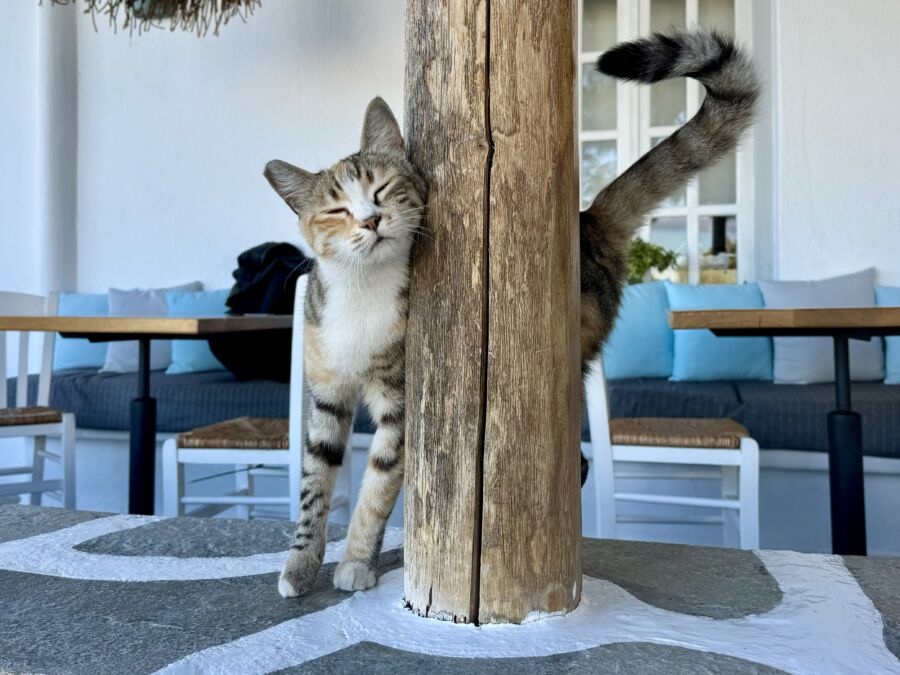
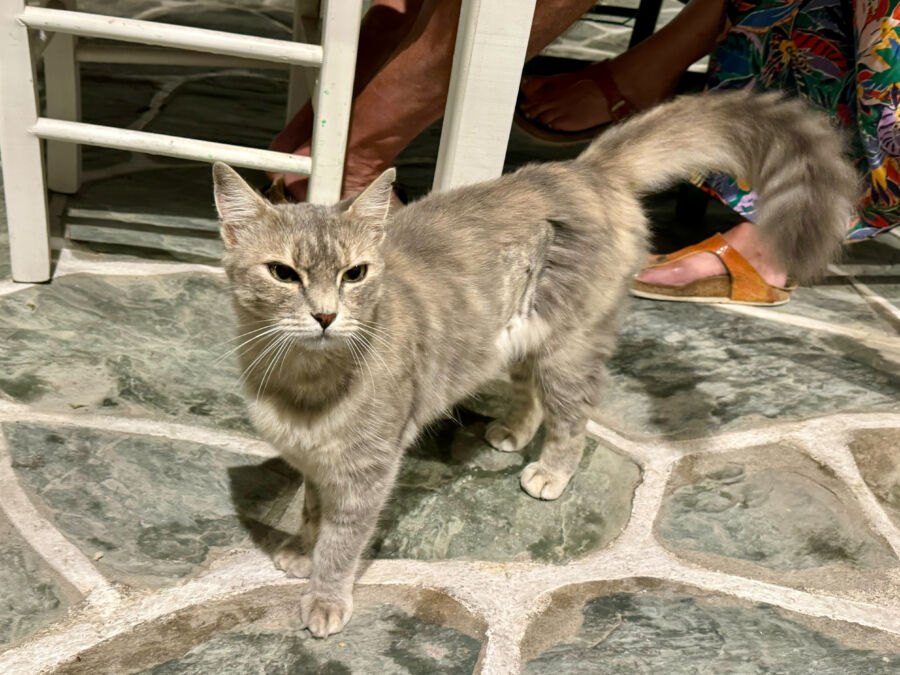
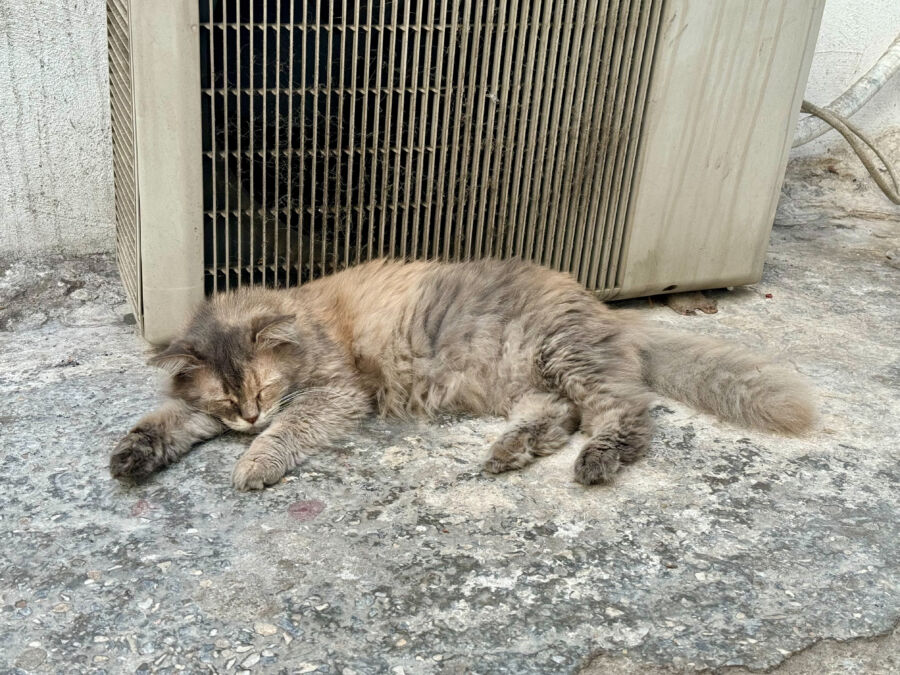
And, I’ll admit, another reason for writing this post is purely as a gratuitous opportunity to share photos of the countless cute Greek cats I’ve encountered in my travels.

Here’s a true story: One time, after a particularly cat-intensive journey through the Greek Islands, I brought home all of my photographs for the company database. Soon after, my colleague responsible for cataloguing and keywording those photos came to my office. “Could I ask you a personal favor, Cameron?” he said. “Can you please, please stop taking so many photos of cats?”

I still take lots of photos of cats… certainly too many. However, I have stopped providing them to the database. I’ve been keeping them to myself… but now I’m pleased to share them with you.

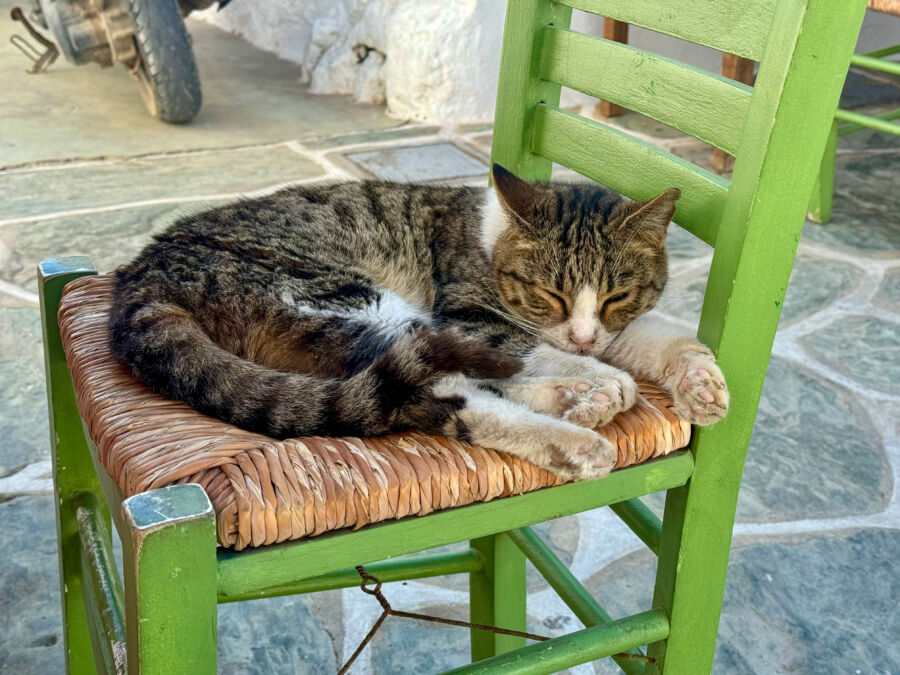
Greek cats seem to have a knack for hanging out in picturesque locales.

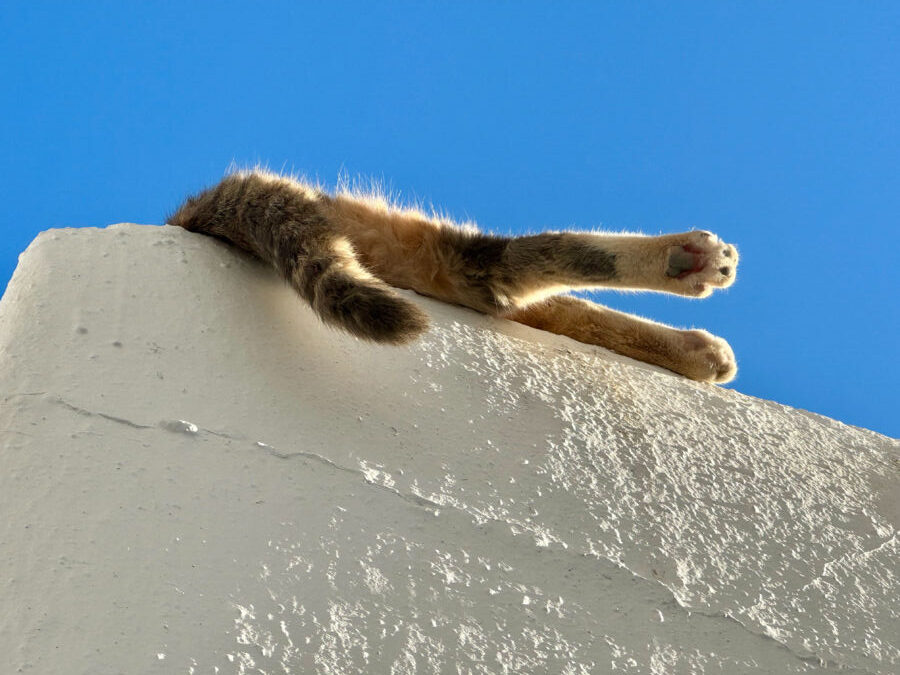
One day, I was walking up a very tight whitewashed lane, when I looked up to  see the legs of a napping cat poking out over the ledge directly above me.

He must have heard me snapping photos, because soon he woke up and peered over the ledge at me, with that air of perturbed judgment that only a cat can master.

Restaurants are, understandably, a particularly popular place for cats to hang out. At one charming café in Megalochori, on Santorini, the family of tabby cats (mom, dad, and five kittens) was clearly a big draw for tourists like us. And yet, nobody wants them sauntering across the tabletops. And so there was a delicate balancing act: They could curl between the legs of diners, even hop up for a nap on a chair…but never on the table.

“But, Cameron!” you may be saying. “Don’t you realize all that’s going on in the world? Strife and warfare, a generation-defining presidential election coming down to the wire! How can you be talking about cats at a time like this?”

Yes, the world feels like it’s unraveling. But that’s just when we all could all use a “moment of zen”…an escape from the blood-pressure-jolting headlines.

Travel broadens your perspective and makes you a better global citizen — and my current trip, overland through the Balkans from Sarajevo to Greece, has done that more for me than any I can remember. But travel also provides much-needed peace and gratitude. It can remind us to slow down our relentless pace, to clear our minds of stressors beyond our control, and to be present in the moment… scratching an adorable cat on the chin, as she tightly presses her eyes closed and revs up her whirring purr motor.

There will be time enough when I get home to worry about all that’s going on in the world. But for now… I’m just enjoying the hell out of these cats of Greece, for as long as I have with them.

Bye, Miko! Have a great life.

The Watchers of the Night Watch

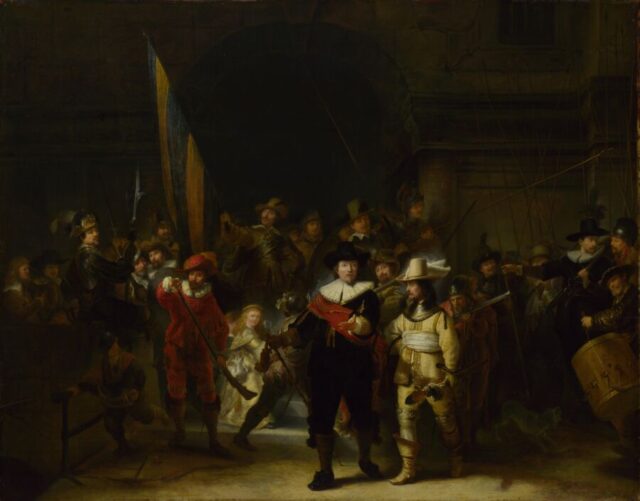
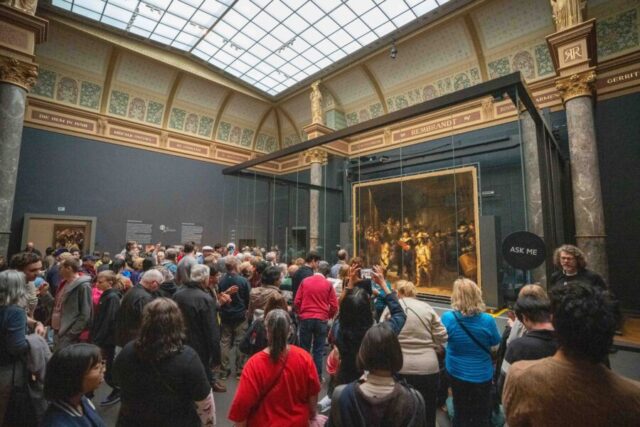
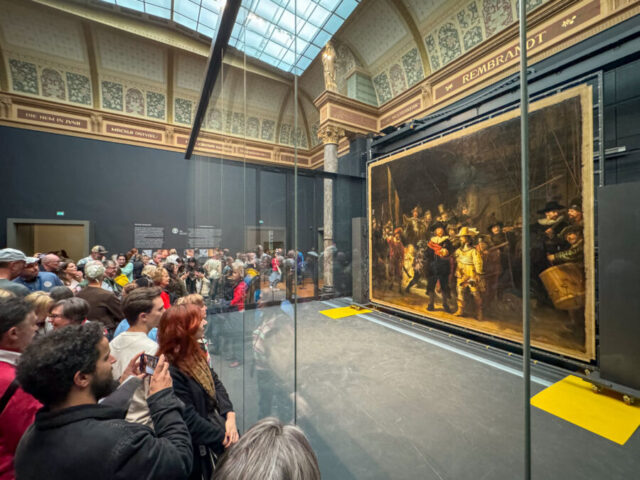
On the upper floor of Amsterdam’s Rijksmuseum, a grand hall is filled with iconic Dutch masterpieces. Among its many treasures, Rembrandt’s Night Watch occupies a privileged position, hovering ethereally at the end of the hall, as if a shimmering high altar of Dutch art.

This large canvas — fourteen and a half feet wide by twelve feet tall — was commissioned in 1642 as a group portrait. The Night Watch depicts a militia consisting not of highly trained soldiers, but of shopkeepers, merchants, and local bigwigs. In mid-17th-century Holland, things were changing rapidly. A generations-long battle for Dutch independence from Spain (now called, without hyperbole, the Eighty Years’ War) was drawing to a close. By the time the members of the Night Watch assembled for this portrait, Spanish forces had been pushed deep into Belgium, allowing Amsterdam and other Dutch cities to flourish. Militias like the Night Watch, once necessary for municipal defense, had become merely ceremonial…social clubs for wartime cosplay and business networking. Amsterdam was a booming hub of commerce, on the cusp of a Golden Age. And upwardly mobile merchants — like the pepole in this painting — were already making their fortunes.

And yet, what vaults this canvas to greatness is not its subject matter, but  its shrewd, innovative artistry. Rembrandt, then in his mid-30s, took a conventional group portrait — staid, static, perfectly lit — and turned it on its ear. Instead, Rembrandt captured a mob scene: members of the Night Watch are scattered across the frame, looking this way and that, in motion, interacting with one another, sliding between dark shadow and glaring light, in some cases leaving their features mostly obscured. Individual personalities leap off the canvas. And I perceive something subversive, even sarcastic, in Rembrandt’s take. You can imagine him responding to critics — perhaps a cloth merchant, annoyed that you can only make out half of his face — by saying, “You said you were a militia. Is this not what a militia looks like?”

The painting is, no doubt, striking. And yet, on this visit, I found myself even more captivated by something else.

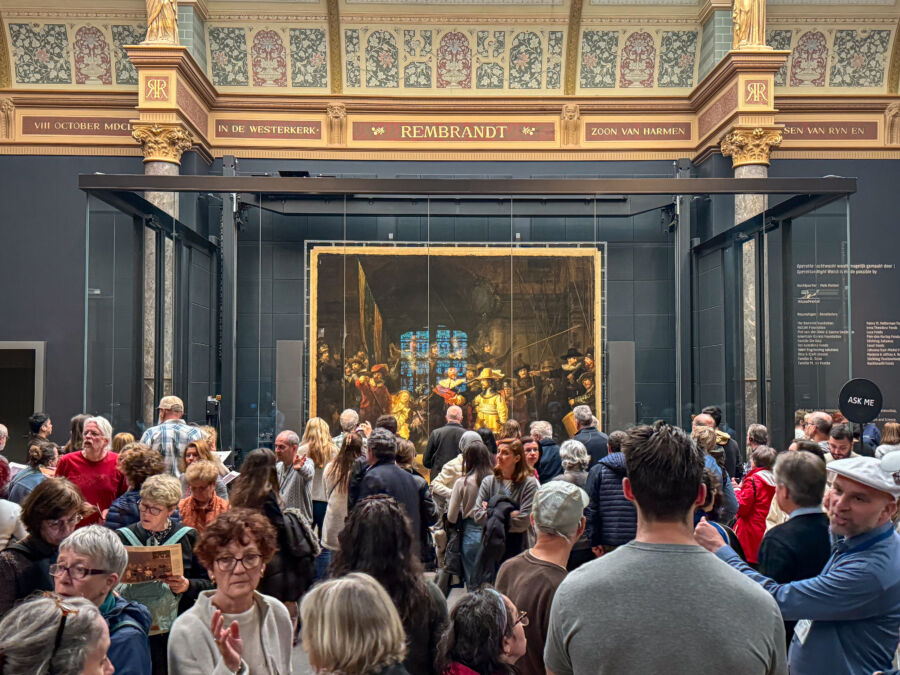
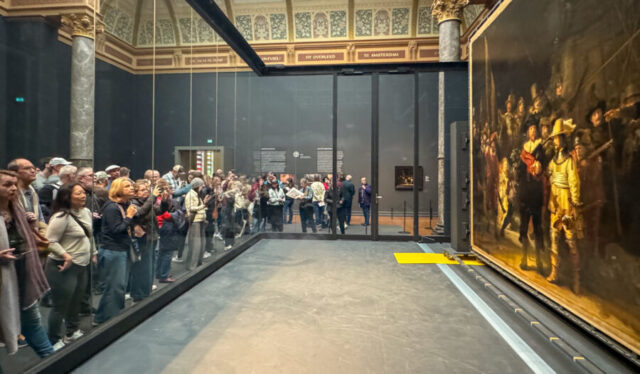
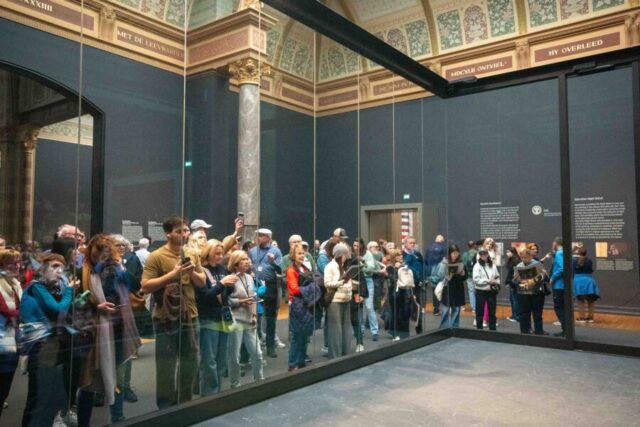
Rembrandt’s fragile masterpiece has been placed within a gigantic plexiglass case, giving the painting room to breathe during a recent restoration. And that case is surrounded on all sides by visitors from every corner of the earth — creating a parallel mob scene even more chaotic than the one depicted on the canvas. Museumgoers press their hands and faces against the smudged glass, as if medieval pilgrims seeking proximity to a holy relic. They become human tripods, stretching their arms to their limits as they hold phones and cameras high, angling them this way and that, trying with futility to resolve the glare separating them from Rembrandt’s greatness.

Something about this spectacle strikes me as absurd: The case, thrusting far out into the room, is filled with more than two thousand cubic feet of nothingness. It’s an airlock, insulating Rembrandt’s 17th century from our contemporary world. It’s an empty void in the very center of the most crowded room, in the most overtouristed city, in the most densely populated country in Europe.

Circling around the side of the cube — to the only part of the hall not jammed with people — I look at the canvas, distorted from this sharp angle…and then back at the scrum facing it. The Night Watch, while engaged in boisterous motion, are strong, proud, and confident; the Watchers of the Night Watch — we 21st-century tourists — have an air of disheveled desperation. Suddenly, I put myself in the shoes of the Night Watch, and see us Watchers through their eyes. What must they think of us?

The members of the Night Watch look out over a sea of faces, who came here from unimaginably remote corners of the earth. We Watchers traveled in a matter of hours a distance that would have cost the Night Watch many months’ journey — tedious, hazardous, quite possibly fatal. We dress far more casually than they do, in garish colors, revealing very nearly the full length of our arms and legs, clad for comfort above all, not a frilly white ruff or chimney-pipe hat to be seen. Observing us constantly pull small, black, mirrored rectangles from our pockets and handbags, and attend to them with intense focus, the members of the Night Watch must wonder what could possibly be so fascinating about these little devices.

There is one thing we Watchers have in common with the Night Watch: Their world was changing at a dizzying pace. And ours is, too. Just a few years ago, this grand hall — today so congested, so steamy, so deafening with rancorous conversation — was entirely empty. We Watchers weathered a pandemic of global proportions, stayed away from each other for months or even years, lived in a swirling eddy of fear, boredom, and anger. During those many long months, the members of the Night Watch looked out over an empty hall. In this vacuous space, they could have easily engaged in conversation with Frans Hals’ cheerful drinker, with Jan Steen’s merry family, even with the world-weary self-portrait of their own depicter, Rembrandt. It was so silent that, as Vermeer’s gentle milkmaid serenely tipped up the base of her jug, you could actually not hear the milk trickling into the bowl. Shhhh!

But now, thanks to a miracle of modern science, we Watchers are back, in force. And the Night Watch has never seen crowds like this. We Watchers are determined to make up for lost time, catching up on two years’ worth of unhad experiences. It has been, in a way, beautiful to observe the persistence of humanity’s determination to fulfill our deferred dreams. And yet, it has not taken long to realize that such persistence can also be destructive.

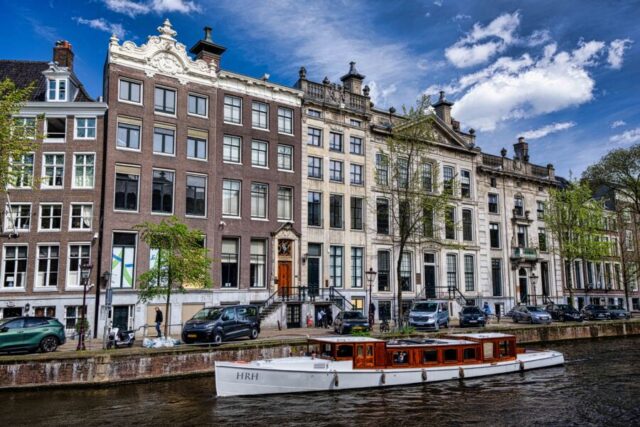
Outside of this hall, beyond the walls of the Rijksmuseum, Amsterdam is struggling with an unprecedented influx of visitors. We 21st-century Watchers are determined to immerse ourselves in the 17th-century core of the city…the Amsterdam that the Night Watch would recognize. All through the concentric-circle Canal Belt, block after block, canal after canal, Amsterdam has preserved its Golden Age landscape: skinny townhomes with elaborate gables and practical little winches, standing tall over even skinnier streets that tiptoe between the houses and the canals. Here and there are more elaborate mansions of the über-wealthy, and fanciful gilded towers that rocket skyward, filled with jovial carillons that jingle-jangle cheerful tunes throughout the day.

But today, this precious, unique cityscape is overwhelmed. Those narrow brick lanes are cluttered with wayward tourists, not paying attention as they wander about in a self-interested fog, seeking the ideal backdrop for their selfie or the perfect framing for that church tower, stepping in front of bicycle commuters — oblivious to the persistent brrrrring!-brrrrring! of handlebar bells — or very nearly stepping off a ledge into a brown, murky canal.

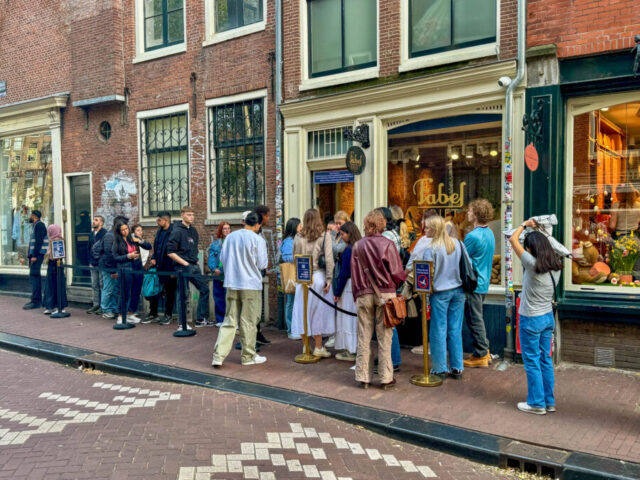
Throughout the Canal Belt, graceful bridges span those canals. And today, across several of those bridges snake long lines of tourists, stretching all the way from one bank to its opposite, patiently waiting in a well-organized queue. Walking past, I asked a random line-stander what, exactly, he was waiting for. He explained that he and his girlfriend had sought out a very famous shop that they had seen on Instagram and TikTok. They had been waiting for about 45 minutes, and he estimated they were getting close.

“So, what kind of food do they sell?” I asked.

He seemed unsure: “Some sort of sandwich? My girlfriend could tell you?” These felt more like questions than answers, quickly followed by a self-reassurance: “But I know it will be very good.”

“I’m sure it must be,” I said, and carried on across the canal. There I passed the front of the line, where carefully positioned stanchions did their best to preserve the flow of foot traffic, allowing passersby to pass by the queue without stepping into bike traffic, constantly monitored by attendants who told each customer where to stand. “Instagram sensation line supervisor” is, apparently, a whole new occupation in 21st-century Amsterdam.

Amsterdam also struggles with its global touristic brand as a city of vice. A history of conflict and suffering taught the Dutch to be pragmatic and open to other worldviews. From the Protestants-versus-Catholics wars that led to the creation of the Night Watch, all the way to the horrific loss of life during Nazi occupation and the Holocaust, the Dutch have learned that tolerance is the opposite of violence, and vice-versa. And Amsterdam’s status as a maritime shipping center — a crossroads of peoples and cultures from around the world — has deepened locals’ affinity for accepting diverse backgrounds and alternative lifestyles.

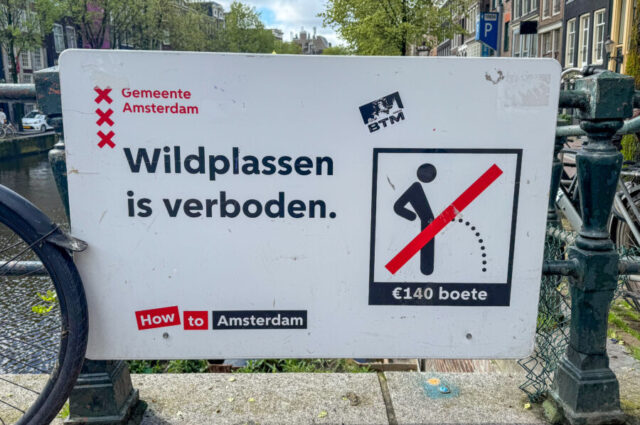
That’s why it was logical for Amsterdam, in the second half of the 20th century, to become a bastion for permitted marijuana use and legal sex work. This began as an expression of Dutch values and a social experiment in pragmatic crime reduction. But it also made the city a hub for marijuana and sex pilgrims — a breed of tourists who, by and large, tend to be rowdy, loutish, and troublemaking. (When you begin to require signs explaining the fines charged for urinating into a canal, you’ve crossed some sort of Rubicon.) That’s why, in recent years, city authorities have begun to roll back the parameters of marijuana use, and are constraining — and may even relocate — the famous Red Light District. With the “Stay Away” campaign, specifically targeting rowdy young men from Great Britain, city authorities are spending money to actively discourage certain visitors from coming to Amsterdam.

As Amsterdam’s popularity has exceeded its capacity — as Europe’s best-preserved 17th-century city has become the poster child of “overtourism” — local residents and city leaders alike have had enough. Recent legislation has forbidden groups in the Anne Frank House and Red Light District; placed a strict cap on new hotel construction; and severely constricted the Airbnb market (with methods so draconian, they are also closing down traditional B&Bs). And yet, the visitors still come — a United Nations of tourists who don’t flinch at paying €300 or €400 a night for a room in a mediocre, midrange hotel in that dreamy Canal Belt.

Amsterdam is a leading example. But all across Europe, we are back where we were in 2019: It’s very trendy to fret about “overtourism.” (For example, the New York Times just covered this topic yet again.) These concerns are legitimate, but it seems to me that we’d rather complain about this issue than tryto do anything about it. So…what can we do about it?

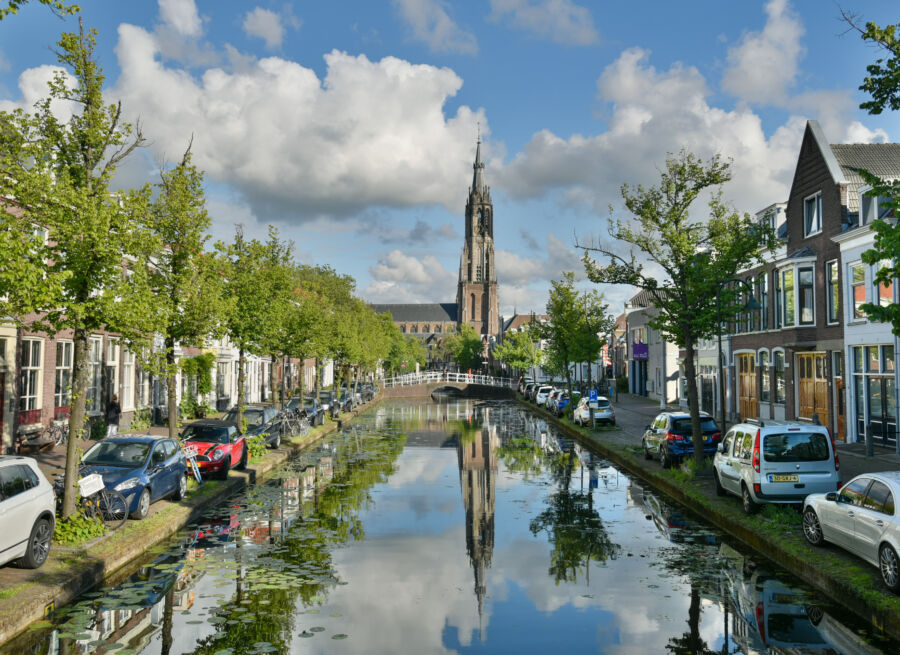
Is the answer as simple as not traveling to these “overtouristed” places? Maybe so. One solution could be to seek out alternatives to the most overwhelmed destinations. The Netherlands has more than its share of gorgeous, historic cities — just as beautiful, if smaller — just a short journey from Amsterdam. Lovely, largely undiscovered Leiden, a gabled university town that gave birth to Rembrandt and asylum to the Pilgrims, is less than 30 minutes by train from Amsterdam. And if you say on that same train another 20 minutes or so, you’ll pull into tranquil Delft, with its Vermeer canals, soaring steeples, and blue pottery.

This year, I have spent time in Amsterdam and in Venice — two of the leading cities of overtourism. But I’ve also spent time in places that are far less crowded: Germany’s Rhine and Mosel rivers; gorgeous Slovenia; off-the-beaten-path corners of the Balkans. Also just this year, Rick has traveled to several great, if relatively untouristed, cities in Germany (Leipzig, Dresden, Hamburg), and to several towns and cities in Portugal, and has marveled at the lack of crowds. Just this spring in Bacharach, on Germany’s Rhine River, I was chatting with a local shopkeeper who asked me, worriedly, “Where are all the American travelers? We used to be so busy. Not anymore.”

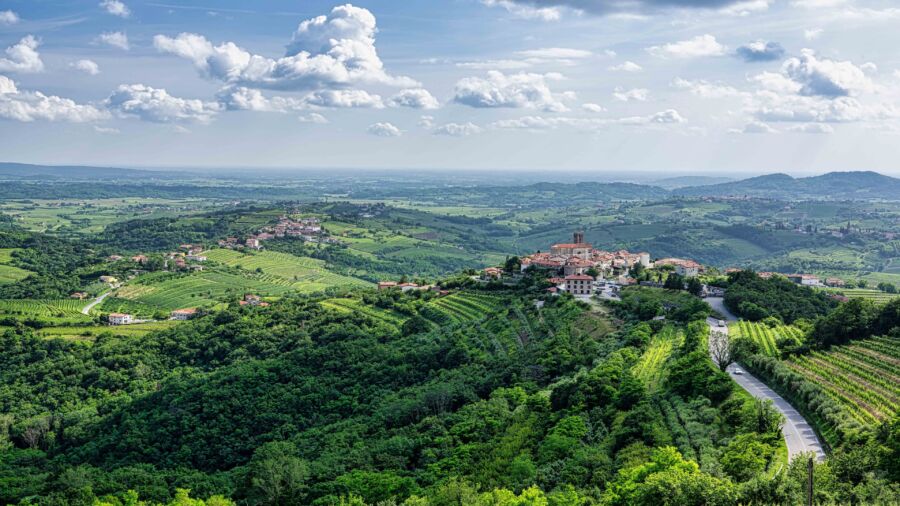
Anytime I post about Slovenia — a striking undiscovered gem of a country —people in the Comments worriedly scold me for running the risk of “ruining” this precious place. I’ve got news for them: I’ve been preaching the wonders of Slovenia — shouting it from the rooftops, in fact — for well over 20 years. And, while a few areas (Lake Bled) are no longer “undiscovered,” there’s still more than enough Slovenia to go around.

The more I travel, the clearer it becomes: There is an overabundance of lesser-known, virtually untouristed places all over Europe that could help us, collectively, spread around the demand without sacrificing quality of experience.

And yet, we Watchers are stubborn. And, quite frankly, we are not particularly original in choosing where to travel. We have our bucket lists… we have our Instagram bookmarks… we have that overwhelming FOMO. We want to go where the people are, and then, all too often, complain about all the people.

I realize that it’s easy for me, as a professional traveler who’s seen the Night Watch, the Mona Lisa, the Sistine Chapel multiple times, to suggest that others skip those icons of Europe in favor of a deeper cut. And, if we’re both being honest, you’re probably going to ignore that advice anyway.

And so, if you insist on going to an immensely popular place, all you can do is to be prepared. Book far ahead — far, far, far ahead — to get your choice of accommodations, tables at the most best restaurants, and time slots to visit the big sights. Do your best to make your visit coincide with less-crowded spells; often that means touring popular sights early or late in the day. (One afternoon, I passed an hour-long line at an Instagram-famous fry shop; the next morning, I took advantage of a much shorter line…and savored the exact same cone of truffled-mayo-and-parmesan-topped fries after just a 10-minute wait.) Or — better yet — avoid peak season entirely, and travel instead off-season.

More important than all of that practical advice — which is, frankly, self-serving — I believe it’s critical to travel conscientiously. Be aware that the places you visit are feeling the strain of their own popularity…and do what you can to avoid adding to that strain. Be mindful of local. Give up your seat on the tram to the local mom with the baby. Invite the Dutch shopper to cut the line at the grocery store. Don’t be the tourist wandering in front of a moving bicycle, as you squint into your black, mirrored rectangle. Be present, be curious, be thoughtful, and be respectful.

Is it my duty, as a travel writer,  to not tell people about Amsterdam — even to actively discourage them from coming here? Or is it my duty to acknowledge that they will come here, regardless…and to equip them to do it more thoughtfully and sustainably?

Understandably, many people these days — locals and tourists alike — are frustrated by overtourism. But let me offer another point of view, from a different poster child of overtourism: Dubrovnik, Croatia. Isn’t it interesting our our contemporary “problem children” tend to be major ports, at the historical crossroads of cultures? Amsterdam, Dubrovnik, Venice, Barcelona, Athens, Lisbon. But maybe it’s not just a coincidence…

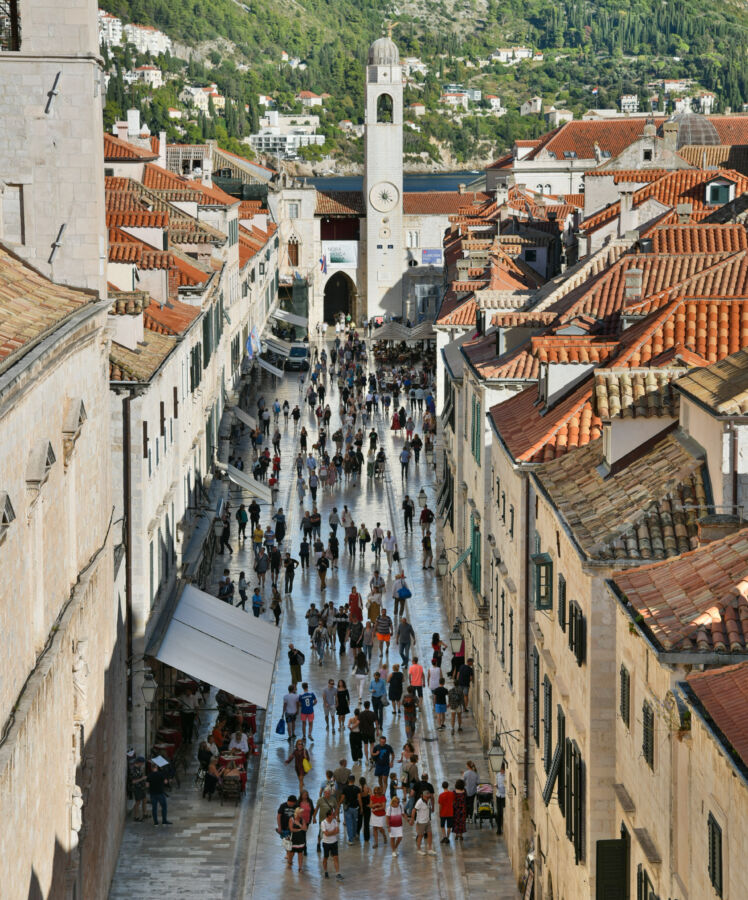
On a recent visit to Dubrovnik, I stood on the Old City’s main drag with my local friend Roberto, observing the crush of cruise-ship passengers, who filled it so completely that going for a simple stroll down the block was impossible. I began to grouse, when Roberto stopped me.

“Yes, but Dubrovnik has always been like this,” he said. “We are an outpost. A trading center. A shipping port. A crossroads. For generations — for centuries — people have come and gone through our city gates. It is what defines the life of our city, in fact! You see these crowds and say, ‘What a problem.’ But there have been many times, through our long history, when you would have found these streets every bit as crowded as today. The faces, the clothing, the reasons for visiting may change. But the humanity is the same. Whether by galleon or by cruise ship, Dubrovnik is a place where people come.”

Which brings us back to the Night Watch — encased in their hermetically sealed glass box, designed to keep all that humanity at arm’s length.

When the members of the Night Watch look out upon us Watchers, what do they see?

I imagine that if they were to climb down off their canvas and stroll through the Canal Belt — nearly four centuries after they departed this mortal coil — the differences would be apparent: What the people filling those streets are wearing and doing and saying. The bicycles, the automobiles, the motorized party barges chugging along the canals.

But — beyond the 17th-century cityscape itself — they may also detect many similarities. The Amsterdam of the Night Watch was no ghost town; it was, as today, a thriving hub of entrepreneurs and peasants, sailors and artists, Dutchmen and outsiders, all filling those same, narrow, brick-lined, canalside streets.

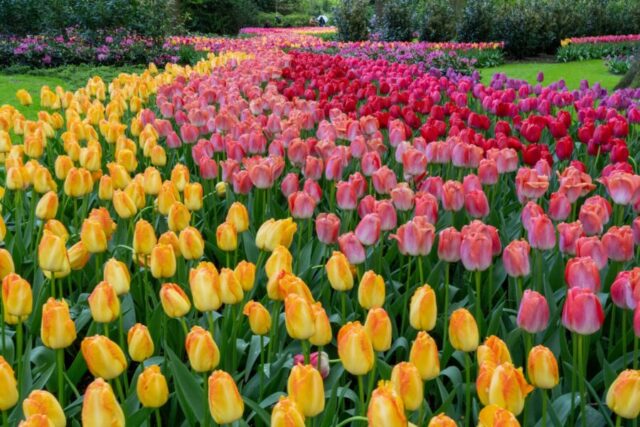
And what about those long lines — those visitors from afar, spending an hour of their precious vacation for an Instagram-famous cookie, sandwich, or cone of fries? Perhaps the members of the Night Watch would understand those people better than I do. In the 1630s — less than a decade before Rembrandt painted the Night Watch — Holland was seized by “tulip fever.” Flower bulbs from the Ottoman lands became a subject of unbridled speculation, escalating prices to unimaginable, ludicrous highs. A few dozen tulip bulbs could make someone a millionaire, by today’s standards. Is a cookie truly worth spending an hour in line? You might as well ask: Is a single flower truly worth as much as several acres of land?

In fact, the members of the Night Watch — shrewd businessmen that they were — might be more impressed by the success of their city than shocked by the crowds. They built a city that attracts visitors; visitors bring money; and Amsterdam is, by any measure, a prosperous place. Is this not entrepreneurial success?

There’s no doubt that overtourism is a genuine concern. Both for the comfort of us travelers, and for the sanctity and sanity of the permanent residents of these places, it deserves to be taken seriously. But maybe these crowds are not such an outlier; they simply represent another chapter in the ebb and flow of a vital, thriving, always-evolving city of the world.

In the end, the most realistic approach may be to recognize that Amsterdam — that city of entrepreneurs, movers-and-shakers, faux-militia members building their fortunes — benefits greatly from tourism, even as they pay a different kind of price for that success. And as conscientious visitors, we can recognize our place in that awkward ecosystem. We come, we enjoy, we learn, we trade our money for fond memories…and we do our best to leave the city no worse off than when we arrived.

Iceland on TV: The Making of Rick Steves’ Europe Season 13

In early 2020, I was very excited: We were going to make travel TV in Iceland!

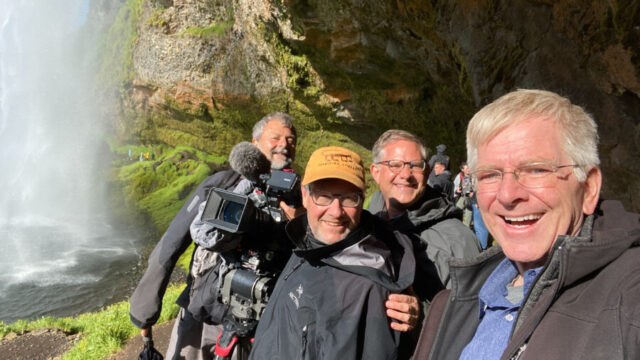
For the first time, Rick Steves’ Europe was set to film two brand-new episodes on the land of ice and fire, for the upcoming Season 13. Rick and I had worked hard on the script, brainstorming wonderful little Icelandic experiences — both grand and intimate, from cinematic glaciers to cute puffins, and from steaming volcanoes to funky back-streets Reykjavík. Producer Simon Griffith was hard at work making arrangements and getting filming permissions from the national tourist board. And camera operator Karel Bauer was all lined up to join us for the two-and-a-half-week Icelandic road trip. It was sure to be an epic adventure…and a fantastic show.

And then, of course, it didn’t happen.

All through COVID, when Rick and I would check in, we’d promise each other that we’d head to Iceland as soon as we could. But it took some time: There was a pandemic to weather; a travel company to keep alive; and then, when things finally opened up, two years of backlog to catch up on.

But finally, in early 2023, the time came to resurrect our Iceland plans. Rick and I dusted off the script, Simon began to reach out to our Icelandic contacts, and Karel started practicing his drone skills. At long last, we were heading to Iceland.
Pre-Production: “It’ll All Work Out”

But first, we had to make arrangements. And if I’m being honest, Iceland didn’t make things easy. It may be a tiny island — with fewer than 400,000 residents, about the population of Honolulu or Cleveland — but it’s extraordinarily popular. We’re a scrappy little public television crew of four people, making the most of a modest budget. But Iceland is accustomed to multi-million-dollar Hollywood productions, with casts and crews in the hundreds: Game of Thrones, various Star Wars installments, and anytime producers need someplace desolate to stand in for a faraway planet (Prometheus, Interstellar, and so on). It quickly became clear that even if Iceland is a fairly small pond, we were minnows… not whales.

For our July shoot, we figured making plans in January would give us plenty of lead time — which it would be, for any other location. But Iceland’s tourist season is as short as it is intense, and we were landing right at its busiest point. Even several months out, we struck out finding three or four available hotel rooms in some of the remote corners of the Island. Scrambling a bit, we eventually managed to secure accommodations…just barely, in some cases booking the last few beds we could find online.

Iceland’s tourist board connected us with a wonderful local fixer, Sunna, who began reaching out to the many locations where we hoped to film. But progress was slow…too slow. As the shoot approached, we voiced our concerns to Sunna and other Icelandic contacts: Would it all fall into place in time?

With a striking consistency, they all told us the same thing: Don’t worry! It’ll be fine in the end. Sunna explained that this is something of a national motto: Þetta reddast…literally, “It’ll all work out.” I had heard this phrase from time to time during previous visits to Iceland. But now we were living it.
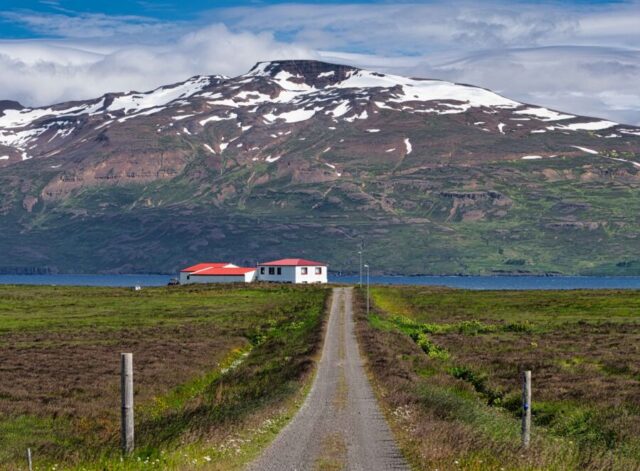
And it makes sense: Iceland has always been a true frontier. The elements are harsh; the winters are long and unforgiving; the landscape itself is constantly trying to kill you, with volcanoes or hissing steam vents or glacier avalanches or sneaker waves.

And yet, the Icelanders — those quintessential pioneers, descended from Viking Age settlers who took it upon themselves to tame an uninhabited, seemingly un-inhabitable land — have learned to persevere. Icelanders have no choice but to be flexible, to take things as they come, and to help each other out as needed. One way or another, things work out.

Simon and I — after many stressful weeks of false starts and hurry-up/wait  — tried to take this assurance to heart. And in the end, Iceland rewarded our leap of faith. Things did work out, wonderfully. We appreciated this motto, and philosophy, so much that we made sure to film one of our Icelandic friends explaining it to Rick: Þetta reddast.

Reykjavík: I’m Soakin’ Local!

In the waning days of June, we convened in Reykjavík to begin filming our Iceland special: producer Simon, camera operator Karel, and (soon after) Rick. We used our first couple of days, before Rick’s arrival, to run around the city — and into the countryside — to film some b-roll: footage to illustrate what we described in our script.

On our night of arrival, howling rain flung frigid rain sideways, instantly soaking head-to-toe anyone foolish enough to set foot outside. It was instantly, painfully clear: Even being here in the “peak of summer,” working around the weather would be our biggest challenge.
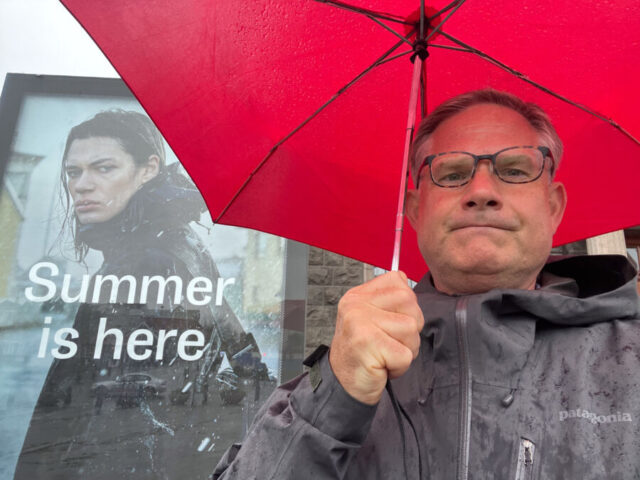
I got so drenched on my first day in town, I headed to an outdoor outfitter for some extra rain gear. The sales clerk patiently explained (as he clearly had to hundreds of tourists before me) that that “waterproof” is a spectrum, not a binary. A proper pair of truly weatherproof rain pants would cost me upwards of $250. (Instead, I bought an $80 pair, figuring it was better than nothing.)

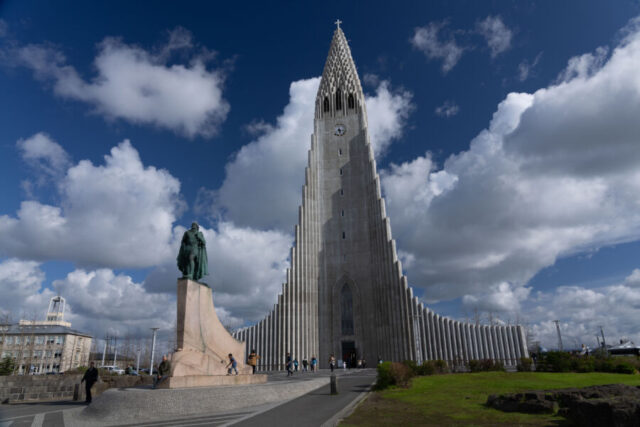
We scrambled around Reykjavík, chasing sun breaks in a desperate attempt to make this wet city look as pretty as possible. We lucked into a rare bit of blue sky to show off the landmark Hallgrímskirkja and Iceland’s parliament square — only to have dark clouds close in just as we were wrapping up shooting.
At one point, when sunbeams gave way to a deluge in a matter of 30 seconds, Simon muttered, “Forget about four seasons in one day…this is four seasons in one block!” This resulted in one of my favorite sequences in the show, as Rick says, “This is Iceland in July” (showing people sunbathing in lawn chairs). “…And so is this” (showing wet people miserably bundled up in Gore-Tex parkas).

Once Rick arrived, we continued our do-si-do around the weather. We scouted scenic locations where Rick could film his “on-cameras” (talking directly to the viewer).
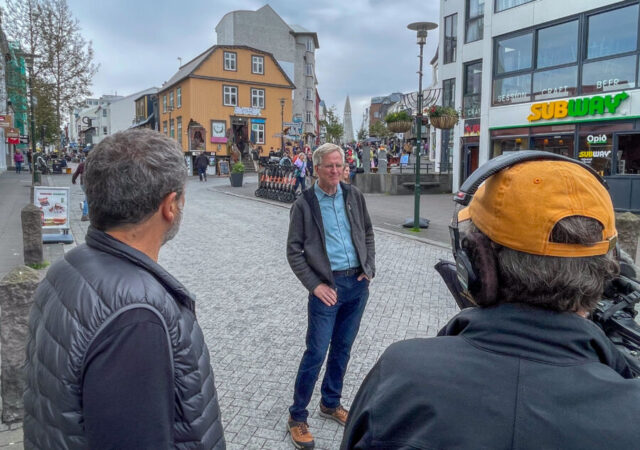
We also planned to film a segment with a local guide, who could help Rick (and our viewers) better understand the distinctive lifestyle. Our goal was not simply to wallow in well-trod Icelandic cliches, but to offer real insight into what makes Icelandic culture unique.

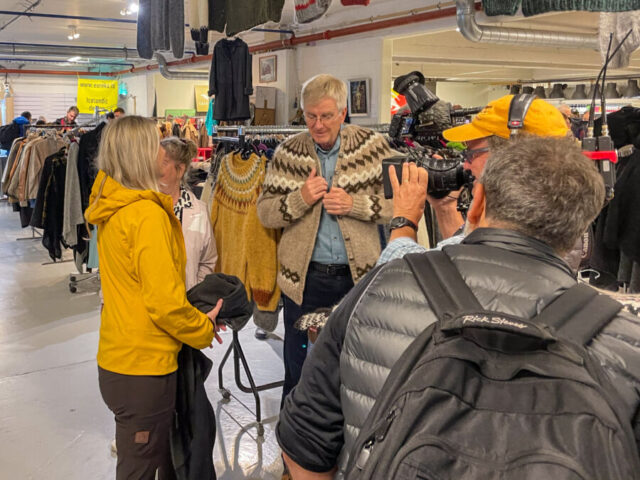
Saga, who runs a tour company called Viking Women,  joined us on a Saturday morning to guide Rick through the downtown flea market. When she showed him some Icelandic sweaters, his enthusiasm seemed hammed-up for the cameras. But it turns out, it was totally genuine; he even bought a sweater to take home (which left Simon’s jaw on the floor, as Rick almost never buys souvenirs). Rick explained that he has fond childhood memories of visiting relatives in Norway, which left him with a lifelong affinity for Nordic woolens — especially ones with pewter buttons.
Then we headed to the fish counter, where Saga encouraged Rick to sample some local specialties: dried-cod jerky (harðfiskur) and, of course, Iceland’s notorious fermented shark (hákarl) — which tastes like rotten fish with a pungent, lingering ammonia aftertaste. From behind the camera, Simon, Karel, and I were astounded, knowing that Rick had just the night before suffered through a nasty stomach bug…and now was going back for second and third takes on a bite that’s hard to choke down even when you’re feeling tip-top. He’s a true pro.

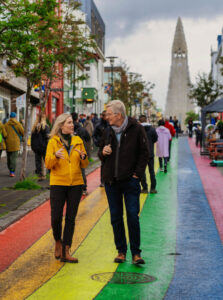
Then Saga and Rick strolled together through the back streets of Reykjavík. Hitting each point on our “wish list” for this interaction, Saga taught Rick a little Icelandic; showed off some street art, a Reykjavík specialty; explained the brightly painted, corrugated “iron” cladding that Icelanders wrap their homes in; and pointed out the many propped-open windows, which Icelanders use to keep the air moving when things get stuffy (thanks to the abundant natural geothermal energy they use for heating). It wound up being one of the best — and longest — segments in the show.
One item that didn’t work out quite as planned was the Blue Lagoon. That famous lava-rock spa is a touristic icon of Iceland. But we were torn: While the Blue Lagoon is an unforgettable experience, it’s also extremely expensive and almost entirely frequented by tourists. In our Iceland guidebook, we explain that most Icelanders skip these fancy “premium” spas and instead go for a dip at their community swimming pool — fed by natural thermal springs, just as hot as the Blue Lagoon, more fun and interactive, and about one-tenth the price.
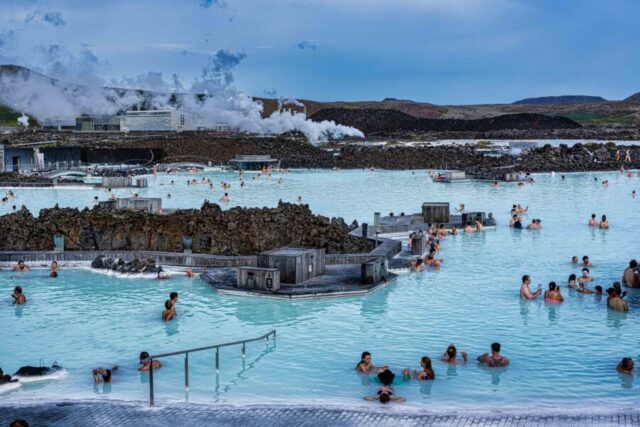
Originally, we thought we’d film Rick in both settings, to illustrate the range of options. But the Blue Lagoon turned out to be the most restrictive location on our list. When they finally responded to our many requests for permission, they were (understandably) concerned about the privacy of their many paying customers. Therefore, Rick could be swimming in one distant corner of the Blue Lagoon, cordoned off and with zero interaction with other bathers.

Meanwhile, we’d also made plans to film Rick at a very local-feeling pool in suburban Reykjavík, called Árbæjarlaug — my favorite of the half-dozen or so pools I’ve tried in the area. (TV scouting is hard work…but someone has to do it.)
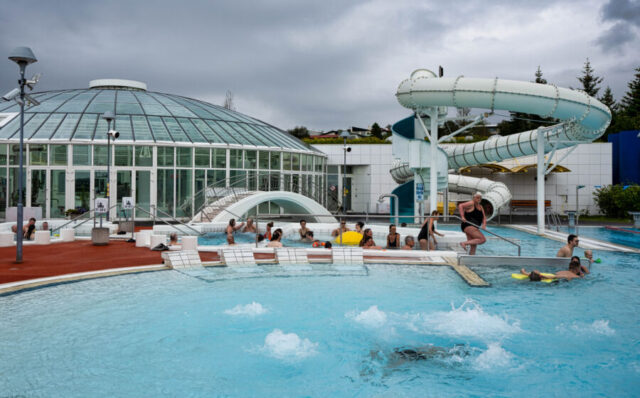
Upon arrival, it was clear that we were the only out-of-towners at the pool — not just that afternoon, but very likely the entire week. It was ideal for showcasing this unique facet of Icelandic life: Rather than heading to the neighborhood pub after work to gather with friends and family, Icelanders convene at a thermal pool. Rick and I got in, splashed around, and made some new friends, while Simon and Karel dutifully filmed. (As if on cue, just as Rick and I slid into the hundred-degree water, the skies opened up in a frigid, pouring rain. Imagine the contrast: Rick and I, swimming around with the Icelanders…piping-hot and soggy; Simon and Karel, huddling under a giant umbrella, desperately trying to keep the camera dry…freezing cold and soggy. We definitely owed them one.)

To cap this experience, Rick came up with a line to say into the camera — submerged up to his shoulders, positioned next to a waterslide with giggling kids. He explained the difference between premium spas (like the Blue Lagoon) and the neighborhood-pool option, finishing with the line, “And today, I’m soakin’ local!” (“I’m soakin’ local!” instantly joined Þetta reddast as our official motto for the shoot.)

With all of this wonderful interaction in the can, we realized we didn’t really need to show Rick luxuriating in the Blue Lagoon after all. We’re not shills for private attractions; rather, we’re advocates for travelers, equipping them with a sense of their options so they can make the best decision for their time and budget. So, one evening, we zipped out to the Blue Lagoon to shoot it from a distance, just to acknowledge it, but kept most of our coverage focused on the local pools. In the end, things worked out for the best. As they say… Þetta reddast.

Into the Countryside: Golden Circle, South Coast, and the Westman Islands

Work done in Reykjavík, it was time to head for Iceland’s big draw: its stunning countryside. Up until this point, we’d been dodging bad weather; if you watch Rick’s back-streets Reykjavík tour with Saga, you’ll notice they’re both drenched to the bone. While not ideal, this was acceptable for in-city sightseeing. But we were counting on bright, sunny skies to properly showcase Icelandic natural beauty at its finest. And on that count, we got very lucky: Right around the time we left the capital, the weather shifted, bathing us in sunshine for nearly the entirety of the shoot.
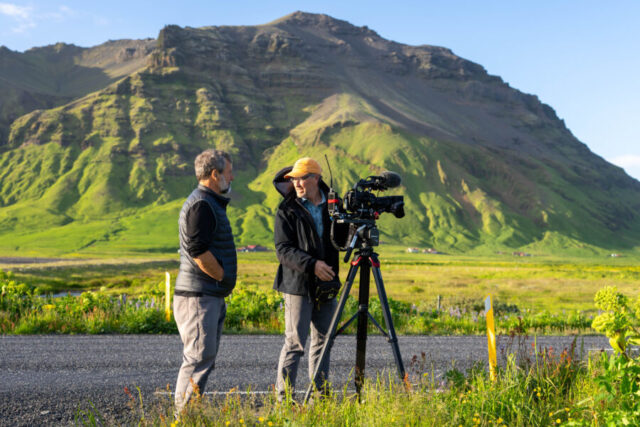
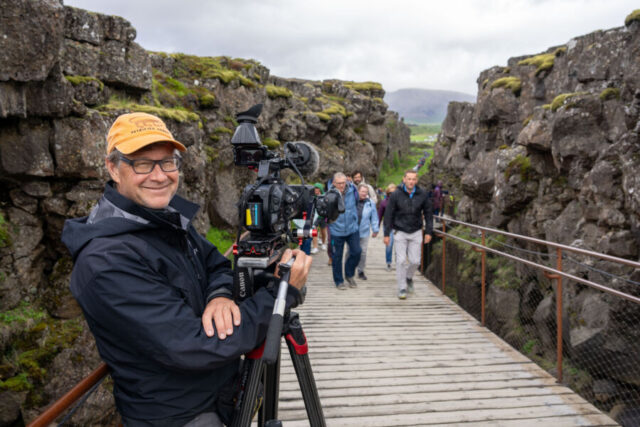
We drove the full Golden Circle (Reykjavík’s most popular side-trip) twice, on two separate days, to cover it well: the national park at Thingvellir (with a gorge that illustrates the tectonic fissure between Europe and North America); the simmering geothermal field at Geysir; and the thundering waterfall, Gullfoss.
Gullfoss was also the location of a particularly memorable mishap. We knew that Karel’s drone would be a must — to capture that epic scenery from a bird’s-eye view. We’d dutifully jumped through the administrative hoops (with Sunna’s help) to make sure we were legal. Before the trip, I read several warnings about the difficulty of using a drone in Iceland, due to the near-constant high winds. But we’d figure it out… right?

We wrapped up a very long day filming the Golden Circle at the epic Gullfoss waterfall, which tumbles into a narrow, dizzyingly steep gorge. This seemed the perfect occasion to get some aerial views using our drone. Karel set it up and took off, zipping high up to capture unbelievably dramatic footage looking down over the falls and canyon.

But then, within moments, the controller began to fire off multiple, simultaneous warnings: First, a “High Wind Warning” popped up on the screen. And then the “low battery” signal began to beep insistently. “Hm, that can’t be right,” Karel said, as Simon and I looked on nervously. “The battery was at 100% when I sent it up.”

To keep the camera steady, the drone makes constant, minute adjustments for the wind. And in Iceland, the wind blows so hard, and so erratically, that the drone’s battery was being drained at a dizzying rate simply to stay stable and airborne.

“Can you get ‘er back?” Simon asked, calmly as he could.

“Maybe,” Karel said. “She’s fighting me.”

We watched helplessly, holding our breath, as the distant, blinking light in the sky struggled to return to us — now heading directly into the battering wind. As the “low battery” alarm reached a critical point, Karel said, “It won’t make it back here, but I think I can drop it on the far side of the gorge.”

Yes, the gorge. We were on one side of the gorge below Gullfoss. And our drone was quickly descending on the far side.

“It’s down,” Karel said, finally. “But I think it’s OK.” We squinted through the waterfall mist and spotted a couple of twinkling lights, in the distant scrub. It was the drone. Not here with us, unfortunately. Not being rushed away by the waters of the Hvítá river far below us, fortunately. But on the opposite side of the gorge…quite inconveniently, just a few hundred yards right in front of us, but possibly unreachable.

“Can we get over there?” Simon asked. I was already on it, panning-and-zooming on Google Maps on my phone. It did appear that we could drive along one bank of the gorge; cross over to the other side; drive back on unpaved roads along the far side; and maybe… possibly… conceivably get to a place where we could park and hike to where we thought the drone had landed. I dropped a pin at its presumed location, we headed back to the car, and we set out.

The drive itself took close to 30 minutes — much of which was along unpaved, jagged gravel roads that pressed our two-wheel-drive car to its limits. We parked where the road ended and headed out on foot toward that dropped pin at the edge of the gorge, with the waterfall’s mist rising from the horizon.
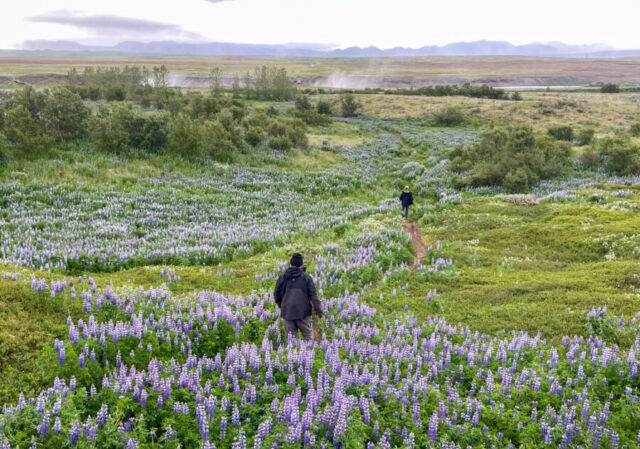
And as we walked, something beautiful happened: We realized we were traipsing through a stunning corner of unspoiled Icelandic nature. We were following a very old, virtually unmarked footpath — one that, clearly, exceedingly few hikers used. It curved between gloriously colorful fields of purple lupine flowers, over rocky but passable terrain, under a big sky.

We’d had a very long day’s work, so we were tired — but that also came with a sense of deep satisfaction. Whether or not we retrieved the drone, it had been an amazing day. And this unplanned hike through a stunning landscape was a bonus, which may or may not terminate at a treasure. It felt like a true adventure.

As we approached the edge of the gorge, Karel’s pace quickened. He began to almost run. And then, sure enough, hidden among rocks, there it was: the drone, intact, in one piece, battery depleted but fully functioning.
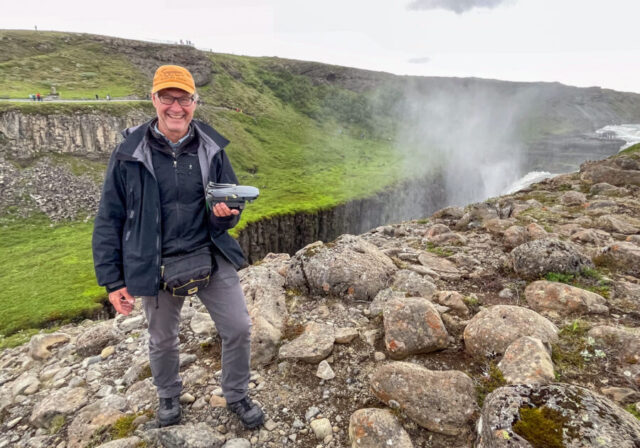
Better yet, we were standing directly across the gorge from where we’d started, a good 45 minutes earlier — enjoying a completely different view of Gullfoss and its canyon that 99.9% of tourists will never see.
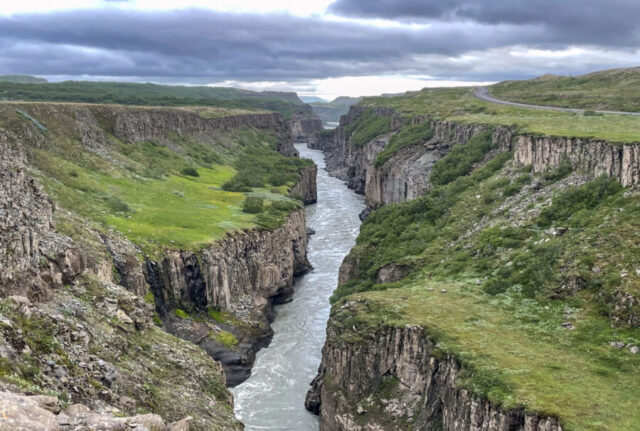
That experience taught us a few things about filming in Iceland. First, you must respect nature, here as nowhere else. We attempted to use the drone a few more times, and each time, the “low battery” light would kick on much faster than we expected. (And on future flights, Karel was much quicker to bring ‘er on home.)

But it also reinforced the idea that things work out as they should. We hadn’t planned for that extra drive and hike at the end of an already very long day. We returned to our hotel much later than we’d have liked. But in the end, we came away with a glorious memory. Once again…  Þetta reddast.

The errant drone was the biggest of just a few bumps we’d encounter on what turned out to be, by and large, a smooth shoot. The weather began to cooperate, and Rick and I had the wonderful experience of turning all of those big ideas about how to share Iceland with our viewers into reality.

One thing Rick was especially excited for was Thórsmörk (literally, “Thor’s Woods”) — a stark glacial valley accessible only by Super Jeep. We loaded into a monster truck, and our driver expertly forded several glacial rivers as we bounced around in our seats. It is, I believe, the first and only “off-road” experience ever filmed for Rick Steves’ Europe.
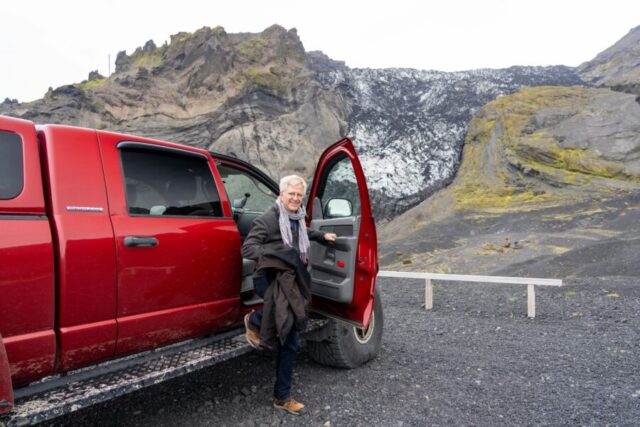
We visited the stunning Seljalandsfoss, Iceland’s most glorious bridal-veil waterfall, on a particularly fine day — with bright blue skies and sunbeams casting rainbows on the mist. And we filmed at the famous black-sand beach of Reynisfjara, just before howling winds kicked up a sandstorm.

On our final day with Rick, we enjoyed an epic all-day trip to the Westman Islands — a volcanic archipelago just off the South Coast. While Iceland is well discovered, these islands are the closest thing to a “Back Door” — frequented by a manageable number of in-the-know travelers, and within day-tripping distance of the capital (by plane) or South Coast (by boat).

In one very busy day, we wanted to tell the Westman Islands’ volcanic story — a dramatic 1973 eruption just above the main town — and show off its abundant bird life, especially puffins. Our guide and sidekick was Ebbi, who along with his wife, Íris, runs a local tour company, Eyjatours. With Ebbi’s and Íris’ help, we were able to pack everything in.
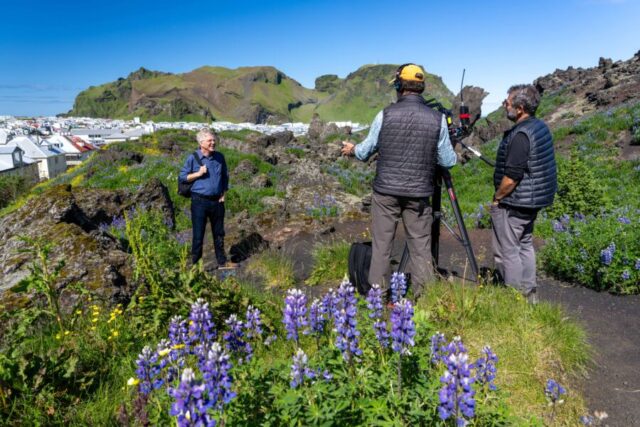
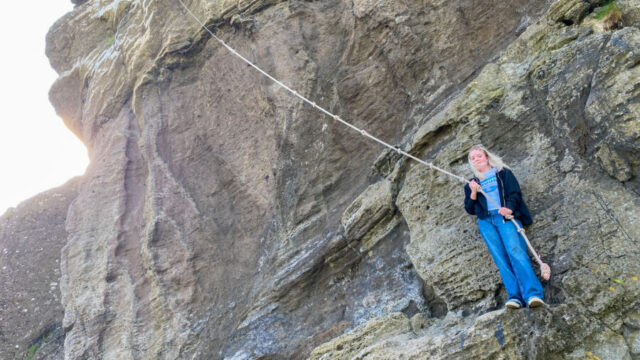
We wanted to show how islanders climb and swing on long, dangling ropes to reach bird nests perched in the crags of sheer cliffs. Ebbi normally demonstrates this for his tours, but we asked if he knew any local kids who might enjoy showing off their skills. Íris contacted a teenager named Aðalbjörg, who met us at the cliffs. Ebbi explained how islanders traditionally used these ropes to harvest sea bird eggs — a rare source of nutrition on this very sparse island — while, in the background, we watched Aðalbjörg swinging back and forth like Tarzan. It’s worth stressing that she was not “performing” for our cameras; young islanders are raised to swing on these ropes…even if, these days, it’s more for cultural heritage than for the eggs. In fact, while we were filming, a few young boys rode up on their bikes and — entirely unprompted by us — began swinging around on a smaller nearby cliff, just for fun.
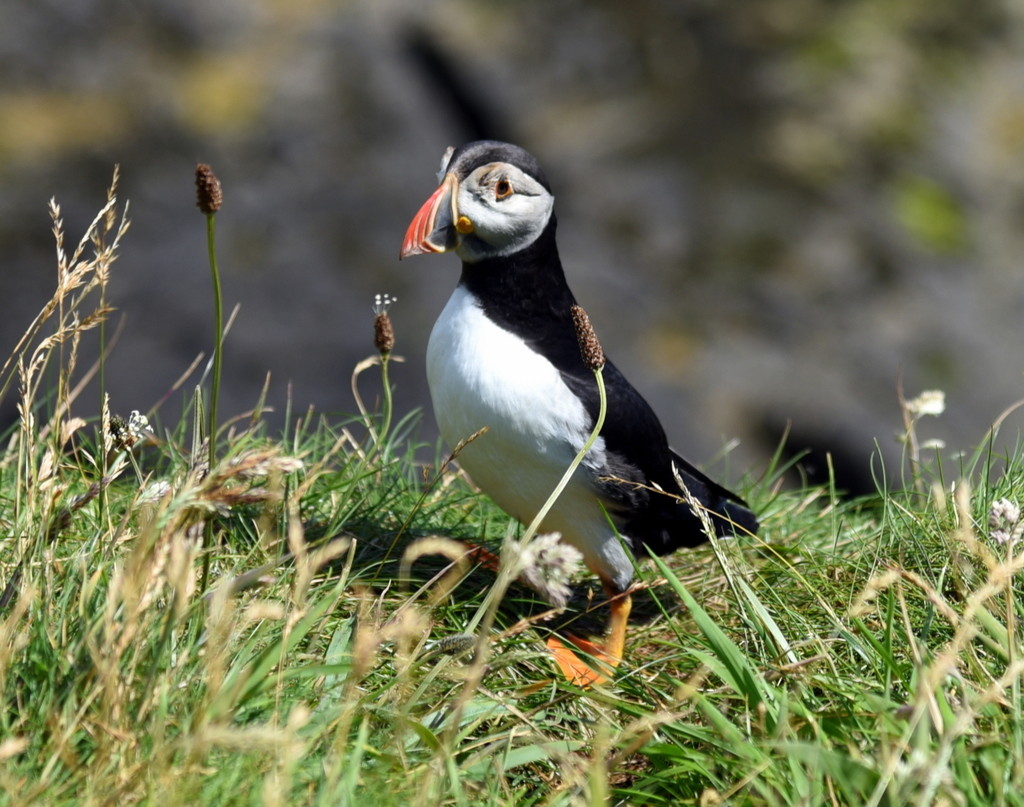
Then we drove out to the far edge of the island, to a green hillside where puffins roost. We sat on the grassy, hummocky hillside — looking out over the Atlantic — as Ebbi lovingly explained how migratory puffins spend their summers in vast numbers on these islands. We watched as adorable puffins careened through the air above us, then came in for an awkward landing.

“These hills are full of burrows, where puffins build their nests,” Ebbi explained. And just then, I heard a strange, almost otherworldly growling noise coming from below my butt.

“Ah,” Ebbi said. “I think you’re sitting on a burrow. There’s a puffin in there. I imagine he’s not happy.” Sheepishly, I scooted over a few feet, having had the new-to-me experience of irritating a puffin.
Cameron Scotland Island Hopping Staffa Puffins

Returning to our mainland rental cottage late at night, we were thrilled at having captured the Westman Island and South Coast on film. And now, it was time to head out on the rest of the Ring Road.

The Ring Road: Europe’s Most Epic Road Trip

Back when we were planning this journey, we knew that — given the long distances, and our ambition to cover Iceland completely and thoughtfully — it would be a longer-than-usual shoot. For most 30-minute TV shows, Rick and the crew spend six days filming. For Iceland, we’d film two such episodes, which would also be combined into a one-hour special. But rather than the standard 12 days, we’d need closer to three weeks.

Rick is a very busy man. And much as he’d have enjoyed doing the entire trip, that was more Iceland than he had time for. Early on, we came up with a plan: He’d join us in Reykjavík and its key day trips, including the South Coast and Westman Islands. And then, for the rest of the Ring Road — driving all the way around Iceland — Simon, Karel, and I would set off on our own.

The question was: How could we explain this to viewers? Wouldn’t they notice that Rick simply disappears three-quarters of the way through the show? Or should we try to “fake it” — film some on-cameras in places that resembled the far corners of Iceland? (This practice is standard for some “travel” TV shows. I’ve been told that at least one host films all of their on-cameras in their own backyard, while the crew does the rest of the filming on location…hostless. But that’s not Rick’s style.)

Simon came up with a solution: We’d be up-front with our viewers, explaining that Rick was heading out — and instead, they’d be following along with me as I did my guidebook-researching rounds. (You’ll notice that, in every shot I appear in, I’m clutching my little black notebook and scrawling notes — a subconscious reminder of why I’m there.)
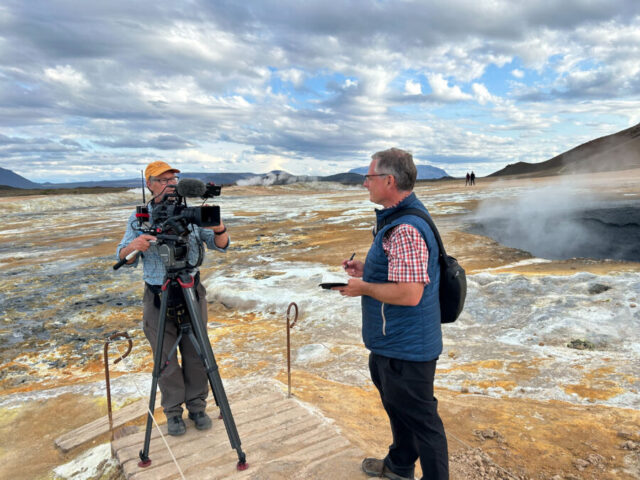
I was, naturally, extremely nervous about taking on this assignment — including having the camera pointed at me. But Þetta reddast, as always: It worked out beautifully, thanks to Rick’s generous and insightful coaching, and working with the best imaginable crew in Simon and Karel.
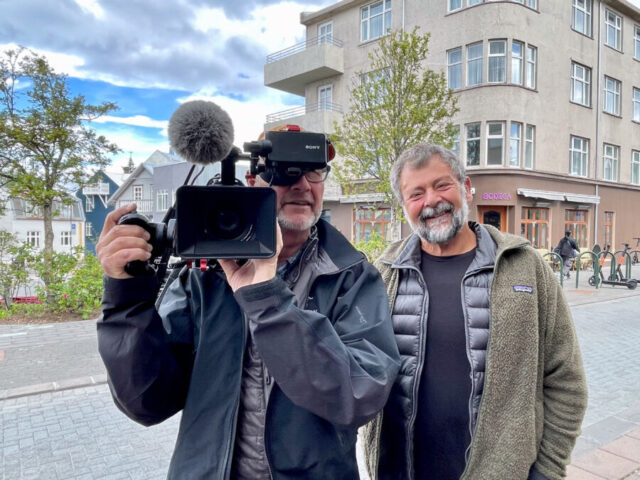
The three of us waved goodbye to Rick and hit the road, circling the entire island counterclockwise on the Ring Road. With Rick, we’d already covered over 100 miles of the Ring, from Reykjavík to Vík. That left nearly 700 miles to go — which we covered in six days. We had many four- or five-hour driving days in a row, interspersed with frantically busy bursts of filming natural wonders and fascinating folk museums, with mostly one-night stays en route.

This being early July, daylight was endless — making it easier to work and drive late into the evening, but all too easy to not even realize how tired we were getting until we were flat exhausted. Often we’d pull into a hotel at 9 or 10 at night — still broad daylight — only to be told that every restaurant within an hour’s drive was already closed. On multiple occasions, dinner consisted of a trio of hot dogs at the nearest gas station.

That said, it was a fantastic road trip — fitting for the wondrous Ring Road. Each stop, each day, and each turn in the road was more stunning than the last.

In the Southeast, we hopped on an inflatable boat for a cruise between icebergs in a glacier lagoon. It was the one stop on the entire Ring where we had rotten weather…and it was still gorgeous. (The family who joined us on the boat were doing the same itinerary as us, but in the opposite direction…and told us they’d had rain and cold every single day.)

Driving up the east coast — along the Eastfjords — we had to be choosy about where we pulled over to shoot the dramatic landscape. Coming around each bend, Karel’s eyes would pop out of his head. “Wow, Simon. That’s a great shot.” Simon, steady behind the wheel and knowing we had a tight schedule to stick to, would give it a quick assessment. If he agreed, we’d pull over and set up the camera. But more often than not, he’d keep on driving… knowing that an even better view was likely to unfold soon. Through a little trial-and-error — and having a clear sense of exactly what we were hoping to capture on film — we developed a good instinct for which views were worth braking for, which merited a U-turn, and which were skippable.
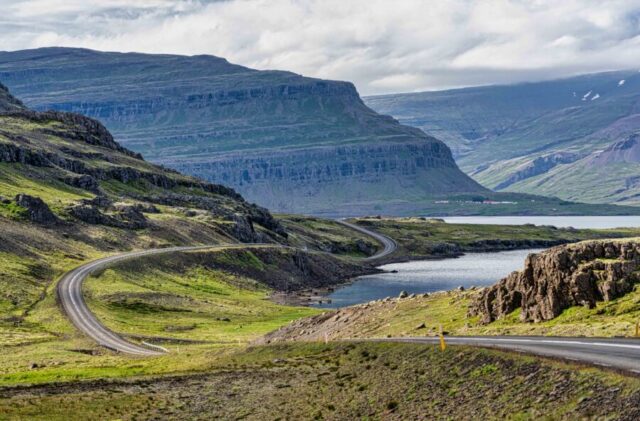
Reaching the northeast corner of Iceland — as far as you can get from Reykjavík without a boat  — we rounded the bend and looped back west along the North Coast, stopping at Mývatn — a giant lake surrounded by mind-bending geological formations…Iceland’s answer to Yellowstone.

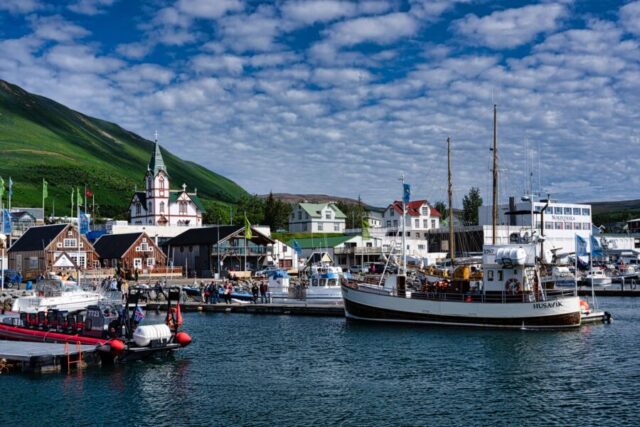
We took a short detour up to Húsavík, famous for its whale-watching industry. We were greeted by a dynamo named Orly, who serves as a one-man chamber of commerce for his tiny town. Orly explained how the traditional fishing fleet of Húsavík has been transformed into whale-watching boats, as we filmed people gearing up and chugging out to look for orcas and breaching humpbacks.

Húsavík is also familiar to some travelers as the setting of the Will Ferrell/Rachel McAdams Netflix movie about the Eurovision Song Contest — which was nominated for the Oscar for Best Song. In fact, Orly himself produced the live performance of that song, right here in Húsavík, that was broadcast globally during the Oscars ceremony. He took us to a fine viewpoint over the harbor, which also happened to be the location of a surprisingly good museum about the movie and the contest, and the Jaja Ding Dong Café, inspired by the film. The owner and proprietor of all this? Orly, of course.
While most of this (aside from the whale watching) was beyond the scope of our show, it illustrates the many fascinating and wonderful Icelanders we met as we toured their island. Even so far from “civilization,” this is a welcoming, endlessly entertaining place. (And I was able to graft some of what got left on the cutting-room floor into the new edition of our Rick Steves Iceland guidebook. That’s only fair, considering that the bulk of our Iceland coverage  was shaped by working on that book, over many years.)

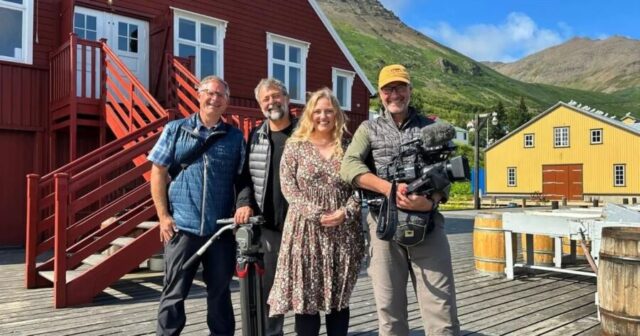
One segment that did make the cut was our visit to the Herring Era Museum, in the fjordside village of Siglufjörður. On a previous visit, I was captivated by the story of how, from 1903 to the 1960s, salted herring powered the Icelandic economy… representing fully one-half of Iceland’s total export income, and arguably leading to financial independence and full sovereignty. Our wonderful local guide Edda met us out front to show us the cutting and salting stations, then brought us inside to tour the dorms where the “herring girls” spent their time, waiting for the fishing boats to arrive so they could do their work. When filming travel TV, it’s so important to include local voices. And hearing Edda bring this obscure-to-us history to life, proudly describing the Rosie the Riveter-style herring girls, made it a segment to remember.
On our way back to Reykjavík, completing the Ring Road loop, we made a few more stops — including the turf houses at Glaumbær, and the glorious scenery of Snæfellsnes Peninsula.
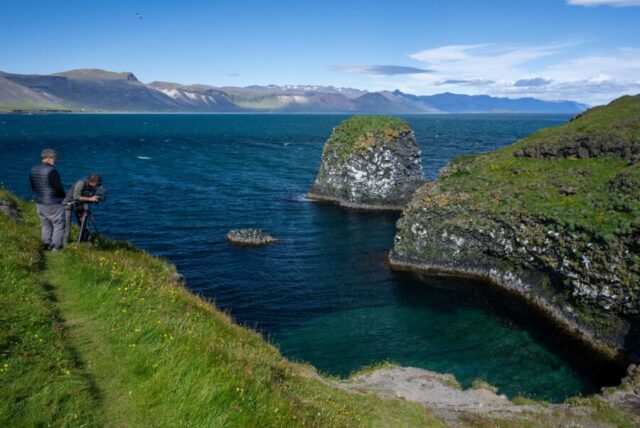
Our shoot was nearly finished. But Iceland wasn’t quite finished with us. Way back when we began in Reykjavík, we were already hearing news reports of small, mostly undetectable earthquakes shaking the western half of the island. It seemed that the slumbering volcanoes beneath the Reykjanes Peninsula — south of the capital, near the Blue Lagoon and international airport — were about to awaken.

As we drove around the Ring Road, we kept an eye on the news for the imminent eruption. And a few days before our trip wrapped up, sure enough, the earth opened up and began to spew molten rock. By that time, we were hundreds of miles away; even as our loved ones back home reached out to make sure we were OK (frightened by the “Iceland in Flames!” headlines), we knew that the eruption was distant, isolated, and effectively harmless.

As we entered the home stretch back to Reykjavík, finishing up our 800-mile journey, we kept our eyes peeled on the horizon. And sure enough, as the skyline of the capital came into view, beyond it we noticed a strange-shaped “cloud” that wasn’t a cloud at all…but a smoke plume from that volcano.
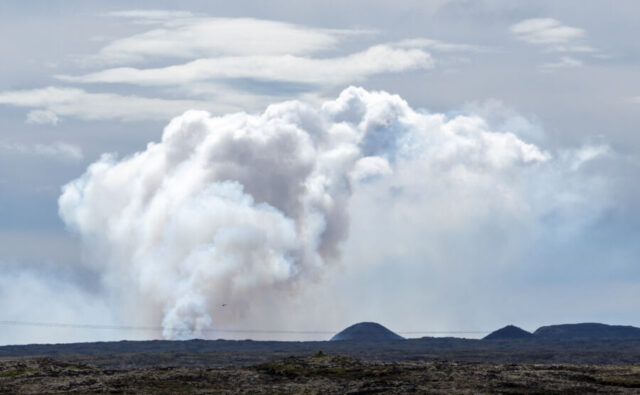
On our final night in Reykjavík, we watched the distant eruption from our hotel window, about 20 miles away — and marveled at how, even being so close, we felt totally safe. And the next day, our drive to the airport took us within a few miles of the smoldering eruption. Pulling over to get some footage, we realized it wasn’t that exciting, after all…just some distant smoke. It was a good reminder of how, even when an event grabs international headlines, the reality on the ground can be far less dramatic. And it left us with one last example of that motto: Þetta reddast…it always works out.
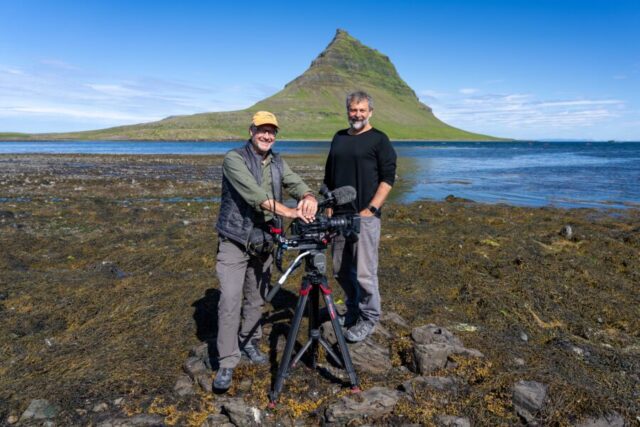
After our return, our ace editor Steve Cammarano stitched together that two-and-a-half weeks of footage into a tight and compelling one-hour tour of Iceland. The rough cut broke a record… tipping the scales at more than six minutes too long. But with a few judicious trims, and Steve’s editorial mastery, we wound up with a show that’s exactly the right length. And later, Steve whittled all that Iceland down even more to create the first two episodes of Rick Steves’ Europe Season 13.

In the end, we are thrilled to have captured a well-rounded look at this remarkable hunk of Europe, adrift in the North Atlantic — from volcanoes and glaciers, to puffins and whales, to fjords and mountains, to a fascinating and endearing Nordic heritage shaped by a hardscrabble history. This is Iceland. And I truly hope that you enjoy experiencing it on your screen as much as we enjoyed making it.


Rick Steves’ Europe Season 13 — starting with those two episodes on Iceland, then Poland, cruising on a Burgundian barge, and the great cities of London, Paris, Rome, and Istanbul — airs in the fall of 2025 on public television stations nationwide (and streaming on PBS Passport).

Or you can check out the one-hour Rick Steves Iceland in its entirety.

Planning a trip of your own? Pick up  our bestselling Rick Steves’ Iceland guidebook.

I’ve written tons of other blog posts, all about my travels around Iceland.

And if you enjoy these behind-the-scenes stories, pick up a copy of my memoir, The Temporary European — with a chapter about making our Romania TV show with Rick, Simon, and Karel.

Honest History Matters

Looking back on my recent travels, I’ve been thinking about what makes a country great. “Greatness” can mean strength and power. Or it can signify wisdom, maturity, respect, and an honest reckoning with the past.

In my travels, I observe a disparity in how various lands think about their history: Some societies acknowledge the more challenging elements of their past, while others only embrace the most flattering version of themselves.

As fractured as we are these days, I genuinely believe that good, caring, intelligent people can agree to disagree on a broad range of issues. Should the government take a heavy hand, or a light one, in collecting taxes, regulating guns or abortion, and guiding the trajectory of a society? What role should the USA play on the world stage? How much immigration is “too much,” and how should we treat those immigrants? You have your opinions; I have mine; sometimes they don’t align. That’s life in a healthy democracy. That’s what elections are for.

However, one thing that I believe is not a partisan issue — or, at least, shouldn’t be — is the fundamental truth of history. Facts matter. What happened, happened. And whether those events were good or bad, the only way for a society to evolve is to be honest about its past, warts and all. That’s why, when those who seek or hold political power begin to selectively reinterpret the past — dispensing with inconvenient truths — I find it alarming, not as a Democrat or a progressive, but as a patriotic American.

This is not a distinctly American challenge. Every country’s story is filled with both moments of virtue, and moments that are regrettable, even “evil.” As I travel from place to place, I’m struck by how each society makes intentional choices about how to reckon with their history. And over time, I’ve also seen how this can vary depending on the swing of the political pendulum.

And so, to provide some international context for the debates we’re having in 2024 USA, join me on a trip to a few case studies of how other societies have gotten this right…and, in my view, ones that have gotten it wrong.

Poland:  The Museum of the Second World War

In Gdańsk — the northern Polish city where World War II began — museum curators designed what was to be Europe’s definitive museum of the Second World War. It told the complicated story of wartime Poland, yes; but expanded its view to encompass a global perspective on the war, and how it affected various lands and peoples.

However, shortly before the museum’s scheduled opening in 2017, the ruling Law and Justice government — which felt the exhibit “wasn’t Polish enough” — intervened. They replaced the director with a political appointee, and installed a new mission to stir the patriotic souls of Polish taxpayers. New exhibits, mainly profiling Polish heroes and victims, were hastily squeezed into any available space. The intentionally ambiguous, thought-provoking final room was re-envisioned and now shows a rabble-rousing film (called “The Unconquered”) espousing a naively, almost offensively pro-Polish point of view.

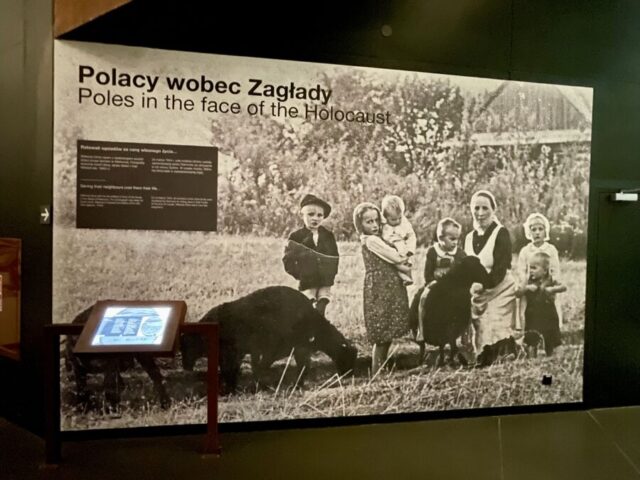
Revisiting the museum not long ago, I stumbled upon one exhibit that I suspect was added by the politicized director. At the entrance to a room filled with portraits of Jews who were murdered by the Nazis in Polish territory stands a wall labeled “Poles in the face of the Holocaust.” Posted information and touchscreens explained how Poles saved the lives of Jews, despite the fact that Poland was the only Nazi-occupied land where such assistance could be punished by death.

This is an inspiring story, to be sure. And there were many righteous Poles who came to the assistance of their Jewish neighbors. But there were also many Poles who colluded with the Nazis, and many more who turned a blind eye to their atrocities. Is it expecting too much for these facts to be acknowledged in the museum, as well?

Soon after, in 2018, the Law and Justice party made it illegal to state that the “Polish nation” was in any way responsible for the atrocities of the Holocaust, under punishment of prison. Under diplomatic pressure from the US Department of State, the law was later softened to remove the criminal component. However, a civil court can still prosecute “whoever claims, publicly and contrary to the facts, that the Polish Nation or the Republic of Poland is responsible or co-responsible for Nazi crimes committed by the Third Reach.” And so, an important part of Poland’s World War II story goes untold.

(It’s worth noting that Poland’s Law and Justice party was defeated in late 2023 by a centrist coalition; as new, more moderate leadership reshapes Poland, it will be fascinating to see if those changes ripple down to the displays of this museum.)

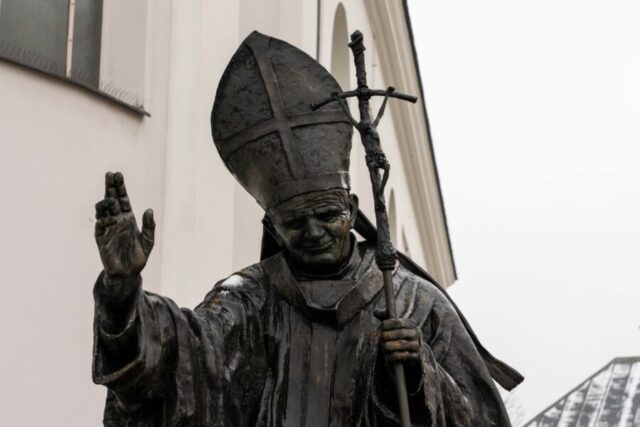
A few days earlier — at the opposite end of Poland, in the town of Wadowice — I toured the museum at the birth house of St. John Paul II. The slickly produced, inspiring, touching museum did a beautiful job of telling the life story of Karol Woytyła, who lost his parents at a young age, entered the priesthood, and eventually became the spiritual leader of one billion Catholics and a critical figure in the final ideological battles of the Cold War.

The museum tells this story so well, in fact, that I didn’t realize until after I’d left that it had omitted some important topics — specifically, the child molestation scandals within the Catholic Church that were covered up under Pope John Paul II’s watch.

Chatting with some Polish friends about this, I was reminded that these things aren’t as black-and-white as they may first seem. Yes, the Pope should have done more. However, John Paul II recognized that he was in a unique historical position as a high-profile crusader against Soviet oppression, and that he played a critical  inspirational role in the democratization of his homeland, Poland. Perhaps there were pragmatic reasons for him to avoid publicly addressing a scandal that would have undermined so much of what he was trying to accomplish.

I’m not entirely persuaded by this reasoning. But it certainly got me thinking more deeply about the full complexity of that chapter in Polish (and Catholic Church) history. I don’t believe “canceling” John Paul II is the answer. Rather, his legacy deserves a complete and nuanced discussion. And I regret that this museum is so reluctant to have that conversation.

History is made by “great” people who, like all people, are flawed. Even the greatest among us have blind spots and vulnerabilities; arguably, it’s a person’s ability to navigate complicated realities and make impossible choices that propels them to greatness.So then, why are we so afraid to be honest about those flaws?

Germany: Documentation Centers and Holocaust Memorials

Let’s cross the border, to a country that dispenses with the kid gloves when handling its own history. In my travels, I have encountered few societies that more conscientiously grapple with their checkered past than Germany. Yes, Germany.

Even to this day, when many people think of Germany, one of their first associations is along these lines: backed a lunatic dictator; tried to take over the world; murdered millions through genocide and conquest; destroyed much of Europe.

Resenting Germany for their crimes in World War II and the Holocaust is understandable, even deserved. But in my 25 years of traveling around Germany, I’ve been impressed by their willingness to be open, candid, and contrite about their history. They even have a term for it: Vergangenheitsbewältigung, “coming to terms with the past.”

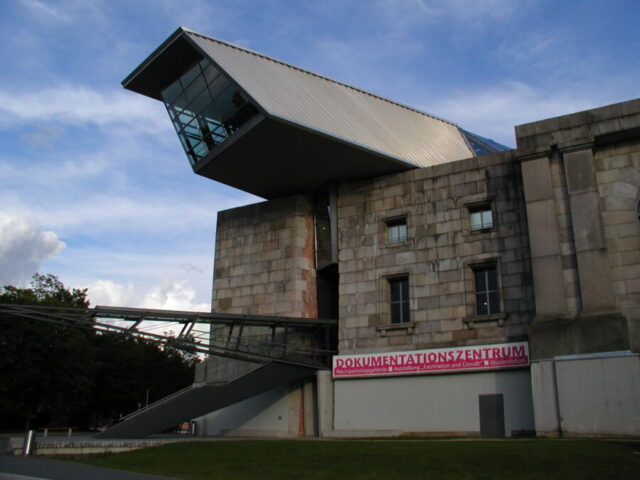
Throughout Germany, I’ve visited perhaps a dozen different “Nazi documentation centers.” That’s a buzzword for a museum that offers a thoughtful, entirely transparent, and no-holds-barred assessment of Germany’s culpability in its crimes of the 20th century. It’s a fascinating exercise in the defendant presenting an ironclad case on behalf of the prosecution. Germany’s documentation centers confront visitors — both German and foreign — with abundant, meticulously collected evidence, always compelling and often gruesome, of their own crimes. No excuses are offered, and there isn’t a whiff of defensiveness — just a matter-of-fact mea very, very culpa.

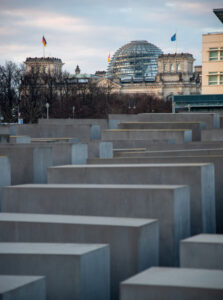
In the German capital of Berlin, immediately adjacent to the landmark Brandenburg Gate and just down the street from the Reichstag stands a sprawling monument consisting of 2,711 stony slabs. The Memorial to the Murdered Jews of Europe, occupying this privileged position in the very heart of Germany’s leading city, is just one of countless memorials, large and small, all across the country, that constantly remind Germans of their historical crimes.

It’s hard to imagine that a country could ever “do enough” to make up for such heinous acts. But as a frequent visitor here, I’m impressed. Even younger Germans — now generations removed from these atrocities — may grow a little weary of these constant reminders. And yet, they recognize that this is their legacy.

The Netherlands: Dutch Resistance and Colonialism

Next door is a country that was occupied by Nazi Germany: the Netherlands. And on a recent visit to Amsterdam, I was struck both by how the Dutch are honestly reckoning with their role in history…and how they still have a ways to go.

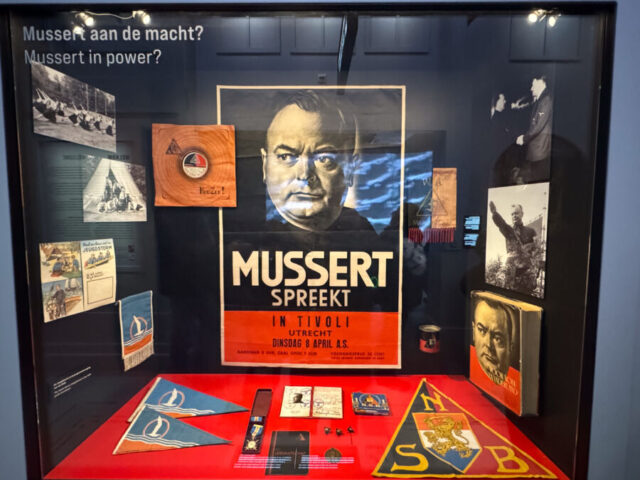
The recently re-envisioned Dutch Resistance Museum traces the story of the Netherlands under Nazi occupation. It’s an exercise in stirring the Dutch patriotic soul with tales of both suffering and valiant resistance — much like the World War II museum in Poland. But, to its credit, the Dutch museum also owns up to aspects of that story that some might prefer to dismiss.

Early on, the exhibit takes pains to introduce us to Anton Mussert, who led the NSB, the local version of the Nazis. And it unflinchingly explains that 25,000 young Dutchmen volunteered to join the Waffen-SS, accepting Hitler’s invitation to stand with him in “Germanic Brotherhood.” After the war, at least 120,000 Dutch collaborators were arrested.

Of course, questionable Dutch deeds extend much farther back than the 20th century. As one of Europe’s great colonial powers, the Netherlands was fabulously wealthy in the 17th and 18th centuries. Amsterdam’s ornate city center — with its concentric canals, stately townhouses, grand museums and palaces, and gilded carillons — was financed primarily through plundered resources, the exploitation of human labor at the far ends of the globe, and Dutch participation in the transatlantic trade of enslaved human beings.

This is an aspect of Dutch history that many visitors (and, until recently, even many Dutch people)  gloss over. But that is now changing. In 2023, the former Tropenmuseum (“Tropics Museum,” built nearly a century ago to show off colonial riches to Dutch citizens) was re-envisioned as the “World Museum.” Many of those same artifacts from former Dutch holdings — as far afield as Indonesia (the “East Indies”) and the Caribbean (the “West Indies”) — are still on display. But now they are given proper context, explaining the lives of the people exploited by the Dutch, from their own perspectives.

On the one hand, it’s impressive to see the Netherlands making these strides: For example, then-Prime Minister Mark Rutte (in 2022) and King Willem-Alexander (in 2023) have both formally apologized for the Dutch role in the slave trade. On the other hand, like any society, not everyone is comfortable with the changing times. The Dutch sidekick to Santa Claus, Zwarte Piet (“Black Pete”), is still usually performed by a white man in Blackface — and in a recent poll, more than half of Dutch respondents continue to support Zwarte Piet’s traditional appearance. And in November of 2023, an anti-immigrant party took the highest total of seats in the Dutch parliament.

Progress sometimes comes in fits and starts…but it’s progress.

New Zealand/Aotearoa: Waitangi Treaty Grounds

On a recent trip to New Zealand/Aotearoa, I visited the Waitangi Treaty Grounds on the Bay of Islands. This is essentially the birthplace of the modern nation of New Zealand, where local Māori tribal leaders signed a treaty with emissaries of the British crown to establish formal colonies on the island. Today you can walk across the grassy field where the treaty was signed, but only after you’ve toured a powerful, beautifully curated museum.

The museum is the best implementation I’ve seen of a “dual narrative” approach — equally weighting the perspectives of both the Māori and the English to tell a complete story. In fact, for most of the exhibit, you see the Māori point of view on one wall, and the English point of view on the opposing wall. It’s fascinating to experience the history of this island through the eyes of its two dominant groups, simultaneously — a parallax view that is both informative and moving.

In the darkened hall that displays the actual treaty, exhibits detail how the document was translated misleadingly into the Māori language. Key concepts like “sovereignty” were phrased in such a way to give Māori leaders the impression that they, and not the Queen of England, were still essentially in control of their island.

I was impressed and inspired to see a society that — rather than try to spin past events in a way that would present the European settlers in a flattering light — plainly acknowledged their misdeeds: We misled the people who were here first. And we were wrong.

New Zealand inspires me. It’s perhaps the planet’s most forward-thinking nation when it comes to the rights of its indigenous population. This national conversation began in earnest in the 1970s — on the one hundredth anniversary of the Treaty of Waitangi — and much progress has been made. While “reparations” is an abstract and hard-to-sell idea when it comes to the descendants of enslaved Black people in the USA, in New Zealand, it’s a reality: Vast tracts of the country’s land has been formally returned to Māori control. While there’s certainly more to do, New Zealand is making real strides in owning up to its historical crimes.

And this trickles down to everyday life, as well. Increasingly, Kiwis from both Māori and European backgrounds are embracing the indigenous name for their archipelago: Aotearoa. Kiwis, regardless of their background, greet each other with a cheery “Kia ora!” — evoking the Māori origins of the land upon which they all reside together today. As an American, this inspires me to do better — so much better. (And if we need a role model closer to home, we need only look to our northern neighbor —  Canada has made impressive gains in better acknowledging the rights of its First Nations peoples.)

Hungary: Slide from Democracy

Now let’s cross hemispheres again, to a place that may be one of the worst-case scenarios for a society retconning its own narrative: Hungary.

Since first taking power in 2010, Prime Minister Viktor Orbán and his party, Fidesz, have aggressively revised history to suit their nativist political agenda. An exhaustive list of examples could fill volumes. But even just as a traveler who drops into the country every year or two, I’ve seen the effects firsthand: streets and squares renamed for obscure historical footnotes;  the vast plaza surrounding the Parliament building completely transformed with new monuments and memorials; and, perhaps most alarmingly, a wholesale revision of the national school curriculum to ensure that the version of history taught to every Hungarian student is perfectly in line with the Fidesz agenda.

And what is that version of history? Essentially, it’s the most flattering possible view of Hungary. Fidesz history presents the country either as a heroic warrior, or a tragically maligned victim of foreign aggression, full stop. Orbán’s story of Hungary is designed to instill unquestioned pride and patriotism: We have always been in the right, just as we are today.

Here are just three examples:

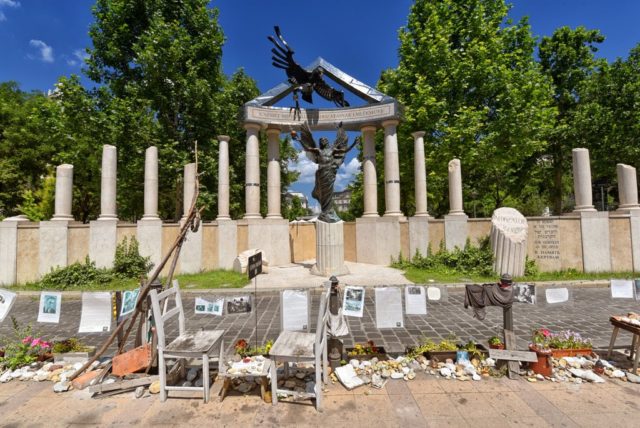
On Liberty Square, Fidesz erected a melodramatic monument to the “victims of fascism.” It’s overloaded with symbolism suggesting that Hungary was a peace-loving land, minding its own business, until Hitler invaded in 1944. In front of the monument, locals have assembled their own makeshift counter-monument — documenting how, in fact, Jews were terribly mistreated by Hungarian authorities, and tens of thousands were deported to certain execution by Hungary’s pre-Nazi leadership.

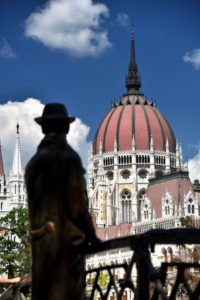
A couple of blocks away once stood a beloved statue of the communist reformer Imre Nagy, casting his judgmental gaze over the Parliament. However,  there was a problem: Nagy may have led the 1956 Uprising against the USSR (and was later sham-tried and executed). But he was also a communist himself, who sought reform from within. The Fidesz worldview simply can’t tolerate such nuance. Nagy was a communist; all communists are bad; therefore, we must remove Nagy’s statue from this favored location. Under cover of darkness and without any warning, one night in the waning days of 2018, it was relocated far from the Parliament.

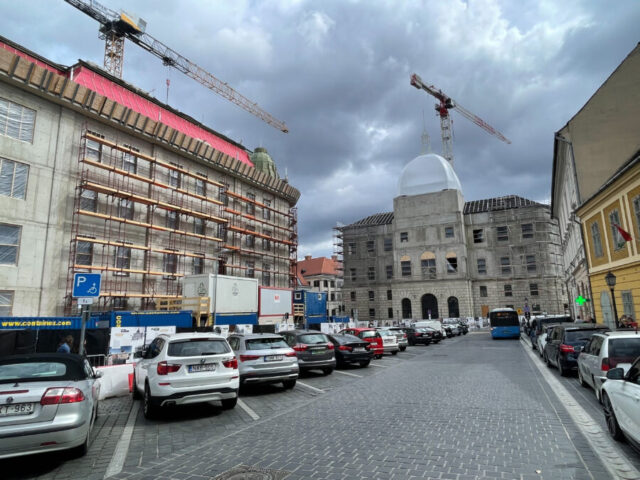
Up at Buda Castle, Orbán has moved his office into the former National Dance Theater and is busily redeveloping the castle quarter, transforming it into his new seat of government. Old buildings — destroyed in World War II and never rebuilt — are being re-created from scratch, with little rhyme or reason. It’s a hodgepodge that randomly juxtaposes buildings from this and that era, based on how pretty or grand or imposing they look rather than their actual role in history — an almost too on-the-nose embodiment of this cherry-picking approach to Hungarian history.

Orbán has become a darling of certain corners of the American right.  Perhaps those Orbán supporters should travel to Budapest, talk to Hungarians on the street, and observe how his approach has eroded two decades of fragile progress in recovering from totalitarianism…including the distorted, oversimplified way that Hungarians are encouraged to view their own complicated history.

Bristol: The Empty Plinth

A couple of years ago, on a dreary late-winter morning, I wandered around Bristol, England, piecing together the story of Edward Colston. This fabulously successful Bristolian grew the wealth and reputation of his home city, largely through his participation in the slave trade.

Colston is one of many historical figures who became a flashpoint during the global Black Lives Matter protests in the spring and summer of 2020. You may recall how a giant statue of Colston was toppled by protesters, dragged down the hill, and dumped into the harbor. (Later, the statue was dredged out of the harbor and displayed in a local museum.)

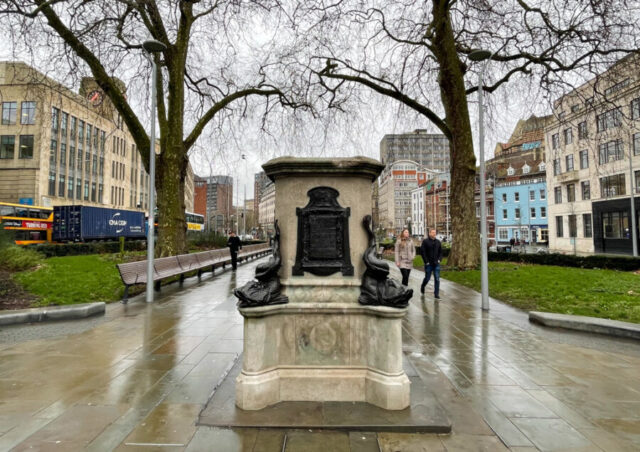
On my visit to Bristol, about two years after this event, I found myself following breadcrumbs of Colston’s legacy around the city. The plinth that once held Colston’s statue — and boldly declared him “one of the most virtuous and wise sons of [the] city” — stood empty. In a parish church, stained-glass windows honoring Colston had been removed; a nearby information panel explained this decision. And in a city history museum, Colston sneered out from a composite painting of prominent Bristolians. His image was identified completely, and accurately: “Slave trader; merchant and philanthropist.”

Back home, we’ve had debates about whether and how we should remove statues honoring problematic historical figures, whether they be Confederate generals or slave-owning Founding Fathers. You may believe that tearing down these statues is just as bad as what Poland or Hungary is doing. But observing Bristol’s approach demonstrates that it’s possible, even responsible, to remember these figures — completely and honestly, in all of the ways they both aided and harmed others — without honoring them. The challenge — one that Bristol rose to — is to find a constructive way to preserve history without remaining beholden to it.

Should we replace those statues with carefully worded plaques, offering a more complete and nuanced explanation of their role in history than simply “virtuous and wise”?  Should the statues be collected into an open-air museum (as Budapest did with its communist statues, in Memento Park), so those generals can preach their racist ideology to each other, removed from polite society, without needlessly confronting passersby? Should we create a Museum of American Racism — a series of Slavery Documentation Centers — that detail the shameful crimes of our past, as a reminder and a warning to Americans in the present and the future?

Again, Bristol inspires me to do better.

Back Home: The United States of America

After hopscotching around our globe, we return home to the United States of America. With the benefit of comparing notes with other societies, how does the USA measure up?

When we’re at our best,  we make strides toward reckoning honestly with our past sins. The Museum of African American History in Washington, DC, for example, does a beautiful, complete, and even-handed job of telling the story of Black Americans and their ancestors.

Juneteenth — a celebration that originated in the Black community to commemorate the abolition of slavery — is now a federal holiday, and more and more organizations (including Rick Steves’ Europe) show their respect by closing their offices for the day.

And even in my own lifetime, I have observed the USA doing a more honest job of acknowledging our genocide against Native American tribes — though nowhere near to the righteous degree of New Zealand/Aotearoa or Canada.

However, in recent years — as the political pendulum swings to dizzying extremes — I fear that we are facing a rising tide of people who would prefer to simply edit out the most uncomfortable details in our national narrative.

In some states, textbooks are being rewritten to downplay our heritage of slavery and racism. These days, ambiguity and intentional omission trump clarity and specificity in explaining to our children exactly how certain people have been treated by our country, and still are, and why.

Critical Race Theory (CRT), paired with the deathly curse of “woke” — both concepts that originated in the Black community — have been appropriated and cruelly weaponized. Terms like these have become an excuse for (mainly) white Americans to shut down any healthy conversation about our shared national narrative that makes them uncomfortable.

Look: I’m not interested in wading into the “woke culture wars.” In fact, I’m sticking to my guns: The importance of history can and should be a nonpartisan issue. History matters, to everyone, even if they don’t realize it. And an honest and frank acknowledgement of the facts of history, by any society, is always a good thing. History tells us where we’ve been, and it helps us figure out where we’re going.

I believe this even more strongly having traveled to places where people grapple constructively with their history, and to places where people would rather hide from it. And I’m here to tell you: Societies in the first group are stronger, healthier, smarter, more successful, and more respected on the world stage than places in the second group. Honesty can be painful, but it’s how we grow and become better.

If you believe that contemporary Germans owe it to the world — and the six million Jews their ancestors murdered in gas chambers — to continue to reckon with their past crimes; if you think that child molestation scandals deserve to be acknowledged in a retelling of the life of John Paul II; if you respect the Dutch for including the stories of collaborators along with stories of victims and uprisers in their Resistance Museum; if you admire the Kiwis for acknowledging that their island was deceptively taken from people who’d been on Aotearoa for centuries earlier; if you think it’s a shame that Viktor Orbán removed the statue of a great communist reformer just because he was also, technically, a communist; if you appreciate Bristol’s nuanced approach of remembering Edward Colston without honoring him — then you should also be willing to face the discomfort of teaching our children about America’s shameful heritage of slavery and racism, and so many other topics that deserve open and frank conversation.

When you brush aside inconvenient realities, they don’t simply go away. They just fester, impacted and infected. They wait there, only getting uglier and worse, slowly beginning to stink, until they’re eventually kicked up again by some future generation — and have become an even worse problem to deal with.

It’s very easy to see blemishes when looking at other cultures, from afar. It’s much harder to see them when we look in the mirror. But we owe it to ourselves, and to future generations, to avoid the temptation to slide into denial. So the next time someone tries to dodge a conversation about less-than-noble elements of our past, consider asking them: Why does it make you so uncomfortable to reckon honestly with our nation’s history? Because that’s what healthy, functioning societies do.

In fact, it’s what makes a country great.

In Europe, It’s the Little Differences

When you’re on the road in Europe, sometimes it’s the little differences that resonate the most: pragmatic, clever solutions to everyday problems that inspire you to do better back home.

I was reminded of this recently while updating our Rick Steves guidebook in Amsterdam. On a sunny day, I was enjoying a stroll through Vondelpark when I spotted an unusual garbage can, which appeared to have a built-in beverage caddy.

Suddenly I realized the purpose: In the Netherlands, to encourage recycling, they charge a €0.15 deposit when you buy any drink in a bottle or can; then, when you return the container, you recoup the deposit.

Of course, many places have a similar deposit system, and have for a long time. (Who could forget the classic Seinfeld where Kramer hatched a scheme to take a mail truck full of pop cans to Michigan to claim the 10¢-per-can deposit?) What struck me was the simple wisdom of making it easy to leave unwanted containers so that they’re easier to collect by someone else — presumably, someone who could use the money.

This little eureka thrilled me. As someone who tries to be a conscientious traveler, I often feel conflicted when finishing a bottle of fizzy water or Coke Zero. The recycler in me hates to stick in the garbage; the efficient traveler in me hates to carry it around (since I typically don’t carry a day bag, it has to jab awkwardly out of my pocket); and the humanitarian in me wishes I could hand it off to someone who’d appreciate the deposit. These “donation rings” (doneerringen)  — really just a few pieces of well-designed metal — are a simple, pragmatic, effective solution.

It solves other problems, too: Elsewhere in Amsterdam, I saw garbage cans (not yet equipped with donation rings) that had been rifled through, with trash strewn across the sidewalk. Clearly someone had gone looking for deposit containers in a way that was degrading to them, while also created a mess. So even if all you care about is a tidy city, donation rings are a no-brainer.

I snapped a photo of the donation rings, spent a few minutes tapping out a post about this little observation, and put it up on Facebook and Instagram, where I like to share these little epiphanies and insights as I travel. The initial response was enthusiastic — similar to my, “Wow, cool idea!”
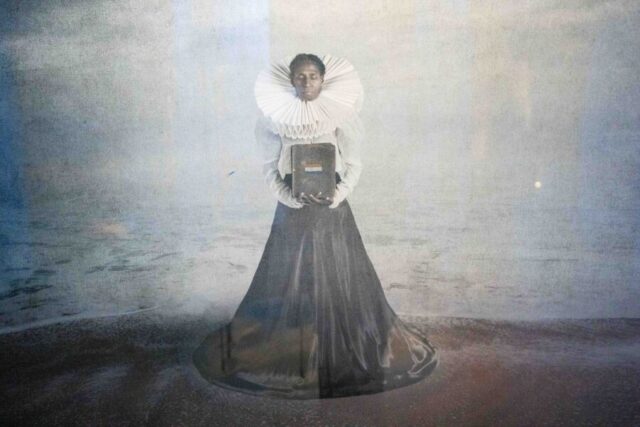
Then a surprising thing happened. A few days later, in the middle of the night, the post went viral. It’s now been seen by more than 10 million people and “liked” by more than 150,000 — which are ludicrous numbers for someone with my modest following. That photo of a garbage can, and a few short, hurriedly composed paragraphs of text, may be the most-read thing I’ll ever write. (One colleague teased me, “This trash can will clearly be your legacy.”)
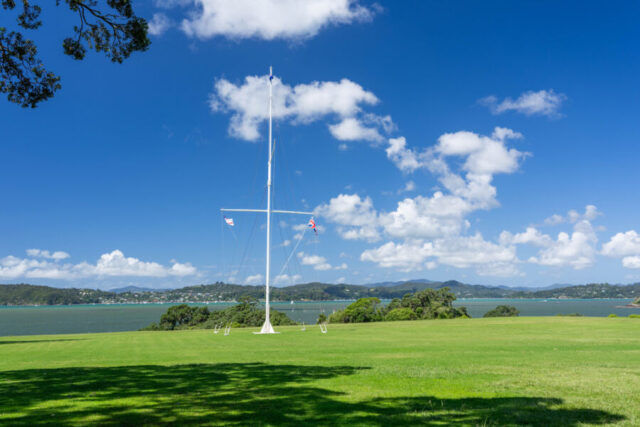
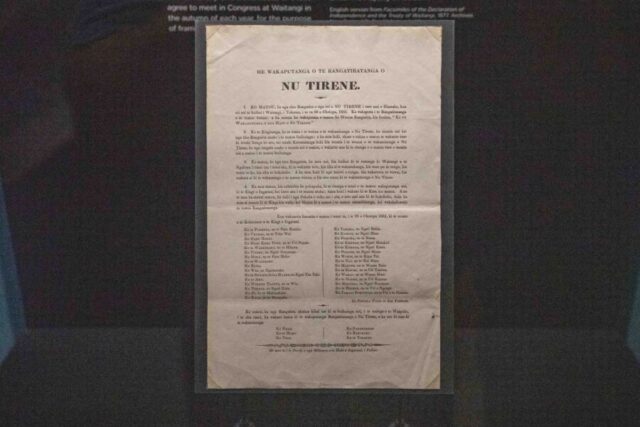
The responses were fun to sift through. Several people (in Portland, Canada, Germany, Denmark, Australia, and elsewhere) wanted credit for having a similar system on their garbage cans. (Noted!) Others pointed out that it would be even better for society to provide a proper safety net, so that people didn’t have to resort to collecting deposit containers. (Agreed! This is a band-aid, albeit a clever one.)

But the consensus was simply this: Great idea! Wish we had that here. Several commenters even CCed their local authorities. If this little post winds up inspiring a few communities to look into donation rings…I consider that a very good day’s work.

This whole episode — along with threatening to brand me “the donation rings trash can guy” for the rest of my career — reinforced my sense that when we travel thoughtfully, attentively, and with our mind and our eyes open, we notice little differences in the way societies operate. Some of these ways, we may find impractical or annoying. But many times, they can be an inspiration…even an epiphany.

§     §     §

In my recent travels, I’ve been making a point to tune into these different ways…and, where possible, to share them with others. Here are just a few examples.

Just a few days before flying to Amsterdam, I was waiting for my boat in Venice when I cracked open a much-needed bottle of ice-cold sparkling water. No matter how hard I turned the bottle cap, one little plastic filament stubbornly kept the cap attached to the plastic ring around the neck of the bottle. In that moment, I realized I’d been running into this same hiccup throughout my time in Italy, and that I’d even noticed it the previous fall in other parts of Europe. At first, I chalked it up to faulty design…a defect. But it was so consistent, it must be intentional.

A little Googling turned up the answer: As of 2024, the European Union requires these “tethered caps” on all single-use plastic bottles. It’s intended to keep the entire bottle intact, as one unit, for easier disposal and recycling. Yes, it takes some getting used to. But when you imagine all of those little plastic bottle caps rolling around the cobbles, piazzas, and gutters of Europe — not to mention, getting lodged in the esophagi of untold numbers of woodland critters and sea life — tethered caps seem a very smart solution.

Also in Italy, I was reminded of the tiered pricing system at cafés: You’ll pay more (in some cases, much more) to sit out on the piazza, rather than if you stand at the counter inside. In fact, even at the grandest of grand cafés in Italy, you can always get a simple espresso (un caffè) at the counter inside for just over €1.

Testing this rule of thumb, I waltzed past the dueling orchestras on St. Mark’s Square — some of the most expensive real estate in all of Italy — and into a venerable café. Inside at the counter, I ordered a caffè macchiato, then stood in the opulent interior as I sipped it. My bill came to €1.50.

As I left, I checked the price for the very same drink at the outdoor tables: €12, plus a €6 cover charge. If you’re lingering over the amazing views and the music, this is a worthwhile investment. If you just want a quick coffee, those prices are absurd. This “progressive taxation” approach to pricing drinks has a certain pragmatic beauty; you pay based on your experience. (And it’s also a great tip for budget travelers.)

Some of these smart solutions are Europe-wide. The EU has a draconian “Air Passenger Rights” policy that protects travelers from having their valuable time wasted by airlines. Strict guidelines mandate what an airline is required to provide to a passenger whose flight has been delayed or cancelled. If I ran an airline in Europe, this would make me pull my hair out. As a frequent air passenger in Europe…I absolutely adore it.

And I have directly benefitted from it. Last year, my wife and I were flying from Seattle to Norway by way of Amsterdam, with a tight connection. The good news: Our first flight was a few minutes early. The bad news: Our connecting flight had already been cancelled due to a technical problem, with no further flights scheduled until the next day. We got nervous, imagining being stranded for hours — maybe overnight — at Schiphol Airport, missing out on reservations we had waiting for us in Norway.

But the Europeans in the waiting area with us seemed unconcerned. One of them pulled out her phone and called up a page with the details of the EU policy. “No worries,” she said reassuringly to her husband, and to all of us antsy eavesdroppers. “If they delay us for more than three hours, they have to pay each of us €250. They won’t let that happen.”

Sure enough, within minutes, they allocated a different plane to take us to our destination, and boarding commenced almost immediately. Soon we were loaded on a bus and zipping across the Schiphol tarmac to our plane. And we wound up arriving in Norway just 45 minutes after our scheduled arrival time — even with the equipment change. Without the financial accountability mandated by that policy, I’m certain we’d have been cooling our jets for much longer.

Let’s head back to the Netherlands, which seems to be one of Europe’s top incubators for these everyday innovations. The Dutch are pragmatic, solution-focused, and early adopters, to the degree that they sometimes leap before they look. When I’m updating our Rick Steves Amsterdam guidebook — as I was on this trip — frankly, it can get exhausting. There’s always some cutting-edge new technology that’s been rolled out. And, often, by the time we come back a couple of years later to do our next round of updates, that Hot New Thing has already been abandoned and replaced with the next trend.

For example: Contactless or “tap-to-pay” credit card and smartphone payments on public transit are widely used throughout Europe and around the world. But the Netherlands, as far as I know, is the first and only European country where you can pay for every single ride on public transit (whether in-city trams, buses, and Metro, or intercity trains and buses) simply by tapping your existing credit card. Using this system (called OVpay), you never have to buy a ticket.

Of course, I needed to try this out. And it worked well. Starting at the airport, where I wanted to take the bus into town, I was able to skip the tiresome chore of looking for a ticket machine. Instead, when the bus pulled up, I just hopped on and tapped my credit card against the scanner to “check in.” And then, when I got to my destination, I tapped my card again to “check out.” The cost of the ride was automatically charged to my card.

I tried this everywhere I went: on trams, the Metro, even the intercity train to the airport. And it worked brilliantly…another example of Dutch problem-solving making life easier. I can imagine a time, a few years from now, when the very idea of “tickets” for transportation are a thing of the past. You just tap in, tap out, and you’re done.

However…

When working on our guidebooks, it’s also my job to think through potential pitfalls. And even this ingeniously simple system has some serious caveats: A couple traveling together needs two separate payment cards. Fair enough. But what if you’re a family of four or five? Yes, that means that each family member needs their own credit card, smartphone payment app, etc.

On a particularly busy afternoon, a French family of five was waiting for the tram next to me. I knew this was going to be a big headache for them. Sure enough, the father wound up having to download a payment app, load up his credit card, use the app to buy five tickets, then scan each one individually. By the time he was done with this agonizing procedure, the family had almost missed their stop.

Another pitfall: Because the Dutch are all-in on this system, they are largely doing away with other ways of paying. Out in front of Centraal Station, where arriving travelers hop onto a tram to their hotel, there used to be abundant ticket machines. Now these have mostly gone away, with just a few hiding out in the Metro station downstairs. And you can no longer buy tickets once you’re on board, unless you download and set up that app that the French father was fumbling with. If you’re in the very slim majority of people who, for whatever reason, don’t want to or can’t pay by tapping your card…your life just got harder.

Here’s my point: It’s fun to notice these clever solutions when you travel. But it’s also important to avoid a “grass is always greener” naivete. Every system is flawed, and a few flaws don’t make it worthless. That’s just another problem to solve.

Smart people, around the world, come up with smart solutions. And if we all put our heads together, notice what works and what doesn’t, and commit ourselves to improving our societies, there are already a lot of great ideas out there, ripe for the picking. We just need to find them, do our due diligence to think through the pros and the cons, adapt them to be even better, and make them our own.

§     §     §

One final thought occurs to me, in this very heated election year: Effectively all of the solutions I’ve described are spearheaded by some level of government, from federal all the way down to municipal. Observing Europe’s willingness to attempt creative solutions, I’m reminded that it’s largely possible because Europeans, by and large, both trust and expect their government to be proactive and effective  in crafting a better society. (And if they aren’t, they face consequences at the ballot box.)

I wonder if Europe is more innovative partly because ambitious solutions like the donation rings, or the tethered caps, or nationwide tap-to-pay must be coordinated by the state? They’re always some naysayer who goes on a crusade against even the best idea — especially in America, where rugged individualism is prized, contrarianism is practically a religion, and many are terrified of the mythical boogeyman of “Big Government.”

Anytime I share observations about Europe’s clever solutions and high-functioning societies (as I did last summer, when I marveled at the slick, well-coordinated infrastructure in Norway), some critics respond that such idealism has no place in America. “Yes, it would be great. But come on! We’d never be able to do that here.”

My response: Why not? We are our government — federal, state, local. If your leaders won’t take action to seek creative and effective solutions, if they’d rather shout and scold and scapegoat and obfuscate about complicated problems rather than trying to solve them…well, then, vote for someone else.

In this election year, support candidates and parties who are inspired by fresh ideas that help everyday people, and who are willing to implement them. (If you liked the sound of that EU “Air Passenger Rights” policy — and, frankly, any travelers should — it’s worth noting that former Secretary of Transportation, Pete Buttigieg, rolled out a similar policy Stateside… only to have  a key provision of that plan later repealed by the Trump administration.)

Europeans solve problems because they have the will to work together toward those solutions. From all of these specific examples, that may be the biggest takeaway: We can do better. We just have to want it.

What are some of your favorite “slice-of-life” little ways that Europe does things differently? Which ones might you like to try out back home?


If you enjoy observations like these, be sure to Follow me on Facebook and/or Instagram. I’m heading to Europe again soon, and will be sharing lots more.