On the upper floor of Amsterdam’s Rijksmuseum, a grand hall is filled with iconic Dutch masterpieces. Among its many treasures, Rembrandt’s Night Watch occupies a privileged position, hovering ethereally at the end of the hall, as if a shimmering high altar of Dutch art.
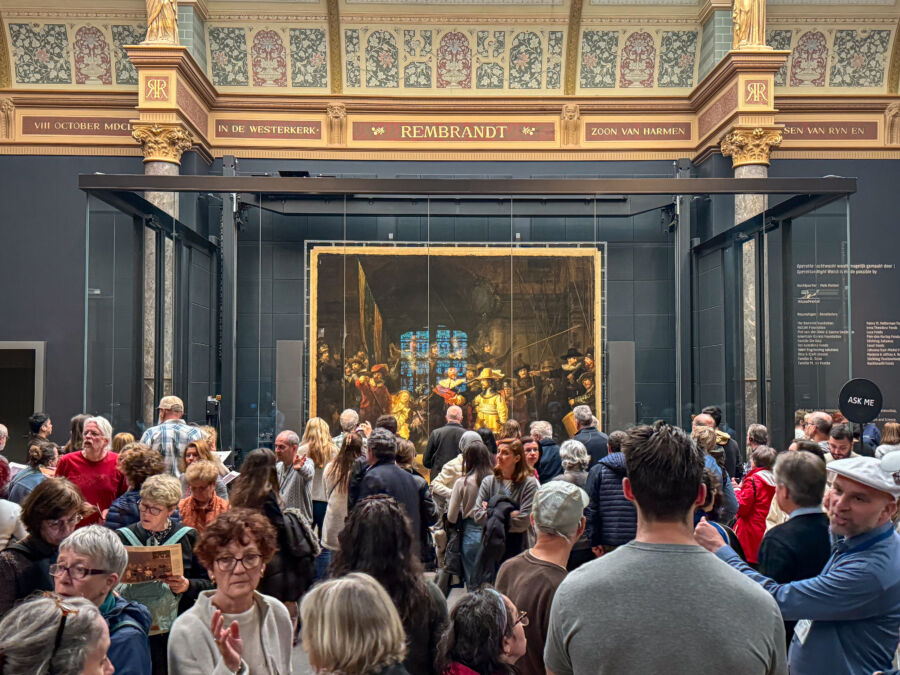
This large canvas — fourteen and a half feet wide by twelve feet tall — was commissioned in 1642 as a group portrait. The Night Watch depicts a militia consisting not of highly trained soldiers, but of shopkeepers, merchants, and local bigwigs. In mid-17th-century Holland, things were changing rapidly. A generations-long battle for Dutch independence from Spain (now called, without hyperbole, the Eighty Years’ War) was drawing to a close. By the time the members of the Night Watch assembled for this portrait, Spanish forces had been pushed deep into Belgium, allowing Amsterdam and other Dutch cities to flourish. Militias like the Night Watch, once necessary for municipal defense, had become merely ceremonial…social clubs for wartime cosplay and business networking. Amsterdam was a booming hub of commerce, on the cusp of a Golden Age. And upwardly mobile merchants — like the pepole in this painting — were already making their fortunes.
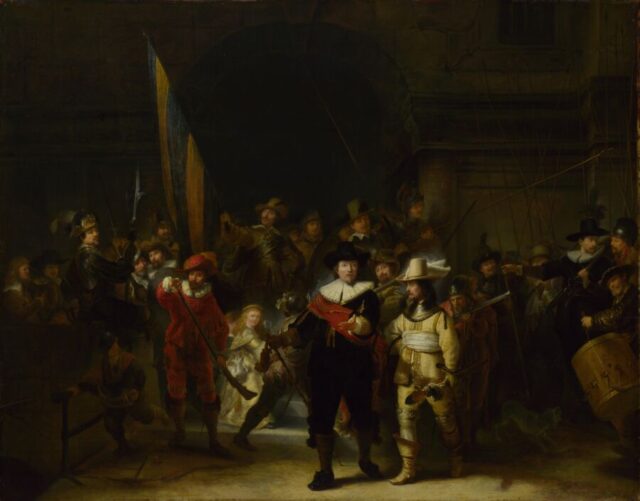
And yet, what vaults this canvas to greatness is not its subject matter, but its shrewd, innovative artistry. Rembrandt, then in his mid-30s, took a conventional group portrait — staid, static, perfectly lit — and turned it on its ear. Instead, Rembrandt captured a mob scene: members of the Night Watch are scattered across the frame, looking this way and that, in motion, interacting with one another, sliding between dark shadow and glaring light, in some cases leaving their features mostly obscured. Individual personalities leap off the canvas. And I perceive something subversive, even sarcastic, in Rembrandt’s take. You can imagine him responding to critics — perhaps a cloth merchant, annoyed that you can only make out half of his face — by saying, “You said you were a militia. Is this not what a militia looks like?”
The painting is, no doubt, striking. And yet, on this visit, I found myself even more captivated by something else.
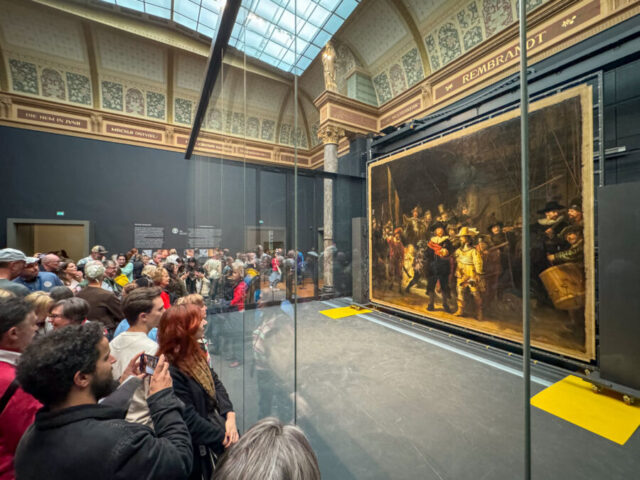
Rembrandt’s fragile masterpiece has been placed within a gigantic plexiglass case, giving the painting room to breathe during a recent restoration. And that case is surrounded on all sides by visitors from every corner of the earth — creating a parallel mob scene even more chaotic than the one depicted on the canvas. Museumgoers press their hands and faces against the smudged glass, as if medieval pilgrims seeking proximity to a holy relic. They become human tripods, stretching their arms to their limits as they hold phones and cameras high, angling them this way and that, trying with futility to resolve the glare separating them from Rembrandt’s greatness.
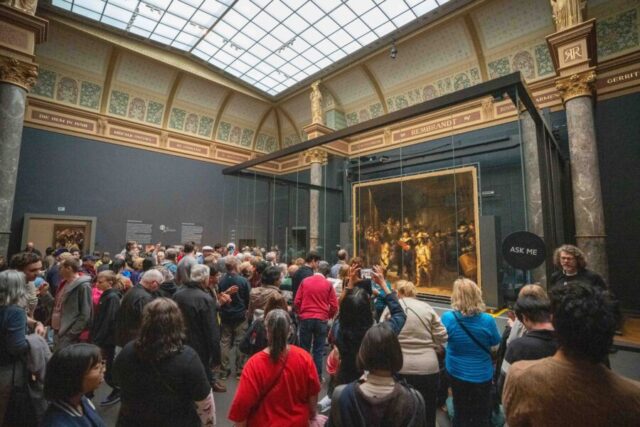
Something about this spectacle strikes me as absurd: The case, thrusting far out into the room, is filled with more than two thousand cubic feet of nothingness. It’s an airlock, insulating Rembrandt’s 17th century from our contemporary world. It’s an empty void in the very center of the most crowded room, in the most overtouristed city, in the most densely populated country in Europe.
Circling around the side of the cube — to the only part of the hall not jammed with people — I look at the canvas, distorted from this sharp angle…and then back at the scrum facing it. The Night Watch, while engaged in boisterous motion, are strong, proud, and confident; the Watchers of the Night Watch — we 21st-century tourists — have an air of disheveled desperation. Suddenly, I put myself in the shoes of the Night Watch, and see us Watchers through their eyes. What must they think of us?
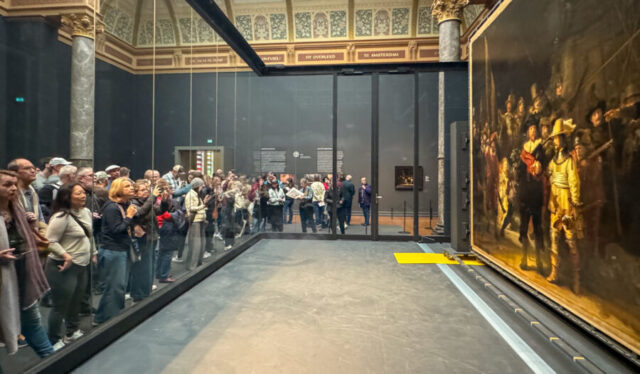
The members of the Night Watch look out over a sea of faces, who came here from unimaginably remote corners of the earth. We Watchers traveled in a matter of hours a distance that would have cost the Night Watch many months’ journey — tedious, hazardous, quite possibly fatal. We dress far more casually than they do, in garish colors, revealing very nearly the full length of our arms and legs, clad for comfort above all, not a frilly white ruff or chimney-pipe hat to be seen. Observing us constantly pull small, black, mirrored rectangles from our pockets and handbags, and attend to them with intense focus, the members of the Night Watch must wonder what could possibly be so fascinating about these little devices.
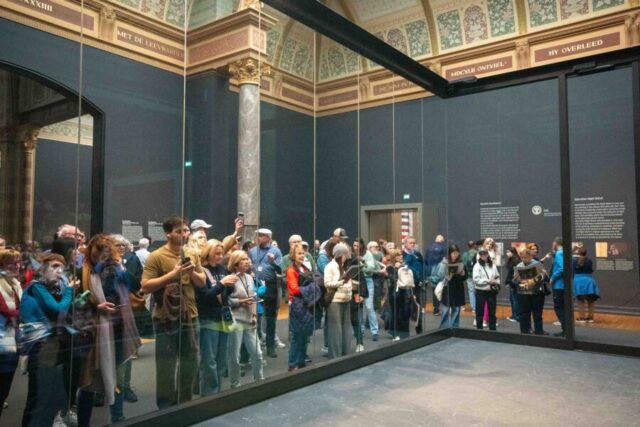
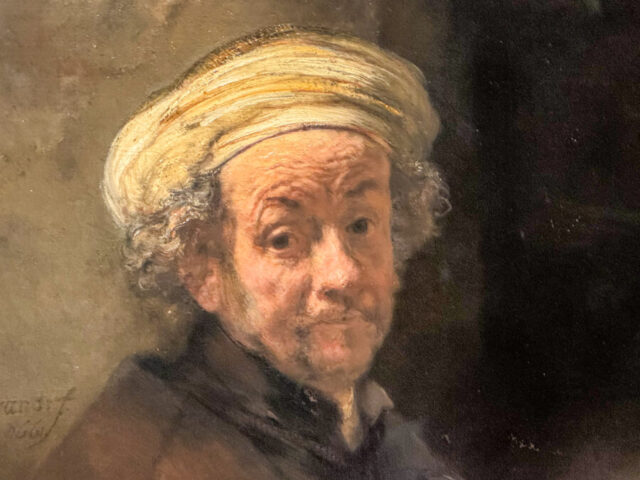
There is one thing we Watchers have in common with the Night Watch: Their world was changing at a dizzying pace. And ours is, too. Just a few years ago, this grand hall — today so congested, so steamy, so deafening with rancorous conversation — was entirely empty. We Watchers weathered a pandemic of global proportions, stayed away from each other for months or even years, lived in a swirling eddy of fear, boredom, and anger. During those many long months, the members of the Night Watch looked out over an empty hall. In this vacuous space, they could have easily engaged in conversation with Frans Hals’ cheerful drinker, with Jan Steen’s merry family, even with the world-weary self-portrait of their own depicter, Rembrandt. It was so silent that, as Vermeer’s gentle milkmaid serenely tipped up the base of her jug, you could actually not hear the milk trickling into the bowl. Shhhh!
But now, thanks to a miracle of modern science, we Watchers are back, in force. And the Night Watch has never seen crowds like this. We Watchers are determined to make up for lost time, catching up on two years’ worth of unhad experiences. It has been, in a way, beautiful to observe the persistence of humanity’s determination to fulfill our deferred dreams. And yet, it has not taken long to realize that such persistence can also be destructive.
Outside of this hall, beyond the walls of the Rijksmuseum, Amsterdam is struggling with an unprecedented influx of visitors. We 21st-century Watchers are determined to immerse ourselves in the 17th-century core of the city…the Amsterdam that the Night Watch would recognize. All through the concentric-circle Canal Belt, block after block, canal after canal, Amsterdam has preserved its Golden Age landscape: skinny townhomes with elaborate gables and practical little winches, standing tall over even skinnier streets that tiptoe between the houses and the canals. Here and there are more elaborate mansions of the über-wealthy, and fanciful gilded towers that rocket skyward, filled with jovial carillons that jingle-jangle cheerful tunes throughout the day.
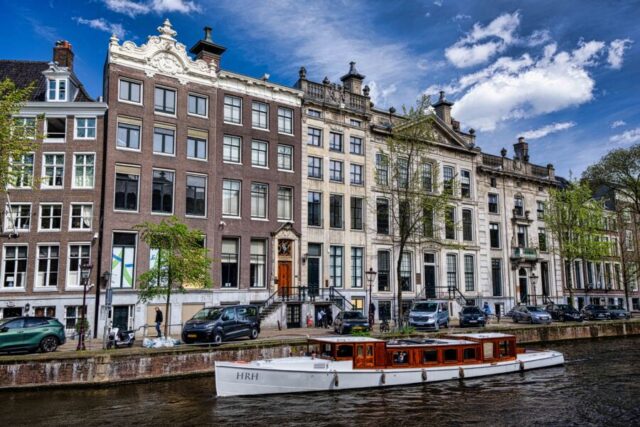
But today, this precious, unique cityscape is overwhelmed. Those narrow brick lanes are cluttered with wayward tourists, not paying attention as they wander about in a self-interested fog, seeking the ideal backdrop for their selfie or the perfect framing for that church tower, stepping in front of bicycle commuters — oblivious to the persistent brrrrring!-brrrrring! of handlebar bells — or very nearly stepping off a ledge into a brown, murky canal.
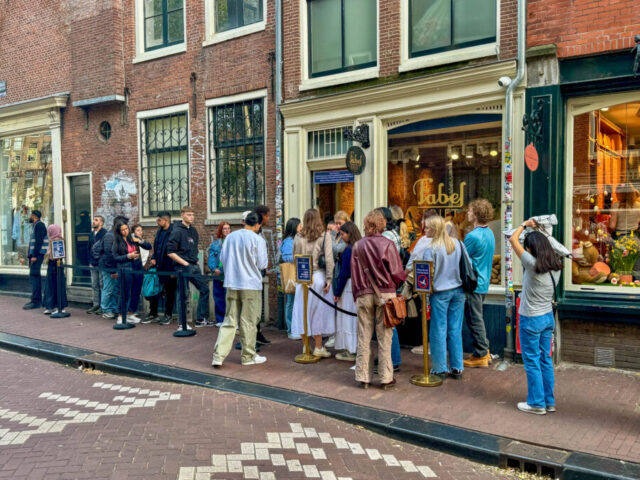
Throughout the Canal Belt, graceful bridges span those canals. And today, across several of those bridges snake long lines of tourists, stretching all the way from one bank to its opposite, patiently waiting in a well-organized queue. Walking past, I asked a random line-stander what, exactly, he was waiting for. He explained that he and his girlfriend had sought out a very famous shop that they had seen on Instagram and TikTok. They had been waiting for about 45 minutes, and he estimated they were getting close.
“So, what kind of food do they sell?” I asked.
He seemed unsure: “Some sort of sandwich? My girlfriend could tell you?” These felt more like questions than answers, quickly followed by a self-reassurance: “But I know it will be very good.”
“I’m sure it must be,” I said, and carried on across the canal. There I passed the front of the line, where carefully positioned stanchions did their best to preserve the flow of foot traffic, allowing passersby to pass by the queue without stepping into bike traffic, constantly monitored by attendants who told each customer where to stand. “Instagram sensation line supervisor” is, apparently, a whole new occupation in 21st-century Amsterdam.
Amsterdam also struggles with its global touristic brand as a city of vice. A history of conflict and suffering taught the Dutch to be pragmatic and open to other worldviews. From the Protestants-versus-Catholics wars that led to the creation of the Night Watch, all the way to the horrific loss of life during Nazi occupation and the Holocaust, the Dutch have learned that tolerance is the opposite of violence, and vice-versa. And Amsterdam’s status as a maritime shipping center — a crossroads of peoples and cultures from around the world — has deepened locals’ affinity for accepting diverse backgrounds and alternative lifestyles.
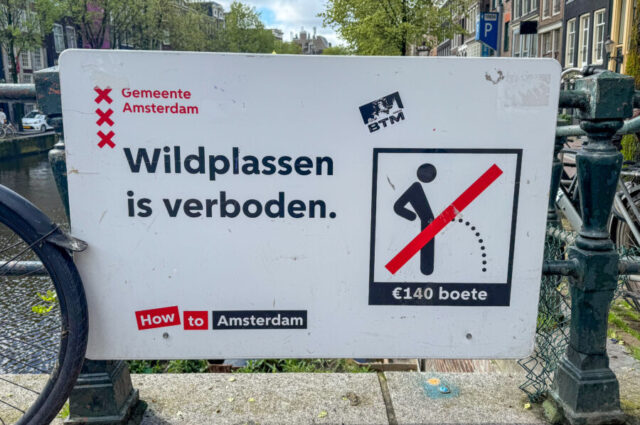
That’s why it was logical for Amsterdam, in the second half of the 20th century, to become a bastion for permitted marijuana use and legal sex work. This began as an expression of Dutch values and a social experiment in pragmatic crime reduction. But it also made the city a hub for marijuana and sex pilgrims — a breed of tourists who, by and large, tend to be rowdy, loutish, and troublemaking. (When you begin to require signs explaining the fines charged for urinating into a canal, you’ve crossed some sort of Rubicon.) That’s why, in recent years, city authorities have begun to roll back the parameters of marijuana use, and are constraining — and may even relocate — the famous Red Light District. With the “Stay Away” campaign, specifically targeting rowdy young men from Great Britain, city authorities are spending money to actively discourage certain visitors from coming to Amsterdam.
As Amsterdam’s popularity has exceeded its capacity — as Europe’s best-preserved 17th-century city has become the poster child of “overtourism” — local residents and city leaders alike have had enough. Recent legislation has forbidden groups in the Anne Frank House and Red Light District; placed a strict cap on new hotel construction; and severely constricted the Airbnb market (with methods so draconian, they are also closing down traditional B&Bs). And yet, the visitors still come — a United Nations of tourists who don’t flinch at paying €300 or €400 a night for a room in a mediocre, midrange hotel in that dreamy Canal Belt.
Amsterdam is a leading example. But all across Europe, we are back where we were in 2019: It’s very trendy to fret about “overtourism.” (For example, the New York Times just covered this topic yet again.) These concerns are legitimate, but it seems to me that we’d rather complain about this issue than tryto do anything about it. So…what can we do about it?
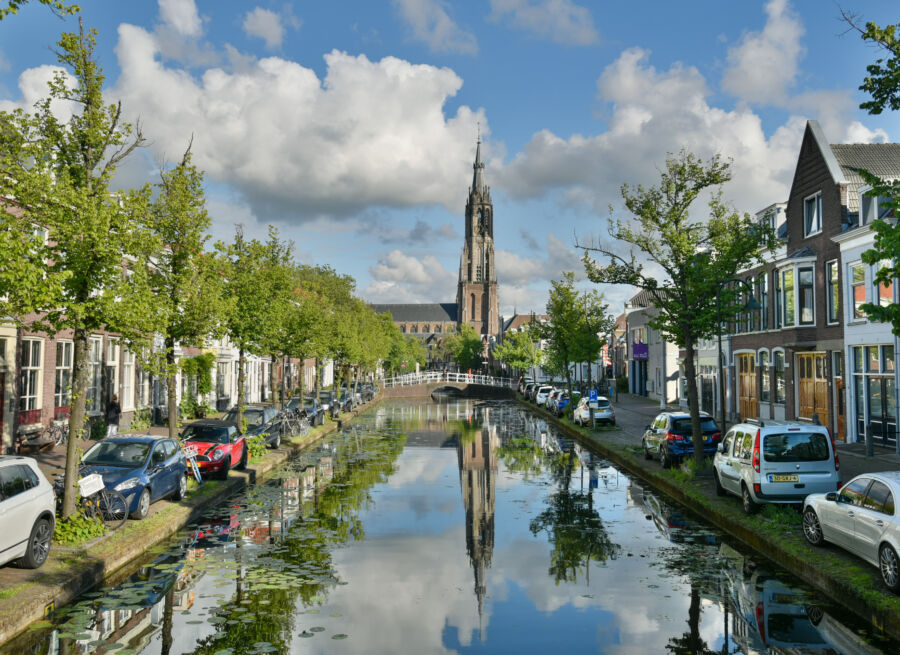
Is the answer as simple as not traveling to these “overtouristed” places? Maybe so. One solution could be to seek out alternatives to the most overwhelmed destinations. The Netherlands has more than its share of gorgeous, historic cities — just as beautiful, if smaller — just a short journey from Amsterdam. Lovely, largely undiscovered Leiden, a gabled university town that gave birth to Rembrandt and asylum to the Pilgrims, is less than 30 minutes by train from Amsterdam. And if you say on that same train another 20 minutes or so, you’ll pull into tranquil Delft, with its Vermeer canals, soaring steeples, and blue pottery.
This year, I have spent time in Amsterdam and in Venice — two of the leading cities of overtourism. But I’ve also spent time in places that are far less crowded: Germany’s Rhine and Mosel rivers; gorgeous Slovenia; off-the-beaten-path corners of the Balkans. Also just this year, Rick has traveled to several great, if relatively untouristed, cities in Germany (Leipzig, Dresden, Hamburg), and to several towns and cities in Portugal, and has marveled at the lack of crowds. Just this spring in Bacharach, on Germany’s Rhine River, I was chatting with a local shopkeeper who asked me, worriedly, “Where are all the American travelers? We used to be so busy. Not anymore.”
Anytime I post about Slovenia — a striking undiscovered gem of a country —people in the Comments worriedly scold me for running the risk of “ruining” this precious place. I’ve got news for them: I’ve been preaching the wonders of Slovenia — shouting it from the rooftops, in fact — for well over 20 years. And, while a few areas (Lake Bled) are no longer “undiscovered,” there’s still more than enough Slovenia to go around.
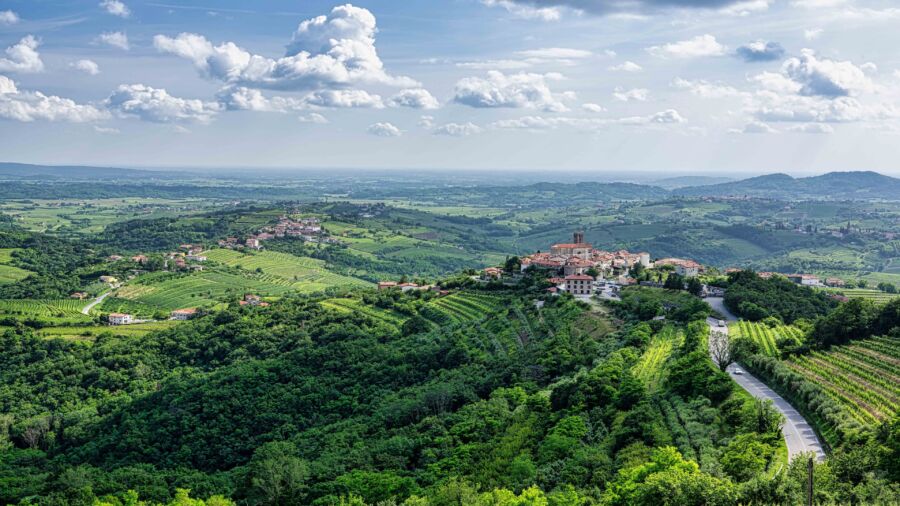
The more I travel, the clearer it becomes: There is an overabundance of lesser-known, virtually untouristed places all over Europe that could help us, collectively, spread around the demand without sacrificing quality of experience.
And yet, we Watchers are stubborn. And, quite frankly, we are not particularly original in choosing where to travel. We have our bucket lists… we have our Instagram bookmarks… we have that overwhelming FOMO. We want to go where the people are, and then, all too often, complain about all the people.
I realize that it’s easy for me, as a professional traveler who’s seen the Night Watch, the Mona Lisa, the Sistine Chapel multiple times, to suggest that others skip those icons of Europe in favor of a deeper cut. And, if we’re both being honest, you’re probably going to ignore that advice anyway.
And so, if you insist on going to an immensely popular place, all you can do is to be prepared. Book far ahead — far, far, far ahead — to get your choice of accommodations, tables at the most best restaurants, and time slots to visit the big sights. Do your best to make your visit coincide with less-crowded spells; often that means touring popular sights early or late in the day. (One afternoon, I passed an hour-long line at an Instagram-famous fry shop; the next morning, I took advantage of a much shorter line…and savored the exact same cone of truffled-mayo-and-parmesan-topped fries after just a 10-minute wait.) Or — better yet — avoid peak season entirely, and travel instead off-season.
More important than all of that practical advice — which is, frankly, self-serving — I believe it’s critical to travel conscientiously. Be aware that the places you visit are feeling the strain of their own popularity…and do what you can to avoid adding to that strain. Be mindful of local. Give up your seat on the tram to the local mom with the baby. Invite the Dutch shopper to cut the line at the grocery store. Don’t be the tourist wandering in front of a moving bicycle, as you squint into your black, mirrored rectangle. Be present, be curious, be thoughtful, and be respectful.
Is it my duty, as a travel writer, to not tell people about Amsterdam — even to actively discourage them from coming here? Or is it my duty to acknowledge that they will come here, regardless…and to equip them to do it more thoughtfully and sustainably?
Understandably, many people these days — locals and tourists alike — are frustrated by overtourism. But let me offer another point of view, from a different poster child of overtourism: Dubrovnik, Croatia. Isn’t it interesting our our contemporary “problem children” tend to be major ports, at the historical crossroads of cultures? Amsterdam, Dubrovnik, Venice, Barcelona, Athens, Lisbon. But maybe it’s not just a coincidence…
On a recent visit to Dubrovnik, I stood on the Old City’s main drag with my local friend Roberto, observing the crush of cruise-ship passengers, who filled it so completely that going for a simple stroll down the block was impossible. I began to grouse, when Roberto stopped me.
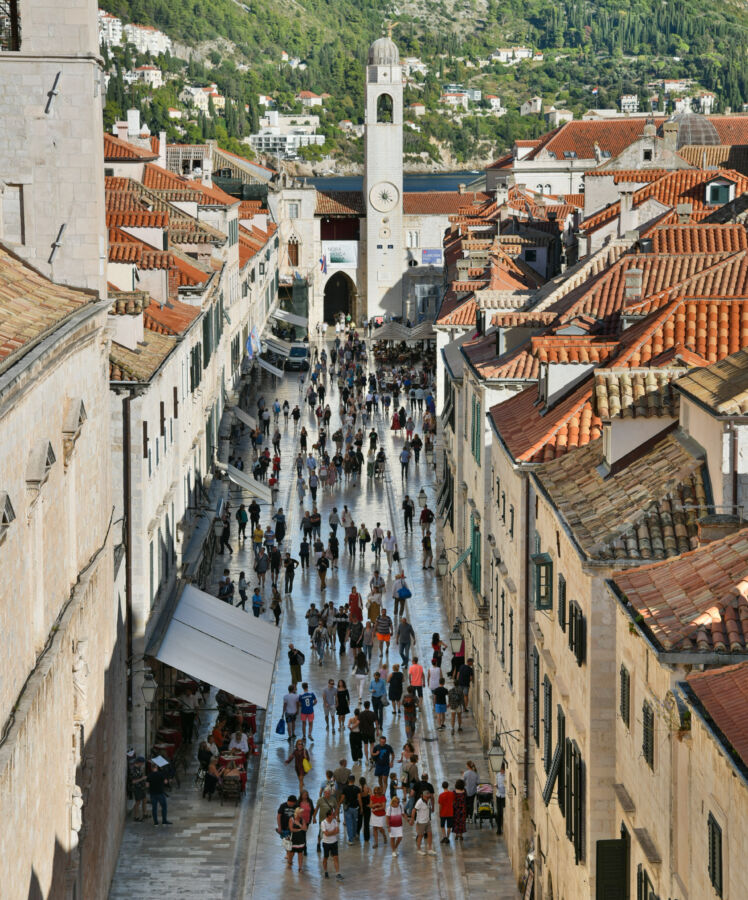
“Yes, but Dubrovnik has always been like this,” he said. “We are an outpost. A trading center. A shipping port. A crossroads. For generations — for centuries — people have come and gone through our city gates. It is what defines the life of our city, in fact! You see these crowds and say, ‘What a problem.’ But there have been many times, through our long history, when you would have found these streets every bit as crowded as today. The faces, the clothing, the reasons for visiting may change. But the humanity is the same. Whether by galleon or by cruise ship, Dubrovnik is a place where people come.”
Which brings us back to the Night Watch — encased in their hermetically sealed glass box, designed to keep all that humanity at arm’s length.
When the members of the Night Watch look out upon us Watchers, what do they see?
I imagine that if they were to climb down off their canvas and stroll through the Canal Belt — nearly four centuries after they departed this mortal coil — the differences would be apparent: What the people filling those streets are wearing and doing and saying. The bicycles, the automobiles, the motorized party barges chugging along the canals.
But — beyond the 17th-century cityscape itself — they may also detect many similarities. The Amsterdam of the Night Watch was no ghost town; it was, as today, a thriving hub of entrepreneurs and peasants, sailors and artists, Dutchmen and outsiders, all filling those same, narrow, brick-lined, canalside streets.
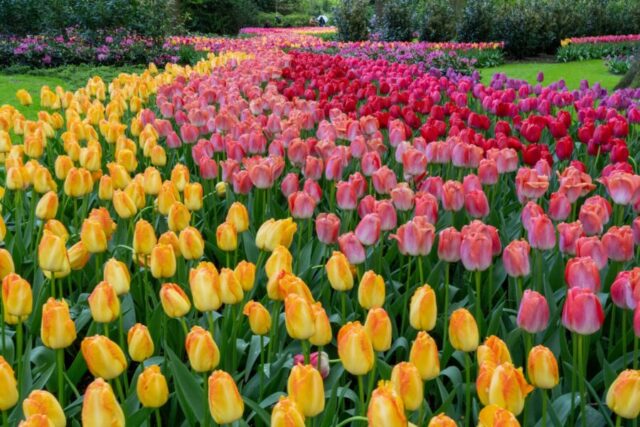
And what about those long lines — those visitors from afar, spending an hour of their precious vacation for an Instagram-famous cookie, sandwich, or cone of fries? Perhaps the members of the Night Watch would understand those people better than I do. In the 1630s — less than a decade before Rembrandt painted the Night Watch — Holland was seized by “tulip fever.” Flower bulbs from the Ottoman lands became a subject of unbridled speculation, escalating prices to unimaginable, ludicrous highs. A few dozen tulip bulbs could make someone a millionaire, by today’s standards. Is a cookie truly worth spending an hour in line? You might as well ask: Is a single flower truly worth as much as several acres of land?
In fact, the members of the Night Watch — shrewd businessmen that they were — might be more impressed by the success of their city than shocked by the crowds. They built a city that attracts visitors; visitors bring money; and Amsterdam is, by any measure, a prosperous place. Is this not entrepreneurial success?
There’s no doubt that overtourism is a genuine concern. Both for the comfort of us travelers, and for the sanctity and sanity of the permanent residents of these places, it deserves to be taken seriously. But maybe these crowds are not such an outlier; they simply represent another chapter in the ebb and flow of a vital, thriving, always-evolving city of the world.
In the end, the most realistic approach may be to recognize that Amsterdam — that city of entrepreneurs, movers-and-shakers, faux-militia members building their fortunes — benefits greatly from tourism, even as they pay a different kind of price for that success. And as conscientious visitors, we can recognize our place in that awkward ecosystem. We come, we enjoy, we learn, we trade our money for fond memories…and we do our best to leave the city no worse off than when we arrived.
Your commentary on overtourism makes me think of the movie, Sideways, about the wine connoisseur who takes his best friend (not a wine connoisseur) to Napa for his bachelor party. The bachelor just wants to get drunk and party, which annoys the wine guy because his buddy isn’t ‘doing it right’, choosing obnoxious fun over a sophisticated wine tasting Odyssey. That is Europe in a nutshell: there are those that want a rich, cultural, perspective changing experience, and those that just want to trophy hunt on Instagram for self-gratification. These two groups will just have to learn to get along, and the tourism trade will have to serve both. If you allow yourself to be annoyed or even angered by the Instagram idiots, YOU are ruining your trip (for yourself and anyone traveling with you), not the idiots. That said, we should be optimistic by measures cities like Venice are taking to curb overtourism. But in the meantime, when in Rome smashed up against the Sistine Chapel horde, channel your inner Marcus Aurelius (the greatest Roman emperor and famous Stoic) and let go of what you cannot control and just enjoy the experience for what it is.
Agree with your sentiments…but it was the Central Coast, not Napa, in Sideways.
Good comments, Matt, we have travelled all over Europe since 2004 and seen the drastic changes in tourist attitudes. Obviously, the pandemic closures fueled some of the frantic “must go and see” attitudes. I think there is a direct connection to the current generations “phone addiction” that is an influencing their Instagram mania. ( We were in Europe 90 days last year, March thru May, best time – no crowds.
Wonderful and informative, like all your shows Rick.
I was born in the Netherlands. So seeing this is uplifting and inspiring.
Thanks.
Cameron, your commentary is stellar. Artfully written while making important points. Thank you!
Thankful that I got a photo of Night Watch before the glass box was installed. And lucky to be on RS Tour, and our guide kept us away from major crowds.
Cameron, you write passionately and knowledgeably about the impact of tourism on countries. Thank you. We were in Barcelona, Porto, Lisbon, Cadiz, and Tangier this summer and heard from our guides about the protests against overtourism.
Our guides, naturally, were very unsympathetic to the protesters, but in my heart, I think the protesters have a point. Those of us who are “tourists”, from wealthy countries, are profoundly impacting the families who live in these “First Cities”, causing rents and home prices to increase, making the economic landscape of those who work and earn their livelihood in these cities, very difficult. It’s the same in these cities in the United States. Those who teach in our schools, who work in the service industries, or are in entry level jobs, cannot make ends meet or afford to live in the cities in which they work—Los Angeles, San Francisco, Chicago, New York . . . and the list continues.
I applaud your article and echo those sentiments—“What would the Night Watchers” think of 21st century tourists and tourism! A double-edged sword.
We can and should visit those major cities. See what they have offer, invite our children and grandchildren to immerse themselves in the culture and history. But let’s remember that there are economic and personal impacts to overtourism that affect real families.
Let’s explore the smaller cities, make real life connections with our tour guide, our server, the bell boy brings who our bags to our room, and the person who wraps the replica of the ship we purchased at the local Navigation Museum. Let’s stop in at the local grocery store housed in the basement of an 18th century building, buy a snack and remember that this store is the European version of our local minimart. How beautiful!
We don’t want to change the landscape and economies of the places we visit. Let’s do all we can to be a positive impact on the culture and struggles of the people who live and work here. We want these same places, and the warmth that the citizens impart, to be available to our children and grandchildren.
I always enjoy what you write but with this column, you have surpassed yourself. The subject demands a fair look at what can be a real concern for local and traveler alike. You have looked at it in the now while reflecting on the historical. For new travelers, it is refreshingly educational. Thank you!
In 1960, the world population was 3 billion. It is now 8 billion. In 1960, Soviet and PRC citizens could not travel the world. In 1960, a photographer had to lug around a heavy camera and accessories.
I really hope that many more over-touristed cities follow Venice’s example and ban cruise ships. Until then, I’ll travel only in April and October.
We saw the Night Watch last January. There were only 10 people in the room. Yes, Amsterdam is cold in January but not many people want to venture out to visit which is good. No lines anywhere.
Having travelled, lived and married in Europe during the past 52 years there are all kinds of little beauties left on the continent once the Grand Tour is done. I feel fortunate having “been there, done that” earlier in that span when crowds and security were less annoying … at least in western Europe. The gems are still out there. Since my wife is Hungarian our big thing is to get out of Budapest and explore the endless circuit of trails on the surrounding hills. Transport is cheap, frequent and the network accessible. You’ll only find Hungarians.
been there love it
I will be taking my trip to amsterdam in just a few weeks. Off season, yes, but also due to my work schedule. And my visit will be for the art and history and not for anything made popular on Instagram or TikTok. An hour wait for a cookie, no. An hour wait for amazing art, yes.
Having lived in Amsterdam before and during the pandemic, I can tell you that over-tourism is real. I actually enjoyed the pandemic’s quiet streets even though we were mostly locked down. We as travelers need to be mindful of the local community and residents and try to be responsible visitors. You are a guest in their country and should go out of your way to courteous and non-intrusive, that means watch where you are walking, make sure you aren’t blocking sidewalks if you are in a group, allow others to pass by if you are moving slowly, etc. One of the worst tourists I encountered during my five years in Amsterdam was a teacher (I am sure well intentioned, and I am a teacher and a huge supporter of them) who was standing in front of the doors to the Van Gogh Museum calling to get her class together-they were teens, not babies. I went to walk around the group and she yelled at me. It fit in to the stereotype that people have about loud and obnoxious American tourists-which I don’t think we are as a whole. I wanted to tell her that she should be organizing her group off to the side and not blocking others, but it wasn’t worth the effort. I try to be the visitor who changes people’s attitude about tourists.
Having lived in Amsterdam for 3 months (in 1991), I couldn’t believe the lengths that they’ve had to go to to protect the Night Watcher. When we travel, we usually spend a couple of days in a major city and then visit other areas of the country, either by train or by car. I don’t understand why people would want an itinerary, booked months ahead, with restaurant reservations and every hour scheduled. You lose the option of finding places by chance and also miss out on local recommendations.
I also always buy a driving map of the country rather than using Google maps so that I can see if there are any interesting places near our route that Google maps wouldn’t have taken us to. One that comes to mind is Trier in Germany, where we stopped for a very pleasant few hours on the way from the Mosel Valley to Luxembourg. Another gem was Girona on the Costa Brava when driving from Barcelona to Figueres. The top “find” was was Cesky Krumlov when we got lost on the drive from Prague to Vienna. Recently, in the Canadian Rockies, we arrived too late for the shuttle bus to Moraine Lake but were recommended by the shuttle driver to visit Takakkaw Falls instead which was different but amazing.
I don’t think we ever regretted “missing something” when we always found something else instead!
Great article! On my many adventures in Europe, I have personally witnessed the hordes of tourists at numerous sites and in over touristed cities. As you said, most of these places are worth seeing. But how does it affect the frequent visitor to Europe? What do you do after you’ve seen all the top recommended sites? I’ve been to Amsterdam twice and seen the major sites. Last spring, I went to the Netherlands and bypassed the city completely. What a different experience! I felt like I got to really know and understand the Dutch by venturing away from the main tourist hub. Any way you slice it, travel always has something amazing to offer.
Dear ricksteves.com admin, Your posts are always well-written and easy to understand.