
Looking back on my recent travels, I’ve been thinking about what makes a country great. “Greatness” can mean strength and power. Or it can signify wisdom, maturity, respect, and an honest reckoning with the past.
In my travels, I observe a disparity in how various lands think about their history: Some societies acknowledge the more challenging elements of their past, while others only embrace the most flattering version of themselves.
As fractured as we are these days, I genuinely believe that good, caring, intelligent people can agree to disagree on a broad range of issues. Should the government take a heavy hand, or a light one, in collecting taxes, regulating guns or abortion, and guiding the trajectory of a society? What role should the USA play on the world stage? How much immigration is “too much,” and how should we treat those immigrants? You have your opinions; I have mine; sometimes they don’t align. That’s life in a healthy democracy. That’s what elections are for.
However, one thing that I believe is not a partisan issue — or, at least, shouldn’t be — is the fundamental truth of history. Facts matter. What happened, happened. And whether those events were good or bad, the only way for a society to evolve is to be honest about its past, warts and all. That’s why, when those who seek or hold political power begin to selectively reinterpret the past — dispensing with inconvenient truths — I find it alarming, not as a Democrat or a progressive, but as a patriotic American.
This is not a distinctly American challenge. Every country’s story is filled with both moments of virtue, and moments that are regrettable, even “evil.” As I travel from place to place, I’m struck by how each society makes intentional choices about how to reckon with their history. And over time, I’ve also seen how this can vary depending on the swing of the political pendulum.
And so, to provide some international context for the debates we’re having in 2024 USA, join me on a trip to a few case studies of how other societies have gotten this right…and, in my view, ones that have gotten it wrong.
Poland: The Museum of the Second World War

In Gdańsk — the northern Polish city where World War II began — museum curators designed what was to be Europe’s definitive museum of the Second World War. It told the complicated story of wartime Poland, yes; but expanded its view to encompass a global perspective on the war, and how it affected various lands and peoples.
However, shortly before the museum’s scheduled opening in 2017, the ruling Law and Justice government — which felt the exhibit “wasn’t Polish enough” — intervened. They replaced the director with a political appointee, and installed a new mission to stir the patriotic souls of Polish taxpayers. New exhibits, mainly profiling Polish heroes and victims, were hastily squeezed into any available space. The intentionally ambiguous, thought-provoking final room was re-envisioned and now shows a rabble-rousing film (called “The Unconquered”) espousing a naively, almost offensively pro-Polish point of view.
Revisiting the museum not long ago, I stumbled upon one exhibit that I suspect was added by the politicized director. At the entrance to a room filled with portraits of Jews who were murdered by the Nazis in Polish territory stands a wall labeled “Poles in the face of the Holocaust.” Posted information and touchscreens explained how Poles saved the lives of Jews, despite the fact that Poland was the only Nazi-occupied land where such assistance could be punished by death.
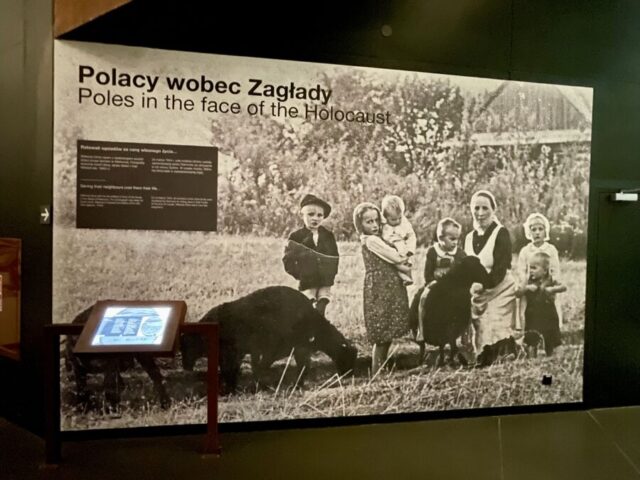
This is an inspiring story, to be sure. And there were many righteous Poles who came to the assistance of their Jewish neighbors. But there were also many Poles who colluded with the Nazis, and many more who turned a blind eye to their atrocities. Is it expecting too much for these facts to be acknowledged in the museum, as well?
Soon after, in 2018, the Law and Justice party made it illegal to state that the “Polish nation” was in any way responsible for the atrocities of the Holocaust, under punishment of prison. Under diplomatic pressure from the US Department of State, the law was later softened to remove the criminal component. However, a civil court can still prosecute “whoever claims, publicly and contrary to the facts, that the Polish Nation or the Republic of Poland is responsible or co-responsible for Nazi crimes committed by the Third Reach.” And so, an important part of Poland’s World War II story goes untold.
(It’s worth noting that Poland’s Law and Justice party was defeated in late 2023 by a centrist coalition; as new, more moderate leadership reshapes Poland, it will be fascinating to see if those changes ripple down to the displays of this museum.)
A few days earlier — at the opposite end of Poland, in the town of Wadowice — I toured the museum at the birth house of St. John Paul II. The slickly produced, inspiring, touching museum did a beautiful job of telling the life story of Karol Woytyła, who lost his parents at a young age, entered the priesthood, and eventually became the spiritual leader of one billion Catholics and a critical figure in the final ideological battles of the Cold War.

The museum tells this story so well, in fact, that I didn’t realize until after I’d left that it had omitted some important topics — specifically, the child molestation scandals within the Catholic Church that were covered up under Pope John Paul II’s watch.
Chatting with some Polish friends about this, I was reminded that these things aren’t as black-and-white as they may first seem. Yes, the Pope should have done more. However, John Paul II recognized that he was in a unique historical position as a high-profile crusader against Soviet oppression, and that he played a critical inspirational role in the democratization of his homeland, Poland. Perhaps there were pragmatic reasons for him to avoid publicly addressing a scandal that would have undermined so much of what he was trying to accomplish.
I’m not entirely persuaded by this reasoning. But it certainly got me thinking more deeply about the full complexity of that chapter in Polish (and Catholic Church) history. I don’t believe “canceling” John Paul II is the answer. Rather, his legacy deserves a complete and nuanced discussion. And I regret that this museum is so reluctant to have that conversation.
History is made by “great” people who, like all people, are flawed. Even the greatest among us have blind spots and vulnerabilities; arguably, it’s a person’s ability to navigate complicated realities and make impossible choices that propels them to greatness.So then, why are we so afraid to be honest about those flaws?
Germany: Documentation Centers and Holocaust Memorials
Let’s cross the border, to a country that dispenses with the kid gloves when handling its own history. In my travels, I have encountered few societies that more conscientiously grapple with their checkered past than Germany. Yes, Germany.
Even to this day, when many people think of Germany, one of their first associations is along these lines: backed a lunatic dictator; tried to take over the world; murdered millions through genocide and conquest; destroyed much of Europe.
Resenting Germany for their crimes in World War II and the Holocaust is understandable, even deserved. But in my 25 years of traveling around Germany, I’ve been impressed by their willingness to be open, candid, and contrite about their history. They even have a term for it: Vergangenheitsbewältigung, “coming to terms with the past.”

Throughout Germany, I’ve visited perhaps a dozen different “Nazi documentation centers.” That’s a buzzword for a museum that offers a thoughtful, entirely transparent, and no-holds-barred assessment of Germany’s culpability in its crimes of the 20th century. It’s a fascinating exercise in the defendant presenting an ironclad case on behalf of the prosecution. Germany’s documentation centers confront visitors — both German and foreign — with abundant, meticulously collected evidence, always compelling and often gruesome, of their own crimes. No excuses are offered, and there isn’t a whiff of defensiveness — just a matter-of-fact mea very, very culpa.
In the German capital of Berlin, immediately adjacent to the landmark Brandenburg Gate and just down the street from the Reichstag stands a sprawling monument consisting of 2,711 stony slabs. The Memorial to the Murdered Jews of Europe, occupying this privileged position in the very heart of Germany’s leading city, is just one of countless memorials, large and small, all across the country, that constantly remind Germans of their historical crimes.

It’s hard to imagine that a country could ever “do enough” to make up for such heinous acts. But as a frequent visitor here, I’m impressed. Even younger Germans — now generations removed from these atrocities — may grow a little weary of these constant reminders. And yet, they recognize that this is their legacy.
The Netherlands: Dutch Resistance and Colonialism
Next door is a country that was occupied by Nazi Germany: the Netherlands. And on a recent visit to Amsterdam, I was struck both by how the Dutch are honestly reckoning with their role in history…and how they still have a ways to go.
The recently re-envisioned Dutch Resistance Museum traces the story of the Netherlands under Nazi occupation. It’s an exercise in stirring the Dutch patriotic soul with tales of both suffering and valiant resistance — much like the World War II museum in Poland. But, to its credit, the Dutch museum also owns up to aspects of that story that some might prefer to dismiss.
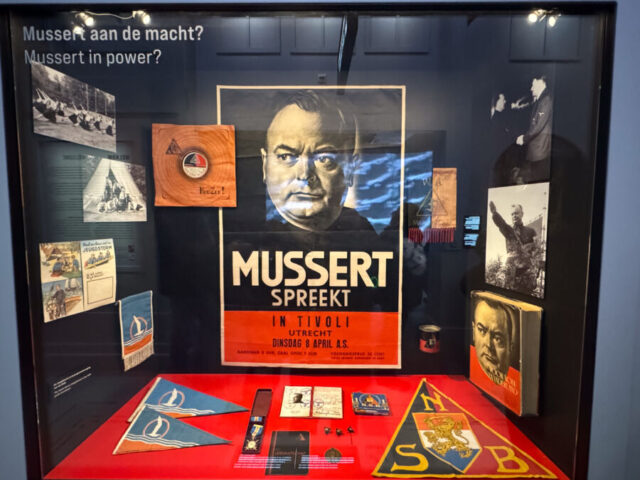
Early on, the exhibit takes pains to introduce us to Anton Mussert, who led the NSB, the local version of the Nazis. And it unflinchingly explains that 25,000 young Dutchmen volunteered to join the Waffen-SS, accepting Hitler’s invitation to stand with him in “Germanic Brotherhood.” After the war, at least 120,000 Dutch collaborators were arrested.
Of course, questionable Dutch deeds extend much farther back than the 20th century. As one of Europe’s great colonial powers, the Netherlands was fabulously wealthy in the 17th and 18th centuries. Amsterdam’s ornate city center — with its concentric canals, stately townhouses, grand museums and palaces, and gilded carillons — was financed primarily through plundered resources, the exploitation of human labor at the far ends of the globe, and Dutch participation in the transatlantic trade of enslaved human beings.
This is an aspect of Dutch history that many visitors (and, until recently, even many Dutch people) gloss over. But that is now changing. In 2023, the former Tropenmuseum (“Tropics Museum,” built nearly a century ago to show off colonial riches to Dutch citizens) was re-envisioned as the “World Museum.” Many of those same artifacts from former Dutch holdings — as far afield as Indonesia (the “East Indies”) and the Caribbean (the “West Indies”) — are still on display. But now they are given proper context, explaining the lives of the people exploited by the Dutch, from their own perspectives.

On the one hand, it’s impressive to see the Netherlands making these strides: For example, then-Prime Minister Mark Rutte (in 2022) and King Willem-Alexander (in 2023) have both formally apologized for the Dutch role in the slave trade. On the other hand, like any society, not everyone is comfortable with the changing times. The Dutch sidekick to Santa Claus, Zwarte Piet (“Black Pete”), is still usually performed by a white man in Blackface — and in a recent poll, more than half of Dutch respondents continue to support Zwarte Piet’s traditional appearance. And in November of 2023, an anti-immigrant party took the highest total of seats in the Dutch parliament.
Progress sometimes comes in fits and starts…but it’s progress.
New Zealand/Aotearoa: Waitangi Treaty Grounds

On a recent trip to New Zealand/Aotearoa, I visited the Waitangi Treaty Grounds on the Bay of Islands. This is essentially the birthplace of the modern nation of New Zealand, where local Māori tribal leaders signed a treaty with emissaries of the British crown to establish formal colonies on the island. Today you can walk across the grassy field where the treaty was signed, but only after you’ve toured a powerful, beautifully curated museum.
The museum is the best implementation I’ve seen of a “dual narrative” approach — equally weighting the perspectives of both the Māori and the English to tell a complete story. In fact, for most of the exhibit, you see the Māori point of view on one wall, and the English point of view on the opposing wall. It’s fascinating to experience the history of this island through the eyes of its two dominant groups, simultaneously — a parallax view that is both informative and moving.
In the darkened hall that displays the actual treaty, exhibits detail how the document was translated misleadingly into the Māori language. Key concepts like “sovereignty” were phrased in such a way to give Māori leaders the impression that they, and not the Queen of England, were still essentially in control of their island.
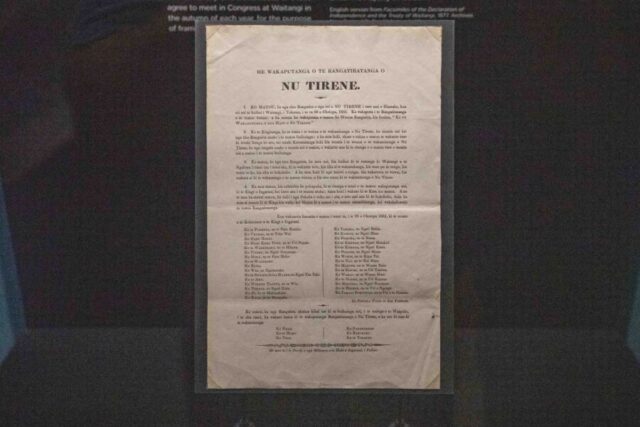
I was impressed and inspired to see a society that — rather than try to spin past events in a way that would present the European settlers in a flattering light — plainly acknowledged their misdeeds: We misled the people who were here first. And we were wrong.
New Zealand inspires me. It’s perhaps the planet’s most forward-thinking nation when it comes to the rights of its indigenous population. This national conversation began in earnest in the 1970s — on the one hundredth anniversary of the Treaty of Waitangi — and much progress has been made. While “reparations” is an abstract and hard-to-sell idea when it comes to the descendants of enslaved Black people in the USA, in New Zealand, it’s a reality: Vast tracts of the country’s land has been formally returned to Māori control. While there’s certainly more to do, New Zealand is making real strides in owning up to its historical crimes.
And this trickles down to everyday life, as well. Increasingly, Kiwis from both Māori and European backgrounds are embracing the indigenous name for their archipelago: Aotearoa. Kiwis, regardless of their background, greet each other with a cheery “Kia ora!” — evoking the Māori origins of the land upon which they all reside together today. As an American, this inspires me to do better — so much better. (And if we need a role model closer to home, we need only look to our northern neighbor — Canada has made impressive gains in better acknowledging the rights of its First Nations peoples.)
Hungary: Slide from Democracy
Now let’s cross hemispheres again, to a place that may be one of the worst-case scenarios for a society retconning its own narrative: Hungary.
Since first taking power in 2010, Prime Minister Viktor Orbán and his party, Fidesz, have aggressively revised history to suit their nativist political agenda. An exhaustive list of examples could fill volumes. But even just as a traveler who drops into the country every year or two, I’ve seen the effects firsthand: streets and squares renamed for obscure historical footnotes; the vast plaza surrounding the Parliament building completely transformed with new monuments and memorials; and, perhaps most alarmingly, a wholesale revision of the national school curriculum to ensure that the version of history taught to every Hungarian student is perfectly in line with the Fidesz agenda.
And what is that version of history? Essentially, it’s the most flattering possible view of Hungary. Fidesz history presents the country either as a heroic warrior, or a tragically maligned victim of foreign aggression, full stop. Orbán’s story of Hungary is designed to instill unquestioned pride and patriotism: We have always been in the right, just as we are today.
Here are just three examples:
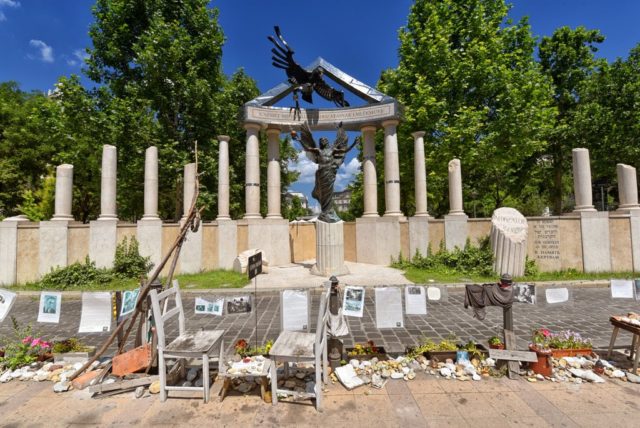
On Liberty Square, Fidesz erected a melodramatic monument to the “victims of fascism.” It’s overloaded with symbolism suggesting that Hungary was a peace-loving land, minding its own business, until Hitler invaded in 1944. In front of the monument, locals have assembled their own makeshift counter-monument — documenting how, in fact, Jews were terribly mistreated by Hungarian authorities, and tens of thousands were deported to certain execution by Hungary’s pre-Nazi leadership.
A couple of blocks away once stood a beloved statue of the communist reformer Imre Nagy, casting his judgmental gaze over the Parliament. However, there was a problem: Nagy may have led the 1956 Uprising against the USSR (and was later sham-tried and executed). But he was also a communist himself, who sought reform from within. The Fidesz worldview simply can’t tolerate such nuance. Nagy was a communist; all communists are bad; therefore, we must remove Nagy’s statue from this favored location. Under cover of darkness and without any warning, one night in the waning days of 2018, it was relocated far from the Parliament.
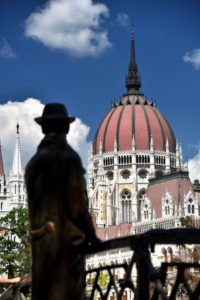
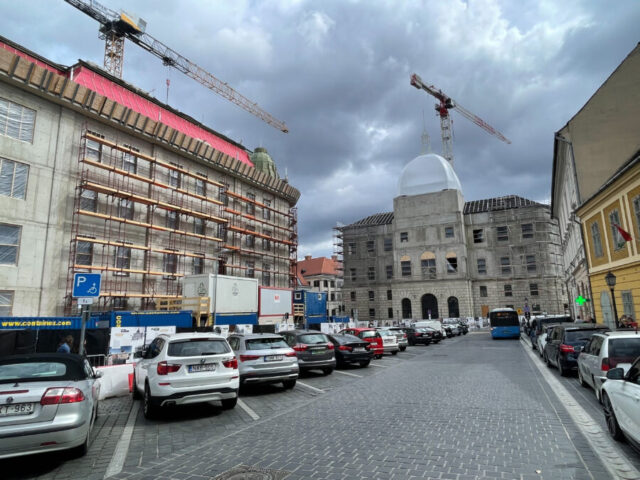
Up at Buda Castle, Orbán has moved his office into the former National Dance Theater and is busily redeveloping the castle quarter, transforming it into his new seat of government. Old buildings — destroyed in World War II and never rebuilt — are being re-created from scratch, with little rhyme or reason. It’s a hodgepodge that randomly juxtaposes buildings from this and that era, based on how pretty or grand or imposing they look rather than their actual role in history — an almost too on-the-nose embodiment of this cherry-picking approach to Hungarian history.
Orbán has become a darling of certain corners of the American right. Perhaps those Orbán supporters should travel to Budapest, talk to Hungarians on the street, and observe how his approach has eroded two decades of fragile progress in recovering from totalitarianism…including the distorted, oversimplified way that Hungarians are encouraged to view their own complicated history.
Bristol: The Empty Plinth

A couple of years ago, on a dreary late-winter morning, I wandered around Bristol, England, piecing together the story of Edward Colston. This fabulously successful Bristolian grew the wealth and reputation of his home city, largely through his participation in the slave trade.
Colston is one of many historical figures who became a flashpoint during the global Black Lives Matter protests in the spring and summer of 2020. You may recall how a giant statue of Colston was toppled by protesters, dragged down the hill, and dumped into the harbor. (Later, the statue was dredged out of the harbor and displayed in a local museum.)
On my visit to Bristol, about two years after this event, I found myself following breadcrumbs of Colston’s legacy around the city. The plinth that once held Colston’s statue — and boldly declared him “one of the most virtuous and wise sons of [the] city” — stood empty. In a parish church, stained-glass windows honoring Colston had been removed; a nearby information panel explained this decision. And in a city history museum, Colston sneered out from a composite painting of prominent Bristolians. His image was identified completely, and accurately: “Slave trader; merchant and philanthropist.”
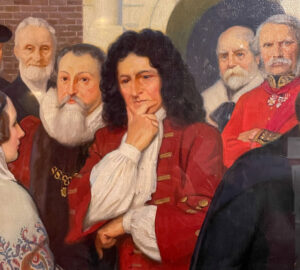
Back home, we’ve had debates about whether and how we should remove statues honoring problematic historical figures, whether they be Confederate generals or slave-owning Founding Fathers. You may believe that tearing down these statues is just as bad as what Poland or Hungary is doing. But observing Bristol’s approach demonstrates that it’s possible, even responsible, to remember these figures — completely and honestly, in all of the ways they both aided and harmed others — without honoring them. The challenge — one that Bristol rose to — is to find a constructive way to preserve history without remaining beholden to it.
Should we replace those statues with carefully worded plaques, offering a more complete and nuanced explanation of their role in history than simply “virtuous and wise”? Should the statues be collected into an open-air museum (as Budapest did with its communist statues, in Memento Park), so those generals can preach their racist ideology to each other, removed from polite society, without needlessly confronting passersby? Should we create a Museum of American Racism — a series of Slavery Documentation Centers — that detail the shameful crimes of our past, as a reminder and a warning to Americans in the present and the future?
Again, Bristol inspires me to do better.
Back Home: The United States of America
After hopscotching around our globe, we return home to the United States of America. With the benefit of comparing notes with other societies, how does the USA measure up?
When we’re at our best, we make strides toward reckoning honestly with our past sins. The Museum of African American History in Washington, DC, for example, does a beautiful, complete, and even-handed job of telling the story of Black Americans and their ancestors.
Juneteenth — a celebration that originated in the Black community to commemorate the abolition of slavery — is now a federal holiday, and more and more organizations (including Rick Steves’ Europe) show their respect by closing their offices for the day.
And even in my own lifetime, I have observed the USA doing a more honest job of acknowledging our genocide against Native American tribes — though nowhere near to the righteous degree of New Zealand/Aotearoa or Canada.
However, in recent years — as the political pendulum swings to dizzying extremes — I fear that we are facing a rising tide of people who would prefer to simply edit out the most uncomfortable details in our national narrative.
In some states, textbooks are being rewritten to downplay our heritage of slavery and racism. These days, ambiguity and intentional omission trump clarity and specificity in explaining to our children exactly how certain people have been treated by our country, and still are, and why.
Critical Race Theory (CRT), paired with the deathly curse of “woke” — both concepts that originated in the Black community — have been appropriated and cruelly weaponized. Terms like these have become an excuse for (mainly) white Americans to shut down any healthy conversation about our shared national narrative that makes them uncomfortable.
Look: I’m not interested in wading into the “woke culture wars.” In fact, I’m sticking to my guns: The importance of history can and should be a nonpartisan issue. History matters, to everyone, even if they don’t realize it. And an honest and frank acknowledgement of the facts of history, by any society, is always a good thing. History tells us where we’ve been, and it helps us figure out where we’re going.
I believe this even more strongly having traveled to places where people grapple constructively with their history, and to places where people would rather hide from it. And I’m here to tell you: Societies in the first group are stronger, healthier, smarter, more successful, and more respected on the world stage than places in the second group. Honesty can be painful, but it’s how we grow and become better.
If you believe that contemporary Germans owe it to the world — and the six million Jews their ancestors murdered in gas chambers — to continue to reckon with their past crimes; if you think that child molestation scandals deserve to be acknowledged in a retelling of the life of John Paul II; if you respect the Dutch for including the stories of collaborators along with stories of victims and uprisers in their Resistance Museum; if you admire the Kiwis for acknowledging that their island was deceptively taken from people who’d been on Aotearoa for centuries earlier; if you think it’s a shame that Viktor Orbán removed the statue of a great communist reformer just because he was also, technically, a communist; if you appreciate Bristol’s nuanced approach of remembering Edward Colston without honoring him — then you should also be willing to face the discomfort of teaching our children about America’s shameful heritage of slavery and racism, and so many other topics that deserve open and frank conversation.
When you brush aside inconvenient realities, they don’t simply go away. They just fester, impacted and infected. They wait there, only getting uglier and worse, slowly beginning to stink, until they’re eventually kicked up again by some future generation — and have become an even worse problem to deal with.
It’s very easy to see blemishes when looking at other cultures, from afar. It’s much harder to see them when we look in the mirror. But we owe it to ourselves, and to future generations, to avoid the temptation to slide into denial. So the next time someone tries to dodge a conversation about less-than-noble elements of our past, consider asking them: Why does it make you so uncomfortable to reckon honestly with our nation’s history? Because that’s what healthy, functioning societies do.
In fact, it’s what makes a country great.
Boring!
How?
Not in the least boring. Essential reading is what this is.
What a wonderful, well articulated, lesson on the importance of accepting history at its face value. So many Americans think our country is perfect.
That’s foolish.
Looking at ourselves honestly allows us to better ourselves.
And yet here you are, without anything substantial to offer but still angry enough to comment.
Good!
Important topic. As we travel in Europe we are impressed with their honesty regarding their ignoble historical acts. Disappointed in what’s happening here in the US.
A very timely article that I appreciate in its intellectual honesty. I have wondered why the divide in the US is so drastic and why so many average citizens on either side display absolute unwillingness to listen to the other side; to compromise; to cooperate. Someone told me it is because of fear; fear that what they have will be taken away if things change. If only we could get the press to promote and value real progress rather than stress sales or their own biases. Even when politicians do work together, the press gives insufficient coverage because controversy feeds fear. I have lost trust in almost all news outlets.
Controversy and fear increase clicks, and therefore money coming in. I’d love to know how we change that.
Spot on! Very well said and I totally agree!
You’re probably a nice chap, but why you and Rick Steves think we want to subject ourselves to your Woke, yes Woke, opinions befuddles me. If I want to read left-wing US-bashing editorials, I could subscribe to Mother Jones or the Nation.
“Look: I’m not interested in wading into the “woke culture wars.” In fact, I’m sticking to my guns: The importance of history can and should be a nonpartisan issue.”
Having said this, you begin wading in a very partisan fashion.
Just a couple of points. There was no genocide of Native Americans, at least in North America. The vast majority of Indians who died in colonial America and the US after the arrival of Europeans died of diseases, they were not intentionally murdered. Thus, their deaths do not meet the definition of genocide.
Conservatives don’t oppose the teaching of black history, but they do oppose the teaching of racist, one-sided history which is what CRT is.
Happy July 4!!
@Duke: So that I can better understand your position, can you tell me which sentences following the text that you quote are partisan?
You need to read Dee Brown’s well-documented book “Bury My Heart at Wounded Knee” about all the horrible things white Americans have done to the natives, and it covers mostly only the period 1860-1890. For New England’s treatment of native American during the mid colonial period, read Douglas Edward Leach’s “Flintlock and Tomahawk: New England in King Philips’ War.” I am a white citizen of the U.S. and a historian. I was taught American “history” from the standard textbooks in grades 1 to 12 and in college. After college I began studying history from primary sources. American history textbooks whitewash (no pun intended) and gloss over the true nature of what we have done to other peoples–not only native Americans, but other peoples around the world. It’s a pretty sordid story, nothing to be proud of, and we continue to do such things.
I’ll add that it is important that we make ourselves knowledgeable about what our past is really like and that we own up to such things so as to avoid repeating them.
Wow native Americans were systematically killed off oh and they died of disease because the white man gave them blankets infected with disease. That’s common knowledge. The US needs to own its history whether it’s about the native Americans we slaughtered, the black people we enslaved, the Vietnam war, our part in the destruction of numerous countries with our meddling. It isn’t a partisan issue it’s our history that we have not addressed and it festers constantly. Have you traveled outside of the US or taken an honest look at our history?
The diseases you refer to ( measles) were often intentionally inflicted on Natives by giving them blankets that had been used by those who died of measles. Marching tribes from the SW US (Trail of Tears) to Oklahoma without adeq food or water is genocide. Forcing Native children out of their homes and into boarding schools, sexually and physically abusing them, is genocide. And these are the only the first 3 examples that came to mind
Duke…..so glad you spoke up! 1995 my first trip to Europe, Rick Steves was a great resource!
WTH does he and his crew go political! Conservatives travel too!
I’m guessing that the entire Rick Steves Crew believes that “climate change” is an existential threat. And yet they continue to encourage their clients to make long international flights. Crazy or simply hypocritical?
Actually Rick Steves recognized the impact travel has and this year will donate one million dollars to non-profit organizations to help those impacted by climate change. Read about it here:
https://www.ricksteves.com/about-us/climate-smart
Native Americans were purposely given diseased blankets knowing it would spread death through villages. Whole villages were wipped out by soldiers or civilians encouraged by the government. Both the federal government and states such as California offered cash to people who brought in Native American skulls. In 1930 the government started sterilizing Native American women. Since the founding of the country there are tribes that were completely eliminated. We are people, like everywhere else in the world, and we have done bad things. You refusing to recognize that does not change the facts.
Thank you for this thoughtful essay!
Appreciate your history lesson on so many levels. Keep informing us Cameron.
Great article, and kudos to Rick Steves for publishing it. One thought: if we continue to travel to places like Hungary, are we helping or harming?
Excellent. As a life-long historian, I applaud those who can look in the mirror and acknowledge their life, warts and all. And that goes for nations as well as individuals. Well done, Cameron.
Well written and pertinent. As they say, those who fail to learn from history are doomed to repeat it.
So much here to digest. I always look forward to reading your lengthy essays.
My visit to the Amsterdam Resistance Museum about 10 years ago, and presumably before it was re-envisioned, was still very thought provoking. In many ways it literally asked people, “What would you do?” What would you do if you were mayor and the Nazis invaded? Would you remain in office with the near futile hope of having at least some way of securing protections for your citizens? Or would you resign in protest? What would you do if your child wanted to invite the a Jewish friend to play in the park together when Jews were banned from being there?
And then there is the Stolpersteine project by German artist Gunter Demnig, who has placed many thousands of bronze plaques in the pavement in Germany and throughout Europe (saw some in Florence on my recent Rick Steves Best of Tuscany Tour) that are placed in front of the former residences of Jews (and others) who were victims Nazi displacement and extermination.
Although criticized by some for downplaying the role of Hungarian citizens in the torture of locals during the Communist era, I remember seeing photos in the House of Terror Museum in Budapest of perpetrators from that era who were still roaming free without being held accountable for their crimes. I wonder if Orban has more recently influenced the balance of responsibility as presented in that impressive museum.
Your characterization of Hungary is reveailing, not about Hungary, but of the fact you’re just another far left political hack. Appreciate the candor though; it help[s to establish conext for anyting else you write.
Len…his characterization of Hungary is on point. Do you deny the facts he listed? Are you upset that it is called bad when you support what Orbsn has done there? Maybe that says something about you.
Good column!
“If the history you are studying makes you feel comfortable, you are studying the wrong history.” There’s a lot of truth in that quote such that we should all strive to pursue the truth of history so we don’t repeat its mistakes.
On visiting Auschwitz several years ago, I was heartened to see busloads of German school children coming to learn the difficult truth about its past so the horrors at Auschwitz are never forgotten or repeated. I’m glad those responsible for putting together the German educational curriculum are not trying to make everyone comfortable.
If I had not traveled, I likely would have never known how Germans are trying to learn from the past such that it makes me want to travel and learn more to expand my horizons
Thank you for including what I long felt was the most deeply moving monument I’ve seen anywhere in Europe, perhaps in part because my mother’s side of the family emigrated from Hungary – where fascism long predated the Nazis. As you know, this monument is anything but monumental: a statute of a pensive man half-way across a sculpted bridge looking at the Hungarian Parliament. A tour guide explained that the statue symbolized the fact that Imre Nagy had gotten the nation half-way to freedom. But that’s too much freedom for the current Hungarian government.
Bravo Cameron, bravo. Keep on keepin’ on and eschew the likes and thoughts of people like Duke, they won’t ever get it. No amount of truth will ever sink in.
Thank you for a really informative and interesting article. It’s a difficult subject and I appreciate the global insights I would never know about otherwise.
Excellent article – we all belong to the human race and each of us has the best and worst of humanity in our DNA. We need to learn from our true history so that hopefully we can be more humble in our nationalism and learn from past mistakes.
Go Team World
pete
Thanks Cameron for this essay. History does matter and is easily subject to spin. I agree with your assessment that some countries (particularly Germany) does a much better – and mostly unflinching – job of self-reflection. In my opinion, America has really never been very good at that task. The Daughters of the Confederacy and their historic placement of statues after the Civil War, the lack of recognition of the negative impact of Native American boarding schools, the Chinese Exclusion act, the internment of Japanese Americans in WWII (individuals of German and Italian descent weren’t put in internment camps) and many other examples impacting BIPOC folks should make thinking people pause. The “trick” is how to engage people in a way that they will chose to really think. If they don’t chose to think – no well designed museum will make them reflect, and then we are in trouble indeed.
Best to stick to travel advise and experiences. Wading into political stuff is not a good look.
Sully…what is political about a country recognizing it’s past failings? We can’t do better if we don’t know what we did wrong. It’s Nationalism to pretend a country is perfect and never failed.
Right on, Cameron. It’s disheartening to see the responses above describing your piece as a partisan attack. How far we have yet to go before people view themselves as citizens of one world. Thanks for your work, it makes a difference in the long run.
Thank you for that discussion. I just returned from Berlin and a visit to the Humboldt Forum. They had an African exhibit called “Matter of Perspective” showing how exhibit information reflected white colonialist perspective. They are working on substituting holographic representations of artifacts collected and put on display so that the objects can be repatriated to their home countries but still discussed openly in the museum.
Good job, Cameron. Thank you.
It’s good to see this sort of honest, fact-based journalism which is so sadly lacking in the mainstream media. It’s sad some people are unwilling to face reality and would rather live in a more comfortable dreamworld. Democracy can’t function well under those conditions but maybe that’s the idea.
Oy. Yet another piece wrongly arguing America doesn’t want to confront the ugly parts of its past. Sorry, this is incorrect. There is nowhere in this country where the ugliness of slavery is not taught. Go look at the standards the Florida Department of Education requires be taught about slavery in US History and, yes, in a completely separate set of standards for African American History. No white-washing, notwithstanding the uninformed commentariat’s suggestions that’s the case. Do your own research, folks.
Nicely done, Rick. While your travels over so many decades have given me a lot of information for my own annual travels, it’s also good that you are willing to delve into the ‘dark side’ of history — both in Europe, and our own. I have visited several former concentration camps, am a student of WWII history (as my father was twice wounded in Europe during WWII, as an American soldier), but standing inside of a concentration camp, staring at the walls, knowing that so many never again saw the outside again, really does give history more perspective — and so powerful! History is always a major element to my travels. I am a proud American, with ancestry participation in most of our wars, since before the Revolution (beginning with the French & Indian War of the late 1750s), up to my part as a soldier in Vietnam. I wish you good travels, and look forward to your next additions to my inbox.
Thank you for your excellent article, Cameron! You have presented facts that should cause readers to think carefully about how history is represented in the US as well as in other countries. Keep it up – we need to hear this!
Very timely article for me as I recently returned from a 140 day around the world cruise. As we toured through so many countries, I feel like all I heard about was the discovery of or conquering of many of the countries by others, mainly Britain, the Dutch, Spain and Portugal and it made me so very sad. These places didn’t need to be “discovered” or “conquered”. They were doing just fine by themselves. It was all about the power and greed of the “conquering” countries.
I always look forward to reading your blog Cameron and once again you didn’t disappoint.
You’ve given me much to think about. Thank you
Great, informative article. Thank you.
Thanks so much for this, Cameron. On a trip to Derry, Northern Ireland, we learned first hand that some countries do indeed acknowledge the entirety of their history. While simply enjoying the scenery is great, that’s only one part of why we travel.
Great discussion, except I’m very confused about the fawning over how Canadians have recently treated First Nation peoples.
There have been variety of recent instances where both the US and Canada have made strides by including these peoples so they are consulted and sometimes included in decision making, where previously neglected rights are acknowledged, and being honest about history regarding indigenous peoples (Deb Haaland has done wonders in the USA), but in other instances both have still come up completely short, through silence, retaining barriers to self determination, or ignoring rights. So not really sure what widely separates Canada from the US (or many other places for that matter).
Although my job requires me to interact with Tribes/First Nations people and governments somewhat regularly, I’m just a white dude.
I suggest you seek out more stories from these folks, especially border tribes/nations for comparison. You might learn something and may not end up as impressed as you seem in the article.
I live in British Columbia and grew up beside a First Nation reserve. We went to school together and although you correctly point out a much maligned history there is rancour and division in indigenous communities as to how to move forward. Ellis Ross who came a strong second in the leadership race for the provincial Liberal party – now known as BC United – and a member of the Haisla Nation in Kitimat is criticized by the traditionalists as an “Apple” – red on the outside, white within. He is strongly against the acceptance of UNDRIP by the present government as it gives the traditionalists an upper hand but impedes self determination and wealth creation on the reserves. I’m only the messenger but you get the picture.
Thank you for your comment, Will. this is a fair point. I don’t mean to imply that Canada has done everything right. I do think that New Zealand has set the bar for many of us to aspire to, but I also think Canada has done more – especially recently – than the United States has. While there’s much more to be done in both places, a good starting point for the US would be to observe some of what Canada is doing and follow suit.
Thanks for this thoughtful article. “Those who do not learn history are doomed to repeat it.” I pray we are not doomed and can collectively learn from our noble and less than noble history.
For all of us who travel to learn, and to learn about history as part of that, I found your post inspiring. “Why does it make you so uncomfortable to reckon honestly with our nation’s history?” is really the question, isn’t it? Of course, people have been taught various versions of history, to serve different purposes, and I guess that’s the place we land—whose version of history are you finding credible?
Your examples were excellent and insightful. Thank you.
Thank you for an interesting article. Museums and monuments present information with a particular mission. Stories can be told from many points of view. Usually the victors or those in power have written the narrative. In recent years, the lives of ordinary people have received more attention and sometimes the reality of their situation shows they were abused or exploited by individuals, governments, or other social structures. Somehow, looking at the full story makes some people upset. But, it is impossible to understand a culture without examining the reality of life for all the people.
I recently visited Clayton, the home of Henry Clay Frick in Pittsburgh. He was a very wealthy industrialist in the steel industry. The home (one of several owned by Frick) is mainly intact and is a good example of “robber baron” wealth. The tour emphasize that the “Gilded Age was not Golden” for most people. It emphasized the hard lives of Frick’s workers and how their wages compared to the luxuries that Frick enjoyed in his home. This certainly was not a story that was told in past years…..
Cindy, Exactly! Your Henry Clay Frick example is a heartening one. Not unlike the treatment of Coulston in Bristol.
The premise of course is the author is someone who doesn’t bleed red, white and blue. Could’ve been saved for publication a day other than July 4th.
John, why do you consider it non-patriotic to aspire for your country to do even better? I would make the case that an informed, deeply considered patriotism is stronger and less superficial than a naïve, knee-jerk patriotism.
John…recognizing our failures so we can do better is the most patriotic thing we can do.
Cameron
You hit it out of the park again. Thoughtful, insightful, compelling.
I see you, Cameron! “retconning”? 8-) A fellow Sci-Fi nerd, I expect?
Ethan, I’m more of a comic book guy, but I do think that concept is highly relevant here. It’s exactly what some of these people are doing.
Leftists are the ones who don’t want to recognize and maintain our history. They are actively seeking to erase and rewrite it and portray it through the lens of DEI. That’s why more people are turning to conservative media and political parties. After all, leftists ruin everything they take over. We can see this in the decline of our once-great cities, our educational system, and so many other facets of Western Civilization. With more and more people pushing back against wokeness and the leftist minority trying to push their values on everybody else, more businesses are learning the hard way that Get Woke, Go Broke is a very real thing.
Agreed
Allen, I would love for you to provide examples of where people on the left are dishonestly reconsidering American history. The whole point of my post is exactly this: we have historically viewed our own history through an extremely narrow and biased lens. And that view has left out very important aspects of our narrative. Looking back to history to more honestly consider all points of view, and to find ways for previously underrepresented voices to be heard, is a healthy stage in the evolution of a country and a culture. If you would like to provide me with any examples of doing this in a way that is untrue or not based in historical fact, I am all ears.
Cameron, I think we can agree that all perspectives should be encouraged so that people can have a more thorough grasp of our history. Unfortunately, the left only wants people to hear their side and tries to silence anyone who disagrees with them. They’ve hijacked our country’s cultural institutions and constantly push the narrative that the US was founded on exploitation, oppression, and inequality while neglecting many of the positive elements of the American experiment such as the free market, personal responsibility, and inalienable rights such as free speech. One egregious example is the 1609 Project. Another is how cities and colleges (and of course Antifa mobs) have torn down statues of important people in American history. Film, TV, and other media are always rewriting history and pushing the Marxist notion that one is either an oppressor or oppressed. Even the Academy of Motion Pictures and Arts requires a film to meet racial and gender quotas in order to be considered for an Oscar, even if doing so results in an inaccurate reflection of the history and culture in which the film takes place. Also, Internet search engine algorithms promote leftist groupthink and distort history by selectively editing what information people are allowed access to. Fortunately, more and more people are waking up to this, and as a result, a populist and patriotic age is rising!
Hello Cameron,
Thanks for putting this essay together. From the varied responses above, I can see that you did a service to people that believe “The unexamined life is not worth living.” As a history teacher, I am amazed at the reluctance of people to look at their own past and that of their country. I was told by the governor not to mention slavery in US and World History classes. That is hard to do and teach students honestly. Anyway I think of Mark Twain’s quote “Travel is fatal to prejudice, bigotry, and narrow-mindedness, and many of our people need it sorely on these accounts.” Bless you!
Love Mark Twain’s quote. Thanks!
Very worthwhile read. Excellent job, Cameron. Having been to all of the countries you mention and many of their museums including most recently, The Dutch Resistance Museum, we have observed so many different perspectives. Seeing honest and non-biased displays is reassuring for the future of our world.
Cameron,
Thank you for such a thoughtful and insightful article. As you so rightly wrote “the only way for a society to evolve is to be honest about its past, warts and all.” And within that honesty, knowledge about and respect for our own American history becomes vitally important and affects how we engage with others. I have been on multiple Rick Steve’s tours and have always been the only Black participant. Fellow travelers who are knowledgeable about America’s past “warts and all” experience cultural traditions quite differently. Less resistance, more respect and curiosity.
Great article Cameron!
My wife is Hungarian and I’ve spent a lot of time in Budapest. Imre Nagy was no saint – he spent many years in the Soviet Union and probably informed on his fellow Hungarian Communists living in exile. But he had a change of heart during the brutal years of the Rákosi government who probably executed more Hungarians per capita than Stalin in the USSR according to Victor Sebestyen in his “Budapest – Between East and West”. He remains a symbol of the 1956 Revolution whose simple statue on a bridge erected in 1996 was poignant with its watchful gaze over parliament. You could say this latter sentiment conflicts with his past but the reinauguration of the original Memorial of the National Martyrs on the same square in 2019 is grotesque and chilling. It was originally built in 1934 as a glorification of lives lost during the 133 day Bela Kun Workers Republic. As brutal as the Reds were the White regime which followed slaughtered thousands during the first few years – specifically Jews who comprised many of the ministers in the 1919 Soviet government. As you point out in present day Hungary history is rewritten to underscore the Orban creed – “We can’t be in opposition, as the nation cannot be in opposition.”
Well said. Thank you for expressing the uncomfortable truth. I believe it’s mostly a matter of fear . . . the right wingers being afraid of losing their privileged status. Their stance for “freedom” is actually a stance for privilege, as they certainly pick and choose what freedoms they want the rest of us to have. More of them should travel abroad and see that people in many other countries might be smarter, happier, and healthier because of laws enacted through the wisdom of age, making living in a civilized society safer and — smarter, happier, and healthier. I say this through having friends and family abroad and through our many travels off the beaten paths.
Cameron,
THANK YOU SO MUCH for your very thoughtful and insightful article. I’m a retired military historian who served in Vietnam fifty years ago, taught U.S. military officers for over thirty years, and in the course of my career and subsequently in retirement traveled across Japan, Europe, Egypt, Turkey, Kuwait, Iraq, and Afghanistan. And have witnessed firsthand much of what you have so aptly critiqued. Thank you again.
Brilliant. Great work Cameron. Well rounded and insightful. Thank you, Craig
Shouldn’t honest history include both the bad and the good? The section on the United States only referenced the bad. You’re blog would be more credible (as non-partisan) if you referenced, for instance, the important role the US played in the outcome of WWII. My experience is that most on the Left have an incredibly difficult time acknowledging the United States’ huge contributions to progress in the world. The outcome of World War II is seen by the Left as a foregone conclusion. Of course the nations supporting democracy would win. And why memorialize those who gave their lives in defense of democracy and freedom; they were probably descendants of slave owners, so innately evil and unworthy of praise.
Including favorable aspects of US history doesn’t preclude presenting balance.
Stephen (wait…is this *the* Stephen Miller?) — the positive stories about the USA don’t need my help to amplify. That’s the whole point. Of the negative examples that I cite feel troubling, then that only demonstrates that they remain outside the mainstream. Requesting equal time for the heroic stories about the USA is a bit like asking they there’s no “White History Month” or “Men’s Studies” college major… it (intentionally) overlooks the fact that until very recently, our nationally storytelling has been almost entirely from the white, male perspective.
Cameron, your response to Stephen was great. Yes, in traditional US history, the successes, the feel-good outcomes are much too often the default – an incomplete portrayal of our nation. I am White and am painfully aware that the White perspective I was taught presented a skewed picture of our history – I can’t remember ever studying how the pain and injustice of slavery affected those under its thumb, but I remember being taught about the successful plantation owners. I’m sad to say I think one of my ancestors was such a person, but I have yet to hear any family stories about those who made him prosperous.
1. People know history and still repeat horrible atrocities.
2. Yes, we need to know history, but history or facts are still subject to interpretation, intentional of not. Omission, context, etc., always is involved.
3. All wealth is achieved through some level of exploitation.
4. IMO, the best way to learn history and move ahead is to both travel and to get to know people from different places. You cannot do that simply by reading, or watching TV shows. You can’t really understand a society until you see how people make their living. For those reasons, what Rick Steves Tours and books so others can travel on their own is very useful
5. Cameron, your posts are too long overall, even if the intention is good.
Thank you for this informative essay. I for one very much appreciate that the Rick Steves world is progressive and caring and realistic about our world and its problems. If only some would wake up and realize America is headed down a dangerous path by trying to sugar coat the worst moments in our history.
Thank you Cameron for your thought provoking essay. How sad that differences of opinion have changed from being just differences, some perhaps short-sighted, some worth consideration, to the perception that those who hold those opinions are not just different but are actually evil.
Cameron,
This commentary was in no way partisan. It merely stated that we should acknowledge our past, warts and all. In no way is that bashing America.
Please let’s not forget what the US government did when they “detained” most of the Japanese Americans in the 1940s. A dear friend of mine was born in one of those camps. I’m reminded of it every day.
First, Rick Steves publishes perhaps the best travel guides in the bookstore’s Travel section. But many of us come to him for his excellent advice on what to see, where to stay, (not what to eat…these have been the weakest of his recommendations for me!), how to move around, and general cultural insight. I have a stack of his guides and have been reading one today for an upcoming trip. What I don’t care about his left-wing political pandering and that of his writing staff. Regardless of our political perspective, we can the excellent travel guidance without ever being preached at. I do think Rick is a bit more practical than so many on his side these days but this article has some definite hypocrisy.
Despite the overt attempt to dismiss it, the writer criticizes Hungary and its leadership for removing a statue of a less than perfect historical figure while lauding Bristol, England for the same. It’s hypocritical to claim one is bad while the other is honorable; from a far left perspective, the writer dislikes Orban while sympathizes with Black Lives Matter.
We should be honest about history, warts and all. But too often that telling is colored by modern perspectives, many, if not most, of which didn’t exist in the historical period. This leads to a far harsher contemporary treatment, often putting more emphasis on the negatives, than the positives, positives that have to be assessed also in the light of their time. Those who most loudly decry the treatment of history, often mistreat it themselves.
Finally, the example of CRT and “woke” is mischaracterized, again likely colored by a far left perspective. Again, fairly document history including negatives. But when tenets of CRT move to indicting all current members of a group of the failing of some of that group in the past, that’s as prejudicial and even bigoted as the historical warts they criticize. That’s much of the pushback on the what is the real weaponization of these perspectives which, in many cases, are deployed in support of a partisan agenda in the 2020s more than a drive for historical accuracy.
There is a critical difference between the Nagy and Colston statues. The Nagy statue was removed by the government, in an intentionally non-transparent way, without warning, in the middle of the night. The Colston statue was removed by grassroots protesters. Afterwards, it was dredged out of the harbor and put on display in a local museum, with an explanation of its history. The museum (and city leaders) actively solicited feedback from the public about what should be done with the statue, and other celebrations of Colston. (And the plinth with the plaque describing him as “virtuous and wise” still stands.) It’s not surprising that a supporter of Orbán can’t distinguish between an authoritarian act, and one reflecting the will of the people; or between an act of silencing and an act of encouraging open and honest debate.
Thank you for writing this article.
Honesty in history. What a novel concept. We really enjoyed this piece.
Interesting and thought provoking article. While I don’t agree with every specific assertion, the basic premise is spot on.
Thank you for this interesting and valuable article. As a side note, I think it’s good to remember that values were different then. We can’t, now in the 2020s, say that slave owners (etc.) were unethical for their times, any more than a person in 2050 can say that all the current gasoline-powered vehicle drivers were unethical for their times. People can absorb true information or lies during their education and from the world around them, and unfortunately as we’ve seen from Hitler times and current times, those in power are selective about whom they are blaming (never themselves). Another side note: don’t use the term “political pendulum.” This implies it will go back to the center or the opposite side. This is not true — those with money and in power are increasingly cementing their ability to stay in power. Hitler started with the courts.
Thank you for this thought-provoking article. I enjoy learning about history and very much prefer that it be factual (even if it has uncomfortable facts). I find I have much more respect for people that display their historical record through all of the lenses (good and bad). Leaving out the uncomfortable truths is ultimately a lie by omission. Thank you for including examples of where they got it right and not. We are not alone in this world and it’s helpful to have societal examples of where they got it right so we can all strive towards that type of honesty too.
Thank you, Cameron, for putting it all in context. My wife and I have personally observed in recent years the openly honest approach of the Germans, and the crudely dis-honest approach of the now defeated Polish nationalists. In Berlin, you cannot go more that a few blocks without discovering another war museum, and all of the ones we visited (including one about the SS) has adopted the no-holds-barred honest approach to the war. On the other hand, in the Berlin Stazi Museum, as well as in the city of Munich, we encountered several ugly incidents which smelled of anti-semitism.
In Poland, we visited the Gdansk tribute to the workers revolt against the government. The exhibits were well done and very honest — but finding them (on that day, at least) required some courage and imagination — there was no signage and staff had apparently been instructed to keep tourist traffic to a minimum. Our visit to Budapest may have occurred early in Orban’s rule, but we did find that access to the main synagogue was restricted for no apparent reason. In summary, the contrasts between (most of) Berlin and other cities was stark.
We hope to see exploration by you of this all-important, and timely topic in the future. Keep up the Good Work!
The dark spots in our history are like a disease and History is the medicine that prevents us from having the same disease twice.
There is no reason to judge ourselves into being a piece of dirt just because we were involved in a dark spot in our history. Instead, do the mea culpa, “I am responsible“, and I will do whatever a little bit is within my reach to make things better. And breathe… And relax… Remember that you are a good person no matter what.
This editorial is brilliant. Very specific examples demonstrate the complexities of human beings and governments, and the consequences of not owning up to their prejudices and mistakes. The concluding paragraphs artistically sum up what is at stake when we do not face or fairly educate citizens of historical truths. The pain-body of victims and their descendants continues to brew, non-victims do not understand, and it stunts cultural growth and world standing.
I applaud Cameron’s research to prepare this genuinely honest work, inspiring travel-mindfulness in its readers.