My co-author and frequent collaborator, Cameron Hewitt, is well-traveled, smart, and insightful. And, while he and I are in perfect sync in our travel styles and priorities, he gives voice to the next generation of "Rick Steves travelers." Join me in enjoying his reports right here. —Rick

I’ve Been in Your Hotel Room: A Day in the Life of a Guidebook Writer

What’s it like to research a travel guidebook?

I’ve spent more than two decades doing just that: updating and writing Rick Steves guidebooks in every corner of Europe.

When I bump into fellow travelers on the road, many are fascinated by my work. Very often, they ask if I need an “assistant” or a “replacement.” Or the ever-popular: “Do you need someone to help carry your bags?”

The fact is, if they tagged along with me for even just a few hours, they’d quickly understand that working on guidebooks is no vacation. While I don’t expect one iota of sympathy, my work is far more tedious, and far less glamorous, than it sounds. But for a travel wonk like me, it’s fascinating and rewarding.

So, for those who are curious, here’s an account of what goes into researching, writing, and updating the bestselling guidebooks in North America. This is a (condensed) excerpt from my travel memoir, The Temporary European, a collection of my favorite travel tales from more than 20 years working with Rick Steves. Most of the book is simply vivid travel stories. But this section is more nuts-and-bolts — it explains what I’m doing while all those other stories are taking place.


I’ve been in your hotel room.

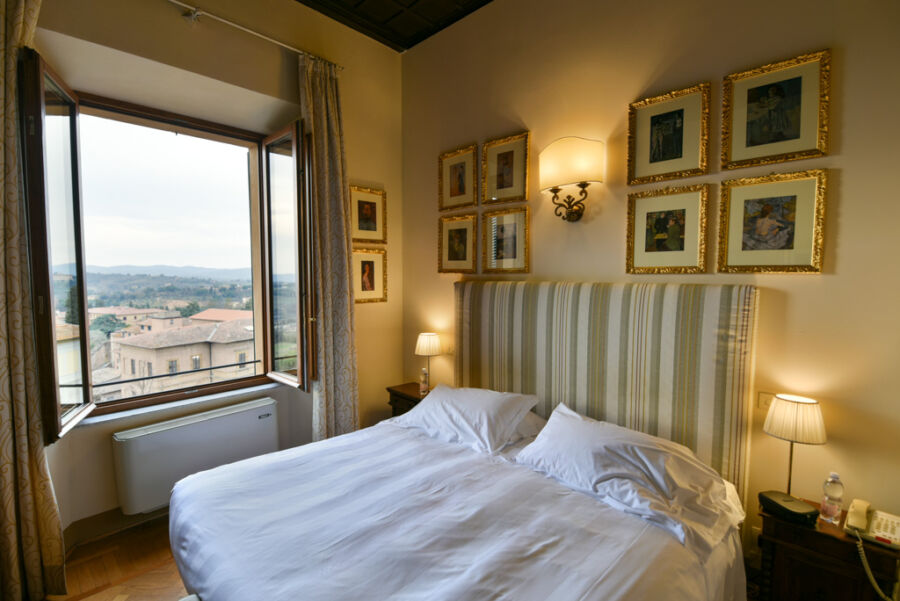
While you were out sightseeing, the receptionist let me in. I saw which guidebooks and brochures you had on the desk. I saw that you left the air-conditioning on, full-blast. I saw the mess, or the lack of mess. Some of you arrange your toiletries by size next to the sink and organize your bedside reading into a neat stack. Most of you leave the room looking like a dirty bomb exploded deep inside your suitcase.

I’m not snooping for a perverse thrill. I’m inspecting your hotel to make sure it’s as we describe it in our guidebooks. Is it still “nicely appointed” and “well-maintained”? Is it “a bit dumpy” or can it be upgraded to “sharp”? There’s only one way to find out.

I have seen thousands upon thousands of hotel rooms, all across Europe. Most are freshly cleaned and ready for check-in. Quite a few, I visit during that odiferous window between check-out and cleaning, when bedclothes are strewn about, a nighttime’s worth of garlic breath and stale farts mingle in the humid air, and the toilet bowl is in a state that might cause a veteran housekeeper to retire on the spot. And some rooms are currently occupied, but the occupants have stepped out.

I respect a hotelier who says, “Sorry, we can’t show you a guest’s room.” But, if I’m being honest, I get a kick out of the ones who just don’t care — they walk down the hall, lightly knocking then throwing open each door.

And sometimes, while I’m judging someone’s choice of toothpaste or deodorant, or marveling at how many different surfaces upon which travelers can drape wet laundry to dry, or appreciating how Germans all seem to fold their pajamas neatly on the pillow — surely this must be taught in schools — I think about how surreal it is to write a guidebook. And also, how much less glamorous it is than everyone thinks.

When I’m training new recruits, I tell them that researching a guidebook means asking a million people a million questions. Obviously, this is hyperbole. Still, when you consider that I’ve been doing this work several weeks each year for 20 years, and that each day I visit 50 or 60 businesses, and that each one might involve ten or twelve questions, I probably have asked around one million questions over my career. (And a significant percentage of those questions would be, “Closed Mondays?”)

Sometimes I’m writing up brand-new destinations; other times, I’m updating existing material. Either one requires gathering detailed information about dozens upon dozens of listings, and thinking critically about that information.

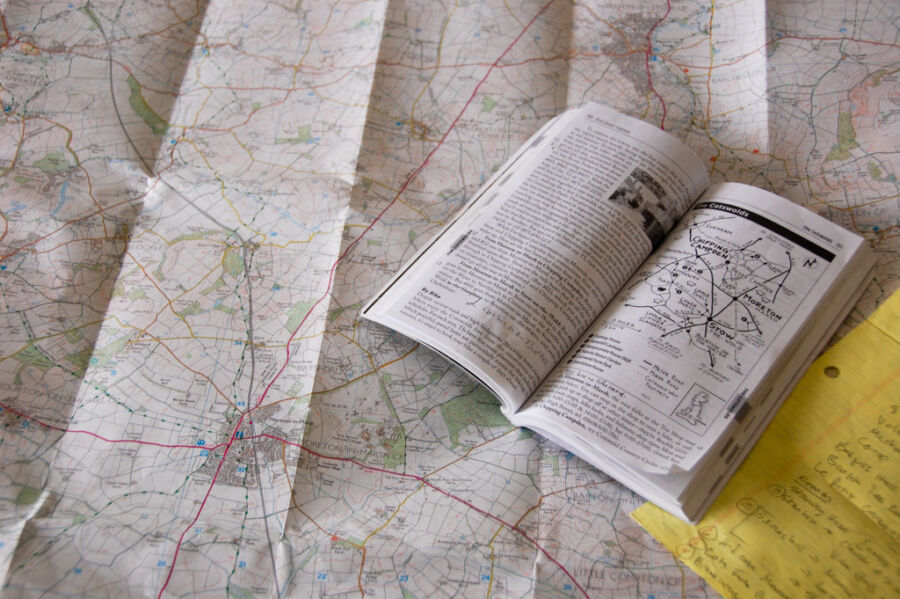
Over breakfast, I get organized, skimming the chapter and drawing an empty box in the margin next to anything that requires my attention. On a separate sheet, I sketch out a list of every item in geographical order, so I can sweep through town systematically and minimize backtracking. As I make my rounds, I scribble changes directly into the narrow margins of my guidebook. If I run out of space, I pull out a small notebook and carry on there. When I’m done with an item, I fill that box with a satisfying checkmark and move on to the next one.

My purpose is twofold: First, to verify “data points” — highly changeable details such as prices, hours, phone numbers, and so on. And second, to engage thoughtfully with the descriptions, weighing whether each one is both accurate and helpful. Does the museum still display the same pieces, in the same order? Does the restaurant still offer the dishes we mention? Even the self-guided walks must be carefully followed: “Turn left at the green building” is unhelpful if they’ve painted it red.

Guidebook researchers are experts who have to think like novices. Even as we infuse our copy with a local savvy, everything needs to be simple and clear to someone who’s just stepped off the plane. They’re standing on a street corner — jet lagged, culture shocked, surrounded by buzzing motorini — and they need advice.

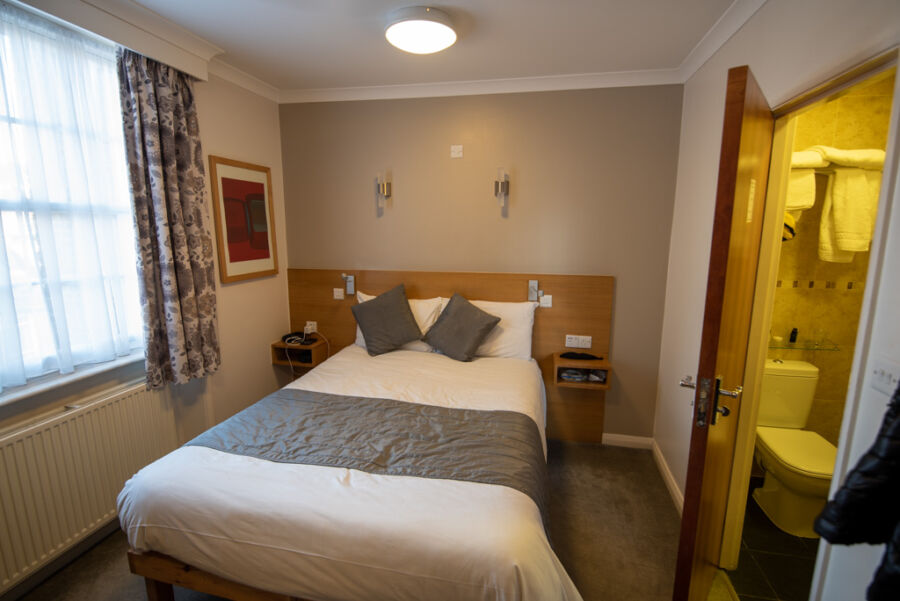
At hotels, I confirm details at the front desk and ask to see a standard double room. I’m usually in and out in about 10 minutes. How could I possibly evaluate a hotel so quickly? Consider this: How much of your overall impression of a hotel room is formed within the first few minutes? We all have our little checking-in rituals: peek into the bathroom and the closet, open the drapes to check out the view, and make a quick — even subconscious — assessment of whether the room meets expectations.

That’s essentially what I do with those precious few minutes in a room. And I know just what to look for: How tidy are hard-to-clean areas, like the bathroom grout or under the furniture? How’s the soundproofing and lightproofing on the windows? Is there heavy wear-and-tear on the carpet, or chipped and scuffed paint on the wall behind the luggage rack? All of these are subtle indicators of whether the management is putting money back into the hotel, or letting it slowly fall apart while using it as a cash cow.

Most important is something Rick taught me years ago: the sniff test. Upon entering a room, I take a big, deep whiff. Does it smell musty? Smoky? Stale? Or — potentially even more dire — overly perfumed, to cover something up? Tracking that faint, vaguely “off” odor to its source, I might discover a thriving colony of mildew on the ceiling above the shower, or that the drapes haven’t been cleaned since Franco died.

Does the hotel know who I am? Sometimes. Other times — especially if we’ve received complaints — I “go incognito”: I walk in off the street, ask to see a room, and only after my inspection do I reveal myself. When Rick taught me this trick, I assumed the receptionists of Europe would be furious. Having done it hundreds of times, however, I’ve almost never received pushback. Many hoteliers even get a kick out of it. (One winked and said, “Aha! Espionage.”)

Following a visit, I consider changes to our description. A few years after a renovation, “fresh” may become “dated.” A “friendly” front desk staff or a claim of “clean” (or even “spotless”) must earn its keep, edition after edition.

At museums, I update details at the information desk. And then, if I have time, I ask permission to quickly zip through the collection — and I mean quickly. Once I needed to assess an obscure history museum in Zagreb, Croatia, that sprawled through an old mansion with creaky parquet floors. My shoes squeaked as I walked at a cantering pace from room to room to room. The museum attendant — whose job was to follow museum-goers around, turning lights on and off — struggled to keep up. After sprinting through ten rooms in about five minutes (and seeing not much of note), I gave her an apologetic smile to convey, “Sorry if I’ve disrespected your lovely museum by seeing it so quickly.” She returned my smile with a chuckle and said, “Express!”

At a restaurant, first I review the posted menu and hours, then I step inside and snoop. I take in the vibe (what Rick calls the “eating energy”), scope out what’s on the plates, and scan for characteristic details. (“At the Stammtisch in the corner, regulars nurse their beers under droopy fishnets.”) This lasts for however long it takes a server to ask if I need anything. I verify the details and, if they’re not too busy, quiz them about their culinary philosophy. Sometimes they have useful tips to share: “In nice weather, reserve ahead for the sunny patio.”

I’m mindful not to push readers too hard toward anyplace in particular. Rather, my duty is to give them a basis for distinguishing among their options. Some of our readers want a memorable splurge; others want a solid, midrange value without pretense; others are seeking a big personality or a big view. We’re careful to keep superlatives to a minimum. Our guidebooks don’t promote; they inform.

This makes us rare in the world of travel content, which is dominated by breathless raves (often sponsored). Our judgment can afford to be candid because businesses don’t pay to be listed; all of our selections and descriptions are based solely on our researchers’ judgment about what’s best for our readers.

I’m often asked: “Do you have secret, favorite restaurants in each town that you save just for yourself?” While some writers might do this, it strikes me as a deeply selfish act. That would be like a professional football coach, in the playoff hunt, saving a few trick plays for his kid’s pee wee league. My philosophy is to leave it all out on the field — I hold back nothing. Family friends often email to say, “I’m going to Berlin. Any tips?” I’m tempted to write back: Just read the guidebook. It’s all right there.

Visiting so many places and talking to so many people quickly eats up a day. From the moment I step out the door each morning, the imaginary stopwatch over my head ticks down the seconds until that last museum closes. The people I meet on my research rounds must think (and often say outright) that I seem terribly rushed. That’s because I am.

Even when the workday’s over…it’s far from over. Just as the museums close, restaurants are opening for dinner, prime time to evaluate them at their peak. I have the unenviable task of stepping into one fantastic eatery after another — each one more tempting than the last — and then turning around and walking right back out. At some point in the evening, I might give in to the temptation to enjoy a sit-down dinner. More often, I just grab a sandwich, slice of pizza, or döner kebab to inhale as I walk back to my hotel.

Once back in the room, is it finally time to rest? Not hardly. Gathering the information is (often) the “fun” part. Writing it up is the real work. And the best time for that is when the day’s findings are fresh in my mind, in that quiet window between dinnertime and bedtime. I’d love nothing more than to kick back and watch TV. Instead, I get very uncomfortable on the tiny, hard chair in the corner and balance my laptop on the chintzy desk as I squint at my marked-up book, brochures, and business cards. I write until I’m exhausted, and then try to finish up later, whenever I have a spare moment on the train or during a quiet afternoon.

A few fitful hours of sleep later, I’m up and at ’em — on to the next town to do it all over again. And when I’m all done with that book, I submit the files and maps to our editors and head to the next country.

Guidebook writers are perennial beta testers on material that will never be “finished.” A guidebook is a living organism, unique in the publishing world. Most books, once in print, are immortalized forever. But with guidebooks, we know there’s always another printing and another edition on the horizon. We do our best to ensure our books are up to date as of the moment we send them to the printer. But things can change, sometimes major things, and sometimes the day after the book ships. So we fix them as soon as we can.

Risa Laib was Rick’s first guidebook editor. For 20-plus years, she oversaw the prolific expansion of the series, and she taught me most of what I know about editing and updating guidebooks. Risa often said she thought of each book as a palimpsest: an archaic vellum manuscript in which some ancient monk, at some distant outpost, wrote over existing text to make corrections or additions. These manuscripts, upon close examination, reveal many generations of amendments, layered on top of each other.

While the changes aren’t as evident, any guidebook you flip through is just as much a palimpsest. It’s difficult to say who even “wrote” each book. Rick Steves penned the first editions of many early guidebooks, and he still travels constantly to leave his marks. But so do other researchers and co-authors. And our editors make their own revisions.

Looking back on a guidebook chapter I worked on many years ago, sometimes I faintly recall which bits and pieces I wrote, and which ones Rick wrote, and which ones Risa or Jennifer or Tom or another one of our editors wrote. Most of the time, all I know for sure is that it’s better than how I left it. Guidebooks are a team effort. If you’ve had a great trip thanks to a solid guidebook, take a moment to skim the list of credits — squeezed in fine print at the back of the book — and imagine how many people worked hard to make your travels better.

Being a guidebook writer isn’t quite what people expect, and it’s certainly not for everyone. But for those of us with a passion for travel, and who are wired to pack as much experience and learning as possible into each day on the road, and who are willing to forego slow dinners, lazy afternoon cocktails, and sleep…it’s the job of our wildest dreams.


To read the full chapter on updating guidebooks — plus much more about guiding tours, making travel TV, and everything else we do at Rick Steves’ Europe — check out my travel memoir, The Temporary European: Lessons and Confessions of a Professional Traveler. It’s available at your local bookstore, through ricksteves.com, and for e-readers such as Kindle.

And if you’re traveling to Europe soon, be sure to pick up the newest editions of our Rick Steves guidebooks. Our team of researchers, editors, and mapmakers have been working furiously for two years straight to get all of our books fully up-to-date, post-COVID. So the current editions available now are the most meticulously, lovingly updated travel books you’ll find anywhere. Happy travels!

I Got COVID While Traveling. Here’s What Happened Next.

When I tested positive for COVID on the morning I was supposed to fly home from Europe — on day 46 of a 46-day trip — I realized something: At this stage in the pandemic, every traveler is expected to be their own ethicist.

I.

The day before, I’d wrapped up a very busy seven-week research trip with a sprint through Glasgow. By mid-afternoon, I was feeling worn out. No surprise there — I’d just worked my eighth straight day without a break, and I had to push hard to finish up the final items on my list. By bedtime, back in my hotel, my throat was getting scratchy. I hoped it was nothing a good
night’s sleep wouldn’t fix, and tried to get some rest.

I woke up early the next morning feeling decidedly crummy — my throat was worse, and I felt flushed.  My flight was due to depart in just a few hours. So I faced a dilemma.

Less than two weeks earlier — on June 12 — the US had waived the requirement to present a negative COVID test to re-enter the country. And when I’d checked in for my flight, I was not asked any questions about whether I had symptoms. Technically, I was within my rights to shrug it off and get on the plane.

What would you do?

I imagine many of you would say: You should test, of course! And if you’re positive, you should postpone your flight.
And many of you would probably say: Come on! COVID is everywhere now. If you have it on the plane, so what? Certainly, others will, too. As long as you try to mask up, you might as well just go home.

I’m a pretty idealistic person. And since the very start of the pandemic, I’ve been preaching about the importance of looking out for each other. So, of course, the “right decision” was to test and wait.

On the other hand…

…if I was at the very start of a lengthy illness, wouldn’t it be better to recuperate at home? This could drag on for days. Not to mention the extreme hassle and significant expense of having to extend my stay.

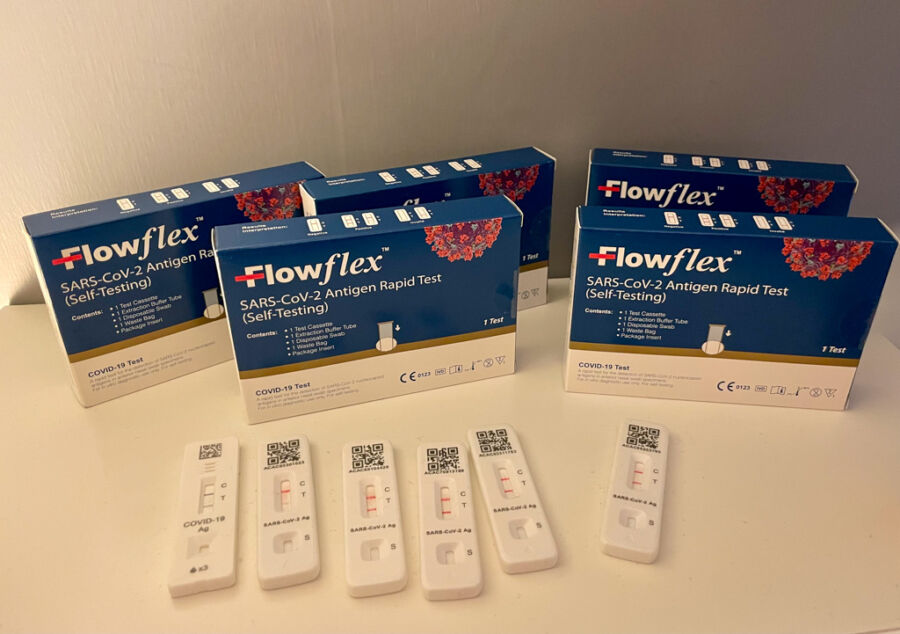
These things seem clear in the abstract. But I have to admit, facing this question in real life was challenging. While I was deliberating, almost as a knee-jerk instinct, I fished around in my bag for my last remaining COVID test. I swabbed my nose, dunked the stick in the little tube of testing medium, and squeezed a few droplets of that solution into the reservoir on the test strip.

Since home tests became widely available, I’ve tested myself more times than I can count: before or after a trip; before seeing someone I didn’t want to expose; simply because I wasn’t feeling great. The test procedure, while thrilling and terrifying in those early days, had grown dull and anticlimactic. After a few minutes, I’d begin squinting at that little control line, waiting for the second test line to appear…and it never did.

This time, however…

That accusing red test line came through loud and clear, and very quickly. It was definitive: I had COVID.

Just to make sure, I strapped on my best N95 and ran to the nearby long-hours pharmacy. Just inside the door was a stack of home tests for £2 apiece. I grabbed six, used the self-checkout machine, and got out of there as fast as possible. I tested twice more back in the room. Both positive.

I called my wife, waking her up in the middle of the night, and we both agreed that the appropriate course of action was clear: I should postpone my return home.

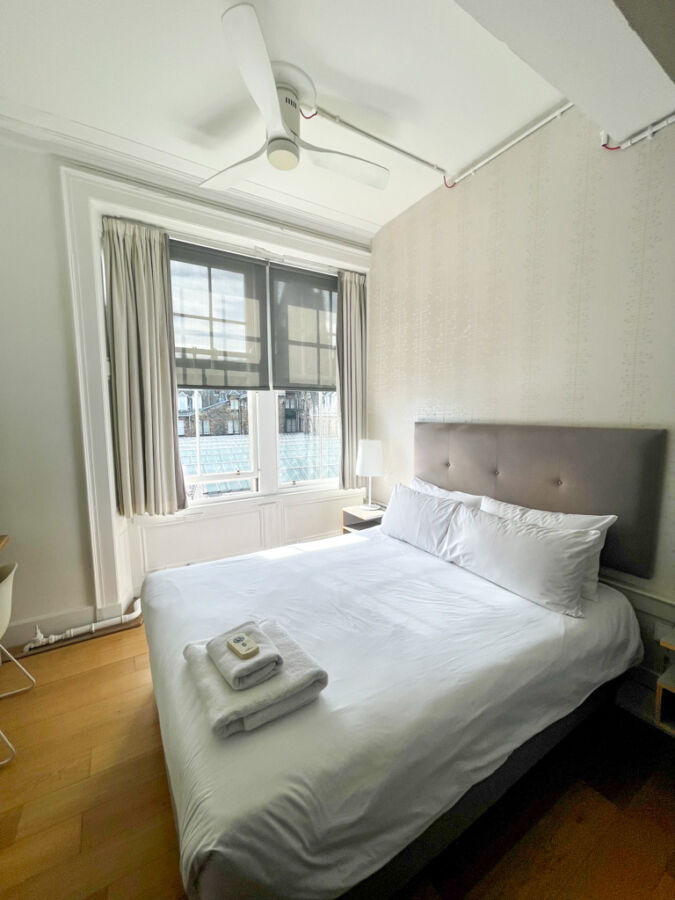
And that’s how I wound up spending several extra days in Glasgow, stretching my trip past the 50-day mark — almost the entire time spent in my quite small (but comfortable) hotel room.

II.

Those first few hours were extremely stressful: Reading articles on “what to do if you test positive for COVID,” I learned that some people continue having symptoms and testing positive for many, many days. A few days’ delay felt manageable. But I certainly did not want to spend another week or two in this little hotel room, far from home. I had things to do, a life to resume. As my flight departure time neared, I realized I could still just barely make it onto that plane if I left right now. Again, I was so tempted to head home.

This is a very confusing time to be making these decisions. Many governments (including in the UK, where I was, and the US, where I was going) are essentially washing their hands of the problem. They offer “guidance” and “advice.” But at the end of the day…it’s up to you.

For me, it came down to two points: First, I was feeling worse by the hour. At this rate, I’d be getting on my evening transatlantic flight just as I felt my crummiest. Selfishly, that did not sound like fun.

But the overriding concern was altruistic: I imagined the many people I know who are still being extremely careful. Some are elderly and have reason to believe that, even fully vaccinated, they might struggle with a COVID infection. Some have kids who are too young to be vaccinated (though, thankfully, that has started to change even since this happened). And some are immunocompromised.

It’s easy to say, “Well, those people shouldn’t travel, then.” Fair enough. But it’s also fair enough for someone who has put off a dream trip for two and a half years to finally say, “I know there’s risk. But I am tired of waiting. I will take every reasonable precaution to stay safe and take a leap of faith.” I don’t blame those people for getting on an airplane.

However, the wild card is other people’s behavior. I can’t control if someone with COVID gets on the plane for a nine-hour flight. But there is one thing I can control: Whether I am that person.

In the end, tempted as I was to just get home, I asked myself one question: “Would I want my parents to be sitting next to me for nine hours across the Atlantic?” And the answer to that question was unequivocal: No way.

I will say, I wish my airline (Lufthansa) had been more supportive of this decision. Because it was within 24 hours of departure, there was no way for me to change or cancel my flight online. After searching for a working telephone number for about a half-hour, then spending an hour and a half climbing through their phone tree, I was told that changing my flight would be possible only if I could fly home six days later…and the fare difference would exceed the original round-trip price.

It apparently made not one iota of difference that my sole reason for rescheduling was not wanting to expose Lufthansa’s passengers to COVID. This was treated as a matter of personal choice. (Which, I suppose, it was.) The best they could do was to suggest that “maybe” I could get future flight credit. They gave me another phone number to request this, and, after 30 more minutes on hold, I was told to email my request instead. The response could take weeks, if not months.

That night — right around the time that I would have been boarding the plane — my fever spiked to over 100 degrees and I had a severe case of chills. I was very glad not to be on that plane.

III.

When you’re lying around for days recovering from COVID, you have ample time to ponder one suddenly very pressing question: How, exactly, did I get COVID?

The fact that I can’t pinpoint the answer tells you everything you need to know. Simply put, I let my guard down, and put myself in multiple situations where I could’ve been exposed. Partly because I was fully vaccinated and recently boosted, I was (perhaps foolishly) more willing to take on the risk. But I am living proof that “taking on the risk” can have real consequences.

When traveling earlier this year, I had been very careful: I masked anytime I was indoors, and I actively avoided indoor dining, with rare exceptions. On this trip, I was still masking on public transportation (planes, buses, trams) and in crowded museums…and I was, very often, one of the only people who was masking. Here’s me in a crowded ferry terminal — the only mask in sight — on the day when I suspect I was exposed.

And yet, I’ll admit, in other ways I was more lax. I stopped masking for brief conversations throughout the day with museum ticket clerks and hotel receptionists. These conversations usually last just a few minutes…but sometimes stretch (delightfully) much longer. Did one of those lovely digressions wind up exposing me?

Part of the reason I let my guard down was simply social pressure. In the places I visited on this trip, masking has become vanishingly rare. In dozens upon dozens of interactions each day, I could count on one hand the number of times the person I was talking to wore a mask. It started to feel pointless to mask up each time I went inside. I wish I weren’t so susceptible to “peer pressure,” but, frankly…when, time after time, you find you’re the only masked person, you begin to feel a bit like a weirdo.

Probably more consequentially, I also got in the habit of eating in restaurants. (Scotland’s unseasonably cold and rainy summer weather limited my outdoor dining options.) In retrospect, this might have been the main thing I’d have done differently, had I known how staggeringly high cases were in the places I was visiting.

Speaking of which, I believe the single biggest factor in how I got COVID is that Scotland was absolutely on fire with COVID while I was there. Later — when it was too late — I found a BBC News article estimating that, during the very week I was sick, one out of every eighteen people in Scotland had COVID. One in eighteen! With those odds, there’s no doubt I was exposed at multiple points each day.

To be honest, this news frustrated me. As I was traveling through Scotland, occasionally I’d hear, anecdotally, that cases were going up. I kept checking the same “dashboards” for global COVID rates that I’ve been relying on since March 2020 — keeping an eye out for hot spots. According to those numbers, Scotland’s rates were increasing, but not to an alarming degree.

However, those statistics rely on confirmed cases. And, like most other places, Scotland has drastically reduced formal testing. (The NHS Scotland website specifically says: “Most people in Scotland no longer need to test for coronavirus.”) Many people who have COVID never even know it for sure, or they know only because of a home test that they likely don’t report to the authorities. Those deceptively low case counts lulled me into a false sense that things were still under control, well after the point when they definitely weren’t.

Had I known the rates were one-in-eighteen, you can be sure I’d have upped my masking. Would that have made a difference? Maybe not. But I wished I’d taken it more seriously when I started seeing “business closed due to illness” signs popping up.

In the end, though, my decisions were my own. At some level, I figured — being so close to the end of my trip, and having been fortunate so far — I could probably skate on through without too much worry. I thought to myself, “I haven’t had it yet, so who knows? Maybe I just won’t get it.”

I was wrong.

IV.

Fortunately, I was fully vaccinated. In fact, I had gotten my second booster shortly before this trip (which might be what spared me until now). Especially after that first night, my symptoms were not bad at all. I ran a slight fever for a couple of days; I had a stuffy nose and a sore throat; I was tired, but not even what I’d call “fatigued.” I would rank it merely as a mid-level cold — far from the worst cold I’ve had. And it was certainly not the sickest I’ve been on a trip to Europe. The only thing that made it remotely unusual was knowing it was COVID.

In fact, I found myself thinking, “This is the reason we all put our lives on hold for a year and a half? This is why nobody could travel for so long?”

But then I’d remind myself that people of my age and general health were dying at alarming rates in those early days of the pandemic. And I felt extremely grateful for those miraculous vaccines. On four separate occasions over the past year, I’ve trained my body what to do in case this happened. I gave my immune system clear instructions and ran it through drills for exactly this eventuality. And so, when the real thing hit…it knew what to do, and it dealt with it admirably.

(I am aware that some of the newer variants do a better job of escaping the old vaccines. This is why we’re starting to hear about potential boosters for this fall. In any event, I was very glad for whatever protection my vaccinations gave me. )

I’ve heard some people say, “I got fully vaccinated and I still got COVID! Obviously, the vaccines don’t work.”

This thought never crossed my mind. Nobody every said that the vaccines guaranteed we’d never get COVID. Rather, we’ve been told all along that the vaccines make COVID less dangerous, drastically reducing severity and hospitalizations. And on that count, they’ve been a smashing success — including for me personally.

As for being stuck in that hotel room…to be honest, it wasn’t so terrible. It was plenty comfortable, with a fun view over the train station’s glass canopy. Having an excuse to take it easy, at the end of a long and demanding research trip, was weirdly welcome. I’d work on finishing up my guidebook writing as long as my energy held out…then I’d reward myself by binging some TV.

I consider British television an important cultural experience. Usually when I’m in Britain, I’m working nonstop, so at best I have the TV on in the background. But COVID let me settle in and enjoy some shows I’d only flipped past before.

 (Related: I am bewildered that no American television production company has managed to properly adapt the wonderful show Gogglebox — in which ordinary, everyday Brits from various walks of life are recorded in their living rooms, watching and discussing TV shows — for the American audience. They attempted a “celebrity” version, which misses the point, and predictably flopped. Come on, America. We can do this!)

Fortunately, the hotel was able to extend my stay in the same room. They told me I was lucky, in a way: Scotland is packed to the gills, and it’s hard to find a room. But because of the ongoing rail strike, they had several cancellations.

If you’re going to be sick anywhere, try to be sick in Glasgow — where people are simply wonderful and kind and easy to talk to. I notified the reception desk I had tested positive to make sure nobody would enter my room and unwittingly expose themselves. The receptionist said, “So sorry to hear that. But it’s not surprising. I just recovered from it myself last week!” They took it in stride and told me they’d sanitize my room with extra vigor when I checked out.

I’d venture out of my room once or twice a day, taking short walks for my sanity. Each time I’d strap on my N95 the entire time and sanitize my hands like crazy before and after I touched anything. (I even shaved my scraggly beard, just to encourage a tighter mask fit.) For food, I’d run into the ubiquitous corner grocery stores, grab a few items, use the “touchless” self-checkout stand, and be on my way as quickly as possible.

On a couple of occasions, I ordered food in a restaurant, then waited outside while it was being prepared. Often, while standing out there in my mask, I’d be passed by multiple unmasked people who were hacking, coughing, snuffling, and sneezing. Given the high caseloads, it’s a certainty that at least some of these people had COVID…but, unlike me, were doing nothing to avoid spreading it.

And that leads to a question I asked myself again and again as I was waiting out this nasty bug: Is it somehow old-fashioned or deluded to be so worried about spreading COVID? Are we beyond that now? Should we really be treating it as “just a cold,” and stop taking extreme precautions…like the ones I was taking?

I’m sure that day will come. Personally, I don’t think we’re there quite yet. I know we’re fed up with the disruption to our lives. (Believe me — after this trip, I speak from experience.) But COVID remains a dangerous virus that can have devastating long-term consequences. To this day, a 9/11’s worth of Americans are still dying of COVID about every two weeks. For those of us privileged enough to be generally healthy and fully vaccinated and boosted, COVID is usually just a nuisance. But for a lot of people, COVID could be a huge problem.

And that’s really the frustrating part about COVID. It’s not going out with a bang. It’s trailing off with a whimper. At what point will we be able to totally forget about COVID — just truly not worry about it anymore? Probably never. Maybe it’s like terrorism after 9/11: Gradually, the constant fear and vigilance will fade…but some element of it will always be with us.

In the interim, for me, it’s too early to throw caution entirely to the wind. Yes, I’m personally more willing now to lower my guard and take a few more chances. But when we take those chances, we have to be prepared for the consequences.

And I believe we need to respect others who are trying to make their own choices. If I got on the plane with a 100-degree fever and an active case of COVID, I would be robbing my seatmate of that choice. Maybe they wouldn’t care; perhaps that person would be part of the fast-growing population who’ve decided that getting COVID is a reasonable tradeoff for doing as they please. (Heck, maybe I’d be sitting next to someone nursing their own COVID fever.) But it could just as well be someone with good reasons to expect others to have their back. I think that person deserves my consideration…even if it causes me some inconvenience. (Then again, I’m also someone who never reclines my seat back. But that’s a whole other blog post…)

V.

After what felt like an eternity in that little hotel room, I had reached the CDC-recommended five-day isolation period. More important, my symptoms had almost entirely resolved, and I had not run a fever in nearly three days. I was able to book a last-minute flight back to Seattle. So I got up, packed my bag, unwrapped and strapped on a brand-new N95 (which I would barely take off for the next 18 hours)…and headed to the airport.

Boarding my flight in Glasgow, I did a little math. My plane had about 180 seats. If one in eighteen people in Scotland had COVID at that moment, there were likely at least ten active cases on that plane. I saw only about a dozen people who, like me, were wearing masks. Which means there were almost certainly unmasked COVID cases on that flight. (And remember that masks — especially when worn by just one person — are far from a guarantee of safety. They are just one layer in what should be a stacking series of protections.)

Allow me to editorialize for a moment. (I think I’ve earned it.) Even though I postponed my trip voluntarily, I understand the need to lift the testing requirement to re-enter the US. But not requiring tests makes far less sense when masking on board planes is optional.

After two and a half years of struggling with this virus, we know of two things that are unequivocally, demonstrably effective in slowing the spread and reducing the impact of COVID: vaccinations and masking. As we “get back to normal” on so many fronts — and, predictably, cases are surging — how many COVID cases are getting on planes these days without masks?

Failing a mask mandate, we can’t  control whether other people wear masks (even if they’re hacking and coughing the whole way across the Atlantic). But you can control whether you wear one. Assuming you still care about not wanting to get COVID — or, perhaps, unwittingly spread it to someone else — mask up on board. These days, not wearing a mask on a flight is like playing Russian roulette with five bullets.

During my layover, I was fortunate to find a nearly deserted concourse. I sat alone and was able to take off my mask for a few minutes to eat and drink. I am aware that air circulation and filtration during a flight helps reduce the spread of COVID. But other aspects of air travel — including waiting in a crowded, unventilated jetway — are more risky. So I tried to be one of the last people to board the plane.

My connecting flight — much longer, at over seven hours — was the one that worried me. Fortunately, everyone within two seats of me, in every direction, wore their mask the entire time. That was a relief. And I kept my mask securely in place for the duration of the flight (other than occasionally sneaking into the bathroom to gobble a snack or blow my nose).

Landing in Seattle, I felt confident I’d made the right decision by delaying my return. And I have to say…it was very, very good to be home.

VI.

Rick Steves likes to say that our job as travel writers is making mistakes so you don’t have to. His favorite example is losing your travelers’ checks. But I suppose catching COVID is more timely. And, much as I deeply regret being your guinea pig…is there anything you can you learn from my COVID experience?

First, if you want to travel but still really don’t want to get COVID, don’t let your guard down. It’s so tempting to give in to social pressure and take off that mask. Or to have a nice, relaxed meal in a (crowded) restaurant. But if you want to keep your level of risk to a minimum, prepare yourself mentally to stick to your “good behavior”…even if it means you’re flying in the face of current social norms.

Another lesson: This was a reality check that these days, nothing prevents someone with COVID from traveling however they like. (I can attest to this, because I came very close to being that person.) You should assume that there are active, contagious, unmasked COVID cases on any plane (or train, or bus) you board. Assuming you still care about not wanting to catch COVID, this demands scrupulous masking with high-quality masks. Don’t mess around with cloth or surgical masks: Get and use a medical-grade N95 (or, failing that, a KN95 or equivalent). As you’ll be surrounded by more and more unmasked people, now is the time to up your mask game…not lower it.

Something that I take to heart now — more than ever before — is really making the effort to understand the current risk in the place you’re visiting. Had I bothered to pay more careful attention when I started hearing that “cases were going up,” I might have better understood how dire the circumstances were becoming, and adjusted my behavior accordingly. When you’re trying to enjoy a vacation, assessing current caseloads is far from “fun.” But it matters. And it can help you decide when it’s probably OK to go ahead and have a nice meal in a restaurant…or when you need to hunker down and stay outside.

Finally, if you do get COVID, I hope you’ll follow my example and do your best to think about your impact on others. I was determined to be the final link in this particular chain of the virus. I took all reasonable (and, some might say, unreasonable) precautions to avoid exposing other people when I knew I would be at my most contagious.

Having been though that decision-making process, however, I have a new empathy for people who might make the opposite choice, and get on that plane despite having COVID. It’s a tough call, and these days, we are essentially on our own.

In my case, I kept coming back to what I have been saying since day one of the pandemic: The only way through this is by looking out for each other…even when it’s inconvenient, or expensive, or frustrating. Or, try this rule of thumb: If I were healthy, would I want to be sitting next to me on that plane?

Should You Still Go to Poland? Yes. Here’s Why.

When I told people at home, back in early May, that I was heading to Poland, I got two very different responses.

The majority of people said, “Poland? Next door to Ukraine? With all the fighting and the refugees? That can’t possibly be safe. Aren’t you nervous?”

A few people, though, said something more along the lines of, “Wow. This would be a fascinating time to be in Poland.”

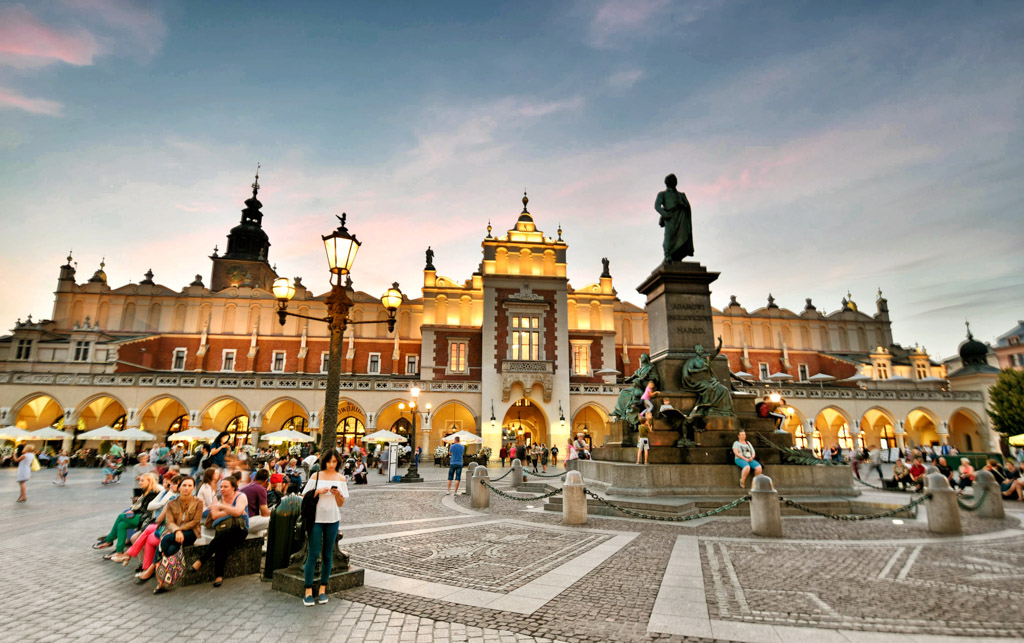
I went ahead with my trip, largely because my Polish friends assured me that things were just fine. And now that I’ve spent two weeks traveling all around Poland, I’m so glad I went. I felt entirely safe and more than comfortable. And it was, to be sure, a fascinating time to be there.

This is not to diminish the ongoing tragedy in Poland’s neighbor to the east, Ukraine. The Ukrainians are suffering, and my heart is with them. But Poland is not Ukraine. And even being within 150 miles from places where bombs have dropped, I felt no fear or worry for my safety while in Poland.

Nobody has a crystal ball, especially where Mr. Putin is concerned. And yes, the Poles are on edge. One told me that he’s gotten used to the sound of heavy-duty American military aircraft rumbling overhead. But they are getting on with their lives. And they don’t appear to be too worried about the potential for imminent invasion.

That’s because Poles understand (far better than skittish American tourists) that Poland is in the EU, and in NATO. This country is surrounded by an invisible “DO NOT CROSS” line. So far, Putin respects the integrity of that line, and we have no reason to believe that will change anytime soon. (And if that does change…well, then, being in Poland as World War III begins is the least of our problems.)

If I were going back to Poland soon, I’d be keeping an eye on the news. If the fighting were to spill over Ukraine’s border, that would be reason to re-evaluate travel plans. But if things stay relatively on par with where they’ve been, I see no reason to cancel a trip or change an itinerary in Poland because of what’s happening in Ukraine.

There’s another consideration, and that’s the influx of Ukrainian refugees into Poland. Over the last few months, Poland (with 39 million citizens) has taken in 3 million Ukrainians. The Poles — who understand what it’s like to be invaded by a powerful neighbor (including, ahem, this very same powerful neighbor) — have generously opened up their country to these refugees. I spoke with many Poles have personally hosted refugees in their homes, or helped to find arrangements for them.

Another Polish friend — a professional driver whose business has tanked along with tourism in general — told me he’s been volunteering his time to buy relief supplies and drive them a few hours to the Ukrainian border, where he loads them into trucks bound deep into the country. Having watched headlines from Ukraine over the last few months, and feeling so helpless, it’s humbling to know a person who’s part of the supply chain that directly supports people impacted by the war.

All of that said, traveling in Poland, I saw zero actual signs of refugees, and never felt like my presence was a burden or a hindrance to refugee relief efforts. It’s striking how the Ukrainians seem to have melted into Polish society. To the casual American visitor, they are invisible. (Though my Polish friends said, “When you go to the market or the shopping mall, you hear Ukrainian everywhere these days.”)

I was worried that being in Poland right now, staying in hotels, I would somehow be “taking beds away” from needy Ukrainians. As it turned out, the hotels where I stayed seemed to have an abundance of available rooms. At least for the moment, hotel occupancy rates are way down (along with tourism in general), and Ukrainian refugees are living in more long-term housing.

One day I was enjoying lunch with some Polish friends at an al fresco restaurant in the colorful, historic heart of Gdańsk. One of them noticed, across the street, a pretty brick hall that belonged to the local contingent of Scouts. Low-profile signs on the door, in cheery blue and yellow, noted that its dorms were now housing displaced people from Ukraine. Had those signs not been pointed out to me, I’d never have known.

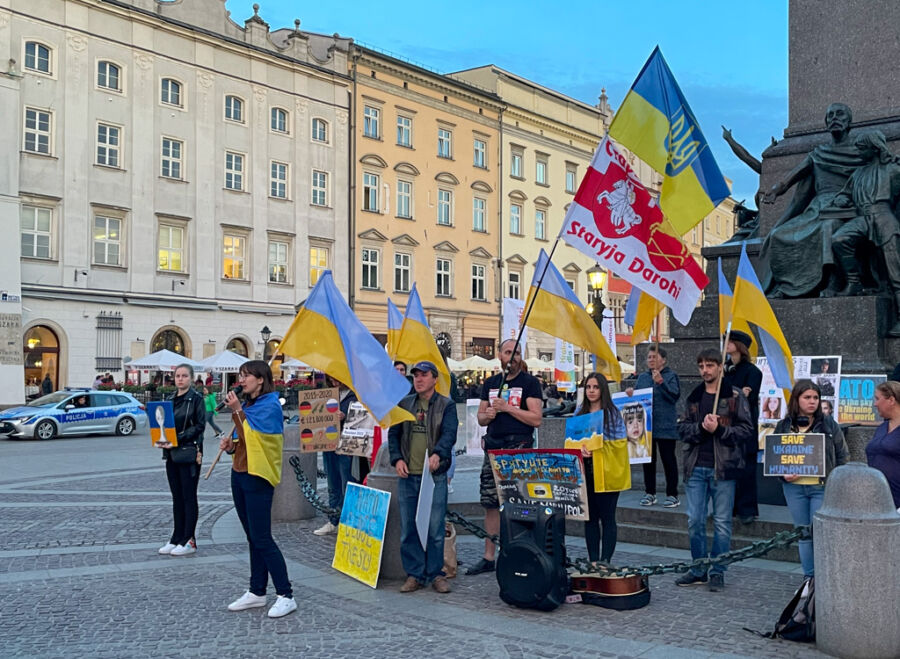
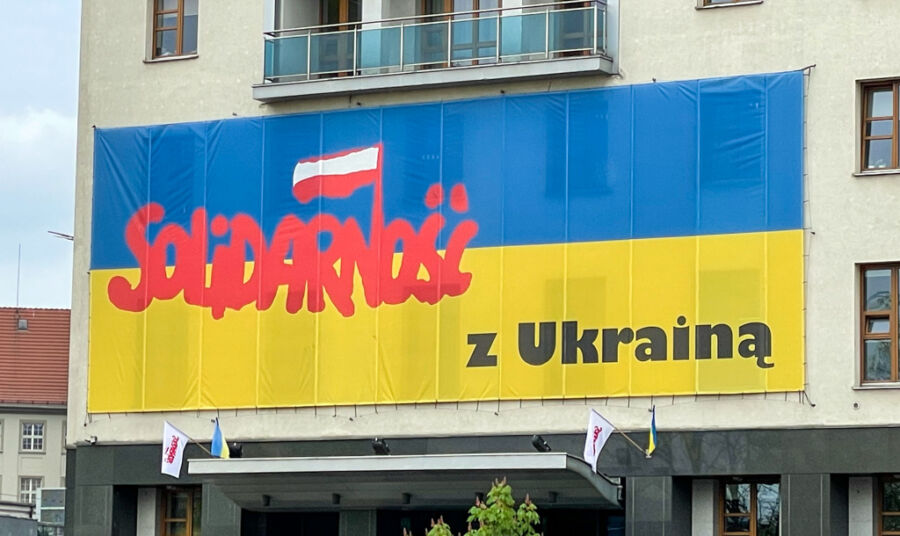
The main way a visitor is aware of the Ukrainian conflict is simply the abundance of supportive yellow and blue, everywhere you go — from tiny lapel pins and postcard-size flags in the window, all the way up to gigantic, building-sized murals. On the outskirts of Kraków, an empty plinth that once held a Soviet war memorial (long since removed) has itself been painted with bold blue and yellow stripes. And everywhere in Poland, the customary spring flower boxes all seem to have the same blue and yellow color scheme.

And I did see some rallies and vigils on behalf of Ukraine. To be fair, I saw even more of these in other parts of Europe (London, Italy) in my travels earlier this year. And it struck me that, to the Poles, these “demonstrations” were entirely non-controversial…just an opportunity for Ukrainians to vent, and to remind everyone else what they are going through.

I had the chance for some candid conversations with Poles about the refugee situation. It was clear that their compassion for their eastern neighbors is genuine, as is their belief that helping those people is simply the right thing to do. (The Poles, who tend to be a bit idealistic, are all about doing the right thing, God bless them.) And yet, they admitted a bit of reluctance, too. One told me that he’s had to overlook Ukraine’s World War II history, when Ukrainian troops (acting on behalf of Stalin’s Red Army) massacred Polish forces. In this part of the world, memories are as long as hearts are big, and sometimes it can come down to an emotional tug-of-war.

Another told me an anecdote: A relative works at a nail salon. A Ukrainian refugee came in for a pedicure…then refused to pay. “I thought you were supposed to be helping us,” she sniffed, as she walked out the door.

So, naturally, there are growing pains that come with accepting so many refugees. Many of the refugees hope to someday return home (some already are; others, from places still devastated by war, have no idea when the coast will be clear). Others will probably make new lives here in Poland. Meanwhile, Poles are understandably starting to ask questions about the financial burden created by these new arrivals. On the other hand, one politically savvy observer reminded me that, after Poland joined the European Union in 2004, something like 2 or 3 million Poles moved abroad for work. So, from a “glass-half-full” point of view, Ukraine is replenishing Poland’s population. The  EU “brain drain” is getting a Ukrainian refill.

Another interesting side effect of the Ukraine conflict is how it’s bringing together a divided nation. Just as in the USA (and in so many other places), Poland’s political discourse has grown dramatically polarized in recent years. The left and the right are farther apart — and the rhetoric is angrier — than ever before. Several Poles told me that finally, their country has found an issue on which they all agree: What Putin is doing is wrong. And Ukrainians deserve whatever help we can give them. This may not be enough to permanently unite Poland, but it’s a refreshing moment of concord. (And it has shamed the ruling Law and Justice Party — which had been getting uncomfortably cozy with Putin — into stepping back from the ledge.)

Personally, I’ve struggled with one aspect of the Ukrainian refugee situation. I was also traveling in Eastern Europe in the fall of 2015, when two million Syrian refugees were moving through the region on their way to wealthier northern European countries for asylum. In places like Hungary and Croatia, I observed train stations jammed full of desperate people, and tent cities that had sprung up along borders. I met desperate people, escaping horrors just as threatening as what Ukrainians face today, fleeing for their lives…and meeting angry resistance.

The fact that these scenes are not being repeated in Poland today is inspiring, to be sure. But the cynical part of me is taking note: It turns out that, when they really want to, Europeans are able to take in those in need.

Why is it so much easier for Poland to admit millions of white, Christian Europeans when so many countries were horrified by a similar situation with brown, Muslim Arabs? Perhaps the answer is obvious: Ukrainians are fellow Europeans and next-door neighbors, whose appearance, language, and way of life are already very close to the Poles’. That’s a case that’s easy to rationalize, but it doesn’t take long to degrade into arguments rooted in xenophobia and racism.

If your heart is breaking for Ukrainian refugees, you should ask yourself why it doesn’t break for Syrian, African, or Latin American refugees in equal measure. I hope that the next time people in need show up at Europe’s doorstep begging for asylum, Europe remembers that it’s simply the right thing to do. Poland is demonstrating to the world that a “refugee crisis” does not have to feel like a crisis. It can simply be a well-coordinated feat of compassion.

So, from the traveler’s perspective, my safety is not really an issue. And in terms of my presence being a disruption to the refugees — or vice versa — I also found it was a non-issue. So, then…why, exactly, should people be avoiding Poland right now?

In fact, I would make the case that, if you truly support those who support Ukraine, you have a civic duty to travel to Poland right now.

Put yourself in the Poles’ shoes: Like everyone else, they have struggled through COVID. People who work in the tourism industry have been patiently biding their time, preparing for the return of travelers. And then, just as that’s about to happen…their eastern neighbor gets invaded, in a manner most grotesque. So many of those bookings you were counting on for the spring and summer are cancelled.

But you’re not bitter. You understand (perhaps better than most people, considering your country’s history) that these things happen. And you rise to the occasion to open your doors and your hearts to your neighbors in need…all the while, trying to figure out if and when you might ever be able to finally get your economic house back in order.

Now I ask you: Are these not people deserving of your tourist dollars right now? Assuming you are going to be spending money to go somewhere, where could possibly be a better place to spend it?

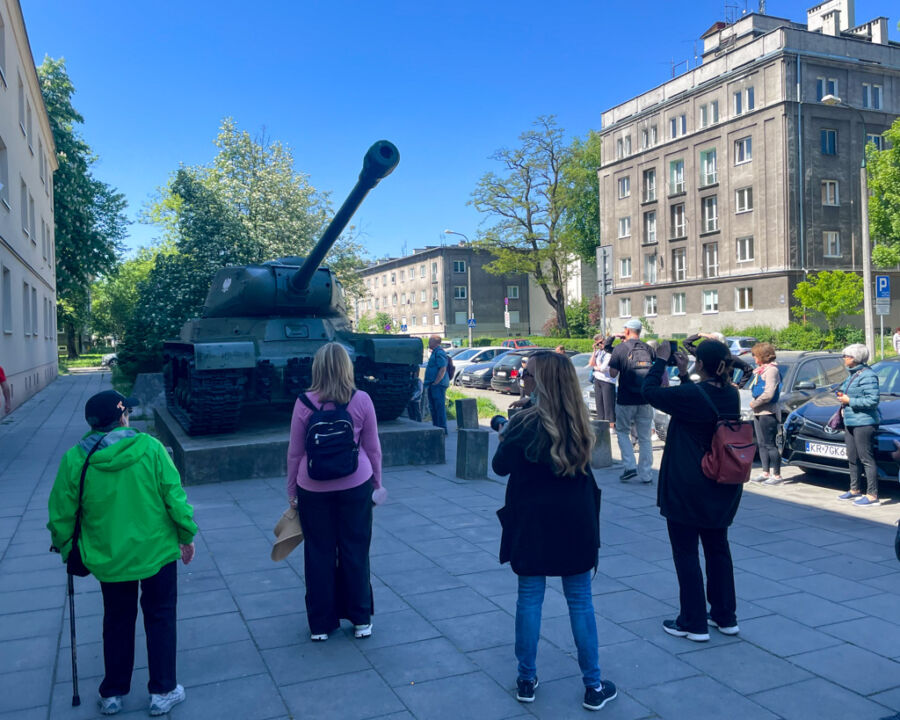
But don’t take my word for it. The reason I went to Poland on this trip was to guide the very first departure of our brand-new Rick Steves Best of Poland in 10 Days Tour. At our first night meeting, I polled the group about their thoughts. Several said they were nervous about both safety and refugee concerns before coming on the trip. A few even said they’d seriously considered cancelling. But by the end of the trip, every single one was very glad they had come, and reported that they felt completely safe the entire time. The closest we came to a Russian tank was one parked in front of a museum…another reminder that for the people of Poland, weathering Russian aggression is nothing new.

At the same time, they were glad to have had this opportunity to learn in a more intimate way about the conflict that has been dominating our headlines for the last few months. And in particular, they were touched to learn more about refugee issues firsthand.

One night in Warsaw, we had planned a fairly conventional group dinner at a fairly conventional restaurant. But then we realized that our hotel employs a largely Ukrainian kitchen staff. So we asked if they might cook us a traditional Ukrainian feast to teach us about their cuisine. They were excited to have the chance to cook from the heart. The food was fantastic (and strikingly different than Polish food — even if the dishes, such as “borscht” and “pierogi,” sounded the same). And we also enjoyed live music by a young woman playing the traditional Ukrainian stringed instrument called a bandura. It was an excellent meal, and it was extremely touching, too.

And there was another big advantage to traveling in Poland right now: Zero crowds. Throughout the trip, my Polish colleagues and I kept remarking on how empty things were. Sights that are normally congested with people were entirely empty. We found ourselves sharing Poland almost exclusively with the Poles (especially packs of cheery children, since May is field-trip season in Poland). It felt like traveling in Poland 15 or 20 years ago, before it was discovered by tourists — while also enjoying all of the advantages of economic development in the present day.

So, if you’re considering going to Poland (or Hungary, or Estonia, or Slovakia)…if I were you, I’d go ahead with those plans. The locals will appreciate it. And you’ll come away with the experience of a lifetime.


Heading to Europe? It’s Time to Get Comfortable with Technology

Finally returning to Europe to update our Rick Steves guidebooks, I was expecting to find lots of changes due of the pandemic. But the biggest trend is something I didn’t see coming: In just two years, Europe has made huge advances in technology. It used to be, there were two ways of doing things: the tech-savvy way, and the old-fashioned way. Now the two options are “get with the tech” or “get left behind.” If you’re heading to Europe soon, it’s time to get comfortable with technology.

This may sound intimidating. Fortunately, the technology — from “contactless” payments, to e-tickets for museums, to buying train tickets on an app — has also become much more user-friendly. Yes, there’s a learning curve. But the “new way” of doing things is easier than ever. And it comes with a bigger payoff.

Contactless Payment

The prime example of this trend is “contactless” or “tap” payment, for purchases both big and small. This technology has already had a stealth rollout in the USA over the last couple of years. About a year ago, my bank sent me — unsolicited — a new “tap” credit card. At first, I thought, “Why? I don’t need that.”

Now that I’ve traveled in Europe, I understand: Yes, I really do need that. Not just on the road; it’s also a great convenience at home. (Surprisingly, many vendors in the US don’t even realize they accept tap payments. This has happened to me several times: A cashier says, “OK, you can insert or swipe your card.” Instead, I tap my card against the terminal. The cashier says, “No, you have to insert…” BEEP! “Oh, it worked.”)

While some of you may be up to speed on “tap” payment, many Americans haven’t quite fully adopted it. And those people are in for a rude awakening when they land in London or Amsterdam and find that, in very many cases, “contactless” is the only way to pay for purchases.

To get ready for contactless, you have two options:

First, check with your credit card company to see if they offer a “tap” version of your card. They may be able to send you one immediately. Or check the card you already have; it may, heretofore unnoticed by you, have the four curved lines indicating that it works for “tap” payment. Since you’ll be using this in Europe, start trying it out at home before you go.

But what if it’s too late to get a tap card? No problem. You can set up contactless payment on your smartphone. For example, if you have an iPhone, you can link any credit card to your Apple Wallet. (In the “Settings” menu, look for “Wallet & Apple Pay,” then “Add Card.” Here’s more information for Apple devices, and for Google Pay on Android.) When it’s time to pay, just move your phone toward the pay pad and click the side button twice. It’ll scan your face (or ask for your passcode)…and Bob’s your uncle!

I don’t want to overstate the “cashlessness” of Europe. In many places, cash is still widely used. For example, in three weeks in Italy, I could have paid for just about everything with cash…had I wanted to. But if you pay with plastic, you’ll be paying by tap (rarely by inserting or swiping your card).

That said, in some places, cash is effectively extinct. In London, I was surprised how many businesses — big and small — simply refused to accept it. Whether paying for a nice dinner, buying a pack of gum, or booking a theater ticket, everyone just wanted me to tap. When I landed at Heathrow, I withdrew £200 from an ATM — assuming, as on past trips, that I’d pay for things with a combination of cash and card. I still have about £180 taking up space in my money belt. (Fortunately, I’m heading to Scotland later this summer, where I will work harder at unloading those bills.)

Here’s a sign of the times: At the City of London tourist office, I was told that they tried to go cashless last year. But then, Americans began to return — and they kept showing up with cash. So the TI had to quickly figure out how to go back to accepting cash payments. (Of course, other businesses aren’t so accommodating.)

If visiting a place where contactless is dominant — such as London — simply take out less cash on arrival. Or wait a day or two, to be sure you really need it. You may never get around to it.

Once you get used to this change, it’s frankly wonderful. Tap payments make things so easy. Gone are the days of worrying if the European machine would accept your American PIN, or figuring out whether you have to insert or swipe. With contactless, it’s just tap and go.

Museum Changes: Reservations, E-Tickets, and the End (?) of Audioguides

Technology has also altered the way that museums operate. The ability to make online reservations for major sights is old news. But through the pandemic, that process has been streamlined and simplified, and now even smaller museums offer this option. This began primarily as a crowd-management measure. Now that occupancy limits have been lifted, most sights seem to be keeping those systems in place for the convenience of their visitors (or, more likely, because they like the way it helps them track attendance data).

Here’s the catch, though: Just because a sight offers reservations, doesn’t mean they are actually helpful for every traveler. Pre-reserving online takes time and makes your day’s structure more rigid. (In Italy, it also usually costs a couple of euros extra to book ahead.) It’s worth doing some homework to establish whether it’s really worth reserving ahead. I find that for popular museums, at busy times, prebooking saves time and stress. But otherwise, I’d rather keep my schedule flexible.

By the way, some sights that used to just recommend reservations now require them. In Rome, I showed up one morning at the Colosseum without a reservation. It was not too busy at other big sights, so I figured I could just buy a ticket and go inside. However, at the turnstile I was informed that all of the ticket windows had been closed during COVID; the only way I could gain entry was by prebooking online. The good news: There were time slots available almost immediately. The bad news: To book one, I had to stand around in front of the Colosseum for 10 minutes, struggling with a buggy website on my smartphone. It worked. But I wished I’d done it back in the comfort of my hotel room.

Will this be the case from now on? Good question. As we update our guidebooks, we’re learning that museum policies are still in flux. Some of my “fresh” Rome updates from just one month ago are already out-of-date. It could well be that, as crowds increase through the summer, some of the Colosseum’s in-person ticket desks will reopen. (Though in that case, you’d still want to reserve ahead, to save time.) To be clear on the latest policy, check the sight’s website for official word before you visit.

When you do book online, it’s easier than ever to enter the sight. Major attractions now have separate entrances for ticket holders. After you book your ticket online, you’re emailed a QR code; just show this at the appropriate turnstile, and you’ll be scanned right in. And that’s it…no need to print anything, or to exchange a voucher or a virtual ticket for a paper one. It’s wonderfully simple. (Some sights, of course, still do have security lines.)

Here’s a handy “travel hack,” straight from Rick Steves: It can be a pain to scroll through old emails to find your ticket, once you arrive at the sight. Consider taking a screenshot of the QR code when you receive it, so it’s easier to find quickly in your camera roll. (Good one, Rick!)

The other trend I noticed was the decline of audioguides. This makes sense: During a pandemic, who wants to press their face against a device that was recently pressed against a stranger’s face? Many museums have replaced physical audioguides with apps that you download and listen to on your own phone. It’s hard to predict anything these days, but now that these apps are in place, I have a hunch that many sights will never go back to physical audioguides (a technology that was already feeling old-fashioned).

As I made these discoveries, I was glad to work for a company that produces our own top-quality audio tours of Europe’s top museums. This sounds like a gratuitous plug, but it’s simply a smart, honest travel tip: As the availability of good museum information is in flux, there’s never been a better time to take advantage of Rick’s entirely free audio tours, which you can download and use via our Rick Steves Audio Europe app.

In London, many museums have also integrated maps into their free apps…and, therefore, have done away with paper maps. Again, this largely began as a “touch-free” COVID measure. But now that they’ve innovated this alternative, museums are figuring out how much it saves them in printing costs. And at museums where they rearrange the collection frequently (such as the Tate Britain and the Tate Modern), digital maps are easier to update, too. I suspect that, for some museums, paper maps will not return. If you don’t want to download the museum app, here’s a tip: Just take a photo on your phone of the map posted in the lobby.

Train Tickets, Getting Online, and Other Technology Issues

On this trip more than ever before, I booked intercity train tickets on apps. In Italy, I used the official Trenitalia app; in Britain, I used the Trainline app. In both cases, I could look up schedules, choose a departure, and book a ticket with just a few taps on my phone. Gone are the days of arriving at the station early to stand in line or grapple with self-service ticket machines. You can just book your ticket over breakfast, or in the taxi on your way to the station. Scan your QR code to enter the platform turnstiles, and keep track of the train’s schedule (including delays updated in real time) right on the app.

I also used apps to hail taxis. In Rome, I used the “Free Now” app to get a regular Roman taxi, for the regular rates, on request, without having to make a phone call or find a taxi stand. And it made it simple to pay and tip with my credit card. (Uber works in Rome, but only at the pricier “Uber Black” level — making a regular taxi more affordable.)

Of course, many of these technology advances require an Internet connection. This can be simple, or an expensive headache, depending on your provider at home. I use T-Mobile, even though their service where I live can be very frustrating, because they offer free (if slower) Internet access in Europe. Some of my relatives use Verizon, which requires buying a special plan to use in Europe. (Here’s an article explaining some of this.)

Even a few years ago, for someone on a casual vacation, I might have advised them not to bother setting up their phone to get online in Europe. Free Wi-Fi hotspots are plentiful, and you’re usually not far from a place to get online. However, with the technological leaps I observed on this trip, getting online abroad is increasingly worth the hassle. While you can still probably get away with skipping it, these days you’re more likely to encounter situations where you’ll be glad you did.

If you just hate dealing with technology, all of these changes may sound demoralizing. I’d flip that logic around: It’s empowering to know that these changes are afoot, so you have time to get used to them and learn the new system. What would be “demoralizing” would be landing in Europe, unaware that these options are out there…and being constantly frustrated by them. It’s amazing how fast the “new standard” gets set when the world changes. And it’s time to get on board.


I was in Europe updating our Rick Steves guidebooks for our brand-new, post-COVID editions. Those will begin to arrive on bookshelves later this summer.

I’m heading out again soon for another trip to Europe. In the coming weeks, I’ll be in Poland, the Netherlands, Belgium, and Scotland. If you’d like to hop in my rucksack, I’ll be posting occasionally to this blog. But for all the latest updates, be sure to  follow me on Facebook. Happy travels!

Spring 2022 Trip Report: What It’s Like Traveling in Europe Right Now

I recently returned from a five-week guidebook research trip in England and Italy. And now that I’m home, everyone’s asking the same question: What’s it like traveling right now, as Europe emerges from the pandemic? By sheer coincidence, I wound up visiting perhaps the least restrictive part of Europe (England), then the most restrictive (Italy) — offering a taste of the full spectrum you might encounter, if you’re hitting the road anytime soon. This trip really was a tale of two COVIDs.

When it comes to traveling during COVID, the only thing that’s constant is change. So I’ll stress that this information is accurate as of my recent visit, from late February through late March. (In fact, Italy partially relaxed its restrictions just a few days ago, even since I got home.) If you’re hitting the road anytime in 2022, check local restrictions closer to your departure date.

London Is Over COVID (Even if COVID Isn’t Over)

Around the time I took off for London, the Queen contracted COVID. Also around that same time, Prime Minster Boris Johnson declared that all remaining pandemic restrictions would be lifted. On February 24 — a few days after my arrival — England celebrated what some cheekily called “Freedom Day”…even as their sovereign still had the sniffles. (Tellingly, this was already the second “Freedom Day” in as many years.)

Coming from cautious Seattle, where indoor masking was still required, I was shocked by how few masks I saw on arrival in London. “Masks are mandatory” signs, still posted everywhere, were flagrantly disregarded by Londoners who knew that the rules had changed. In many indoor situations — for example, waiting in line at a café to order a takeaway latte — I was the only person who wore a mask.

On the Tube and on public buses, I’d estimate that one-quarter to one-third of passengers wore masks. This figure seemed to go up and down depending on which part of town I was in (perhaps the highest ratio was on a day trip to Cambridge). One Londoner I talked to, who lives in an outlying bedroom community, told me the majority of people on his Tube ride into central London were masked, but once downtown, that number would plummet. (I was too busy updating guidebooks to conduct a reliable sociological survey…but the results would have been fascinating.)

It was an exciting, slightly scary time to be in London. On the one hand, I enjoyed feeling the momentum of a society that is finally restarting. Museums and restaurants were open (though in a few cases, hours were still somewhat reduced). People were out and about, walking the streets, riding the Tube, and mixing and mingling just like old times. It felt good to feel so normal.

On the other hand, I was just starting out on a five-week trip — 5,000 miles from home, and with piles of work to do. I did not want to contract COVID, if only because the editorial team back at the home office was patiently waiting for my guidebook files to kick-start our 2022 season. So while the people around me were celebrating “Freedom,” I was still dutifully wearing my mask and rubbing sanitizer on my hands.

During this strange transition period, I’ve been trying to be what I think of as a “non-judgmental masker.” I choose to wear a mask in most indoor situations, simply because my understanding of the science leads me to believe that wearing a mask is safer both for me and for those I come into contact with. (And I will say, trying to be careful for my own sake brought me a lot of empathy for immunocompromised people — who must feel terribly alienated from society right now.)

That said, I’ve overcome my instinct to criticize or shame someone near me who chooses not to wear a mask, if it’s in accordance with local regulations. That’s your choice; this is mine. One caveat: If you’re actively sneezing, coughing, and wheezing, well then…yes, I am going to get up and move elsewhere. And I will try not to shoot you a dirty look. (But I’m only human.)

Being cautious was not easy, I’ll admit. It was chilly in London, so every time I strapped on a mask to step into a hotel lobby and quiz the receptionist on their latest details for our book, my glasses became opaque with dense fog. (Stupidly, it took me well over a week to buy some spray-on defogger, which worked wonders.)

I also skipped one of my absolute favorite London activities: eating in its many amazing restaurants. I just love the food scene here, and normally I spend each evening in a trendy new hotspot in Soho or Shoreditch, to “try it out for the book.” But given my current risk-aversion, I mostly skipped indoor dining (especially when a place was crowded — which the best places always are). London’s many outdoor (or semi-outdoor) street markets, such as the wonderful Borough Market, offered high cuisine in a safer environment.

Even though I was being cautious, having a good N95 mask bought me peace of mind. For instance, I did not want to miss another one of my favorite London experiences, watching a play at Shakespeare’s Globe (specifically, their wonderful indoor venue, the Sam Wanamaker Playhouse). Wearing a medical-grade mask gave me peace of mind, even if about half of my fellow theater-goers were unmasked.

I believe my caution paid off. Other than indoor dining, I still did everything I would have done in pre-pandemic times, but with a good mask on. I still toured every museum, inspected every hotel, reconnected with old friends, and interacted with dozens of people each day. And after five very busy weeks of traveling in Europe, I never had any symptoms, and I never tested positive for COVID.

In Italy, COVID Remains a Part of Life: Vaccines, Boosters, and Masking

Imagine the culture shock of flying from England to Italy, which occupies the opposite end of the COVID precautions spectrum. Italians remain as vigilant and strict as London is loose. This began the moment I arrived in Naples, when I had to go through a time-consuming airport screening to ensure that my paperwork (vaccine card and passenger locator form) was fully up to snuff.

In two weeks in London, not a soul asked to see my proof of vaccination (except when I checked in for my flight in Seattle). But on my first day in Italy, I was repeatedly asked to show it — to enter restaurants, museums, and so on. It’s worth talking about the specifics here, because this will come up if you’re traveling in a country that still requires proof of vaccination.

In Europe, fully vaccinated means boosted as well. Italians (adorably) refer to this as “super-vaccinated.” Italians prove their vaccination status with a “super green pass,” a QR code on their phone that gets scanned when they enter a building.

For American visitors, you only need to show them your printed vaccination card from the CDC (or a photocopy — I kept my original safe in my money belt). However — crucially — your vaccination card needs to list all three shots, including the booster. (I was surprised how many times they actually counted — Uno, due, tre! Ees O.K.!) In my case, for reasons I will never understand, each of my three shots was issued on a separate card. Fortunately, I had contacted my HMO a few weeks before my trip, and they sent me a new card that listed all three. That turned out to save me a lot of hassle — I hate to imagine trying to explain the three-card system, in Italian, several times each day.

(One important side note: On April 1 — just a few days after I flew home — Italy relaxed some of its regulations for showing proof of vaccination. You no longer need to show your CDC card to enter a museum or public transit, but you still do in order to dine indoors…at least, through the end of April. Again, wherever you are traveling to, do some homework so you know what to expect as of the time of your visit.)

Italy also had remarkably high, virtually 100 percent masking compliance. I almost never found myself in an indoor space — museum, church, restaurant, bus, train — where I saw a single unmasked person. Even outdoors — where masks are not required — I’d estimate about 20 to 30 percent of pedestrians were masked anyway (a higher ratio than what I typically saw indoors in London).

When dining indoors, Italians diligently masked up any time they weren’t sitting and actively eating. Even in huge, cavernous churches, this is taken seriously. Inside Pisa’s Duomo, which was nearly empty of visitors, I spotted two elderly tourists who apparently forgot to don their masks. No sooner had I noticed this than an attendant went rushing over to remind them. I got so used to this, I didn’t even notice that I was wearing my mask. And St. Peter’s is just as spectacular when you’re masked.

Keep in mind that in Italy, a mask must be medical grade. They call this “FFP2,” but it’s equivalent to N95, KN95, and KF94 masks widely available in the US. It must be worn over the nose and mouth, and cloth masks are not acceptable substitutes.

By the way, Italians don’t wear masks because they enjoy it. I promise you — as much as you hate wearing masks, Italians hate it more. Italians are deeply social creatures, keenly tapped into nonverbal cues. For them, removing half of the face is a massive hardship; you might as well cut off their tongue or poke out their ears. But they do it anyway, with pride, for the greater good.

This was the case even in my first stop in Italy, Naples. Naples! A city synonymous with chaos and disorder. This is a place where flagrant disregard for rules is a hobby passionately pursued, and where any authority is viewed with deep suspicion. And yet, there I was, walking down the Spaccanapoli, surrounded by carefully masked Neapolitans.

Wearing my anthropologist’s hat, I asked around as to why Italians were taking this stuff so seriously. One hotelier — who is clearly a bit fed up with all of this — described the Brits as coraggiosi (courageous) for simply moving on with life. Others reminded me that northern Italy was devastated by the very first wave of COVID, back in February of 2020. Night after night, Italians watched news of the rising death count. They still feel the personal pain from that loss — and all of the losses since — and are not yet willing to give up on making small, reasonable changes to their behavior if it means saving a few more lives.

Anecdotally, I was told that masking compliance and vaccination rates were both higher in the South, and diminished as you moved toward the North. Based purely on my Naples-to-Florence itinerary, there may be a speck of truth to this; or it may simply be another salvo in the age-old North-South rivalry.

Testing

As yet another indication of how fast things are changing, a couple of weeks before my flight to London, I believed I would be required to show a negative test before getting on the plane. But the UK waived this requirement just days before my departure. And then, for my trip from London to Naples, Italy also changed the rule just days before I flew. In the end, I wasn’t required to get a single COVID test until the day before I flew home.

Speaking of which: Right now, you are still required to get a negative COVID test the day before you re-enter the United States. This sounds troublesome and time-consuming. But fortunately, they accept a rapid antigen test (which only takes about 15 minutes), as long as it’s administered by an official provider. And testing is affordable and widely available in most of Europe, making it less of a hassle than you might think.

In my case, I was flying home very early from Florence. The day before that, I rode the train from Lucca to Florence. And the evening before that, I was hanging out in Lucca, wondering where I should get my COVID test. I did a quick search on my phone and found a pharmacy right on the main square that administered the test. I dropped by, and they penciled me in for an appointment the next morning.

When I woke up, I packed my bag, checked out of my B&B, and headed through lovely Lucca to the train station — making a slight detour to the main square for my appointment. They instructed me to drop my bags in the corner, swabbed my nose, and asked me to wait outside for 15 minutes. It was actually an enjoyable experience to stand in front of that pharmacy, listening to the church bells clang, watching small-town Tuscany wake up. After what felt like just a few moments, they called me in, handed me an official-looking paper with my test results, charged me €15, and sent me on my way. I made it to the train station with 20 minutes to spare. I can only hope red tape is always so delightful.

What Else Is New?

In the coming weeks, I’ll be sharing lots more observations about my return to Europe. (If you haven’t yet, be sure to follow my Facebook page to get all the latest updates.) But here’s a quick rundown of what else is new in Europe for 2022:

I was struck by how rapidly new technology has been adopted through COVID. For instance, London has gone practically cashless. Every purchase now uses “contactless” technology: a credit card, smartphone, or watch that you tap against a pay pad. (You probably already have a “contactless” credit card, even if you don’t realize it — check your card for four curved lines — or you can easily set this up on your phone.) The same technology is now common throughout Europe, though in Italy, I found cash was still more widely used.

Another change: Most museums have “temporarily” done away with audioguides, for obvious reasons. (Who wants to spend two hours pressing your face against a device that was just pressing against someone else’s face?) But now that they’re gone, I have a suspicion audioguides may not be back. Instead, museums encourage visitors to download apps so they can follow the tour on their own device. (Better yet, download the Rick Steves Audio Europe app, with heaps of entirely free, self-guided museum tours and city walks.)

For the major sights, it’s more important than ever to do your homework and reserve ahead. Many museums — even minor ones — have introduced online reservation systems. Initially this was a crowd-control measure due to COVID restrictions. But now that they’re in place, these reservations systems will probably stick around.

And some major sights (including Rome’s Colosseum) now require reservations, instead of just recommending them (as previously). If you want to visit the Colosseum, you must prebook a time slot online. This is serious. On my visit, they didn’t even have any in-person ticket windows open at all; if you just show up, you’ll wind up standing around outside the turnstiles, booking a ticket on your smartphone. Also in Rome, the Pantheon had a long line out front of people waiting to get in. On weekends, they now require reservations to enter; on weekdays, you don’t need a reservation; and either way, you’ll stand in the same line. If you’re going to any major sight, spend a few minutes reviewing their website a few weeks before your trip to figure out the latest.

The other major issue on this visit, of course, was Russia’s invasion of Ukraine. Chatting with Londoners and Italians, it was clear that this was weighing very heavily on many hearts. Personally, I don’t consider the war a “safety issue” for travel (including in Poland, where I’ll be in just a few weeks). However, it has certainly dampened spirits at a time when many were just getting excited for the “return to normal.” When I’d ask people, “How have you been?”, Ukraine was often the very first thing they wanted to talk about.

It’s simply unnerving and tragic for Europeans — many of whom are quite pacifistic — knowing that a terrible war is raging, and so many people are suffering, on their own continent. Everywhere I went, I saw vigils, flags, and signs demonstrating in solidarity with Ukraine.

In Pisa, one of the main civic buildings flew three flags: the European Union, Italy, and — not Pisa — but Ukraine. Nearby flew two rainbow flags, an Italian symbol for PACE (“peace”).

Anecdotally, I learned that the one-two punch of Omicron and the Ukraine invasion has led many travelers to book trips more last-minute than before. A hotelier in Rome explained, “Usually we see people booking many months ahead. This year, it feels like people are taking a more ‘wait-and-see’ approach, and are booking only a few weeks ahead.” If you wait too long to book, you may find that you’re trying to jump into a pool jammed with others doing the same…and miss out.

What about crowds? It’s very early in the season, but even so, in London and Rome, things were not nearly up to their overwhelming 2019 numbers. Things are definitely returning to normal; lines were forming in front of major sights like the British Museum, National Gallery, Pantheon, and St. Peter’s. And yet, in the Vatican Museums, the Map Gallery was as empty as I’ve ever seen it.

I found smaller cities much quieter. Cambridge, Pisa, Siena, Lucca — these places felt borderline-deserted. I’ve never seen Pisa’s Field of Miracles so empty, and my Lucca B&B told me that I was the only person staying there for those three nights. (On the other hand, on Friday and Saturday night, all of the best Siena restaurants were fully booked.) Of course, smaller towns and cities like these will ramp up and become busy again — but it may take longer than in the big cities.

As for those guidebooks: I’ve already turned in my updated files and maps for the Rick Steves London and Rome books, and other researchers (including Rick) are currently updating every corner of Europe. Our guidebook department is working at a heroically accelerated pace this year to churn out new, post-COVID editions as quickly as possible. The first new books (including London and Rome) will hit bookshelves as early as August, so if you’re heading to Europe this fall, keep an eye out for the latest.

In the meantime, while much has changed, I found our guidebooks fundamentally sound. The best sightseeing advice, the self-guided museum tours and walks, the lists of our favorite restaurants and hotels…while each of these has been slightly adjusted, the current edition is still as up-to-date as anything you’ll find in print for assembling a dream return trip to Europe.

The Final (?) Word

I’ll stress again that this is a very small sample size: one traveler, two countries, five weeks. And it represents just a snapshot in time; this blog post will go stale remarkably fast. But I hope it offers some insight and encouragement about wading back into international travel at this moment.

What’s the situation in France, or Germany, or Spain, or Prague, or Greece? Honestly…I have no idea. But I imagine it’s somewhere between the two extremes of London and Italy. And if anyone out there wants to give us their own trip report here in the Comments, we’d all appreciate it.

In the end, this was one of my favorite, most successful trips in years. It felt wonderful simply being back; the weather was unseasonably pleasant; and I must admit, I didn’t miss the crowds. Most of all, I came away with a confidence that you can have a safe and enjoyable trip in 2022, even as COVID sputters on. Just be prepared: Before you hit the road, think carefully about how much risk you’re willing to take on, then adapt as needed — even if that means skipping indoor dining or wearing an N95 mask for that performance you’ve been dreaming of. Be aware that each place you visit may have their own restrictions, and be conscientious about following them. Check back frequently to understand any red tape you might need to sort through. But most of all, simply enjoy being back in Europe.


During the pandemic, I took some time off to write a travel memoir, The Temporary European: Lessons and Confessions of a Professional Traveler. It’s a collection of my favorite travel tales from my 20-plus years working with Rick Steves, plus inside looks at what it’s like to write guidebooks, make travel TV, and guide tours. You can order it from your favorite local bookseller; get it at the Rick Steves’ Europe Travel Store; or buy a copy at Amazon.com (paperback or Kindle edition).