“Foodie” Doesn’t Have to Mean Expensive: My €25 Day in Ljubljana

“Foodie-ism” comes with a generation gap — just like the Charleston or the Beatles. And when I mention Foodie-ism to Baby Boomers, many seem to think “foodie” means “expensive.” But it doesn’t have to: It’s about the quality of the ingredients, the care of the preparation, and a knack for merging innovation with a healthy respect for tradition.

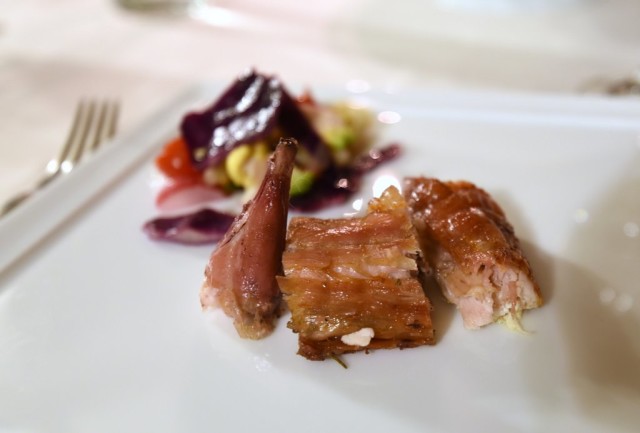
Slovenia — for my money, the most underrated country in Europe — embraces tradition and lives close to nature, but also has an un-snooty sense of style and sophistication. That’s an ideal mix for foodies on a budget. On my September trip to the Slovenian capital, Ljubljana, I had one of my best “eating days” of the year. I’d categorize each place I went as “foodie.” And I spent a grand total of €25.

cameron-slovenia-ljubljana-town-hall-2

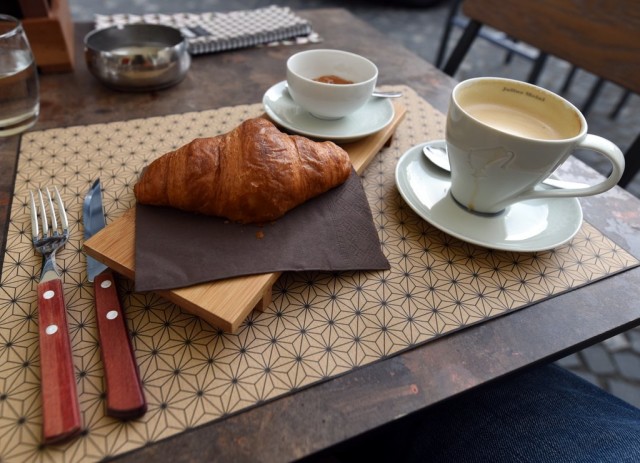
I was staying at a perfectly located rental apartment (Meščanka, overlooking the most colorful stretch of Ljubljana’s riverfront), so I was on my own for breakfast. They steered me to a fine little café in the mellow pedestrian zone under the town hall’s bell tower. I ordered a bela kava (like a latte), a glass of fresh-squeezed orange juice, and a crispy croissant. Total cost for breakfast: €6.
cameron-slovenia-ljubljana-breakfast

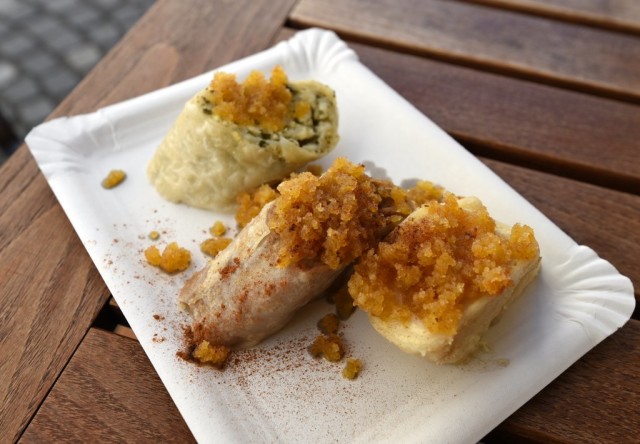
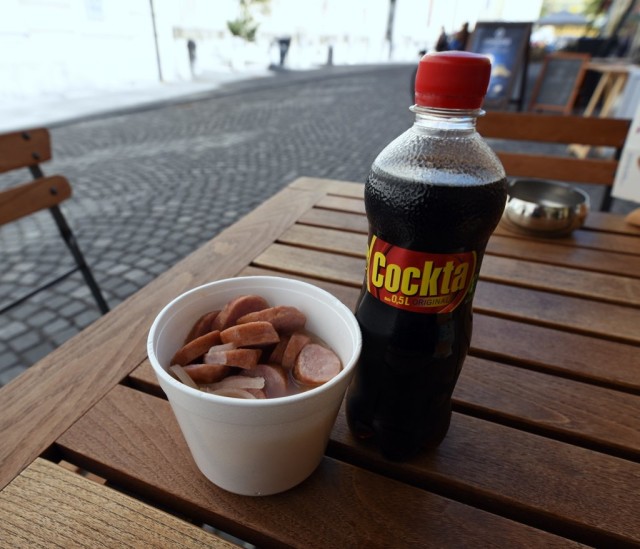
For lunch, I stopped by a hole-in-the-wall called Klobasarna. They specialize in doing one thing, and doing it very well: rustic sausages from the region of Cariniola. I got mine cut up into a bowl of jota — a traditional Slovenian soup made with marinated turnip. (Last summer, I got some heat on my blog for saying “cassoulet” must be French for “bowl of farts.” My hunch is that jota carries the same meaning in Slovene.) Klobasarna recently added one more traditional Slovenian item to the menu: štruklji, boiled dumplings stuffed with various fillings. One had tarragon, another had cottage cheese, and the last one — essentially a dessert — had walnuts and cinnamon. Sprinkled with coarse, buttery, sauteed breadcrumbs to complement the smoothness of the dough, they were both flavorful and a textural treat.
cameron-slovenia-ljubljana-struklji

I washed the meal down with Cockta, one of those soft drinks that’s fiercely beloved in its homeland but utterly unknown everywhere else. (Cockta comes with its own epic origin story — how it was originally called “Cockta-Cockta,” and designed as an ersatz Coca-Cola during the austere Yugoslav period — but you’ll have to pick up my Rick Steves’ Croatia & Slovenia guidebook for that.) I took my order out to a tipsy table on the cobblestones, in the heart of one of Ljubljana’s most delightful pedestrian zones. Watching the tour groups follow their guides and the bikes whiz past, I had a delicious and filling meal. Grand total for sausages, jota, štruklji, and Cockta: €8.
cameron-slovenia-ljubljana-sausage

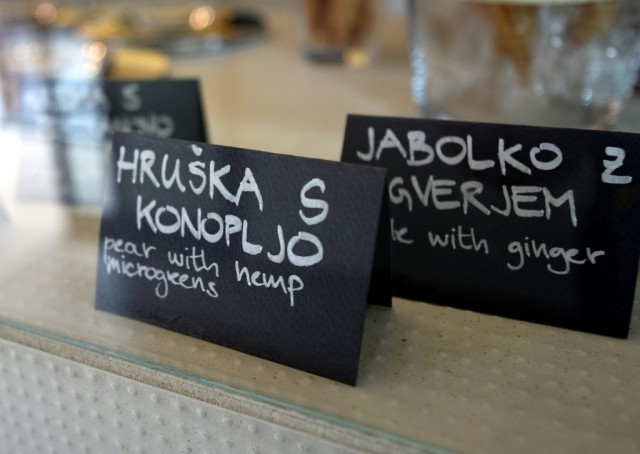
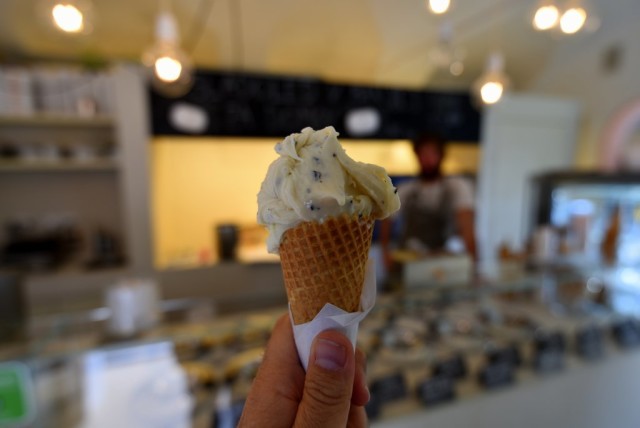
For a midafternoon snack, I stopped by a buzzy new gelateria called Romantica. Behind the glass counter, tidy silver-lidded containers held an array of deliriously creative flavors: chocolate-rosemary, pear with hemp microgreens, melon-arugula, line-basil, and so on. They also had some distinctly Slovenian flavors: pumpkin oil (a local favorite for salad dressings) and the national dessert, potica — a hearty nut layer cake with cinnamon and a drizzle of chocolate. Because Romantica doesn’t use artificial colors, everything’s white (except the chocolate). The clerk told me that he was in the middle of making that afternoon’s batch. He showed me a tub of fresh nectarines, just sliced and ready to toss into the blender. He was also preparing their chocolate and chili flavor, and explained that they’ve been experimenting to find just the right kind of chili powder to finish a pop of chocolate with that satisfying back-of-throat tingle. Total for ice cream: €2.
cameron-slovenia-ljubljana-ice-cream-2

cameron-slovenia-ljubljana-ice-cream-1

For dinner, some local friends took me to one of the hot new places in town, which prides itself on putting substance over style: Hood Burger. Taking “unpretentious” to extremes, it’s a glassed-in kiosk on the grassy fringe of the parking lot of the Interspar supermarket.

cameron-slovenia-ljubljana-hood-burger-kiosk

I’m skeptical of burgers in Europe, where they usually taste…off. The wrong mix of meat. The wrong spices. But the owners of Hood Burger, Til Pleterski and Klemen Ptičak, did their homework. Every bit up to speed with the hipster foodies in Portland or Brooklyn, Til and Klemen pride themselves on using locally sourced ingredients (“100% Slovenian beef!”), and cultivate a personal relationship with their producers. And the results speak for themselves: the best burger I’ve had in Europe. Hood Burger also has three house microbrews on tap. And on each table is a bottle of Čili Pipp sauce, the award-winning local answer to Tabasco started by a Slovene who simply enjoyed planting chilies in his backyard. Total cost for burger, fries, and mint lemonade: €9.
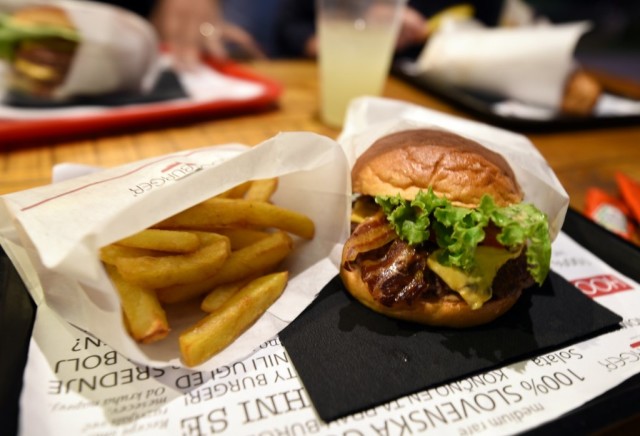
cameron-slovenia-ljubljana-hood-burger

Slovenia — and Ljubljana in particular — is an ideal place for an affordable foodie experience. Sure, you could splurge on an upscale feast here. But sometimes the best meals are eaten outside, with plastic utensils.
Pasta-Making Night at the Agriturismo

At Agriturismo Cretaiole, Thursday night is pasta night. Guests return from a busy day of tooling around Tuscan hill towns and wineries to make pasta — specifically, the local hand-rolled noodles, called pici.

cameron-italy-tuscany-cooking-class-cretaiole-009

After a lively week of group bonding, all of the guests pack into the glassed-in veranda. They squeeze behind rustic tables with a hubbub of anticipation. In front of each small group is an oversized, rough-wood board with just the right texture for rolling noodles.

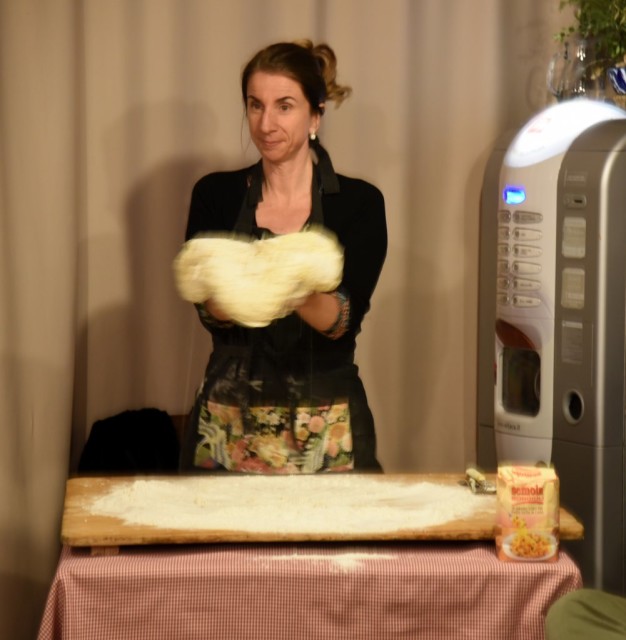
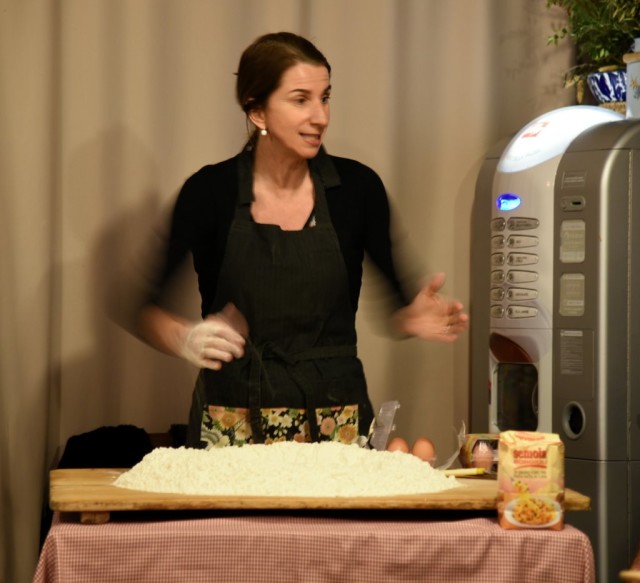
In one corner of the room, our agriturismo host, Isabella, stands at a small table and addresses the group. The board in front of her is piled high with a 10-pound mountain of flour. She explains — with the seasoned confidence of someone who’s taught hundreds, maybe thousands, of travelers how to make perfect pasta — the precise procedure.

cameron-italy-tuscany-cooking-class-cretaiole-003

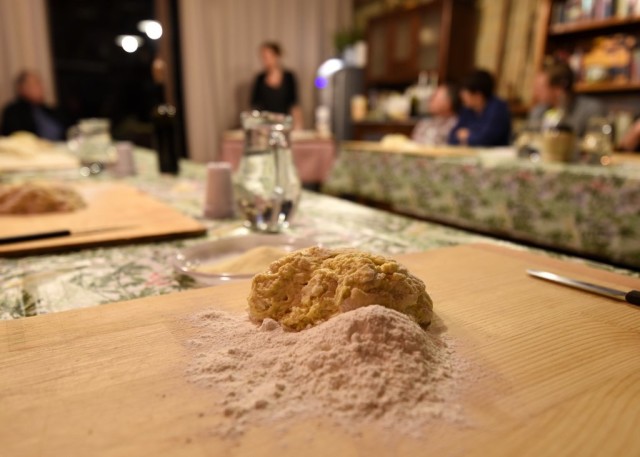
First, she dredges out a crater in the top of her flour mountain, turning it into a volcano. Into this precarious container she cracks eight eggs. She gingerly beats the eggs with a fork, gradually sprinkling in water — a few drops at time — as she pulls in more and more flour from the lip of the crater. With each stir, the sea of eggy goo threatens to breach the fragile walls. But gradually, liquid turns to solid. And with one last vigorous stir, it becomes a mound of sticky dough.

cameron-italy-tuscany-cooking-class-cretaiole-006

It’s time to knead. Isabella carefully explains the importance of keeping the “cut” — or, in more pleasant terms, the “smile” — facing you at all times. After each knead, you rotate the dough a quarter-turn, then repeat. It’s a steady rhythmic, motion — like waves crashing on a beach: Pull, push, push, rotate. Pull, push, push, rotate.

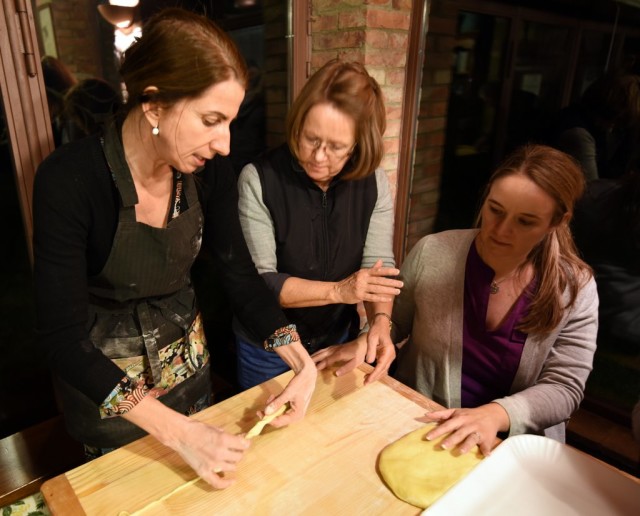
Each family huddles around their communal wad, taking turns. Isabella circulates through the room, gently correcting our awkward technique. “Done?” someone asks her. She sticks an accusing finger deep into the center of the seemingly finished ball of dough, and withdraws a sticky fingertip. “Not done yet,” she says. “Keep going.”

Finally, the dough is ready, and it’s time to make the pasta. Pici (pronounced “pee-chee”) are peasant noodles. Pici are hand-rolled — not neatly extruded from a metal tube. But it’s deceptively tricky to master.

cameron-italy-tuscany-cooking-class-cretaiole-041

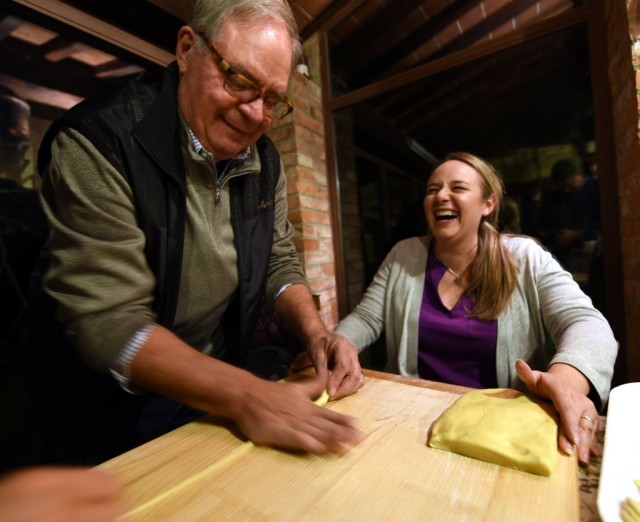
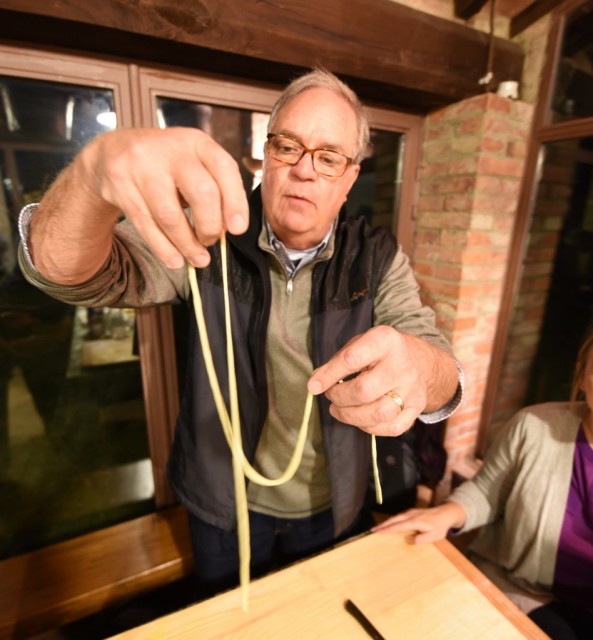
Here’s the technique: Cut off a hunk of dough, hold it in your left hand, and roll it with your right.  Continually massage the dough with the heel of your hand against the cutting board, always gently tugging on the dough clump to tease out a strand. It’s harder than it sounds. Too little pressure, and you get thick, inedible ropes. Too much pressure, and it breaks into bits. But if you do it right, you get pasta shaped like a four-foot-long earthworm. This is where those special boards come in: They offer just enough texture to provide friction for rolling the pici, but not so much that it sticks.

cameron-italy-tuscany-cooking-class-cretaiole-029

Families take turns rolling their pici, offering each other tips and encouragement. Some people go fast. Others go slow. Some pick up the technique immediately, churning out long strands of perfectly uniform noodle. Others can’t quite get the hang of it, and spend most of their time pinching together broken strands…while nervously eyeing Isabella across the room, hoping she doesn’t notice.

cameron-italy-tuscany-cooking-class-cretaiole-036

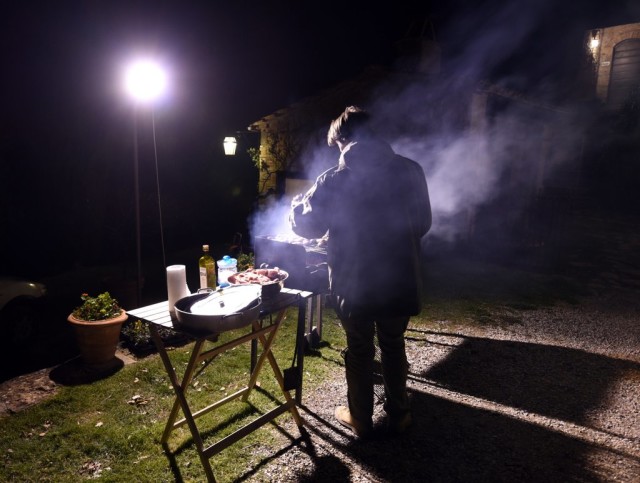
I take a break to head outside, where I find Isabella’s husband Carlo at the grill. His roaring fire has died down, and he’s repositioning his glowing coals. Carlo gently nestles his pork sausage and ribs onto the hissing grill.

cameron-italy-tuscany-cooking-class-cretaiole-057

In the little garden shed nearby, Isabella has brought a 20-gallon pot of water to a rolling boil. To season the noodles, Isabella pours three generous handfuls of coarse salt into the water. It tastes as salty as soup. Then she drops in the handfuls of pici, which squirm around the bubbles like miniature eels.

In just five minutes — when the water starts to foam up — it’s done. Isabella tosses the pici with some meat ragù she’s been simmering all day long, then takes the giant, overflowing, stainless-steel bowl back to the veranda.

At Cretaiole, pasta night is also potluck night. Each guest brings down a salad, side dish, or dessert they’ve prepared in their apartment. Some use it as an opportunity to try out recipes they’ve picked up at cooking classes this week: a radicchio salad with pecorino and fennel, or a lightly sweetened, simple ricortta. Others import favorites from back home — my mother-in-law’s apple crisp (made with Tuscan apples) is a hit.

cameron-italy-tuscany-cooking-class-cretaiole-058

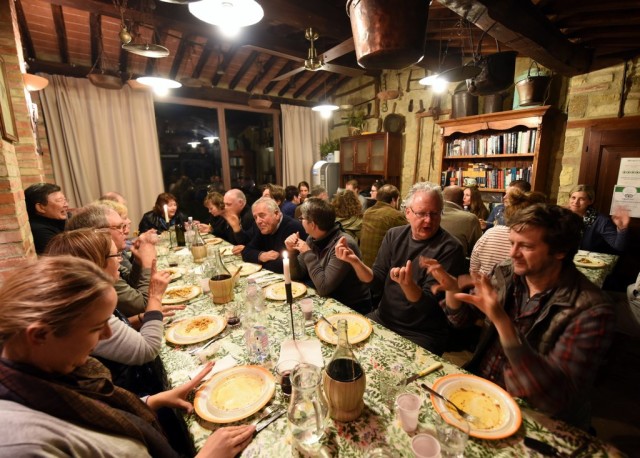
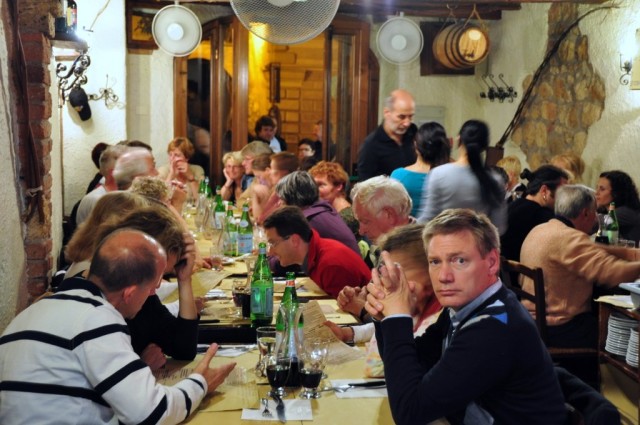
Settling in to a delicious (and hard-earned) dinner, the Cretaiole guests chatter and drink and eat and laugh. Old Man Luciano shows up, clutching bottles of Vin Santo and grappa that he’ll be sharing later in the evening. Once-strangers, now-friends animatedly discuss all they’ve experienced this week. That great art museum in Siena. That stunning scenery from the drive to Monticchiello. Adorable Milli, our canine companion who sniffed out truffles during our hike through a wooded valley. People swap the Italian words they’ve learned and the Italian gestures they’ve mastered.

Digging into my pici, I screw my index finger deep into my cheek, then wave my hand alongside my head: Delizioso! The noodles we made are firm but tender. Each noodle clings to just the right amount of flavorful ragù, exactly as it was designed to do. As time stands still around this convivial dinner table — so far from home, yet so familiar — it’s clear why here in Tuscany, the traditional ways are still the very best ways.

The Craftsmen of Montepulciano

Every traveler has their favorite Tuscan hill town. Mine’s Montepulciano. For one thing, it’s fun to say: Mon-tay-pool-chee-AH-noh. And it’s simply charming. Steep, twisty, cobbled lanes clamber up through an ancient, stony cityscape draped over a ridge. But the main reason I love Montepulciano are the people who pass the years here as their families have for generations. Here, like nowhere else, I feel connected to the heritage of a real, living town.

cameron-tuscany-montepulciano-night

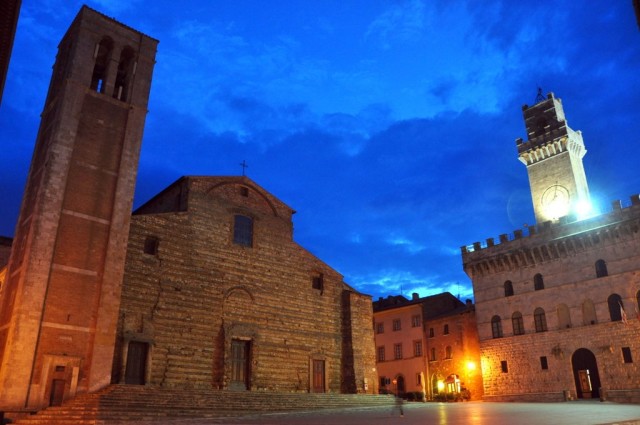
Montepulciano’s main square occupies a postage stamp of rare flat land at the very pinnacle of town — the misnamed Piazza Grande. Facing the square are the proud tower of the town hall, some fine Renaissance mansions, a lion-topped fountain clutching a shield of Medici pills, and the jarring naked-brick facade of the town’s Duomo, which locals have never had the money to dress up properly.

From the main square, a pedestrian lane snakes down through town. Strolling just a hundred yards along this main drag, I drop in on three different craftsmen — each one with a fierce passion for doing just one thing, and doing it better than anyone.

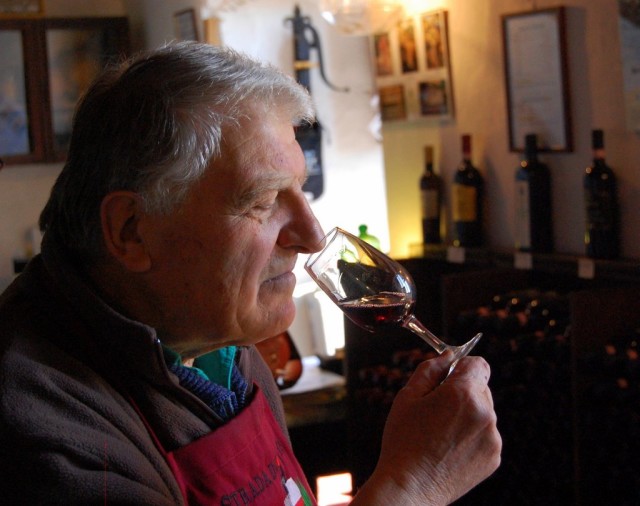
My first stop is the Cantina Contucci, where I’m greeted with fanfare by Adamo. Spraying me with rapid-fire Italian, Adamo explains that he’s been making wine here since he was in short pants. He officially retired 20 years ago, he says, but they still let him come to work every day.

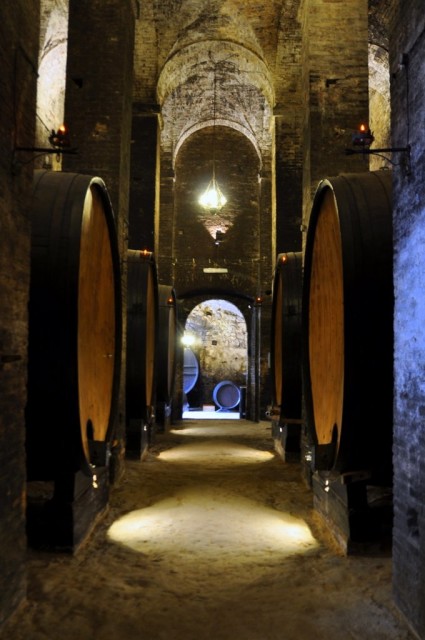
This town is famous for its robust Vino Nobile di Montepulciano wine. The grapes are grown in the surrounding hillsides, but it’s here, in a deep warren of cellars, that they become Vino Nobile. Underfoot, endless tidy rows of wine casks silently age beneath dramatic Gothic vaults.

cameron-tuscany-montepulciano-cellars

Walking among the truck-sized barrels, Adamo’s animated chatter crescendos. When it comes to his wine, he’s not just enthusiastic — he’s evangelical. Each cask is an old friend. My Italian is rusty, but Adamo’s exuberance is a universal language. For emphasis, he periodically reaches out and excitedly grips my arm.

Adamo

Fixing me with an intense but caring gaze, Adamo explains that a good wine has three essential qualities. He points to his eyes, his nose, and his mouth: color, bouquet, and taste. Finally, Adamo pops a cork and pours a sample in my glass. He won’t let me leave until he’s certain that I fully appreciate his life’s work.

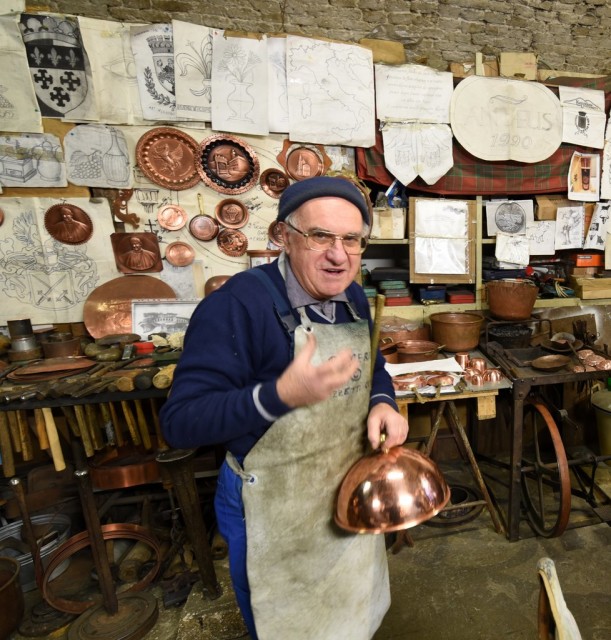
I step from Adamo’s dank cellars into the crisp winter air. Wandering just a few steps downhill, I’m drawn in by the clang of metal against metal, like the ringing of an out-of-tune bell. Peeking into a cluttered time-warp of a workshop, I see a hardworking coppersmith named Cesare, hunched over an anvil—an actual anvil, like from the Roadrunner cartoons.

cameron-tuscany-montepulciano-cesare

Cesare invites me in to see his finely detailed, hammered-copper pots. Like Adamo, he needs no English to convey his devotion to his craft. He lets me peek into the adjacent museum of his works, and shows me a photograph of the huge weathervane he created to adorn the rooftop of Siena’s cathedral.

Excited to demonstrate the heat-conducing properties of his favorite medium, Cesare instructs me to crouch down so he can place a copper bell over my head. He shushes me and taps the bell with a little hammer, creating a rich, harmonious tone. I can actually feel the sound waves radiating all around me, warming up the top of my head.

Flattered by my interest, Cesare declares that he will make me a gift. He pulls out a set of tools that he inherited from his father, who inherited them from his father, and so on, dating back to 1857.  He lays a copper circle onto his anvil, and methodically arranges his antique hammers. Then he lovingly dents the disc with floral patterns, my wife’s initials, and our wedding date. He refuses payment. Instead, he shows me a scrapbook crammed with photos and postcards from his past visitors. While he has a shop around the corner (Rameria Mazzetti), it’s clear that Cesare is not in this for the money. It’s all about his love for the craft.

A few steps farther down the same street, I step into a lively restaurant: Osteria dell’Acquacheta. It’s dinnertime, and it’s packed. The handwritten menu is a sure sign that this place revels in what’s fresh today. But one thing that’s always on the menu is steak.

Osteria dell'Aquacheta Restaurant

Giulio appears. He’s a tall, balding, lanky artist of a butcher with a pencil sticking out of his gray ponytail. Just as his neighbors have devoted their lives to one thing, Giulio’s calling is grilling the perfect steak.

Giulio makes his rounds through the crowded restaurant. He pulls up a chair at each table and talks the customers through their options. When a steak is ordered, Giulio walks up the seven steps at the back of the restaurant to his busy open kitchen. There, a giant slab of beef rests on a butcher block. First, Giulio gently saws his way through the soft flesh. Then he hacks the clinging sinews with a giant cleaver. He slaps the five-pound T-bone on a sheet of paper, descends the stairs, and shows it to the customer. They nod in approval.

cameron-tuscany-montepulciano-giulio

Back up the stairs, the steak goes on the grill, pushed deep into a wood-fired oven: five minutes on one side, five minutes on the other, then sprinkled with coarse salt. When Giulio delivers the still-bleeding streak to his customers, they dig in — their eyes much bigger than their fast-filling stomachs. It’s a meal any steak-lover will never forget.

Whether it’s steak, copper, or wine, there’s something so inspiring about people who are completely devoted to their life’s work. In Montepulciano, you meet people who can’t stop working just because they’re retired. People for whom appreciation is better payment than money. People who find their niche in life and fill it with gusto.

Cooking with Chef Roberto: New Olive Oil and Old Wine

Cooking in Mamma Laura’s kitchen was a fantastic culinary experience. But for a more refined take on Italian cooking, we joined Chef Roberto behind the scenes at his restaurant. Our agriturismo arranged this experience as “sort of a cooking class,” but it turned out to be so much more: We were flies on the wall of a brilliant chef’s working kitchen — a graduate-level seminar on Advanced Italian Flavors.

Chef Roberto Rossi owns a Michelin star and a fine restaurant in his humble home village of Pescina, stranded high on the slopes of Mount Amiata. To reach Ristorante Il Silene, we corkscrew up and up — on choppy gravel roads — into the mountains overlooking the Val d’Orcia. As we gain altitude, fat raindrops become fat snowflakes. Finally, we crest a summit and enter a remote village where we park, scurry across the street in the slush, and step into the cozy-classy world of Il Silene.

Chef Roberto greets us at the door, takes our dripping coats, and offers us a glass of wine. The fireplace in the corner warms both us, and the two slender rabbits that are spending a few hours on a rotisserie. (We’ll see them again later.)

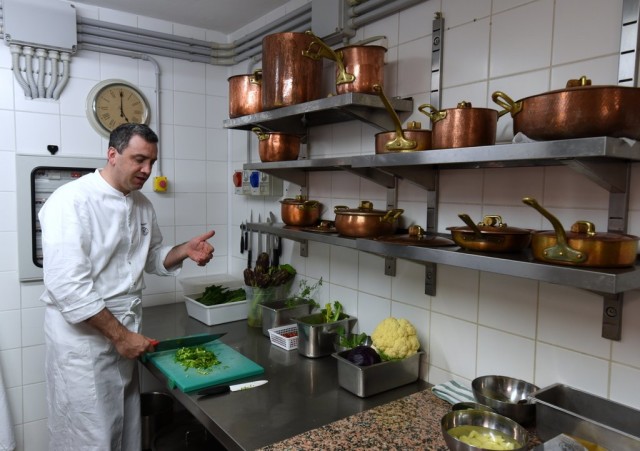
At 4:30, Roberto invites us back into the kitchen. With playful eyes under curly black hair, and a constant wry smirk, Chef Roberto seems relaxed. He leans against the counter and chats with us, while his staff scurries around the kitchen: Lella, the Sicilian sous chef who’s been his right hand since he entered the restaurant business; a few eager Italian chefs-in-training; and a pair of timid young Japanese culinary interns, who study the master intently.cameron-italy-tuscany-cooking-class-il-silene-001

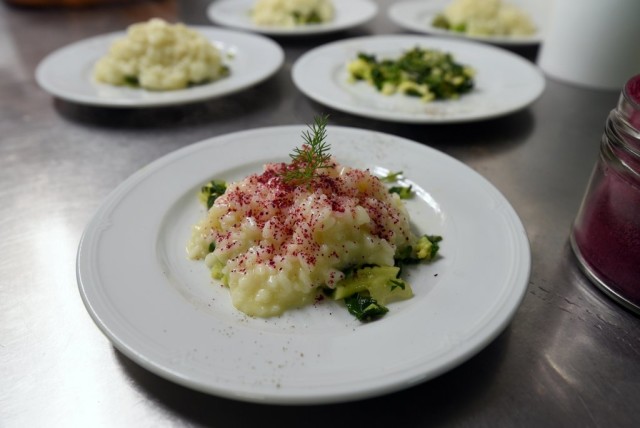
“So,” Roberto finally says, rubbing his hands together. “What do you feel like eating? How about risotto?” He walks casually to the stovetop, pulls out a pan, and ladles in some vegetable stock from a simmering pot. He sprinkles in some rice and gives the pot a few stirs, then hands the spoon to Lella, who dutifully stirs and stirs and stirs for the next 20 minutes. The result: a luxuriously creamy risotto. On top, Roberto grates precious, aged parmigiano reggiano cheese — each crumbly little flake instantly melting into the steaming rice. And finally, he sprinkles the dish with his own invention: a pinkish-purple powder made from dried and finely grated beets. Both the cheese and the beets give the dish an earthy umami kick. A little sprig of fennel perches on top, like a Christmas tree on a snowy mountain.

cameron-italy-tuscany-cooking-class-il-silene-005

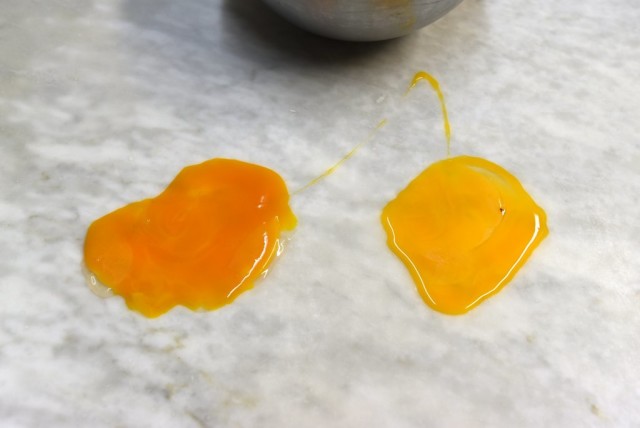
Satisfied with our first course, Roberto invites us back to his pasta-making room. We huddle around the rickety old table with a smooth marble top. Sipping his wine, Roberto — whose father owns a farm just up the street — explains the critical difference between farm-fresh and store-bought eggs (even “organic” and “free range” ones). To demonstrate, he cracks one of each on the white marble. Can you guess which is which? (The rich, orangey tones of the farm-fresh egg are a dead giveaway.)

cameron-italy-tuscany-cooking-class-il-silene-011

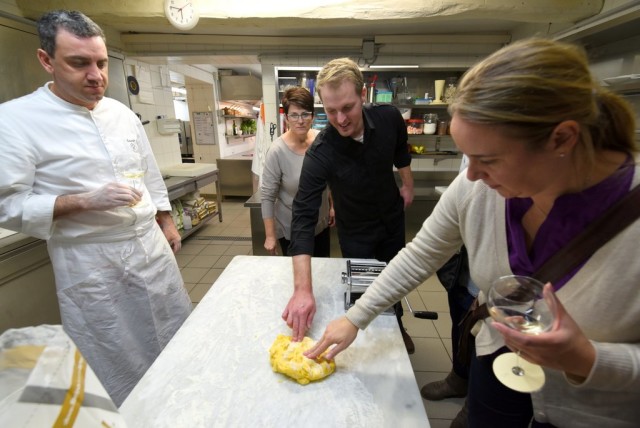
Point made, Roberto scrapes the eggs into a bowl, throws in some flour and a duck egg yolk (for elasticity), runs it through a mixer, then hand-kneads the small knot of yellow dough with mechanical precision. The moment it reaches the perfect texture, he invites us to prod it.

cameron-italy-tuscany-roberto-dough

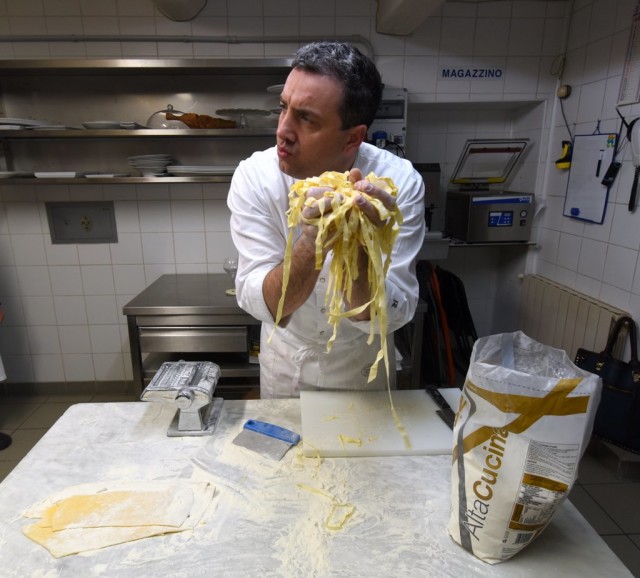
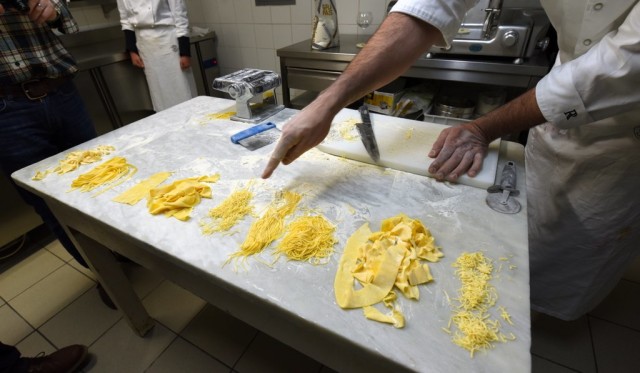
Roberto rolls out the dough, then starts running strips through his pasta maker. “Italy has so many kinds of pasta,” he explains. “Hundreds and hundreds. Each one is designed to show off the other ingredients: local produce, meat sauces, cheeses, and so on. But they all start with basically the same dough.”

cameron-italy-tuscany-cooking-class-il-silene-031

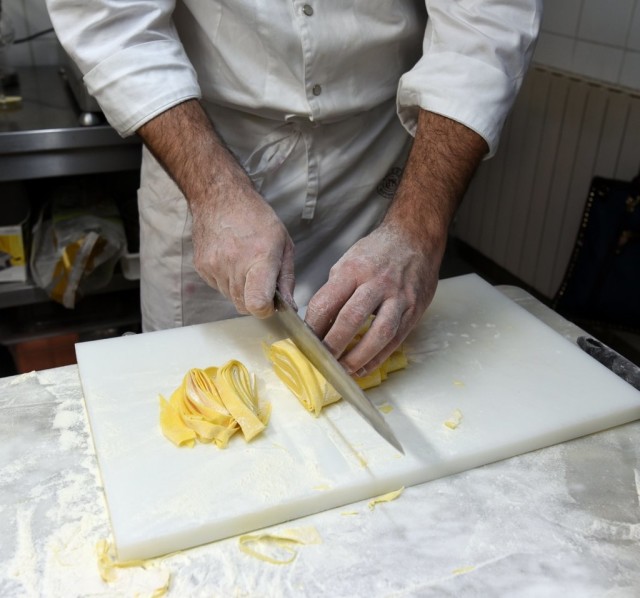
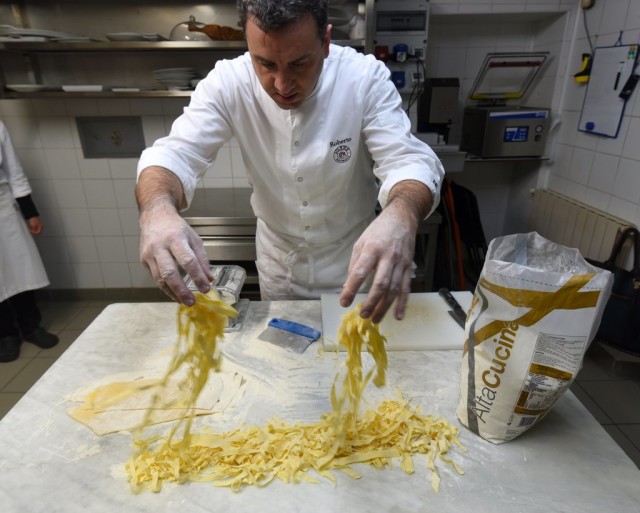
As he pulls each long, skinny, translucent sheet of dough from the roller, he folds it over on itself several times. Then he attacks each little bundle with his knife, eyeballing textbook-perfect examples of different pastas.

cameron-italy-tuscany-cooking-class-il-silene-029

Papardelle,” he says, chopping thick ribbons.

cameron-italy-tuscany-cooking-class-il-silene-028

Tagliatelle.” This one is thinner. His hands work fast and furious — almost too fast to track.

cameron-italy-tuscany-cooking-class-il-silene-035

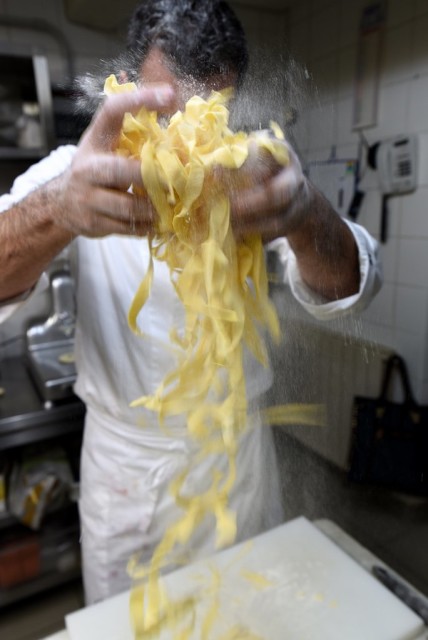
Capellini.” Thinner still. With each batch, he grabs the wad of new noodles and tosses them gently in the air.

cameron-italy-tuscany-cooking-class-il-silene-049

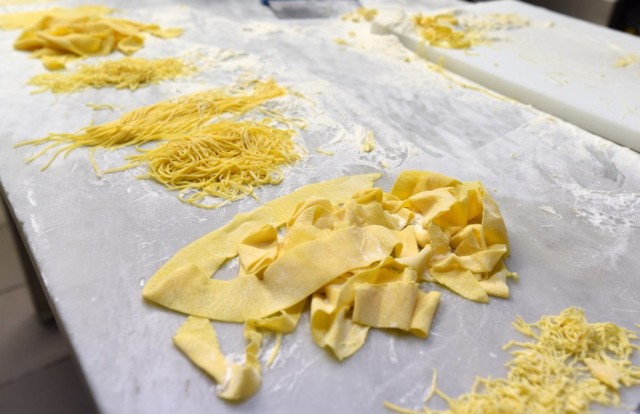
“You cut the capellini in small pieces, like for a soup, and you get fideo pasta.”

cameron-italy-tuscany-cooking-class-il-silene-042

Stepping away from the table triumphantly and sipping his wine, he beams at his creation. With nine different types of pastas lined up along the flour-scattered marble, it looks like the cover of a foodie magazine…all done in a just few minutes, by one man and his knife.

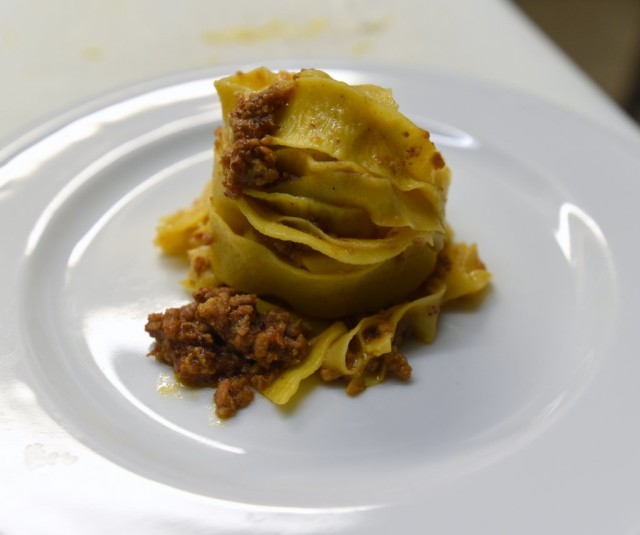
Roberto sends one of his assistants to heat up our pasta (so fresh it needs only a brief, boiling bath) and mix it up with some turkey ragù. Delicious.

cameron-italy-tuscany-roberto-pasta

Next comes a lesson in olive oil. Roberto holds up two squirt bottles. “The blue one is last year’s. Still good, but just for cooking. The green one is this year’s. For finishing.” Only a few days before, Roberto was at the olive mill down in the valley, where he personally watched the precious golden-green oil pressed out of his olives. We taste each one, and the difference is remarkable: Last year’s, still decent, has subdued, muted flavors. You can’t quite taste the olives. But this year’s? Explosively piquant.

For an even better taste of top-quality oil, Roberto thin-slices a baguette and toasts the slices. Holding a bottle high in the air, he rains down a shimmering stream of golden-green oil, then tosses them with his hands. Crunching into the crusty, coated little discs, the pungent, acidic, tingly taste of fresh olive oil blankets our palates.

cameron-italy-tuscany-cooking-class-il-silene-056

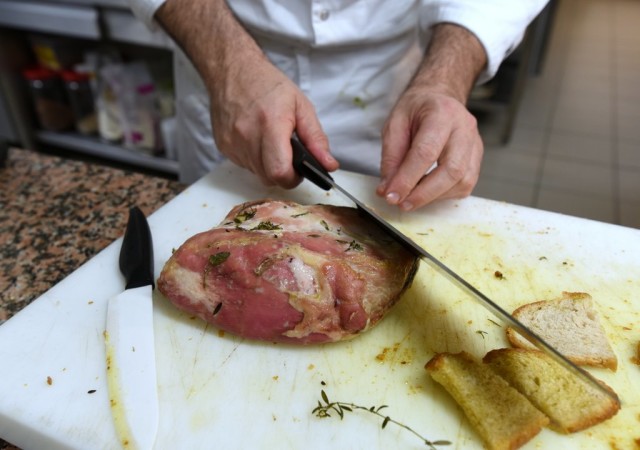
Seeking another topping for his little crostini, Robert disappears out back and returns with a breast of turkey that he’s been slow-roasting for hours. “I don’t usually cook turkey,” he says. “But I know it’s Thanksgiving in America, so I decided to try. If you understand the principles of how to cook meat — salt, herbs, aromatics, slow-roasting at a low temperature — you can cook anything well.” He slices off some thin tastes. It is, without a doubt, the best turkey I’ve ever eaten.

cameron-italy-tuscany-roberto-turkey

For another topping, Roberto makes a batch of his signature salsa verde: a vibrant-green sauce made with a generous bunch of Italian parsley, ample olive oil, a couple of medium-boiled egg yolks, capers, top-quality anchovies, and some salt. When we taste it, our questions of “What do you put it on?” are instantly answered: Anything. This outrageously flavorful, catch-all condiment tastes faintly of each of its ingredients, but is far greater than the sum of its parts.

As we munch, Roberto explains his passion for wine. Not a rare quality in Italy — especially in Italian restaurants. But more specifically, Roberto has an affinity for very old wines. “Later on,” he says, “I’m going to open for you a very special bottle. From the Südtirol — the very northern part of Italy, in the Alps, touching Austria. It’s a white wine, aged several decades.” It’s the paradox of a great chef: He insists on only the freshest and most local ingredients, yet prefers extremely old wines from distant lands.

Roberto explains that he recently returned from a trip to Spain. Near Barcelona, he visited the restaurant of a celebrity chef who owns a second Michelin star. Roberto enjoyed his meal, of course, but couldn’t help but stoke a little rivalry with his colleague. (He shows us the little sample of olive oil they sent home with him — in a gaudily labeled plastic bottle, which, as every oil aficionado knows, spoils the taste.) He tells us that this famous chef, who appears virtually every day on television, seemed very tired. “Well, I am not,” Roberto says defiantly, standing up straight and smiling wide. “I live here, in Pescina.”  If we were wondering why such a talented chef chose to live so far off the grid…we have our answer.

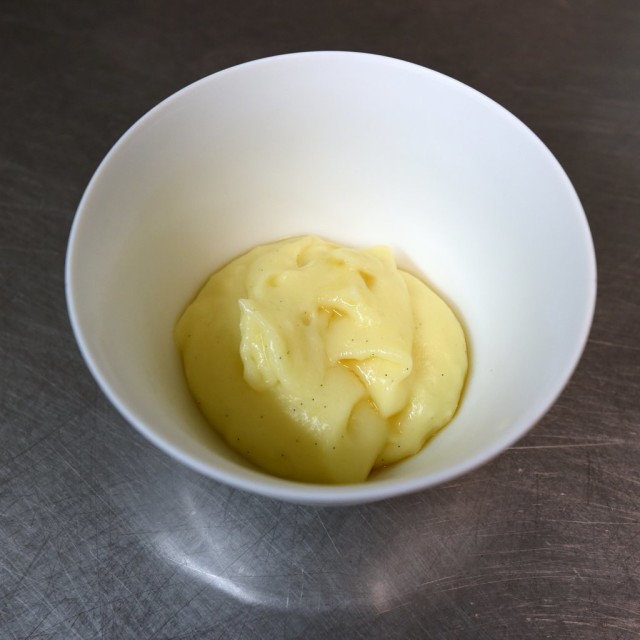
To wrap up our kitchen visit, Roberto whips up a batch of pastry cream: Heat up a pot of milk with lemon peel and vanilla seeds. Then, at the point of boiling, introduce a mixture of eggs, sugar, and flour…and stir vigorously, whipping it into a custard-like consistency. As a special treat, he drizzles in a dram of 1860 marsala wine. It’s not much to look at, but like everything else he creates, it’s sensational. Digging into this simple yet heavenly confection, we ask, “When do you serve this?” Roberto thinks it over, then says, “When I have a guest who doesn’t know what they want — or who doesn’t like anything at all — this is what I give them. Everyone likes this.”

cameron-italy-tuscany-roberto-cream

After a couple of hours of shadowing Roberto in his kitchen, we’re stuffed: Risotto. Pasta ragù. Bruschetta with olive oil, and slow-roasted turkey, and salsa verde. And now pastry cream.  So imagine our surprise when Roberto glances up at us, with a twinkle in his eye, and says, “OK! Now it’s time for dinner.” Despite our protests, he leads us out into the elegant dining room, seats us at a grand table, and proceeds to serve us a fantastic four-course dinner: handmade pasta, of course; those slow-roasted fireplace rabbits; and that bottle of antique Dolomite wine. Everything is fantastic, and the portions are mercifully modest. (He must have taken pity on us.)

cameron-italy-tuscany-roberto-rabbit

Our evening in Robert’s kitchen might seem like an unrealistic goal for the casual tourist. But, like the cooking class in Mama Laura’s home, these sorts of experiences are perfectly accessible to anyone who’s willing to do a little homework and make the arrangements. Hanging out for a couple of hours with Roberto, then dining in his restaurant, probably cost us just a few euros more than dining in the restaurant alone. And we came home with a renewed appreciation for how a top-end kitchen — and a top-end chef — masters the art of pleasing diners.

Recipe for Marta’s Simple Tomato Sauce

Looking for an easy, timeless, and delicious Tuscan tomato sauce recipe? Look no further.

Tuscany is synonymous with great food. And I’ve been fortunate to have taken a variety of cooking classes there — from hanging out in the kitchen of a Michelin-star chef, to joining Mamma Laura in her home kitchen, to hand-rolling pasta at my favorite agriturismo.

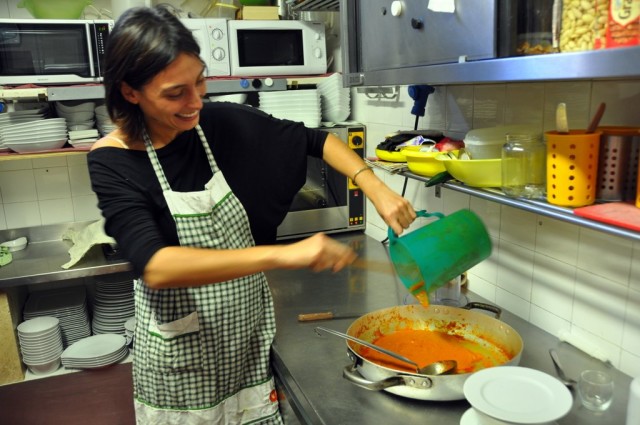
I’ve brought home several of these recipes, but my favorite culinary souvenir is  this simple tomato sauce. My wife and I joined Chef Marta (the daughter of Mamma Laura) in her restaurant kitchen, where she taught us how to make the best tomato sauce I’ve ever tasted. This versatile, explosively flavorful sauce — which is fantastic with all kinds of pasta, or can elevate just about any dish — immediately became a go-to recipe for my extended family. We call it “Marta’s simple tomato sauce.” (That’s “simple” in the best possible sense: easy, unfussy, and delicious.)

cameron-italy-tuscany-marta

Ingredients

Ample extra virgin olive oil, 6 cloves garlic, 2 large cans of whole peeled tomatoes (San Marzano are best; in season you can use fresh cherry or Roma tomatoes); a bit of water as needed; salt, sugar, and red pepper flakes to taste. Serves about 8; the sauce freezes very well. (We usually eat half right away, and stick the rest in our freezer for later.)

cameron-italy-tuscany-marta-sauce

Procedure

Use a pan with as big a surface area as possible. Pour in lots and lots of olive oil (about 1/2″ in the bottom of the pan). Don’t be shy…when you think you’ve used too much oil, add some more.

Drop in the garlic and heat it at high temperature until oil begins to bubble, then turn to low. Add the tomatoes, a small handful of salt, a pinch or two of sugar, and red pepper flakes to taste.

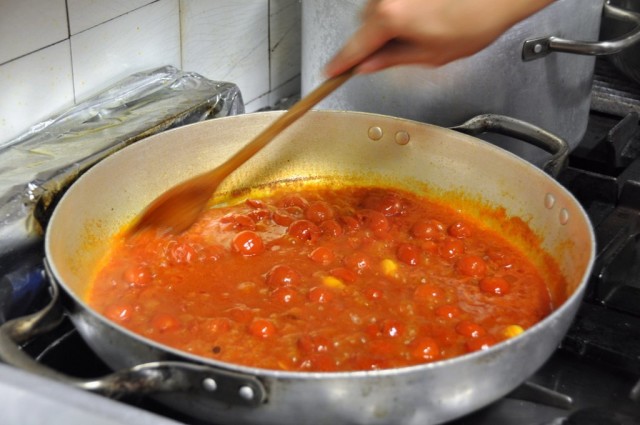
Turn the heat back to high, allowing it to sizzle and bubble, and cover it to reduce spattering. (There will be spattering.) Boil for about 10-15 minutes, until it gets “creamy” around the edges. Stir frequently, and have fun crushing the tomatoes with a big wooden spoon. (If using fresh tomatoes, cook for 30 minutes.) If it’s thicker than you’d like, you can add some water partway through the simmer (a half-cup to a cup).

When it’s done cooking, remove the three biggest garlic cloves and puree the sauce with a hand mixer (or transfer to a food processor or blender).

Enjoy!

cameron-italy-tuscany-marta-sauce-pasta


For lots more on Italy’s heartland, check out my series with 12 Tips on How to Experience the Best of Tuscany.