December is here, and as many Americans settle into the familiar festive rhythm of shopping for gifts, stringing up twinkle lights, and humming “Jingle Bells,” it can be fun to pause and consider where these Christmas traditions come from. Many of the most popular — like Christmas markets, Christmas trees, and caroling — started in Europe.
Christmas markets trace their roots back to 13th-century Austria, when a local duke thought multi-week December fairs might help lift spirits during long, cold winters. While these weren’t expressly “Christmassy” in nature, the idea proved to be a popular one, and other communities hopped on board. Over time, Austria and its German-speaking neighbors refined these fairs into charming holiday-themed markets, where locals could sing songs, sell handmade crafts, and indulge in seasonal sweets.
While no Christmas market can accurately claim the title of “first,” several have been going strong for centuries — like Dresden’s Striezelmarkt, which started in 1434, or Nuremberg’s Christkindlesmarkt, which has been around since 1628. Increasingly, more countries are getting in on the fun, and garland-smothered extravaganzas now fill town squares all over Europe and North America. We even have Christmas market tips, to help you get the most out of these cozy collections of wooden stalls, steaming pots of mulled wine, and gigantic trees.
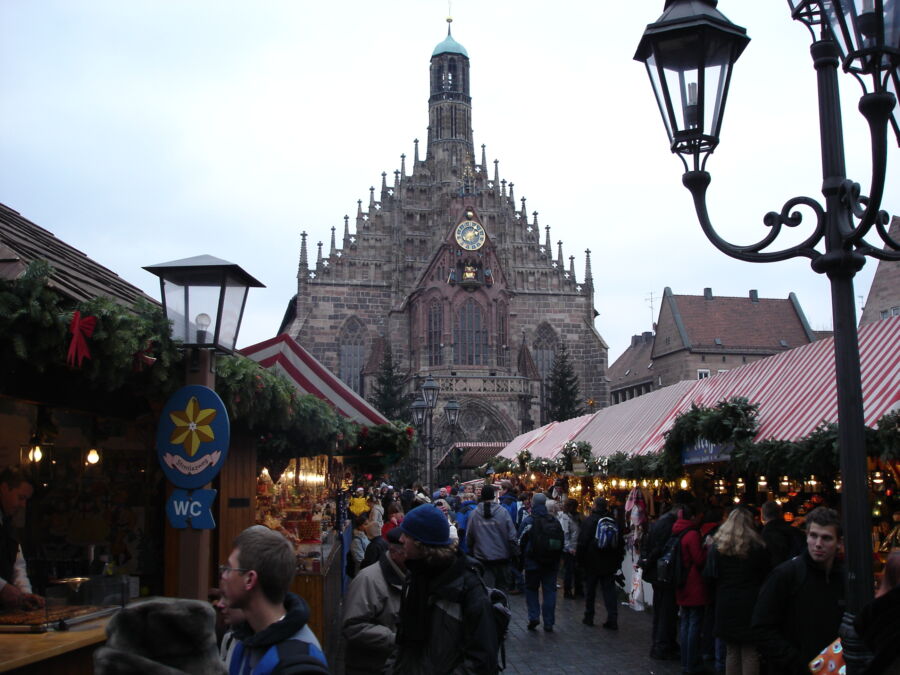
Those trees also have European roots. Evergreens have long embodied the spirit of perseverance in the winter, as they were one of the few things that didn’t die in the cold, dark season. The Druids and ancient Celts adorned their temples with them as a symbol of everlasting life; the Vikings considered them the favored plant of their sun god; and medieval Christian families in Germany used them to help celebrate the season, by reenacting Biblical stories. On December 24 (the Feast of Adam and Eve), these families would use fir trees to symbolize the Garden of Eden’s Tree of Knowledge. To represent its tempting fruit, they would hang sweets on the branches of these “paradise trees,” turning a religious symbol into an early form of holiday decor.
The ritual of lighting trees, however, has murky origins. One early account comes from 16th-century Latvia, where merchants put up a tree in a Riga town square and lit it on fire, dancing around it to celebrate the warmth and light it provided in the face of the cold, dark winter. Another popular story is that Martin Luther, walking home on a cold winter’s evening, was so taken by the gorgeous stars above that he attempted to recreate the scene for his family by adding candles to their paradise tree. This is probably folklore, but it’s not surprising that candles made their way onto these trees — as they, too, held deep religious symbolism, often standing for the light of Christ and Star of Bethlehem.
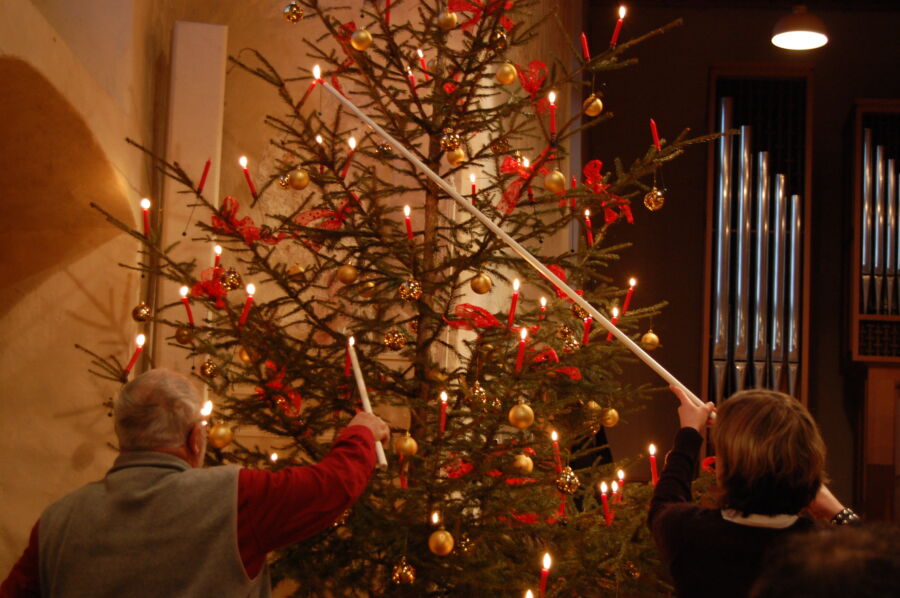
By the 1800s, trees decorated with candles and sweets had become a holiday staple in Germany, where they were called Tannenbaums (meaning “fir tree”). In 1840, the Tannenbaum was introduced to England’s Queen Victoria by her German husband, Prince Albert. Victoria took a liking to them…and, since England ruled a quarter of the world, the Christmas tree went global.
Speaking of England, this was the birthplace of another holiday staple: caroling. Back in the Middle Ages, wassailing was a way for peasants to essentially sing for their supper, going door to door and finagling food, ale, and charitable gifts out of the wealthy in exchange for entertainment. This practice grew more aggressive over time, and many started seeing it as an excuse for extortion. Townsfolk who felt menaced by the demanding riffraff attempted to kill it off, but with limited success.
Eventually, the Victorians — amidst their revival of medieval choral music — polished it up and included it as a festive tradition. Now, bundled-up carol singers gather on English street corners from London to the Lake District, and “Here We Come A-Wassailing” is a holiday tune hummed around the world.
Even if a hop across the pond isn’t in the cards this December, a little European culture probably is. When you browse your Christmas markets, decorate your tree, and hear carolers knocking on your door, just know…you might be in America, but you’re being very European.
We’d like to hear from you! As a member of our merry band of travelers, please weigh in on this article by using the comments below. Meanwhile, many of these topics will also be covered on Rick Steves’ Europe’s various social media platforms — Facebook, Instagram, X, and TikTok — and we hope you’ll join the conversation there as well.
What a great read! So interesting!
However, when is the Rick Steves Christmas program going to be presented on TV?
Date and Time?
Hi Celeste! Travis here. On public television, the Rick Steves European Christmas special varies by region and channel, so it’s best to check your local listings. But you can stream it whenever you’d like on PBS Passport or Ricksteves.com: https://www.ricksteves.com/watch-read-listen/video/tv-show/pledge-spe/european-christmas-pledge-special
Wish you had a Christmas market tour. We would definitely sign up.
Wow never thought of the extortion roots of caroling😂 but for real, love the historical context as always thanks!
Our Christmas Eves have always been what we believe our Swedish ancestors have. Home made Korv, Lutefisk which you hope once boiled turns to fish and not jelly. And rice pudding with whoever gets the baked in almond is the next to marry! God Jul everyone!
We celebrate our Swedish heritage with the same foods and also add ost kaka and rye bread. I have my angel chimes up and am getting ready to celebrate St. Lucia Day. This weekend I will bake the pepparkakor and Lucia buns with my son. For years I have dressed up as St. Lucia and shared the tradition with countless groups and families. It’s good to hear from another one who celebrates the Swedish traditions! God Yul och ett gott nytt ar!
I grew up in a village near Nuernberg. Going to the Kristkindlmarkt was a great treat since money was tight.
Am now in my 60s and every few years I head “home” to see the Kristkind, eat Bratwurst, drink Gluehwine and attend a concert in one of the churches.
And here in the states only a real tree will do 🙂
Yes, of course, and with about 50 real candles on it, because nothing less will do when you grew up with the beauty of their lights; as I did, growing up in a small French town, just on the other side of the Swiss border; close to the German border as well (we were almost neighbors!). No candles on the trees near Nuernberg?
I always watch Rick Steves European Christmas special on television or on YouTube to start the holiday season and it’s always fun watching how Christmas is celebrated in Europe.
Such great memories I have of caroling in my youth in the small town where I grew up. And my grandparents of German descent on one side and English descent on the other exposed me to each of their traditions. And of course a visit from Santa Claus, Saint Nick, Kris Kringle in the flesh always occurred.
My mother was from Waiblingen, a tiny village outside Stuttgart and my father from Dresden, so we always had a mix of Bavarian and Saxon Christmas traditions. Home made stollen and Aufschnitt (German cold cuts. Bratwurst and Weisswurst, cheeses, fresh bread, and a variety of salads). It’s a tradition we still keep alive every Christmas Eve!
I was just in Japan, and both Tokyo and Osaka were getting Christmas Markets ready!
My husband and I have talked about going to Germany and Austria to do a Christmas tradition tour.
Does Rick Steves do such a thing these days?
Best,
Lisa
Hi Lisa, Travis here. While we don’t do a Christmas traditions tour per se, we have plenty of itineraries that feature both countries… and some (like our Munich, Salzburg & Vienna tour) have departures that run in winter, when those traditions are in full swing! You can check it out here: https://www.ricksteves.com/tours/austria/munich-salzburg-vienna-tour#all
As an American teenager living in the quaint village of Kitzingen, Germany, I enjoyed several magical Christmas celebrations. A special memory was visiting the Christmas Market in Nuremberg with my family.