My co-author and frequent collaborator, Cameron Hewitt, is well-traveled, smart, and insightful. And, while he and I are in perfect sync in our travel styles and priorities, he gives voice to the next generation of "Rick Steves travelers." Join me in enjoying his reports right here. —Rick

Coffee and Ćejf: Learning from Muslims in Bosnia

This post was written in February of 2017, immediately after President Trump imposed a travel ban on seven predominantly Muslim countries.

The past week has made it clear that there’s still a lot of fear and mistrust when it comes to Muslims in America. As a patriot and a humanitarian, this makes me sad. And as a traveler, it perplexes me. In several visits to the Muslim world, I’ve had nothing but positive experiences.

I’m not naive. I realize that some Muslims do terrible things. But judging an entire faith based on the actions of a tiny fanatic fringe is insulting at best, and dangerous at worst. When you travel, you realize that the vision of Islam presented by Donald Trump and Steve Bannon is highly selective. Meeting Muslims face to face comes with rich opportunities to connect with a different slice of humanity, and to learn.

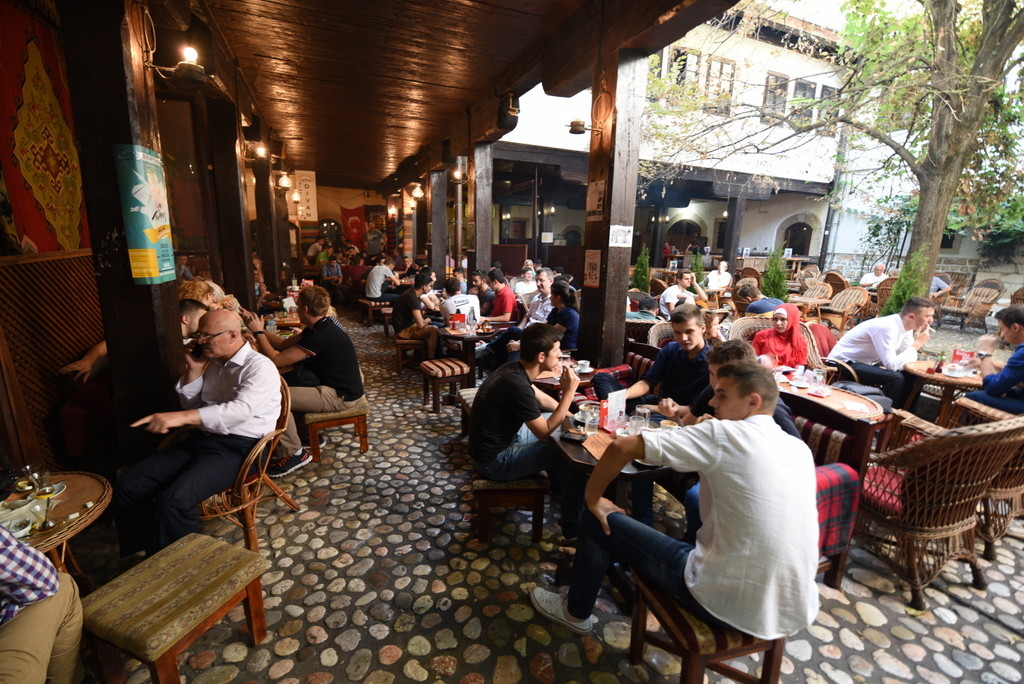
The Muslim country I’ve spent the most time in is Bosnia. On my last visit to Sarajevo, my local friend Amir invited me out for coffee. Not just coffee — Bosnian coffee.

“Here in Bosnia, coffee is not just a drink,” Amir explained. “It’s almost a way of life.” Unfiltered, potent Bosnian coffee (which you probably think of as “Turkish coffee”) is the linchpin of a complex social ritual that captures this culture’s deliberate, stop-and-smell-the-tulips approach to life.
Cameron-Bosnia-Sarajevo-Coffee

We settled into a rickety table in a cozy, cobbled caravansary courtyard. When the coffee arrived, I was ready to slam it down. But Amir reminded me that Bosnian coffee punishes those in a hurry…with a mouthful of gritty grounds.

He patiently talked me through the procedure — and, more important, the philosophy — of Bosnian coffee. “There’s no correct or incorrect way to drink Bosnian coffee. People spend lifetimes perfecting their own personal ritual. But one thing everyone agrees on is that coffee isn’t just about getting caffeinated. It’s about relaxing. It’s about being with people you enjoy. Talk to your friends. Listen to what they have to say. Learn about their lives. Then take a sip. If your coffee isn’t strong enough, gently swirl your cup to agitate the grounds. If it’s too strong, just wait. Let it settle. It gives you more time to talk anyway.”

Cameron-Bosnia-Mostar-Coffee

Reaching the bottom of my cup, I remarked that the grounds had left no residue at all. “When it’s done properly,” Amir said, “you’ll never taste the grounds. If you find a layer of ‘mud’ in the bottom of your cup, it means that someone — either you or the person who made the coffee — was in too much of a hurry.” (So I guess that technically, there is an incorrect way to drink Bosnian coffee.)

Looking around the courtyard, Amir said, “This is a good examples of merak. Merak is one of those words that you cannot directly translate into English. It’s more of a concept. It means, basically, enjoyment. This relaxed atmosphere among friends. It’s when you’re nursing a cup of coffee with nowhere in particular to go — savoring the simple act of passing the time of day.”

Amir explained that the Bosnian language is rife with these non-translatable words. Another example: raja.  “Raja means a sense of being one with a community,” Amir said. “But it also means frowning on anyone who thinks they’re a big shot. It’s everyone knowing their place, and respecting it.” In American terms,  Raja is what prevents you from being the jerk who shows up in a convertible and a tux to your high school reunion.

Cameron-Bosnia-Sarajevo-Coffe 1

But my favorite Bosnian word of all is ćejf (pronounced “chayf”).

Ćejf is that annoying habit or ritual you have. It’s the unique little quirk that drives your loved ones batty. And yet, it gives you pleasure. No, not just pleasure: deep satisfaction. In traditional Bosnian culture, ćejf is the idiosyncratic way someone spins his worry beads, the way he packs and smokes his pipe, or the very particular procedure she has for preparing and drinking a cup of Bosnian coffee.

In American culture, we have ćejf, too. We just don’t have a word for it. Maybe you have an exacting Starbucks order that mystifies your friends, but tastes just right. (“Skinny one-pump vanilla split-shot latte, extra hot.”) Or every weekend, you feel compelled to wash and detail your car, or mow your lawn, or prune your hedges…just so. Or maybe it’s the way you keep your desk organized, according to a special logic that only you fully appreciate. My own ćejf is probably the way I tinker with my fantasy football lineup. (Should I start Jordan Howard or Latavius Murray this week?) Or the way I chew gum when I’m stressed out: Exrta Polar Ice flavor, always two sticks…never just one.

In our culture, people call this behavior “fussy,” or “O.C.D.”…or, simply, “annoying.” We’re expected to check our ćejf at the door. But in Bosnia, they just shake their head and say, “What are you gonna do? That’s his ćejf.” You don’t have to like someone’s ćejf. But — as long as it’s not hurting anyone — you do have to accept it. Because everyone has one. What’s your ćejf?

Another Muslim moment that sticks with me came in Morocco. I had just sailed over from Spain to Tangier, setting foot in Africa for the first time. My tour guide, Aziz, brought me to a restaurant where we sat down to a hearty lunch. I’m self-conscious about the very clumsy, very American way I use my knife and fork: Grip the knife in my right hand to cut, then drop it and pick up the fork to eat. I’m jealous of my suave European friends, who deftly use their left-handed fork and right-handed knife, in concert, to eat like pros.

But here in Morocco, Aziz watched me very closely as I ate, a smile slowly spreading across his face. Finally, he blurted out, “I love the way you eat! So respectful.” In Aziz’s culture, the left hand is considered dirty — traditionally used for cleaning yourself — while the right hand is used for eating. By transferring my fork to my right hand, I was — unknowingly — being a very good Muslim.

Traveling in the Muslim world has changed me. And not just by opening my eyes to a beautiful faith — in little ways, too. Thanks to Islam, I force myself to slow down a bit when I get coffee with friends. I’m more forgiving of my loved ones’ little quirks. And I unapologetically grab my fork with my right hand.

When you travel, you figure out where your minuses become pluses, and vice-versa. You pick up new ideas and discover that you fit better into a larger world. With the stroke of a pen, President Trump just made connecting with Muslims much more difficult. Let these stories be a gentle reminder that the world can be an immeasurably rich place…but only if we’re open to it.

God bless America. And may peace be upon us.
17 Travel Lessons for 2017

Like many people, I felt a bit brutalized by 2016. But the new year offers the perfect opportunity to look ahead. Reviewing the blogs I’ve written over the last year, I came away with a few important lessons that I’ll pack along on my 2017 travels.

Destroying a perfectly good guidebook can be a smart travel tip.

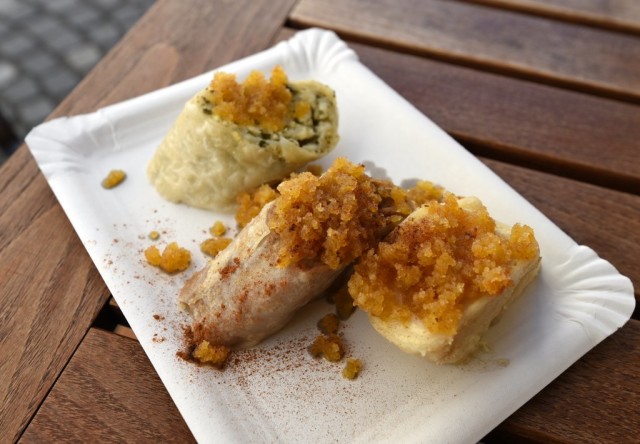
“Foodie” doesn’t have to mean “expensive.” You can eat very well for budget prices — if you do your homework (and don’t mind eating off a paper plate). This works everywhere from Ljubljana to Kraków — the cities where I had two of my most memorable (and cheapest) meals of 2016.

cameron-slovenia-ljubljana-struklji

In Italy, small-town politics can get extremely heated. Even when it comes to gelato. Especially when it comes to gelato.

The more you travel, the more you collect two very different things: pet peeves and favorite little pack-along items.

cameron-austria-SOM-tour

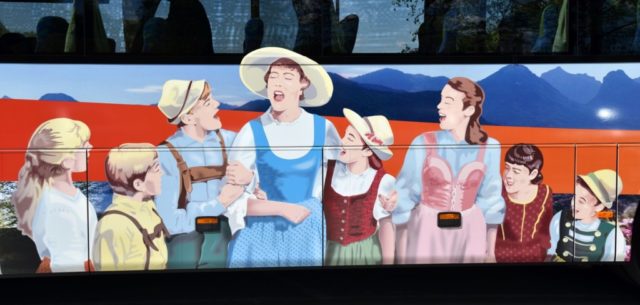
Speaking of pet peeves, if you don’t like The Sound of Music, then for heaven’s sake, don’t go on a Sound of Music-themed tour. Or two of them.

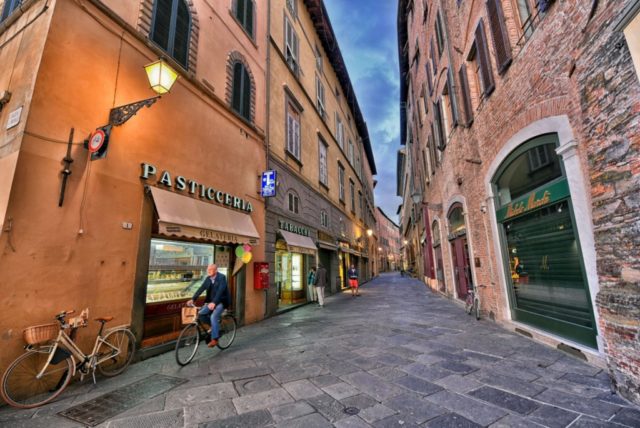
If you really want to find the elusive “untouristy alternative” to popular Tuscan destinations like Florence, Pisa, Siena, and San Gimignano…head to Lucca.

cameron-italy-lucca-street-7

Many of Europe’s quaint and quirky little towns — like Austria’s Hallstatt — are waging a losing war against the rising tide of corporate tourism. Enjoy them now, while they’re still more idyllic than commercialized.

Many alpine trails are snow-covered through early summer. But in Italy’s sunny Dolomites, it’s possible to enjoy a scenic hike even in mid-May. (Still…dress warmly.)

cameron-italy-dolomites-signs

Some of the most memorable travel experiences come in places you’ve never heard of — like off-the-grid villages high atop the Slovenian Alps — especially if you have trusted local friends to show you around.

Taking the time to take good photos is worthwhile. The pictures I’ve snapped this year in places like the Cinque Terre, the back streets of Lucca, Lake Bled, and other Slovenian grandeur are some of my favorite souvenirs.

cameron-italy-riomaggiore-sunset

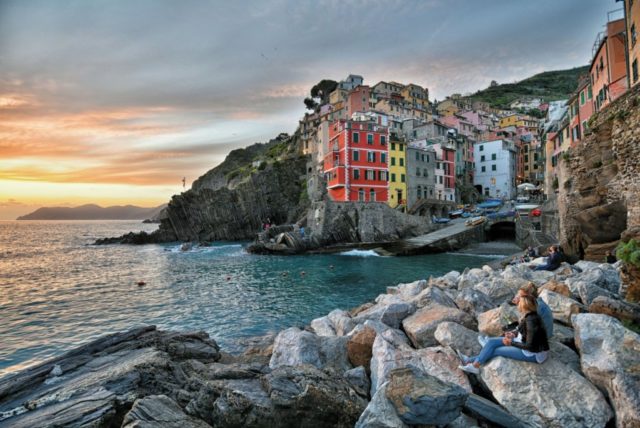
Italy’s Cinque Terre is tremendously crowded these days. But you can still enjoy it — as long as you equip yourself with smart crowd-beating strategies. (Trains jammed up? Hire a boat for a speedy and scenic ride to the next town.)

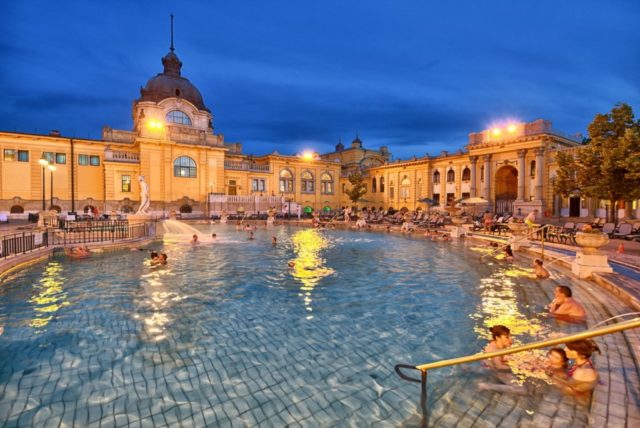
My ultimate travel thrill for 2016: Soaking in the Széchenyi Thermal Baths of Budapest. (OK, this was far from a new discovery — but it was just as glorious as I remembered.) And if you like Hungarian hot water, those baths are just the tip of the iceberg.

cameron-hungary-baths-budapest-szechenyi-14

Speaking of Budapest, the Hungarian capital still gets my vote for most underrated (and most improved) city in Europe. Budapest has some of the best nightlife anywhere — from ramshackle “ruin pubs” to budget opera to ritzy rooftop bars. Budapest is also emerging as one of Europe’s top foodie cities.

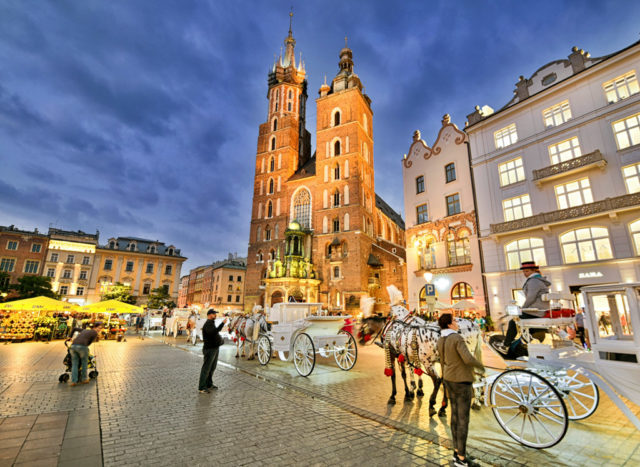
The main square of Kraków, Poland, remains my favorite in Europe — and on a balmy late-summer evening, when the horse carriages and breakdancing buskers are out, it’s pure magic.

CH16SepKrakow_372

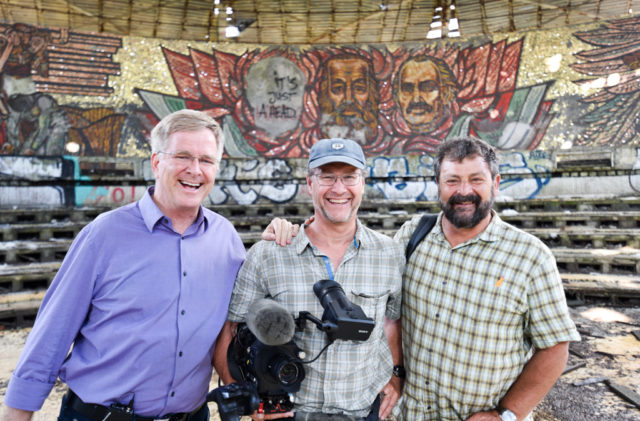
Making great television requires a lot of hard work. But it’s worth it. I enjoyed traveling with Rick and his crew as we filmed new episodes in Bulgaria and Romania — from cheesy polenta at a rustic shepherd’s encampment to bureaucratic snafus that nearly forced us to scrap our Bucharest shoot.

CH16MayBuzludzha_071

While much of the United States was shocked by our election results, Europeans have seen a similar trend rising for a long time — from Trump-style leaders like Hungary’s Viktor Orbán to the Brexit vote in June. In the new year, I resolve to learn more about other countries’ experiences — to better understand what’s happening back home.

It’s a sad fact these days: Terrorist attacks will happen. And when they do, it’s natural to get scared and second-guess your travel plans. But in my view, it’s essential to separate fear from actual risk. Statistically, you’re far more likely to get killed this year in a car crash (1 in 50,000), in a plane crash (1 in 750,000), or even struck by lightning (1 in 14 million), than you are to be killed by terrorists (1 in 20 million). If you really fear for your safety when going to Europe…then you should walk to the airport. Especially in dicey times, I embrace travel as an opportunity to appreciate the full beauty on our planet — which becomes especially poignant when those places are in the news,  as Brussels was in March.

As a new year dawns, my travel plans are starting to take shape. I hope yours are, too. It seems we may be in for another tumultuous year. There’s never been a better time to keep on traveling.

Rick Steves’ Europe Behind the Scenes: Post-Production

After a busy shoot — scrambling to get as much usable footage as possible while dodging the weather — we return home with a hard drive that’s loaded up with all that hard work. That’s when Steve takes over.

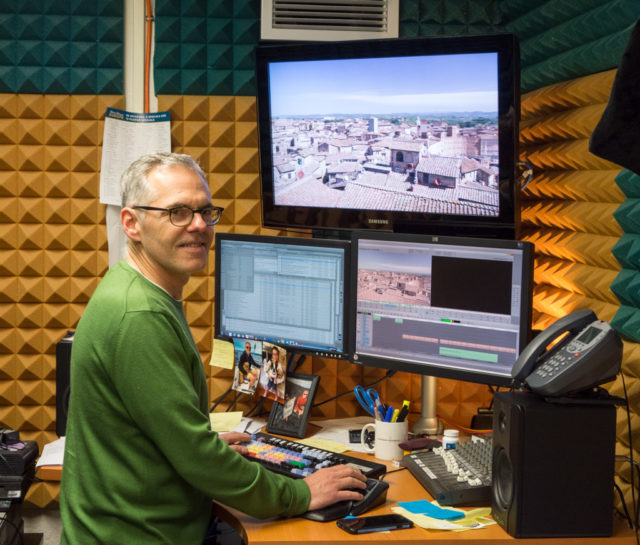
Rick is the creative spark, Simon is the logistical mastermind, and Karel is the artistic eye. But Steve Cammarano — who has edited every single one of the more than 100 episodes of Rick Steves’ Europe — is the one who puts it all together.

cameron-romania-tv-steve-cammarano-02

In the field, Simon and Karel always have Steve’s concerns in mind — making sure they provide him with footage that can be cut together easily. For example, it’s jarring to cut straight to a close-up — you need to ease the viewer into it with an establishing shot. So Simon and Karel make sure they’ve shot all of the bits and pieces that Steve will need.

When filming, each shot needs to be identified to facilitate Steve’s work. There’s no literal slate clapboard, but at the beginning of each shot, Karel verbally “slates” what he’s about to film: “Hey Steve, this is that communist statue.” “Hey Steve, another angle on that statue.” “Steve, a close-up of the two main figures.” “OK, this is a wide on the Square of the People, where that statue is.”

Steve also gets a copy of the (semi-) final script, which has been tweaked and polished throughout the shoot — a process we call “scrubbing the script.” “Scrubbing” means simply reading through the entire script, again and again, making each word earn its keep. Part of the scrub is knowing which footage worked — and which didn’t — and tailoring the words perfectly to what’s in the can.

When we’re satisfied with the script, Rick records a “scratch track” — a quickie voice track of the entire script, whose sole purpose is to give Steve something to cut to. This doesn’t have to be perfect — it’ll be replaced later — and in a pinch, Rick might even record it on his iPhone in a hotel-room closet (between hanging clothes to buffer echoes).

cameron-romania-tv-steve-cammarano-01

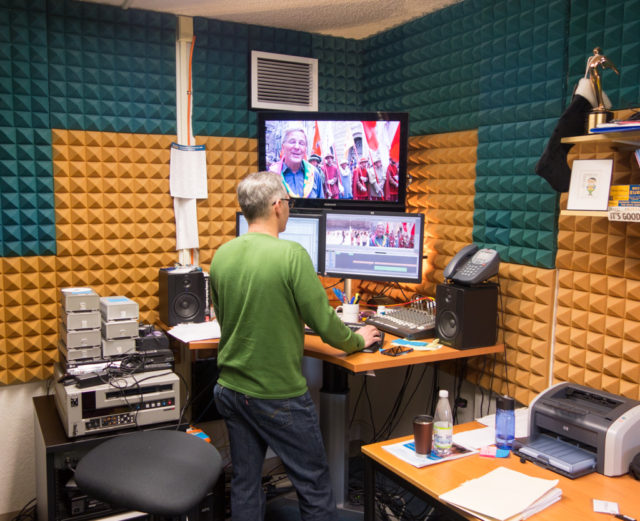
In his rabbit’s warren of an office, Steve uses the script, the verbal slates, and the scratch track as guidelines for piecing together the show. Like every other part of the process, editing TV is equal parts science and art: Steve has a clear blueprint, but he employs his own artistic vision in how he pulls it all together. It’s also tedious: Steve has to rewind each little snippet and rewatch it, again and again and again, to cut it just right. (I used to work in an office adjoining Steve’s, and I must admit: Overhearing a little two-second audio clip — say, a Swiss cowbell clanging, or a Norwegian girls’ choir singing a Christmas carol, or Rick shouting “Freeeedooom!” on the Scottish Highlands — 20 or 30 times in a row was enough to drive me batty. How Steve maintains his sanity, I’ll never know.)

Once Steve is finished with the rough cut, Rick and Simon watch it and weigh in with notes. If the show comes in a little long (not unusual) — or a lot long (as was the case in Romania, which was nearly four and a half minutes over) — it’s time to reach a consensus about what to trim. It’s a tough decision. Some cuts are pretty obvious, but others come down to a no-win pick-’em between two equally good bits that both deserve to be in the show. But at the end of the day, each show gets just 30 minutes (24 minutes and 16 seconds of actual content, to be exact, once you subtract the open, credits, and underwriting). And to be honest, those time constraints are probably a blessing in disguise: They force us to respect the attention span of our fans, and make tough decisions rather than bore our viewers.

Once the final cuts are made, Steve sends the footage to be color-corrected, evening out variations from different shooting situations to help the show feel visually cohesive. (It’s amazing what a good colorist can do to spruce up washed-out or cloudy footage.) Meanwhile, Rick and Simon watch the final cut one more time — the final “scrub,” with the help of ace wordsmith Risa Laib — and make a few last-minute wording tweaks. Finally, Rick records the final voice track, Steve cuts it to the color-corrected final cut…and the show is finished.

dv-bd-sn97d0e46e6d7f944fd8889ede469d45b50

The last of 10 brand-new episodes of Rick Steves’ Europe Season 9 (Cornwall) is airing across the country right now. We hope you enjoy them. And if you do, keep in mind the many talented experts — both in front of and behind the camera — who make that scrappy little show some of the most lovingly produced and most compelling travel television out there.

CH16MayBuzludzha_071

Thanks for tuning in for this “behind the scenes” blog series on Rick Steves’ Europe. And, of course…keep on traveling!


This is the ninth and final installment of my “Behind the Scenes” blog series about Rick Steves’ Europe Season 9 — now airing nationwide (check your local listings). You can also watch the Bulgaria and Romania episodes for free. And in case you’re in a gift-giving mode, the brand-new, 10-episode Season 9 DVD is currently on sale in our Travel Store.

Rick Steves’ Europe Behind the Scenes: Romania’s Parliament Votes No… Then Yes

After filming more than 100 episodes of Rick Steves’ Europe, Rick and the crew have seen most everything…until they got to Romania. While we wound up with a great show, the crippling red tape didn’t make things easy.

I want to be clear that we worked with dozens of exceptionally gracious, helpful, and capable people in Romania. Sadly, they all seem to be trapped in a ridiculously dysfunctional system. They tried to help us — they really did. At every major sight, the tourist authority would dispatch little delegations to greet us: guides, local tourist board representatives, big-name hoteliers, and so on. But at the end of the day, all of them answered to a higher power that seemed to relish saying “no.” Our contacts’ main function seemed to be commiserating with us when things fell through.

The tourist authority was over the moon that Rick was going to film in Romania. But they were also nervous. Apparently, another American travel TV personality filmed a show in Romania a few years back, and it did not go well. We were told that the presenter — known for employing his sharp tongue to call it like he sees it — grew so frustrated with bureaucratic snafus that he decided to take it out on Romania itself, producing a show that made the country seem like a miserable wasteland. The tourist authority was terrified that Rick, too, would present Romania in a negative light. And so — as if to guarantee the very thing they feared most — they gradually tortured us by trying to (subtly and not so subtly) exert control over the project.

Their paranoia bred paranoia in us. The night before we arrived in Romania, I got a call from the tourist board. Due to a “clerical error,” we had been assigned a guide who would accompany us at all times. He explained that this mistake was only just discovered, the guide had already been booked, and it was impossible to cancel. Rick — who remembers traveling here during the communist era, when any visiting foreigner was assigned a “minder” to report their activities to the authorities — wondered whether this “tour guide” was only there to keep us in line.

It turned out that he was a great guy, and that it really was just a mistake…probably. However, because we had already arranged our own, trusted local guides all over the country, our government-provided guide had literally nothing to do the entire time. We began brainstorming errands we could send him on, just so he could feel useful. (He was.)

CH12SeptBcharest_067

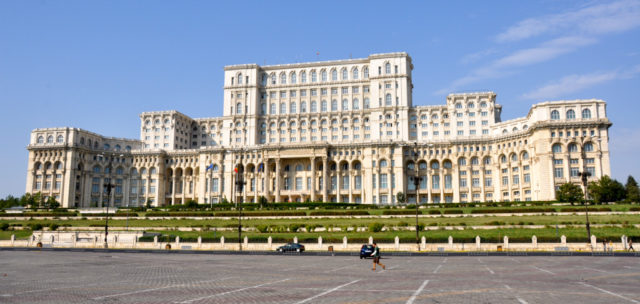
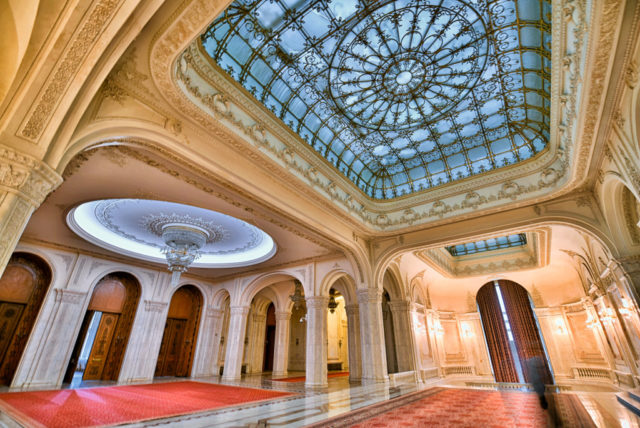
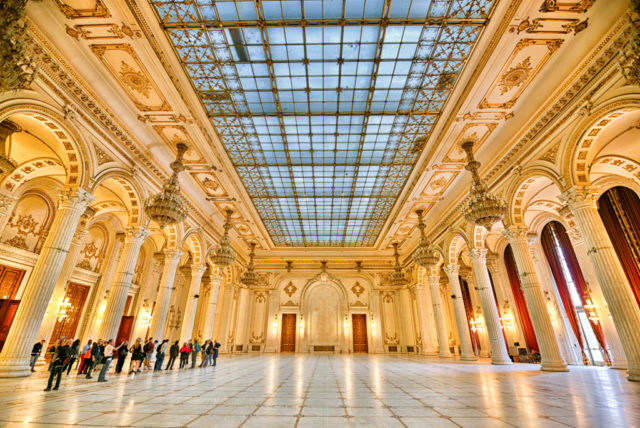
The biggest headaches came along with Europe’s biggest building: the Palace of Parliament, which was built to accommodate communist dictator Nicolae Ceaușescu’s ballooning ego. It was a must to film the palace’s jaw-droppingly vast and opulent interior — a priority we had made explicitly clear to the authorities months before we arrived. They repeatedly reassured us that all was being arranged.

But then, something happened. The night before we were to film, we found ourselves being told by the honcho of the tourist authority that we probably wouldn’t be allowed official access. It was suggested that we show up anyway, buy a tourist ticket, and send our cameraman in with the regularly scheduled tour to film it on the fly. It wasn’t ideal, but it could work. It had to work.

CH16MayBucharest_021

The next morning, we were greeted by a half-dozen tourism officials. As instructed, we bought tickets for the official tour and lined up. But then, moments before the tour began, we were told that the authorities were onto us. To keep a low profile, we decided to send only our cameraman, Karel.

Karel hung his DSLR around his neck and headed inside to “play tourist.” Rick, Simon, and the entire delegation waited nervously outside, hoping Karel could get the shots we needed. But just a few minutes later, Karel walked out the door. “I got kicked off the tour,” he said apologetically. Nothing could be done.

We decided to bail on the parliament and began filming other sights around Bucharest. A few hours later, as Rick was filming an on-camera with the parliament in the distant background, my phone rang.

“I am sorry to say there was a misunderstanding,” came the voice of our tourist authority contact. “But we have now obtained permission, and you may go film at the parliament.”

We didn’t buy it. “Are you sure we have official permission to film?”

“Yes.”

“With our big camera?”

“Yes.”

“And with our tripod?”

“Yes.”

“Complete access?”

“Yes, of course.”

“Do we have to tag along with a tour?”

“No, you may go wherever you like. They will provide you with your own guide. In fact, do not go to the tourist entrance. Go to the parliamentarians’ entrance. ”

Still skeptical, we hopped a taxi back to the parliament to be warmly greeted by a literal red carpet and a press secretary. Sure enough, we had the run of the place. Talk about a turnaround: from being kicked to the curb, to VIP treatment…in just a couple of hours. (And the Palace of Parliament segment turned out great.)

CH16MayBucharest_019

While much of Eastern Europe is doing well these days, Romania still struggles. Throughout our shoot, we got to know many wonderful Romanians grappling with a system that simply doesn’t understand how to function. When pressed, many locals deny that this is an artifact of Ceaușescu’s brutal rule (embodied by the opulent palace that he literally starved his people to build). But, given the success stories I’ve seen in so many other formerly communist countries, and the number Ceaușescu did on poor Romania, it feels like they protest too much. Are they in denial? Or still trying to hide the damage that was done?

Thanks to the help of many fine individuals, we came home with 30 glorious minutes of TV celebrating the beauty of Romania. On my scouting trip, several locals quoted a cryptic saying: “Romania is a beautiful country…what a pity it’s inhabited.” I’m charmed by Romania, and couldn’t understand where this cynicism came from. But after dealing with the red tape of filming a show here…I have a new appreciation for the unofficial national motto.


This is part eight of my “Behind the Scenes” blog series about Rick Steves’ Europe Season 9 — now airing nationwide (check your local listings). You can also watch the Bulgaria and Romania episodes for free. And in case you’re in a gift-giving mode, the brand-new, 10-episode Season 9 DVD is currently on sale in our Travel Store.

The Unkindest Cut: Shepherds, Mud, Dogs that Bite, and Cheesy Polenta

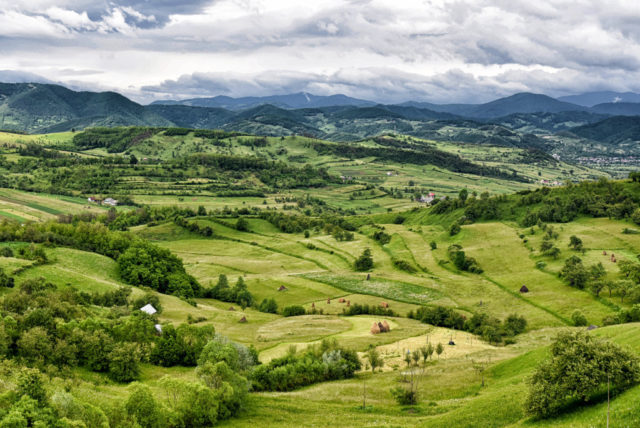
Stepping out of our car into the mist, Karel and I begin to organize our filming gear. Our guide, Teo, has driven us up a twisty road high into the Budeşti Mountains of Maramureş, in Romania. He’s brought us here to visit a very traditional shepherd settlement, where people still make rustic cheese as they have for centuries. It should make for great TV.

CH16MayMaramures_063

Gathering up the heavy tripod and the industrial-strength golf umbrella, I hear a pack of mangy, mud-stained, mismatched dogs bark furiously as they gallop across the soggy fields to greet us. They are very protective of their settlement — even though, to our eyes, there’s little worth protecting. “Don’t worry,” Teo says, with his wry smile. “Their bark is worse than their bite.” Over the chorus of yelps and growls, the shepherd yells something to Teo in Romanian. A flash of concern crosses his face. Translating, Teo points to one of the dogs. “Careful,” he says. “That one bites.”

We trudge through the muddy settlement, scouting what we’re about to film. Near the road is a paddock. A hundred yards uphill is a little roofed shed, a small hut, and a picnic table under a tarp. Everything is soaking wet. And everywhere we step, our feet squish.

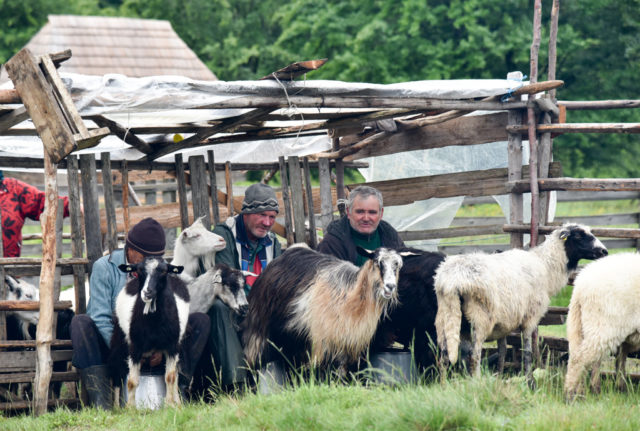
Teo introduces us to the settlement’s owners, a Mutt and Jeff duo: one built like an aging linebacker, the other an emaciated beanpole. These shepherds live up here through the summer, tending their flock of goats and sheep, milking them three times a day, and making cheese. This is a far cry from the log-cabin-cutesy, government-subsidized cheesemaking huts high in the Swiss Alps — with flower boxes, antique cowbells hanging from the eaves, and lederhosen-clad, apple-cheeked farmhands straight out of Central Casting. No, this is a much more authentic scene: a patch of mud with just enough pasture to graze a flock, and buildings so basic they barely qualify as “buildings.” Nevertheless, the shepherds take pride in their work, and do it with precision.

CH16MayMaramures_039

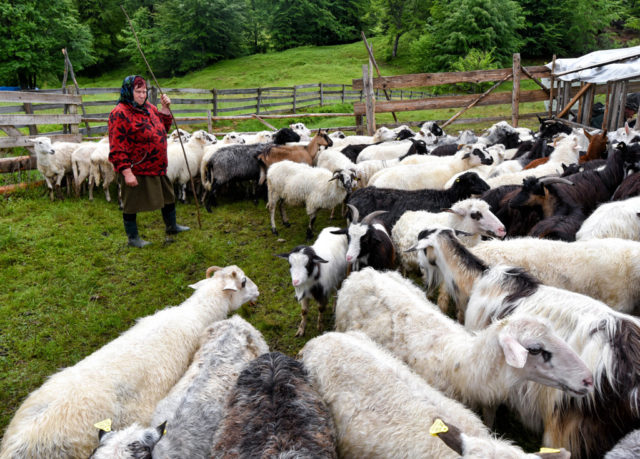
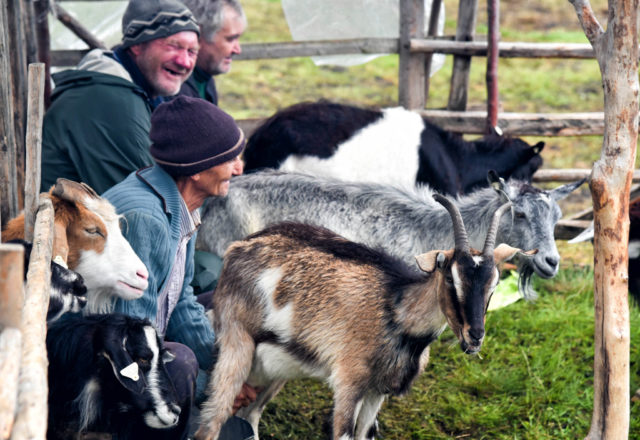
It’s time to milk. The motley mix of goats and sheep huddle up at a rickety wooden turnstile separating the two halves of the paddock. Another stout shepherd — more linebacker than beanpole — plants herself in the middle of the paddock, gently prodding the livestock toward three shepherds who hunch on little stools, evenly spaced under a plastic tarp.

CH16MayMaramures_032

They grab each animal as it passes through, and milk it into a stainless-steel bucket. Teo explains that every goat and sheep is different, so the shepherds gradually figure out the preferred technique for each one.

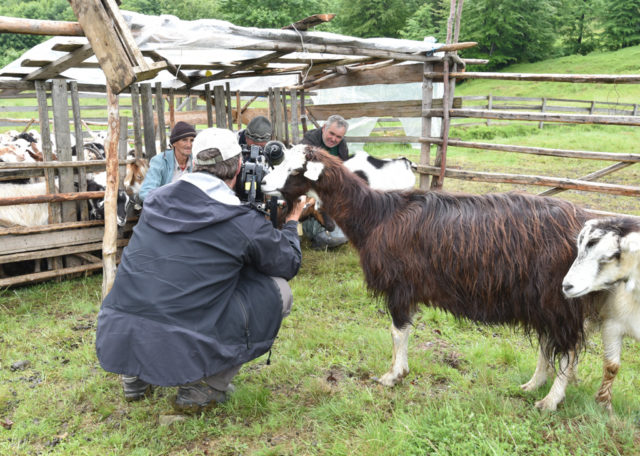
Karel gets to work, detaching his camera from the tripod for a shoulder-held shot. A few minutes later, Teo and I watch helplessly, in slow motion, as a curious goat sniffs the tripod until it tips over. Its delicately machined head lands with a damp thump in a goat patty. I spend the next ten minutes fruitlessly trying to polish it with a few tattered tissues I find in my pocket.

Meanwhile, Karel is lost in his viewfinder, squatting a few inches above the muck. A nosy goat waddles up and tickles Karel’s ear with his goatee. But Karel holds the camera steady…he knows he’s shooting gold.

CH16MayMaramures_038

The chorus of barks crescendos again, and we look up to see another shepherd coming over the horizon. He brings his own ragtag herd of sheepdogs, who quickly engage the local pack in a delicate do-si-do for dominance. It’s a commotion of fur and teeth, barking and growling and posturing — until, finally, one of the guest dogs goes too far and starts biting. The shepherds exchange angry words until the neighbor retreats to his own settlement with his pack — all of their tails tucked between their legs.

CH16MayMaramures_044

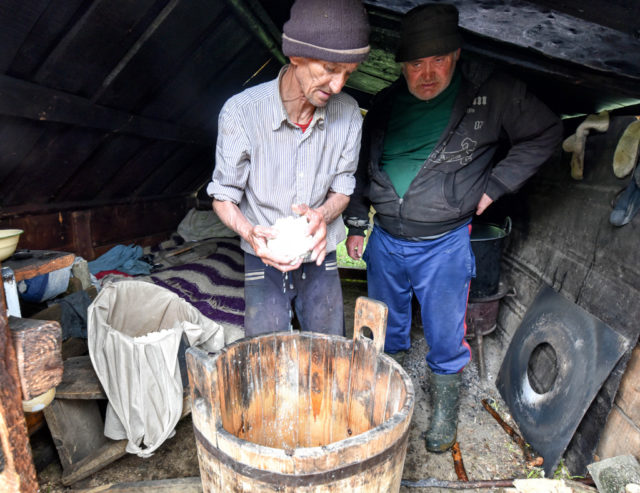
After about 45 minutes, the entire flock has been milked, and we follow the shepherds as they lug the buckets up to their little house. Pulling back the curtain at the door of their dirt-floor cabin, they reveal an impossibly spartan lifestyle: a cot covered with heavy blankets, a simple basin on a shelf, and a little potbellied stove. Standing in the doorway, they pour all the milk into a wooden bucket, then sprinkle in a powdered enzyme.

CH16MayMaramures_058

After 15 minutes, the shepherds dip in a cheesecloth to skim out the curds. Then the skinny one carefully hand-shapes them in a slow, rhythmic, squeezing motion, resulting in a tight little clump of cheese. Karel stands in the doorway, filming, while I hold the golf umbrella to keep his gear dry. Feeling the several inches of liquid mud and dung finally crest the cuffs of my shoes, I don’t even mind.

CH16MayMaramures_047

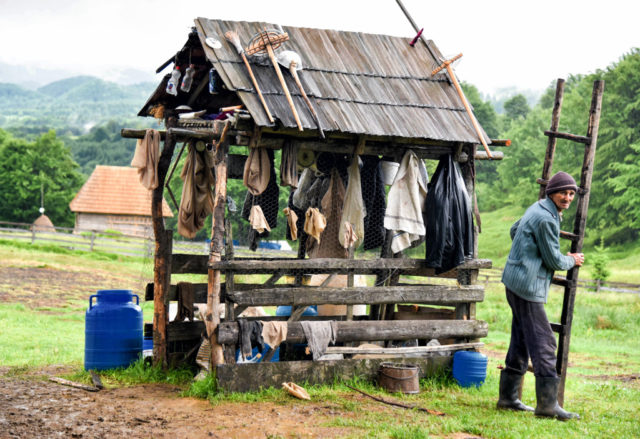
Having wrung out as much moisture from his newly formed clump as possible, the spindly shepherd pulls out a spindly ladder and climbs up to place the new cheese in the little attic above their supply shack. It seems that this is the only dry place in the entire compound: Its sharply angled roof protects food, jackets, towels, and damp laundry. On the roof rest tools that look like the spoils of a folklore museum heist.

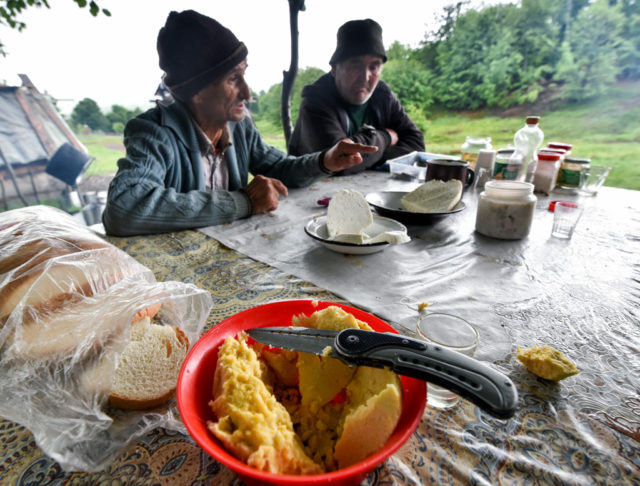
Finally, it’s time for a break. We retreat to a heavy wooden picnic table under a jerry-rigged tarp, and break bread over the plastic paisley tablecloth. With gratitude, we nibble on little samples of their very young, semi-flavorless cheese.

CH16MayMaramures_054

Then they bring out a red plastic bowl with a special treat: polenta mixed with cheese. One of the shepherds pulls out a wicked pocketknife, wipes it on his sleeve, carves off a little chunk, and hands it to me. Popping it into my mouth, I bite into a decadent, creamy texture — halfway between cheese and polenta — and taste the pungent kick of goat cheese. Fantastic.

In our travels around Romania, we’ve learned time and again about the importance of polenta. It’s such an important staple here that, in this part of Europe, Romanians are nicknamed “polenta-eaters.”

To finish the meal — and cut through the chilling wind — the shepherds pull out bottles of homemade firewater, along with a fascinating concoction: a dense, sweet syrup made of pine needles. Taking a sip, it’s sweet, but not too sweet, and mildly piney…unexpectedly delicious.

We bid farewell and head back to Teo’s car, where he winds us back down the mountain to the dry, warm comfort of our hotel. Karel and I are well aware that our Romania show will be too long. But we don’t yet know that the cheesemaking segment we just filmed will wind up on the cutting-room floor.

Trimming an overstuffed show to fit its 30-minute window requires some difficult calls, and — in the context of the entire show — this was the right call. But thinking back on the magic we captured, it feels like a particularly unkind cut. Maybe someday, somehow that footage will see the light of day. But even if it never does, my rainy afternoon on a Maramureş mountaintop was well worth it: I came away with a vivid travel memory.