My co-author and frequent collaborator, Cameron Hewitt, is well-traveled, smart, and insightful. And, while he and I are in perfect sync in our travel styles and priorities, he gives voice to the next generation of "Rick Steves travelers." Join me in enjoying his reports right here. —Rick

Postcards from Athens

From time to time, I like to share a few of my favorite photos with random observations, travel tips, and anecdotes. This batch of “postcards” is from my early-October visit to Athens, where I was working on the upcoming fifth edition of our Rick Steves Greece guidebook.

Athens is on the upswing. On my first visit, in 2005, the Greek capital felt a little haggard — as if still recovering from their Olympics hangover. Soon after, the Greek economy collapsed, and Athens saw protests, high unemployment, and worries about the future. But on my latest trip, I got the sense that the city is rebounding. I had trouble finding a hotel room — even several months ahead — and discovered a reassuring economic vitality, at least in the central touristy areas. Of course, many Greeks are still struggling. But at least things are on a promising trajectory.
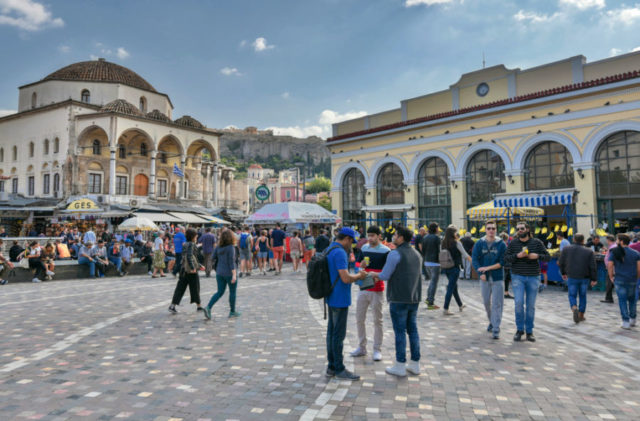
Athens’ central square — Monastiraki — exerts a strange magnetism, day and night. It’s both historic and lovably scruffy, with an old Ottoman mosque-turned museum, a historic subway station, and the Acropolis hovering in the distance. Ringing the square are tacky souvenir stands, rooftop bars with gobsmacking Acropolis views, and designer frozen yogurt shops.

I don’t feel like I’ve been to Athens until I’ve enjoyed one of my favorite street foods anywhere. Just off Monastiraki square is a bustling lane I think of as “Souvlaki Row,” where three industrial-strength restaurants churn out cheap plates of souvlaki, gyro, and kebabs (pictured here) — slathered with tzatziki, piled with pungent onions, dripping with grilled tomatoes, sprinkled with chili powder, and wrapped in a pita. I’m not saying this is the best place in town to try souvlaki (that’s a heated debate I am totally unqualified to participate in — though I hear good things about Kosta, just a short walk from here). But it’s one of those Athenian experiences I look forward to, and always savor.

The lively Psyrri district — just across the street from the central Monastiraki square — has completed its transformation from sketchy slum to trendy hotspot. With the 2004 Olympics, Athens rezoned Psyrri to encourage restaurants and bars to open up here, in a bid to spur gentrification. And it worked. Today this is one of the most pleasant places in Athens to hang out, with a mix of avant-garde bars and accessible, touristy, traditional Greek restaurants.

Street art is an Athenian forté. In a city and a country with limited resources for urban beautification, many Athenians consider graffiti an affordable way to make their drab cityscape more colorful and vital. This can be off-putting to some American visitors, who see graffiti as disrespectful. But Athenian street artists are heralded both within Greece and abroad for their talents. Yes, tagging can be unsightly…but imagine this Psyrri street with nothing but cracked concrete and rusty metal.

Through Alternative Athens, I took a fascinating food tour through Psyrri and the adjoining Central Market area. I’ve wandered through the market before, but having a guide explain some of the nuances of the place made it so much more meaningful and accessible. We learned why much of the fish you buy in Athens is frozen (and how you can tell the difference), why legumes are a staple of Greek cooking, and why camel pastrami has a strange popularity among some Athenians. This visit inspired me to write a new food-themed self-guided walking tour of Psyrri and the Central Market for the next edition of our guidebook.

As a photographer, I enjoy finding new perspectives on iconic subjects. This was taken at the Acropolis, looking up from inside the Propylaea — the ceremonial entryway to that hilltop ensemble of temples. The Propylaea is a tourist bottleneck, perennially jammed with a slow-moving chain gang of shuffling visitors, most of whom are staring at their feet, trying not to trip over each other. But when you get under those beams, squeeze over to one side and gape up in awe, at what — at the time — was the grandest gate ever built, still standing some 2,400 years later.

I enjoy simply getting lost in Athens’ urban jungle and stumbling upon sleepy squares surrounding stately churches. This no-name church — a 10-minute walk from the main tourist zone — is both beautiful and typical, with a little religious-goods sales kiosk out front where you can buy a cheap icon.

Athens is the Acropolis, delicious souvlaki, and the most beautiful statues from antiquity. But it’s also urban blight. This photo — taken in the touristy Plaka neighborhood — is quintessential Athens: a sidewalk blocked in three different ways. The photo below shows the exquisite 100 B.C. statue of Aphrodite and Pan at the National Archaeological Museum, all dolled up for a high-tech temporary exhibit…which is currently on the fritz. Some people are put off by Athens’ scruffiness, but over several visits, I’ve come to find it endearing. If you need everything slick, sanitized, polished, trouble-free, and injury-proof, Athens is not the city for you. But if you can approach the rough edges with a sense of humor, Athens is richly rewarding.

At the end of the day, Athens is one of those cities you accept on its own terms. With each visit, I enjoy it more and more. And I can’t wait to see what comes next.
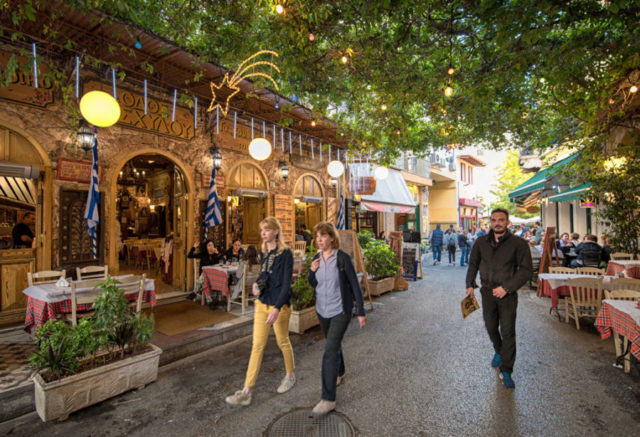

The funky Psyrri district was included in my list of 10 European Discoveries for 2018.

All of our best Athens tips appear in our Rick Steves Greece guidebook. And if you’re headed to Athens, be sure to use our free audio tours of the main sights.

Our Athens and the Heart of Greece 14-day tour begins and ends in Athens.

Postcards from Greek Islands: Santorini and Mykonos

From time to time, I like to share a few of my favorite photos with random observations, travel tips, and anecdotes. This batch of “postcards” is from last September, when I visited the Greek islands of Santorini and Mykonos, working on the fifth edition of our Rick Steves Greece guidebook.

Santorini is famous for its glorious caldera — the faint echoes of a volcano crater that erupted, then filled with seawater, millennia ago. Today cruise ships huddle in the center of the caldera and tender their passengers to shore. This view is from the terrace at Venetsanos, one of many wineries that take advantage of Santorini’s unique volcanic composition. (Before tourism, the Vinsanto — “holy wine” — produced here kept Santorini’s economy afloat, as it was exported for Eucharist purposes to Orthodox churches across Russia.) It’s fun to drive around Santorini, stopping in for tastings at your choice of wineries (our favorites are listed in the Rick Steves Greece guidebook). But if you want to come at sunset to enjoy this view with your wine…book ahead!

Santorini has many classic views, with cute domed churches against a caldera backdrop. I had an excellent local guide — Kostas from Santorini Private Tours — who helped me write new self-guided walks for our guidebook of both the main town, Fira, and jewel-box Oia. With Kostas’ help, I have a new appreciation for how to tell the difference between a Greek Orthodox church and a Catholic one (built by the Venetians who settled here after the Crusades, and gave the island its international name: “Santa Irini”). This one’s Orthodox.

Santorini’s main town, called Fira, is a gauntlet of souvenir and jewelry shops (and an odd abundance of “fish foot massage” places — a phenomenon that originated in nearby Turkey, and has caught on here with a strange vengeance). In this vertical village, most lanes come with steps — which are helpfully painted with directions to the cable car, whisking cruisers to and from the old port. Despite its touristy nature, I enjoy losing myself in Fira’s lanes.

All over Greece, it seems like cats are posing for pictures. I swear the Santorini Tourist Board plopped this one down on his perch moments before my guide brought me around the corner for this spectacular caldera view.

One of my favorite Santorini experiences was the sunset catamaran cruise I enjoyed with Caldera Yachting. The trip included a big, swanky boat with all the amenities; a fun-loving but professional crew dedicated to creating a memorable experience; an excellent meal of traditional Santorini cuisine; a few opportunities to go for a swim from the boat; easygoing and enjoyable fellow passengers; and perfect positioning for viewing the sun dip slowly into the Aegean. There are cheaper options offering a similar experience on a packed tourist boat, but I found the catamaran trip to be a worthwhile splurge.

The village of Oia — at the far tip of Santorini’s main island — is one big postcard, with its whitewashed houses and churches huddled along the caldera cliffs. Everyone (and I mean everyone) comes to Oia for the sunset. A half-hour before, its narrow lanes are a human traffic jam. I came in the late-afternoon, enjoyed the views and the rich sunlight, did my work, then hopped in my car minutes before the sunset. A few miles down the road, I pulled over at a stunning roadside viewpoint, which I had all to myself.

Greek islands are connected by speedy catamarans. On my journey from Santorini to Mykonos, I had to resist the urge to hop off at each idyllic island we stopped at. Ios — which struck me as a sleepy, less glitzy alternative to the big-name islands on my itinerary — was particularly tempting. I’ll be back.

Mykonos is a breathtaking little fishing village that’s been transformed into a bucket-list stop for the jet set. I love Mykonos itself, but was a little put off by many of the upscale, snobby-seeming tourists I met here. Still, I can’t resist this town’s whitewashed beauty.

Even on a crowded day, it’s easy to lose yourself in Mykonos’ back lanes. Everything is painted a blinding white, including the seams between the paving stones. Today this is decorative, but originally it was practical: By painting the lanes with lime — a natural disinfectant — Mykonians offset the unhygienic living conditions (people living on top of each other, and emptying their chamber pots in the streets). And the rooftops were painted with lime, too — they collected precious rainwater, which was carried through a network of gutters to cisterns down below. (Fresh water is hard to come by on an arid island.) Today the doors, staircases, and trim are painted bright, cheery colors, giving Mykonos its distinctive look.
Like on Santorini, I had the help of a great guide — Antonis Pothitos — to write a self-guided walking tour of Mykonos town for our guidebook. Antonis took it as a personal challenge to get me lost in the twisty lanes — to prove the value of having a live tour guide. I took it as a personal challenge to disentangle everything he showed me, then to organize it and write it up in a way that even a guide-less novice could follow. You’ll have to try the walking tour to see if I succeeded…or if Antonis is correct that you really shouldn’t attempt touring Mykonos without a guide. Antonis isn’t just looking out for his livelihood. Mykonians embrace their crazy street plan as a matter of civic pride. It’s not just atmospheric, it’s practical: The randomly angled and gnarled lanes help break the howling winds that famously swirl around the island, and the crazy street plan makes it all but impossible for would-be invaders to find their way around…unless they’re toting a good guidebook.

Mykonos’ most famous inhabitants are its three resident pelicans: Petros, Nikolas, and Irini. Because every visitor is on the lookout for these three birds, normally you’ll spot them being followed around by a chaotic scrum of paparazzi tourists. One afternoon, as I was wandering the back streets of Mykonos (desperately trying to make sense of Antonis’ tour), I stumbled upon one of these pelicans all by himself in a quiet courtyard. My breath caught in my throat as I found myself alone with this surprisingly majestic bird. As if recognizing a celebrity desperate to remain incognito, I exchanged knowing glances with the pelican, gave him a nod of respect, and quietly moved on — leaving him with a rare moment of privacy.

Mykonos’ most famous corner is “Little Venice,” a row of former sea captains’ residences that rise up from the water. It’s the perfect place to enjoy the sunset while looking back over the town’s other claim to fame — its five windmills on a ridge (perfectly positioned to harness that legendary wind). Skeptical, I invested $20 in a cocktail here…and was very glad I did. As there are basically no sights worth paying to enter on the island, consider this your “experience budget” for an hour of relaxing with a fine view.

If — like me — you find Mykonos town a little too crowded, snooty, and overpriced, it’s easy enough to escape. From the bus stop at the top of town, cheap buses fan out to beaches all over the island. It’s a breeze to master the system and beach-hop to your heart’s content. Each beach has its own personality, which we’ve outlined in our Rick Steves Greece guidebook — or you can get tips from a local. Late one afternoon, I found myself on one of my favorite beaches — Agios Ioannis (known as the filming location for Shirley Valentine) — while it was still sunny and pleasant, but after most of the beachgoers had gone home. I appreciated having this sandy paradise to myself for a little while, and watching the sun set over the Aegean.


Rick Steves was on these same islands just a couple of weeks before I was. He was there filming an upcoming public television special on cruising, and enjoyed summiting the ancient site of Delos (just off Mykonos).

All of our best tips appear in our Rick Steves Greece guidebook.

My Favorite Food Tour: Teaching History and Culture Through Cuisine in Trendy Warsaw

I consider myself a foodie. But my definition of “foodie” isn’t just about hedonism. It’s about using a country’s cuisine to unlock a greater understanding of its culture and its history. If you can zoom out to the bird’s-eye view, it’s clear that food is culture, and so much of a nation’s identity is wrapped up in its culinary reality.

I make a point to take food tours all over Europe as a way to indulge my curiosity about how food influences culture…and to indulge my palate. And the best one I’ve ever experienced was in an unlikely place: the Polish capital, Warsaw — which has, over the last few years, quietly transformed itself into Europe’s budget foodie mecca.

In Warsaw, I spent a fascinating (and delicious) half-day with Eat Polska, in the company of an excellent guide named Michaś. Now, Poland is one of my favorite countries. My grandfather was Polish, I’ve written guidebooks about Poland, and I’ve traveled to Poland more than 20 times for both work and pleasure. I thought I had a pretty good handle on this place. But Michaś opened my eyes to how the country’s epic history, hardships, victories, and persistent personality flavor every bite of every dish. Whether you’re going to the land of borscht, pierogi, and vodka — or a place better known for pasta or foie gras — a great guide can turn a food tour into a food tour de force.

After we met on a busy urban street corner, Michaś brought me to a traditional restaurant to build a foundation for the rest of the tour. We sat down to a table laden with bread smothered in lard, pickles, a bowl of bright-red borscht, and a shot of vodka. Just as I was about to dig in, he said, “Wait! Before you eat, look at this table. Only two items here are not fermented. Which ones?” After several wrong guesses, he gave me the answer: the salt and the vodka. Even the beets are fermented (for days, weeks, or even months) before they go into the borscht.

Michaś explained the importance of fermentation in Polish cuisine: Historically, Poland has been a poor land of hardscrabble peasants. Nourishment is a perennial challenge. And in a place with harsh winters, fermentation preserves nutrition — and, in some cases, actually increases the levels of important vitamins. (All that fermentation is why Polish cooking has such abundant umami flavors.)

When it was time for the vodka, Michaś explained the procedure: First, you eat a bite of bread with lard. Then the shot. And finally, the pickle. This routine is rooted in science more than superstition: The fat in the lard coats the digestive tract; the acidity and mineral salt of the pickle replace those killed by the alcohol; and both bites mask the burn of the vodka.

Strolling through a park to our next stop, we talked about the importance of thick, hearty soups in a peasant culture. These allow poor people to nourish their families, even if they lack protein. Most Polish soups are thickened with flour, cream, or chunks of vegetables — replacing the substantial-ness that would normally be provided by meat. “You could say that Poles were vegetarians — not by choice, but by circumstance,” Michaś said.

In olden times, meat was a major status symbol in Poland. That’s why Poles still sprinkle little fried chunks of bacon fat on just about every dish. Rather than hide it inside the dish, they perch their paltry protein on top for all to see.

Our next stop was a trendy foodie restaurant that takes some of the traditional recipes we’d just tasted, and modernizes them. Speaking of fermentation, they have an entire wall with jars of fermented produce, which looks a demented chef’s chemistry experiment.

The server brought out a plate of individually labeled sausages and cheeses. Now, there’s “Polish sausage”…and then there’s Polish sausage. And this sausage was delicious. Michaś gave me a guided tour through the subtle flavor differences of each one, as if sampling wines: Lightly smoked. Garlic. Marjoram. Peppercorns. Juniper. He explained why Poles smoke their ham hocks, rather than air-curing them, as in Mediterranean lands: It’s simply too wet here.

And he explained how the best sausage actually came about during the lean communist times. Back then, people had to raise their own livestock to supplement the paltry, poor-quality, government-rationed foodstuffs. (Most of the official production of Polish pork was exported. “The only things you’d find in a grocery store,” Michaś half-joked, “was shelves and vinegar. And sometimes mustard.”) Raising your own pig became a cottage industry…“farm to table” in the most literal sense.

In the spirit of “let them eat cake,” Michaś pointed out what really brought down the USSR: For most of the front-line protesters here in Poland, it wasn’t about political philosophy, or economic -isms, or craving democracy and freedom. At the end of the day, it was about feeding your family. If the communist system had succeeded in providing for all of its people, it may well still be the law of the land.

Since the end of communism, people can buy sausage in supermarkets rather than raising and butchering their own pigs. And so, traditional, organic, locally rooted farming has given way to modernized factory farms. These days, pigs are grown as big as possible, and pork is pumped with brine before it hits the supermarket. Poles may not be nostalgic for much from communism — but they do miss the delicious kielbasa from that age.

Our next stop was Bibenda, a hip bar with clever fusion food. The chefs pride themselves on deconstructing Polish classics, then reinventing them by pulling in elements from comparable dishes in other cultures. Digging into our dish — a reinvention of the Polish cabbage roll (gołąbki), but wrapped in a grape leaf — Michaś pointed out the subtle and surprising Turkish connection to Polish cuisine.

In the 17th century, when much of Eastern Europe feared the Ottomans, Poland maintained relatively good diplomatic relations with the sultan. (Even during the Partitions — when the state of Poland was divided among its neighbors, formally ceasing to exist — the Ottomans continued to recognize the Polish ambassador.) And to this day, Polish cooking retains a few surprising echoes of that history: Cinnamon. Raisins. Apricots. And what is the classic Polish cabbage roll, but a supersized version of the Turkish dolma (stuffed grape leaves) with a more locally sourced wrapper?

One of the themes in Polish history is that this vast, flat land — smack in between powerful neighbors Germany and Russia — has always been a crossroads of mighty civilizations. And you can taste that cultural mingling in the food. For example, Polish cooking uses more celery and cauliflower than its surrounding nations. That’s because, in the 16th century, King Sigismund the Old had a young Italian bride, who imported this Mediterranean produce to her new homeland.

And what about that quintessential Polish staple, pierogi? They’re so similar to Asian dumplings. (Think about it: The main difference between gyoza and pierogi is the seasoning.) Maybe that’s because pierogi arrived in Poland in the 13th century — exactly when the Tatars rode from Asia, all the way across the steppes of Russia, to ransack the Polish countryside.

Enjoying the last few bites of our meal, Michaś grows philosophical. “Of course, many cultures respect bread. Especially poor countries, where bread is the staple that keeps you alive. But here in Poland — so historically poor, and so very Catholic — it’s actually revered. Remember, bread is considered the body of Christ. Fifty years ago, people would remove their hats in the presence of bread. And they’d make the sign of the cross over a loaf of bread before cutting into it. Even to this day, if you drop a piece of bread on the floor, many traditional Poles kiss it before throwing it away.”

“In French, they have a style called à la polonaise — “Polish-style” — with buttered bread crumbs. That’s because Poles are determined to use the very last little bits of bread to its fullest. It’s not because Poles are cheap, but because we’ve had to make do with less, at many points in our history. There’s a local saying: Zastaw się, a postaw się…roughly, ‘Go in debt, but provide.’ Being poor is no excuse for not feeding your family.”

Many Poles still bake their own sourdough bread, using bacteria cultures more than a century old. In this modern age, there are online message boards to arrange for someone to “feed” your sourdough starter when you’re on vacation.

I asked Michaś about my favorite polish dish, bigos. Sometimes translated as “hunters’ stew,” this is a thick, rich, and incredibly flavorful mix of sauerkraut, mushrooms, sausage, and any kind of meat available. “It’s like American chili,” Michaś said. “There’s no one recipe; everyone makes it their own way. Even the ingredients can change — whatever protein you have available, you can put in the pot.” Also like chili, bigos tastes better the next day…or the day after that. Traditionally, you’d make a pot of bigos to use up any leftovers after your Christmas feast. After a long simmer, you’d put the pot outside to freeze overnight, then bring it in again to thaw. Sometimes you’d do this for many days — freeze, thaw, freeze, thaw — each time rupturing the cells of the plant matter inside, breaking down and marrying all the flavors. By the time it’s done, it’s incredibly delicious.

Nearing the end of our tour, I asked Michaś about the state of Polish cuisine today. “Many of the things we’re discussing today — the importance of bread; fermentation; hearty soups; and so on — are beginning to fade away to some degree, as modern life is changing our eating habits. On the other hand, artisanal, traditional foods are on the upswing. Many thirtysometings and fortysomethings — who came to the cities for work in the years after communism — are giving up on the rat race, moving to the countryside, and dedicating themselves to reviving these old customs. So I do have hope for the future of Polish cuisine.”

I heartily concur. After a few hours with Michaś in Warsaw, now when I bite into a Polish dish, I can practically taste Tatars and Turks shaping Poland; I can taste hardworking peasants cultivating a barren countryside; and I can taste a deep, soulful national pride that goes beyond salt and pepper.


For more tips on what makes a great food tour, check out my blog post on the topic. And if you love Polish food (like I do), join me on a visit to my favorite milk bar.

If you’re inspired by the idea of using food as a way to better appreciate a place’s history and culture, you might enjoy my “Europe for Foodies” talk. I’ll be presenting this class next Saturday, March 3, at our Travel Center in Edmonds, WA (free for anyone in the Seattle area). If you can’t make it, check out my class handout. (Later this spring, we’ll be adding a video version of this talk to our Travel Talks page…stay tuned! In the meantime, you can watch Rick’s travel talk about eating in Europe.)

And, of course, the best food tours we discover — in Poland, or anywhere in Europe — go straight into our Rick Steves guidebook series.

Jams Are Fun: A Rough Day on the North Sea

My wife’s Great-Great-Aunt Mildred traveled far and wide, long before such a thing was fashionable. Late in life, Aunt Mildred set about to writing a memoir. The title: Jams Are Fun. It turns out that, after seeing so much of the world, Aunt Mildred realized that it’s not always the big museums, the fancy dinners, the castles, or the cathedrals that stick with you most. It’s those serendipitous moments when things go awry. And so, in the spirit of Aunt Mildred, this post is part of my “Jams Are Fun” series about when good trips turn bad, and the journey is better for it…if only in retrospect. I wrote this a few years back, while working on our Northern European Cruise Ports guidebook, somewhere in the churning North Sea.

As I write this, my cruise ship is rocking violently to and fro. My mascot baboon — which my cabin steward cleverly made by folding a towel in a special way they must teach at cruise-ship steward school — is clinging to the ceiling in the corner of my room…going for the ride of its short life. In addition to the slight but persistent listing to port, with the occasional, violent bob to starboard, every ten minutes or so the ship shudders and shakes as if the captain just accelerated over a speed bump.

But I’m getting ahead of myself. I went to bed last night as we cruised out of the Sognefjord. Next stop: Norway’s other top fjord, Geiranger. But I awoke to news that, due to extremely high winds, they were cancelling the stop. And so, the captain turned this bucket around and headed back out of the Geirangerfjord.

The screaming winds managed to momentarily clear out some of the thick cloud cover we’ve been huddled under since entering Norwegian waters, shining a spotlight on wicked whitecaps all around us. The brief sun break also teased us with an enticing view of an idyllic Norwegian countryside of green forest, red cottages, and chalky gray cliffs. It was a Norway we would not actually visit, nor one we would see again for the rest of the day. This would be, in the parlance of the cruise industry, an unplanned and very turbulent “day at sea.”

As we navigated out of the fjord and into the North Sea, the seas grew dramatically rougher. All over the ship, subtle indicators popped up to hint that we were in for an even bumpier ride: Little plastic bags discreetly appeared in the hallways. All of the water was drained first from one swimming pool, then from the other, to keep it from sloshing out onto the deck. Precautions were being taken.

This was the first time I’d been on truly rough seas…and I was pleased to discover I was handling it relatively well. (My family lore includes the unfortunate tale of a friend who didn’t realize she was prone to violent seasickness until she boarded her honeymoon cruise to Bermuda — and spent the week hugging porcelain.) Maybe my 25 percent Norwegian DNA came with an iron stomach…and those sea bands don’t hurt, either.

In a bit of delicious serendipity, the afternoon’s scheduled entertainment was — I am not making this up — a troupe of Chinese acrobats. Now, I would pay any amount of money to see acrobats perform in these conditions. But this show? This show was free. As the time of the show drew near, morbid curiosity drew me down to the theater. But a polite notice explained that the show was postponed. Wise move, Chinese acrobats. So instead I strolled around the ship to survey the damage.

At this point, we’d left “rough” and entered “rodeo.” People were either green in the face or, like me, immune and chuckling at the absurdity of it all. Everyone — even seasoned crew — walked with the same unusual gait: first leaning a bit and plodding slowly to the right, then rushing with sudden urgency to the left, then slowly again to the right, and so on. I sat looking out a window for a while, watching through the fire-hose spray the mesmerizing rhythm of the railing as it teeter-tottered dramatically waaaay above, then waaaay below the horizon.

Curious, I made my way up to the top deck, and was surprised to find the door unlocked. I stepped outside and wandered around for a while — one hand in a death grip on the railing, the other in a death grip on my camera — feeling like the only person on the entire ship. Somewhere in the control room, I imagined someone watching surveillance feed of this idiot wandering around outside in the worst storm the ship had ever weathered…taking bets on when he’d be blown overboard.

As dinnertime approached, I wondered whether, like the Chinese acrobats, the main dining room staff would have come to their senses and just called the whole thing off. But dinner, much to my surprise and my delight, was on. I knew I was in for an entertaining night when I walked past a Dutch teenager who suddenly — and, apparently, with as much surprise to herself as to me — vomited a little bit into her hands.

Stumbling and careening to my table, I noticed that at least a third of my fellow diners had decided to skip it tonight. My waiter hustled awkwardly toward me — propelled by an unwanted inertia and briefly overshooting his target — to drop off the menu.

Now, I’m sure there was a good reason for the ship designers to locate the main dining room at the bottom-rear of the ship, directly above the engines — but on a rough night like this, it seemed like a cruel prank. Things were far worse down here than in my stateroom up on the eighth deck. The entire dining room tilted violently this way, then that. Every few minutes, the curtains slid themselves open and closed, as if possessed. At one point, a precarious angle sent plates and glasses cascading off tables. And periodically there was a deep, loud humming noise — as if the engines had been lifted out of contact with the sea, immediately followed by a sickening thud that shuddered the whole ship and rattled the wineglasses.

And then there were the diners. Those of us who had showed up for dinner tonight were, no mistaking it, here on purpose. We were not about to let this thing get the best of us. And yet, some of us must fall. The woman who sits at the table in front of me — who has this funny habit of staring off into space, which happens to be directly at me — began fanning herself with her menu. The sweet French lady at the next table got up after the first course and never came back.

Having grown up watching the movie Stand By Me, I kept envisioning a Lardass-at-the-pie-eating-contest chain reaction. So I made a game of it. Looking around, I tried to guess: Who would be the first to pull the trigger? Would it be the balding, bespectacled fellow who lifted his napkin to his lips for a suspiciously lingering moment after each bite? The young lady who kept coughing loudly, then swallowing and rolling her eyes? The little girl resting her head on the table? Or maybe…the American smart aleck at table 103, smugly pondering the suffering of others?

I think I psyched myself out, because suddenly I found it next to impossible to swallow. I wasn’t sick — just tired of proving I wasn’t. I decided that a violently swaying room full of gastrointestinal time bombs was not a smart place to be, and — like so many before me — politely excused myself.

Still hungry, I wandered up to forage at the 24-hour shipboard pizzeria. But, inexplicably, their lone variety tonight was topped with a less-than-appetizing combination of tuna fish, capers, and onions.

Oh, well — it’s bedtime anyway. If I don’t get physically tossed out of my bed, manhandled by Mother Nature while I sleep, I’ll wake up tomorrow in Bergen…and, hopefully, better weather. And if I’m lucky, maybe they’ll reschedule those Chinese acrobats.

(P.S. They did. And they were spectacular.)

The Trouble with Tapas: 8 Tips for Enjoying Spain’s Tapas Scene

Recently, my wife joined me on her first-ever trip to Spain. Before we arrived, she couldn’t wait to dive into the fabled tapas scene: an endless array of bite-sized baguette sandwiches, deep-fried sea creatures, grilled veggies soaking in garlic-infused olive oil, and toothsome tortilla española. We arrived late one rainy Friday evening in Bilbao. By the time we’d checked into our hotel, it was around 9 p.m. — prime tapas time. This was going to be fun.

But then…it wasn’t. The bars were jammed. We could barely get inside. And when we finally managed to muscle our way to the bar, we couldn’t get served. I’ve spent several months in Spain, dating back to a semester abroad in college — and even I was overwhelmed by the experience. On a busy Friday night, Spanish tapas are a full-contact sport…an eat-or-be-eaten world.

Americans who are used to “small plates” restaurants back home might underestimate the cultural hairiness of the true tapas experience. Don’t get me wrong: Tapas are quintessential Spain. What’s not to like? You get culinary variety and an authentic encounter with Spanish culture for reasonable prices. But wading into a claustrophobic mosh pit of tapas aficionados is no fun for nervous novices. Here are my top tips for navigating tapas bars with the savvy of a local.

Don’t be shy — stake your claim at the bar.

If you walk in and see a wall of people, don’t bother looking for the end of the line. There is no line. Instead, tuck your elbows up like chicken wings and plow through the melee until you reach the bar. If you smile demurely, wait patiently, and expect to be waited on…waiting is exactly what you’ll do. The onus is on you to get the bartender’s attention. Introverts starve, and the person who makes the biggest fuss gets served first. When you’re ready, wave your hand, make eye contact, and boldly say, “Por favor!” or “Perdón!”  (Observing the dominance displays required to get fed, it suddenly makes a little more sense that the national pastime involves the ritual slaughter of an innocent animal.)

Survey the options on the bar, but don’t overlook the menu.

Most tapas bar line up a few ready-made dishes on the counter, or in a glass display case. But these have been sitting out for who-knows-how-long. And at many tapas bars, the most interesting options can only be ordered from a menu. In more traditional places, you’ll squint at the handwritten menu, hung in low light at the back of the bar. Even if it were in English, it’d be next-to-impossible to read.

You can try asking for a printed English menu. But even if you get one, your choices can be far from straightforward. (Trendy eateries have a penchant for naming their dishes creatively. Is “Flavors from the Briny Depths” some sort of seafood salad? Paella? Dredged sewage with a seaweed garnish?) You can ask the bartender for some clarification, but don’t overdo it (see the next point).

When I go for tapas, I pack along a sense of culinary adventure: If I can identify roughly what the key ingredients might be, and it sounds good, I’ll give it a chance. Sometimes it’s delicious. Other times…not so much. But one thing’s for sure: It’s always different from back home. To increase your odds of getting ostras (oysters) instead of orejas (pig’s ears), equip yourself with a list of key food terms. An extensive menu decoder designed precisely for this purpose is a major feature of the Rick Steves Spanish Phrase Book. The Google Translate app also works well, but isn’t tailored specifically to menu decoding.

Be ready to order.

The bartender’s job is not to chitchat. She’s not there to conduct a nuanced dialogue about the provenance of various ingredients, or the pros and cons of each dish. And forget about substitutions. Just watch how hard the bartenders work — a perpetual-motion machine of order-taking, drink-pouring, and cashiering — and you’ll understand why they seem rushed.

So, be prepared: Once you get the bartender’s attention, cut to the chase — clearly and succinctly. (“Glass of vermouth, glass of beer, grilled beef loin, tortilla española. Por favor.”) On rare occasion, you may luck into a bartender who has the time and language skills to explain your options. But it’s safest to assume you’re pretty much on your own.

Know the specialties.

A dozen bars on a given street might do serviceable gambas a la plancha (garlic-sautéed shrimp) — but discerning locals know which one does it the best. And that place might do another dish the worst. Octopus (pulpo) can be rubbery and gross at one place, then tender and delicious at the next. Some tapas bars are hip, trendy, foodie, and fusion; other places are old-school, serving just the classics to appreciative traditionalists. If you’re an “A+” eater, do some homework to find out not only which tapas bars to try, but what to try at each one.

Order sparingly, and share everything. Then repeat.

With so many temptations all lined up, it’s hard to resist overdoing it at your first stop. But  Spaniards would never eat an entire meal at one bar. The whole point is to assemble a moveable feast. People stroll from bar to bar, running into different friends and neighbors at each place. And at each bar, they order a drink, and a plate or two to share. Everything is family-style by default — don’t even try to order a tapa just for yourself. (That’s why many places serve plate-sized raciones alongside the bite-sized tapas. And in many cases, the tapas are designed to lure you in the door, but the raciones kick things up a culinary notch.)

This works even better in a small group, which allows you to maximize the number of raciones you can sample. Try to see how many different dishes you can taste without getting stuffed. To pace yourself, alternate between hard drinks and soft drinks (for this very reason, most bars have cerveza sin alcohol — N/A beer — on draft; just say “thervetha seen”).

“Basque-style” self-service tapas bars are more user-friendly.

The Basque Country has a more streamlined, self-service approach: The bar is lined with a wide variety of bite-sized tapas, each one pieced with a toothpick. Just grab whatever looks good, leaving the toothpicks in a little pile on the plate as you graze. At the end, flag down the bartender to tally the toothpicks and give you your bill. This “Basque approach” is also beginning to catch on in other parts of Spain, especially Barcelona; look for eateries with the name “euskadi” (the Basque word for “Basque”).

For a less intense experience, go earlier in the evening.

Spaniards eat notoriously late — dinnertime begins around 9 p.m. (When I was a student in Salamanca, I would marvel at families taking their kids out for a walk after midnight.) While this might seem mystifying to outsiders, the siesta-then-a-late-dinner tradition perfectly suits Spain’s blazing-hot climate.

However, most bars are open all day long, and start to lay out their tapas for early birds at what approximates a reasonable dinnertime back home — say, 7 or 8 p.m. — to catch office workers for a bite on their way home. If it’s your first time experimenting with tapas, get your bearings at an off-time, when it’s far less crowded. As you master the tapas tango, you can start nudging your dinnertime later and later, eventually achieving the all-in, late-night, fully authentic Spanish tapas experience.

Take a tapas food tour.

All of this might seem bewildering. And, for many travelers, it is. But these days, most Spanish cities have tour companies offering fully guided, thoughtfully curated culinary walks that link up a representative sampling of tapas bars. (I took a great one with Mimo San Sebastián; others are listed in our Rick Steves Spain guidebook.) Food tours know which bars specialize in which dishes, and offer cultural context that brings meaning to your munching.

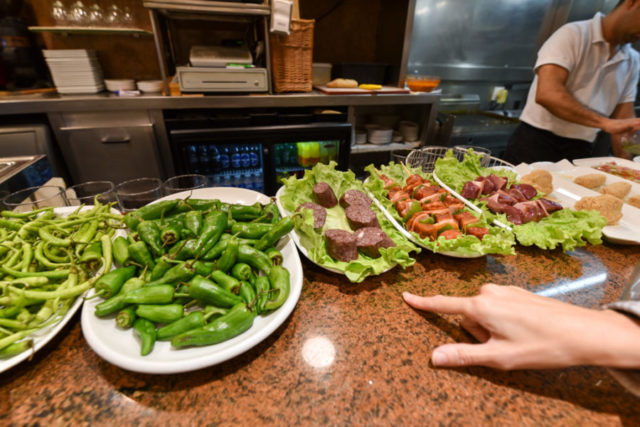
You guide can point out, for example, that if you walk past the premade tapas in front, there’s a grill counter in back where they’ll cook up a fresh dish for you while you wait. And without a guide, you might order a delicious plate of pimientos de Padrón —miniature green peppers, flash-fried and coarsely salted — and discover the hard way that a random number of the peppers on that plate are jalapeño-hot. Doing a tapas tour early in your trip provides an ideal crash course in how the whole scene works, emboldening you to delve into a swarming tapas bar with the confidence of a local.

Just a few days after her baptism by fire, my wife was already an old pro. And she’s already looking forward to her next trip to Spain. Armed with these tips, being steep on the learning curve in a Spanish tapas bar is fun rather than frustrating. Dive in!