My co-author and frequent collaborator, Cameron Hewitt, is well-traveled, smart, and insightful. And, while he and I are in perfect sync in our travel styles and priorities, he gives voice to the next generation of "Rick Steves travelers." Join me in enjoying his reports right here. —Rick

Lake Mývatn: North Iceland’s Geothermal Wonderland

Few visitors to Iceland get beyond its southwestern region, around Reykjavík. And that’s a shame, because one of the most spectacular corners of Iceland is in the North. Our Rick Steves Iceland guidebook co-author, Ian Watson, told me I’d love the Lake Mývatn area. And he was right. Continuing my Iceland blog series, here’s a recap of perhaps the most memorable day I’ve spent in Iceland.

The midges are swarming. They don’t bite. But they do get stuck in your nose.

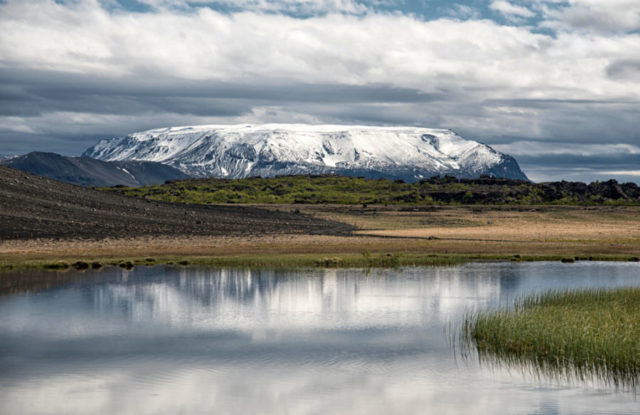
Mývatn — literally “Midge Lake” — fills an expansive plain ringed by flat-topped, snow-capped mountains in the north of Iceland, about a seven-hour drive from Reykjavík. Mývatn sprawls along the fissure between the North American and Eurasian tectonic plates, infusing the area with tremendous geothermal energy (and, consequently, some of the most breathtaking volcanic landscapes in Iceland).

Within a short drive — never straying farther than about a half-hour from the lakeshore — you can hike through a valley of lava pinnacles, summit two different craters, eat sweet rye bread baked in the hot earth, wander a neon-yellow plain of hissing fumaroles and bubbling hot pots, take a shower in the middle of nowhere, visit a geothermal power plant, and simmer in naturally heated hundred-degree water among steaming lava rocks. It feels like someone gathered up a half-dozen great American national parks and tucked them into one little corner of North Iceland.
The other thing you’ll see here —  like it or not — are midges, distant Nordic cousins of the miniature mosquitoes that terrorize the Scottish Highlands (called “no-see-ums” by some Americans). Mývatn’s broad, still, relatively warm expanse of water is just right for a bug spa. Fortunately, Mývatn’s midges don’t leave itchy welts. But if you’re near the lakeshore in the summertime, they do swarm relentlessly in your nose, ears, eyes, and mouth. Local shops sell mosquito nets to drape over your head. Budget travelers appreciate the free protein.

From Iceland’s second city of Akureyri, I drive an hour and a half east, through an uninhabited expanse. Eventually signs direct me to turn off and loop around the south shore of Mývatn. I’ve been primed by several Iceland aficionados (including our book’s co-author, Ian Watson) for Mývatn to blow me away. But at first glimpse, I don’t get it…it’s just a big lake.

Soon I reach my first lakeside stop, Skútustaðir, and step out of the car into a swarm of midges. Brushing them aside, my eyes zoom out to take in a series of pseudocraters extending out into the lake. A well-marked, half-mile trail leads around these giant popped bubbles of molten rock. So maybe there’s something to this Mývatn place, after all.

Continuing 10 minutes farther, I reach Dimmuborgir. True to its name — “Dark Castles” —  this area feels like an otherworldly Monument Valley, where petrified vampires lurk in the cracks and crevasses. Here again, easy nature trails offer a choice of hikes, from 15 minutes to two hours. Strolling between chunky formations that rise up from the earth like mighty stalagmites, I begin to understand why so many science-fiction epics are filmed in this part of Iceland.

Back in the car, it’s just another 10 minutes to the turnoff for Hverfjall, a volcanic crater with loose, pebbly slopes. I don’t have time for the hour it’d take to hike up to the summit and back…but I make a mental note to budget more time for Mývatn on my next visit.

I’m hungry. And, sure enough, I’m minutes away from one of the region’s most appealing eateries: Cowshed Café. The country-cutesy restaurant, serving a menu of modern and traditional Icelandic dishes, shares a building with an actual cowshed, just a few steps from the lakeshore. I dig into a plate of the sweet, dense, local rye bread topped with smoked arctic char. “This bread is baked in the ground,” the server explains. “Pardon?” “It’s what we call Geysir bread. You find a hot spot in the ground, bury a pan of raw dough, and dig it up once it’s done.”

I ask about the rooms at the adjoining Vogafjós Guesthouse. “Oh, yes. We used to have 10 rooms, but we’ve just finished building 15 more. ” Throughout Iceland — even in remote Mývatn — there simply aren’t enough beds to meet the exponentially growing demand. But can-do businesses are scrambling to accommodate their guests.

Before leaving, I get directions for the famous “Game of Thrones Cave”: “Just head back the way you came, take the first left, let yourself in the gate, and follow the gravel road until you see the tour buses.” Sure enough, another 10 minutes’ drive takes me to this middle-of-nowhere spot just in time to see a crowd of tourists pile back onto their bus. I make my way down a steep crevasse into Grjótagjá — a cave filled with naturally heated water. Most of what you see “north of the Wall” on Game of Thrones was filmed in Iceland. And this was the cave where Jon Snow and Ygritte, ahem, violated the oath of the Knight’s Watch. In an effort to curb reenactments, swimming in the cave’s pool is strictly prohibited. But that’s no problem, because a much better opportunity is just around the corner.

The Blue Lagoon, near Reykjavik, is Iceland’s most famous thermal bathing experience. But my personal favorite is Mývatn Nature Baths — roughly the same concept as the Blue Lagoon, but smaller, simpler, less pretentious, and half-price. For about $50, you can luxuriate for as long as you want in its murky, blue-green waters.

At the entrance, the clerk warns me, “Don’t wear your glasses in. The natural minerals in the water are a great exfoliant, but they’re hell on lenses.” I change, step outside into the lunar landscape, and walk the plank down into the serene lagoon. Almost instantly, I recover from a busy day of driving, hiking, and guidebook-scouting. The pebbles on the floor of the lagoon massage my feet, while the hundred-degree water takes care of the rest.

The lagoon is filled with just the right number of people, all enjoying a languid midafternoon paddle.  Slowly making my way over to the edge of the lagoon, I hang out for a while, using the panoramic views over the entire Mývatn region to visually retrace my route between uncanny landmarks. There’s a very slight sulfur smell, but it’s easy to ignore…and it keeps away the midges.

Recharged, I leave the Nature Baths and follow highway 1 east, where I twist my way on a serpentine road over a low pass. At the summit, a pullout offers sweeping views over the baths, and the nearby geothermal plant that supplies it, all in the shadow of the Hverfjall crater.

Descending the other side of the pass, the terrain levels out and becomes completely barren. It feels like Iceland’s “big sky” country. I pull off at the sign for Námafjall — an intensely geothermically active field that Mother Nature has painted an unnatural shade of bright yellow.
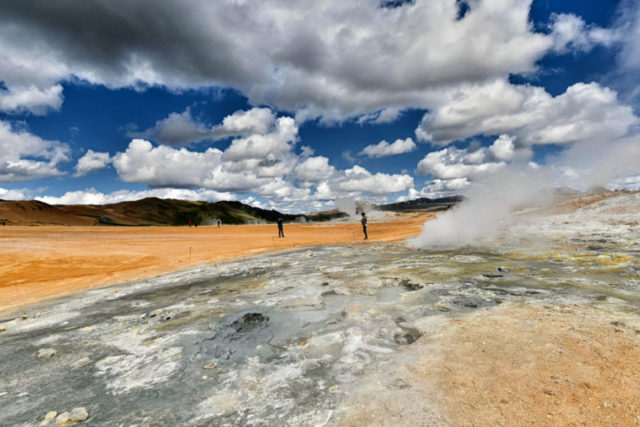
Opening the door of my car, I’m nearly knocked over by the eye-watering stench of sulfur. I regroup, plug my nose, and push on through, following the scantly marked trail through a Martian landscape. Giant, steaming pools of grey sludge sluggishly bubble like a great witch’s cauldron. Pointy cairns of yellow rock — called fumaroles — hiss like angry teakettles, venting volcanic energy from deep beneath the earth’s crust. On the horizon, a trail climbs up a naked, steaming hillside to a viewpoint overlooking the entire plain. Never have I stood somewhere that feels so little like my home planet.

A few fellow awestruck travelers wander slack-jawed around me. I notice a Swiss tourist getting closer and closer to a steaming fumarole. She seems mesmerized…like a midge drawn to a bug zapper. Finally, my breath catches in my throat as she plants herself right next to the fumarole and reaches her hands out to touch the rocks. And then…nothing. Turns out those particular rocks are not as hot as they look. She laughs the giddy giggle of someone who just played Russian roulette with Iceland, and won.

Reeling from the mind-bending (and pungent) setting, I continue a few more minutes on highway 1 to the turnoff for the Krafla Valley, which saw live volcanic activity as recently as the 1980s. Heading up the valley road, I swear that I see — out of the corner of my eye — a random showerhead sticking up in the middle of a bare field.
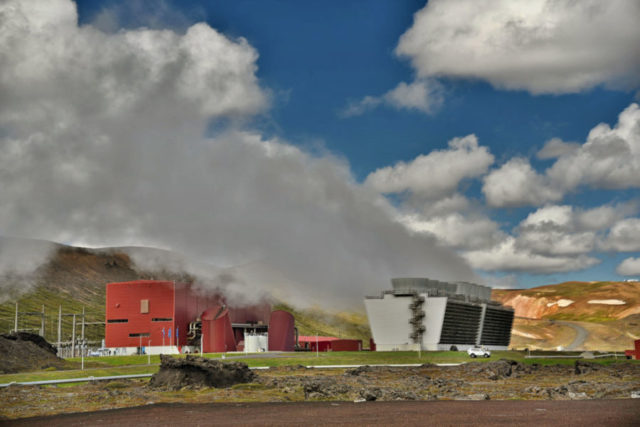
Writing it off as a sulfur-induced hallucination, I continue up the valley to a steaming geothermal plant, where the modest visitors center hands out free coffee as an enticement to sit through a brief film detailing how Iceland has harnessed its geothermal power. I’m no engineer, so I can’t really follow the process. But I’m duly impressed. And, since the visitors center has the last bathrooms for at least two hours to the east, I’m very appreciative.

From the power plant, I continue up the valley, passing the parking lot for Leirhnjúkur — a volcanic cone that was formed in the 1980s eruption, and is now popular with hikers for its steaming rocks and simmering pools. From there, the road twists up to a grand overlook of the valley, and finally terminates at the crater called Víti (literally “Hell”) — a strangely turquoise-colored lake filling yet another spectacular crater, formed by volcanic activity in the 1720s. Noting yet more once-in-a-lifetime hiking opportunities at both of these places, by now I’m really kicking myself that I did not budget more time for Mývatn.

Speaking of time…it’s getting late, and I have a long drive ahead of me. I retrace my route back out of the Krafla Valley, keeping my eyes peeled for that mysterious showerhead. Sure enough, I slam on my breaks when I see it — and the bearded backpacker using it to take a shower, stripped down to his skivvies and standing in the middle of nowhere. (Looking this up later, I learn that the showerhead appeared years ago, presumably to take advantage of all that natural thermal water for hikers who can’t afford the Mývatn Nature Baths.)

Leaving the Mývatn area behind, I carry on toward the Eastfjords. After just 15 minutes, I turn off to see one last spectacular sight in North Iceland: the epic waterfall called Dettifoss.
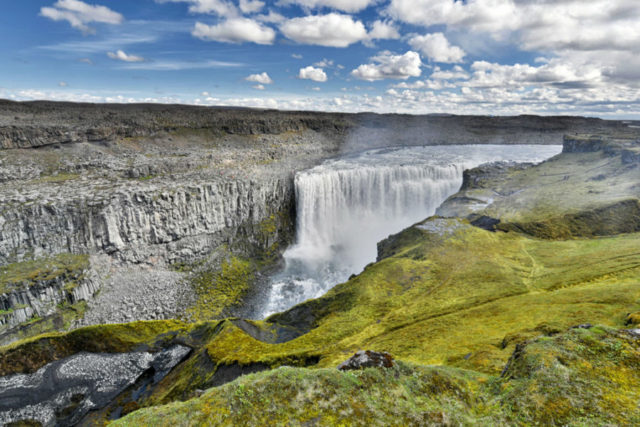
From the parking lot, a one-mile hike leads through a chunky field scattered with jagged, dark canyons of petrified lava. Finally, I emerge at a grand canyon filled with a thundering cascade. The violent thrust of the water sends a cloud of mist high in the air, casting rainbows across the wasteland.

On my way back to the parking lot, a short detour takes me farther up the river to yet another waterfall, Selfoss. From here I have a better view of the broad river — flowing from the north edge of Vatnajökull, Iceland’s largest glacier, to the Greenland Sea — that carves a path through a basalt landscape, creating these magnificent cascades.

The churning water is milky with glacial grit, which washes up on riverbanks here and there to create inviting little black-sand beaches. The basalt ledges that frame the mighty scene are trapped in a slow-motion process of sloughing off. Change is the status quo in this always-changing Icelandic landscape.

The epic Dettifoss is a fitting grand finale for my visit to the Mývatn area. As I head two hours through the desolate Highlands toward the Eastfjords, I’m confident that this area will be what I remember most vividly and fondly after my trip around the country. If Mývatn were two hours from Reykjavík, it’d be mobbed. But it’s halfway across the country…so it still feels largely undiscovered. And best of all, I’ve already forgotten all about those midges.


Mývatn is about a seven-hour drive from Reykjavík (non-stop on highway 1). It works best for those driving the entire 800-mile Ring Road loop around the country; of all the stops around the Ring, Mývatn is the one most deserving of two nights. Another option is to fly from Reykjavík up to Iceland’s second city, Akureyri, on Air Iceland Connect. From there, it’s about an hour-and-a-half drive to Mývatn — you can rent a car or take a tour.

All of the details for visiting the Mývatn area — including our top picks for hotels and restaurants, a self-guided driving tour connecting everything mentioned in this post, and even more area attractions — are covered in the Rick Steves Iceland guidebook.

How to Enjoy Iceland’s Thermal Baths: The Blue Lagoon and Beyond

Iceland’s Blue Lagoon spa is famous. But it’s just the tip of the country’s thermal-bathing iceberg…as I enjoyed discovering while working on our new Rick Steves Iceland guidebook. This post (part of my Iceland blog series) is a roundup of the many hot-water opportunities around Iceland. Special thanks to our co-author, Ian Watson, who taught Rick and me everything we know about Iceland’s thermal bathing culture.

The volcanic island of Iceland sits atop vast reservoirs of naturally superheated water. And, in a sparse land with few natural resources, the Icelanders have expertly figured out how to harness that water to create electricity, to heat their homes…and to have fun. If you’re visiting Iceland, be sure to check out its many opportunities to soak in naturally heated water, starting — but certainly not ending — with the famous Blue Lagoon.

The Blue Lagoon

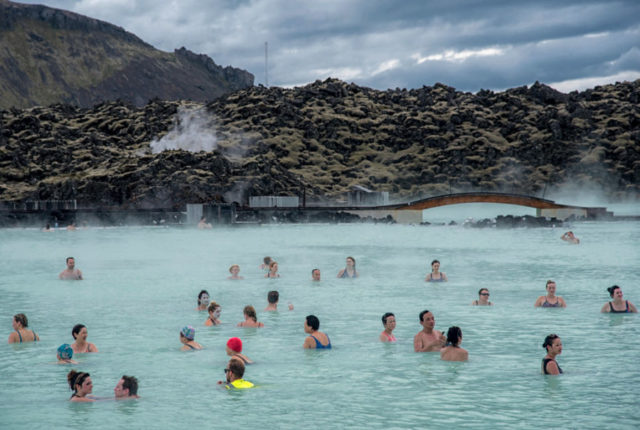
In some ways, the Blue Lagoon is the ultimate expression of Icelandic thermal bathing culture: a top-end spa with steaming, murky-blue water filling a lava-rock basin. It’s pricey…but, for many visitors, well worth it. I love the Blue Lagoon, and can’t imagine a trip to Iceland without it.

On the other hand, some travelers — especially those on a tight budget — find that the Blue Lagoon doesn’t live up to its hefty price tag (about $100 to get in, slightly cheaper if you go early or late) or the inconvenience (reservations are required). Critics also point out that the only Icelanders you’ll meet at the Blue Lagoon are working there. (Icelanders understandably favor their own neighborhood swimming pools, at a tenth the price. More on those later.) While the Blue Lagoon is hedonistic bliss, it’s far from an “authentic Icelandic experience.”

That said, those who decide that the Blue Lagoon is right for them are in for a memorable experience. From the parking lot, you’ll walk up a jagged canyon to the entrance. Find your locker, get changed, head outside, lower yourself to the vast, relaxing pool…and simply float. You can paddle over to the bar to buy an overpriced microbrew or skyr smoothie. You can cruise beneath the little footbridges (where you’ll find water fountains). You can plant yourself under a thundering mini-waterfall for an aqua-massage. And you can get a sample of the slime that builds up on the walls of the lagoon — a natural exfoliant — and smear it all over your relaxed face.

Once your face is all oozed up, consider this: You’re simmering in industrial waste. The Blue Lagoon got its start when a geothermal plant was built in the middle of a petrified lava flow. The water they pumped up from deep underground wasn’t pure enough to pipe into area homes. However, it was hot enough to heat other water. Once that’s done, they simply dumped vast volumes of still-pretty-hot water into the nearby rocks. Locals discovered this as a secret spot for a memorable dip. Eventually developers took note, turned it into a top-end spa…and now you’re spending a hundred bucks for the pleasure of bathing in byproduct.

I tease. The Blue Lagoon experience is a memorable one — and the water is incredibly inviting, and perfectly clean and safe. (And opaque. Don’t drop anything while you’re in the lagoon, or you’ll never find it. Leave your glasses in the locker room.) By the end of my soak at the Blue Lagoon, I was already strategizing how to fit a five-hour layover into my next European flight plan.

A few practical considerations: Remember that reservations are required (www.bluelagoon.com). And notice that the Blue Lagoon is 45 minutes from downtown Reykjavík, but quite close to the international airport, Keflavík. The most efficient plan is to combine your Blue Lagoon visit with your arrival to or departure from Iceland. (All other things being equal, it makes sense to hit the lagoon on your way home, so you’re relaxed for the flight. But your flight schedule will likely dictate which option works best.) Airport-transfer companies make it very easy to splice in the Blue Lagoon, and there’s easy baggage storage right at the parking lot.

Beyond the Blue Lagoon

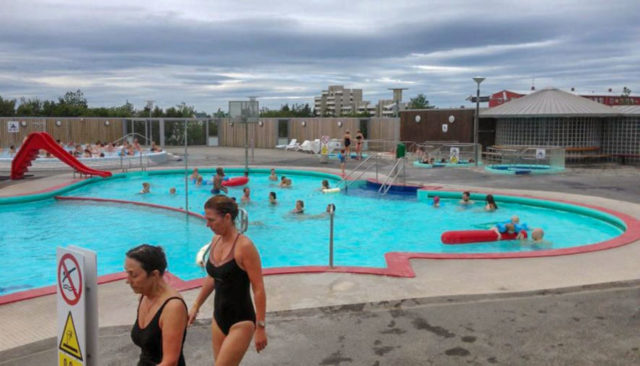
While almost every tourist in Iceland goes to the Blue Lagoon, very few of them dive into even one of the more than 120 municipal swimming pools all around the country (including about a dozen in the Reykjavík area alone). It seems that every little Icelandic community of just a few hundred people has managed to scrape together the funds to build a top-notch municipal pool (sundlaug). This is where Icelanders come with their families, after work and after school, to hang out in the hot water and catch up with their friends and neighbors.

Icelandic swimming pools can range from tiny one-poolers to sprawling suburban complexes, with indoor and outdoor sections, saunas, waterslides, and full cafeterias. And most of them cost less than $10 to enter (even cheaper if you get a shareable multi-visit card). Various resources list all of your options, including www.swimminginiceland.is, www.hotpoticeland.com, or the Thermal Bliss brochure downloadable here.

Visiting an Icelandic swimming pool comes with a very specific procedure, which we’ve explained in detail in our Rick Steves Iceland guidebook. The gist: Remove your shoes outside the locker room. Get naked and shower (yes, naked — it’s a hygiene thing, and locals might hassle timid tourists who try to shower in their swimsuits). Slip into your swimsuit, head out to the pools, and enjoy.

While the ambience is unmistakably “suburban swimming pool,” the water is luxuriously warm — lap pools at 85 degrees, other pools around 100 degrees — and the whole experience is quintessentially Icelandic.

Beyond the municipal swimming pools, Iceland has several other ways to go for a soak. A variety of “premium” baths offer a more upscale, tourist-oriented experience. Two options sit about an hour from Reykjavík (Laugarvatn Fontana to the east, on the Golden Circle route; and Krauma, to the north, near Borgarnes).

But my favorite premium bath in Iceland is Mývatn Nature Baths, in North Iceland (about a seven-hour drive from Reykjavík, or a two-minute detour from the Ring Road). Nestled in a rocky landscape overlooking Lake Mývatn, this spa has a Blue Lagoon ambience at about half the price.

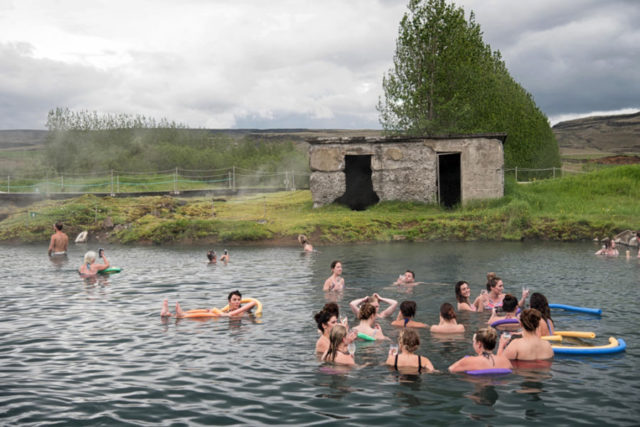
Another popular bath experience, just off the well-trod Golden Circle route, is the not-so-“Secret Lagoon,” where you can splash and soak in what claims to be Iceland’s oldest swimming pool, surrounded by steaming chasms and busy greenhouses. While convenient for Golden Circle day-trippers and popular with younger travelers, the Secret Lagoon is pricey for what you get and can be crowded; it’s wise to reserve ahead. (It’s also just one of four entirely different thermal bathing experiences near the Golden Circle; to help you choose, we’ve outlined each one in the Golden Circle chapter of our Rick Steves Iceland guidebook.)

Yet another option is to go natural: bathing in the wide-open Icelandic nature. If you’re rugged and low-maintenance, you can hike to a variety of thermal hot springs. Don’t expect many services — you’ll need to haul in your suit and towel, and changing rooms and bathrooms are limited or nonexistent. One popular choice is Reykjadalur (literally “Steamy Valley”), just above the town of Hveragerði between Reykjavík and the South Coast. Here you can park your car and hike about an hour up to a warm, knee-deep stretch of river where you can lie back and soak. Be warned, though, that hiking or bathing in a geothermal landscape comes with a risk of getting burned — watch your step and stay on marked trails.

Ready for a Soak

It’s been a long day. From the little fjordside village of Borgarnes on the west coast, I’ve driven 150 miles on rugged, one-lane roads through Icelandic splendor and drizzle. What could have been a three-hour drive stretched to about ten, with dozens of guidebook-scouting stops en route at farmhouse B&Bs, open-air folk museums, truck-stop cafeterias, climbable volcano craters, and Icelandic horse-riding ranches. Kissing frogs for a new guidebook is exhausting work.

In yet another little fjordside village —  Hofsós — I close down the fine little Emigration Museum and retreat through the increasing rain to my car. There I sit, my glasses fogging up, as I flip through my notes and try to rally one last time for the 45-minute drive back to my (reportedly haunted) hotel across the Skagafjörður.

But then, I remember: Hofsós has a municipal pool. And, from what I’ve heard, it’s a great one. Driving through town, sure enough, I spot the blue-and-white, head-poking-above-the-waves sign that I’ve seen in every town between here and Reykjavík. It’s 6 p.m., nothing awaits me at my hotel but angry Viking ghosts and a pile of work, and it’ll be light out for another six hours at least. Might as well take a dip.

Stepping into the pool’s lobby, I’m told the good news and the bad news. The good news: the pool is still open for another two hours. The bad news: the smaller hot pot is closed for maintenance. But they’ve cranked up the temperature in the main lap pool to compensate. Shrugging, I insert my credit card in the chip-and-pin machine to pay the $9 admission, stick my shoes in the cubbyholes at the entrance to the locker room, shower, and head out into the drizzle.

The Hofsós pool is simple, but delightful: One big, welcoming infinity pool perched on a bluff overlooking the fjord. It’s a steamy, turquoise oasis shrouded in a gloomy landscape that sent a generation of villagers in search of a better life in Manitoba and the Dakotas. Easing myself into the hundred-degree water, my decision is instantly validated. It’s just me and the fjord.

I float, feeling the stress of a long day leach out of my pores and joints. I came to Iceland to see fjords and lava flows and glaciers and geysers. What I hadn’t bargained for was that, tucked around every corner, I’d also find a pool like this one to recharge and warm up.

Whether you’re enjoying a basic municipal pool overlooking a misty fjord, soaking in a thermal river deep in the countryside, or splashing out with a deluxe soak in a lava-rock lagoon, make sure to take advantage of Iceland’s hot water.

The Westman Islands: Volcanoes and Puffins in Iceland’s Undiscovered Gem

My favorite underappreciated corner of Iceland is the Westman Islands — the no-longer-secret discovery of our Rick Steves Iceland guidebook co-author, Ian Watson. This installment of my Iceland blog series explains why, if you want to escape some of the tourists — and can flex with unpredictable weather — the Westman Islands are worth fitting into your Iceland itinerary.

In Iceland, it seems every traveler is in the same two- to three-day rut. (It’s a glorious rut…but it’s a rut.) That’s why I was thrilled that our co-author, Ian Watson, insisted on including the Westman Islands in our new Rick Steves Iceland book. Because the Westman Islands — which sit just eight miles off the South Coast — are Iceland’s undiscovered gem.

The Westman Islands (“Vestmannaeyjar” in Icelandic) are worth considering for an overnight, but they’re made to order for a day trip from either Reykjavík (by plane) or Iceland’s South Coast (by boat). However, the main reason the islands are less visited is that the transportation connections linking them to the mainland can be unpredictable in questionable weather. (For details, see the end of this post.)

Weather caveats inside, once you arrive on the Westman Islands, you’ll be glad you came. There are eight islands, but only one — called Heimaey — is inhabited. The town itself, while quite functional, has a pleasantly workaday charm. But you’re not here for the town — you’re here for the glorious setting, the recent volcanic history, and the evocative sights.

Blessed with a fantastic natural harbor — hemmed in by steep sea cliffs — Heimaey is kept afloat by its thriving fishing industry. Other Icelanders call people from Heimaey “islanders.” Islanders are known for their skill at free-climbing vertical sea cliffs to harvest sea bird eggs. One islander I met demonstrated a training wall above a grassy lawn, where young kids learn how to scramble up sheer cliffs, and use thick ropes to swing back and forth across the cliff face like Nordic Tarzans. “If they fall off the training wall, they just break some bones,” he explained, matter-of-factly, as he swung to and fro. “But if they fell off a real sea cliff, they’d land on sharp rocks and probably die.”

If you’ve heard of the Westman Islands, it’s probably because of the 1973 eruption of the Eldfell volcano. In the middle of one dark, frigid January night, the islanders awoke to the thunderous sound of a volcano erupting overhead, shooting geysers of lava 500 feet into the air. Heimaey was evacuated, and for the next several months, the world watched as a slow-creeping wall of lava gobbled up part of the town, enlarged the island’s size by one-fifth, and threatened to seal off the harbor.

Eventually Eldfell — meaning “Hill of Fire” — fell dormant, and the islanders moved back to dig out of the ash and tephra.  Today, as you walk on the craggy bluff over town, it suddenly dawns on you that you’re standing 50 feet above what was, not that long ago, a busy residential street.

The best volcano-themed museum in Iceland is called Eldheimar, which is built around an actual family home that became stuck in lava in 1973. You can peer into the house and see the family’s possessions right where they left them as they fled. All around, high-tech exhibits track the progress of the eruption.

You can even climb all the way up to the summit of Eldfell, which is still warm to the touch. It’s about a 30-minute hike up from the museum. On the way up, you enjoy higher and higher views over the dramatic islandscape, and pass technicolor chunks of volcanic rock.

You can see most of Heimaey’s main sights on foot. And if you bring your rental car onto the ferry, exploring the rest of the tiny island is a snap — you can drive from one end to the other in about 15 minutes. But for a more complete and informative look at the island, I enjoyed a two-hour minibus tour with Ebbi from Eyja Tours. Ebbi offers a local perspective, while making sure you get to see the big natural-rock amphitheater that hosts a popular summer music festival, good views of the smaller islands offshore, and rolling hills dotted with lambs.

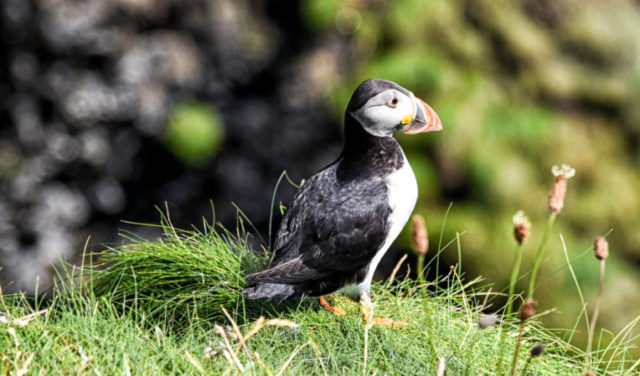
Best of all, in summer (usually early June-late Aug), you’ll likely see puffins. While puffins are the unofficial mascot of all of Iceland, the Westman Islands have the biggest puffin population in the world. A baby puffin is called — wait for it — a puffling. And at the end of each breeding season, the freshly hatched pufflings take off for the first time. Some of them get confused by town lights and wind up crash-landing in the streets. Local kids take them in and nurse them back to health. But occasionally, a puffling can’t quite be rehabilitated — so they’re taken in by the Westman Islands aquarium, called Sæheimar.

One of these puffins, named Tóti, is the museum’s mascot and star attraction. Visitors can’t pet Tóti (because of the delicate oils in his plumage), but it’s a goofy thrill to watch him waddle around the exhibits, followed by earnest staffers who scoop up his runny droppings.

Intrigued? Here are the logistics for reaching the Westman Islands: You can fly on Eagle Air from Reykjavík’s handy domestic airport (near downtown), making it easy to do a one-day round-trip. Or you can take the ferry from Landeyjahöfn on the South Coast, which takes about 40 minutes each way, and carries both walk-ons and cars. But here’s the catch: in bad weather, either the plane or the boat — or both — can be cancelled. If planning a trip to the Westman Islands, have a Plan B in mind.

If you’re based in Reykjavík and the flight is grounded, simply choose another side-trip. But the best plan may be to schedule two overnights (and the better part of two days) for the South Coast. As the date approaches, keep an eye on the weather forecast, and devote the better-weather of your two days to the Westman Islands, saving the drearier day for the South Coast (which is plenty spectacular in any weather).

While planning a visit to the Westman Islands comes with an element of unpredictability, flexible travelers who make the trip are rewarded by one of Iceland’s most delightful, undiscovered corners.

Just tell Tóti I said hi.

How to Find Italy’s Best Gelato: Tips from an Expert

Like just about anyone who’s ever visited Italy, I fancy myself a gelato aficionado. But I never really understood gelato until my Italian friend gave me a lesson I’ll never forget — including tips for how to find the best gelato anywhere you go.

On a visit to Florence, I was working on updating our Rick Steves Italy book with Chiara — a fellow guidebook researcher and tour guide for Rick Steves’ Europe Tours. One evening, I mentioned that I always wanted to learn more about gelato. “Of course!” Chiara said. “Let’s go.”

As we tiptoed between Renaissance balustrades and double-parked motor scooters, Chiara explained that she once dated someone while he was opening his own gelateria — so she understood the business side of gelato, along with the culinary side. If I really wanted to understand gelato, it seemed, I’d found the perfect teacher.

I asked Chiara something that I had never really understood: How, exactly, does gelato differ from American ice cream? “American ice cream has a higher butterfat content,” Chiara explained. “That makes the texture very rich and sultry. However, the butterfat coats your tongue, dulling your taste buds. Some people say that gelato has stronger flavors. That’s not necessarily true — rather, your taste buds are better able to fully appreciate those flavors. Gelato is also churned differently from ice cream, incorporating less air. That makes it harder in texture, and a little more concentrated.”

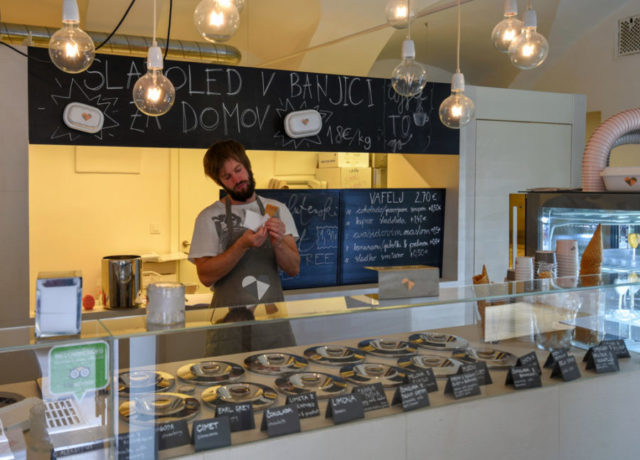
Strolling through the atmospheric urban core of Florence on Via dei Calzaiuoli toward the main square, we passed a row of seemingly interchangeable gelaterie. So, how do you know which one is best? “The vast majority of gelato places use the exact same powdered or paste-like mixes,” Chiara said. “That’s why you should look for words like artigianale — artisanal; or fatto in casa — homemade. You want a place that makes all of their gelato fresh, on the premises, ideally that same day. But be careful, eh? Some places advertise these words even though they use the same mixes as everyone else. Let me show you a few things to look for.”

Pausing at a display case with vividly striped mountains of gelato, Chiara whispered, “See there? That is not good gelato. The big piles and the bright colors are designed to attract children. At the best gelaterie, you don’t actually see the gelato — rather, you read the flavors. The gelato is kept in stainless-steel covered tubs, until someone orders it. It’s fresh, and they want to keep it that way.”

“Another sign of good gelato is muted colors. Natural colors. If you see a color that does not occur in nature, it’s artificial. Think about it: What color is the part of the banana that you eat? Not neon-yellow. It’s sort of off-white, with a hint of yellow. So, logically, a good, artisanal banana gelato will be closer to white than to yellow.”

We stepped into Florence’s majestic Piazza della Signoria. At this moment, late in the day, it felt like the city’s living room. We lingered in a quiet corner of the square, peering over at a gaudy gelateria.

“The other thing to be careful about with these tourist-trap gelaterie,” Chiara continued, “is to be very specific when ordering, to avoid getting ripped off. At irreputable places, if you ask for a cone of gelato, they might pick the most expensive, chocolate-and-candy-dipped waffle cone, pile it with five or six scoops, and charge you fifteen euros. Be specific. When I order, I say something like, ‘a three-euro cone with two flavors.’ Of course, you don’t need to be so paranoid at friendly neighborhood places — just the tourist traps.”

As if to punctuate this tip, just then a pack of ragazzi kicked their soccer ball against the peeling plaster wall next to us. They were gearing up for a game…and we were in the way. We decided to surrender the pitch and carry on across the Ponte Vecchio. The languid evening light draped the famous bridge in a gauzy glow.

As we left the bridge behind and made our way up a sleepy Oltrarno back street, Chiara explained the business end of making gelato. “A gelateria has many flavors, but only a few machines. So obviously they make all of their gelato on the same machines. Every gelato begins with the same, neutral, sweet-cream base: fior di latte. As they work through their batches, they make progressively more complex flavors, with darker dyes. The last batch of the day is the dark chocolate flavor. That’s why, if someone has a nut allergy, they should be careful. Some shops carefully clean their machines between batches, but not all do. If you order a darker-colored gelato, several other flavors have been processed before that one — including one that may contain nuts.”

Finally we came upon a gelateria that passed Chiara’s protocol: promising gelato artigianale, from covered metal bins, with muted colors. “But even then,” she said, “the only way to know for sure is to taste.”

Surveying our options, Chiara reminded me, “It’s perfectly fine to ask for un assaggio — a taste. And, while Americans are accustomed to combining whichever random flavors strike their fancy, Italians believe that some flavors go together better than others. It’s like pairing wine and food: Ideally, you want to find a combination that’s mutually enhancing. In fact, if a gelateria takes it craft very seriously, they might politely refuse to pair two flavors that don’t go well together. For example, if you ask for chocolate and lemon, you might get a funny ‘are you sure about that?’ look. Or even a curt shake of the head and a click of the tongue. For Italians, mixing lemon and chocolate gelato is like putting cheese on seafood, or drinking milk after lunchtime.”

“If you are adventurous,” Chiara continued, “you can put yourself in the expert’s hands and ask them what marries well — which flavors go well together. Sometimes they can suggest some surprising and delicious pairings.” Trying this approach, I asked the clerk what he recommended with one of my favorites, cannella (cinnamon), and he topped it with pera (pear). Delizioso. Chiara ordered pistacchio.

As we licked our cones, Chiara said, “My choice of flavor was strategic. If you really want to gauge the quality of a gelateria, you try the pistacchio. Here’s why: Did you ever notice that every gelato flavor costs the same to buy? But, of course, they cost different amounts to produce. There’s a huge profit margin for fior di latte, crema, vaniglia, and other basic flavors. Meanwhile, the most expensive flavor to produce — if it’s done correctly, with real nuts — is pistacchio. Only the rare gelateria uses real pistachios in its pistacchio. Places that are cutting corners will just make almond gelato, and throw in some artificial pistachio flavoring and green food coloring. You can sometimes tell this because the green is just too bright. But if the pistacchio is real pistacchio, it’s a very good sign that the gelateria owner is committed to making quality gelato, even at the expense of potential profits.” Taking a satisfied bite, Chiara concluded, “Mmmm. This one is real pistacchio. You can taste the difference.”

After that walk through Florence with Chiara, every time I step into an Italian gelateria, I can survey my options with confidence — knowing that I can tell the difference between run-of-the-mill gelato and top-shelf gelato. And, as a budding gelato snob, I now make a point of asking for a sample of pistacchio as my first barometer of quality.

So, after all that…what’s my favorite gelato? When working on our Rick Steves guidebooks in Italy, I take very seriously the sober responsibility of recommending at least one top-quality gelateria in each town. Unfortunately, after much (delicious) trial and error, I’ve learned that some cities — even biggies like Venice and Florence — have plenty of perfectly good gelaterie, but no head-and-shoulders “best” choice. (And believe me, the competition can be fierce…especially in small towns. But that’s another blog post.)

That said, I do have several personal favorites that I would consider traveling halfway across the country for. My all-around favorite gelato in Italy is at a small chain called De’ Coltelli, with branches in Lucca and Pisa. On one trip, I made a point to take an extra day off in Lucca…I must admit, at least partly to fit in another couple of gelato cones at De’Coltelli. Another Tuscan favorite, in the tiny town of Pienza, is Buon Gusto. Slaves to tradition, Nicola and Giuseppe make just a few batches each morning, scheduled to be ready just after lunch. But don’t wait too long. Once they’re gone…they’re gone. Rome has a variety of creative gelaterie serving unusual flavors (which I have an affinity for); I’ve had memorable gelato at Fatamorgana, with locations in the Monti and Trastevere neighborhoods, and elsewhere.

And finally, I must admit, even as it has expanded to the point of self-parody (including branches Stateside), the Grom chain still churns out reliably good gelato. Yes, Grom is the Starbucks of gelato. But if I’m in a smaller town or a neighborhood where my only choices are a Grom and a suspiciously touristy-seeming gelateria…I’ll stick with Grom. And I’m rarely disappointed.

Finally — while this may be appalling to purists — some of my favorite gelato isn’t even in Italy. Ljubljana, the delightful Slovenian capital (and just an hour’s drive from Italy), has a burgeoning artisanal gelato scene. My favorite spot is Romantica, with delicious, creative flavors that highlight Slovenian ingredients and Italian know-how. Other great choices in Ljubljana include Rustika (a small chain that also produces excellent chocolate truffles), Fétiche Patisserie (along the river, with Asian-inflected flavors), and Zvezda Kavarna (a local institution with rich, decadent flavors).

Where’s your favorite gelato in Europe?

Buon gelato!


My favorite gelato-related travel anecdote was the time I became embroiled in a fierce war between rival Cinque Terre gelaterie. Some people take gelato very seriously.

My favorite Ljubljana gelateria, Romantica, was included in my blog post about how to eat well on a budget in the Slovenian capital.

Over on Rick’s blog, he interviewed one of my favorites, Buon Gusto in Pienza.

And, of course, all of our favorite gelaterie are listed in our Rick Steves guidebooks. Or you can join Chiara (or one of our other top-notch tour guides) in person on a Rick Steves’ Europe Tour.

Postcards from Greek Islands: Santorini and Mykonos

From time to time, I like to share a few of my favorite photos with random observations, travel tips, and anecdotes. This batch of “postcards” is from last September, when I visited the Greek islands of Santorini and Mykonos, working on the fifth edition of our Rick Steves Greece guidebook.

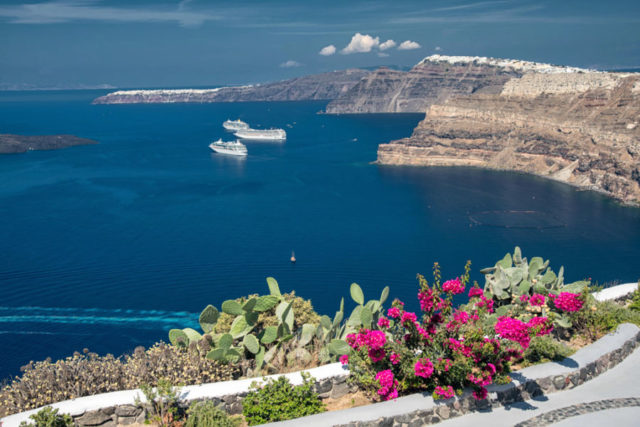
Santorini is famous for its glorious caldera — the faint echoes of a volcano crater that erupted, then filled with seawater, millennia ago. Today cruise ships huddle in the center of the caldera and tender their passengers to shore. This view is from the terrace at Venetsanos, one of many wineries that take advantage of Santorini’s unique volcanic composition. (Before tourism, the Vinsanto — “holy wine” — produced here kept Santorini’s economy afloat, as it was exported for Eucharist purposes to Orthodox churches across Russia.) It’s fun to drive around Santorini, stopping in for tastings at your choice of wineries (our favorites are listed in the Rick Steves Greece guidebook). But if you want to come at sunset to enjoy this view with your wine…book ahead!

Santorini has many classic views, with cute domed churches against a caldera backdrop. I had an excellent local guide — Kostas from Santorini Private Tours — who helped me write new self-guided walks for our guidebook of both the main town, Fira, and jewel-box Oia. With Kostas’ help, I have a new appreciation for how to tell the difference between a Greek Orthodox church and a Catholic one (built by the Venetians who settled here after the Crusades, and gave the island its international name: “Santa Irini”). This one’s Orthodox.

Santorini’s main town, called Fira, is a gauntlet of souvenir and jewelry shops (and an odd abundance of “fish foot massage” places — a phenomenon that originated in nearby Turkey, and has caught on here with a strange vengeance). In this vertical village, most lanes come with steps — which are helpfully painted with directions to the cable car, whisking cruisers to and from the old port. Despite its touristy nature, I enjoy losing myself in Fira’s lanes.

All over Greece, it seems like cats are posing for pictures. I swear the Santorini Tourist Board plopped this one down on his perch moments before my guide brought me around the corner for this spectacular caldera view.

One of my favorite Santorini experiences was the sunset catamaran cruise I enjoyed with Caldera Yachting. The trip included a big, swanky boat with all the amenities; a fun-loving but professional crew dedicated to creating a memorable experience; an excellent meal of traditional Santorini cuisine; a few opportunities to go for a swim from the boat; easygoing and enjoyable fellow passengers; and perfect positioning for viewing the sun dip slowly into the Aegean. There are cheaper options offering a similar experience on a packed tourist boat, but I found the catamaran trip to be a worthwhile splurge.

The village of Oia — at the far tip of Santorini’s main island — is one big postcard, with its whitewashed houses and churches huddled along the caldera cliffs. Everyone (and I mean everyone) comes to Oia for the sunset. A half-hour before, its narrow lanes are a human traffic jam. I came in the late-afternoon, enjoyed the views and the rich sunlight, did my work, then hopped in my car minutes before the sunset. A few miles down the road, I pulled over at a stunning roadside viewpoint, which I had all to myself.

Greek islands are connected by speedy catamarans. On my journey from Santorini to Mykonos, I had to resist the urge to hop off at each idyllic island we stopped at. Ios — which struck me as a sleepy, less glitzy alternative to the big-name islands on my itinerary — was particularly tempting. I’ll be back.

Mykonos is a breathtaking little fishing village that’s been transformed into a bucket-list stop for the jet set. I love Mykonos itself, but was a little put off by many of the upscale, snobby-seeming tourists I met here. Still, I can’t resist this town’s whitewashed beauty.

Even on a crowded day, it’s easy to lose yourself in Mykonos’ back lanes. Everything is painted a blinding white, including the seams between the paving stones. Today this is decorative, but originally it was practical: By painting the lanes with lime — a natural disinfectant — Mykonians offset the unhygienic living conditions (people living on top of each other, and emptying their chamber pots in the streets). And the rooftops were painted with lime, too — they collected precious rainwater, which was carried through a network of gutters to cisterns down below. (Fresh water is hard to come by on an arid island.) Today the doors, staircases, and trim are painted bright, cheery colors, giving Mykonos its distinctive look.

Like on Santorini, I had the help of a great guide — Antonis Pothitos — to write a self-guided walking tour of Mykonos town for our guidebook. Antonis took it as a personal challenge to get me lost in the twisty lanes — to prove the value of having a live tour guide. I took it as a personal challenge to disentangle everything he showed me, then to organize it and write it up in a way that even a guide-less novice could follow. You’ll have to try the walking tour to see if I succeeded…or if Antonis is correct that you really shouldn’t attempt touring Mykonos without a guide. Antonis isn’t just looking out for his livelihood. Mykonians embrace their crazy street plan as a matter of civic pride. It’s not just atmospheric, it’s practical: The randomly angled and gnarled lanes help break the howling winds that famously swirl around the island, and the crazy street plan makes it all but impossible for would-be invaders to find their way around…unless they’re toting a good guidebook.

Mykonos’ most famous inhabitants are its three resident pelicans: Petros, Nikolas, and Irini. Because every visitor is on the lookout for these three birds, normally you’ll spot them being followed around by a chaotic scrum of paparazzi tourists. One afternoon, as I was wandering the back streets of Mykonos (desperately trying to make sense of Antonis’ tour), I stumbled upon one of these pelicans all by himself in a quiet courtyard. My breath caught in my throat as I found myself alone with this surprisingly majestic bird. As if recognizing a celebrity desperate to remain incognito, I exchanged knowing glances with the pelican, gave him a nod of respect, and quietly moved on — leaving him with a rare moment of privacy.

Mykonos’ most famous corner is “Little Venice,” a row of former sea captains’ residences that rise up from the water. It’s the perfect place to enjoy the sunset while looking back over the town’s other claim to fame — its five windmills on a ridge (perfectly positioned to harness that legendary wind). Skeptical, I invested $20 in a cocktail here…and was very glad I did. As there are basically no sights worth paying to enter on the island, consider this your “experience budget” for an hour of relaxing with a fine view.

If — like me — you find Mykonos town a little too crowded, snooty, and overpriced, it’s easy enough to escape. From the bus stop at the top of town, cheap buses fan out to beaches all over the island. It’s a breeze to master the system and beach-hop to your heart’s content. Each beach has its own personality, which we’ve outlined in our Rick Steves Greece guidebook — or you can get tips from a local. Late one afternoon, I found myself on one of my favorite beaches — Agios Ioannis (known as the filming location for Shirley Valentine) — while it was still sunny and pleasant, but after most of the beachgoers had gone home. I appreciated having this sandy paradise to myself for a little while, and watching the sun set over the Aegean.


Rick Steves was on these same islands just a couple of weeks before I was. He was there filming an upcoming public television special on cruising, and enjoyed summiting the ancient site of Delos (just off Mykonos).

All of our best tips appear in our Rick Steves Greece guidebook.