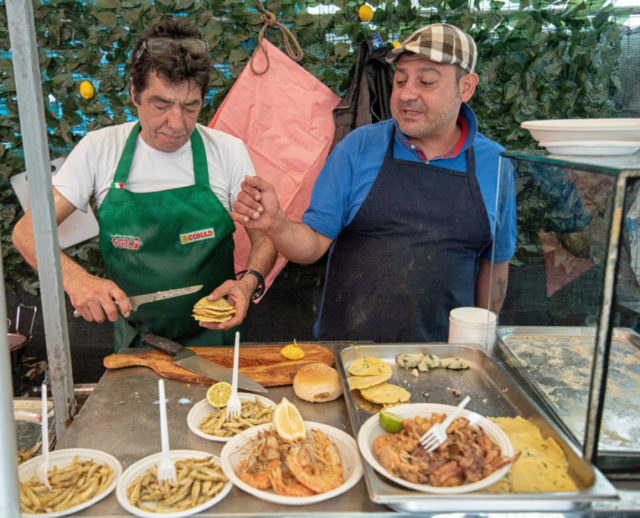
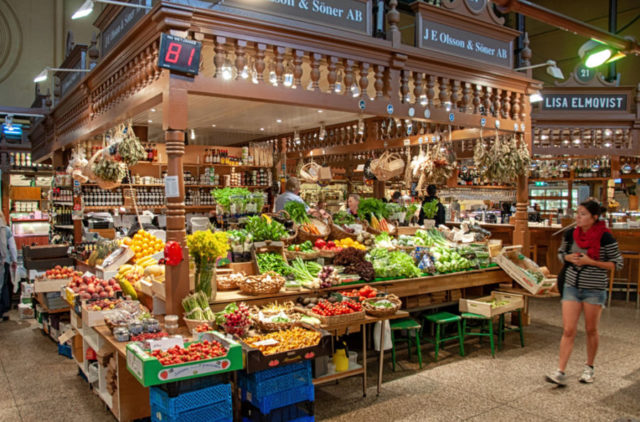
We didn’t have a year in Provence. But we had a week. And that was enough for seven entirely different, but equally enjoyable, Provençal markets. Mountains of plump produce, glistening olives, and fragrant spices. Neatly stacked piles of salamis and gigantic wheels of mountain cheese. Colorful fabrics — tea towels, tablecloths, bolts of vivid patterns — flapping like flags in the warm breeze. Fishmongers, butchers, cheesemakers. All under a generous canopy of plane trees, warmed by the autumn sun. The marché provençal is, simply, one of the great experiences of European travel.
In September of 2019 — not long before the world changed — my wife and I took some time off in Provence. We set ourselves a goal: Visit a different market for each day of the week. Some were new to us; others were oldies-but-goodies. But all of them were memorable. If you’re desperate for a little vicarious travel, settle in for a lazy weeklong tour of seven different markets — with tips mixed in for your next trip to France.

Le Marché Provençal: A Crash Course
Traditionally, the people of Provence — as throughout France — do their shopping at market day (jour du marché), a sprawling, once- or twice-weekly celebration of local produce and other products that take over the entire town center. From anyplace in Provence, there’s a market (or several) within a 30-minute drive, any day of the week. My wife and I scheduled our itinerary specifically to hit a few markets in particular, but serendipity works like a charm, too.
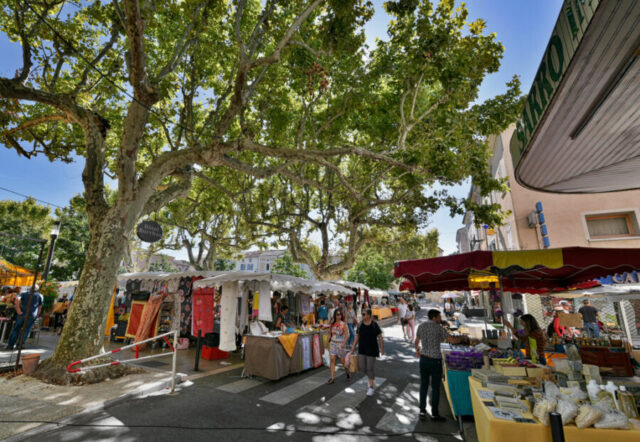
The best market is the classic marché provençal — a combination farmers, craft, and clothing market — which begins around 8:30 in the morning, peaking around 11:00. By 12:30, they begin to run out of goods; at 13:00, the producers are packing up. (Stands selling non-perishable items may stay open longer.) That’s when shoppers settle into cafés for the obligatory après-marché debrief and chill session. It’s all so…civilized. Pro tip: Prebook a table at a café or restaurant of your choice, for a memorable après-marché meal — ideally out on a sun-dappled square, with a view of the goods being crated up and carted away. Those who wing it have to scramble for whatever they can get.
Browsers wander from stand to stand, propelled by a lazy curiosity, just seeing what’s available. Meanwhile, other shoppers hone in with laser precision on just the items and producers they’re after. Bring plenty of cash and a shopping bag…or buy a big straw market basket, the perfect souvenir to take home and never use again. (We have two dusty ones in our basement, and, inexplicably, very nearly bought a third.)

Full disclosure: I am not much of a shopper. Local taste treats and picnic supplies constitute the vast majority of what I buy. But even if you don’t spend a dime, Provençal markets are a glorious, and quintessentially French, travel experience.
Saturday: Uzès
On our first day in Provence, we were staying in the mellow small town of St-Rémy — famous for its ties to Van Gogh. We’d chosen St-Rémy partly for its proximity to one of our favorite market towns, Uzès.
Getting a later start than we should have (blame the jet lag), we arrived in Uzès around 11:00. Parking along the ring road and following the trail of shoppers into the town center, we realized that things were already on the verge of winding down.

Reaching the main square — a cozy plaza under artfully gnarled plane trees — we surveyed the bewildering array of vendors. Cheesemongers whittled delicate little curls from giant wheels of cheese, offering them for a taste. Butchers and fishmongers held court over refrigerated cases showing off their wares. The luscious pyramids of olives and fragrant mounds of tapenade were irresistible.
Dappled sunshine, breaking through the leafy canopy, illuminated jars of golden honey. Each one was a slightly different shade of yellow, and you got the sense that the seller knew the bees personally…perhaps by name. Tables groaned under the weight of bowls, platters, and spoons carved from local olive wood. Bulging bags of spices were each artfully identified in cursive script on a miniature chalkboard.

At each produce stand, locals filled little plastic tubs with carefully selected items: Carrots so perfect they belonged in a Bugs Bunny cartoon. Green-and-purple artichokes. Heads of yellow and green lettuce — shaped like a colorful starburst — that could have been crafted in an artisan workshop. Heirloom tomatoes — red, orange, purple, and green — that must’ve come from that same workshop. Monster shallots, unblemished heads of garlic, muscat grapes with explosive sweetness encased in tough skins.

Everything in sun-drenched Provence just tastes better. Tomatoes really taste like tomatoes. Strawberries really taste like strawberries. Apricots really taste like apricots. Raspberries and figs are explosive. The sundried tomato tapenade we bought in Uzès redefined our sense of what tomato can taste like. For Americans raised on fruits and veggies trucked thousands of miles to the local supermarket — often in the dead of winter — tasting Provençal produce, fresh from the harvest, is a revelation. A local person once told me she observed a visitor weeping upon biting into a strawberry…and truly tasting one for the very first time.
We were getting peckish. The stand with the slowly turning rotisserie chickens tempted us, but we weren’t ready for such a big meal. We saw a line forming at a stand with little deep-fried chickpea fritters. At a Provençal market, if you see a line…get it in it. After waiting for our turn among the well-organized scrum, we purchased a steaming paper cone filled with these delicious little savory bites. It was just the thing to take the edge off our mid-morning hunger.
While tasty, those fritters had sidetracked us from our main goal: sniffing out what we’d heard was the local specialty, fougasse d’Aigues-Mortes. This is a puffy, cake-like bread gently infused with the essence of orange blossom, and sprinkled with coarse sea salt from the Camargue. Our guidebook told us that this sold out quickly, and we were late as it was, so we scoured the market, eyes peeled. Finally we spotted a baker’s table, two aisles over. But by the time we got there, we watched in horror as the very last piece of fougasse was bagged up and sold before our eyes. We pointed to the one giant chunk that was set aside, and the baker shook her head apologetically — this piece, she conveyed with a shrug, was being saved for a fellow vendor.
Dejected — but buoyed by a shopping bag bulging with tapenade, cheese, and red peppers — we headed back to the car. On the way, we passed a bakery selling the fougasse we’d missed out on. And it was, indeed, heavenly.
This turned out to be a teachable moment about Provençal markets: When we thought we’d missed out on that fougasse, we reassured each other that we’d find it somewhere else. Surely, in a full week in Provence, fougasse d’Aigues-Mortes would cross our path repeatedly. But we never saw a single piece after we left Uzès. “Local” specialties in Provence are truly local. Don’t wait.
Sunday: Coustellet and l’Isle-sur-la-Sorgue
Heading from St-Rémy up to our next stop, in the Côtes du Rhône, our route took us past two very different markets. Doing our homework, we decided to double up for a day of market contrasts: Tiny and local, then big and famous.
First up, we stopped by the humble and proudly local market in the dusty crossroads village of Coustellet, just a 15-minute drive south of l’Ilse-sur-la-Sorgue. The least visually appealing market we explored, this was clearly the choice for purists — not tourists. Filling the town parking lot were many of the usual market stalls: fabrics, kitchenware, nonperishable goods, and so on.

But it was the produce that caught our eye. On this autumn Sunday, the tables were piled high with ruby-red heirloom tomatoes, gigantic leeks, huge gnarled peppers as red as a fire engine, fragrant and perfectly shaped basil plants pulled from the pages of a botany textbook, mounds of skinny multicolored beans, and three different kinds of eggplants — purple, white, and Thai.
While the stands in Uzès had felt dressed up, here in Coustellet, the farmers simply backed up a van and dumped their harvest onto a rickety table. One exception were the adorably composed baskets of tiny fall squash (coloquintes), painted a variegated rainbow of yellow, orange, and green.

This being early in our trip, we could not resist buying one of those gigantic bouquets of sunflowers to decorate our hotel room. After spending the rest of the day in a hot car, by that afternoon the flowers had already begun to wilt, their pockmarked faces — heavy with seeds — slumping over in a melancholy pose. In a few hours, they had gone from an explosively colorful celebration of Provençal life to a haunting reminder of mortality…Van Gogh on his last leg. (When we asked our B&B host that evening if she had a vase we could borrow, she gently chided us, “Why do tourists always think buying sunflowers is such a great idea?”)
Before leaving the Coustellet market, we stocked up on picnic supplies. At one stand, we taste-tested various salamis and other cured meats. We settled on a delectable smoked pork loin — tender as prosciutto, flavorful as brisket — that would become the main feature of several picnics. We also picked up a couple of tiny wheels of soft, young, local goat cheese, one encrusted with chopped shallots and the other with peppercorns.

From Coustellet, we drove a few minutes up the road to the granddaddy of all Provençal markets: l’Ilse-sur-la-Sorgue, a workaday town surrounded by gently gurgling canals. Finding parking here on market day — especially in the late morning — is a challenge. But, after striking out at the lots near the town center, we eventually found a space to wedge our car alongside the road about a 10-minute walk from town.
l’Ilse-sur-la-Sorgue’s market is impressively comprehensive and justifiably famous — basically the polar opposite of Coustellet. It’s also exhausting. The canalfront embankments were hopelessly clogged, and the main lanes leading through the twisty old town to the main square — lined with market stalls and tables laden with wares and produce — were not much better. We found ourselves taking shortcuts between the main market streets by spelunking down narrow back lanes, forging our own path through deserted alleys. While l’Ilse-sur-la-Sorgue’s market is one of those things “you have to do once”…on this, our third time, we finally recognized that once is enough.

However, l’Ilse-sur-la-Sorgue had one of our favorite culinary discoveries of any market in Provence: Delicate macarons sold by a husband-and-wife couple. He’s French, she’s Japanese, and their delectable little merengue sandwich cookies were the perfect embodiment of their marriage — with a mix of pungent Provençal fruits and berries, combined with mellow and exotic Asian flavors. They were the best macarons we had in Provence; I regret only that I never got the name of their stand. But I guess that’s la vie du marché. There are few European experiences more living-in-the-moment than following your nose through a Provençal market.
Needing lunch and discovering that all of the town’s restaurants were chockablock full, we made our way to a pizza truck we had seen earlier. Ordering our pepperoni pie, we also asked for a bottle of water. The pizza chef was a bit offended: “I do not sell water! I make only pizza!” While I appreciate the French propensity to do just one thing, and do it the best, this refusal to carry beverages seemed bold for a guy who turns out what is, by any reasonable assessment, a pretty subpar pizza. We found drinks at a different stand and ate our pizza in a sweet little canalside park…a peaceful eddy just steps away from the market crowds.
The next day — Monday — is a relatively sleepy day for Provençal markets, and we’d doubled up the day before. So, rather than drive into Cavaillon for their market, we decided to linger in the Côtes du Rhône region, doing a fun little driving loop, enjoying grand views, and dropping in for some wine tastings. But the next day…
Tuesday: Vaison-la-Romaine (Côtes du Rhône)
Before moving on from the Côtes du Rhône, we headed into the region’s main town — Vaison-la-Romaine — for its big weekly market. We were not disappointed.
Vaison is a simple, user-friendly town that’s more practical than cute. But that’s exactly its charm: It feels like a place where real people live, and have lived for a very long time. The market here has been going strong for 600 years…which would seem impressive, if not for the 2,000-year-old Roman ruins that sprawl through the center of town.

Vaison was one of the more local-feeling markets we encountered: We heard far more French spoken than English — the opposite of our experience in l’Isle-sur-la-Sorgue, or even Uzès. It has a few touristy stands, yes, but more of the market’s footprint is devoted to practical goods: clothing, kitchenware, textiles, plants, and so on. We tend to be more browsers than buyers, but in Vaison, we picked up some placemats to match our patio umbrella.
We also stopped by a stand (which we’d already seen at another market) selling every kind of pocketknife imaginable. We chose one, and the vendor demonstrated its sharpness by slicing little curls off a piece of paper. I bought it as a birthday present for my dad, a pocketknife connoisseur. It came with a certificate of authenticity and a leather sheath, and before we left, the vendor pulled us in close with some advice: Don’t keep it in the sheath for more than a few days at a time, or it might discolor the handle. In Provence, even knives are treated with the respect of delicate produce.
In addition to the market stalls, Vaison has some excellent little hole-in-the-wall shops. Our guidebooks directed us to Peyrerol Gilles, an artisanal chocolaterie with a tempting array of truffles and macarons. And the tiny but tempting fromagerie Lou Canesteou had display cases crammed with cheesy delights. I only wished I knew a bit more about French cheeses to be a more informed shopper. (The next day, I got my wish…read on.)
After the market, having learned our lesson, we’d made a reservation at a restaurant that had come highly recommended by our Provence guidebook co-author, Steve Smith. Bistro du’O, in the quiet upper town just across the old Roman bridge from the market action, turned out to be one of the best meals of our trip: exquisitely crafted modern French cuisine served by a well-trained staff that’s clearly gunning for a Michelin star.
Wednesday: Aix-en-Provence
Our next stop was Provence’s stunning Luberon region, with endless picturesque hill towns and bucolic scenery. However, it turned out that Wednesday was a sleepy market day in our neck of the Luberon. So we side-tripped about an hour to the elegant city of Aix-en-Provence.

While the Aix markets are bigger on Tuesdays, Thursdays, and Saturdays, the daily produce market on Place Richelme enlivened the old center with just the right marché ambience — all the usual suspects selling gloriously colorful fruits, veggies, and berries.
Coming on a quieter day also gave us a better chance to explore Aix. In fact, we met up for a stroll with Mathilde, a guide from Taste of Provence, which does market tours and cooking classes in Aix. It turns out Aix is an ideal city for browsing, whether or not there’s a full-blown market going on.
We began at the produce market on Place Richelme, generously shaded by towering plane trees and ringed by stay-a-while cafés. Surveying the various fruit and veggie stands, Mathilde quizzed us: “How do you tell the difference between a farmer and a produce reseller?” Seeing our shrugs, she gave us a crash course: If the producer specializes in a narrow range of items — say, only berries, or just tomatoes and peppers, or just apples and apricots — that’s a good sign. If they sell bananas, pineapples, mangoes, or other tropical fruit — which don’t grow here — they’re probably a reseller. (Produce with stickers is also a sure sign of a reseller.)

Buying from a reseller isn’t necessarily a bad thing, Mathilde stressed, and the produce can still be quality. But knowing the difference can help you choose produce more carefully. “A farmer picks their produce only when it’s perfectly ripe, to sell today at the market,” Mathilde explained. “When picking for a reseller, they tend to pick it a bit before it’s ripe, to give it more time to be transported.” Connoisseurs shopping for today seek out farmers first; if they don’t find what they need, they turn to the resellers. This also means showing up early: The farmers come to the market first thing, then head out to their fields, while resellers stick around later.
Another tip: For top quality, watch for a stand selling only one item: Plums. Tomatoes. Jams. Goat cheese. Strawberries. The expression “jack of all trades, master of none” probably did not originate in Provence…but it might as well have.

From here, Mathilde took us on a meandering stroll through town, as if following breadcrumbs between perfect little Provençal shops. First up: cheese. We stepped into Fromagerie Savelli, air heavy with the pungent aroma of a hundred types of cheese. We surveyed the remarkable variety, from tiny mini-bouchon (“mini-plugs”) of goat cheese, to giant wheels of mountain cheese. We wouldn’t know where to begin…but Mathilde did, buying a representative sampling of three cheeses for us to taste: goat, sheep, and cow’s milk.

Cutting into a wheel of cheese and watching the inside ooze out, Mathilde pointed out casually that, of course, French cheeses are not pasteurized. The decadent creaminess comes with a subtle tingle on the tongue. Mathilde explained, “Pasteurization kills bacteria, both good and bad. When cheese is pasteurized, it no longer ripens or matures. We choose flavor over safety.” I think back on the last couple of times I’ve gotten food poisoning in Europe — in both cases, after having American-style fast food. But I’ve never had a sore stomach from French cheese. Mathilde and I reach quick agreement that the risk is minimal…and well worth taking.
Biting into a tiny wheel of local goat cheese with a sprig of rosemary mounted on top, Mathilde explains, “What grows together, goes together. Both the chèvre and the rosemary are from La Garrigue, the arid rugged countryside around Provence. So they taste perfect together.”
The cow’s milk she presents us with — Trappe d’Échourgnac, soaked in walnut liqueur until it forms an explosively flavorful brown rind, which encases a luxuriously mild cheese with tiny bubbles — comes from far away, in the Dordogne. “This is not local, but I wanted you to try a cow’s milk cheese. And you may have noticed that we don’t have many cows in Provence.” Mathilde explained that, within France, cow’s milk cheese predominates in cooler, wetter areas, where grass grows green. Warmer climates — like Provence — produce more goat and sheep’s cheese, often rubbed in olive oil.
As we nibbled, Mathilde explained that the role of a fromagerie is not simply to sell cheese, but to age it properly. They buy raw cheeses, then mature them to perfection. In fact, it’s the mastery of aging that is the expertise of a great fromager. A key term when shopping for French cheese is mois d’affinage — “months aged.”
Mathilde began chattering in French with the shop clerk, both of them gesturing toward their feet. Excitedly, she translated for us: “They have offered for us to visit the aging cellar. This is a great honor!” We followed the clerk behind the counter, then through a maze of narrow hallways to a steep staircase. Arriving in the cellar, we were surrounded by priceless mold. Big wheels of cheese sat upon wooden shelves, and small wheels of cheese were neatly stacked on wooden trays. Some of the cheeses were fuzzy, as if flocked with cotton. All of them awaited that perfect moment of ripeness.

Our feet crunched on the gravel floor. Mathilde explained how that floor is designed to allow in just the right amount of humidity to help ripen the cheese — and the temperature had to remain a steady 12 degrees Celsius (54 Fahrenheit).
As if leaving a secret hideout, we twisted our way back out to the shop entrance, and carried along our way.
Mathilde next took us past a high-end, venerable pâtisserie called Weibel. Increasingly, pâtisseries (dessert shops) are being combined with boulangeries (bakeries) to create a one-stop shop. But purists believe that it’s supremely difficult — or impossible — for one shop to properly execute both boulangerie and pâtisserie. And, in fact, even within the goodies of a pâtisserie, things can be hit-or-miss. Mathilde explained, “A pâtisserie does some combination of four things: cakes, chocolates, candies, and ice cream. It is very rare for one pâtisserie to do all four things well. But this one does.”
We sampled the local specialty, calisson d’Aix — a delectable candy made of almond paste and candied fruit, topped with a delicate layer of icing (“representing purity,” she explained). Locals say it tastes like a communion wafer, but sweeter. In all of Aix, there are only seven authorized calisson makers, who are — no joking — blessed by the local bishop each year.
For another treat, Mathilde took us even deeper into the city streets, winding us through movie-set squares and sandstone townhouses until we reached a nondescript back street. Here we found Macarons de Caroline, a hole-in-the-wall shop where sweet Caroline makes fresh macarons with seasonal flavors. Apricot and fresh verbena. Strawberry and basil. Lavender and lemon confit. Strawberry and essence of rose.
Enough sweets. Finally, it was time for a true artisanal boulangerie. The people of Provence — and especially Aix — are aficionados in everything. And for the crème de la crème of bread snobs, Le Farinoman Fou is tops. “The Mad Flour Man” (as its name means) doesn’t crank out your standard-issue baguette rustique; this bakery experiments with a wide variety of grains, including “old grains” that aren’t commonly used in modern cooking. Because their offerings change by the day, they post a weekly schedule in their window for connoisseurs. We sampled a luscious olive loaf with beefy multigrains. I can still taste it.
Bidding Mathilde adieu and driving back over the Luberon Mountains to our home base — leaving Aix and the shimmering Mediterranean in our rearview mirror — we appreciated having an urbane break from our week of French village life. But tomorrow…it’s back to small-town Provence.
Thursday: Roussillon
We were staying near the little pastel hamlet of Roussillon, perched on its orange hilltop overlooking the lush Luberon. We were nearly marché-d out, so Roussillon’s pint-sized market was an ideal antidote. It was like other markets we’d browsed, but in miniature: Just a few stalls filling a parking lot and some nearby lanes, covering the essential bases. One new feature we appreciated was the gingerbread man, carving off wedges of tasty gingerbread flavored either with lemon or with lavender.

We finished our browse in a matter of minutes, then went for an easy hike along the ochre cliffs just below town. We enjoyed the hike so much, we decided to drive 40 minutes to an area that came highly recommended by our Provence guidebook co-author, Steve Smith: Le Colorado Provençal, a compact, user-friendly hiking area as ruggedly beautiful as its American namesake (if much, much smaller). After a parking-lot picnic assembled from the spoils of several days’ worth of markets, we set off on an easy and rewarding hike through a landscape so vivid it almost hurt our eyes: soaring orange and white cliffs, green trees, azure sky, and big, puffy clouds. It’s no wonder that so many artists have found inspiration in Provence.

Friday: Lourmarin
After our palate-cleansing stops in Aix and Roussillon, we were ready to end strong with a classic marché provençal. And our final market town turned out to be one of our favorites: lovely Lourmarin, tucked among the foothills of the Luberon Mountains, separating the inland and coastal parts of Provence.
The roads approaching Lourmarin were lined with parked cars under plane trees. We carried on close to the town’s outskirts and pulled off into the big grassy park-turned-parking lot just below the town château. From here, it was just steps from one of many traffic-free roads that radiate out from the town center — each one lined with market stalls.

Stationed at the edge of the market was a little stand where you could pet adorable baby pigs and goats. At first I thought this was a vegetarian guilt trip — “How could you eat something so cuuuute?” — but it turned out to be an organization that rescues sick animals and nurses them back to health. They sell lozenges (at a big mark-up — one box for €7) for those who want to support their work. After getting to know a baby goat, I suddenly felt a tickle in my throat…

Continuing deeper into Lourmarin, we found the town to be a delightful sprawl of market stands — including several vendors who were by now familiar to us from a variety of other jours du marché. Lourmarin’s market felt like a “greatest hits” collection: Technicolor produce, big bundles of lavender lashed like wheat stalks, fragrant soaps stacked in neat piles, olives overflowing rustic wooden buckets, straw baskets in every shape and size, stacks of sausages and wheels of cheese, display racks draped in vivid fabrics, and on, and on, and on, and on.
Of the markets we’d visited, Lourmarin felt like the best balance between local and touristy…the Goldilocks of the marché provençal. It all felt very easygoing and user-friendly — big enough not to be overwhelmed by crowds, but small enough to encourage exploration. The town center is a snail-shaped curl of interlocking streets, making our market meanderings even more rewarding. It’s one of those towns that feel designed to get lost in, only to find yourself a few steps later when you pop out into a familiar square or next to those adorable piglets.

In addition to all of the tourist-pleasing beauty, we saw old-fashioned hucksters fast-talking as they demonstrated the newest miracle product or gadget. At one stand, a salesman demonstrated how his magic solution could instantly remove scratches from your car. At another, we were treated to an “it slices! it dices!” kitchen tool demo. We picked up a couple of handy silicon caps for opened bottles of wine, keeping them sealed and drip-free for the next day…and wished we’d discovered this little invention five days ago.
Lourmarin reminded us of the sensory delights of Provençal markets. At one stand, a lavender vendor poured a few fragrant seeds into my palm to demonstrate how pungent they were. At another, we sampled explosively flavorful jams. At another, we felt a crispy macaron break into little sheets of merengue on our tongue — like an ice floe entering warm waters — then slowly dissolve like a sweet bath bomb.
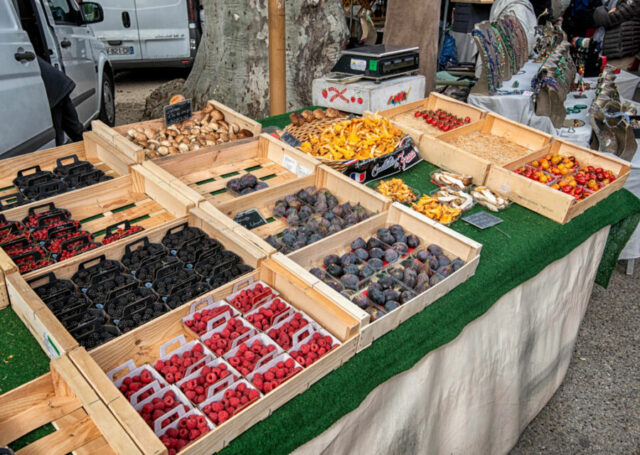
We took advantage of this last-chance shopping — on our way out of Provence — to stock up on a few items still on our list: another bar of that incredible-smelling bath soap; a little container of tiny-but-mighty strawberries to snack on in the car; a few lavender sachets for a cheap souvenir that also freshens up your luggage; and a jar of raspberry jam that really tasted like raspberries. (We hoped it would be as good as the homemade jam at our B&B…and, amazingly, it was.)
After a couple of hours of wandering Lourmarin’s stage-set streets, we found ourselves daydreaming about renting an apartment here for our next visit to Provence. You can’t really say you’ve been to Provence until you’ve contemplated coming back…for a vacation, if not for the rest of your life. Peter Mayle had the right idea.
Pulling out of Lourmarin and heading for Marseille’s airport — and our flight home — it was striking how quickly we re-entered the world of traffic-clogged superhighways, smoggy air, and hypermarchés (France’s answer to big-box stores, and the antithesis of a marché provençal). Already our idyllic memories of Provence were fading into a happy haze — as if it had all just been a very pleasant dream. But it was real, and I have the lavender sachets to prove it. We’ll be back in Provence someday. And even if we wind up going to seven entirely different Provençal markets the next time, I know that the experience will be vivid and rewarding all the same.
What am I missing? In the Comments, suggest your favorite Provençal markets, things to buy at them, and tips for navigating them.
For my week exploring Provençal markets, we had two key resources: In our Rick Steves’ Provence & the Riviera guidebook, co-author Steve Smith offers listings of the most appealing markets in the region, and ample practical tips for exploring them. We supplemented that with Marjorie R. Williams’ Markets of Provence, a vividly written, deeply insightful, and highly informative guide that explains local markets day-by-day. And we learned several tips about how to shop a Provençal market from Mathilde at Taste of Provence, which offers guided market tours and cooking classes in lovely Aix-en-Provence.
One of my favorite French markets isn’t in Provence — it’s in Sarlat, in the Dordogne region. Wherever you go in France, tune into market-day opportunities. You won’t regret it.