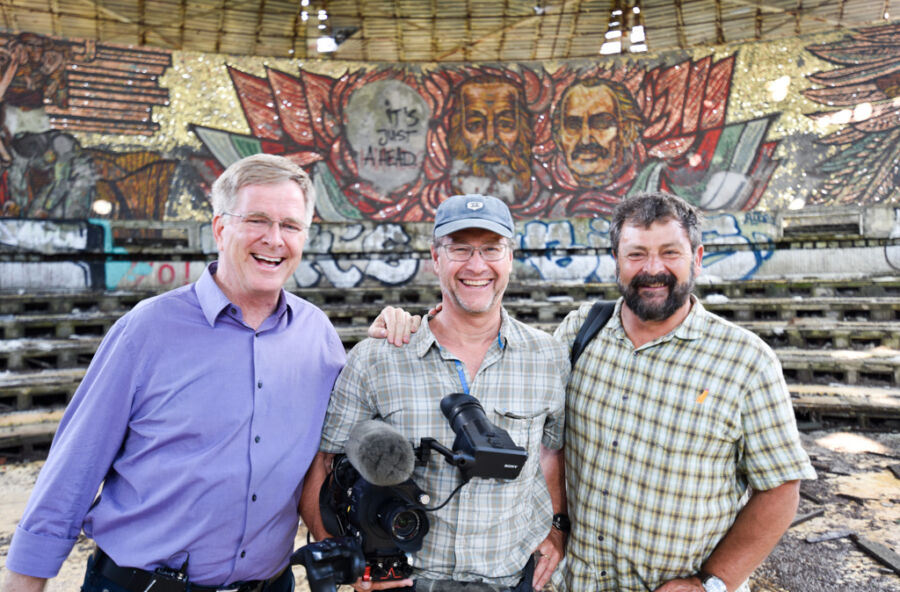
My co-author and frequent collaborator, Cameron Hewitt, is well-traveled, smart, and insightful. And, while he and I are in perfect sync in our travel styles and priorities, he gives voice to the next generation of "Rick Steves travelers." Join me in enjoying his reports right here. —Rick

That Wonderful Language Barrier

Are you one of those travelers who struggles with languages? You shouldn’t. Getting your hands dirty with unfamiliar languages is one of the great joys of being in Europe.  It enhances your travels, and it can pull back the curtain on some fascinating discoveries.

Many years ago, before my first visit to Russia, I decided to learn the Cyrillic alphabet. I made flashcards for each letter and quizzed myself daily. Deep down I suspected that this was pointless: Would it matter if I could sound out Russian words when I don’t speak Russian?

After landing in Moscow, I went for a long walk and dissected every word I saw, phonetically, letter by letter. And I was shocked at how many I understood. Loanwords from English looked exotic but sounded familiar: йо́га — yoga, or сувениры — souvenirs, or Старбакс кофе — Starbucks coffee, or even the supermarket chain Дикси — Dixie. And I recognized proper nouns, too: Сталин — Stalin, or Италия — Italy, or парк горького — “Park Gorkogo,” Gorky Park. Simply noticing which words had migrated into Russian offered insights about how Russia relates to the rest of the world.

The fearsome cliché of the language barrier intimidates travelers. They view a foreign language as exactly that: a barrier to be overcome. I disagree. Grappling with language is one of the joys of being on the road. Not only is it a fun puzzle to solve; trying to understand it — even psychoanalyze it — can unlock deep cultural secrets.

To be clear: I’m not talking about learning a language before you visit a place. That’s unrealistic. I’m talking about approaching language openly and constructively, rather than assuming it’s a lost cause. You’re smart. You’ve already mastered at least one language. Give yourself some credit to play around with another. Many of my favorite cultural insights have been earned through a willingness to get my hands dirty with Europe’s languages.

For example, universal words are a godsend to travelers. Once you learn that “cashier” is Kasse in German, you’ll recognize it everywhere: caisse in French, cassa in Italian, kasa in Polish, kassa in Swedish, and касса in Russian.

Sometimes these pan-European words reflect history. Throughout Europe, furniture is “movables” — muebles in Spanish, meubles in French, Möbel in German, and so on. This recalls a time when the nobility would take cupboards and chairs with them when moving between their summer, winter, and country estates. The only thing you couldn’t take along was the building itself, which is why real estate is “unmovables” (inmuebles, immeubles, Immobilien, and so on).

Idiosyncrasies between languages are also revealing. The people we call “Germans” are Allemands to the French, Saksalaiset to the Finns, Tedeschi to the Italians, Duitsersto the Dutch, and Deutschen to themselves. This, too, reflects history: Until the mid-19th century, there was no unified “Germany,” but a loose collection of German-speaking kingdoms, fiefdoms, and city states. Whichever Germanic group a culture came into contact with — the Allemands, the Germanni, the Saxons — became the term used for all Germans. The Slavs of Central and Eastern Europe dismissed this whole mess and, with a striking consistency, called them all “mute” (in other words, “people we can’t speak with”): Niemcy in Polish, Nijemci in Croatian, Немецкий in Russian, and so on.

Similarly, the nickname each country uses for syphilis speaks volumes about international relations. To the Russians, it’s “the Polish disease”; to the Poles, it’s “the German disease”; to the Germans, it’s “the French disease”; to the French, it’s “the Neapolitan disease”; and to the Turks, it’s simply “the Christian disease.”

Let’s talk for a moment about diacritics: those wee doo-hickeys that are appended above or below letters, mystifying foreigners and infuriating typesetters. Most Americans can handle simple accents, like á, and umlauts, like ä. (And by “handle,” I mean “ignore.”) But the Slavic lands provide a crash course in advanced diacritics. The “little roof” is easy — it’s just like adding an “h” after the letter in English: č sounds like “ch” and š like “sh.” But each language has its one-offs, like the Croatian đ or the Czech ď. Poland ramps it up, with ą and ł and ń and ż.

The (understandable) temptation is simply to blow right past these. But that’s like skipping minus signs and exponents in mathematics. Each of these carats, curls, or hooks changes the pronunciation and the meaning, sometimes dramatically. (For example, in Turkish, the curlicue over the ğ effectively makes it silent.) Taking the time to learn each symbol gives you a rewarding sense of mastering something that most travelers simply pretend isn’t there. And locals will ooh and aah when you’re the rare tourist who’s bothered to pronounce their hometown right.

Of Europe’s dominant languages, the one I’m least comfortable with is French. I can’t, for the life of me, figure out how to pronounce written French, or how to transliterate spoken French. At least a few syllables’ worth of letters always get left out. How can it be that the pileup of words Qu’est-ce que c’est? is pronounced, simply, “kess kuh say”?

A breakthrough came when a Parisian colleague helped me assemble a handful of exceedingly succinct, all-purpose “Caveman French” phrases. For example: Ça (pronounced “sah”). Meaning “this” or “that,” this tiny syllable is the puzzled tourist’s best friend; when combined with pointing, it conveys worlds of meaning.

Also, there’s Ça va (sah vah). While textbooks teach this as the casual way to say both “How are you?” and “I’m fine,” it’s so much more. As a question, Ça va? (“Does it go?”) can mean “Is this OK?” In concert with a gesture, you can use Ça va? to ask, “Can I sit here?” or “Can I touch this?” or “Can I take a picture?” or “Will this ticket get me into this museum?” As a statement, Ça va (“It goes”) is just as versatile. When the waiter asks if you want anything more, say Ça va (“Nope, I’m good”).

Another handy one is Puis-je? (pwee-zhuh). Meaning “Can I?”, Puis-je? is a more refined alternative for many of the Ça va? situations. Instead of saying, “May I please sit here?”, just gesture toward the seat and say, Puis-je? Instead of, “Do you accept credit cards?”, show them your MasterCard and ask, Puis-je?

While English speakers reserve Voilà (vwah-lah) for grand unveilings, the French say it many times each day. It means “Exactly” or “That’s it” or “There you go.” You’ll hear it in response to the questions above: Unsure of how much your plums cost, you hold a euro coin out to the vendor and say, Ça va? He responds with a cheery Voilà…and you’re on your way, biting into a plum.

So there — with seven syllables — you’ve got all you need to politely make your way through the majority of simple interactions tourists are likely to encounter in France. Voilà!

There’s one thing that is, for me, simply hopeless…undecodable: the words for “push” and “pull” in any European language. Maybe it’s a mental block, but I can never memorize these. If you ever spot me in Europe, I’ll be the guy pushing on a door marked tiri or ziehen or ciągnąć.


This is an excerpt from my travel memoir,  The Temporary European, which is filled with my favorite travel tales, insights, and European encounters.

Live Candles on the Tree: Christmas in Switzerland

Have you ever spent Christmas in Europe? I was fortunate enough to have that experience several years ago, when my family and I spent the holiday season in Swiss Alps. 

More recently, I wrote about that experience for my travel memoir, The Temporary European: Lessons and Confessions of a Professional Traveler. Except…that chapter didn’t make the cut. Just before I turned in the manuscript to my publisher, it was still a smidge over my word-count limit. I’d spent weeks polishing my story of a wonderful Christmas spent in Switzerland many years ago. But it wound up being the very last chapter I had to cut to get my book to the right size.

Even so, I love the nostalgic feeling of this piece — it’s my very own version of A Christmas Story, if you replace the Red Ryder Carbine Action BB Gun with a pot of bubbling fondue and live candles on a Christmas tree. So here’s a special Christmastime look at a deleted chapter from The Temporary European. I hope it helps transport you to a beautiful, carefree, snow-flocked place during a season of peace and joy.

Soon after they were married, my parents lived for a year and a half in Switzerland. The holidays they spent high in the Swiss Alps left indelible impressions on their notion of Christmas — and, because this is how these things work, also on their kids’.

When my sister and I were growing up, our Christmases took on a Swiss flavor. Our tree decorations included handmade, vintage straw ornaments — including our tattered treetop angel, a veteran of decades of holiday seasons. When we would indulge him, my father would read us the story of the Nativity in German. And our it-just-isn’t-the-holidays-without-it Christmas Eve tradition is a pot of cheese fondue.

Every December, my parents would get around to telling the story of one of their all-time favorite memories: attending a Christmas Eve service in a small village church high in the Swiss Alps. The Christmas tree by the altar had candles pinned precariously to its boughs. At the start of the service, ushers with long poles carefully lit each candle. One usher remained stationed next to the tree, so that if a candle set the branch above on fire, he could grab a stick with a wet sponge lashed to the end, swing it up, and slap it out with a wet SMACK!

With each retelling of this tale, the melodrama increased: The usher was dozing off in his chair as the congregation hissed “Feuer! Feuer!” He awoke with a start, leapt to his feet, whacked the offending branch with his sponge, then went back to his nap. And the stoic Swiss congregation behaved as if nothing had happened.

Likely because of these experiences, my family has always approached holidays with a spirit of adventure (straw ornaments and cheese fondue notwithstanding). When I was three years old, we spent Christmas in Mexico. Instead of shivering in moon boots and parkas in the Ohio snow, my sister and I wore flip-flops and tank tops as we followed the posada procession door-to-door through a workaday Cuernavaca neighborhood. One Thanksgiving, I traveled with my in-laws to Tuscany for a hybrid American-Italian feast with pillowy sweet potato gnocchi and turkey drizzled with just-pressed olive oil. And for Easter in Greece, it’s slow-roasted lamb instead of foil-wrapped chocolate eggs.

Holiday traditions are powerful, and some people can’t imagine doing anything different. But those who are willing to bust out of their rut are richly rewarded. And never once have I regretted what I was “missing out on” back home. If holidays are fundamentally about surrounding yourself with the people you care about, you can do that anywhere. Your traditions will always be there, back home, waiting for you…next year.

My favorite holiday travel memory of all came several years ago, when my family spent Christmas in Switzerland. My parents were newly retired and eager to relive one of their most formative holidays with their adult children. We were aware that attempting to rekindle past magic is courting disappointment. But we gave it a shot.

§

A few days before Christmas, we landed in Zürich and rode the train to the Berner Oberland — the dramatically scenic heartland of German-speaking Switzerland. We’d chosen to stay in the village of Wilderswil, filling a sleepy valley just outside the busy transit hub of Interlaken.

Workaday Wilderswil has few claims to fame. (Not long before our visit, the town’s big play to put itself on the map — its “Mystery Park” — opened to much fanfare, then quickly closed in disgrace, and is now recalled as a regrettable boondoggle.) But Wilderswil’s nondescriptness suited us. Sleepy and effortlessly charming, it’s a split-shingle community of bulky chalets that crowd along streets dating back to horse-and-buggy days. The village — just big enough to have a well-stocked Migros grocery store, but small enough to escape most tourists’ itineraries — turned out to be an ideal home base. From our cottage, a short walk took us to the train station, connecting us to all of Switzerland.

Determined to make the most of our railpasses, we fanned out across the country on scenic day trips. One day, we rode the Golden Pass route south, through a Christmas-card landscape of hibernating farms snoozing in valleys and cuckoo-clock villages blanketing white hillsides. Chugging our way past ski resorts, we crossed the linguistic and cultural border from German to French Switzerland. The terrain softened and thawed, replacing evergreens with vineyards and wooden chalets with handsome stone homes. On the shores of Lake Geneva, we strolled the chic streets and enjoyed a bistro lunch.

On other days, we took full advantage of the Christmas markets that were in full swing across the country. Bern — Switzerland’s mellow seat of government, filling its promontory with warm arcades — was all decked out with garlands, giant illuminated stars, and cheery mood lighting. Bundled up against the chill, we sipped hot spiced Glühwein and munched on chestnuts roasted by street vendors, which filled the streets with their Christmas-carol aroma.

Basel — with its fire truck-red city hall — sits at the nexus of Western Europe, where Switzerland, Germany, and France touch. One of the town’s landmarks is Jean Tinguely’s Carnival Fountain — a cyberpunk playground with “robots” that spray and splash water at each other. But on this day, each robot was a chunk of solid ice, draped in thick icicles. The many Christmas trees decorating Basel’s downtown core were elegant in their organic, tasteful restraint: towering evergreens strewn with twinkle lights and just a few unglitzy ornaments.

At Basel’s Christmas market, a vintage locomotive — belching cotton-candy billows of steam — chugged along tram tracks through the main square, offering wide-eyed, cherry-cheeked cherubs rides around town. Window displays were explosions of red velvet, tinsel, and greenery. Inviting faux-log-cabin market stalls — draped in garlands and twinkle lights — offered fragrant wreaths and greenery, wooden children’s toys, handwoven baskets, giant wheels of cheese, neatly stacked jars of preserves, handmade crèche figures, garlicky sausages, bouquets of dried flowers, and a rainbow of ornaments. We stocked up on some new straw ornaments to (finally!) retire our antique ones.

Seeking snow, we rode some lifts high into the mountains. From Wilderswil, trains trundle up to the touristy gingerbread village of Grindelwald. This was where intrepid 19th-century English mountain climbers based themselves when first conquering this region’s harrowing 13,000-foot summits. To gain some altitude — without the sweat or the danger — we hopped on a gondola, stepped out at the mid-station, and went for a walk in the snow. Even in late December, the mile-high sun was intense. We hiked past woody mountain lodges, their outdoor terraces jammed with sunbathing skiers — cheeks and noses rosy from frigid air, warm sun, and schnapps.

§

Finally, December 24th arrived. Now, just try to imagine the decades of pressure piled upon our Christmas Eve plans. How could it possibly live up to my parents’ gauzy memories of the village church and the live candles and the usher with a sponge on a stick?

After much research, speculation, and discussion about which village church would be graced with the honor of our visit, we shrugged and went with the most obvious choice: Kirche Gsteig, the humble old church over a covered wooden footbridge from the Wilderswil train station, and just a few minutes’ walk from our house. It wasn’t quite the remote mountain church of our Swiss Christmas fantasies. But we figured we’d make it easy on ourselves. (That said, if there were candles…well, we wouldn’t exactly complain.)

We spent most of Christmas Eve side-tripping to Christmas markets. And as our train approached Wilderswil, after days of a brown landscape, it finally began to really snow for the first time. After the sun set (at 4 p.m.), as the town’s holiday lights twinkled on, we made our way between plump snowflakes and across the covered footbridge to the tiny community of Gsteig.

On our way through town, the church bells began to toll. Other villagers emerged from their homes and joined us in an impromptu procession. Everyone was out — all the Whos down in Whoville were heading to church. Our hearts grew three sizes that day.

Plain and white on the outside, tidy and stony inside, the Gsteig church’s walls are decorated with a few faint frescoes from the 14th and 15th centuries. On this Christmas Eve, those simple halls were decked, and very tastefully. The arched alcoves lining the nave were filled with Advent wreaths on tall wooden stools. The congregation wore cheery red sweaters and green scarves. And there, by the altar, stood a sparse but elegant Christmas tree — with candles pinned to its branches, ready to be lit.

A hush settled over the crowd as ushers stood and began to light those candles, one by one, with long poles — just like they had in all those years of stories. It was a beautiful moment of serene silence, as the entire congregation appreciated the arrival of this holy light into their world. Everything was precisely as we’d always imagined. My parents’ eyes danced with the joy of treasured memories, old and brand-new, coming together.

The Swiss live their lives in dual linguistic worlds: In official contexts, at school and in the workplace, and in most radio and TV, they speak High German (or, as they call it, Schriftdeutsch — “written German”). But at home, at the pub, and among friends, they switch to their own language, Schwyzerdütsch. Germans and Austrians say “Fröhliche Weihnachten,” while the Swiss greet each other with “Guëti Wienachtä!” In big-city Swiss cathedrals that night, the Fröhliche Weihnachten service would have been in High German. But here in the humble Gsteig village church, the sermon was proudly in Schwyzerdütsch. As the only out-of-towners in the pews, we felt honored to be observers at this intimate Guëti Wienachtä gathering.

After church, we mingled with the ruddy-cheeked villagers of Gsteig and Wilderswil. Outside the church, at the fellowship hour, we made some new friends, nursed Styrofoam cups of Glühwein, and caught fat snowflakes on our tongues. Shimmering red lights drew us around the side of the church, to the graveyard. The villagers had decorated the graves of departed loved ones with tasteful garlands and red votive candles, inviting generations past to join in the celebration.

Then we headed back through the flurries — which were beginning to stick on the roof shingles — to our family Christmas Eve tradition: fondue.

§

Swiss fondue is elegantly simple: cheese liquefied in wine. But making the perfect fondue is equal parts art and science, mastered over a lifetime. You need the right kind of cheese, the right kind of wine, the right kind of bread, the right equipment, and the right technique. In my family, we are insufferable fondue snobs. And being in Switzerland on Christmas Eve, we were in our element.

Earlier in the day, we’d stopped by the Wilderswil Käserei (cheese shop). When we make fondue back home, we improvise on the cheese: usually half Emmental and half Gruyere, all grated into one big fluffy pile. But a real Swiss Käserei sells a Fonduemischung engineered for perfect fondue — usually about half Gruyere, and one-quarter each Appenzeller and Fribourger. Real Swiss cheeses are majestically funky, so pungent you can taste them through your nose. Appenzeller in particular smells like a festering toe fungus…and yet, somehow, once melted, it washes the taste buds with a nutty, tangy, rich flavor. There’s nothing else that smells so wretched, but tastes so delicious.

Cheese in hand, we stocked up on the other ingredients: a couple cloves of garlic; ground nutmeg; white wine; a pinch of cornstarch; and Kirschwasser — cherry schnapps. Our rental cottage, of course, came with a ceramic pot specifically designed for fondue — right down to the Swiss cross on the side — and a stand with a Sterno-can burner for keeping it warm at the table.

Oh, and you need the perfect loaf of fresh, mixed-grain bread — crusty on the outside, soft and spongy on the inside. We cut the bread into bite-sized chunks, about one-inch square. Each chunk — and this is very important — should have some crust, to pierce with the skinny fork. Otherwise, the bread instantly becomes unmoored when it hits the cheese, lost in the bottom of the pot.

Ingredients assembled, we began by rubbing the inside of the pot with cross-sections of garlic cloves, then filling it with white wine. Then we heated it up on the stovetop…not to hot, and not too fast, never boiling, or even simmering.

Soon — after 10 minutes or so — a haze rises from the surface of the wine, like fog clinging to the surface of a glassy lake at dawn. It’s time to start mixing in the cheese. But this, too, should not be done too quickly. Grab a scant handful of grated cheese and sprinkle it in. Stir until it’s dissolved into the wine. Then mix in another handful. Then another. Wait until the previous sprinkling of cheese has fully melted before adding more. The whole time, never stop stirring. Just keep whirling the wooden spoon in a smooth, continuous, mesmerizing figure-8 motion.

If done correctly, the fondue becomes an opaque liquid, without individual strands of cheese. That’s when you mix in a glug of the Kirschwasser, premixed with a bit of cornstarch and a smidge more wine. Add a pinch of ground nutmeg and some fresh-ground pepper. And keep stirring. Once the mixture begins to thicken, carefully transfer the pot to the tabletop burner.

At a certain point — seamlessly — you stop stirring with the spoon, and start stirring with a long, skinny fork affixed to a chunk of bread. Take turns stirring and eating — someone should always have their fork swirling around in the pot. To really get the party going, the Swiss sometimes dip their bread in Kirschwasser before stirring it into the cheese. But we are not nearly that hardcore.

A good fondue is life-altering. What’s not to love? Fresh bread, melted cheese, and wine. We always have our fondue with a side salad. It’s comforting to imagine the lettuce settling into the stomach, creating a leafy buffer between the layers of cheese.

The best part is the charred cheese that coats the bottom of the pot at the end. Usually, we let my wife and my sister debate which of them gets the intensely satisfying (and delicious) task of gently peeling off the skin of browned cheese with their fork, then popping it in their mouth.

Settling into our Christmas Eve tradition, still buzzing from the impossible-to-plan-for serendipity of our day, we jabbed our forks into the bubbling cheese and planned our Christmas Day.

§

On Christmas morning, we awoke to glorious sunshine, with deep-blue skies over white-fringed fields. We piled onto the train in Wilderswil and rode into Lauterbrunnen. As we made our way up the valley, the slight increase in elevation took us through higher and higher snowbanks. Snow clung to the evergreen boughs, tracing pretty piney patterns on either side of the train tracks. The fresh coating of white, as far as the eye could see, was lit up so brightly by the midwinter sun that we had to squint. It felt like a vast blank canvas on which to create new memories to build on last night’s perfect Christmas Eve.

In Lauterbrunnen, we transferred to a bus — even on Christmas Day, coordinated with flawless Swiss efficiency — to the far end of the valley, where we stepped onto the Schilthornbahn cable car. We rode it up, up, up, feeling our ears pop as we ascended through a landscape painted by winter.

Stepping out at 12,000 feet, we surveyed that classic lineup of cut-glass peaks on the far side of the Lauterbrunnen Valley: the Eiger, Mönch, and Jungfrau. Aspirational yellow arrows pointed in every direction, suggesting hardy summertime hikes down into the valley far below. But not today. On this Christmas morning, giddy skiers were strapping on their skis for the long, blissful glide back to civilization.

Escaping the bitter chill into the warmth of the revolving restaurant, we noticed a special “early bird” offer for brunch, and quickly changed our plans for a picnic. We settled into a table and watched the peaks slowly crawl past for an hour as we dug into heaping plates of Rösti (Swiss hash browns) slathered in creamy mountain cheese, with chunks of potato and bits of bacon.

Having dispensed with the need to ever consume food again, we waddled back to the cable car and rode it down the mountain to Mürren — perched on a snowy lip over the valley — where we began a long, scenic stroll through the village.

Bright sunshine spotlit rustic wooden homes, revealing precisely stacked piles of firewood under rugged eaves, assembled with Swiss precision by farmers who were engineers at heart. Skiers — just completing their eye-popping journey down from the Schilthorn — shuffled past us on the snow-covered streets. Everyone was in a festive mood. Even the cable-car operators were uncharacteristically jolly.

Reaching the end of Mürren, we decided to extend our hike (and burn off more of that Rösti). Circling back through town, we continued 30 minutes gently downhill to the hamlet of Gimmelwald. Warmed by the sun and the just-right exertion of plodding through snow, we peeled off our jackets.

The steep trail switchbacked down past frozen little waterfalls, soon depositing us at the upper flanks of Gimmelwald — marked by Walter’s classic old Hotel Mittaghorn. From there, we continued past farmers’ houses buried in snow banks and frozen water troughs for stabled cows. Reaching the edge of the bluff that faces the Jungfrau — looming across the valley, so close, yet a deep chasm away — we walked out to a barn clinging to the lip of the cliff.

Panning up once more to survey 360 degrees of Swiss peaks, we realized we were having a very merry Christmas, indeed. Trying to capture Christmas magic is a risky business. We got lucky. Or maybe it’s just that Switzerland makes it seem easy.


I hope you’ve enjoyed this little trip to Switzerland. Maybe it’ll inspire you to spend the holidays far from home someday yourself. And if you like this, please consider picking up a copy of my travel memoir, The Temporary European, which has lots more stories that didn’t wind up on the cutting-room floor. It’s the perfect book for stoking those post-holiday travel dreams, as it’s packed with vivid stories about exploring Europe and getting to know its wonderful people.

I hope you all have a happy holiday season and a very happy New Year!

My New Travel Memoir Is Here! — The Temporary European

I have some exciting news to share: I wrote a book!

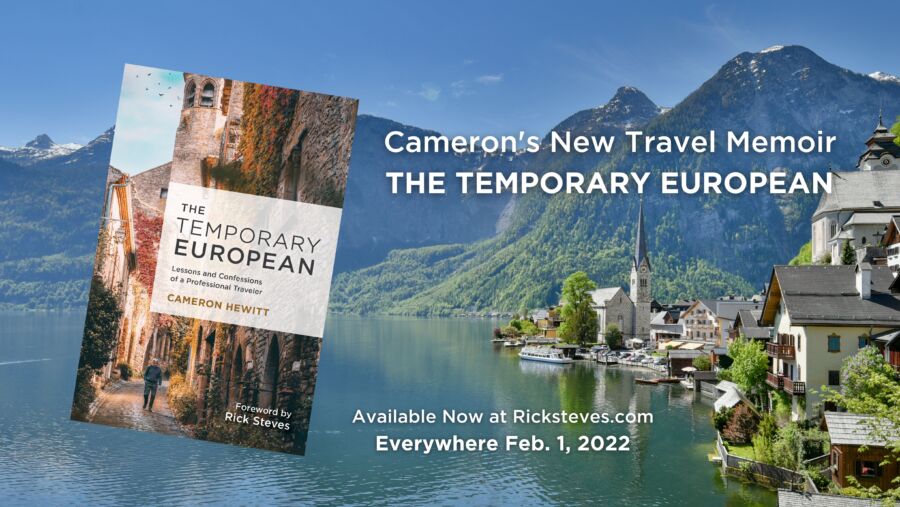
OK, I write a lot of books…but those are mainly Rick Steves guidebooks. This one’s special: It’s more personal, more vivid, more fun. It’s a memoir of my 20-plus years of working alongside Rick and the rest of our team, spending 100 days each year all over Europe, getting to know wonderful Europeans and learning from them. It’s called The Temporary European: Lessons and Confessions of a Professional Traveler. And it’s now on sale at Ricksteves.com (and will be available on Amazon.com and at bookstores nationwide, and as an e-book, on February 1).

Many of us found creative ways to make the most of the pandemic. In my case, by the summer of 2020, it was becoming clear that I wouldn’t be going back to Europe anytime soon. Facing a long, gloomy winter of trying to stay busy with not very much to do, I decided to take a sabbatical from the Rick Steves’ Europe home office and finally pursue a dream that I’d been mulling over for years.

And that’s how, last winter, I spent several months fully focused on my manuscript. It was a strange time: On my first day off work, I awoke to news of successful COVID vaccine trials. But in the several weeks it took those vaccines to arrive, the US saw a grisly winter surge that kept us feeling more isolated than ever.

In my case, being in pandemic limbo was just fine — maybe even ideal — for reliving my European travels since I first spent a semester abroad in Salamanca, Spain, in 1996 (a story I recount in the book). Many of us who love to travel found that having to stay home for a while was the perfect opportunity to reflect on why we have this inexplicable urge to go out and experience the world. As my book took shape, I wrestled with those questions.

Most of The Temporary European is drawn from many years’ worth of my blog posts, some of which you may have already read. This was a great opportunity to revisit those stories — some of them typed out in the middle of night in a dreary European hotel room — and make them sharper and more focused. And as those chapters firmed up, I realized I also needed some connective tissue. So I finally got around to writing down many stories that have lived only in my memory until now. As I organized all those stories — old and new alike — themes emerged that tied them all together. Through that exercise, I learned a lot about myself as a traveler, about travel in general, and about how I want to travel even more mindfully in the future.

The Temporary European is two books in one. First, it’s a travel memoir — a “greatest hits” of my favorite travel tales from a quarter-century of exploring Europe. Many of the stories focus on Europeans who have made a big impact on my travels (and my life): Tina, the Slovenian tour guide who has made me a part of her family — and gets me thinking about how I interact with my own. Fran, my host-brother in Salamanca, who taught me how Spaniards eat acorns but never corn on the cob. Alma, who transforms the simple act of sipping a cup of Bosnian coffee into a cultural and philosophical epiphany. Siniša, who is determined not to let the rising tide of international tourism spoil his home island of Hvar. Isabella and Carlo, whose idyllic Tuscan agriturismo perfectly embodies Europe’s marriage between traditional and modern. And many others.

The stories capture the giddy excitement of simply experiencing Europe: Spending a drizzly day at an endearingly small-town Highland Games in rural Scotland. Hiking high in the Swiss Alps, entirely alone with grazing cows. Trekking across a mysterious moor, past wild ponies, to an ancient stone circle in Dartmoor National Park. And — because I’m a travel teacher at heart — many stories also sneak in some Trojan-horse practical advice for your next trip: How to find the best gelato in Italy, navigate Spain’s tapas scene, select the best produce at a Provençal market, and survive the experience of driving in Sicily.

The Temporary European is also a behind-the-scenes look at the life of a professional traveler. I’ve included “inside look” chapters giving in-depth, warts-and-all insights into what it’s like to research and write guidebooks, guide bus tours, make travel television, and work with Rick Steves and his merry band of travelers. If you’ve ever wondered what a guidebook writer is looking for when checking out endless lists of hotels and restaurants; what tour guides do during their time off; why it takes six days, and a lot of hard work and good fortune, to film a 30-minute television show; and what it’s really like to work in an office that shares a (lightly soundproofed) wall with Rick Steves’ office…these chapters will fascinate you.

There’s one other important character in the book: Mildred C. Scott, the great-great aunt of my wife Shawna. In the 1960s — when she was already well into what was then considered “old age” — Mildred used her inheritance to travel the world. She made up for lost time, eventually touching down on every continent on earth and visiting more countries than the rest of her Ohio hometown combined. In her later years, Mildred penned a travel memoir — sort of the spiritual ancestor of The Temporary European — with a title that has become my travel motto: Jams are fun. I’ve peppered my book with quotes and wisdom from Aunt Mildred, plus tales of my own memorable misadventures — which, after all, make for the most vivid travel memories. There’s the time I became embroiled in the Gelato Wars of Corniglia, in Italy’s Cinque Terre. Or the time my cruise ship weathered a hellacious storm in Norway’s North Sea. Or every time I check into a crummy hotel and realize that it’s gonna be a noisy night.

By the spring of 2021, I was wrapping up my manuscript. I was very fortunate to make contact with Larry Habegger at Travelers’ Tales, a travel press in the Bay Area that specializes in publishing just this kind of thoughtful, experiential travel writing. I spent the summer and fall revising and finalizing the book with Larry’s guidance (and with insights from many friends who generously donated their time to critiquing my manuscript). And Rick, who was wonderfully supportive through the entire project, generously wrote a Foreword.

It’s funny when you write a book and then send it off to the printer. Weeks, even months go by, and this thing that you poured so much of your soul into gradually fades into the background. You even start to forget about it. Then, one day, you get an email that the shipment is on its way. And you feel that rush of excitement (and terror) all over again.

Now that it has finally arrived, I hope you’ll consider buying a copy of The Temporary European, hopping into my rucksack, and joining me on a couple of decades’ worth of European travel experiences and epiphanies. If you’ve enjoyed reading my blog, I promise you’ll have fun on this journey, too.

For now, you can buy The Temporary European exclusively at Ricksteves.com. And, because our holiday sale is still going on, it’s 30 percent off through January 2. If you order now, you may just get it in time for a stocking stuffer. But even if it comes a day or two late, it’s perfect for post-holiday travel dreaming.

Soon — on February 1 — The Temporary European will also be available as an e-book, on Amazon.com, and at bookstores nationwide. (If you prefer to support your local bookseller, ask them to order you a copy.) And over the coming weeks, I’ll be sharing excerpts from The Temporary European along with some new posts as I look forward to 2022 travels.

Thanks for everyone’s support over the years. I’ve loved getting to know you thorough the Comments on my blog…and I’ve even bumped into several of you, either in Edmonds or while on the road in Europe. It’s truly an honor to be a part of this community of great travelers. And I hope you enjoy joining me on the trip of a lifetime as I tell the story of The Temporary European.

Vielen Dank, Mutti! And viel Glück, Deutschland!

I woke up this morning in Berlin to catch my flight home to the USA. And when I stepped out the door of my Prenzlauer Berg apartment, I saw a long line of people stretching down the block. It’s Election Day, and today the Germans choose who will succeed Angela Merkel after 16 years as Chancellor.

As I leave Europe, after two long years of dreaming of being back here, I find it especially poignant that my last few days coincide with the end of Merkel’s rule. I remember traveling here when she was first elected in 2004, and worrying that she would take Germany in a conservative, regressive direction. Instead she is, almost without contest, the most successful and respected Chancellor Germany has had since Reunification. She’s broadly supported and appreciated by all political stripes, at home and abroad, for the sensible stability she brought this country. Her nickname, “Mutti” — “Mom” — smacks of sexism, but the Germans intend it as a very high compliment. Mutti helped them feel safe, cared for, and seen over her 16 years in the Chancellery.

And as I return to the United States, I’m especially sad to say Auf Wiedersehen to Mutti, because I feel like the era she represents — of reasonable, consensus, centrist rule — is a dinosaur. In my own country, the political discourse has been hijacked by the fringe on both sides of the political spectrum. The same thing is happening across Europe; over the last few years, I’ve seen country after country that I love — Hungary, Poland, Slovenia — opt for extremism instead of centrist cooperation. I often think that if only the USA could find its own Angela Merkel, we might somehow make our way out of our current mess. But she’s one of those generational figures that don’t grow on trees. Joe Biden has attempted this, but the headwinds are fierce.

In order to avoid the perception that this is a partisan post, let me stress that Merkel leads the dominant conservative party of Germany (though they have a multi-party system, so Merkel’s CDU is effectively the moderate conservatives — think the GOP before Trump, along the lines of John McCain and Mitt Romney). Imagine if Elizabeth Warren were somehow a Republican, and you’re getting the idea.

Even my most progressive friends in Berlin, begrudgingly, speak admiringly of Merkel’s gift for sensible governance. One of them even bumped into Mutti once in the local supermarket; she shops and cooks for herself, and enjoys showing up to buy groceries unannounced. The biggest complaint Berlin’s liberals can register is that she has allowed leftist policies (such as legal same-sex marriage) to be implemented, then implicitly gets the credit for them.

She certainly has some detractors — including those who say she’s not done enough, fast enough, to protect the environment (again, shades of Joe Biden). But even progressives can’t deny that she’s leaving a Germany with a huge and affluent middle class, an elevated status on the world stage, and a more diverse populace than ever (with 25 percent of Germans having at least one parent who was born abroad).

In fact, one of Angela Merkel’s signature achievements was a “bleeding-heart” humanitarian one, when during the 2015 refugee crisis she invited over one million migrants to take shelter in Germany. This did not come without growing pains. But Merkel’s continued popularity suggests that the Germans agree with her vision to be a compassionate society and a moral leader for the world. Imagine: going from der Führer to die Mutti, from gas chambers to safe harbors, in just 70 years. There are many reasons for this incremental evolution — in fact, I’ve spent this visit to Berlin trying to understand how it happened — but it’s clear that Merkel represents the culmination of that transformation.

And, as a scientist herself, Merkel was the perfect person to lead Germany through the COVID pandemic. Traveling here, I find a remarkably high awareness and understanding of the science and adoption of masking, testing, and other mitigation measures. They understand the stakes, and what works, because their Mutti explained it to them, with patience, reason, and a compelling compassion. One of my friends was grousing that “only” 73 percent of Germans are fully vaccinated. When I expressed envy at this extraordinarily high (by American standards) figure, he ranted a bit longer about how it should be at least in the 80s, if not the 90s! This is a country whose leader has encouraged them to set a very high bar.

Merkel is not term limited, and many suspect that if she ran for another term, she could make it an even 20 years (if not longer). She is the first Chancellor to leave office voluntarily. But, like George Washington before her, she has the wisdom to recognize when the time comes to step aside for fresh leadership.

The German word for “vote” is wählen — “choose.” For 16 years, the Germans have chosen centrist leadership that is confident yet reasonable, compassionate but not wishy-washy, strong but not strongarm. Now they are faced with a variety of potential successors, and everything I’m hearing is that each one appears more flawed than the last. In fact, virtually anyone would be flawed when compared to the combination of attributes that Merkel has brought to the Chancellery. Each one of my Berlin friends offered a different prediction as to the outcome of today’s vote, but all of them clearly felt that anyone who wins will be a downgrade. (One of them told me that, in a recent poll, the top vote-getter was “none of the above” — obviously a stand-in for a hypothetical Mutti fifth term.)

Merkel herself has joked this week about who will fill her shoes, by pointing out how (literally) small those shoes are. Of course, even this joke revealed precisely the opposite: that her pragmatic humility is one of the many traits that make her darn near irreplaceable.

As I get on my plane back to the USA, and Germany votes to say goodbye to their Mutti, we’re both heading to a place of uncertainty, frustration, and fear. I wish all of us good luck weathering our second pandemic winter. And I can only hope that each country eventually finds its own Angela Merkel to show them the way.

Vielen dank, Mutti! And viel Glück, Deutschland.

What It’s Like to Travel in Europe During COVID

“Cameron! You must tell Americans what it’s truly like to travel here right now.”

This was the plea from Isabella, who runs a stunning countryside hotel in most beautiful corner of Tuscany. Isabella is frustrated because she designed her business for American guests. And even though she’s been able to pivot to a mostly European clientele, she’s eager for her American friends to return. Unfortunately, the mixed messages about traveling in Europe have given many of her guests pause. And now quite a few, who booked weeks or months ago, are getting cold feet and cancelling.

Some of those people have good reason to postpone; perhaps they’re immunocompromised, or they know themselves enough to recognize that they lack the flexibility to travel during uncertain times. But others are overreacting to attention-grabbing, misleading news reports of “travel bans,” worst-case nightmare scenarios, and headachy red tape.

Fear looms large in the American imagination, so it’s not surprising that many American travelers are skittish. I understand. The week before I left, in late August, the news was full of vague yet alarming rumors that the European Union was about to “ban” non-essential American travelers. Spoiler alert: That did not happen. And, speaking only for myself, I can report that I’ve been struck by how normal it feels to be traveling in Europe again.

OK, not “normal” — but new normal. Social-distancing, temperature-checks, masking-indoors, showing-your-vaccine-card-to-enter-a-restaurant kind of normal. Being fully vaccinated and taking all of the reasonable precautions, I feel safe, or at least as “safe” as anyone can these days. I feel at least as safe as I do at home, which is safe enough to not have nightmares anymore. In the abstract, traveling in Europe sounds frightening and stressful; in practice, it’s just fine. Not just fine. Wonderful.

Previously, I posted about how I rationalized traveling to Europe during a pandemic; and about the many steps I took to plan and prepare for travel during these strange times. This post is a bit more freewheeling: It’s simply a report on what it’s like to be an American traveling in Europe during (we hope) the late stages of the COVID-19 pandemic.

Landing in Europe once again, all those mundane little European quirks came rushing back: the bizarre plumbing — complicated shower knobs and enigmatic washer/dryers that should come with an instruction manual; the secondhand smoke at outdoor cafés; the frustration of paying for a meal with your credit card, then trying to scare up a few coins for the tip; the little basket of warm, hard-boiled eggs at the breakfast buffet, instead of scrambled or fried. Some of these are good things. Others not so much. But at least they are all Europe. And in a weird way, I missed all of them, even the parts I don’t particularly like.

Especially while traveling, every cough and sneeze I hear in public sounds amplified. Late summer is turning to fall, and reliably balmy weather is transitioning to warm days and chilly nights. As cold-and-flu season approaches, everyone’s got a tickle in their throat. And I am more aware than ever of how Europeans aren’t as careful about covering coughs and sneezes as we Americans are. I’ve always noticed this — there’s a kind of European pragmatism that figures you’re going to get sick at some point, so why fight it? But it’s jarring in the age of COVID.

As my wife and I enjoyed an outdoor lunch on our first day in Europe, the adorable towheaded twins from Germany at the next table took turns coughing violently into the air, as Mom and Dad looked on proudly. We nudged our table a few inches farther away and dubbed the duo “KOVID Karl and KOVID Kristoff.” A couple of weeks later, walking to my train in Prague’s station, I saw a guy pull down his mask just in time to expel a juicy sneeze into the air.

There are far fewer American travelers in Europe right now, and — for various reasons — there are virtually no travelers at all from China, India, Great Britain, Australia, New Zealand, and many other places. And yet, being here has been a severe hit to my American traveler’s narcissism, because I’m seeing how easily we’ve been replaced. European tourists, who might normally prefer to travel to North America or Asia, instead are vacationing closer to home. On the trails of the Julian Alps, the trattoria terraces of Tuscany, the beaches of the Cinque Terre, and the cobbles of Prague, I find myself surrounded by Germans, Swiss, Dutch, French, and so on.

Some places are downright crowded. I had trouble finding parking during a midday visit to the Tuscan hill town of Montepulciano, and I had to reserve dinner ahead each night I was in the Cinque Terre. In fact, the crowds have been one of the biggest surprises of my trip. While nowhere near as busy as the peak year of 2019, Europe is far from empty. If you’re thinking, “Now is a great time to go to Europe to avoid the crowds”… you’re already too late. It’s less crowded, sure, but it’s not uncrowded.

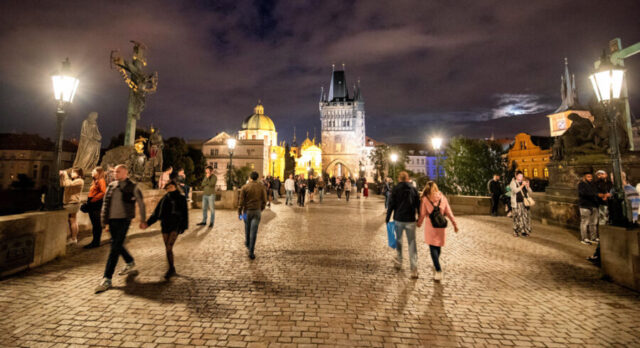
That said, it is enjoyable being in places that feel more local than they have in many years. One chilly, early-autumn Sunday afternoon in Prague, strolling along the Charles Bridge, I realized with a start that the majority of my fellow promenaders were speaking Czech. On past visits, I’ve walked the entire length of that bridge, utterly clogged with humanity, without hearing a single syllable of the local language.

From there I headed up to Prague Castle, which is typically overstuffed with obnoxious tour groups, and found I had the place largely to myself. It was eerie…almost lonesome.

This shift in the demographics of travelers has also brought about a big change in traffic patterns. Those intra-European tourists are not flying or taking trains or buses; most are driving — just as road trips became the go-to American vacation in 2020. This has led to some serious traffic jams on major freeways and in parking lots (like what I found in Montepulciano). Instead of one big bus carrying 50 people, you have 20 or 25 individual cars. One friend in Slovenia — which is right on the way between Austria and Czechia in the north, and Croatia and Italy in the south — termed 2021 the “Summer of Carmageddon.”

Through the pandemic, I’ve been mightily worried about my favorite small businesses in Europe. Now here, I’m seeing that most have survived, sometimes in a slightly different form. A few restaurants have retooled; as in the US, there’s more and better outdoor seating than before. Some savvy businesses took advantage of the closure to finally do some long-overdue renovation work. Hotels and restaurants that were once filled with Americans (like Isabella’s place) are now a microcosm of the EU. In some cases, this has required the business owner to make some changes to become more Euro-friendly. I’m wondering whether they might decide that they prefer to diversify, with both European and American clientele, and never go back to exactly how they did things before.

I am meeting a smattering of Americans over here, and I have to say, they’ve mostly been great travelers. These are clearly people who love travel so much, that, like me, they weren’t willing to wait six more months to get back. I’m not bumping into many novices on the road. It must be a miserable time to be a European pickpocket: All of the easy marks are scared at home.

Meanwhile, everyone’s already thinking ahead to 2022: Assuming all goes well, Europeans will presumably go back to overseas vacations, clearing the way for Americans to return. But what if the Europeans decide to stay closer to home, too? Will we be stacking two huge demographics of travelers on top of each other? And one big question I’ve heard again and again is this: When will the Chinese tour groups return? (Many Europeans see these groups as having been a breaking point in terms of excessive crowds, and wouldn’t mind if they held off a bit longer — let’s say 2023, or why not 2024? — to allow capacity to ramp up again.)

In general, I can’t shake the sense that traveling right now is a test run for 2022. Europe is ironing out the wrinkles in anticipation of what many expect will be a huge rebound year. While there are no guarantees, it certainly feels like traveling in Europe next year — in some form — will be a go. In fact, several of my European friends (especially ones in not-long-ago-overwhelmed places like the Cinque Terre and Prague) expressed concern that next year could bring bigger crowds than ever.

Of course, what I’m experiencing is a moment in time; things are constantly changing. For example, just two days after I landed in Italy, the country implemented a testing requirement for arriving visitors. In most places, these changes are speed bumps, not insurmountable hurdles. “Test in, show your vaccine card, test out. Simple!” Isabella explained, with an elegant simplicity. And, ultimately, it really is simple. I don’t know about you, but spending an hour getting a COVID test strikes me as a remarkably minor hassle for the privilege of basking in Tuscan splendor or hiking the Cinque Terre for a few days.

And what about COVID?

When it comes to pandemic measures, I see how Europeans are handling things in ways that are subtly different from the American approach, but those “little” differences add up to a huge impact.

First and foremost is simply a matter of worldview. My impression, at least among my friends and acquaintances, is that we Americans are either completely terrified of COVID, or willfully oblivious to it (even venturing so far as to call it a “hoax”). The Europeans I’m interacting with have found a middle path: pragmatism. They are soberly aware of the risks and, consequently, willing to put up with commonsense, public-health regulations…and then getting on with life. They are realistic but not frightened; cautious but not cowed. Frankly, being among Europeans through this crisis is refreshing, and inspiring.

In general, on the ground here in Europe, I feel far more comfortable than I do back home. Vaccination rates are high (and increasing); cases are low (if rising); hospitals are not overwhelmed, as they are in many parts of the USA. Overall, masking compliance is extremely high. On the few occasions when I dined indoors in Italy, I felt a wave of relief upon being asked to show my vaccination card to enter. While not a guarantee of safety, it brings peace of mind knowing that every single person in the room with me is also vaccinated.

Of course, Europe is far from monolithic. And, while each country has its own vaccination rates, caseloads, and quirky regulations, it’s been interesting to see how things vary from place to place. My sample size is small — just four countries — but broad enough to notice nuances. While the general rules are the same, they are implemented differently: In Slovenia, I noticed people sanitizing their hands like crazy when entering shops, while in Italy it’s all about the masks.

And Germany is extremely specific that people must wear FFP2 masks (the European equivalent of an N95 or KN95). Here’s a typical sign, from a restaurant in Berlin:

It says: “Inside with test; outside without. From this point, only with an FFP2 mask or a surgical mask, over mouth and nose.”

Meanwhile, the Czech Republic (where reported cases are low… suspiciously low?) feels a bit like the USA before the Delta surge: masking “requirements” are loose, and I found I was often the only person in line at the coffee shop who bothered to put on a mask. On my train from Prague to Berlin, the guy across the aisle (who was Czech) pulled his mask under his chin soon after boarding, and punctuated the four-hour trip with coughs.

As we sat together inside a crowded Prague café, in which nobody was masked, a Czech friend told me that technically, you do need to have proof of vaccination, a negative test, or proof of recovery from COVID in the last six months to dine inside. However, through some strange bureaucratic loophole, people who work at restaurants are not allowed to check your vaccination status; this is left to government officials who, in theory, can show up at any time for a surprise inspection. She heavily insinuated that these inspections are vanishingly rare. (To be honest, I’m a bit worried about a winter surge in Prague compared to places like Italy or Germany, where restrictions are being taken with grave seriousness.)

And yet, the Czechs are applying their sharp, sarcastic sense of humor even to this crisis. Here are a few new cakes I noticed at a dessert shop:

A few things are universal, though: Old social distancing stickers on the floor are completely ignored by everyone. And every European seems to have picked up the same style: When not in use, a mask is worn around the elbow or bicep. (I just stick mine in my back pocket, but maybe the European way is more sanitary — for airing out the mask — in addition to being quite fashionable.)

Another European trend that impresses me: the widespread availability of testing, both more substantial PCR lab tests and rapid antigen tests. Popup testing centers are set up everywhere. I have some Czech friends with kids too young to get vaccinated. If the kids want to go to the movies or the swimming pool, they simply stop off for a rapid antigen test on the way there. I was told that in Czechia, each citizen is entitled to two free PCR tests and two free antigen tests per month; Germany has similar subsidies. Imagine being able to run out for a fast, free test on the way to Grandma’s house. Many experts believe this is an important tool that the USA simply isn’t using.

In general, Europe is focused on what, in some countries, are called the “Three G’s”: vaccination, recovery, or testing. (In German, it’s geimpft, genesen, getestet.) In other words, if you’re not vaccinated; if you haven’t recovered from COVID within the last six months; or if you haven’t recently tested negative…then you’re not welcome to fully participate in society. As Isabella might say, “Simple!”

Being in Europe, it’s even more apparent to me than ever how the American response to COVID has fallen apart on virtually every dimension. Many in our society resist masking, and refuse to take vaccines that have been proven safe and effective. We have no uniform way to verify someone’s vaccination status, and even if we did, there are few broad-based policies to ensure that only vaccinated people can share an indoor space (this is mostly left to private business owners). And testing — which could at least provide some safeguard to compensate for those other lapses — is hard to access, time-consuming, and expensive.

Being here, I can’t shake the sense that Europe is figuring this out better than we are. And the numbers bear that out: So far, 680,000 Americans have died of COVID, in a country of 330 million people; that’s one in every 485 Americans. Meanwhile, the European Union, with 445 million people, has lost 765,000 people, a ratio of one per 580. We and Europe are fighting the same battle, with the same weapons. But the implementation is different, and so is the result.

I’ve been asked (mainly by fellow Americans staying at home) whether Europeans really want me here. Based on my highly personal and anecdotal experience, I can say I’ve been universally welcomed with open arms. In the end, most European countries do want (vaccinated, considerate) American travelers. They rely on us for their income. And they simply miss us.

Throughout this trip, I’ve been seeing lots of dear friends around Europe whose way of life revolves around travel. They’ve been patient long enough, and they are thrilled beyond measure to see American travelers again.

In Italy’s Cinque Terre, I had dinner at a restaurant with a famously entertaining waiter — a huge personality who cracks jokes constantly, wears funny hats that he changes between courses, and makes friends with each night’s diners. He thanked me graciously for coming back to Italy, and he spoke from the heart about how much he’s missed us Americans. “This is my stage,” he explained, sweeping his hand across the cozy terrace of tables overlooking the Ligurian Sea. But he hasn’t just missed his audience; he’s missed those precious connections he gets to make, night after night, with people from all over the globe…those moments where our huge, scary, cruel world feels just a bit smaller, softer, and friendlier.

Traveling right now is not for everybody: the skittish, the vulnerable, and the inflexible may do well to wait a bit longer. But for hardy independent travelers who are willing to assume the risk that comes with doing anything these days, Europe is as richly rewarding as ever.

That said, many of my European friends predict that they’re not quite out of the woods. The looming possibility that Americans could (temporarily) be asked to stay home again for a while — or even that certain countries may have a winter lockdown — is on everyone’s mind. Several have told me that  I chose the perfect time to visit (September): While weather is still good enough for outdoor dining, but crowds are less than July and August, when Europeans on holiday flooded popular places. They expect that when people move inside for the winter, just as last year, cases will rise. And they’ve watched with concern the huge spike in the US and elsewhere resulting from the Delta variant — which, so far, appears not to have fully reached many parts of Europe. The big question is whether their high vaccination rates, masking compliance, and testing availability will be enough to forestall a big winter surge. I imagine the answer will be mixed, on a country-by-country basis. Stay tuned.

Even if things do get worse again, I’m hopeful that they will rebound by spring. Europe is getting the hiccups out of the system for “traveling and enjoying life during COVID.” And even if you are choosing to wait until 2022 (or 2023), eventually you’ll reap the benefits of what’s going on here now.

In the end, nobody (including me) wants to go out on a limb and say, “It’s safe to go to Europe — go ahead!” That is still an individual decision, which comes with risk. But in my case, I’m glad I made the choice I did. And, once again, I just have to say it: It feels very, very good to be back in Europe.


UPDATE, October 5: I’ve now been home from Europe for over a week. And I am happier than ever that I made the decision to go. In the end, it was less “unpredictable” than I expected: I assumed that I’d need to make several adjustments to my plans along the way, as conditions evolved. As it turns out, my itinerary came off exactly as I’d planned it, to the minute. Who knew?

I did have to take a COVID test before re-entering the United States, as required by US law. So, two days before my flight, I stopped by one of the many popup testing centers in my Berlin neighborhood — less than a 10-minute walk from my rental apartment. There was no wait, and I was in and out in a matter of minutes. (The only hitch came when I filled out the online form on my phone and paid the €40 testing fee with a credit card. “Oh no! You didn’t need to do that,” the clerk told me. “The government recently changed the policy. Now the test is free, even for foreigners. I’ll refund your money.”) Ten minutes later, I got an email with my official test result — negative — which I showed when I checked in for my flight. Test in, test out, simple!

Again, there are ample good reasons not to travel to Europe right now. But fear is not one of them. Nothing in life comes without risk. As we move into the late/post-COVID era, I suspect we’ll all need to get a little more comfortable with accurately assessing risk, and then making an informed decision about what we do and don’t do. It’s easy to say in hindsight, but in my particular case, this trip was absolutely worth the risk.