Experience Tuscany: Ogle Great Art in a Forgotten Church

When in Tuscany, make a point to go to a town you’ve never heard of, and see works by an artist you’ve never heard of. Here, far from the tourist crowds, hidden gems demonstrate that the art world of 1400s and 1500s Tuscany boasted a world-class lineup of artistic geniuses. Even Tuscany’s “also-rans” would be a big deal just about anywhere else.

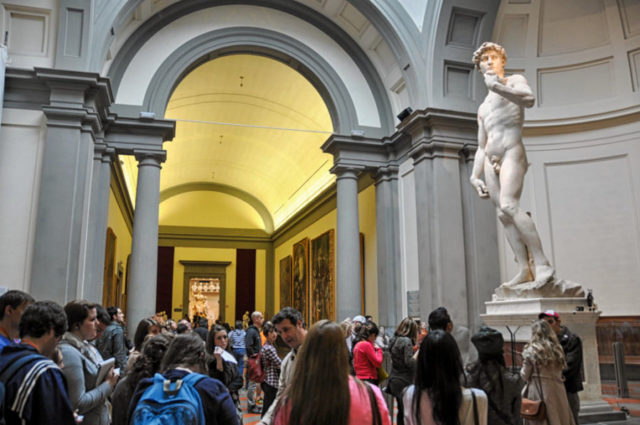
Sure, you want to see the biggies, too.  Florence — the cradle of the Renaissance — has some of the greatest artistic sights in the world: The Uffizi Gallery shows off the most sumptuous collection anywhere of Renaissance greats, from Botticelli and da Vinci to Raphael and Caravaggio. The Accademia Gallery is home to Michelangelo’s David — probably the most recognizable statue on earth. The Borghese Gallery is loaded with even more stunning sculptures, including masterpieces by Donatello, Michelangelo, Verrocchio, and Brunelleschi. And that’s just for starters.
But — without taking anything away from Florence — many of my favorite works of Tuscan art are far from the big cities and famous museums. These memorable masterpieces are tucked away in smaller, less-visited towns or remote countryside outposts.

On my recent trip, I took a day off from my guidebook-updating work in Arezzo, a provincial capital of about 100,000 people. I went to Arezzo specifically because it isn’t particularly famous, or particularly jammed with great museums. It’s just a great place to settle in, relax, eat, enjoy…and stop taking notes for a day. If it’s known for anything, Arezzo is famous for its weekend antiques market, which happened to be going on during my visit.

In the center of Arezzo is the rough-brick facade of the Basilica of San Francesco. Inside, the apse is lovingly frescoed with tales of the True Cross, created in the 1450s and 1460s by Piero della Francesca. These illustrations take the viewer on the epic journey of the very cross that, it’s believed, Jesus was crucified upon.
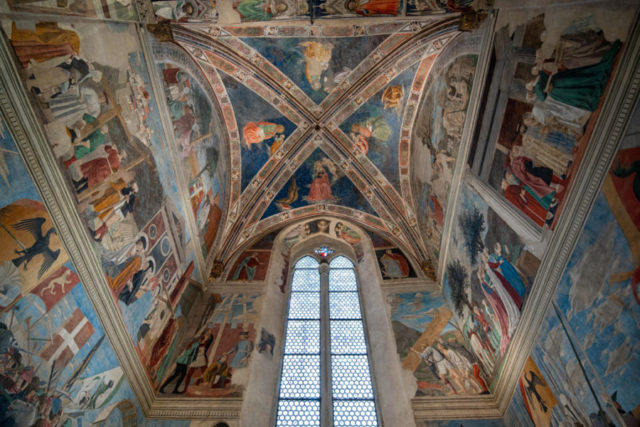
The narrative twists and turns through history — from Adam (yes, the Adam, of Adam and Eve fame) to the Queen of Sheba to Emperor Constantine’s mother Helena — while illustrating in starkly human terms the people who took part in the journey of the cross. In these scenes, della Francesca demonstrates his expertise in composition and perspective while also imbuing his figures with a graceful humanity — all of which was still relatively new to the art world, 50 years before Michelangelo or da Vinci.
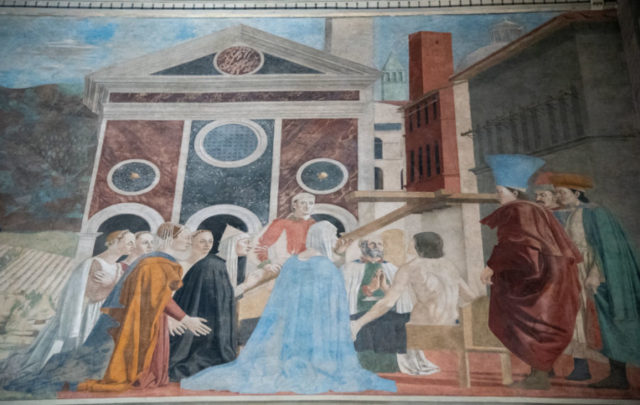
Della Francesca barely rates “honorable mention” status in the panoply of astonishingly talented Renaissance artists from this part of Italy. If the Tuscan Renaissance Artists were a baseball team, della Francesca would spend most games in the dugout…maybe seeing a little action when Vasari or Fra Angelico needed a day off. And yet, those True Cross frescoes in Arezzo are a remarkable masterpiece that — if someone important had taken notice at a certain moment in history — might very well be on the globe’s bucket list today.

About an hour’s drive away are works by a guy who never even came close to making the cut: Il Sodoma. Deep in the Crete Senese — the clay hills that ripple across a desolate, sparsely populated terrain south of Siena — the abbey of Monte Oliveto Maggiore perches on a wooded hillside. Here, an order of Olivetan monks live far from modern society, keeping watch over the precious artwork that fills their home.
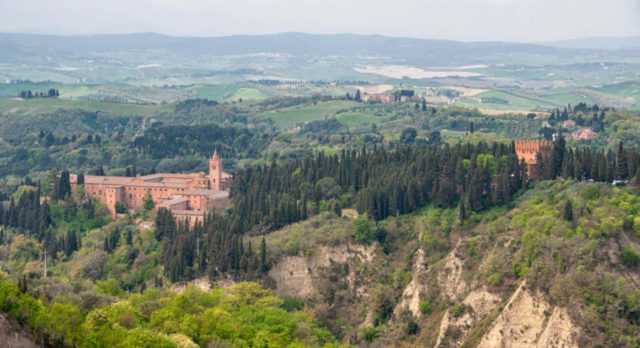
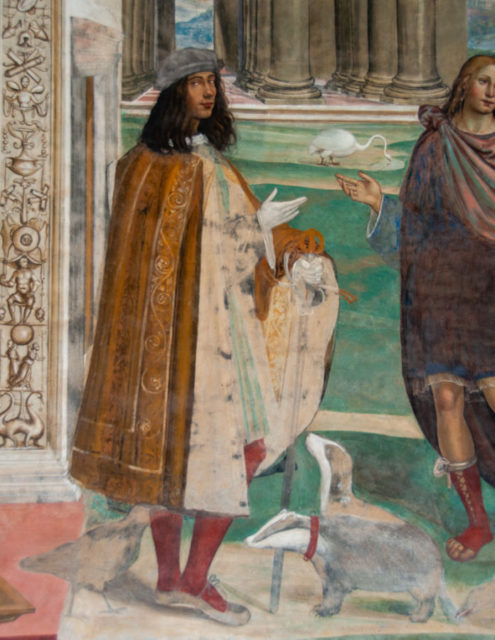
In 1497, the abbot commissioned the fresco artist Luca Signorelli to illustrate the cloister’s corridors with scenes from the life of St. Benedict. But Signorelli bailed out early — when he was only about a third finished — to take an even more plum gig down the road in Orvieto. His replacement was a highly irreverent and brutish painter named Giovanni Antonio Bazzi. The monks nicknamed him “The Madman” (Il Mattaccio), but history knows him as Il Sodoma. This nickname — “The Sodomite” — may have been a reference to his sexuality, or it may simply have been an insult applied by his mystified contemporaries…who didn’t know what to make of his bizarre behavior. Here he is in a self-portrait with, of course, two pet badgers:
Il Sodoma completed the work Signorelli had begun. The result is a series of 35 frescoes illustrating the life of St. Benedict. It would be easy for an impatient tourist to roll their eyes through these hallways, jaded and unimpressed. But a great guide brings the story of St. Benedict — and of the stories of the two dueling artists who decorated this space — to life.
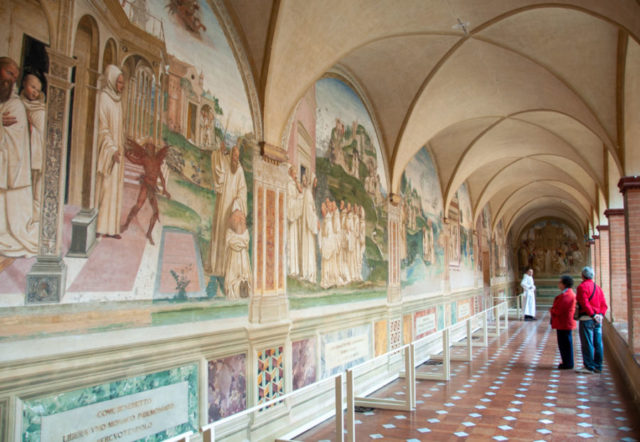
Roberto Bechi— one of our favorite guides in Tuscany (who also helped us design our new Best of Tuscany Tour) — led me through the abbey’s frescoes. And it simply blew my mind. Roberto focused my attention on delightful little details, including hidden portraits of some of Il Sodoma’s contemporaries: Leonardo, Michelangelo, Raphael, and Lorenzo the Magnificent.
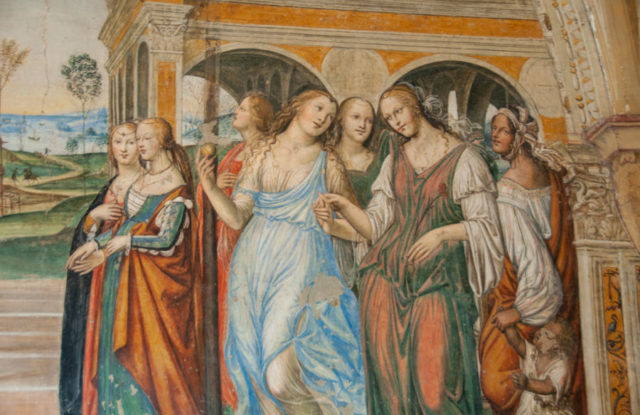
He also clued me into details that spoke to the huge personalities of the artists. Il Sodoma grew tired of hearing about how masterful Signorelli’s 3-D illusion table was — so he topped it with an even more striking one of his own. Different items on the table snap into focus depending on the angle and distance you’re viewing from.
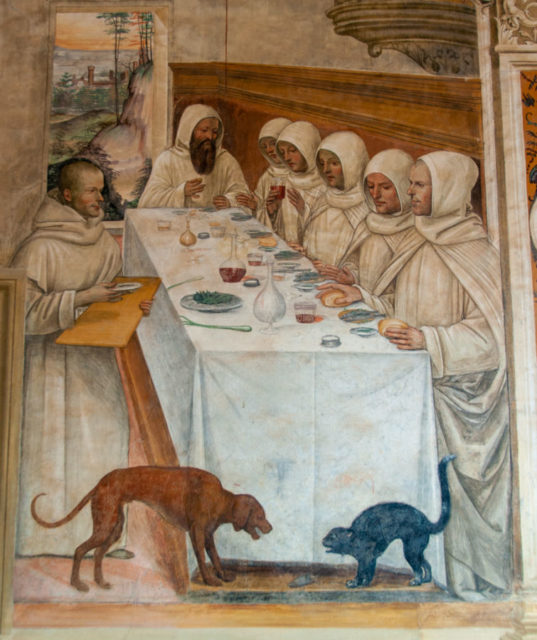
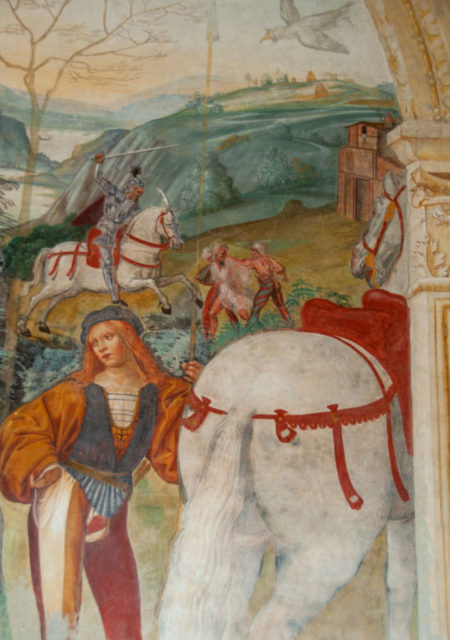
Il Sodoma clashed with the abbot — who, already well behind schedule and over budget, prodded him to work ever faster. This conflict came through in the artist’s work. In one panel, two donkeys share six legs — an intentional error. (A snarky Il Sodoma wrote in his journal: “Working too fast causes mistakes.”) In another scene, Il Sodoma painted a horse’s rear end, and above it, the window of a house where a shirt hangs in the breeze. During this era, a typical person owned seven shirts: six for workdays, and a seventh for Sunday, when they could rest (and do laundry). With this detail, Sodoma is saying to the abbot: “You made me work on Sunday — made me sweat through my seventh shirt. You horse’s ass!” Cheeky. Take that, Michelangelo.
If you haven’t heard of Monte Oliveto Maggiore or Il Sodoma, you’re not alone. They are but a blip on the radar of the mainstream art world. But the longer you spend in Tuscany, and the deeper you dig, the more you realize that the top museums in Florence and Siena barely scratch the surface of the artistic bounty here. Seek out some of these hidden masterpieces, and make a point to linger over them. Come for the art…but stick around for the huge personalities.


Heading to Tuscany? I share a dozen of my favorite Tuscan experiences here.

Our new Best of Tuscany in 12 Days Tour — which begins in 2020 — incorporates many vivid experiences in Italy’s heartland…including a guided tour of Il Sodoma’s frescoes at Monte Oliveto Maggiore.

Or, to do it on your own, you’ll find all of the details you need in our Rick Steves Florence & Tuscany guidebook.

Experience Tuscany: Meet a Real-Life Artisan

In the hill town of Volterra, tucked down a narrow lane a few steps from the main drag, Roberto delicately chips away at an alabaster statue. Everything in the cluttered workshop is covered in a thin layer of white dust — including Roberto. You can practically taste the gritty powder in the air. But Roberto doesn’t seem to notice, or to care. With intense concentration, he chisels and carves and tap-tap-taps — like Michelangelo 500 years before him, slowly revealing the form that already exists within the stones.

What’s striking about Roberto’s shop is that, while it welcomes curious travelers, it doesn’t exist for the sake of tourism. It’s real.

Tuscany’s rich aesthetic heritage means that contemporary Tuscans still find great meaning and beauty in their work, whatever it may be. Sculptors, leatherworkers, carpenters, mosaicists, potters, coppersmiths, jewelers, weavers, painters, vintners, chefs — everyone does their work with deep pride and conviction, as if tourism didn’t exist. Meeting a few of these artisans is both educational and inspiring.

In the little hill town of Montepulciano alone, I’m struck by the high concentration of uncompromising artists. On the street below the main square, in the course of just a few blocks, you can get to know four different masters of their crafts.

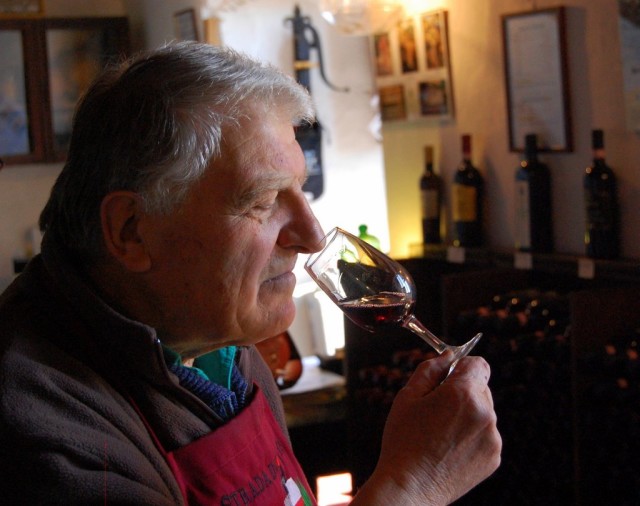
At Cantina Contucci, Adamo has been making wine for decades. Every time I visit, he tours me through the caverns of giant wooden casks that burrow deep into the stony hill upon which Montepulciano sits — and, as if for the first time, evangelizes about his wine with the passion of someone who has truly found his life’s work. (On a recent visit, he announced to me, “Last year, I finally retired…but they still let me come to work every day!”)

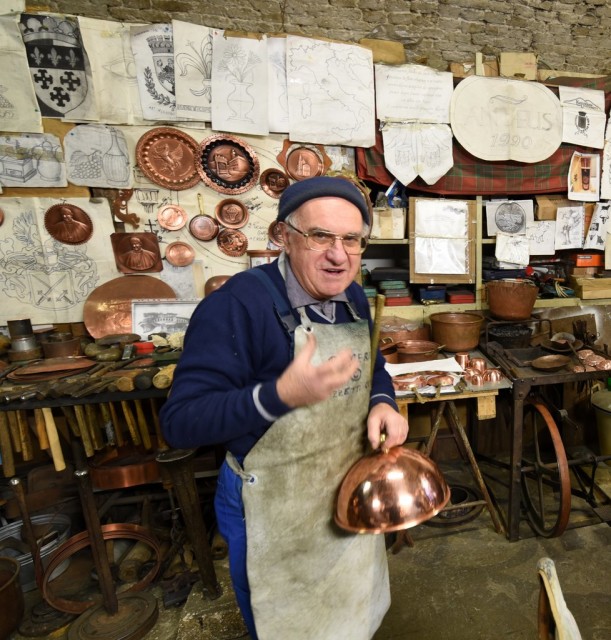
Just down the street from Adamo is the copper shop of Cesare, who — clad in a heavy leather apron — hammers out delicate copper artwork. Cesare has a big Roadrunner-style anvil and a set of heirloom stencils dating back to the 1850s. He still crafts his copper vessels the way he was taught as a young boy. And he still brings the same care and attention to detail to his work as he has his entire life.

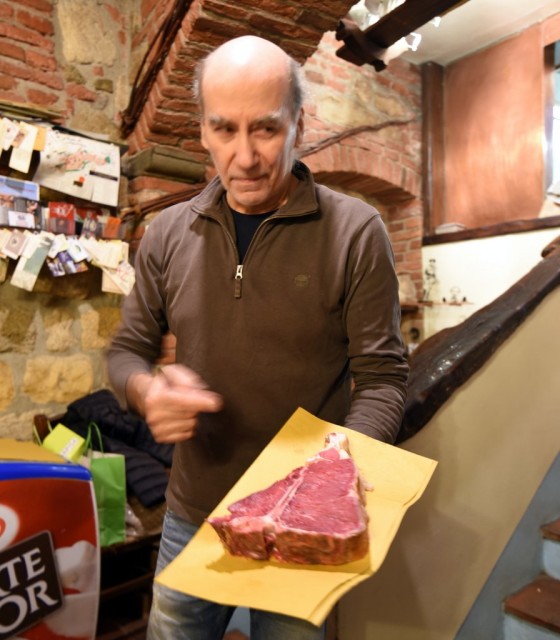
A few more doors down is a different type of craftsman: Giulio, who runs Osteria dell’Acquacheta — the best steak house I’ve ever experienced. While his diners dig into big, steaming plates of pasta (a primo — supposedly a “starter” — is more than enough for an entire meal), Giulio walks up the stairs in the back of his restaurant and carves off giant hunks of steak from a slab of the local, prized Chianina beef.

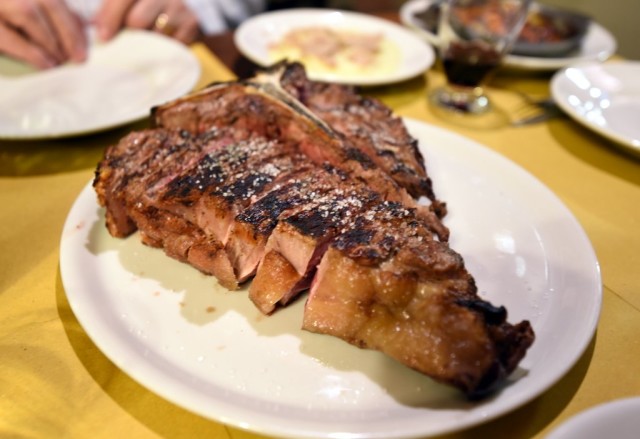
After verifying the steak with his customer, Giulio throws it onto his wood-fired grill, cooks it until it’s barely browned, sprinkles it with coarse sea salt, and delivers it to your table — an edible work of art.

As of my latest visit, this unofficial fraternity of precise Montepulciano craftspeople has been joined by a new member: Nicola, who makes artisanal gelato along the main street into town. (Read more about Nicola here.)

Nicola, who is obsessed with making gelato fresh every day, and only from locally sourced ingredients, is just the latest in a long string of the Tuscans I’ve met who have impressed me with their careful, precise attention to their craft. If you want something done just right, with precision, artistry, and care…find yourself a Tuscan.


Heading to Tuscany? I share a dozen of my favorite Tuscan experiences here.

Read more about the artisans of Montepulciano here.

Our new Best of Tuscany in 12 Days Tour — which begins in 2020 — incorporates many vivid experiences in Italy’s heartland…including the chance to meet an alabaster artisan.

Or, to do it on your own, you’ll find all of the details you need in our Rick Steves Florence & Tuscany guidebook.

Experience Tuscany: Sleep (and Eat) at an Agriturismo

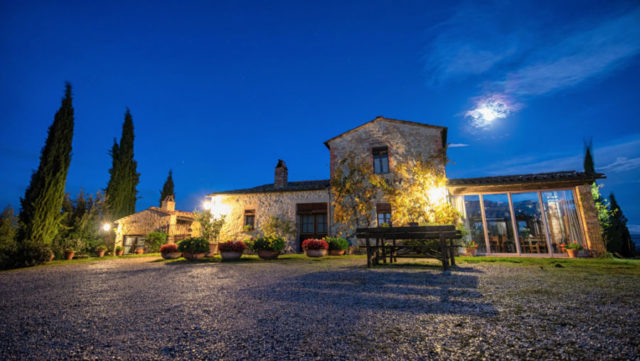
The rustic farmhouse called Cretaiole perches on a ridge overlooking postcard Tuscan farmlands, less than a 10-minute drive outside of Pienza. Its generous lawn is framed by pointy cypress trees and a gentle olive grove.

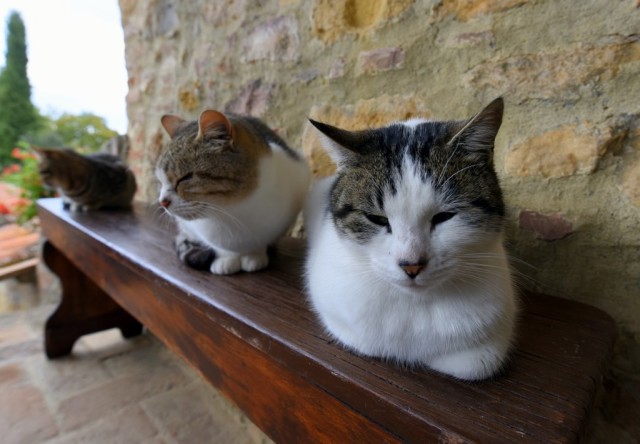
The resident cats are just how I like them: curious, playful, and starved for attention — they wait outside your door, looking for any chance to slip inside your room and make themselves at home.

And in the evening, an aging farmer named Luciano makes the rounds — knocking on doors, clutching his bottles of homemade grappa and Vin Santo, and cajoling everyone and anyone to come join him for drinks on the veranda.

Cretaiole is an agriturismo — one of more than 20,000 farms subsidized by the government to introduce travelers to Italy’s unique pastoral lifestyle. Agriturismi are required to be working farms — that is, they must actually produce something — while also offering accommodations, restaurants, educational activities, or all of the above. Sleeping at an agriturismo is the ultimate in Italian country living.

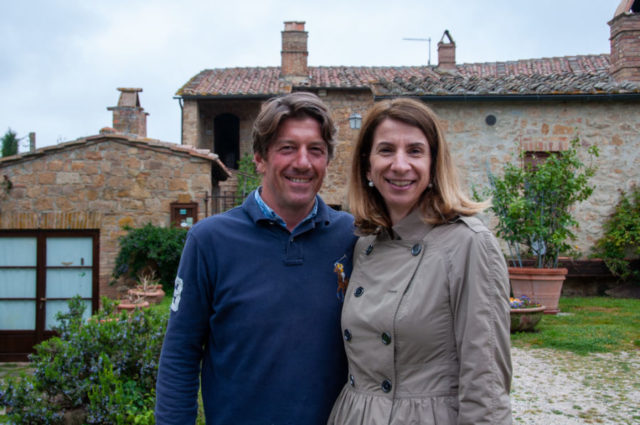
Cretaiole is the joint effort of husband-and-wife team Carlo and Isabella. Years ago, Isabella came on vacation from Northern Italy to this part of Tuscany. She fell in love with a local farm boy, Carlo, and decided to stick around. Soon she persuaded her father-in-law, Luciano, to turn their working farm into an agriturismo. And now, about a dozen Americans gather here each Saturday to begin a week-long stay in the comfy apartments that Isabella has carved out of the antique farmhouse.

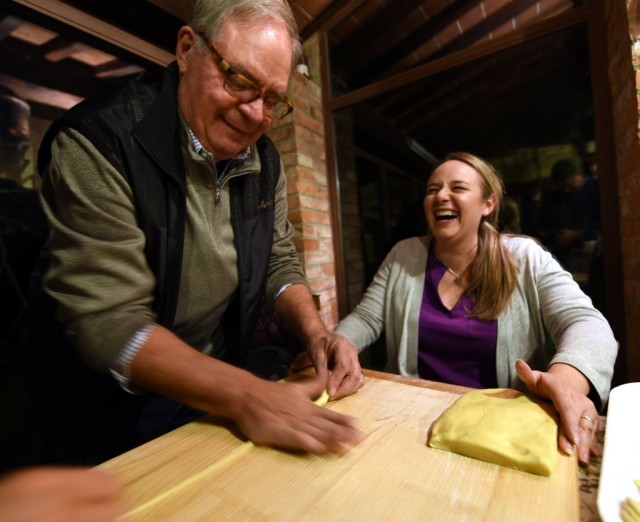
This isn’t just a place to stay; Isabella has come up with a tempting array of experiences that guests can take part in: olive-oil tastings, truffle hunts, vineyard visits, pasta-rolling classes, and guided excursions to Siena.

Luciano, the old farmhand, has slowly grown accustomed to the visitors from around the world who travel thousands of miles to sleep in his old olive-oil mill. He enjoys knocking on doors after people have returned from dinner, inviting guests to join him for a nightcap of homemade grappa, Vin Santo, and limoncello. While he clearly adores these interactions, Luciano enjoys playing the curmudgeon; one time, observing clueless guests trying to be helpful during the olive harvest, he nudged me and muttered, “That’s the problem with an agriturismo — too much turismo, not enough agri.” But the twinkle in his eye told me he wouldn’t trade it for anything.

Cretaiole is the agriturismo that I know best, but there are many, many choices — some more rustic and remote, others on the outskirts of big cities. We recommend our favorites in the Rick Steves Florence & Tuscany guidebook, and you can also find a comprehensive list at Agriturismo.it.

One word of caution: Be aware that an agriturismo is truly a working farm. While some are more refined than others, expect muddy roads, manure smells, and tractor engines firing up in the wee hours. Some travelers who think they want an agriturismo would actually be more comfortable with a more polished “countryside hotel” experience. For example, the owners of Cretaiole just opened a brand-new hotel called La Moscadella that’s purely posh — offering higher-end amenities and furnishings, if less of the down-home barnyard charm of the original.

Be honest with yourself about what type of rural Tuscan accommodations you’re really interested in — then find the perfect fit.


If Cretaiole sounds good to you, read this full rundown on what it’s like to spend a week there. Then book it.

While I’ve stayed at Cretaiole several times, the most memorable was the wonderful Thanksgiving week that Isabella arranged — an ideal off-season alternative.

Heading to Tuscany? I share a dozen of my favorite Tuscan experiences here.

Our new Best of Tuscany in 12 Days Tour — which begins in 2020 — incorporates many vivid experiences in Italy’s heartland…including a stay in the countryside of Chianti, plus three nights at Isabella’s wonderful new rural hotel, La Moscadella.

Or, to do it on your own, you’ll find all of the details you need in our Rick Steves Florence & Tuscany guidebook.
Experience Tuscany: Play “King of the Castle” atop a Fortified Tower

Exploring the tiny, hill-capping town of Montepulciano, I wandered up a side-street from the main square. Looking back, I was struck at how the facade and tower of the town hall — so stately and respectable from the middle of the square — were clearly pasted onto a rough brick structure. This reminded me that Tuscany is obsessed with its fancy towers.

“Italy” as we know it was an invention of the 19th century. During Tuscany’s medieval and Renaissance prime, this region was a collection of feuding city-states dominated by rich families. To this day, Tuscans remain fiercely loyal to their home community, and are keenly aware of subtle differences between people from different cities, towns, and villages. (Italians have a wonderful word for this: campanilismo, meaning that a community consists of the people within earshot of its bell tower — campanile.)

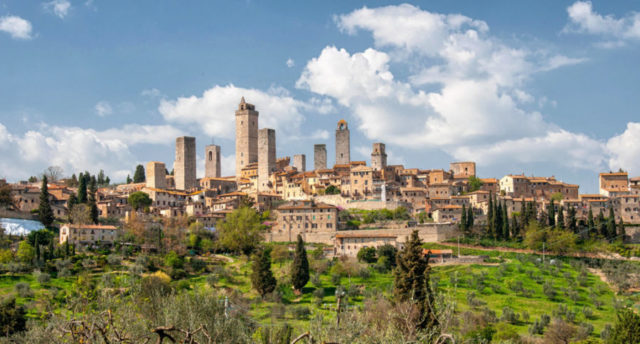
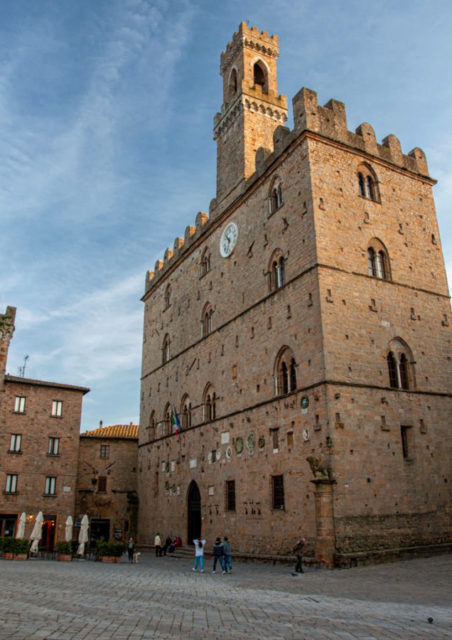
One of Tuscany’s architectural fortes are its fortified townhouses. Many towns have several such tower houses — representing the many, often competing wealthy families who once lived there. San Gimignano famously has 14. In those Romeo and Juliet days of feuding families, prickly skylines like San Gimignano’s were commonplace.

Some of these townhouses still have an intact tower — the keep, or place of last resort for a noble family. But many others have had the tower lopped off. If you know what to look for, it’s often possible to see the faint outlines of a former tower embedded into the side of an otherwise nondescript townhouse.

This Tuscan territoriality — even within a single town — can be taken to extremes. On my visit to Montepulciano earlier this summer, I noticed various colorful flags that flew in different parts of town. A local explained that these represent the eight different contrade (neighborhoods) within this small town of just 14,000 people: the red-and-black castle of Voltaia, the blue-and-white flag of Poggiolo, the green-black-and-yellow lion of Gracciano, and so on. Tensions run high between rival contrade, and everyone comes together the last Sunday in August, when the strongest young lads from each contrada compete to see who can roll a 180-pound wine barrel all the way up the steep main drag. (The ultimate expression of this is Siena’s famous Palio horse race — which is, at its basest level, a pissing match between contrade.)

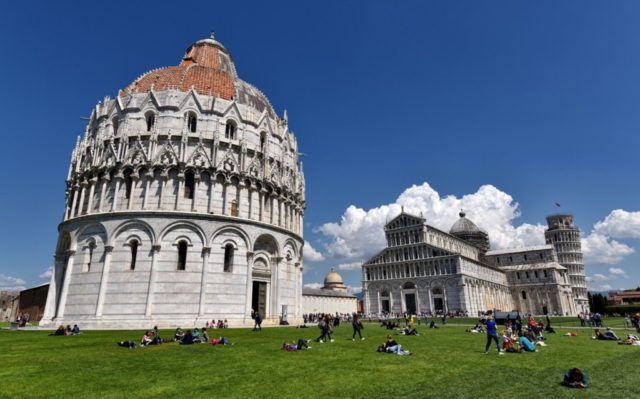
The most famous Tuscan tower, of course, is the tipsy one in the city of Pisa. While the Leaning Tower of Pisa is a touristic cliche, the surrounding Field of Miracles is well worth a visit.

The “Leaning Tower” is simply a bell tower for Pisa’s grand 12th-century cathedral, which mixed Romanesque, Byzantine, and Gothic architectural elements in an eye-pleasing melange called “Pisan Romanesque.” And the cathedral and tower are just two parts of a striking ensemble of white-marble buildings that share an unusual architectural harmony, all connected by a putting-green-quality lawn.

While tourists pose for goofy “holding up the tower” photos, travelers who do a little homework appreciate how these buildings — baptistery, cathedral, hospital, cemetery — symbolically follow the human life span, from birth to marriage to illness to death. (To be entirely clear, it’s perfectly fine to also snap one of those goofy photos. Hey…you’re on vacation.)

In many towns, the tallest tower belongs not to a rich family’s mansion, or even to the church, but to the town hall. Like Scandinavia today, Renaissance Tuscany placed tremendous faith in the role of a well-run state. In fact, Siena’s City Hall — one of the region’s biggest and best — is decorated with frescoes illustrating the consequences of both good and bad government.

Religious as Tuscans were (and remain), they were also humanistic — with a deep, abiding belief in the importance of humanity. While the medieval worldview dictated that the realm of God, Jesus, and the saints was the one and only thing that mattered, Renaissance Humanists began to recognize that the deeds of humans on earth were also significant. In fact, the greatest deeds of humans were seen as the ultimate expression of God’s power.

The right hand of Michelangelo’s David is hyper-detailed and over-developed. In a sense, it’s the hand of God. Michelangelo’s message: The humble shepherd boy David succeeds in slaying the giant Goliath not just because he’s a powerful man, but also because he is super-charged with the will of God. When Michelangelo created a statue, he believed he was chipping away a form that already existed within the stone (put there by God). And when he painted the Sistine Chapel ceiling at the Vatican, it was a great expression of faith in both God and humanity. (The billowing clouds surrounding the famous scene of God giving Adam the spark of life is, not coincidentally, shaped like a human brain.) This harmony between God and humanity is the essence of the Tuscan Renaissance.

And so, when you see the towers of Tuscany, look at them as giant versions of David‘s hand. Tuscan towers are exclamation points — proclaiming the worthiness of humanity overcoming a thousand years of darkness, fear, and brutality. They are a statement that together, and backed by God, humanity can accomplish great things.


Heading to Tuscany? I share a dozen of my favorite Tuscan experiences here.

Our new Best of Tuscany in 12 Days Tour — which begins in 2020 — incorporates many vivid experiences in Italy’s heartland…including visits to many places mentioned here, including a day in Siena, with one of Tuscany’s most striking towers.

Or, to do it on your own, you’ll find all of the details you need in our Rick Steves Florence & Tuscany guidebook.

Experience Tuscany: Lick Artisanal Gelato

Amazing gelato abounds in Italy — and Tuscany is no exception. My favorite gelato artist in the region, Nicola Sgarbi, now has two branches: One in Pienza (called BuonGusto) and the other in Montepulciano (look for Dolcivoglie sign on your way up through town on the main drag, at Corso #50).

In Montepulciano earlier this summer, I stop by Nicola’s shop. As usual, he greets me with a robust “Buongiorno!” and loads me up with little plastic spoons of free samples.

Enjoying all these little tastes, I ask Nicola what led him to the gelato business. He explains that, after apprenticing at a renowned London restaurant, he came back to Tuscany and opened a laboratorio — determined to make his mark on the culinary world.

In those humble days, his first product was jam made from fruit and berries that he gathered for free on the ground of posh villas. The villas had planted fruit trees and berry bushes for aesthetic reasons, and were all to happy to have Nicola put the fruit to good use. Back then, Nicola had only a bicycle, which he’d ride through the idyllic Tuscan countryside to build a network of producers to work with: truffle hunter, vintner, olive oil producer, and so on. (While intended as a sad-sack tale of humble beginnings, this experience sounded pretty amazing to me.)

Slowly Nicola transformed his preserves business into a gelateria. And he is the very best kind of gelato snob. Nicola makes his gelato from scratch each morning, which means it’s not available until around noon. But don’t wait too late in the afternoon to stop by — when it’s gone, it’s gone.

Originally Nicola made only two flavors each morning. Local customers would come in, asking for other flavors they’d seen elsewhere. Unapologetically, he’d steer them to the two flavors on hand. Over time, he re-trained his customers to go for what’s fresh.

Nicola embraces both locally sourced ingredients and unusual flavor combinations. Whether collecting his plums and berries from a local orchard, or shipping in top-quality pistachios from Sicily, hazelnuts from Piedmont, or lemons from Puglia, he always ensures top quality. And the base of his gelato — the milk — is delivered fresh three times each week from a local dairy farm.

While I’ve never seen the same flavors twice, there are always wonderful surprises. On this visit, his creamy basil tastes like an herb garden. In addition to some of the old standbys (done exceptionally well), Nicola enjoys experimenting with exotic flourishes: carrot-ginger, kiwi-spinach, custard with raspberry jam, orange and ginger, and a dairy-free gelato made with chocolate imported from Venezuela.

Nicola points out that — when compared to processed, mass-produced gelato — the real stuff not only tastes better…it makes you feel better. “It’s not just about the taste, it’s about how it digests.” Italians are very in tune with digestion (which is why, for example, they rarely drink milk after lunchtime); for them, good gelato makes you feel good both while you eat it…and after you eat it.

I ask Nicola how a casual visitor can quickly judge the quality of a gelato shop. His advice matches up with the advice I’ve gotten from many other Italians: Look for truly homemade — as fresh as possible. That means you’re looking for small batches, stored in little metal bins, rather than piled high on top of a giant plastic container.  Beware of bright, garish colors that don’t exist in nature — which are artificial and used to attract children’s attention.

While it seems these days every gelateria in Italy advertises artigianale (artisanal or homemade), these claims are not regulated and can be bogus. “That’s why you have to taste before you buy,” Nicola insists.

I ask Nicola which flavor is the best barometer of quality. Real pistachio gelato is very expensive to produce. So thrifty (or unscrupulous) gelato makers do a “faux-pistachio” — cutting their pistachios with pumpkin seeds, sunflower seeds, or almonds. If you know what real pistachio tastes like, it’s a mark of high quality.

Nicola also suggests trying a fruit flavor. While a layperson’s palate may not be able to distinguish between pistachio and sunflower-seed-almond-pistachio, everyone knows what a strawberry or raspberry is supposed to taste like.

Beyond Nicola’s places, I have a few other favorite gelaterie in Tuscany. De’Coltelli, with branches in Lucca and in Pisa, has powerful flavors in the style of Sicily (where, as every Italian knows, all of the best desserts come from). Florence has many good and famous options, but I often find myself at Gelateria dei Nerior or Perchè No. But when traveling in Tuscany, it’s hard to resist the temptation to try several different places to find your favorite. So…don’t resist.


I’ve blogged about Italian gelato before, including advice for how to find the best gelato anywhere, and — for a laugh — a surreal tale of when I became embroiled in a dispute between one small town’s gelato artists. (I survived.)

Heading to Tuscany? I share a dozen of my favorite Tuscan experiences here.

Our new Best of Tuscany in 12 Days Tour — which begins in 2020 — incorporates many vivid experiences in Italy’s heartland…including many, many opportunities to sample Italy’s finest edible art, gelato.

Or, to do it on your own, you’ll find all of the details you need in our Rick Steves Florence & Tuscany guidebook.