Experience Tuscany: Get to Know the Etruscans

Tuscany is named for the Etruscans — those mysterious prehistoric tribes who inhabited central Italy before the ancient Greeks and Romans arrived. While it’s hard to wrap your head around anything that goes back 3,000 years, I find the Etruscans insistently fascinating. Although very little is known about them, it was the Etruscans who laid the earliest cultural foundation for what we today call “Western Civilization.”

The Etruscans peaked around the sixth century B.C., but were defeated and essentially absorbed over time by the more powerful Romans. (It was an Etruscan soothsayer who whispered to Julius Caesar, “Beware the Ides of March.”) Very few actual artifacts of their culture survive, which — to me — only adds to their allure. But a few fragments of art still do exist, exhibited in tragically under-appreciated museums scattered across Tuscany.

The delightful hill town of Volterra remains particularly close to its Etruscan roots. American expat Annie Adair — who leads excellent daily tours of Volterra for Rick Steves readers — once told me that, at a town meeting about whether to run high-speed Internet cable to the town, a local actually grumbled, “The Etruscans didn’t need it — so why do we?”

Volterra has one of the best Etruscan museums in the world, which displays one of my favorite pieces of art from any place or time: the haunting statue called The Evening Shadow (L’Ombra della Sera).

While more than 2,500 years old, this tall-and-skinny work — by an unknown artist — has an unmistakably modern aesthetic. With his supremely lanky frame, distinctive wavy hairdo, and inscrutable Mona Lisa smirk, this Etruscan lad captures the illusion of a shadow stretching long, late in the day. With his right foot shifted slightly forward, he even hints at the contrapposto pose that would become common in this same region during the Renaissance, two millennia later.

Most of what survives from Etruscan times are funerary urns — each one tenderly carved with a unique scene, offering a peek into Etruscan society. Many are decorated with well-dressed figures who recline as if lounging their way through the afterlife. But this pose offers insight into the ways of the Etruscans: People would lie down to enjoy a banquet, and the figures depicted on these urns are actually inviting the gods to a banquet that they hope will be impressive enough to earn them an invitation to paradise.

While there aren’t any striking Colosseum- or Pantheon-type Etruscan landmarks to see, there are a few places where you can see Etruscan tombs, which were built like huge stone igloos, buried deep into the ground.

Walking through a vast, lonely field of themes tombs recently — at Populonia, overlooking Tuscany’s west coast — I could feel the Etruscans reaching out, through eons of history, leaving their mark on Italian culture to in the present day.


Heading to Tuscany? I share a dozen of my favorite Tuscan experiences here.

Our new Best of Tuscany in 12 Days Tour — which begins in 2020 — incorporates many vivid experiences in Italy’s heartland…including learning about those mysterious Etruscans.

Or, to do it on your own, you’ll find all of the details you need in our Rick Steves Florence & Tuscany guidebook.

A Tuscan Island Getaway on Elba: Napoleonic Villas, Salty Fishing Harbors, and Terrifying Gondolas

Pebbly beaches, boat-speckled harbors, and seafood feasts…in Tuscany?

Our just-announced Best of Tuscany in 12 Days Tour includes an island getaway on Elba. This is great news… not only because it’s a dynamite stop on a dynamite tour. But also because, selfishly, it gave me an excuse to finally visit Elba. I hopped a ferry earlier this summer to research a brand-new chapter on Elba for the upcoming 18th edition of our Rick Steves Florence & Tuscany guidebook. And I loved it.

Most people come to Tuscany for great art, rolling farmland, picturesque hill towns, and hearty meat dishes. But Elba — an easy one-hour ferry ride from the mainland — is the perfect Tuscan counterpoint…a delightful seaside break. Elba is synonymous with Napoleon, who was exiled here for 10 months after he attempted — and failed — to conquer all of Europe. But there’s much more to this island than its brief Napoleonic interlude.

Elba’s main town, Portoferraio, fans out from its charming, colorful, historic harbor, which bobs with a mix of luxury yachts and humble fishing boats. I’m lucky to score a room at Porto Sole B&B, overlooking this salty scene. My big windows are perfectly positioned at the corner of the harbor. As if conducting a Monet-type light experiment, I become obsessed with snapping photos from my balcony at different times of day, tracking the slow-motion flux of light and clouds and water texture.

Walking along the breezy harborfront promenade in the late afternoon, I pause to watch fishermen mending nets and preparing their rough vessels for the next day’s trip.

Portoferraio is shaped like an amphitheater, with the harbor as the stage. Setting out to explore, I hike steeply up stone staircases to the mighty, Medici-built fortresses that ring the harbor on three sides.

Catching my breath at the top of countless uneven steps, my eyes are drawn to a stately building nearby: a fine little Baroque-era theater built just for Napoleon during his short stay there. The proud attendant encourages me to step into the serene interior, which has an air of historical class and sophistication that feels a world apart from the gritty harbor below.

I follow my phone’s GPS on a quest to find Napoleon’s onetime residence, the Palazzina dei Mulini, just a few minutes’ walk away. I wind up walking right past it three times, assuming it can’t possibly be the boxy, drab building shown on the map. Finally, I sleuth my way around the left side of that house and find the ticket office, where the ticket-seller seems as listless and unenthused as the villa’s interior.

The recently defeated would-be Emperor of Europe arrived on Elba in May of 1814. As if to extend the flimsiest of lifelines to his sense of dignity, the European powers who negotiated his abdication decreed that he would be the ruler of this tiny Mediterranean island. Napoleon got off on a very good foot indeed when he greeted his new subjects by saying, “I will be a good father to you; you try to be good children to me.”

Walking through the rooms of Napoleon’s residence — which were feebly redecorated to give the little tyrant a fleeting taste of his once-opulent lifestyle — it’s  impossible not to feel the poignancy of a man who believed he was on the verge of ruling the world, suddenly humbled, defeated, and relegated to being the two-bit ruler of a no-name island. (I fight back deep Schadenfreude as I imagine Donald Trump leaving the White House, bankrupting his real estate empire, and moving into a Motel 6.) In one room, a petulant bust of Napoleon sneers at me, as if to say, “Watch the carpet!”

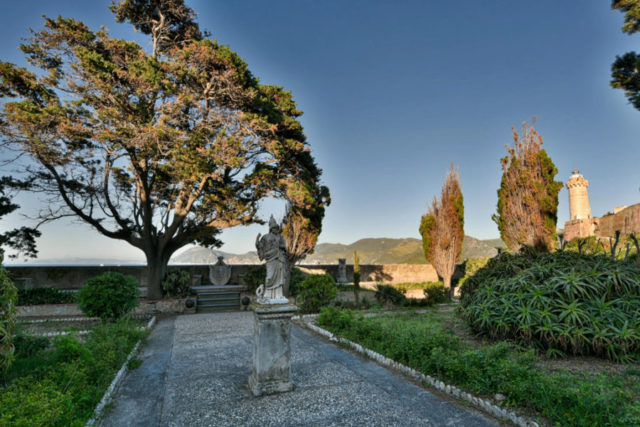
Stepping out onto the villa’s back terrace, I walk through the overgrown garden and peer over a stone wall to see waves crashing at the base of the cliffs far below me — with mainland Italy hovering faintly on the horizon, like a mirage. Again my imagination takes flight, picturing a humbled Napoleon doing furious laps in this little garden…seething, strategizing, and fantasizing about his sure-to-be-triumphant return at a place called Waterloo.
Hiking back down into town, I think about how bizarre it must have been for those loosey-goosey islanders to suddenly find themselves subjects of the most Type-A individual in European history. Napoleon arrived on Elba with an entourage of military leaders and diplomats, thousands of books, and 70 horses. And in his 10 short months ruling Elba, he pushed through infrastructure improvements, implemented education and legal reform, and exploited Elba’s lucrative mines to grow his personal wealth. Like having a houseguest who takes it upon himself to rearrange your cupboards and alphabetize your bookshelves, the people of Elba were probably relieved when he escaped the island for one last military campaign.

Back at sea level, I pull up a tipsy chair at a rustic table for dinner at the harborfront Osteria Libertaria  — gazing out at the very boats that, hours before, delivered the fish to my plate. Feeling adventurous (and needing a break from my steady Tuscan diet of hearty pastas and heavy meat), I order the carpaccio di ricciola marinata (yellowtail carpaccio drizzled with olive oil) and the linguine con acciughe e finocchietto (pasta with anchovies and wild fennel). Feeling the wispy anchovy bones getting stuck in my teeth, I’m satisfied — just this once — getting a break from pappardelle alla bolognese.

Beyond Portoferraio, Elba is a joy to explore by car. While quite small (just 18 miles long by about 11 miles wide), Elba has a dramatic landscape. Towering, stony mountains reach up to puffy clouds, and driving what looks like “a short distance” on the map takes much longer than expected — thanks to serpentine roads that twist up and over the many hills and mountains, and along the undulating coastline.

Following those curving roads, I make my way to the charming seafront town of Marciana Marina, which feels mellow and welcoming, with a tidy cobbled square and a beachfront promenade. (Visiting in May, I’m warned that July and August are anything but “mellow” — in fact, I’m repeatedly told it’s best to stay away during those peak-of-peak months. But May, early June, late September, and October are divine.)

Italian beaches don’t often appeal to me. They tend to be crowded, rocky, and greedy (charging a high price for chair and umbrella rentals). For Americans accustomed to Hawaiian or Caribbean beaches, Italian ones are pretty disheartening. As if too put too fine a point on the shortcomings of Italian beaches, the one in Portoferraio is called Le Ghiaie — literally, “The Gravel.” But Marcina Marina’s pebbly, crystal-clear shoreline makes me wish I had time for a dip.

From the seafront, I follow a winding road up, up, up the mountain to the village of Marciana, where I’ve heard that a gondola can take me up to the summit of Monte Capanne. Leaving my car, I follow a gurgling mountain stream up to the ticket desk. My jaw drops when I look up to see that the “gondola” consists of flimsy yellow metal cages, open to the air, suspended from above.

Gulping hard, I step inside my cage. The gate slams weakly shut behind me, and I begin my ascent. For 20 excruciating minutes, I feel like a terrified parakeet going for the ride of my life as I trundle sloooowly up the side of the mountain. The terrain 30 feet below me gradually transforms from alpine forest to naked, serrated rocks. I grasp the bars of the cage so hard my hands start to hurt, and each little bump or jostle tests my faith in Italian engineering. At one point, gripped by abject terror, I think I even record an “in case something goes wrong, tell my wife I love her” voice memo on my iPhone.

Exiting the gondola at the top — after kissing the ground for several minutes — I hike steeply up a rocky, uneven path to the highest point on the entire island, 3,300 feet above sea level. From here, jagged mountain spines — like the backs of giant dinosaurs — spin off in every direction. At my feet are the hill town of Marciana and its port of Marciana Marina, in the distance is Portoferraio, and Corsica looms to the west. On my way down to the gondola, I tiptoe (c-a-r-e-f-u-l-l-y) to the edge of a deserted helipad, where I contemplate, as if for the first time, the meaning of “vertigo.”

On my way back toward Portoferraio, I stop at Napoleon’s other Elba residence — his country home, Villa San Martino. This one is, if anything, even more depressing than his in-town digs. The shabby interior (halfheartedly dressed up with C-minus frescoes) seems designed to make it clear that he was being punished. And the elaborate but empty Neoclassical-style hall that was built next door — with colonnades, ornate ceilings, and geometric designs on the floors — feels somber, stately, almost tomb-like.

Later that day, I go for an evening stroll in the seafront town of Porto Azzurro (a short drive from Portoferraio). Classy without feeling objectionably ritzy, this pleasant village — scenically set under jagged cliffs, its harbor sheltering sailboats and fancy yachts — feels like a poor man’s Portofino. On Porto Azzurro’s elegant main square, I lick gelato on a bench under a genteel trellis. Low in the sky, the sun shines on the piazza like a spotlight — illuminating a vivid tableau of island Tuscany. Kids are playing soccer, their grandparents are gossiping on the benches, and cops are taking a break from walking their beat to chat with neighbors.

Sitting there on that square, feeling a world away from Michelangelo’s David or the Leaning Tower of Pisa or the turrets of San Gimignano, I am very happy I decided to take a chance on island Tuscany. If — and I’m not saying this is likely to happen, but if — all of the Botticellis and Brunellos and giant rare slabs of Chianina beef start getting a bit old… well, then, Elba is the perfect seaside counterpoint to your Tuscan vacation.


Italophiles, stay tuned! More Tuscan tips are coming in the next few days.

The Elba chapter I was researching will be included in the upcoming 18th edition of our Rick Steves Florence & Tuscany guidebook — available in fall of 2019.

Elba is also a stop on our brand-new Best of Tuscany in 12 Days Tour. This is a fantastic itinerary that highlights both Tuscany’s big, famous stops and some off-the-beaten-path gems…including a seaside break in Elba.

Experience Tuscany: Take a Cooking Class

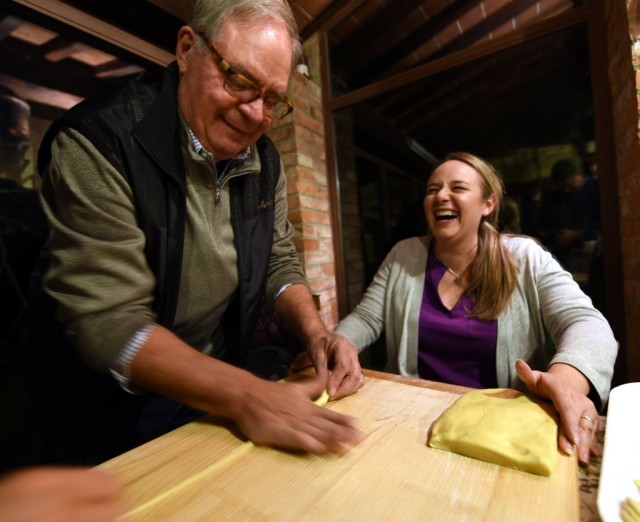
“Tuscan cooking classes” are an entire subgenre of travel. I’ve blogged more about this subject than I have about entire countries. That’s because this region has an outrageously appealing food culture — ranging from big, sloppy plates of pasta to refined high cuisine. And there’s a cooking class or a food experience for every taste. Here are a few of my favorites:

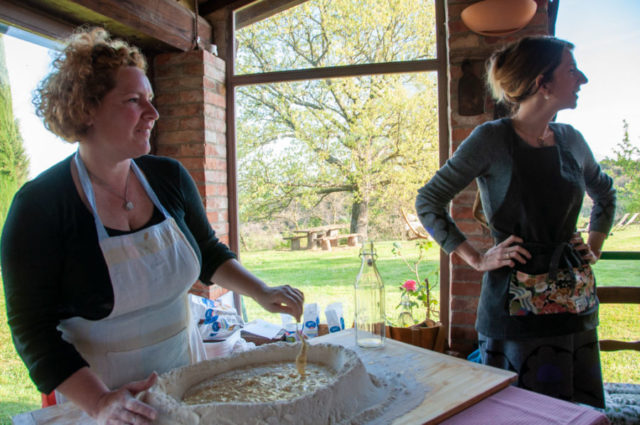
At the Cretaiole agriturismo, every Thursday night is pasta-making night: All of the week’s guests gather on the veranda, and Carlotta and Isabella walk everyone through how to make the local, hand-rolled pici noodles — from a little volcano of flour to a delicious feast. Everyone gets in on the action: Grandparents and little ones all challenge each other to roll out the perfect noodle.

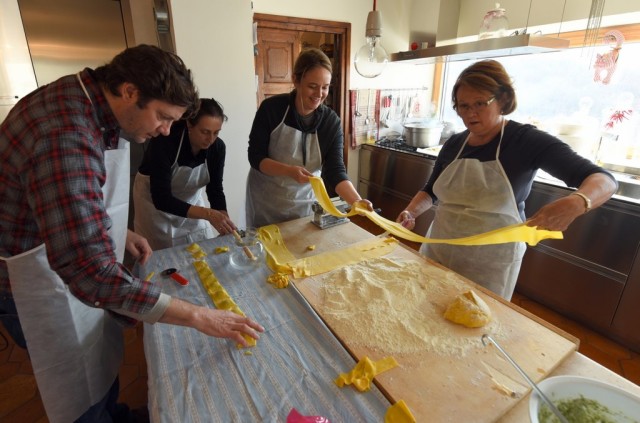
High in the hills overlooking the Val d’Orcia, we went to the home of Mamma Laura, who instructed our small group how to assemble a seasonal feast. From the moment we arrived, Mamma Laura masterfully orchestrated the meal. She’d demonstrate the task at hand — chopping up chunks of squash, packing ingredients into little pouches of cabbage, rolling out long sheets of pasta dough — then turned us loose to try it out. Ingredients would disappear into an oven or pot or blender, then reappear when it was time for the next step. Miraculously, everything was finished at exactly the right time. And it was all outrageously delicious.

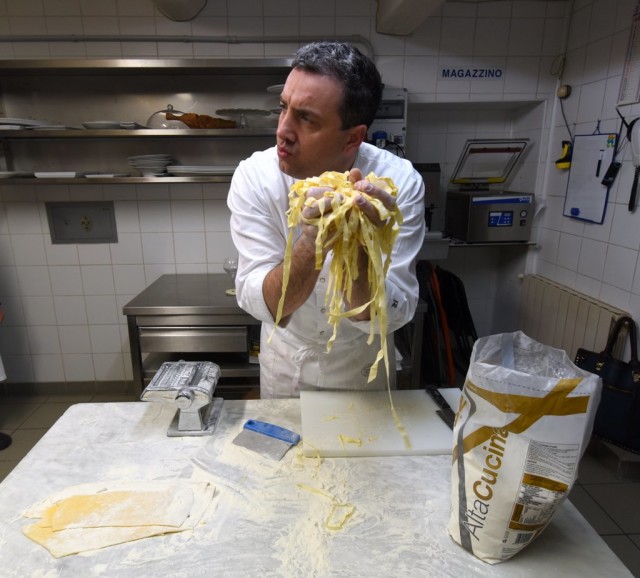
Chef Roberto invited us into his Michelin-star restaurant, hiding out on the summit of Monte Amiata. This wasn’t quite a “cooking class.” We were flies on the wall of a brilliant chef’s working kitchen — a graduate-level seminar on Advanced Italian Flavors. He threw together a luxuriously creamy risotto sprinkled with precious, aged parmigiano reggiano cheese. He attacked a wad of dough with his knife, demonstrating how to make a half-dozen different types of pasta. He threw together a batch of all-purpose, vibrant salsa verde that instantly answered the question “What do you put it on?”: Anything. And he whipped up a batch of pastry cream drizzled with aged marsala wine. And then, after all of this…we had dinner.

Some food experiences are more about sourcing the ingredients than the actual cooking. One misty, chilly late-November day, I followed a persistent pooch named Mili and her owner through a damp oak forest, sniffing out precious truffles embedded deep beneath the soil. Once she found one, her owner tenderly unearthed the truffle — that pungent nugget of decadent flavor — with a special shovel. Digging into our truffle pasta later that day, the flavors were all the more delicious.

If you’re seeking not just food — but food experiences— there are few better places in Europe to find them than Tuscany.


Heading to Tuscany? I share a dozen of my favorite Tuscan experiences here.

Our new Best of Tuscany in 12 Days Tour — which begins in 2020 — incorporates many vivid experiences in Italy’s heartland…including a hands-on cooking class.

Or, to do it on your own, you’ll find all of the details you need in our Rick Steves Florence & Tuscany guidebook.

Experience Tuscany: Linger on a Convivial Piazza and Join the Passeggiata

In Italy, the piazza is the town’s living room. This is where Italians practice the art of la dolce far niente — “the sweetness of doing nothing.” And Tuscany has some of the best piazzas in all of Italy.

Florence has two contenders. Majestic despite being jammed with tourists, the Piazza del Duomo peers up at the stunning, colorful facade of the cathedral, capped by Brunelleschi’s exquisite dome.

A few blocks away (down one of the most tourist-clogged streets in Italy) is the grand Piazza della Signoria. A replica of Michelangelo’s David stands guard at the base of the Palazzo Vecchio — the stout fortress of the Medici family that bankrolled so much of what tourists come here to see.

Next door are the former offices (uffizi) of the Medici — now occupied by one of the world’s great art collections. Unlike the Piazza del Duomo, the Piazza della Signoria feels expansive and airy — the kind of place you want to just hang out.

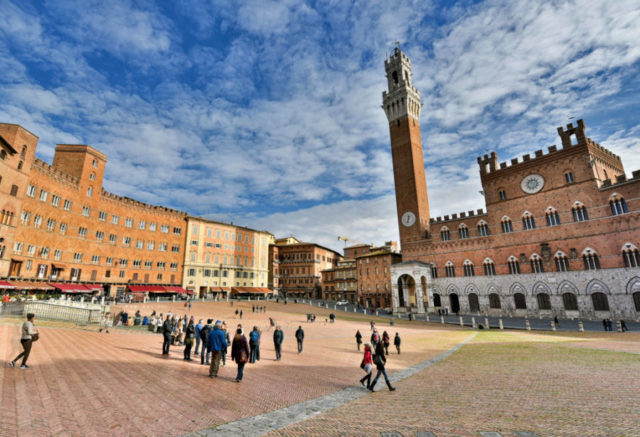
Grand as Florence is, the connoisseur’s favorite piazza is Siena’s Il Campo — a massive, gently sloping, oblong, red-brick-paved people zone that splays out from the mighty tower of City Hall.

This rounded “square” acts like a magnet on visitors to Siena — it’s impossible to resist its pull. This is one of those places where it’s worth paying way too much for an aperitivo and a bowl of potato chips, just for the privilege of people-watching. And twice each summer, the famous Palio horse race — in which Siena’s neighborhoods (contrade) vie against each other for bragging rights — turns the square into a wild racecourse.

Every Tuscan town has its own piazza where people gather. And each one has its own story. For example, little Pienza has a tiny main square that packs a huge Renaissance punch.

Pienza is named for Pope Pius II, who was born here in 1405. After he became pope, Pius brought an esteemed colleague to his hometown, and was deeply embarrassed by how humble and backwards it all seemed. So he hired some of the most accomplished architects of the day to come and transform it into a showcase Renaissance town.

The perfectly symmetrical, painstakingly geometrical result is the town that visitors tour today. The lines in the pavement align with the ones on the buildings — creating a three-dimensional gridded cube that frames the elegant cathedral facade. They even made the windows at the far end of the square larger than the ones at the near end, just to make the space feel even bigger and even more perfect.

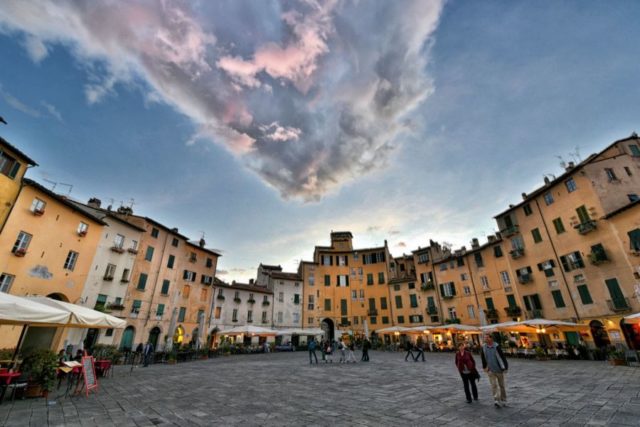
In postcard-perfect Lucca, Piazza dell’Anfiteatro fills the footprint of the ancient Roman amphitheater.

A half-dozen other, smaller piazzas honeycomb the old center, connected by traffic-free streets. In the evening, the Lucchese stroll between these squares — chatting, promenading, licking gelato, catching up with neighbors, complimenting little kids on how much they’ve grown, talking vigorously with their hands, and simply being together with their community. This is that quintessentially Italian custom called the passeggiata.

The old-timers hang out on the stone benches built into the facade of the town post office, watching the world go by, grousing and reminiscing. It’s like one big communal living room. (I just love Lucca. How could you not?)

And even small, no-name, unspectacular Tuscan piazzas are very inviting. Montepulciano’s Piazza Grande is nothing special, but — like all things in this region — it’s draped in a rustic-yet-elegant harmony. The little stone well at the corner of the square is a fixture of many Tuscan hill towns — which needed to be self-sufficient and siege-resistant. On Montepulicano’s well, you can run your fingers through grooves carved by centuries’ worth of ropes, pulling buckets up and down.

Whether in a big city or a small town, Tuscan piazzas are a fixture of the community and a highlight for slow-down-and-smell-the-pecorino travelers.

Where are your favorite Italian piazzas?


Heading to Tuscany? I share a dozen of my favorite Tuscan experiences here.

Our new Best of Tuscany in 12 Days Tour — which begins in 2020 — incorporates many vivid experiences in Italy’s heartland…including ample free time to hang out on the piazzas and join the passeggiata in Florence and Lucca.

Or, to do it on your own, you’ll find all of the details you need in our Rick Steves Florence & Tuscany guidebook.

Experience Tuscany: Visit Off-Season — and Have the Place to Yourself

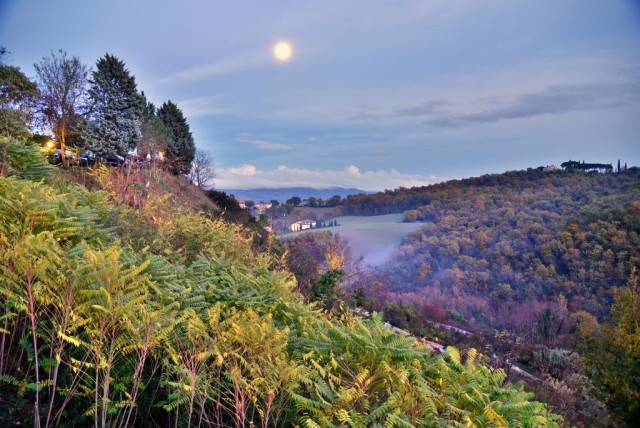
Tuscany is marvelous in all seasons. I’ve been here in the springtime, when the fields are a vivid AstroTurf-green and everything’s draped in explosively purple wisteria. And I’ve been here in late September and October, after the hot summer sun has scorched everything to a uniform brown — revealing the rugged contours of the landscape.

But one of my favorite visits was off-season, in late November — when I came to the Val d’Orcia with my wife’s family for a Tuscan Thanksgiving celebration. (Of course, Tuscans don’t normally celebrate Thanksgiving — but Isabella, who runs the Cretaiole agriturismo, quite rightly figured it was a great time to invite Americans to Tuscany for an off-season break…and she made sure we got the requisite turkey on Turkey Day.)

While not quite “tropical,” Italy has a warmer climate than much of Europe. When Germany and England are in parkas and snow boots, Italians are in sweaters and windbreakers. Even better, Tuscany — so jammed with visitors from April through October — is far less crowded off-season. It becomes possible to be spontaneous. You can simply drop into restaurants or museums that have long lines or require reservations in peak season.

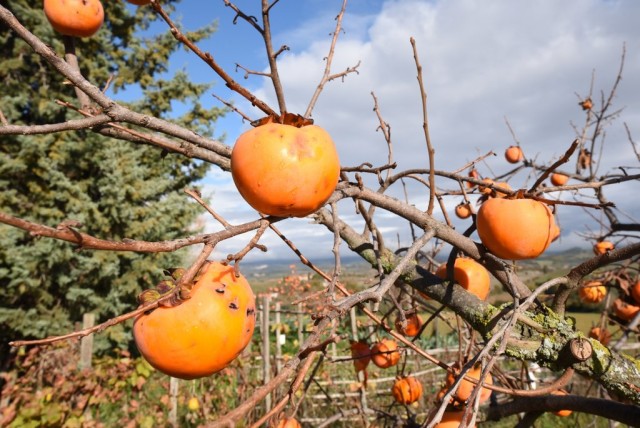
During our late-November visit, the air was crisp but not cold, and the sun — when it emerged — was quick to warm us. Thanks to a fuzzy-green crop of winter wheat, the landscape was, to my surprise, more colorful than it is in October. And seasonal flavors that are only available at this time of year — plump orange persimmons, luxuriously roasted chestnuts — were explosively delicious.

The days were short, but the evenings were cozy. At Creataiole, our apartments had fireplaces and a generous woodpile that we could help ourselves to. And Luciano’s powerful grappa was a surefire way to warm up on a cold evening.

By the time we left Tuscany — during the first few days of December — holiday decorations were beginning to pop up in some of the towns: tasteful twinkle lights, Christmas trees trimmed with restraint, and rustic wooden kiosks just setting up for Christmas craft and food markets.

Europe’s popular sights and areas — like Tuscany — are increasingly, unpleasantly crowded. If you’re someone who’s reluctant to visit a place where you’ll feel like one of the herd, off-season travel is a smart alternative.


Read my full report on my Thanksgiving in Tuscany — including many tips on off-season travel in general.

Heading to Tuscany? I share a dozen of my favorite Tuscan experiences here.

Our new Best of Tuscany in 12 Days Tour — which begins in 2020 — incorporates many vivid experiences in Italy’s heartland. We have departures as early as April and as late as October, allowing you to avoid the heat and crowds of peak season.

Or, to do it on your own, you’ll find all of the details you need in our Rick Steves Florence & Tuscany guidebook.