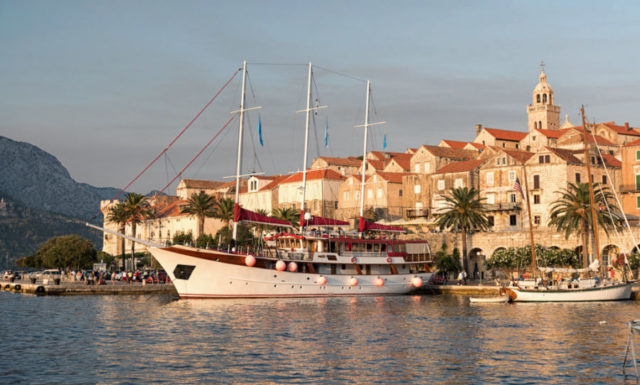
How to Visit King’s Landing: Game of Thrones Locations in Croatia and Beyond

Game of Thrones tourism has become big business at locations all over Europe — in Croatia, Spain, Iceland, and Northern Ireland — where curious travelers from around the world come to walk in the footsteps of Jon Snow, Daenerys Targaryen, Tyrion Lannister, and the Stark kids. I’ve enjoyed watching this phenomenon take hold in a sleepy town I’ve known since long before it became synonymous with Westeros: Dubrovnik, Croatia…or, as GoT fans know it, King’s Landing.
On my last visit to Dubrovnik, I stayed in a delightful B&B in an old stone house, buried deep in the heart of the Old Town. Like a swallow’s nest in the rafters of a busy cathedral, I was central to everything, yet just removed from the hustle and bustle. On my first evening, enjoying the peace and quiet and the cool of dusk in my B&B’s private garden, I heard the distant clang of a handbell. A few minutes later, I heard it again. It was simply mysterious: Over many years of visits, I’d never heard this before. But that occasional toll of a handbell quickly became the soundtrack of this visit to Dubrovnik.

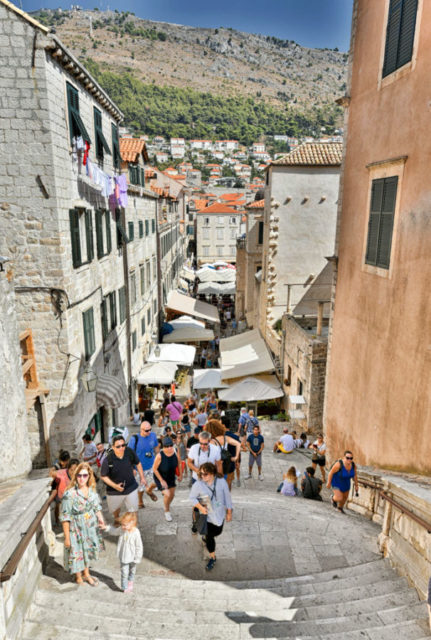
On my third day in Dubrovnik, I finally figured it out: As I was descending the grand, steep staircase that leads from the Jesuit church down to the main drag, I heard the bell clang again — this time followed by chants of “Shame! Shame! Shame!” Glancing over, I saw a Game of Thrones walking tour, beaming with giddy delight at re-creating the most humiliating experience of Cersei Lannister’s life.
Game of Thrones Locations in Dubrovnik

Fans of the HBO television series Game of Thrones may feel the tingle of déjà vu during their visit to Dubrovnik. On the show, Dubrovnik and the surrounding coastline and islands provided the setting for two main storylines: the royal family intrigue at King’s Landing; and Daenerys Targaryen’s conquest of the continent of Essos, from idyllic Qarth to the cities of Slaver’s Bay. Of course, in most cases, the real-life Croatian locations are dressed up with special effects — the sea, rocks, and bottoms of the buildings are real, while the fanciful towers and spires (and the dragons) are pure fantasy. If you digitally plop the Sept of Baelor in the middle of Dubrovnik’s Old Town, presto! King’s Landing. (The series stopped actually filming in Dubrovnik a few years back, and yet, the town’s real-life landmarks continued to appear on the series even through its final episode — re-created using a combination of archival footage and digital reconstructions.)

The chance to visit the “real King’s Landing” and other important sites has begun to attract a new breed of traveler: “set jetters” whose passion for the show attracts them here from around the globe. For die-hard GoT geeks, here are some specifics (mild spoilers ahead for early seasons of Game of Thrones):

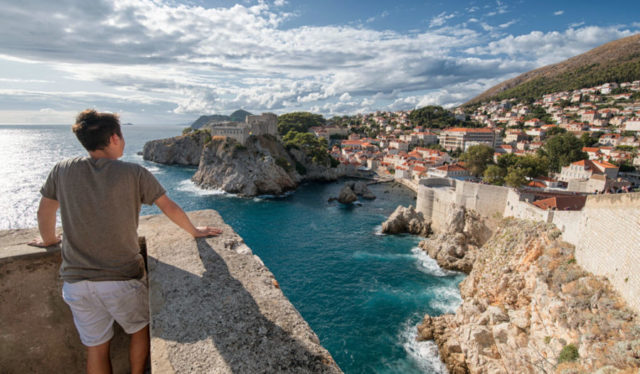
The real-life Fort of St. Lawrence (Tvrđava Lovrijenac) — the Red Keep of Westerosi royalty — looks over a pleasant cove that stands in for Blackwater Bay, the site of a calamitous naval battle in season two, and some poignant Stark family goodbyes in the series finale.

The City Walls, which wrap entirely around Dubrovnik’s Old Town, have seen frequent airtime as the mighty fortifications of King’s Landing — the site of many strategic (and scenic) conversations between the royals and their advisors. And in the epic Battle of King’s Landing, Drogon strafed these walls and bastions with dragon fire.

Several of the streets in Dubrovnik’s Old Town — especially St. Dominic’s Street (ulica Svetog Dominika), connecting the main drag to the PločeGate — become the crowded market streets of King’s Landing. The real-life “Rupe” Ethnographic Museum, in the upper reaches of the Old Town, served as the exterior of Littlefinger’s brothel.

The greater Dubrovnik area features more locations: The eventful “Purple Wedding” of Joffrey and Margaery was filmed in Gradac Park, just outside the Pile Gate. The epic duel between Oberyn Martell and The Mountain was filmed at the amphitheater below Hotel Belvedere, facing Dubrovnik’s Old Port. And the island of Lokrum played host to the Qarth garden party. Today, a monastery on Lokrum hosts a very modest exhibit about the Game of Thrones filming.

The fortress where Daenerys’ young dragons were held captive was Minčeta Tower (the highest point in Dubrovnik’s City Walls).  Later, when her dragons got bigger, they were chained up in a dungeon that was filmed deep inside the cellars of Diocletian’s Palace, just up the coast in Split.

Trsteno Arboretum, just north of Dubrovnik, is where Sansa Stark had many heart-to-hearts with Olenna and Margaery Tyrell. And the fortified town of Klis, just north of Split, was the slaving town of Meereen.

While it’s easy enough to find these locations on your own, various companies in Dubrovnik offer Game of Thrones sightseeing tours (two well-established local outfits are Dubrovnik Walks and Dubrovnik Walking Tours).

When Your Hometown Becomes King’s Landing

For their part, the people of Dubrovnik recognize that it’s an honor to play a major role in history’s most epic television series. And they’ve enjoyed the ride. For years, locals have been excitedly telling me about their brushes with Game of Thrones greatness: Seeing Peter Dinklage, in full Tyrion Lannister regalia, strolling down the main street. Or sitting down for dinner at a neighborhood konoba and spotting Joffrey at the next table. One of my Dubrovnik friends was an extra — dressed as a blink-or-you’ll-miss-him nobleman at a royal wedding.

At times, the filming could be frustrating. The route of Cersei’s “Walk of Shame! Shame! Shame!” — which traversed essentially the entire historic town center of Dubrovnik — was walled off with high privacy fences. And in this vertical town, that meant that locals who were caught unawares had to circle up a steep stepped lane, then all the way around town, just to cross the street. But one elderly woman — a local fixture famous for her incredibly slow gait — reached the fence and asked very kindly if she might be able to take a shortcut. The crew took pity on her, halted production, opened the gate…and proceeded to hemorrhage money as they watched her hobble through the middle of their set for several excruciating minutes.

For the first few years of the Game of Thrones phenomenon, Dubrovnik remained oblivious to the touristic gold mine they had stumbled into. I recall one visit, around season three, wondering why there was not one Game of Thrones attraction, tour, or brochure in town. For a city whose lifeblood is tourism, it seemed clueless.

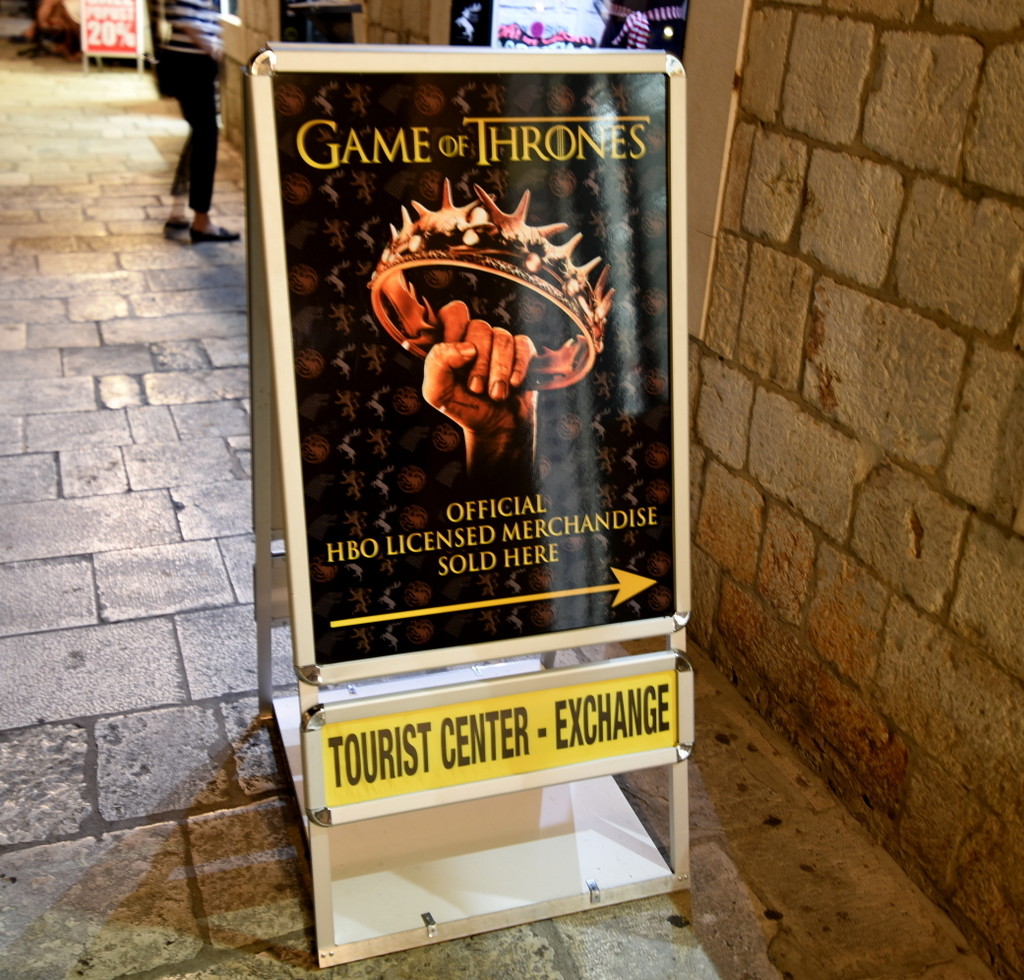
But soon Dubrovnik caught on, and fast. By the time of my next visit, just a year or two later, Dubrovnik was awash in Game of Thrones-themed attractions: walking tours, souvenir stores, a sunset cruise where passengers are invited to dress up in Game of Thrones costumes, and a shop with a replica of the Iron Throne. If you buy an overpriced souvenir, you can take a picture of yourself seated as the Lord of the Seven Kingdoms. (The cheapest trinkets I saw were $6 lighters and refrigerator magnets, making this one expensive photo op.)
This sudden fame requires adjusting to a new clientele. I asked a local guide how she felt about adding Game of Thrones locations to her walking tours. She said she didn’t mind. But some customers are asking her, “Can you just do Game of Thrones locations, without all of that boring Dubrovnik history?” That’s where she draws the line: If you want GoT, you’re gonna get some Dubrovnik, too. (Respect!)

Game of Thrones has helped put Dubrovnik on Hollywood’s map for other projects, too. The town stood in for the casino city of Canto Bight in Star Wars: The Last Jedi, and 2018’s Robin Hood was shot in the Old Town. (My local friends were impressed by the construction of wood-frame castle extensions to the City Walls at the Old Port — and then were disappointed when everything was burned down for the film’s finale.) Mamma Mia! Here We Go Again was filmed on the nearby “Greek Island” of Vis, Croatia. And persistent rumors suggest that the upcoming 25th James Bond film (featuring Daniel Craig’s final appearance as 007) may use Dubrovnik as one of its primary settings.

[Update after Season 8: Watching the final two episodes of the series — with the horrifying events of the Battle of King’s Landing and its aftermath — it was painful to see the fine old buildings of Dubrovnik destroyed by dragon fire. It felt like witnessing a place I actually know being wiped from existence — and even more poignant when you consider that the real Dubrovnik was badly damaged in a military siege during the Wars of Yugoslav Succession in the mid-1990s. I imagine watching those scenes hit a little close to home — perhaps literally — for the residents of Dubrovnik.]

More European Game of Thrones Locations

Other European destinations have played major roles in Game of Thrones. Beyond Croatia, the warmer-weather, tropical areas of Westeros and Essos have been filmed mostly in Spain — where, for example, the Alcazar Gardens of Sevilla appeared as the lavish and lush backyard of the Martell clan, and the bullring in Osuna was the site of an epic battle in Meereen. If you want to hike up the vertiginous, rocky trail to Dragonstone Castle, you’ll find it at San Juan de Gaztelugatxe in the Basque Country.

The frigid areas North of The Wall were mostly filmed in Iceland. Major tourist areas — such as Þingvellir, the dramatic and historic gorge on the Golden Circle tour route — were used as locations for some of this rugged scenery, as were far more remote areas that are all but inaccessible to casual tourists. In the North of Iceland (near Lake Mývatn), one popular stop is Grjótagjá, the hot-water spring grotto where Jon Snow and Ygritte, ahem, violated the oath of the Knights’ Watch.

And the temperate landscapes of the North near Winterfell, plus many of the jagged coastline scenes (and lots more), were shot in Northern Ireland — also the site of the primary studio for interior filming (Belfast’s Titanic Studios, which recently opened a GoT exhibition).

For honorable mention, consider Wester Ros, an area in the northern Scottish Highlands; while it hasn’t appeared on screen, its rugged, cinematic scenery inspired George R. R. Martin to name his fictional land “Westeros.”

Of course, there’s so much more to see and do in Croatia, Iceland, Ireland, and Spain than hunt down Game of Thrones locations. But if that’s what it takes to draw visitors to these wonderful corners of Europe, I’m all for it…especially if those “set jetters” are willing to put up with some real local stories alongside the fantasy lore. I’m not against using trojan horses to get people traveling. And I have to admit: It’s fun to see some of my favorite spots in Croatia popping up on one of my favorite TV shows.


Have you enjoyed visiting the filming locations of famous movies and TV shows? I’d love to hear about it — please share your favorite experiences in the comments.

And if you’d like to discover Game of Thrones locations yourself, check out our guidebooks on Croatia, Iceland, Spain, and Ireland.

It’s Truffle Day in Istria

Waking up in my cozy, cavelike apartment, buried deep in the winding streets of Rovinj, I have a special spring in my step. Today I’ll be touring the hill towns of Istria. And you know what that means: Today is Truffle Day.

The Istrian Peninsula — a wedge-shaped appendage dangling from the northwest corner of Croatia — has some of the world’s richest truffle deposits. Truffles love the damp floor of the oak forests that fill much of the Istrian interior. In 1999, a local entrepreneur unearthed a nearly three-pound white truffle. And ever since, Istria — and Croatia — have exploited their connection to these pungent, earthy, delicious little nuggets of flavor.

Truffles are tough tubers that grow entirely underground, virtually undetectable — except for their distinctive scent, which can be picked up only by the trained snout of a dog or a pig. Strolling through an Istrian hill town, you pass paddocks of noisy dogs…not pets, but working dogs, who help provide this region its livelihood. Truffles have been harvested in Istria since antiquity, and in more recent times of hardship, they’d be eaten as a stomach-filling substitute for meat. But these days, they represent a significant chunk of the local economy — and of the emerging Croatian culinary identity.

On my first visit to Istria, researching the first edition of my Rick Steves Croatia & Slovenia guidebook a decade and a half ago, I knew little about truffles…and, to be honest, wasn’t even sure if I’d ever tasted one. My local guide — who seemed to take it as a personal challenge to pry open my culinary blinders — brought me to a high-end restaurant (owned by that lucky giant-truffle discoverer) where every dish on the menu involved truffles. It was an education.

We dug into a tasting menu that included truffle-embedded hard cheeses and salami, truffle-infused pâté and tapenade, truffle frittata, handmade pasta grated with fresh truffles, vegetables sautéed in truffle oil, and truffle ice cream.

To this day, every time I start sketching out an itinerary to Croatia, when I get to Istria…my tongue tingles with the phantom flavor of truffle. And this morning, as I set out to explore the countryside, I already know that today will be my best “food day” of the trip.

Driving inland from Rovinj, I exit the Y-shaped “upsilon” highway and quickly lose myself in back roads, lacing together fine vistas and sleepy hill towns, stopping off at rustic rural hotels and restaurants, and driving past hardworking vintners — just preparing for the harvest — and the characteristic stone farmer huts called kažun. Istrians brag that their fertile soil comes in three colors — white, black, and red — which dictate the nuanced characteristics of local wines and produce. And on this September day, the hillsides are striped with colors.

Finally, it’s time for lunch. From Livade — the hub of the local truffle industry — I follow winding country lanes about 10 minutes to reach a middle-of-nowhere konoba I have been wanting to try. Pulling up the gravel driveway into Konoba Dolina (“Valley Inn”), I’m greeted perfunctorily and seated at a table with a polyester pink tablecloth, still stained by whoever just ate here. This place is nondescript and purely functional — not even charming enough to qualify as “rustic.” You’d never know this humble place was any good, if it weren’t for the happy hum of diners who fill the terrace.

Virtually every menu item highlights truffles. Knowing I’ll have pasta later, I choose the “pork loin with truffles.” It’s a simple but perfectly grilled slab of pork served on a bed of roasted and lightly smashed potatoes, delicately dusted with a generous layer of fresh-shaved black truffle. The dish is perfectly seasoned and outrageously good — and just 100 kunas (about $15).

As I eat, I notice that the jovial, fiftysomething Germans at the next table keep glancing over at me with a knowing smile — clearly enjoying how much I’m enjoying my food. When I get up to leave, one of them lifts his glass in a silent toast, one truffle aficionado to another.

Totally stuffed — and feeling the most blissful (and most sluggish) post-meal high of my trip — I waddle back to my car and drive across the valley, then twist up, up, up like a corkscrew along the slopes of Motovun — the ultimate Istrian hill town.

I park near the base of the cobbled main street and trudge 15 steep minutes up to the main square. I take my time, enjoying the tranquility, the refreshing breeze, and the peekaboo views of the gentle Istrian countryside: vineyard-draped hills over oak tree-dappled valleys.

Nearing the summit, I pass the restaurant I’ve already preselected for tonight’s dinner: Mondo Konoba. The problem is, it’s only been about an hour since my filling lunch. Normally I hope to get through my work as quickly as possible. But deep down, I’m secretly hoping that Motovun slows me down a little today…juuust enough to recover my appetite.

For the next few hours, I attend to my guidebook-research rounds in Motovun. Much hasn’t changed, but some things have. For example, the only hotel in town has opened an endearing town history museum, which I enjoy touring. I always knew that racecar driver Mario Andretti grew up in this traffic-free little burg. But it was fun to see an interview of him getting a little emotional talking about his hometown. (We love wee Motovun so much that our Rick Steves’ Best of the Adriatic Tour spends two nights here…and you can be sure that our tour members taste some local truffles.)

Sure enough, my to-do list is completed just in time for the opening of Mondo Konoba…and my next truffle feast. Mondo Konoba is run by a Sicilian-Istrian family who injects a little southern Italian pizzazz into their dishes. I sit on the little patio and peruse the menu.

I think I’ve made my selection — homemade ravioli with black truffles — when my server turns the page. “But did you see the white truffle menu? We have some of the first white truffles of the season.” Ah, the elusive “Queen of the Truffles,” freshly unearthed by some clever Istrian mutts. The menu is basically identical to the black truffle menu, but each price is around $8 to $10 higher. That’s a lot to spend on fragrant fungus. But how can I resist? After all, it’s Truffle Day. Homemade ravioli with white truffles it is.

As the sky fades from pink to deep blue, the plate of pasta arrives, and a precious lobe of white truffle is grated on top, before my eyes. The ravioli is stuffed with a mix of spinach, celery, and cauliflower, and if anything, it’s a little underseasoned. But this may be intentional: The preparation allows the truffles to really take center stage. These white truffles are noticeably different from the black truffles at lunch: Extraordinarily earthy, almost nutty. Subtler, yet somehow also more pungent. Like a fine Belgian praline instead of a Hershey bar.

After the meal, I roll down the hill to my car and drive through the inky Istrian night back to Rovinj. It’s been a very, very good Truffle Day indeed. But, if I’m being honest, when I head to Slovenia tomorrow…I may be ready for a little truffle detox.

━━
This post was published in 2018.

Adriatic Island-Hopping: Decoding the Schedules

Keeping our Rick Steves Croatia & Slovenia guidebook fully up-to-date, I really sweat the details (often literally). If you think travel writing sounds glamorous, I invite you to shadow me for a few hours as I stand in long lines at ferry terminals, quizzing agitated ticket clerks and squinting at byzantine schedules, on a mission to to help our readers smoothly ply the waters of the Dalmatian Coast.

But I digress. The good news is that the boat situation is getting better and better in southern Croatia. More high-speed passenger catamarans are setting sail each year, zipping travelers between Dalmatia’s many dreamy destinations. However, the boat companies love monkeying around with their schedules as much as I do with my fantasy football lineup. Which means that even our relatively fresh, year-and-a-half-old guidebook is already hopelessly out of date.

The other challenge is that three separate companies run catamarans between Split and Dubrovnik. And, because they operate independently, you have to do your homework to know how to get from point A to point B. But if you do your homework, island-hopping is a breeze.

One Saturday night in Dubrovnik, as I heard the distant thumping bass of the neighborhood jazz club echo up the narrow lane to my B&B, I spent a couple of hours spreading out all of the various schedules on my bed and mentally tracing the route of each and every boat as it ferried to and fro between Dalmatian islands. By the time the clock hit midnight and the music went quiet, I hadn’t had any fun…but our book is, once again (and, you can be sure, very temporarily) up to date.

If you’re hoping to take a Croatian boat anytime soon, here’s the brand-new, cover-all-our-bases text that will appear in the upcoming seventh edition of Rick Steves Croatia & Slovenia:

While slow car ferries plod up and down the Dalmatian Coast, for most travelers, the best connections are on  fast passenger catamarans. These are run by three different companies, and the only way to fully understand all of your options is to check the websites for all three: Jadrolinija (www.jadrolinija.hr), Krilo (www.krilo.hr), and Nona Ana (www.gv-line.hr). Boats can sell out at busy times. Fortunately, you can book online at all three of these sites (though Jadrolinija requires you to book in person for same-day departures). Ideally, get your tickets at least a day or two ahead —  or longer, in peak season. All three companies can send an e-ticket to your phone, which the attendant will scan as you board. At busy times, be sure to arrive at your boat a little early, since the best seats go fast. For the best views, sit on the port (left) side of the boat on northbound journeys, and on the starboard (right) side when going south. Happy sailing!

12 Days of Dalmatia: A Sunny Photo Essay

As the December gloom descends, I have particularly fond memories of my late-summer adventures on Croatia’s Dalmatian Coast. Here are a dozen of my favorite photos from that trip, prefect for chasing away the winter blues. If you’d like to do more than just look at pretty pictures, plan your own journey with my Rick Steves Croatia & Slovenia guidebook (currently on sale for the holidays), or book a seat on our Best of the Adriatic in 14 Days Tour — that itinerary is already filling fast for 2018.

Split, Dalmatia’s transit hub and de facto capital, is finally coming into its own as a tourist destination. Visitors fill its main square (and onetime Roman Emperor’s drawing room), the Peristyle.

The island of Hvar, with the most inviting sun-drenched main square in Dalmatia, is more popular than ever…for better or for worse.

As the sun sinks low in the sky, visitors climb to the top of the deserted fortress that looms over Hvar. It’s the best vantage point in Dalmatia for enjoying the sunset.

Of the many Dalmatian islands, I’ve always had a soft spot for Korčula, with its “mini-Dubrovnik” peninsular Old Town and its persistent backwater charm.

The majority of Dalmatian beaches are not broad or sandy — most are merely a patch of rock just flat enough to spread out a towel. But the views are spectacular, and the water is breathtakingly clear.

Every town in Dalmatia has a “restaurant row” lined with pricey, memorably scenic eateries. Korčula’s lines up along its eastern seawall. While a few places along here are desperately trying to go high-end, my top choice is the affordable, counter-service place called Silk — a nod to the Silk Road ramblings of local boy Marco Polo — which serves Asian fusion street food at outdoor tables.

The national park on the mostly uninhabited island of Mljet is a delightful place to spend a day (on the way between Korčula and Dubrovnik, or as a side-trip from either one). The island has many hiking and biking trails, and pair of seawater-fed lakes. The narrow channel that connects the two lakes creates a fun current, making this spot the island’s favorite swimmin’ hole.

Even after so many visits, Dubrovnik remains my favorite Dalmatian destination. And hiking the scenic hour-and-a-half around the top of the intact City Walls is my favorite guidebook-research “chore” — with a sea of red rooftops on one side, and the actual sea on the other.

Dubrovnik’s Old Town can be unpleasantly jammed with cruise passengers in the middle of the day. Check the cruise schedule online, and if a particularly busy day is expected, get out of town — for example, walk just 10 minutes to the idyllic Banje Beach.

Another way to escape Dubrovnik’s crowded Old Town is to head for Cold Drinks Buža, a cocktail bar that clings like a barnacle to the outside of the City Walls. Its name means “hole in the wall,” and that’s exactly what you’ll climb through to reach this peaceful oasis, with unobstructed Adriatic views.

The cable car up Mount Srđ over Dubrovnik is jammed at sunset. Hardy mountain goats scramble down onto the rocks just below the cable car station, with unobstructed views of the setting sun and Dubrovnik’s rooftops below their dangling feet. One tip I learned the hard way: The line for the cable car back down stacks up immediately after the sun sets. Don’t dillydally getting back to the cable car…or be prepared to wait around a bit.

I love using Dubrovnik as a multi-night home base for even more Dalmatian day-trips: the charming small town of Cavtat, the vineyard-draped Pelješac Peninsula, Montenegro’s Bay of Kotor, Bosnia’s Mostar, and many more are all within easy side-tripping distance. Best of all, there are few places as delightful to come home to at the end of a busy day of sightseeing as Dubrovnik’s floodlit marble.

Siniša Saves Hvar: Zero-Kilometer Boar Burgers

I usually do my Croatia guidebook updating rounds in shoulder season — May, June, and September — which works great, since that’s when most of our readers are traveling. July and August tend to have the hottest temperatures and the worst crowds (mostly Europeans enjoying their summer vacations). But this year, due to some scheduling peculiarities, I did my Dalmatian swing the last week of August. And boy, did I see a difference.

The island of Hvar — an easy one-hour boat ride from Split — used to be a sleepy fishing village. But over the last decade, it’s been discovered by affluent jet-setters looking to party under the Mediterranean sun. Celebrities have started showing up on their yachts, making the circuit of posh nightclubs. Comparisons to Ibiza or Mykonos used to feel like a stretch. But on this visit, I could really see it. The place is changing…and, for my tastes, not for the better. Late one evening, walking along the cocktail bar-lined harbor of the main town, dodging drunk and rowdy American bros, I came this close to just giving up on the place and taking it out of my book. But then Siniša saved the day.

Siniša runs Secret Hvar, which specializes in off-road tours to the untouristed corners of Hvar. A few years back, he took me on a fascinating loop around the island, greatly enhancing my appreciation of Hvar beyond its showcase town.

On this visit, I met up with Siniša late one afternoon. We groused at each other for a few minutes, a pair of budding curmudgeons: “Would you believe they’ve had to put up big signs that prohibit picnicking on the main square?” he ranted. “People were getting a takeout pizza and a three-liter bottle of the cheapest beer they could find, and then just lying around all night, getting drunk in front of the cathedral!” “I KNOW!” I agreed vigorously, shaking my head. “Kids today! I just dunno…”

With that out of our system, Siniša gently reminded me that there’s more to Hvar than the few crowded blocks around its main square. To prove his point, he drove me deep into the countryside, past rustic stone igloos, scrubby lavender bushes, and distant sea views over hardscrabble vineyards.

As we drove, Siniša — who’s extremely politically active, having held public office here — filled me in on the struggles of an emerging destination that’s becoming too successful for its own good. There’s a tug-of-war going on between Hvarins who are just trying to grab whatever passing tourist dollars they can, and a vocal minority (Siniša among them) who preach sustainable tourism.

For example, the plucky new mayor of Dubrovnik — just down the coast — recently introduced a no-tolerance ban on loud music late at night. If authorities hear even a peep after midnight, they pull your permit for outdoor tables. And virtually overnight, the Old Town was tamed. Of course, this irritates bar owners, and scares away people who are there only to party, which hurts a bit in the short term. But the status quo was scaring off a more thoughtful (and, frankly, wealthier) breed of traveler, which may be worse in the long term.

Another controversial strategy is to extend the tourist season. Currently the town shuts up tight in mid-October, going into hibernation until mid-May. But winters here can be balmy. And Siniša has unearthed some old postcards, from many decades ago, written by tourists enjoying Hvar well into the winter months. So, how can Hvar balance its residents’ need for a break against the prospect of more income and the benefits of spreading the intensity of the crowds over a longer period of time?

Hvar is at an interesting crossroads. Once a place reaches a certain threshold of success, it can actively decide what kind of destination its going to become. What policies can Hvar pursue today that will shape its reputation — and its long-term viability — tomorrow?

Finally Siniša turned down a rustic driveway barely wider than his car. We stepped out into the cool twilight air and felt a gentle sea breeze — a world away from the intense, glaring heat of Hvar’s marbled main square. Walking down a gravel path to a rustic restaurant, we heard only crickets.

This was Knoboa Kokot, in the village of Dol. “You know about ‘zero-kilometer’ and ‘locally sourced,’ and all that foodie stuff?” Siniša said. “Well, this is as locally sourced as it gets. But that’s just how they’ve always done it…they have no idea they’re perfectly on-trend.”

Konoba Kokot is run by the Pavičić clan, who source virtually everything they serve right on the premises: They raise lambs, have a prolific produce garden, cure their own prosciutto, make and age sheep’s-milk cheeses, and hunt wild boar in the surrounding countryside. The short and remarkably inexpensive menu include the classic peka meal — that’s slow-roasted veal and potatoes, prepared under a copper baking lid covered with glowing coals.  But they also have something unique.

“Do you like wild boar?” Siniša asked. “Don’t laugh, but the specialty here is what they call ‘boar burgers.'” We passed the grilling time with some farm-made prosciutto and an array of pungent sheep’s-milk cheeses. And before long, a big platter hit our table, piled high with grilled vegetables, fries, and steaming patties of perfectly seasoned boar meat.

Biting into the most flavorful chunk of meat I’ve ever been lucky enough to enjoy, I pictured all the travelers jammed into the crowded, steamy town center, eating overpriced and overcooked pasta, not even aware that this alternative exists. And I thought to myself how Siniša — and people like him, who respect and care for the delicate traditions of their home turf, and want to share it responsibly and engagingly with visitors — give me hope for the future of Hvar. I think this little island is going to be OK.

…but just in case, from now on, I’m going to stay away in July and August.