You might have heard that Barcelona’s famously unfinished church is about to be finished. Well…not quite. The Sagrada Família, the Modernista masterpiece of Antoni Gaudí, will not truly be “finished” for a long time. However, its most striking element will soon be shedding much of its scaffolding: In 2026, builders expect to complete the church’s central Jesus Tower, just in time for the centenary of Gaudí’s death on June 10.
Since construction began in the late 1800s, the exterior of the Sagrada Família has been dominated by cranes, scaffolding, and all sorts of construction miscellanea. Gaudí labored on the church for 43 years, from 1883 until his death in 1926. For the century that followed, workers continued to toil to bring Gaudí’s vision to life — an inspiring act by a community of committed people who were willing to work on a church that they knew wouldn’t be completed in their lifetimes.

Today, 17 of the church’s planned 18 towers are fully constructed, and the last and tallest one — the Jesus Tower — is in its very final stages. When finished, the Jesus Tower will rise 172 meters (about 560 feet) and be topped with a cross that will be visible even from out at sea. It will also mean that, for the first time ever, the top of the Sagrada Família will be free of scaffolding. But other major elements of the church will remain under construction, including the baptistery, Chapel of the Assumption, and the Glory Façade — which one day will be the main entrance.
So why are we seeing headlines about the church being “finished”? It’s largely because June 10, 2026, is the centenary of Gaudí’s death — an arbitrary deadline that developers set for themselves a long time ago. To their credit, completing the main tower is a huge achievement that’s worth celebrating. But the church is still far from truly “finished.”
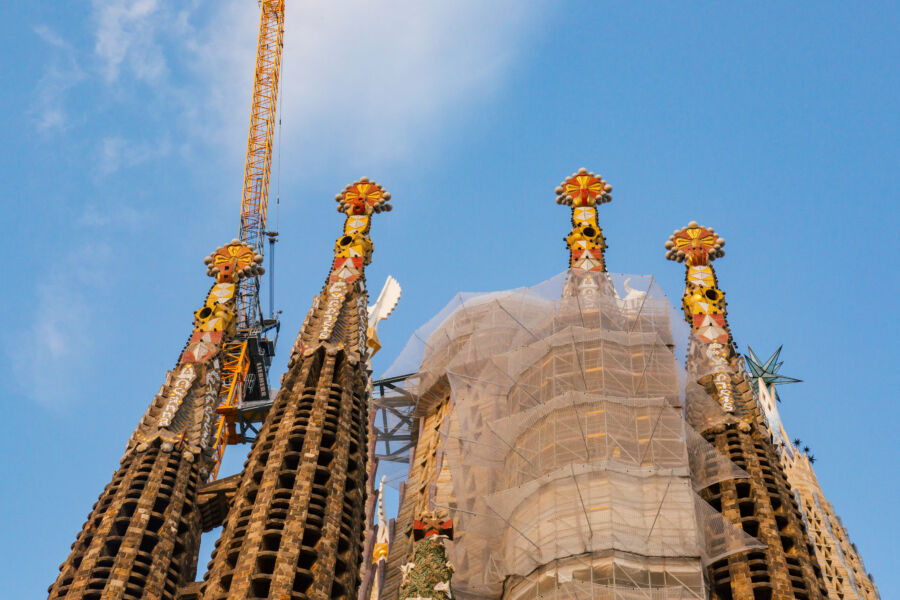
Beyond the chapels and entrances that remain works in progress, other elements of Gaudí’s original vision still have a long way to go. For example, Gaudí designed a grand esplanade leading up to the church. But in the 1950s, a shortsighted mayor (figuring the church would never truly be completed) sold the land destined for the esplanade. Now, it’s filled with drab, doomed apartment blocks that the city must buy back to fulfill Gaudí’s full plans.
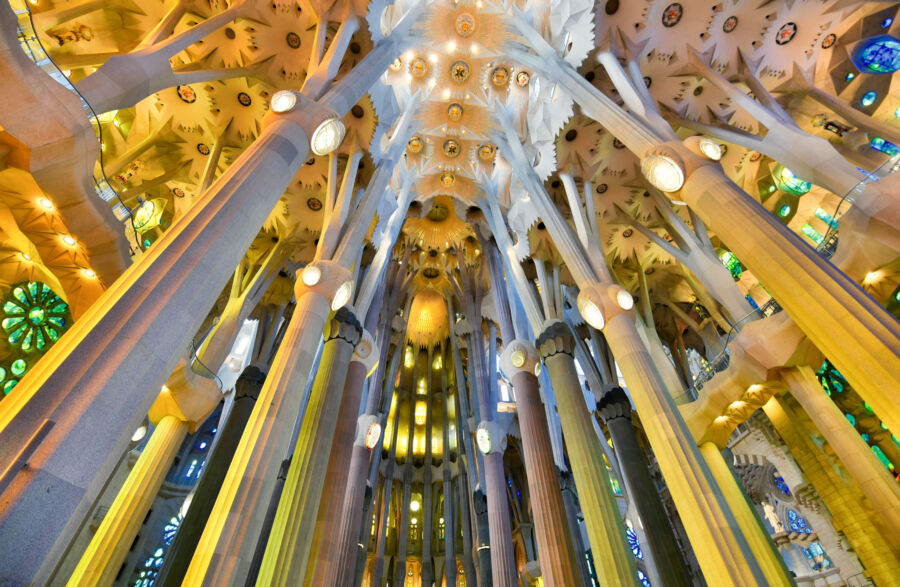
Regardless of the incomplete nature of its exterior, the interior of the Sagrada Família remains a sight to behold. The nave, transept, and aisles feature breathtaking displays of Gaudí’s distinctive engineering and love of nature. Columns rise like tree trunks, complete with branches, leaves, and knot-like capitals, as light filters through stained-glass windows to create the effect of a rainforest canopy. It’s an awe-inspiring symphony of colored light, which Gaudí purposefully curated to help encourage a contemplative mood.
Recognizing that his masterpiece would be a decades-long project, Gaudi once famously said, “My client is not in a hurry.” And, even with the nearing completion of the Jesus Tower, that remains the case. If you visit the Sagrada Família in 2026 (and many years beyond) you will still see some scaffolding. You will still encounter construction sites. And you will still have to use your imagination to picture Gaudí’s vision fully achieved.
But soon, that imagination won’t be required for the church’s iconic towers. While the Sagrada Família won’t be truly “finished,” this is a major step forward in the church’s lengthy history.
We’d like to hear from you! As a member of our merry band of travelers, please weigh in on this article by using the comments below. Meanwhile, many of these topics will also be covered on Rick Steves’ Europe’s various social media platforms — Facebook, Instagram, X, and TikTok — and we hope you’ll join the conversation there as well.