My co-author and frequent collaborator, Cameron Hewitt, is well-traveled, smart, and insightful. And, while he and I are in perfect sync in our travel styles and priorities, he gives voice to the next generation of "Rick Steves travelers." Join me in enjoying his reports right here. —Rick

Happy Birthday, Mr. Vonnegut!

If he were still alive, Kurt Vonnegut would be one century old today. I know this for certain, because throughout high school and college, I celebrated “Vonnegut Day” with a fervor on par with the run-up to Christmas. I would wear my Vonnegut T-shirt, carry around stacks of his books, and say intensely obnoxious things that only a teenager would say. Things like: “Aren’t you going to wish me a happy Vonnegut Day?”
 
If you are an avid reader, and you’re incredibly fortunate, you may find that one author you connect with on a primal level. Flipping through the pages of anything written by this person feels like a visit with an old friend. And for me, that old friend was Kurt Vonnegut. He certainly helped make me the writer, the traveler, and the human being I am today.
Reflecting on Kurt Vonnegut’s works on the centennial of his birth, what’s interesting is that I don’t think much about the works themselves. Plot points, characters, even specific turns of phrase don’t stand out in my mind as much as the feeling his works created in me. Sparking my imagination with very real-feeling people immersed in fantastical situations. Viewing events with a world-weary sense of humor. And, above all, having compassion and empathy for humanity, and human beings, not just in spite of our many flaws…but because of them.
 
Like so many others, I discovered Kurt Vonnegut in high school. It was the summer after my sophomore year, when I spent a month studying Spanish and living with a host family in Mexico. Back in the day before Kindles, I packed along a stack of ratty paperbacks. About midway through that trip, I found myself tearing through a half-dozen Vonnegut books in a matter of days: Slaughterhouse-Five, Cat’s Cradle, Bluebeard, and so on.
 
Returning home, I made my way through the rest of his works. And I mean everything. Every last word he wrote, I devoured. By the time I got to college, I’d already decided to be an English major and was seriously considering becoming a professional Vonnegut scholar, as if that were a viable career path. (No less viable than “guidebook writer,” I suppose.)
 
Which is Vonnegut’s best book? It’s difficult to choose anything but Slaughterhouse-Five. As a young GI fighting in World War II, Vonnegut was captured by the Nazis at the Battle of the Bulge. He was taken as a prisoner of war to Dresden, Germany, where on the night of February 13, 1945, he lived through the Allied firebombing of that city — which killed an estimated 25,000 people.
 
Later in life, as Vonnegut gained renown as an author — first of short stories, then of pulpy science fiction, and eventually as a significant literary voice — everyone wondered when he’d write about his Dresden experience. When he finally did, it was in the most outlandishly creative, most Vonnegutian way possible: His descriptions of a flattened and scorched Dresden were interwoven with the tale of Billy Pilgrim, a young GI who was “unstuck in time” — hopping back and forth between different points within his own lifetime, including the time he was abducted by aliens from the planet Tralfamadore. Vonnegut called his masterwork Slaughterhouse-Five, after the building in which Pilgrim (and the author himself) took shelter to survive the firebombing.
 
During high school and college, I re-read Slaughterhouse-Five so many times I practically had it memorized. And I listened to Vonnegut’s audio recording of the book so often that now I hear his voice in my head when I read it. It is, to be sure, a marvelous book — an evocative war story that’s also wildly imaginative, darkly hilarious, and aching with humanity.
 
I had other favorites, too — chief among them the underrated Bluebeard, about an aging, reclusive Abstract Expressionist painter who is prodded and inspired by a nosy neighbor to create his finest work. Other quintessential books that I particularly enjoyed were Cat’s Cradle, Mother Night, Galápagos, and the essay collection Palm Sunday. And, of course, there’s Breakfast of Champions, which Vonnegut filled with his own hand-drawn illustrations.
 
Vonnegut cut his teeth writing for his high school newspaper, which made his prose style lean, efficient, and to the point. Like Hemingway, his novels are concise and move swiftly. He tells stories that feel much bigger than the pages that contain them. Sometimes I worry my writing style is too “basic” and unadorned. When I read Vonnegut, I remember that’s by design.
 
Vonnegut recognizes that life can be full of tragedy and sadness, sometimes oppressively so. (He experienced this firsthand, far more than most, from digging out charred civilian corpses after the Dresden firebombing, to his mother taking her own life, to the tragically young deaths of his beloved sister, Alice, and her husband.) But he also taught us that, when given the choice between laughing or crying, the best choice is to laugh — “since there is less cleaning up to do afterward.” My family and friends are perplexed, sometimes distressed, at my capacity to crack jokes even in the grimmest of circumstances. I learned it from Vonnegut.
 
There are few true villains in Vonnegut’s works; what villains you do encounter have complicated, often understandable motivations; and his heroes are severely flawed. He has taught entire generations of young Americans that being compassionate and empathetic is cool. His one piece of advice to newborns entering life on this earth: “God damn it, you’ve got to be kind.”
 
On a personal note, I had the incredible good fortune to have two personal encounters with Mr. Vonnegut, at precisely the moment that my interest in his works was peaking.
 
Early in my college career, a friend of mine who attended Indiana University told me that Vonnegut would be speaking on campus one weeknight. A friend and I piled into my little Toyota Corolla and drove more than four hours, each way, to attend his one-hour lecture. It was entirely worth the long journey. Vonnegut held the audience rapt as he discussed his works, pondered his quirky approach to life, and took questions. The most thrilling moment came when he stood at a chalkboard and illustrated a system he’d devised to plot stories on an axis — tracking how the protagonist moves between ill fortune and good fortune as the story progresses. The big epiphany was that the narrative arc of the New Testament precisely matches Cinderella. (You can find old clips of Vonnegut doing this presentation online; it’s also explained in his book Palm Sunday.)
 
A couple of years later, during my senior year, my college — Ohio Wesleyan University — made a stunning announcement: Kurt Vonnegut would be coming to campus. By that time, my Vonnegut idolatry was well-known, maybe even notorious, among my professors and classmates in the OWU English department. One professor, Dr. Peterson, pulled some strings to have the student board — of which I was a member — attend dinner with Kurt Vonnegut before his lecture. And then, in an incredibly kind gesture, Dr. Peterson ensured that I got to sit at the table right next to my literary hero.
 
Vonnegut was tall, mellow, and weary. By that time, he was in his mid-seventies; he’d just published Timequake, a spiritual sequel to Slaughterhouse-Five that he claimed would be his final book. At that point in his life, I can only imagine how many fawning fans he’d politely endured, so I tried to stay restrained and mostly just listen.
 
I recall he lamented the miserable state of cinema in those days. I generally agreed, but wondered if he was familiar with Pulp Fiction, which hinted at something innovative. He was disinterested and quickly changed the subject. I may have failed, but at least I attempted to introduce Quentin Tarantino to Kurt Vonnegut.
 
After those precious few moments with Vonnegut, and after graduation, I decided that academia — and the prospect of becoming a professional Vonnegut expert — wasn’t the right fit for me. Somehow, I wound up on a path to becoming a professional traveler instead. Like the protagonist of many Vonnegut tales, I certainly didn’t see that coming.
 
These days, Kurt Vonnegut plays almost no role in my day-to-day life. On a shelf in my basement, you’ll find a little shrine consisting of a multitude of paperbacks and a votive candle featuring the great author. But even that, I barely pay attention to anymore. It’s just part of the detritus of my personal past, charged with fond memories but mostly ignored…like a box of dusty baseball cards or a dented trumpet from high school marching band.
 
But the great thing about a literary soulmate is that you never really outgrow them. Vonnegut’s influence still hides out in everything that I do — both consciously and, I’m sure, subconsciously. Kurt Vonnegut’s insatiable curiosity, his keen observational eye for both beauty and foibles, his ability to gather and synthesize nuggets and notions and inspirations, and his lifelong quest to more deeply understand humanity as a collection of fascinating and flawed individuals — these are all tenets of being a great traveler.
 
Not to mention, as he said to a howling audience one night nearly 30 years ago in Bloomington, Indiana: “We are here on earth to fart around, and don’t let anyone tell you different.”
 
I’m just one of millions of people who have been touched, in ways small and big, by Vonnegut’s unique and beautiful way of seeing our world. And so today, on behalf of all of us, let me just say: Happy one hundredth birthday. And thank you.

Renting an EV (Electric Vehicle) for a European Road Trip

Renting an all-electric car (or EV, electric vehicle) for the first time ever on my recent trip to Italy, I was incredibly steep on the learning curve.

If you follow me on Facebook, you know I am a devotee of the little, sporty Fiat 500 (cheengkway-chento). For a short getaway in Piedmont between guidebook research assignments, my wife and I were looking to rent one again — ideally with an automatic transmission. I was comparing prices when a screaming deal popped up: a Fiat 500e that was automatic, because it was also all-electric, for the same price as a gas-powered car. I figured, why not?

It turns out, there are many answers to that question…mainly because, while I am fully on board with the idea of electric cars, I had never actually driven one. In the end, it worked out fine. But it provided a few moments of drama and an education in the pros and cons of EV road-tripping in Europe. If you already have an EV, none of this will surprise you. (In fact, you’ll richly enjoy the Schadenfreude of an EV newbie making every possible mistake.) But for fellow rank beginners, I hope you can learn from my experience.

I’m not a total fool, so before booking the car, I checked the range on the model I was renting: Approximately 200 kilometers on a full charge. We were picking the car up in Milan, then driving to a B&B near Alba (about 175 km away), where we’d be joyriding and day-tripping for a few days. Our B&B had a charger, so I knew we’d be set once there. The question was: Would we be able to get all the way down there? Preoccupied with booking the many details of my trip, I brushed that concern aside. Eh, whatever. We’ll figure it out.

I may not be a total fool…but I am certainly on the fool spectrum, because I failed to do anywhere near enough homework until we picked up the car. As she handed over the keys, the rental agent offered a grave warning: “You know the range is much lower on the highway…right?” Still in denial, we drove away from Milan and headed for our reserved lunch in beautiful Piedmont, cruising along the expressway at 130 kilometers per hour. But it soon became clear that our vacation was not immune to the laws of science. The “projected range” number on our dashboard began dropping precipitously…very nearly at a rate of two “kilometers to go” wiped out for every kilometer we traveled.

It soon became clear that there was no way we’d make it anywhere near our B&B on a single charge. And even our lunch stop, about midway there, was looking questionable.

This was the first of many stark lessons in driving an EV: The “optimal” range is for in-city driving, which continuously recharges the battery as you brake. On an expressway, however, the vehicle absolutely gobbles your battery. When you think about it, this makes perfect sense: You’re asking a lot of that electric motor to keep those wheels spinning at top speed. But it’s counter-intuitive to someone who’s driven gas-powered cars my entire life, and who’s absorbed the immutable rule that you get better mileage on the highway.

I should add, in hot weather, the battery drains even faster…for the same reason, which I’ve never fully understood, that my phone battery dies quickly on a beach vacation. And on this September day, the outside temperature was an unseasonably warm 90 degrees. (Obviously-in-retrospect, it did not help that we were also blasting the AC.)

We did make it to lunch. Rather than savoring three different delectable risottos, I spent most of that meal frantically researching our predicament on my phone. Searching for top-up options, I was horrified to see that a basic home charger might take as long as 22 hours to fully charge our car. (I briefly imagined scrambling to find a crummy roadside hotel, somewhere near a charging station, instead of the idyllic B&B we’d booked.) My panic subsided as I learned that there are different speeds of chargers. Most common are 22 kWh (kilowatt hours); to fully charge our car on one of those, it could still take a few hours. But when I searched for “fast EV charger,” I found some that were 110 kWh, which — I hoped — could fully charge our car in less than an hour.

Between the second and third courses, I located a fast (110 kWh) charging station about a 20-minute drive from our restaurant, in the direction of our B&B. After we finished eating, we headed out. Let me tell you, that was a harrowing trip. When the battery charge meter crossed below 20%, it began flashing yellow. At 10%, it went red. Soon after, we pulled into the hot asphalt parking lot of a gas station, in a particularly ugly industrial zone — and lo and behold, there was the charging station. (Cue angelic voices and miraculous sunbeams.)

In order to use the charger, I had to first download an app on my phone, then create a profile, and then add a credit card to my account. At that point I was able to active the charger and plug it into my thirsty car. We held our breath until…bingo! The Fiat was charging.

Charging the car from just under 10% to 100% took approximately 45 minutes. We went into the little gas station café and ordered a couple of cappuccinos, while I watched the charging progress on my app. (Another lesson I learned was that the first 80% is much faster than the last 20%. However, we were just far enough from our B&B that we did not want to take any more chances on a less-than-full battery.) Once it hit “full,” we hopped in and drove the rest of the way to our B&B…only about an hour later than we’d hoped.

A long expressway journey was, clearly, entirely the wrong use case for a small EV. But once we were at our destination, we adored our little electric car. Our B&B had two chargers available, and our gracious host, Fausto, let us use them for free.

Fausto was also extremely patient with how green we were — and I mean “green” not in the “environmentally conscious” sense, but in the “clueless beginner in desperate need of education” sense. One night, I plugged in our car, locked it, and went to bed. The next morning Fausto kindly explained that, once the car is locked, the charger cannot be removed. A fellow guest with a plug-in hybrid had to wait for me to unlock the car and free up the charger. While he was charging his car, this jovial German said to us, “You’re very bold for taking a fully electric car on a trip like this. That’s why I have a hybrid. I don’t need that kind of stress.” (Golly, thanks for the tip!)

We spent the next few days joyriding around hill towns, rustic restaurants, and remote wineries. We learned quickly that EVs love hilly terrain — which is as good for your range as expressway driving is bad for it. Anytime we were braking or going downhill — which we did a lot — it recharged our battery (slowly). It became a fun challenge to see how far we could go without our battery level dipping. My wife became an expert in driving to maximize our charge. The “scenic route,” over the hills and above vineyards, is even sweeter when it also tops up your fuel supply.

That said, driving an EV certainly changed the way we planned our time. We became paranoid about running out of charge at an inopportune moment. One day, we felt very risky driving to a city about 50 minutes away. As it turned out, we made it there and back easily — and, thanks to the hilly terrain, had plenty left “in the tank” to extend our drive to a nearby wine village.

There’s an old joke that “FIAT” stands for “Fix it again, Tony.” At one point, when we were scrutinizing our battery percentage while trying to decide if we could risk taking a scenic detour on the way home, we decided that they should change the name to CIAT: Charge it again, Tony.

On the other hand, from a philosophical point of view, it’s a healthy thing to be so aware of the fuel we consume as we travel. Every kilometer you drive burns energy, and takes some sort of toll on the environment. I have never been so keenly aware of this as when I was driving that little car.

Our B&B’s charger made life easy, allowing us to start each day topped up. But when we needed to charge on the road, we were impressed by the extensive EV charger network in this part of Italy. The most abundant ones were accessed through the Be Charge app, which — once set up — was easy to use. However, most of the chargers we found were the slower 22 kWh version (which would take something like 3-4 hours to fully charge our car), with only a few faster 110 kWh ones (which took 45 minutes or less).

Our big challenge was the return trip. My wife had a late-morning flight from Milan’s airport, which was about 175 kilometers (a 90-minute drive) from our B&B — within the Fiat’s theoretical optimal range, but, as we now knew all too well, far below its actual highway range. We plotted out a fast 110 kWh charger about halfway there, which should be just right to make the entire trip with just one recharge. This forced us to get up and take off an hour earlier than we’d have been able to with a gas-powered car. (This doesn’t sound too bad. But when you’re talking about getting up at 5:30 instead of 6:30, that’s a painful adjustment.)

We topped up our battery overnight, took off before dawn, and — just a few minutes after the sun rose above the horizon — pulled off at the fast charger I’d located. It was in the middle of an industrial zone, down a parkway from a giant furniture store, with not a soul in sight — extra-deserted since it was Sunday morning. During the 40 minutes it took us to hit 100%, we sat in the car, having a makeshift breakfast from leftover groceries. And then we were off — making it to the airport, and dropping off the car, in plenty of time.

I should note that our EV experiment was also a money-saver. The base price of the rental was about the same as it would have been for a gas-powered Fiat 500. But the fuel was drastically less. The car came fully charged. Our B&B let us use their charging station for free (though I’m guessing you’d pay at many others). The two times we did use a public charger, it cost about $12 for a rapid charge from 10% or 20% to 100%. And we were able to return it “empty” (just under 20%) with no penalty. So our total cost for fuel on this trip — 660 kilometers, or just over 400 miles — was less than $25. Based on my rough figuring, gas for that same journey would’ve cost well above $100.

In the end, despite a couple of hours of drama that first day — and the early departure the last day — I was glad to have had the experience of renting an EV in Europe. I’d do it again, under the right circumstances. And it got us thinking even more seriously that our next car back home should be an EV.

That said, if you’re considering renting an EV for a European trip, here are the points I’d take carefully into consideration:

  • An EV works best for in-city or in-region countryside driving, rather than a big, point-to-point road trip. Unless you enjoy the adventure of finding charging stations, and don’t mind waiting around for the car to charge, don’t attempt using an EV for a long-distance trip…especially on your first time out.
  • I’d only rent an EV if I were confident that all of my lodgings had easy, on-site access to a charger — and only if I could pick up the car relatively near where I’m staying. (In retrospect, my biggest mistake was underestimating how challenging that 175-kilometer initial drive would be for my EV’s range.)

  • Do some homework to fully understand the model EV that you’re renting. What’s the “optimal” range, and — more important — how is that affected by being on the highway, hot or cold weather, and so on? I had perhaps the “worst-case” scenario: an older-model (late-2010s) Fiat 500e. The optimal range is just over 200 km, but even when charged to 100%, it never showed more than 180 km available — and on a hot day on the expressway, we could barely make it more than 100 km. I understand that this particular car is known for its limited range; in fact, even Fiat’s own newer EVs have better batteries and longer ranges. And, of course, Teslas and other premium EVs are many times better still. (On the other hand, renting a Tesla costs a pretty penny — well beyond my budget.)

  • Be very clear on the availability of public charging stations in the areas you’re visiting, should you need them — not only whether there are enough of them, and where they are, but how fast they are. For a relatively speedy, on-the-way top-up, look for a 110 kWh or better charger; the charger at your accommodations can be slower, for overnight charges. Northern Italy impressed us with its widespread availability of charging stations. But, as the saying goes (and this time quite literally), “your mileage may vary”: I imagine there are parts of Europe (and vast swaths of the United States) where you’d simply be out of luck.
  • Also be clear on how to access public charging stations. In Italy, most options appeared to be through Be Charge. Their app made it easy to find chargers, know how fast they were, and even see whether they were currently in use. However, you must have the app installed — and decent Internet access on your phone — in order to activate the charger once you’re there.  I was expecting that I’d be able to “tap” a credit card at the terminal when I got there. But — in the case of these chargers, at least — I was surprised to find that payment and use was available only through the app. Of course, in other parts of Europe, other companies may dominate. Do your homework, download the app(s) you need, and set them up before you need them.

With all of those points in mind…happy EV traveling! While it’s a little scary to be so steep on the learning curve, in the end I’m glad to better understand the all-electric car option — especially because, I imagine, EVs will become more and more accessible to travelers in the coming years. And next time, I’ll make smarter use of this exciting technology.

The Italian Airport Experience: A User’s Guide

I recently dropped my wife off at Milan’s Linate Airport for her flight home. Accompanying her inside to the check-in line, I was reminded of the many experiences I’ve had at Italian airports over the last year or so: Venice, Bologna, Florence, Treviso, Naples. All of them were eerily similar…and uniquely vexing. Curious, I did some research and discovered the following explanation, of uncertain origin, which finally helped me understand why Italian airports work the way they do. I hope you find this as enlightening as I did.

Welcome to the Italian Airport System! We are very pleased that you have chosen to patronize one of our many fine ports of entry. Here are a few pointers to help you make the most of your Italian Airport Experience.

Are you departing from an Italian Airport, and wondering how far ahead you need to arrive? Good news: Thanks to our egalitarian and efficient check-in system, it matters not one bit whether you arrive three hours before your flight, or thirty minutes. At the check-in line, we call up anyone departing on a flight sooner than yours to jump to the front of the line, regardless of how many other passengers have already been waiting, or for how long. This is our patented “Last Arrivals Go First” Protocol™.

Here at the Italian Airport System, we believe spontaneity should be rewarded! And we also place a premium on the importance of sleep; those who rise early to have “plenty of time at the airport” richly earn the frustration provided by our “Last Arrivals Go First” Protocol™. We also believe our Protocol is theologically sound: As is written in the Gospel according to Matthew, “The last [to arrive at the airport] shall be first [to get to their plane], and first last.”

The result: Go ahead and arrive several hours early, if you like. This will provide you with ample opportunity to stand still, observing a sea of humanity pass you by while contemplating the life choices that have brought you to this moment. To enhance this sensation, we have introduced our 10 Minute Guarantee™: At this phase in the Protocol, each passenger in line ahead of you will be processed in no fewer than 10 minutes.

To complete our Italian Airport Check-In Experience, we’ve pinpointed the precise moment at which the typical passenger descends into panic with the realization that there’s just no way they can make their flight. And then…we wait just a few minutes more. And then, our highly trained check-in agents click into action, suddenly becoming highly efficient professionals possessing a heretofore unobserved competence. With stunning speed, that 100-person line clears out — and each and every one of them hustles to the security line, to do it all over again.

On the topic of the security line, we have a very exciting announcement: After many years of fruitful negotiation with the governmental body responsible for security, they have agreed to implement the same “Last Arrivals Go First” Protocol™ that we use for the check-in line. That’s right: Rather than taking passengers in the order they arrive, those who are cutting it the closest will always skip right to the front.

The Italian Airport Experience hallmarks of spontaneity and surprises continue through the entire security check. First, our security agents will bark confusing orders about what you do, and don’t, need to remove from your bag. If you ask follow-up questions to seek clarity — for example, whether your Kindle or your big camera needs to come out of your carry-on — we strive to offer precisely the wrong answer. In this way, we guarantee that you will be treated to the complete Italian Security Check Experience of having all of your luggage pawed through and manhandled during a riveting secondary screening. Are you carrying sensitive electronic equipment, such as a fragile extra lens for your big camera? For your entertainment, we’ll toss it around in a display of frenetic juggling as we send it through the scanner again, and again, and again.

The Italian Airport System is proud to have some of the world’s most marvelous lounges. You’ll have to take our word for it, though, because our patented, double-stage “Last Arrivals Go First” Protocol™ guarantees that you’ll never have a single instant to spare, once you’ve cleared security. With this in mind, we have designed the entrances of our lounges to be some of the most beautiful and enticing on earth. That way, you’ll really know what you’re missing out on as you run past, shaking your head in disappointment.

The other thing you’ll rush past in an Italian Airport: shops selling outlandishly high-end items, from the most ostentatious jewelry to the finest perfumes to the most exclusive watches to cutting-edge fashions from the streets of Milan and Rome. Who would go shopping for such items at an airport?! is what you’ll be asking yourself as you run, soaked in flop-sweat, to your closing gate. It’s those little mysteries that bring life meaning, don’t you think?

As you can tell, one wonderful feature of the Italian Airport Experience is all the exercise it provides: standing, running, standing again, more running, more standing, hyperventilating, and so on. In order to enhance your cardiovascular stimulation, we endeavor to maintain our airport temperature just a little too hot, and the humid air just a little too sticky and stale. And, in the extremely rare event that you have a moment to sit down, we’ve ensured that the number of viable seats in any area of the airport is kept to an absolute minimum — extending to you the opportunity for yet more healthy standing around before boarding your flight.

Speaking of shopping: If you did some in Italy and need to process your Customs documentation to be eligible for a VAT refund, you may assume that we have implemented our “Last Arrivals Go First” Protocol™ there as well. Not so! Instead, we have engineered a special and unique-in-the-world system for our Customs verification process, which we have branded as The Immovable Line™. No matter how many people are standing in the line, or for how long, our agent has been trained to ruffle papers, stare at a computer, and make mysterious phone calls while somehow managing not to process one single customer. (Of course, the line does eventually move…in so far as, sooner or later, everyone gives up, throws their hands in the air, and retreats to the check-in line — where they are immediately treated to our original “Late Arrivals Go First” Protocol™.) It is through our Immovable Line Protocol™ that we ensure as much revenue as possible remains in Italy’s coffers.

That’s just a small flavor of the experience you are in store for, if you are departing from an Italian Airport. But what if you’re arriving here? Sadly, there’s only so much we can do to provide as miserable — excuse me, I meant to say “memorable” — an experience as we do for departing passengers. (We are particularly disappointed to observe the high numbers of passengers who carry their bags on the plane, allowing them to head directly to the exit.) But we still do our utmost to inject your arrival with a few hallmarks of the Italian Airport Experience.

One of our great regrets at the Italian Airports System is that, although we strive to meet our goal of misplacing 100 percent of passenger bags, ultimately we must rely on the assistance of our partner Airport Systems. And so we are happy to announce that in 2022, airports across Europe have ramped up their efforts to ensure that as few bags as possible make it on to the correct airplane. We’d like to single out our Dutch colleagues at Amsterdam Schiphol Airport, who have achieved an exemplary and many-thought-impossible degree of mastery in the art of luggage loss.

Despite our best efforts, not every bag is lost in transit. But those that do arrive with your flight will appear at the luggage carousel as long after your landing time as possible. This provides ample time for arriving passengers to fully appreciate the Italian Airport Experience: the utter lack of seating…the unflinching, unfeeling, bureaucratic staff…the bewildering signage…the hot, moist air…the absurdly expensive shopping opportunities. We have ensured that any ATMs available in our baggage claim area (and, in some cases, on the entire premises of the airport) are not operated by banks, but by exchange bureaus that probe the human extremes of disadvantageous exchange rates. Passenger surveys indicate these aspects of the Italian Airport Experience are even more acute at the end of a seven-to-ten-hour, transatlantic flight.

If your bag is successfully lost by a partner Airport System, and fails to make it to our luggage carousels, first we ask you to wait approximately 30 to 60 minutes after the carousel stops spinning to ensure it doesn’t somehow magically appear. At this point, we will allow you to fill out the required paperwork to track your misplaced bag.

You might assume that we will deliver the bag to your hotel when it arrives. Think again! We are very pleased to have implemented our “No Bag, No Problem” Policy™: If you ever want to see your bag again, you’ll just have to wait around the airport until the next flight arrives from that destination — or make a special trip back to the airport later to claim your bag in person, if and when it ever appears. For you see, we know how special our Italian Airport Experience is for all of our passengers. And this increases the likelihood of an encore experience.

It is our hope that this helps clarify the many trademark features of the Italian Airport Experience. Remember our motto: Come early…come late…it doesn’t matter! Don’t ask why. Just accept it. You’ll suffer all the same either way.

Practical Packing Tips for the Unfashionable Male

Being a snappy dresser can be a hazard for travelers who want to pack light. Fortunately, “Unfashionable” is my middle name.

You will see plenty of articles, blog post, YouTube videos, and TikToks along the lines of “How to pack light and still look great!” Well, I look fine, but I certainly don’t look great — never have, never will. When I find a shirt that I like, I buy three of them, in subtly different plaid patterns, and wear them until holes appear…and sometimes well beyond. Ditto for jeans. And shoes. And sweaters. My clothes have never enjoyed the caress of a hot iron — if it wrinkles, just shake it out and hang it in the bathroom while you’re in the shower. Hey presto! Fewer wrinkles. An acceptable number of wrinkles.

While I’m full of travel tips, where fashion is concerned I’m something of an “anti-influencer.” So instead, this is a post about how to pack light and practical, and how to be comfortable on the road, without embarrassing yourself. Yes, I am fully owning my male privilege of being able to get away with dressing like a borderline-slob. And, with apologies to nobody, here are some packing tips for my fellow borderline-slobs. (You know who you are.)

What to Wear

Years ago (in high school, probably), I accepted the immutable fact that being “stylish” is forever beyond my reach. But my goal when traveling — and back home — is to be comfortable, practical, and respectful in my dress. While I’m far from “dressy,” I rarely wear T-shirts, cargo shorts, baseball caps, or flip-flops around Europe (except at the beach). Instead, I aim to thread the needle: dress presentably, yet without needing to carry a garment bag and travel iron.

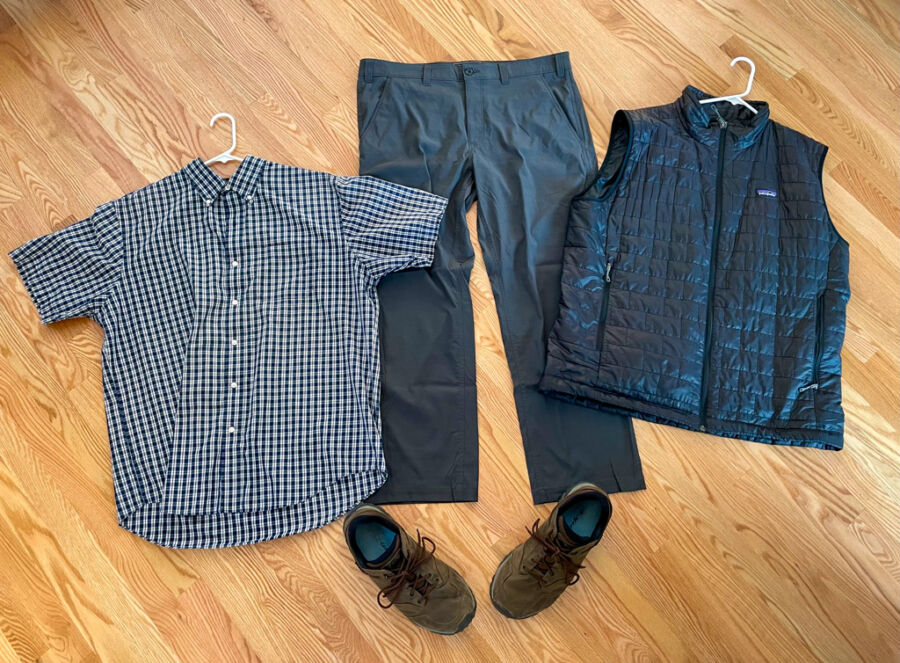
The first rule of travel packing, for anyone: Favor dark colors made of breathable fabrics (cotton or cotton blend). I typically travel with three or four short-sleeve button-down shirts; a couple of lightweight T-shirts (mainly for sleeping, hiking, hitting the beach, or to wear on laundry day); a couple of pairs of jeans or lightweight pants, plus (depending on the weather) a pair or two of shorts; a swimsuit, if I’ll be doing lots of swimming; a lightweight sweater; a puffy vest; a lightweight raincoat; a half-dozen pairs each of socks and underwear; and one very comfortable, very well broken-in pair of shoes. And that’s it. That’s all I take when I go to Europe — for anywhere from four to eight weeks per trip.

The secret for getting by with so few clothes? Doing laundry often. I do a little washing in my hotel-room sink every few days. In most European climates, if you wring out wet clothes really well, then hang them carefully, they’ll be dry by morning. (Pro tip: I wring out wet clothes wrapped in a towel to wick out the most possible moisture, and to create less of a drippy mess.) If your room has a radiator to drape things over — or, even better, one of those nice, heated towel-drying racks in the bathroom — you can get drying time down to just a few hours.

About every week to 10 days, I visit a laundromat, or, if I’m feeling flush, I pay for laundry service. (Another pro tip: If your hotel washes laundry by weight or by the load, it’s probably a decent value. But, unless you’re desperate, avoid those that charge by the piece — or you’ll pay a buck or two to launder each pair of socks or underwear, and even more for shirts and pants. It adds up.) Often, I scout ahead of time to figure out which upcoming hotel has laundry service, or a nearby laundromat, and save up my dirty clothes for that happy day.

I like short-sleeve, collared, button-down shirts, which are breathable and versatile. (Polo shirts work well, too.) While not exactly “dressy,” the collar helps me feel a little more dignified — especially in more formal settings, like a hoity-toity theater performance or a nice restaurant. I also pack a nice, relatively lightweight, dark-colored sweater, which instantly classes up my whole ensemble.

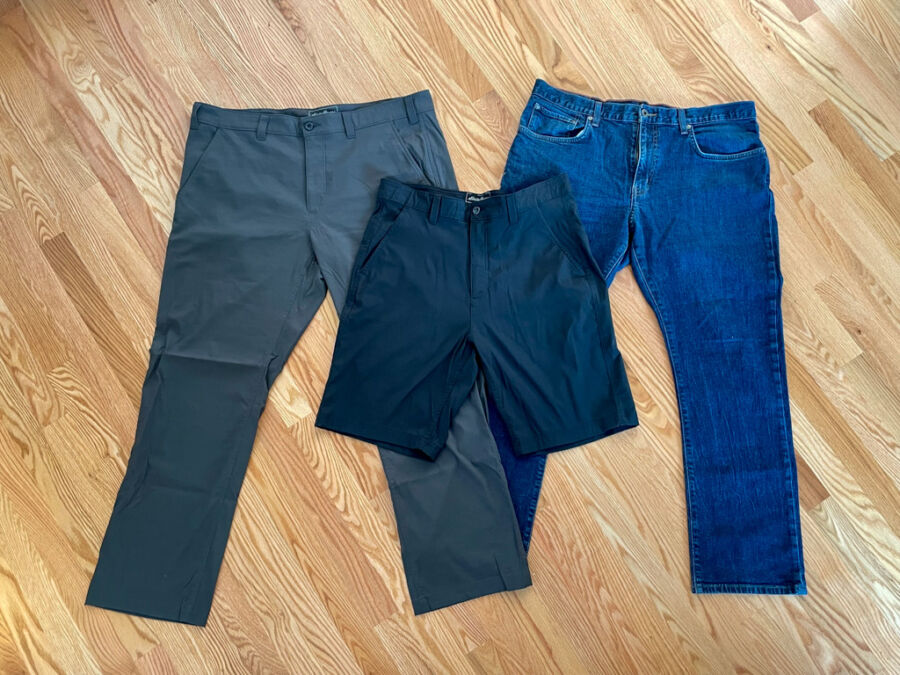
Jeans go with everything. So do black or dark-grey chinos, and beige or black shorts. Most of my bottoms fall into one of those three categories.

What about those travel pants that you can turn into shorts by zipping off the legs? Personally, those are not my style. In general, I don’t take any “travel clothes.” I used to own a few “travel shirts” and “travel pants” (Ex Officio is one good brand). But I found them very expensive and too clever by half — they really look like travel clothes, with weird hidden pockets, mysterious gussets, and cumbersome sweat vents. Everything I take to Europe is something I’d wear in my everyday life back home. That way, I know it’s well broken-in, and I look a little less like a tourist.

One of my favorites recently are Eddie Bauer’s Horizon Guide Chino Pants. These are much lighter than jeans, so they’re better for warmer climates. Unlike “travel pants,” they look more or less like regular chinos, but the material is stretchier — making them more comfortable and reducing wrinkles. I find them ideal for everything from climbing a mountain to going to a nice dinner.

You may be asking: Is it really OK to wear shorts in Europe? Won’t the Europeans know I’m an American? I have some shocking news for you: Europeans already know you are American. You could go to a stylish boutique in Europe and have them dress you from head to toe, and the second you walk out the door, everyone you pass will instantly know you’re an American. It’s not just about how we dress; it’s about how we carry ourselves. You’re not fooling anyone. (Fortunately, Europeans like Americans and won’t think less of you for being one.)

That said, there are some cultures — for example, Italy, especially in the cities — where grown men who wear shorts look silly. It’s not “offensive” or “insensitive,” exactly. Just…a little strange. (These cultures think of shorts as something exclusively for children, or for the beach.)

For comparison, think about those breezy, shin-high capri pants that men wear proudly in many northern European countries. If you saw a guy in the USA walking around wearing those, you wouldn’t think, “Wow, what a FREAK!” or “Well, I never! How RUDE!” No, most people would probably think more along the lines of, “Huh, that’s a bit unusual. Don’t see that every day.” And then — unless they’re total jerks — they’d just shrug and go about their business. Well, that’s how you look to the locals when you wear shorts in southern Europe. Non-jerks might give you a second glance, jerks might snicker and point, but at the end of the day, it’s all pretty harmless. I find most Europeans are pretty live-and-let-live.

On the shorts issue, the question is, what’s more important to you: being comfortable or not looking silly? This is a sliding scale, which is calibrated against the current temperature. If it’s very hot, I’ll wear shorts even in places where it’s very silly. If it’s only moderately hot, I’ll err on the side of long pants in most places. But if I’m in a country up north where grown men wear shorts without apology or remorse — where, in fact, shorts are merely a gateway to those stylin’ and, I must admit, enticingly comfortable-looking capri pants — well, in those places, you can barely keep me from wearing shorts.

(One more shorts caveat: Seasoned travelers know that in some Catholic countries — Spain and Italy in particular — some churches deny entry to men who are wearing shorts. Of course, these also happen to be some of the hottest parts of Europe. If I know I’ll be going inside a major church where this is an issue, I make a point to wear long pants even when it’s sweltering…grumbling the whole time. You can do a little homework — on the church’s website, or in the Rick Steves guidebooks — to figure out places where this could be a factor.)

Let’s talk about unmentionables. A couple of years ago, I kept reading about amazing travel underwear that were super-lightweight, super-comfortable, super-breathable, and super-easy to wash in the sink. I bought a few pairs from different companies to test-drive them. And after a couple of these test trips, I just went back to my reliable old Hanes cotton boxers — which, it turns out, were plenty comfortable, lightweight, and breathable to begin with. You can spend a lot of money on high-tech globetrotting undies. But I wouldn’t.

I bring along swim trunks only when I know I’ll be doing a lot of swimming. Otherwise, I don’t bother. In the event of an unexpected swimming opportunity, the shorts I travel with are lightweight and fast-drying, and can double as swim trunks in a pinch.

Wait, hold up: Did I say that I take only one pair of shoes? For a month or longer?! Yes, absolutely. The critical thing here is that it must be a super-comfortable, extremely well-broken-in pair of shoes. Do NOT buy a new pair of shoes a couple of weeks before going to Europe, wear them around the block and to the office a few times, and then convince yourself, “Meh, they’re probably fine.” Because they may not be fine…and you may be miserably blistered a few days in. (I live to tell.) Don’t underestimate how much more you’ll walk in Europe than you do in your everyday life. Be ready for it.

My preferred footwear falls in the category of “walking shoes”: low-profile, brown-leather, substantially-soled shoes that are more comfortable than dress shoes, yet more presentable than hiking or jogging shoes. Again, the perfect shoe is equally suitable for climbing a mountain as it is for going to a nice dinner (though, admittedly, it’s not quite ideal for either).

Two examples that I’ve personally enjoyed wearing on multiple trips to Europe are the more loafer-ish Keen Boston II (which, sadly, they don’t make anymore, but the Keen Austin is similar); and the more hiker-ish Merrell Moab Adventure. I find the Keens more comfortable all-around shoes, but I appreciate the sturdiness and waterproofing on the Merrells — especially if I know I’ll be in rainy climates. Of course, each foot is different, and these are just a couple of ideas — find ones that suit your feet and your needs.

By the way, if I know I’m going somewhere warm and beachy, I do sometimes take a second pair of something lightweight, just to give my feet a break. Sometimes that means flip-flops, other times my trusty Birkenstock Milanos (which I’ve been wearing since high school — I’m on about my tenth pair —  and which remain timelessly stylish in Germany, even as they’re precisely the opposite stateside). More recently I purchased a pair of Allbirds Tree Runners, which are more fashionable and comfortable than my sandals.

Finally, I pack along a puffy vest and a lightweight, waterproof (Gore-Tex) raincoat — both in low-profile, dark colors. These two top layers, combined with that sweater I mentioned earlier, are incredibly versatile; when used in combination, they’re suitable for almost any climate.

With all of that in mind, the key to smart packing — for borderline-slobs and fashionistas alike — comes down to one thing: layers. I’ve had itineraries that included both blazing Sicily and frigid Iceland, in the same multi-week trip. I wear many of the same items in both places. When it’s cold, rather than throw on a huge parka that takes up a ton of space in my bag, I layer up: T-shirt, then short-sleeve button-down shirt, then sweater, then vest, then raincoat. If I know I’ll be in cold climates, I’ll pack along a super-lightweight Merino wool beanie. Worn together, all of this keeps me plenty warm — even that time I ran into an early-October blizzard in Iceland.

How to Pack

OK, so you’ve got your clothes figured out. Now it’s time to pack your bag. I fit everything, easily, into a carry-on-the-plane size bag. For many, many years, I used  the Rick Steves Convertible Carry-On  — and Rick still does. You can’t beat it for the price. A few years back I decided to try something new and stepped up to the Seattle-made Tom Bihn Aeornaut 45, which is approximately the same size, three times the price, and has a compartment configuration that works better for my needs. (Honestly, unless you travel four months a year like I do, or are made of money, the Rick Steves bag is all you need.)

I’m a big believer in using packing cubes, which keep things well-organized and easy to pack. I have one packing cube for my jeans, pants, and shorts; another for my socks, underwear, and T-shirts; and another for all of the travel accessories and little odds and ends that I never go to Europe without. (But that’s a topic for another blog post. In fact, here it is!)

To keep my button-down shirts and sweater as unwrinkled and spiffy-looking as is reasonable to expect for an unfashionable male, I fold them and stack them carefully in a Pack-It Garment Folder from Eagle Creek.

The garment folder lies flat in the bottom of my bag, and on top of it I stack my packing cubes and my toiletries kit. Engineers love the feeling of sliding their packing cubes into their bag, like a game of Tetris. It’s so much more satisfying than a bag filled with balled-up, loose articles of clothing.

For liquids, I really love the Go Toob bottles by Humangear. One bottle’s worth of shampoo or laundry detergent will last me for several weeks. After a few incidents of leakage (usually with other types of bottles), just to be on the safe side, I zip each bottle into a “snack”-size plastic baggie before I get on the plane.

I also carry a day bag that contains my laptop and my big camera. But most travelers — going for vacation rather than work, like me — may not even need that. I often carry a Civita Day Pack or similar small, lightweight bag for the airplane, and for hiking and sightseeing. When I’m not using the day bag, it’s small enough to flatten out and squeeze in the bottom of my big bag — I don’t even know it’s there.

And that’s about it: my method for being comfortable and, if not stylishly, at least adequately clothed while traveling for weeks at a time in Europe.

What about you? Any suggestions, favorite clothing items, or other travel tips I’ve missed?


Affiliate disclosure: I do not receive one single penny, or any free products, for any of the items I mention in this post. I paid for them all myself! My sole incentive in writing this post is helping my fellow unfashionable males pack that much smarter.

To find out what’s in that little packing cube of travel gizmos and accessories, check out my list of 10 Little Things I Won’t Go to Europe Without. And while you’re at it, here are five more pack-along items, related to electronics.

For more travel inspiration, check out my list of 10 Europe Travel Hacks — and its follow-up, the creatively named 10 MORE Europe Travel Hacks.

If you are not an unfashionable male…well, first of all, why on earth did you read this far? But if that is the case, there’s lots of other, more stylish packing advice on our website. Check out Rick’s Packing List,  and his philosophy for packing light.

The Outlander Effect: Should You Travel Through Scotland with Claire and Jamie?

Traveling in Scotland in 2022, you just can’t avoid Outlander. The series of novels by Diana Gabaldon, now also a hit television show on Starz, is having a major impact in shaping people’s travels. And if I’m being honest…I don’t think that’s a bad thing.

In my travels, it’s interesting to observe how a movie or TV show can transform the tourism industry of a place. Sometimes called “set jetting” (or “location vacation”), the phenomenon of visiting a place just because you’ve seen it onscreen is an ever-bigger factor in itinerary planning. And in Scotland, Outlander is driving tourist traffic to a huge degree. But how should a thoughtful traveler approach this trend? Here are a few thoughts.

On a previous trip to Scotland, back in 2015, the TV series had only just begun, and Outlander tourism was in its infancy. As a fan of the first season myself, I sought out a few locations to include in our Scotland guidebook — including Doune Castle, which stood in for “Castle Leoch”; the charming village of Culross, featured as “Cranesmuir”; and the Highland Folk Museum, where scenes of traditional life were filmed. But my travel writer’s sixth sense told me that Outlander was on the verge of something big.

Returning again this summer, I was stunned by the difference seven years had made. Several more seasons of the TV show have only increased its fandom, and added to the already-long list of Outlander “must-sees.” The national tourist office has even produced a high-quality, fold-out map — and maintain a comprehensive website — locating Outlander-related sites throughout Scotland. In gift shops, life-size cardboard Jamie Frasers are elbowing aside Loch Ness Monsters. I even saw an official Outlander Tartan Pocket Square™.

Outlander tourism has even trickled down to small sights: In the wonderful, endearing, volunteer-run Glencoe Folk Museum — on the main drag of a tiny, one-street Highlands village — they’ve taped up a photo of Sam Heughan (who stars as Jamie) perusing the display cases.

I’ve seen this happen before. I’ve seen in at Harry Potter-related sights around the UK (including ones in Scotland). I’ve seen it in Dubrovnik and Croatia’s Dalmatian Coast, which came on many travelers’ radar thanks to Game of Thrones. Even Albuquerque, New Mexico, is newly trendy for a weekend getaway, thanks to those eager to walk in the footsteps of Walter White from Breaking Bad or Kim Wexler from Better Call Saul.

Most recently, I’ve seen this phenomenon in the town of Richmond, just outside London, which has started to attract quite a few Ted Lasso pilgrims…including me.

Sometimes this impact is short-lived. For a brief period in the mid-Aughts, we added mentions to our Paris and London guidebooks about various landmarks pivotal to the plot of The Da Vinci Code; a few years later, after that fad had passed, we took most of them out again. Others are evergreen: In Salzburg, Sound of Music tours are as big an industry now as they ever have been, even as the film approaches its 60th birthday. (And sometimes it’s hard to judge: Doing our Scotland updates this summer, we’ve debated whether it’s time to finally retire our “Debunking Braveheart” sidebar about the 1995 movie.)

As a travel writer who tries to approach Europe thoughtfully, I have complicated feelings about “set jetting.” (Full disclosure: In addition to being a professional traveler, am also a massive TV and film buff; in a previous life, I even wrote movie reviews for my hometown newspaper.)

On the one hand, I’ve observed how becoming famous in a movie or TV show can bring well-deserved attention to a worthy place that might otherwise get overlooked. Once there, those visitors come to love that place on its own merits. That’s a good thing.

On the other hand, I don’t have much patience for people who go to a place only because of the screen connections, with no appetite for going beyond that basic photo op. A friend of mine, who works as a tour guide in Dubrovnik, once told me that she occasionally gets requests from people asking her to do a tour exclusively of Game of Thrones filming locations…“without that boring history or culture stuff.” She turns down those requests, and frankly, I wish those people would stay home.

One distinction to consider is whether the place you see on screen is actually “playing itself.” In Scotland, Harry Potter pilgrims book months ahead for a chance to ride on what they call “Hogwarts Express,” perhaps not even realizing that the historic steam locomotive has a real name: the Jacobite Steam Train.

Or take Dubrovnik — which, in Game of Thrones, represents fictional locations that exist only in the fantasy world of Westeros. There’s nothing “Croatia” about what you see on the screen. This can lead to some unfortunate missteps. Late in the run of the series (spoiler warning), the city of Kings Landing is blown to bits by Daenerys Targaryen and her dragon. Many of these scenes featured recognizable streets and landmarks of Dubrovnik — a city which was, during the breakup of Yugoslavia in 1991 and 1992, the tragic subject of a real-life, medieval-style military siege. Back then, the actual buildings of Dubrovnik were bombarded from above; townspeople took cover, rooftops burned, streets smoldered. Having seen photos and news footage from the Siege of Dubrovnik — and having heard the real-life stories of its victims — it struck me as particularly insensitive for the show’s producers to so gruesomely destroy its fantasy doppelgänger onscreen.

In Outlander, on the other hand, Scotland represents Scotland — better yet, historical Scotland. I’ve been won over by the way that Outlander is rooted in real Highlands history. It gets people in the proverbial door, and then — crucially — focuses them on the “right things.”

The best example: Culloden. The Battle of Culloden, which was fought on April 16, 1746, on a moor just outside of Inverness, was the pivot point for all of Scottish history. As the Jacobite troops of Bonnie Prince Charlie were defeated by the Hanoverian army of King George II, the traditional clan system of the Highlands was shattered; life for the Scots changed forever.

Likewise, Culloden presents a turning point in the Outlander saga. (Light spoilers ahead.) Not only does Jamie Fraser fight on Culloden Moor; earlier, Bonnie Prince Charlie himself appears as a major character, as the Frasers move to France and hobnob with the Stuart royal family in exile.

I’ve toured the Culloden Battlefield on multiple occasions over the years. Each time, I’ve been impressed by the site’s haunting ambience, and by the outstanding visitors center that tells its story. But I’ve noticed some key differences between pre-Outlander visits and post-Outlander visits. First, post-Outlander, there were a lot more people out on the moor with me…and many were laying fresh flowers at the Fraser clan marker. Also, I must admit, having seen the dramatization of the battle on the show — and feeling a more personal connection to some of the battle’s (fictional) participants — my appreciation of the site was even greater.

If the impact of Outlander is that more people are going to a genuinely great and important site, and learning about real history while there…then I’m all for it.

Of course, there are many Outlander sights in Scotland that have less to do with real history. A very short drive from Culloden are the prehistoric Clava Cairns, including the stony remains of a burial chamber dating back millennia. We’ve described these in our guidebook for years as a good place to get a glimpse at Scotland’s (relatively sparse) prehistoric artifacts. Now we’ve also had to add a mention of the split standing stone, which vaguely resembles the one Claire Fraser uses to travel through time. Are the many new visitors flocking here for a photo op also taking a moment to learn about this site’s real origins? Possibly…but somehow, I doubt it.

Understandably, some locals have misgivings about all of this. At the tourist office in one small town, I picked up a brochure for a local folk museum that touted its ties to Outlander. Later, when I got to the museum, I asked the attendant whether they actually had an Outlander exhibit. She grew instantly perturbed. “Oh, come on! That’s fantasy. This is a real museum about real history. Where do people get the idea that everything is about Outlander?” “Um,” I responded, and showed her the brochure — produced by her own museum — trumpeting the Outlander connection. (What can I say? The Scots know what sells. And I will resist the urge here to draw comparisons with a certain mythical sea monster…)

That said, many Scots I’ve talked to — including the sticklers — acknowledge (sometimes begrudgingly) that Outlander does a pretty impressive job of conveying real Highlands history amidst all of the time-travel fantasy and bodice-ripping. Many Scots still feel burned by Braveheart — the last time a movie thrust Scotland onto the international stage — in which Mel Gibson completely distorted actual history in service of a rollicking action picture. Even if they don’t love Outlander, most Scots recognize that it’s far better than Braveheart.

So maybe it’s about more than just whether it’s a “real place” — but about the realness of that place. When Stephenie Meyer wrote her original Twilight novel, she set it in Forks, Washington. How did she choose? She simply looked up which American town got the most rainfall (reasoning that vampires would appreciate a gloomy climate)…and Forks was it.

Forks is not far from where I live in Seattle, and on a few occasions, I’ve visited the area (for its stunning Olympic Peninsula scenery, not the Twilight connection). And I was struck by how, based on this offhand decision made two decades ago, Forks has completely rebranded itself as “Twilight town.” When you go to little Forks, you see a Twilight café, Twilight gift shop, Twilight cabins, Twilight tour company, Bella’s truck from Twilight…one time, I even drove by a soggy stack of Twilight firewood (no joke).

I don’t mean to besmirch Stephenie Meyer or Twilight (or Forks, for that matter). The fact is, a first-time author doesn’t always have the resources to travel far and wide, scouting locations for a novel that may never see publication…much less become an international phenomenon.  But when it comes to what guides your travel planning, “I basically picked it out of a hat” doesn’t strike me as a good enough reason to visit a place.

Meanwhile, it’s clear that Diana Gabaldon eclipsed Meyer (pun intended) in her meticulous research for Outlander. Before writing her novel, Gabaldon had earned a Ph.D. and was, effectively, a professional researcher. And it shows. Then, the producers of the TV series doubled down by committing both to honor Gabaldon’s original vision, and to respect real Highlands history. And the result is a show that gets a lot of people — including many who previously never cared one lick about Scotland — very excited to visit the site of a 275-year-old battle. That’s an impressive feat. Yes, even if the side effect is a few Outlander-themed souvenirs.

In the end, I believe the best kind of “set jetting” is when a piece of pop culture both attracts people to a new place, and whets their appetite to learn more. And on that count, Outlander sets a high bar. If you’re heading to Scotland because you fell in love with the place by reading or watching Outlander…good for you. Have a great time tracking down all of those sights. But once you get there, make sure you go beyond the Claire and Jamie photo ops, and really get to know Scotland, too.


I was in Scotland updating our Rick Steves Scotland guidebook. Our brand-new, fully up-to-date Fourth Edition arrives in December — just in time for the holidays. If you’re going sooner than that, the current (Third) edition is still fundamentally sound and packed with great tips…just expect some changes, and confirm hours ahead of time.

My travel memoir, The Temporary European: Lessons and Confessions of a Professional Traveler, includes a chapter about “set jetting,” and specifically about the time I had to take two Sound of Music tours back-to-back, on assignment. For a more cynical and humorous take on when “set jetting” lacks the cultural insight of Outlander, check it out.