My co-author and frequent collaborator, Cameron Hewitt, is well-traveled, smart, and insightful. And, while he and I are in perfect sync in our travel styles and priorities, he gives voice to the next generation of "Rick Steves travelers." Join me in enjoying his reports right here. —Rick

Rejuvenating — and Psychoanalyzing — Naples

Wild and crazy as Naples is, the city is working hard at urban renewal. They’ve torn up drab squares that for decades have greeted arriving visitors: On Piazza Municipio, facing the cruise port, they’re excavating the ruins of an ancient Greek settlement, which will be viewable inside a futuristic new Metro station. And on Piazza Garibaldi, the football-field-sized expanse in front of Napoli Centrale train station, they’ve excavated a totally different space: a sunken shopping mall, covered by a slick new canopy to shield shoppers from sun and rain.

Both of these are part of an ambitious eNaples Stationxpansion of the city’s Metro system. Several new “art stations” on the subway have been designed by prominent architects — a point of pride for Neapolitans who are weary of the conventional wisdom that they live in a backwards, broken-down city.

But, to be honest, I’m not buying it. Don’t get me wrong: Cities can get better. Especially in Eastern Europe, I’ve personally observed big, grimy cities — Budapest, Warsaw, Zagreb — reinvent themselves and flourish into thriving 21st-century communities. It can be done. But not in Naples. Because you have to want it. And my sense is that most Neapolitans are content with the chaos they swaddle themselves in. Why “fix” it? It’s the essence of Naples. It’s by design.

At the corners of big intersections, I kept noticing walled-off stairwells to nowhere. Years ago, some ambitious civic leader proposed underpasses to make pedestrians’ lives easier. But I imagine these passages turned out to be magnets for crime and grime, so now they’re all sealed off and forgotten. I wonder if today’s glitzy new subway stations are tomorrow’s deserted underpasses.

Struggling to wrap my brain around this, I asked my Neapolitan friend Virgilio, who thoughtfully psychoanalyzed his hometown.

“You must understand, people in Napoli are the same way they have been for thousands of years,” he explained. “The Bay of Naples has always been a big crossroads for trade, and that means lots of foreign invaders. Spanish, French, Austrian, Sicilian, everyone took their turn ruling Naples. This has given us a clear picture that we are never in control of our own destiny.

“And to top it off,” he said, waving his arm toward Mount Vesuvius on the horizon, “we live in the shadow of an angry volcano. We always remember that it destroyed life here two thousand years ago. Maybe it can happen again.

“That’s why Neapolitans don’t plan. We aren’t organized. We don’t live for tomorrow. We live for today. Because today is the only thing we can be sure of.

“When you have no power and nothing is certain, you have to hold on close to your family, ’cause that’s all you have. This is why in Napoli, family is so important. And maybe that’s why the mafia has been so powerful here. Those ties are stronger here than anywhere.”Naples Shrine

He paused to point out a little shrine embedded into a grimy wall by someone’s front door. “This little altar, it’s so important. You see these everywhere. It honors our ancestors — a grandparent or great-grandparent who died. If you go to the ruins of Pompeii, you will see even thousands of years ago, people would have altars to their family members in their homes. We are still doing this today.”

Suddenly, the chaos of Naples began to make sense. Understanding the worldview behind wild traffic, hot tempers, and living life with abandon doesn’t necessarily make Naples easier to take. But it helps.
Pizza and Fried Goodies in Naples

Even though Naples is a huge city (Italy’s third-largest), it’s still a small town. The community is close-knit, and “networking” operates on a more primal level than LinkedIn and business lunches. On arrival at Napoli Centrale train station, I hopped into a taxi. The driver asked where I was from. When I said, “Seattle,” he said, “Oh, my friend moved to Seattle many years ago. He opened a pizzeria there — Via Tribunali. I helped him import all of his equipment. Brick pizza oven, everything, it comes from here. I put it on the ship myself.” Five minutes in Naples, and already I’d met the close friend of a guy whose pizza I’ve eaten back home.

I’m not surprised that the common denominator between Seattle and Naples is pizza. The best pizza I’ve eaten anywhere is in Naples — as well it should be, since pizza was invented here.Da Michele Pizza

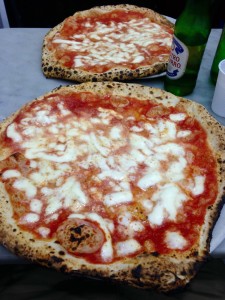
On this trip, I ate at Antica Pizzeria da Michele, which pizza purists insist is the best in town. You have just one choice: marinara or Margherita? And that’s it. Like In-N-Out Burger back home, Michele understands that when you achieve perfection, you keep things simple.

When the pizza arrived at our table, my Neapolitan friend Virgilio was in ecstasy. “Aha! You taste that? The perfect crust. Thin, soft, a leetle sour. You don’t even need to chew it. You just put it in your mouth and…” He pantomimed a delicious glob of pizza sliding down his esophagus, ending with a big smile.

Watching me gingerly nibble at my slices, Virgilio said, “This is the correct way to eat a pizza.” He cut out a wedge, rolled it up into a bundle, sawed off a lengthwise chunk, and jammed it into his mouth. I tried it. And in one perfect bite, I got the gooey middle, the singed crust, and a squirt of tomato sauce — all in just the right proportions.

Strangely, my favorite pizzeria experience on this trip had nothing to do with pizza. One day, I naively showed up at lunchtime on Via dei Tribunali — the namesake of that Seattle pizzeria, it’s a street buried deep in the historical center, lined with several of the planet’s best pizzerias. A mosh pit of hungry pizza patrons crowded around the Pizzeria da Matteo. Occasionally they’d spill out into the cobbled street just long enough for a delivery truck to beep them back up against the wall.

Some of the patrons were elbowing their way up to a window, where a busy vendor was tossing deep-fried snacks the size of tennis balls into takeaway bags. I joined the mob and worked my way to the front, where I ordered a couple of fried UFOs.

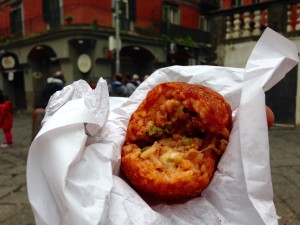
AracninoRetreating to a park bench on a seedy square, I peeked into the bag at the two items I’d randomly requested. One was an arancino, a deep-fried ball of rice that really did resemble the “little orange” it’s named for. I’d eaten arancini before, and they were dry, crumbly, and forgettable. But this one was heavenly. When I bit in, the filling — rice mixed with tomatoes, ragú (meat sauce), and a few peas — melted into my mouth as soon as my teeth broke through the fried skin. It was moist, piping hot, and delicious…instantly setting an impossibly high bar for all of the arancini I’ll ever eat.
Then I turned my attention to the other item in my bag, a frittatina. I’d never heard of this before, but it was oblong and had irregular edges. Taking my first bite, it was clear I’d discovered the perfect food: macaroni and cheese, with a bit of meat sauce mixed in, rolled into a ball, dropped into a fryer, and served steaming hot.

I love it when cultural cliches live up to the fuss, and Neapolitan pizza certainly does. But you have to go beyond the cliches, too.


Bella Napoli: Love It, Hate It, Maybe Both

I made it to Naples, and my guard is up. The American travelers I’m meeting around Italy have a sort of terrified fascination with this city. More than one person has told me, “We planned our trip around not going to Naples.”

I get it. Napoliphobia is understandable. This is the birthplace of organized crime. It’s gritty, it’s gross, it’s in your face. The city is an assault on all of the senses: piles of garbage, pungent odors, and a neverending racket of buzzing motors and hollering natives. The streets are an impenetrable maze. The graffiti manages to be profane in multiple languages. The traffic is mortally terrifying. And the people…well, actually, the people are wonderful. But their unbridled, full-bodied engagement with living can be jarring to a mild-mannered American.

And yet, even with all that’s stacked against it, after several visits Naples has really gotten under my skin. Frightened or not, you owe it to yourself to experience Naples. If you hate it, you hate it. The train station is that way. But if you give it a chance, you may learn to love it.

Naples is a world — and a worldview — unto itself. As you explore, keeping one hand on your wallet and the other on your camera, you’re immersed in Neapolitan life. Everyone is out, it seems, all of the time. People have animated conversations, waving their arms to illustrate a point…while talking on a cell phone. Babies balance on the handlebars of motorbikes. If you can tune out that knee-jerk sense of danger, this city has Europe’s undisputed best people-watching.

Here are few photos of my latest visit to Naples. But vivid as they may seem, nothing can capture the experience of being there.


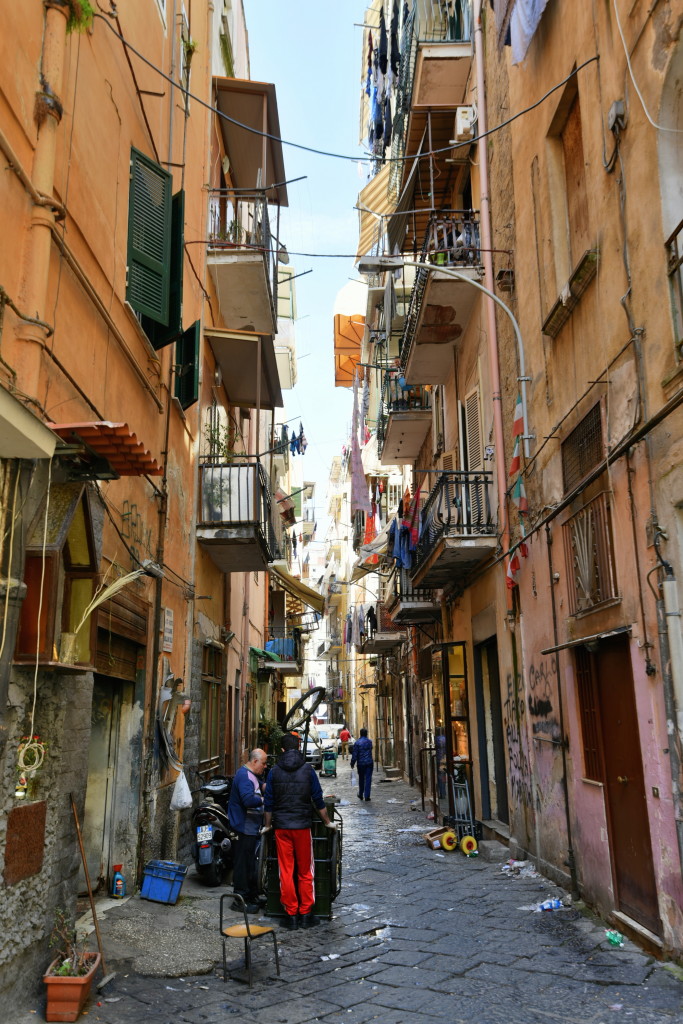
NaplesNarrowStreet

In Naples, people live, love, eat, chat, and die in impossibly narrow lanes like this.


NaplesProduce

Colorful cottage industries spill out into grimy streets.


NaplesCourtyard

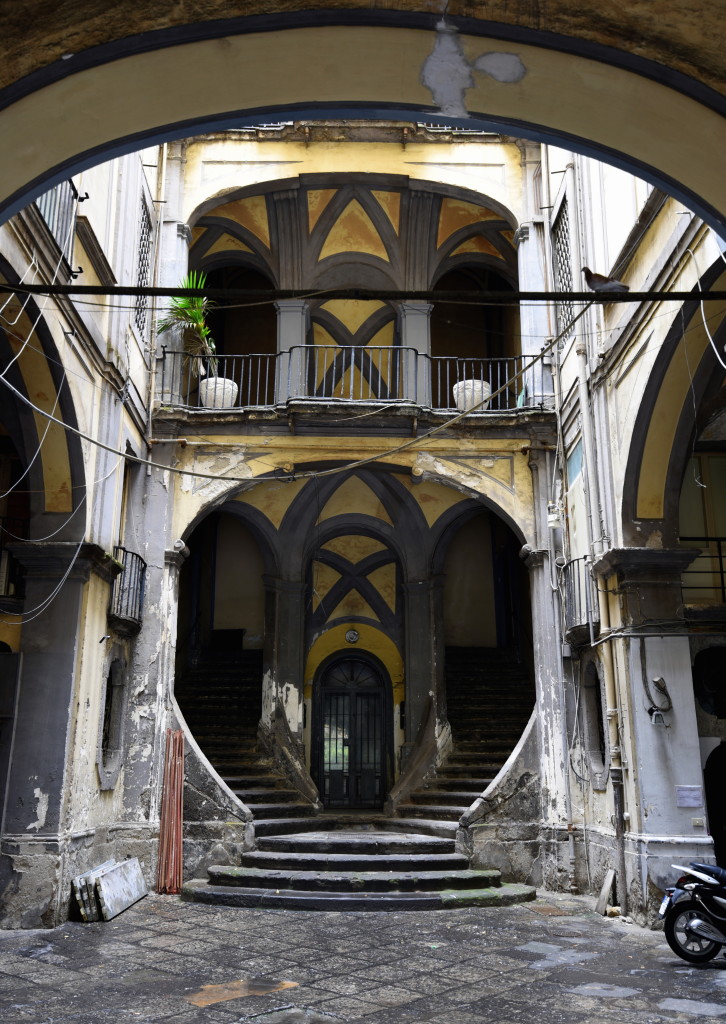
Walking between Naples’ gigantic, soot-covered buildings, occasionally you find an open doorway. Peeking into the courtyard, you get a glimpse at what, at one time, must have been an opulent place to live.


NaplesCarNudge

When I’m in Naples, I don’t worry about getting mugged…I worry about getting run over. Cars, trucks, and motor scooters assertively nudge their way between pedestrians. Often, the smallest motor scooters make the biggest noise. I watched an old-timer, comfortably resting on his rickety plastic chair, get beeped out of his seat by an impatient delivery truck who couldn’t quite squeeze by. After four days in the city, I was only clipped in the shoulder once by a side-view mirror. (It was just a brush-back pitch, really.) I consider this a pretty decent track record for four entire days in this city.


NaplesLeopoldo

Strolling the streets of Naples late at night, modern-day tableaus like this one catch your eye.


NaplesStreet

Tucked between the glum buildings are stunning churches and grand squares, like this one.


NaplesLionSmileExpressive stone lions welcome visitors to Naples’ Piazza Plebescito. This one has a goofy, welcoming grin.


NaplesLionSnarl

Meanwhile, this lion seems to be saying, “You talkin’ to me?”

South Italy Leftovers

Before plunging into the urban jungle of Naples, here are some pictures of two more stops on my South Italy swing: the Isle of Capri, and the ancient Greek and Roman ruins of Paestum.

CapriPort

I was primed to hate Capri, with its reputation as a jet-set resort. But, like so many before me, I totally fell for its charms. (It didn’t hurt that the weather was glorious.) Everything operates on an unhurried island logic that’s lost on outsiders, but somehow just works. It’s all very endearing.

CapriRocks

To reach the island, rather than being herded onto the overcrowded ferry, I signed up for an all-day excursion on a 10-person private boat. Once you factor in all of the transportation costs, it was only about $25 more than going it alone — and well worth it, considering how much easier it made my visit. It even included a trip through the “Cave of Love,” in the iconic Frangiolini Rocks.

CapriSolaro

Leaving Capri —and the Amalfi Coast — behind, my last stop before Naples was Paestum. In antiquity, Paestum was first a Greek town, then a Roman one. And today it has three of the best-preserved Greek temples outside of Greece. Ancient sites sometimes leave me cold, but these temples are impressive.

Paestum OV

Unlike the more famous ruins at Pompeii (which I also visited on this trip) — surrounded by urban sprawl, congested with cruise passengers, and still wincing in the shadow of a smoldering Vesuvius — Paestum sits alone in a tranquil field. It’s dignified. Pensive. And very, very old.

PaestumTemple

Touristy Town? Spend the Night.

Some towns are relegated to perennial “day trip” status — visitors always just zip in and zip out, rarely spending the night. On this trip, I made a point to spend a couple of nights in the town of Amalfi, the namesake of the famous Amalfi Coast and a fine little town in its own right. And sure enough, it’s an entirely different (and more appealing) place after all of the side-trippers have gone home. Below are some pictures showing this famous, yet underrated, town…after hours.

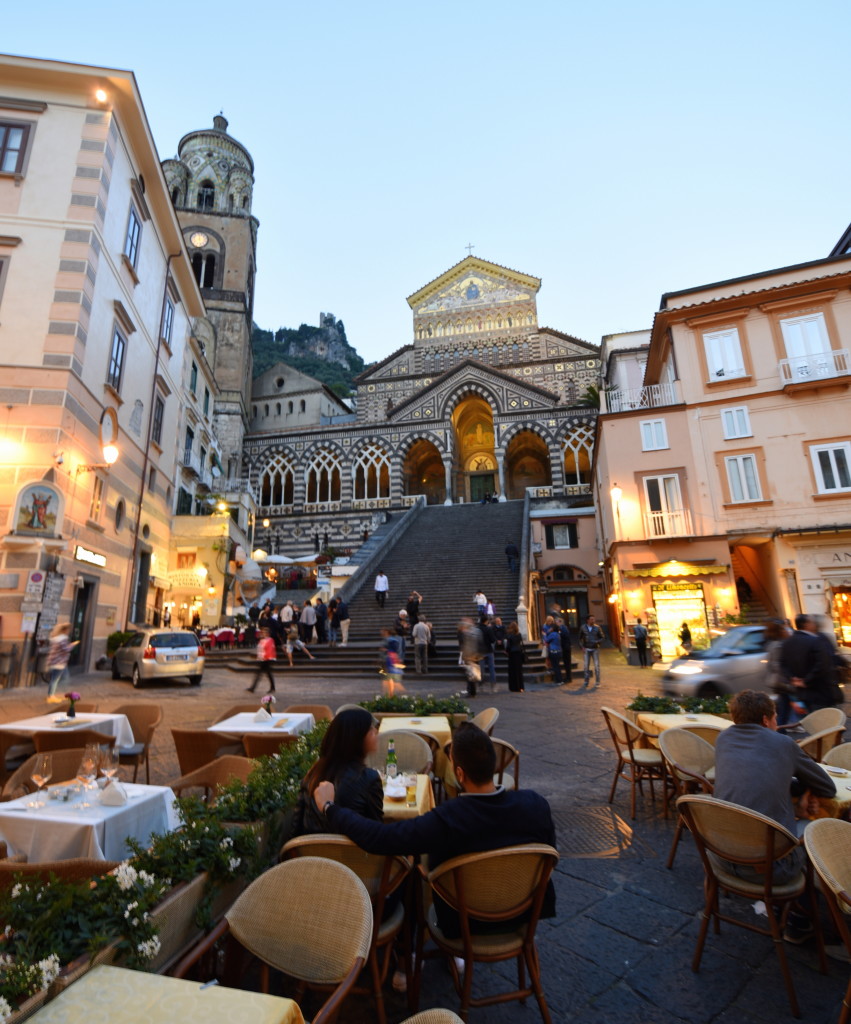
Amalfi Square

Amalfi’s main square — at the foot of its cathedral steps — is a pure delight, particularly in the twilight.

Amalfi Pansa

After all of the day-trippers have retreated to Sorrento and Naples, the town’s pulse slows. The most venerable pastry shop in town, Andrea Pansa, is a favorite sundown hangout.

Altrani

Having a whole day in Amalfi gave me the chance to explore. Mid-day, when the town was jammed, I hiked across the hills to the next town over, tranquil Altrani — an undiscovered gem that most tourists only get an enticing, fleeting glimpse of from the bus up to Ravello.

Amalfi Hotel

I’ve stayed in probably hundreds of hotels in Europe. But my Amalfi hotel room may have been the smallest I’ve ever seen (pictured here full size). To get between the bed and the postage-stamp bathroom, I had to shimmy around the desk (which was effectively just a big shelf…there’s no way you could fit a chair in front of it). But you know what? It was a great stay: comfortable bed, strong Wi-Fi, and a huge window that let in the sounds of neighborhood Amalfi…until I wanted to shut them out.

Amalfi Church Sign

In Italian churches, you see a lot of “please cover your shoulders and knees” signs. But I’ve never seen one quite as weirdly moralistic (or as passive-aggressive) as this one, at Amalfi’s cathedral. For God’s sake, have some dignity!