My co-author and frequent collaborator, Cameron Hewitt, is well-traveled, smart, and insightful. And, while he and I are in perfect sync in our travel styles and priorities, he gives voice to the next generation of "Rick Steves travelers." Join me in enjoying his reports right here. —Rick

Stunning Skye

One proud local told me that the Isle of Skye is Scotland’s second-most popular destination, after Edinburgh. While that seems like a stretch, Skye was certainly packed when I was there at the peak of summer. And for good reason: The biggest of the Hebrides Islands offers some of the best scenery in all of Scotland.


Cameron Scotland Skye Portree

Skye’s “capital” is Portree. Apart from its stunning pastel harbor, I love all of the endearingly quirky stories that bubble through little island towns like this one. Portree first hit it big thanks to its rich deposits of kelp…yes, seaweed (they’d burn it to create an ash that was rich in soda — apparently a big industry in the 18th century). The island has just one high school (some kids get bussed in from an hour away) and two hospitals — but no obstetricians. Mothers-to-be are sent three hours away to Inverness a week before their due date. Babies are born on the Isle of Skye only by accident.


Cameron Scotland Skye Quiraing

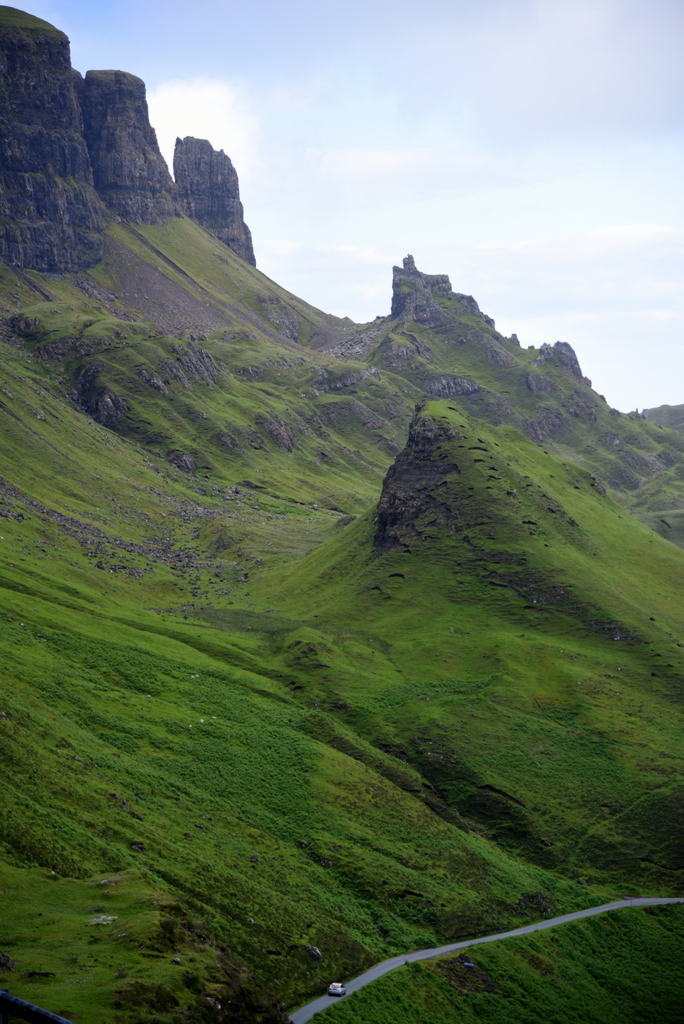
The Trotternish Peninsula, north of Portree, has some of my favorite views in all of Scotland (right up there with Glencoe). These jagged formations — called the Quiraing — show up frequently in movies that call for an otherworldly location, from Flash Gordon to Prometheus.


Cameron Scotland Skye Sheep

Driving up into the Quiraing on a single-track road, I slammed on the brakes when I found myself immersed in a traffic jam of sheep. Just ahead of me, the truck of a farmer was just pulling away after moving the flock to a new grazing patch. While I waited for the sheep to clear out, I looked up on the ridge to see this hoofed couple, who seemed to be posing just for me.


Cameron Scotland Skye Trotternish

In summer, Scotland enjoys long hours of daylight. I have a lot of guidebook-research chores to squeeze into every day. So on Skye, I did the two-hour Trotternish Peninsula driving loop after dinner. After a socked-in day, the sky opened up as I headed north out of Portree…and I had the roads all to myself. As I crested the tip of Trotternish, the setting sun lit up the cliffs like a spotlight.


Cameron Scotland Skye Fairy Pools

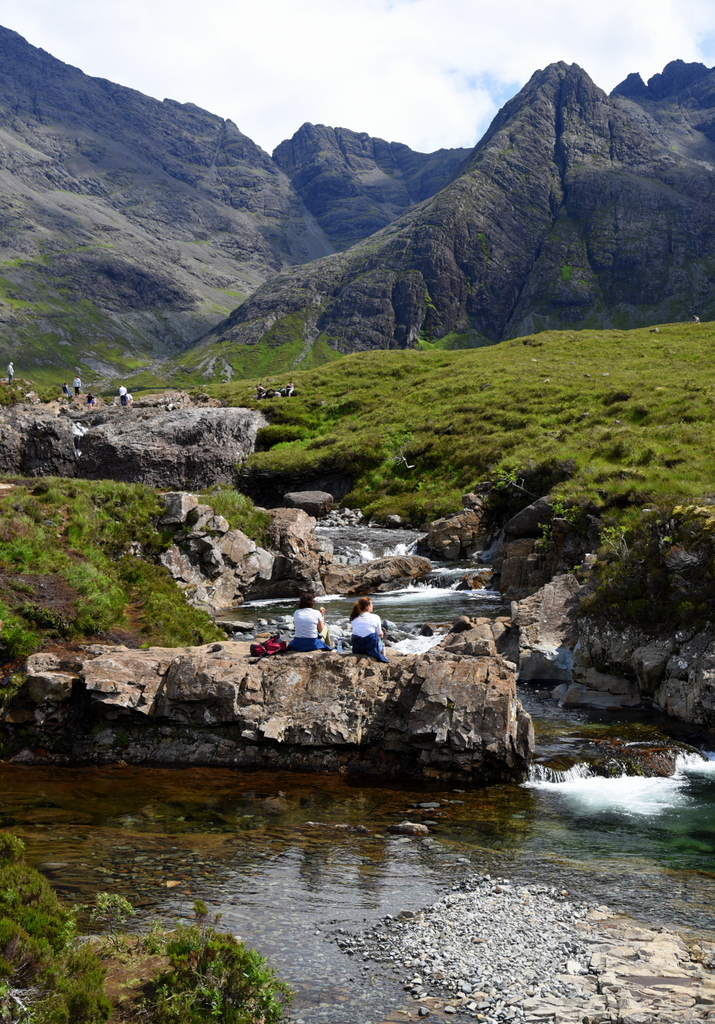
For our new Rick Steves Scotland guidebook, I’m adding some new hiking tips. And in the dramatic Cuillin Hills — in a different part of the Isle of Skye — I tried out the glorious hike to the “Fairy Pools.” As a stream of mountain runoff trickles out of the Cuillin, it carves a canyon deep into the bald turf. The water tumbles down several cascades, creating stunning pools where you really could imagine supernatural sprites hanging out. Even on a chilly day, people were taking a dip. I overheard a tourist say, with her delightful Scottish lilt, “Despite the fact that it’s so cold, it’s so invitin’!”

Scottish Island Hopping

Scotland’s stunning Highlands are matched by its wonderful islands. And I enjoyed the best weather of my trip for a very busy, very satisfying day of island-hopping from the port of Oban.


Cameron Scotland Island Hopping Oban

From the busy harbor in Oban — the “Gateway to the Isles” — boats fan out to the Hebrides. I signed up for a long (10-hour) trip that included stops on three different islands.
Cameron Scotland Island Hopping Oban Harbor

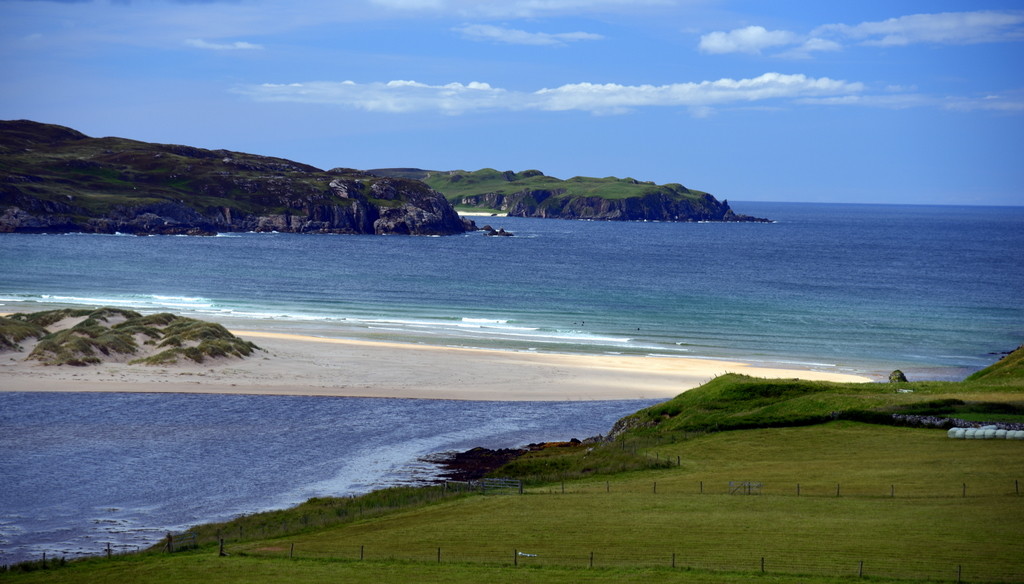
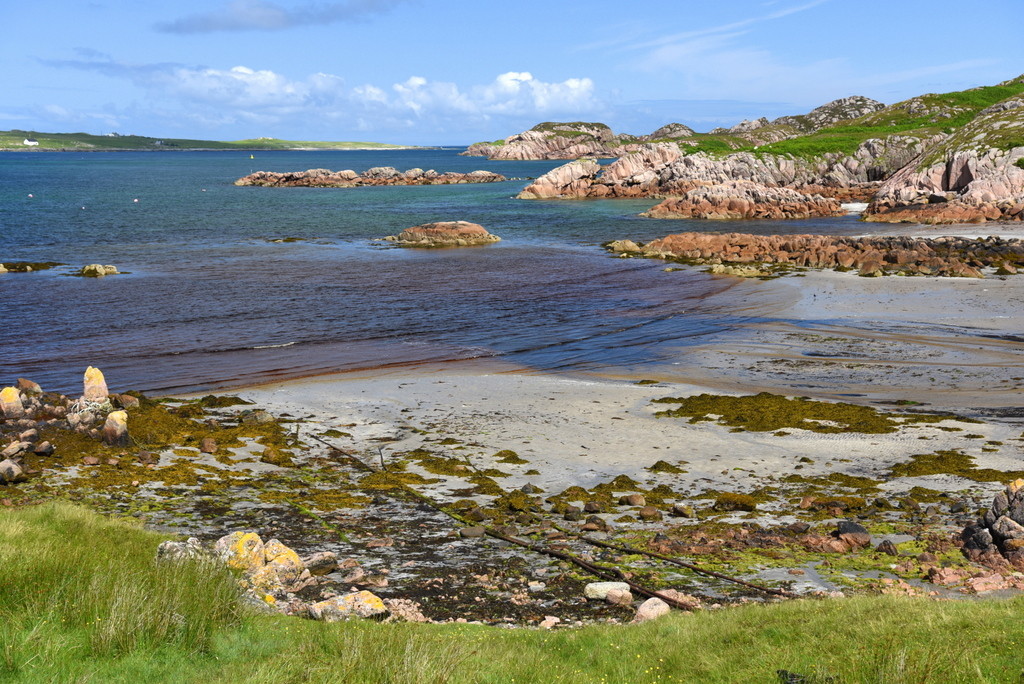
You could spend days exploring Mull, the second-biggest of the Inner Hebrides. But I had one hour — and I used every minute to drive (on twisty, single-track roads) from the ferry port at one end of the island to the ferry port at the other end of the island. Parking my car, I had five minutes to enjoy this view of a rocky cove before boarding my next boat.


Cameron Scotland Island Hopping Iona

Just across a narrow channel from Mull is the Isle of Iona, the spiritual heart and soul of Scotland. This is where St. Columba, a sixth-century Irish monk, introduced Christianity to Great Britain. To this day, it has a spiritual aura. Church groups from all over the world come here to spend a week in soulful contemplation and kumbayah fellowship. Its mellow, nurturing spirit reminded me of the church youth groups I grew up attending. But all of that serenity is at odds with the many day-trippers from Oban, who have exactly two hours here before they have to make a mad dash back to the ferry.


Cameron Scotland Island Hopping Iona Cloister

For my work, I’ve been inside probably hundreds of churches around Europe. One thing they have in common is that, even if they seem nondescript at first glance, they’re packed with details that only become meaningful with explanation. Inside Iona’s historic abbey — which is still an active church — you’ll find eternally screaming faces hiding in the Gothic vaults, an ornate tomb of the local clan chieftain who donated the property back to the Church, and a sleepy cloister ringed with old Celtic tombs (dead clansmen holding massive Braveheart swords). If a place seems boring at first, you probably just don’t know enough about it yet.


Cameron Scotland Staffa Island Hopping

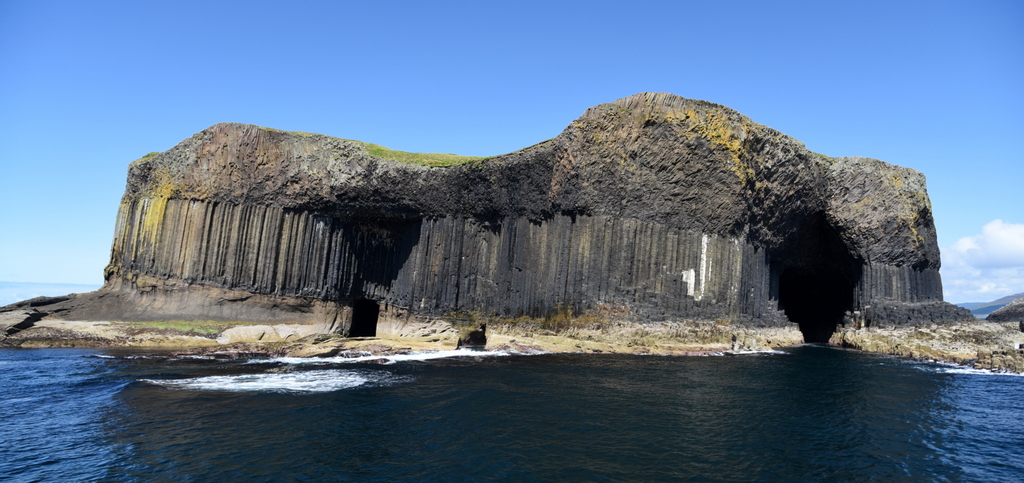
One of the most pleasant surprises of my entire trip was Staffa. This uninhabited, castaway islet has always been there — hovering somewhere between Scotland and Ireland — but until now, has only warranted a brief mention in our guidebook. I noticed that the local boat companies are pushing the Staffa option now, so I checked it out. And I loved it.


Cameron Scotland Island Hopping Staffa Formations

Staffa is the “other end” of the much more famous Giant’s Causeway, across the sea in Northern Ireland. Hexagonal basalt pillars push up from deep below the sea. Walking across these natural formations reminded me of playing Q-Bert as a kid.


Cameron Scotland Island Hopping Staffa Fingals Cave

From Staffa’s boat dock, it’s a picturesque 10-minute walk (across those Q-Bert blocks) to Fingal’s Cave. There’s a legend about the Irish warrior, Finn Macool, and the cruel giant Fingal, and how the causeway was destroyed as the climax of an earthshaking feud between them…but I just enjoyed the view.


Cameron Scotland Island Hopping Staffa PuffinsIn the opposite direction from the ferry dock, it’s about a 15-minute hike to where the puffins hang out. Our boat captain explained that they scatter when the boat arrives. But if you head to their cove and just sit still, the curious sea birds will come to say hello. It was a nice excuse just to enjoy the sun and sea scenery. And sure enough, after a few minutes, I started to spot the adorable little birds bobbing through the air, fluttering to a stop just a few feet away. I’ve seen a lot of cool stuff in Scotland…but the puffins of Staffa were a particular treat.

The British Really Have a Way with Signs

British people revel in coming up with punny names for their businesses. And anytime I travel in Britain, I love to collect funny signs. Here are a few of my favorites from this trip:


Cameron Scotland British Signs

Is “posh” really the right word here?


Cameron-Scotland-British Sign 4

For the indecisive hipster in your life.


Cameron-Scotland-British Sign 2

Coffee shops with “beans” puns are particularly popular. Also spotted on this trip: “Has Beans.”


Cameron-Scotland-British Sign 1

Not the most appetizing name for a paint-your-own-pottery place. But memorable. I’ll grant them that.


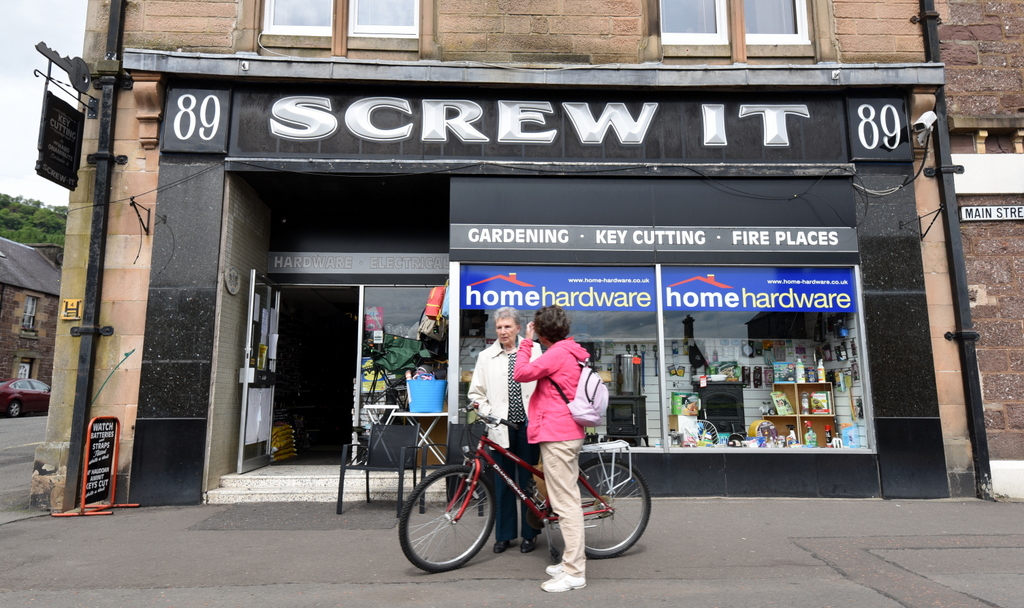
Cameron-Scotland-British Signs-Screw It

Usually when I visit the hardware store, I use much more colorful language than this.

As creative and punchy as Brits are about naming businesses, they can be just as long-winded when it comes to official pronouncements. Why use one word when you can use ten? Here are a few needlessly wordy signs, with succinct subtitles:

Cameron-Scotland-Brirtish-Sign-Concise 1

“Slippery when wet”


Cameron-Scotland-British Sign Concise 2

“Sold”

And finally, sometimes you find a sign that’s simply perfect: Clear. Concise. And to the point. No ambiguity here:

Cameron-Scotland-British Sign-Award Winning Beach

Highlands Highlights

Most Scottish travel dreams are set in the Highlands, the rugged and remote northern fringe of Great Britain. The Highlands are the most mountainous, least inhabited, and most scenic and romantic part of Scotland. In the Highlands, grizzled islanders man drizzly ferry crossings, intrepid Munro baggers scale bald mountains, and mini-mosquitoes called midges make life miserable (bring bug spray). Here are a few of my favorite pictures of the Scottish heartland.


Cameron Scotland Highlands Glencoe

I’ve driven thousands of miles across Scotland… and the valley called Glencoe may just have my favorite Scottish scenery anywhere. It’s famous as the site of the Glencoe Massacre, when British Redcoats rose from their beds and murdered their Clan MacDonald hosts, violating the rules of Highland hospitality. It’s fitting that this achingly beautiful place — where countless waterfalls inspired the nickname “the Weeping Glen” — would host one of the most tragic stories in Scotland’s very tragic history. Today the valley is justifiably popular with hikers. I attempted a hike myself, but the saturated turf stymied my plans. With each step, my foot disappeared into a brown puddle. The summer of 2015 has not been ideal for Highland hikes.


Cameron Scotland Highlands Crannog Centre

Cameron-Scotland-Highalnds-Crannog Centre Fire

At the excellent Scottish Crannog Centre on Loch Tay — which Rick wrote about after his visit there — I enjoyed touring the reconstructed stilt house and learning about Stone Age tools. I watched in awe as our guide created fire out of nothing but wood, string, and stone.
Cameron-Scotland-Highlands-Inveraray Ext

Cameron Scotland Highlands Inveraray Castle

The Highlands are littered with castles. Inveraray Castle, between Loch Lomond and the west coast, was one of my favorites. The outside is a turreted masterpiece. And inside, its grand public spaces have a lived-in coziness. Here in the main atrium, swords and rifles are artfully splayed into starbursts. Public television fans may recognize Inveraray as “Duneagle Castle” (a.k.a. Uncle Shrimpy’s pad) from one of the Downton Abbey Christmas specials. (Big photos of the Grantham and MacClare clans decorate the genteel rooms.)


Cameron-Scotland-Highlands-Hairy Coo 2

Cameron-Scotland-Highlands-Hairy Coo 3

Cameron Scotland Highlands Hairy Coos

When I’m in the Highlands, I can’t get enough of the adorable “Hairy Coos.” These shaggy Highland cattle have hair falling in their eyes, protecting them from troublesome insects and unpredictable weather. Hairy coos graze on sparse vegetation that other animals ignore, and, with a heavy coat (rather than fat) to keep them insulated, produce a lean meat that resembles venison. Highland cattle meat is not commonly eaten, so they’re basically kept for patriotic reasons…like gigantic mascots.


Cameron Scotland Highlands Glenfinnan Viaduct

You probably know the Glenfinnan Viaduct from the Harry Potter movies — it’s where the Hogwarts Express made its journey to a remote school of witchcraft and wizardry. But patriotic Scots also know it as the place where Bonnie Prince Charlie began his Jacobite uprising. To reclaim the thrones of England and Scotland, the fresh-faced, 24-year-old prince would need the support of the Highlanders. And here at Glenfinnan, he held his breath at the moment of truth: Would the Highland clans come to his aid? As Prince Charles waited, gradually he began to hear the drone of bagpipes filtering through the forest. And then, the clan chiefs appeared: MacDonalds. Camerons. MacDonnells. McPhees. They had been holding back — watching and waiting, to make sure they weren’t the only ones. And before long, the prince felt confident that he’d reached a clan quorum. And so, here at Glenfinnan, on August 19, 1745, Bonnie Prince Charlie raised the royal standard — officially kicking off the armed Jacobite uprising that came to be known as “The ’45.” (Sadly, Glenfinnan is also the place Bonnie Prince Charlie retreated to eight months later, after his campaign failed in the crushing defeat at Culloden.)

Behind Scottish Clichés: Bagpipes

Everywhere you go in Scotland, you hear the hum, whine, and drone of bagpipes. In my first couple of weeks here, I’ve probably seen at least a dozen different pipers, ranging from a teenaged lass on Edinburgh’s Royal Mile, to a spry octogenarian a few steps below Stirling Castle, to a twentysomething kilted slacker on Glasgow’s posh shopping street.Cameron Scotland Edinburgh Royal Mile Bagpipes

Bagpipes are a way of life for the Scots. And, like so many quirky Scottish customs, bagpipe music has become a cliché — practically a parody of itself.

But like any cliché, piping becomes meaningful when you learn more about it. To do that, I paid a visit to Glasgow’s National Piping Centre. This isn’t a tacky tourist trap. It’s quite the opposite — in fact, it almost seems designed to bore a superficial tourist to tears. And that’s a good thing. Affiliated with one of Scotland’s premier music schools, this fine little museum takes the history and musicality of the bagpipes very seriously. For those with an attention span for either history or musical instruments — or ideally both — it’s riveting.

Cameron Scotland Glasgow National Piping CentreThe Piping Centre is basically one big room packed with well-described exhibits, including several historic bagpipes. The scholarly, beautifully produced audioguide — which mixes a knowledgeable commentary with sound bites of bagpipes being played, and brief interviews with the performers — sounds like a BBC radio documentary.

Leaving the museum, I stopped to chat with the lads at the ticket desk. One of them, named Chris, pointed out a new attraction: an actual set of bagpipes that visitors are encouraged to try out. “Really?” I asked. “O’ course,” he assured me. “Like, I could try it?” “Why not?”

I have zero musical training, beyond a couple of Led Zeppelin riffs my high school friends taught me to pluck out. But, with Chris’ patient explanation, I gave it a whirl. I’d never really paid attention to the way a bagpipe actually work — until I was the one trying to make it work.

First, you tuck the deflated bag under your left arm. There’s no strap — you just wedge it in there. (Chris explained that seasoned bagpipers build up an overdeveloped left shoulder muscle, like callouses on a guitarist’s fingers.)Cameron Scotland Edinburgh Royal Mile Bagpipes

Jutting out from the bag, at willy-nilly angles, are five different sticks. The three stoutest, longest ones are the drones. Those rest against your left upper chest and shoulder. Another one is the blowpipe. And the fifth one, with a row of holes like a recorder, is the chanter. The chanter is what makes the music.

Holding the blowpipe in your mouth, and with both fingers on the chanter, you start to blow. That’s the hardest part. Just as trumpeters and didgeridoo players have to develop circular breathing to keep a steady tone, pipers become masters of keeping the bag fully inflated at all times. For them, it’s second nature. But for me, it was all I could do to keep the bag half-full without passing out.

As I huffed and puffed and the bag began to inflate, the three drones groaned to life with a horrifying cacophony of mewing and whining that sounded like euthanasia day at the cat shelter. As Chris patiently coached me with the poise of a master, I suddenly realized he wasn’t just a ticket-taker. “So you play, then?” I said. “Yes! In fact, I just earned my Master’s in piping.”

Now completely self-conscious about butchering the instrument my tutor has devoted his life to, I gave it another shot. As my face turned purple, the warbling drones began to even out. And only then did the chanter spring to life. I was on the verge of hyperventilating, and had only just gotten to the point of generating music.

Cameron Scotland Stirling BagpipesFeeling sheepish about what anyone within earshot must be thinking, I said, “So I guess there’s really just the one volume, then?” Chris laughed. “Yes, there’s only one dynamic: loud. Pipers have to be careful of their hearing, especially with the drones always so close to the left ear. I wear earplugs when I play.”

As my brief career as a piper came to a close, Chris told me about learning to play the instrument. “First you focus on learning the fingerings on the chanter. You simply blow into it, like a recorder, and make music. Then, when you’re ready, you try it with the bag. But at that point, it’s like learning an entirely new instrument.”

While all of the kitschy kilted pipers in Scotland’s cities and green glens are fun, I’m glad I stopped by the National Piping Center. It’s given me a new appreciation for the skill and musicality that goes into playing an instrument that I can confidently say I will never master.