My co-author and frequent collaborator, Cameron Hewitt, is well-traveled, smart, and insightful. And, while he and I are in perfect sync in our travel styles and priorities, he gives voice to the next generation of "Rick Steves travelers." Join me in enjoying his reports right here. —Rick

Off-Season Italy

For my work, I tend to be in Europe for a few weeks each in spring and fall: April and May, then September and October, year after year. Our Tuscan Thanksgiving gave me the chance to be in Italy off-season. And it was a delight.

Traveling off-season — like traveling at any time — has its pros and cons. The weather is unpredictable: Two weeks before Thanksgiving, highs were in the 60s. But just as we arrived, the forecast plunged 20 or 30 degrees, forcing us into ski caps, long underwear, and wool socks. But at least it was mostly sunny, aside from a couple of rainy afternoons (and a few snowflakes and hail pellets). Our agriturismo came complete with a fireplace and an unlimited supply of firewood…and the resident cats enjoyed keeping an eye on the woodpile.

cameron-tuscany-woodpile-cat

We took drizzle as an excuse to visit the hot springs in Bagno Vignoni, an ancient spa town a half-hour’s drive from our agritirusmo. Having a huge, steamy pool of spring-fed thermal waters almost to ourselves, and being able to book massages on the fly, made us feel pretty smart for coming here off-season.

cameron-tuscany-bagno-vignoni

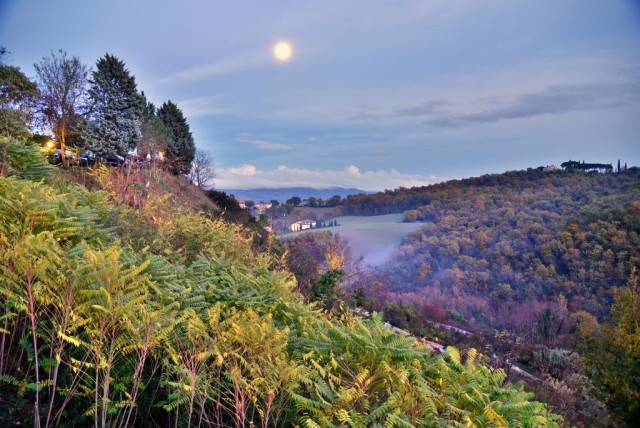
The days are short in the winter…deceptively short. Despite its sunny reputation, Tuscany is at the same latitude as Toronto. Nightfall drew the shades on our sightseeing around 4:30 — leaving us with several dark hours to kill, scenery-free, before dinner. (The limited daylight also made getting over jet lag a bear, in both directions.) But at least the setting sun cast evocative, long shadows over the winter landscape.

cameron-tuscany-tree-shadows

Because we were there so far off-season, a few things were unexpectedly closed. For example, my favorite gelateria in Pienza was closed (I checked…three times). But in most cases, it was easy to avoid disappointment by calling ahead.

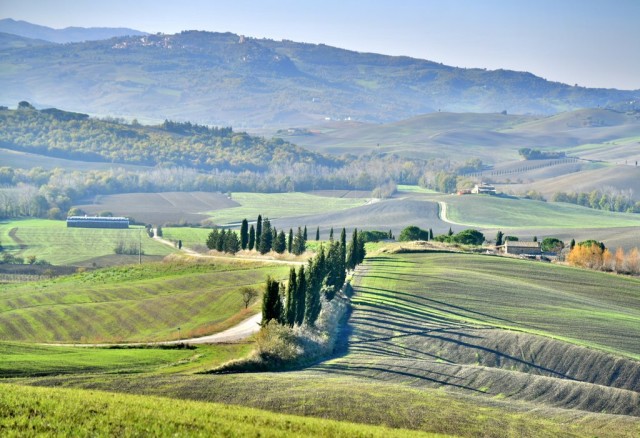
All in all, late November was a wonderful time to be in Tuscany. The most pleasant surprise was the vivid colors. We enjoyed the final, fleeting yellows and oranges of autumn leaves. Spindly branches hung heavy with bright-orange persimmons. And because winter crops had gone in a few weeks prior, several of the rolling hillsides were fuzzy with the vibrant green of winter wheat. Most days, we enjoyed blue skies (albeit briefly). We found that, from a landscape-scenery perspective, late November was much better than a previous trip in early October (after the harvest, and when trees and lawns had been singed by the hot summer sun).

cameron-italy-tuscany-Scenery-024

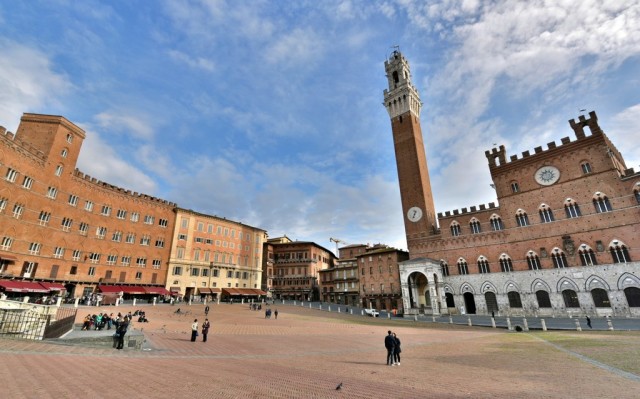
The lack of crowds was another huge plus. Being able to park anywhere, go anywhere, and show up at any restaurant without consideration for crowds, it’s easy to get spoiled. It was nice to be in popular places — like Il Campo in Siena — and have them basically to ourselves. Enjoying the empty cobbles, I had flashbacks of being in these same place during the peak spring months — parking my car at distant satellite lots and hiking into town, only to find my first through fifth choices for dinner completely booked up.

cameron-tuscany-siena-winter

Late November is also a festive time to be in Tuscany. Holiday decorations were not yet in full swing, but throughout we week we saw people putting up garlands and lights — further dressing up already gorgeous towns like Pienza and Montalcino. Each town set up a Christmas tree on the main square. The most impressive was Montepulciano, which hosts a weekend Christmas market starting in mid-November. That town’s already adorable main square was filled with lights, stalls, and a Christmas tree.

cameron-tuscany-montepulciano-christmas

Italy is obsessed with seasonal foods. You might think that would leave few options in winter, but dining in the late autumn was a pleasure. Chestnuts worked their way into many dishes, and fennel salads were everywhere.

Winter is also the season for the precious white truffle — which is both delicious and fun to find. In the summer, truffle hunts are popular…but pointless. Tuscany’s worst-kept secret is that truffle hunters usually have to pre-hide a truffle for the dog to “find,” so as not to disappoint tourists. But November is legitimately truffle season, and our dog found four — including one surprise truffle in a park where we weren’t even looking.

cameron-tuscany-truffle-dog

All in all, assuming you pack layers, plan to bundle up, and call ahead to steer clear of unexpected closures, there’s no reason not to visit Italy off-season. You may even find you prefer it.

cameron-tuscany-sunset

The Craftsmen of Montepulciano

Every traveler has their favorite Tuscan hill town. Mine’s Montepulciano. For one thing, it’s fun to say: Mon-tay-pool-chee-AH-noh. And it’s simply charming. Steep, twisty, cobbled lanes clamber up through an ancient, stony cityscape draped over a ridge. But the main reason I love Montepulciano are the people who pass the years here as their families have for generations. Here, like nowhere else, I feel connected to the heritage of a real, living town.

cameron-tuscany-montepulciano-night

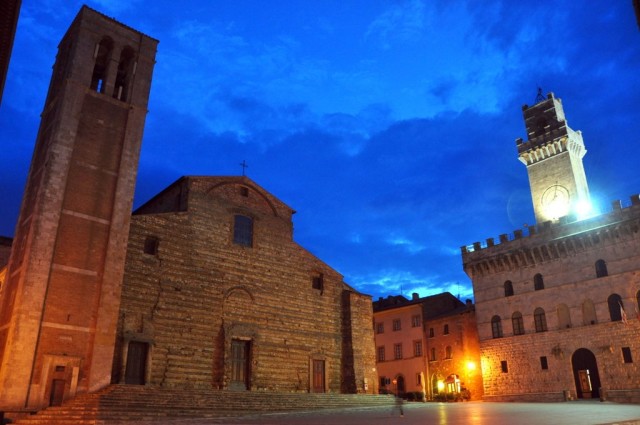
Montepulciano’s main square occupies a postage stamp of rare flat land at the very pinnacle of town — the misnamed Piazza Grande. Facing the square are the proud tower of the town hall, some fine Renaissance mansions, a lion-topped fountain clutching a shield of Medici pills, and the jarring naked-brick facade of the town’s Duomo, which locals have never had the money to dress up properly.

From the main square, a pedestrian lane snakes down through town. Strolling just a hundred yards along this main drag, I drop in on three different craftsmen — each one with a fierce passion for doing just one thing, and doing it better than anyone.

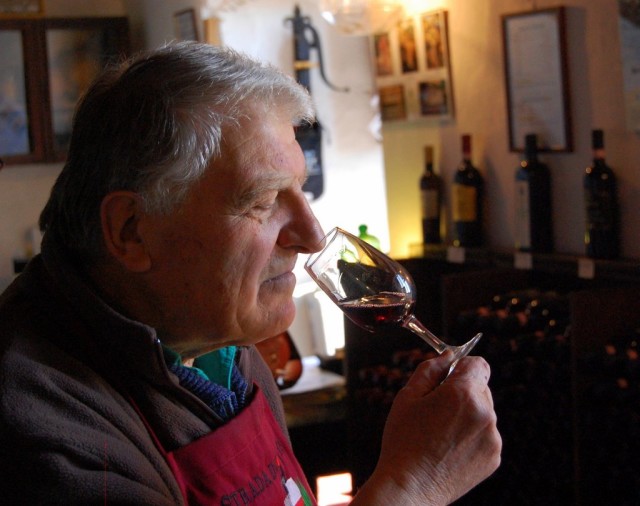
My first stop is the Cantina Contucci, where I’m greeted with fanfare by Adamo. Spraying me with rapid-fire Italian, Adamo explains that he’s been making wine here since he was in short pants. He officially retired 20 years ago, he says, but they still let him come to work every day.

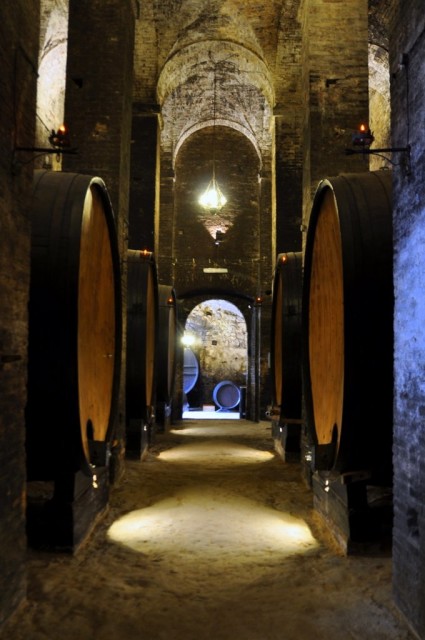
This town is famous for its robust Vino Nobile di Montepulciano wine. The grapes are grown in the surrounding hillsides, but it’s here, in a deep warren of cellars, that they become Vino Nobile. Underfoot, endless tidy rows of wine casks silently age beneath dramatic Gothic vaults.

cameron-tuscany-montepulciano-cellars

Walking among the truck-sized barrels, Adamo’s animated chatter crescendos. When it comes to his wine, he’s not just enthusiastic — he’s evangelical. Each cask is an old friend. My Italian is rusty, but Adamo’s exuberance is a universal language. For emphasis, he periodically reaches out and excitedly grips my arm.

Adamo

Fixing me with an intense but caring gaze, Adamo explains that a good wine has three essential qualities. He points to his eyes, his nose, and his mouth: color, bouquet, and taste. Finally, Adamo pops a cork and pours a sample in my glass. He won’t let me leave until he’s certain that I fully appreciate his life’s work.

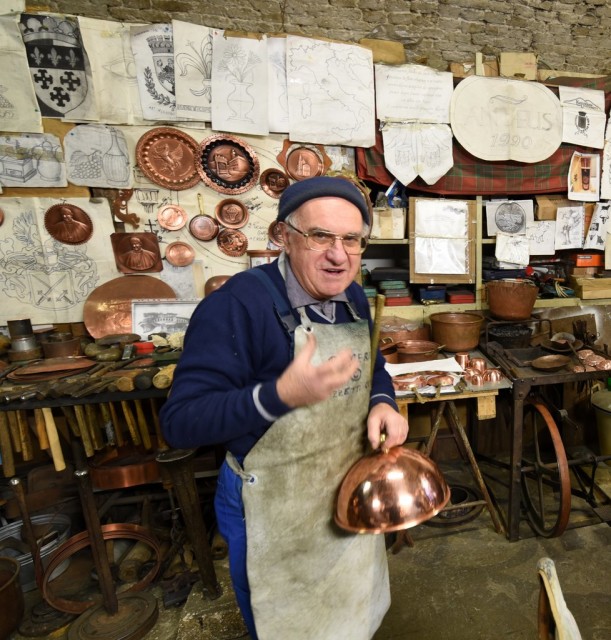
I step from Adamo’s dank cellars into the crisp winter air. Wandering just a few steps downhill, I’m drawn in by the clang of metal against metal, like the ringing of an out-of-tune bell. Peeking into a cluttered time-warp of a workshop, I see a hardworking coppersmith named Cesare, hunched over an anvil—an actual anvil, like from the Roadrunner cartoons.

cameron-tuscany-montepulciano-cesare

Cesare invites me in to see his finely detailed, hammered-copper pots. Like Adamo, he needs no English to convey his devotion to his craft. He lets me peek into the adjacent museum of his works, and shows me a photograph of the huge weathervane he created to adorn the rooftop of Siena’s cathedral.

Excited to demonstrate the heat-conducing properties of his favorite medium, Cesare instructs me to crouch down so he can place a copper bell over my head. He shushes me and taps the bell with a little hammer, creating a rich, harmonious tone. I can actually feel the sound waves radiating all around me, warming up the top of my head.

Flattered by my interest, Cesare declares that he will make me a gift. He pulls out a set of tools that he inherited from his father, who inherited them from his father, and so on, dating back to 1857.  He lays a copper circle onto his anvil, and methodically arranges his antique hammers. Then he lovingly dents the disc with floral patterns, my wife’s initials, and our wedding date. He refuses payment. Instead, he shows me a scrapbook crammed with photos and postcards from his past visitors. While he has a shop around the corner (Rameria Mazzetti), it’s clear that Cesare is not in this for the money. It’s all about his love for the craft.

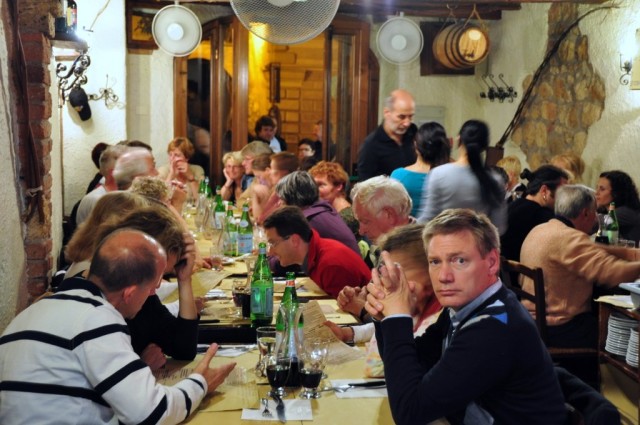
A few steps farther down the same street, I step into a lively restaurant: Osteria dell’Acquacheta. It’s dinnertime, and it’s packed. The handwritten menu is a sure sign that this place revels in what’s fresh today. But one thing that’s always on the menu is steak.

Osteria dell'Aquacheta Restaurant

Giulio appears. He’s a tall, balding, lanky artist of a butcher with a pencil sticking out of his gray ponytail. Just as his neighbors have devoted their lives to one thing, Giulio’s calling is grilling the perfect steak.

Giulio makes his rounds through the crowded restaurant. He pulls up a chair at each table and talks the customers through their options. When a steak is ordered, Giulio walks up the seven steps at the back of the restaurant to his busy open kitchen. There, a giant slab of beef rests on a butcher block. First, Giulio gently saws his way through the soft flesh. Then he hacks the clinging sinews with a giant cleaver. He slaps the five-pound T-bone on a sheet of paper, descends the stairs, and shows it to the customer. They nod in approval.

cameron-tuscany-montepulciano-giulio

Back up the stairs, the steak goes on the grill, pushed deep into a wood-fired oven: five minutes on one side, five minutes on the other, then sprinkled with coarse salt. When Giulio delivers the still-bleeding streak to his customers, they dig in — their eyes much bigger than their fast-filling stomachs. It’s a meal any steak-lover will never forget.

Whether it’s steak, copper, or wine, there’s something so inspiring about people who are completely devoted to their life’s work. In Montepulciano, you meet people who can’t stop working just because they’re retired. People for whom appreciation is better payment than money. People who find their niche in life and fill it with gusto.

Cooking with Chef Roberto: New Olive Oil and Old Wine

Cooking in Mamma Laura’s kitchen was a fantastic culinary experience. But for a more refined take on Italian cooking, we joined Chef Roberto behind the scenes at his restaurant. Our agriturismo arranged this experience as “sort of a cooking class,” but it turned out to be so much more: We were flies on the wall of a brilliant chef’s working kitchen — a graduate-level seminar on Advanced Italian Flavors.

Chef Roberto Rossi owns a Michelin star and a fine restaurant in his humble home village of Pescina, stranded high on the slopes of Mount Amiata. To reach Ristorante Il Silene, we corkscrew up and up — on choppy gravel roads — into the mountains overlooking the Val d’Orcia. As we gain altitude, fat raindrops become fat snowflakes. Finally, we crest a summit and enter a remote village where we park, scurry across the street in the slush, and step into the cozy-classy world of Il Silene.

Chef Roberto greets us at the door, takes our dripping coats, and offers us a glass of wine. The fireplace in the corner warms both us, and the two slender rabbits that are spending a few hours on a rotisserie. (We’ll see them again later.)

At 4:30, Roberto invites us back into the kitchen. With playful eyes under curly black hair, and a constant wry smirk, Chef Roberto seems relaxed. He leans against the counter and chats with us, while his staff scurries around the kitchen: Lella, the Sicilian sous chef who’s been his right hand since he entered the restaurant business; a few eager Italian chefs-in-training; and a pair of timid young Japanese culinary interns, who study the master intently.cameron-italy-tuscany-cooking-class-il-silene-001
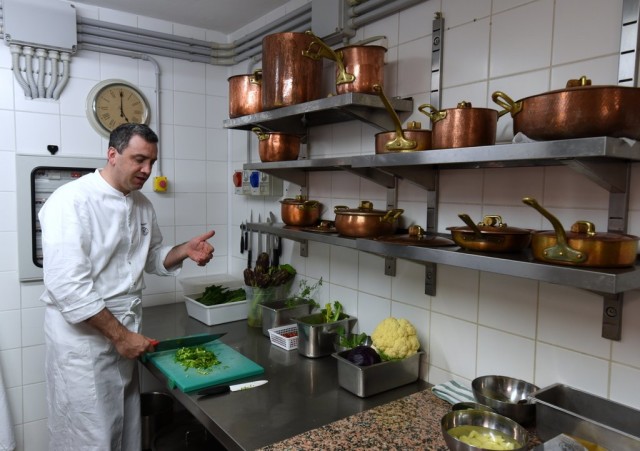
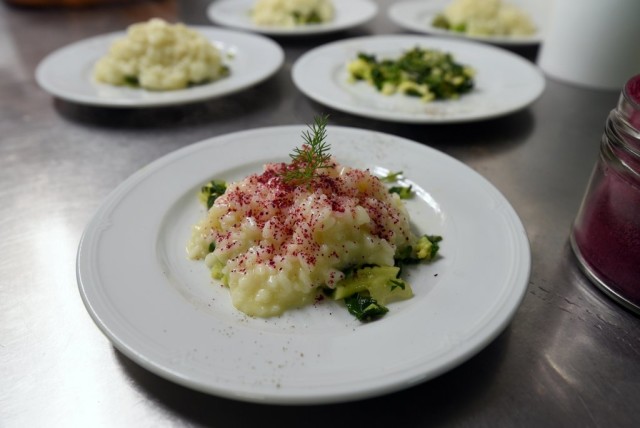
“So,” Roberto finally says, rubbing his hands together. “What do you feel like eating? How about risotto?” He walks casually to the stovetop, pulls out a pan, and ladles in some vegetable stock from a simmering pot. He sprinkles in some rice and gives the pot a few stirs, then hands the spoon to Lella, who dutifully stirs and stirs and stirs for the next 20 minutes. The result: a luxuriously creamy risotto. On top, Roberto grates precious, aged parmigiano reggiano cheese — each crumbly little flake instantly melting into the steaming rice. And finally, he sprinkles the dish with his own invention: a pinkish-purple powder made from dried and finely grated beets. Both the cheese and the beets give the dish an earthy umami kick. A little sprig of fennel perches on top, like a Christmas tree on a snowy mountain.
cameron-italy-tuscany-cooking-class-il-silene-005

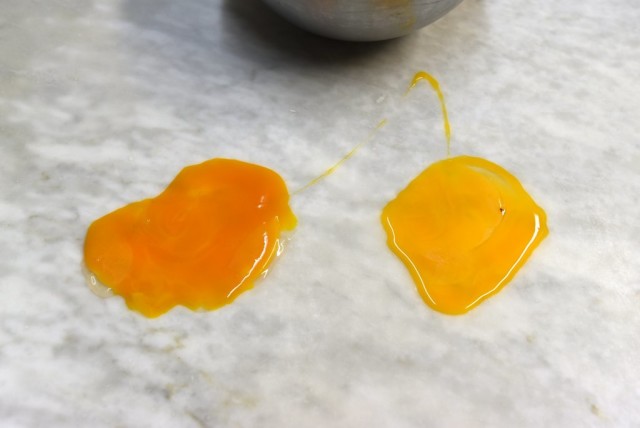
Satisfied with our first course, Roberto invites us back to his pasta-making room. We huddle around the rickety old table with a smooth marble top. Sipping his wine, Roberto — whose father owns a farm just up the street — explains the critical difference between farm-fresh and store-bought eggs (even “organic” and “free range” ones). To demonstrate, he cracks one of each on the white marble. Can you guess which is which? (The rich, orangey tones of the farm-fresh egg are a dead giveaway.)
cameron-italy-tuscany-cooking-class-il-silene-011

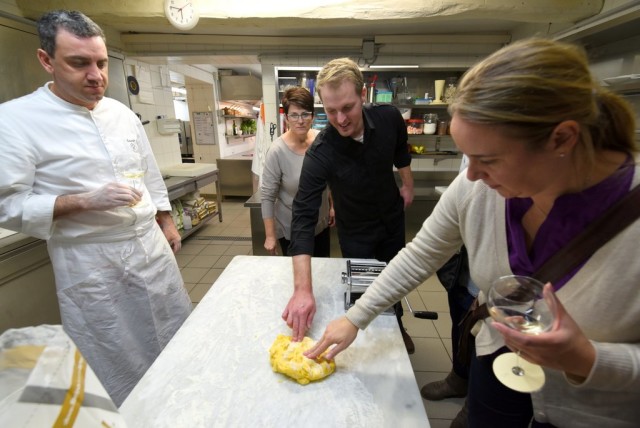
Point made, Roberto scrapes the eggs into a bowl, throws in some flour and a duck egg yolk (for elasticity), runs it through a mixer, then hand-kneads the small knot of yellow dough with mechanical precision. The moment it reaches the perfect texture, he invites us to prod it.
cameron-italy-tuscany-roberto-dough

Roberto rolls out the dough, then starts running strips through his pasta maker. “Italy has so many kinds of pasta,” he explains. “Hundreds and hundreds. Each one is designed to show off the other ingredients: local produce, meat sauces, cheeses, and so on. But they all start with basically the same dough.”
cameron-italy-tuscany-cooking-class-il-silene-031

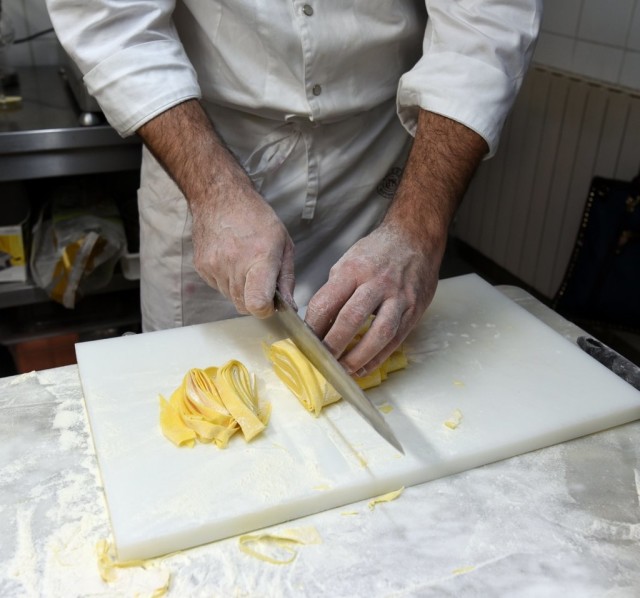
As he pulls each long, skinny, translucent sheet of dough from the roller, he folds it over on itself several times. Then he attacks each little bundle with his knife, eyeballing textbook-perfect examples of different pastas.
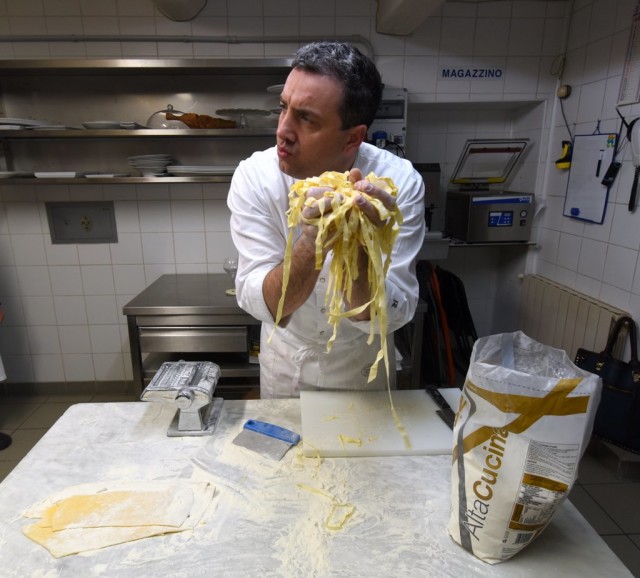
cameron-italy-tuscany-cooking-class-il-silene-029

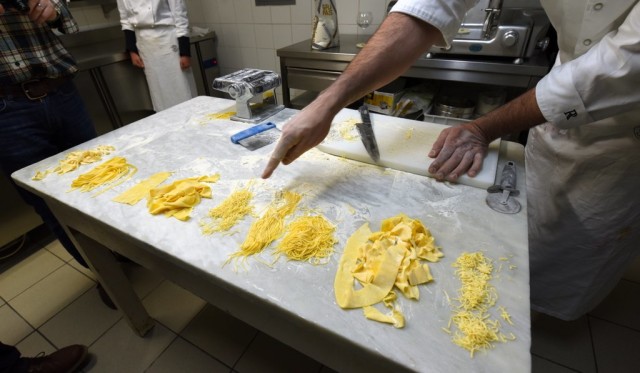
Papardelle,” he says, chopping thick ribbons.
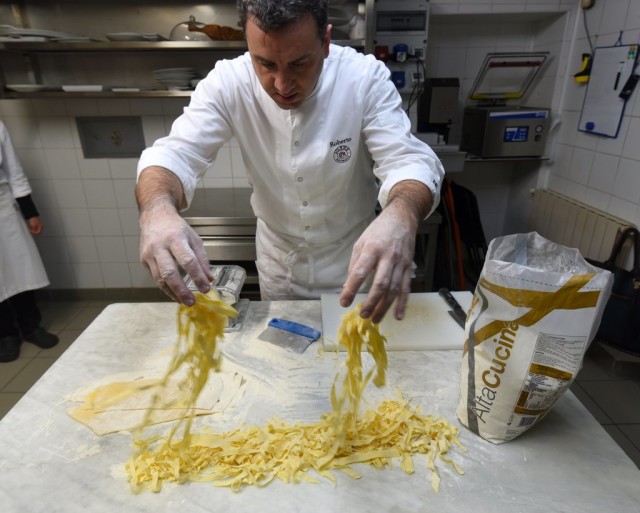
cameron-italy-tuscany-cooking-class-il-silene-028

Tagliatelle.” This one is thinner. His hands work fast and furious — almost too fast to track.
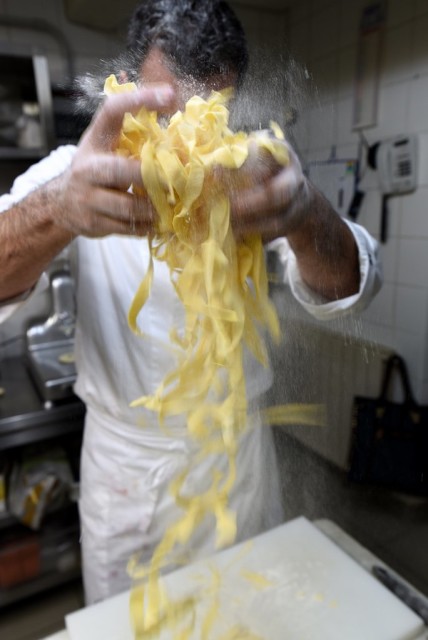
cameron-italy-tuscany-cooking-class-il-silene-035

Capellini.” Thinner still. With each batch, he grabs the wad of new noodles and tosses them gently in the air.
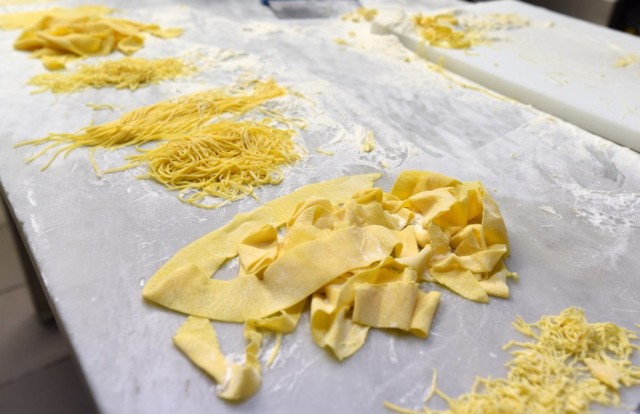
cameron-italy-tuscany-cooking-class-il-silene-049

“You cut the capellini in small pieces, like for a soup, and you get fideo pasta.”
cameron-italy-tuscany-cooking-class-il-silene-042

Stepping away from the table triumphantly and sipping his wine, he beams at his creation. With nine different types of pastas lined up along the flour-scattered marble, it looks like the cover of a foodie magazine…all done in a just few minutes, by one man and his knife.

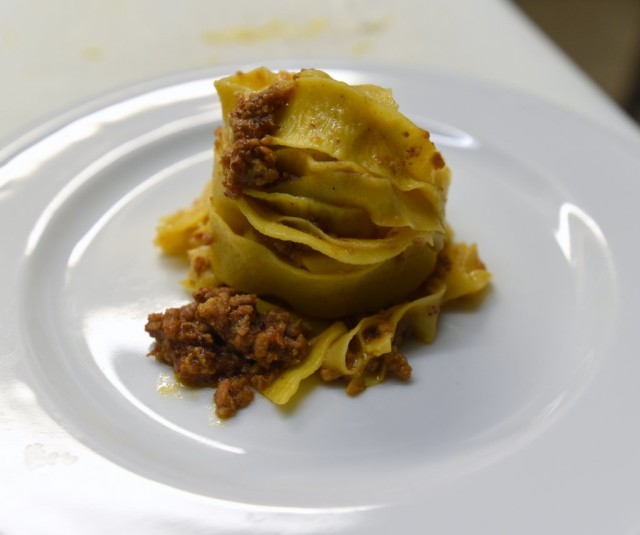
Roberto sends one of his assistants to heat up our pasta (so fresh it needs only a brief, boiling bath) and mix it up with some turkey ragù. Delicious.
cameron-italy-tuscany-roberto-pasta

Next comes a lesson in olive oil. Roberto holds up two squirt bottles. “The blue one is last year’s. Still good, but just for cooking. The green one is this year’s. For finishing.” Only a few days before, Roberto was at the olive mill down in the valley, where he personally watched the precious golden-green oil pressed out of his olives. We taste each one, and the difference is remarkable: Last year’s, still decent, has subdued, muted flavors. You can’t quite taste the olives. But this year’s? Explosively piquant.

For an even better taste of top-quality oil, Roberto thin-slices a baguette and toasts the slices. Holding a bottle high in the air, he rains down a shimmering stream of golden-green oil, then tosses them with his hands. Crunching into the crusty, coated little discs, the pungent, acidic, tingly taste of fresh olive oil blankets our palates.

cameron-italy-tuscany-cooking-class-il-silene-056

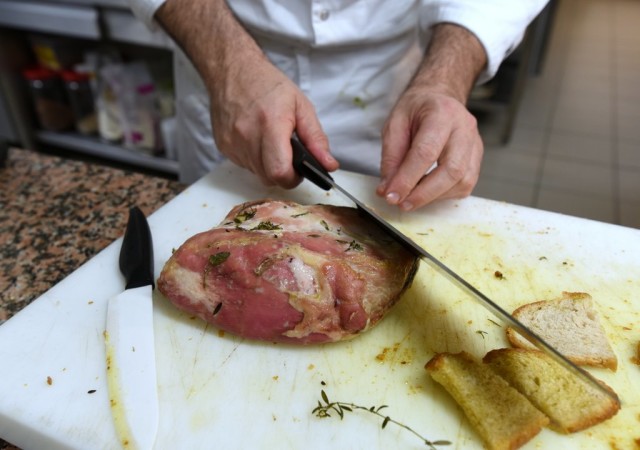
Seeking another topping for his little crostini, Robert disappears out back and returns with a breast of turkey that he’s been slow-roasting for hours. “I don’t usually cook turkey,” he says. “But I know it’s Thanksgiving in America, so I decided to try. If you understand the principles of how to cook meat — salt, herbs, aromatics, slow-roasting at a low temperature — you can cook anything well.” He slices off some thin tastes. It is, without a doubt, the best turkey I’ve ever eaten.
cameron-italy-tuscany-roberto-turkey

For another topping, Roberto makes a batch of his signature salsa verde: a vibrant-green sauce made with a generous bunch of Italian parsley, ample olive oil, a couple of medium-boiled egg yolks, capers, top-quality anchovies, and some salt. When we taste it, our questions of “What do you put it on?” are instantly answered: Anything. This outrageously flavorful, catch-all condiment tastes faintly of each of its ingredients, but is far greater than the sum of its parts.

As we munch, Roberto explains his passion for wine. Not a rare quality in Italy — especially in Italian restaurants. But more specifically, Roberto has an affinity for very old wines. “Later on,” he says, “I’m going to open for you a very special bottle. From the Südtirol — the very northern part of Italy, in the Alps, touching Austria. It’s a white wine, aged several decades.” It’s the paradox of a great chef: He insists on only the freshest and most local ingredients, yet prefers extremely old wines from distant lands.

Roberto explains that he recently returned from a trip to Spain. Near Barcelona, he visited the restaurant of a celebrity chef who owns a second Michelin star. Roberto enjoyed his meal, of course, but couldn’t help but stoke a little rivalry with his colleague. (He shows us the little sample of olive oil they sent home with him — in a gaudily labeled plastic bottle, which, as every oil aficionado knows, spoils the taste.) He tells us that this famous chef, who appears virtually every day on television, seemed very tired. “Well, I am not,” Roberto says defiantly, standing up straight and smiling wide. “I live here, in Pescina.”  If we were wondering why such a talented chef chose to live so far off the grid…we have our answer.

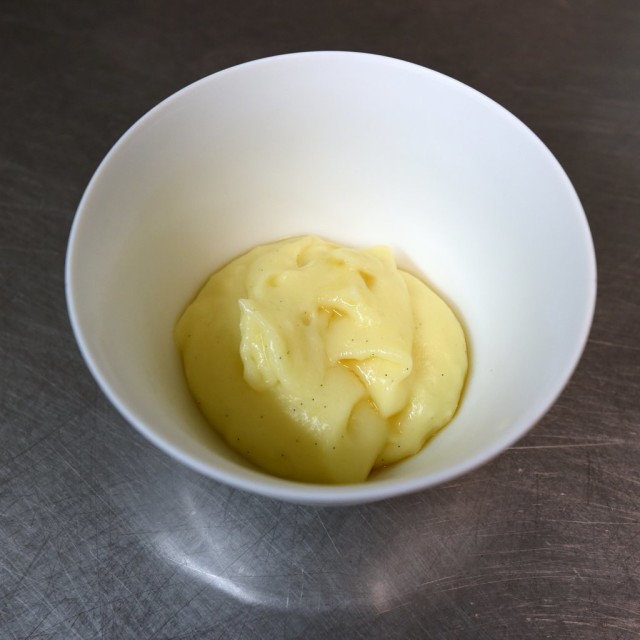
To wrap up our kitchen visit, Roberto whips up a batch of pastry cream: Heat up a pot of milk with lemon peel and vanilla seeds. Then, at the point of boiling, introduce a mixture of eggs, sugar, and flour…and stir vigorously, whipping it into a custard-like consistency. As a special treat, he drizzles in a dram of 1860 marsala wine. It’s not much to look at, but like everything else he creates, it’s sensational. Digging into this simple yet heavenly confection, we ask, “When do you serve this?” Roberto thinks it over, then says, “When I have a guest who doesn’t know what they want — or who doesn’t like anything at all — this is what I give them. Everyone likes this.”
cameron-italy-tuscany-roberto-cream

After a couple of hours of shadowing Roberto in his kitchen, we’re stuffed: Risotto. Pasta ragù. Bruschetta with olive oil, and slow-roasted turkey, and salsa verde. And now pastry cream.  So imagine our surprise when Roberto glances up at us, with a twinkle in his eye, and says, “OK! Now it’s time for dinner.” Despite our protests, he leads us out into the elegant dining room, seats us at a grand table, and proceeds to serve us a fantastic four-course dinner: handmade pasta, of course; those slow-roasted fireplace rabbits; and that bottle of antique Dolomite wine. Everything is fantastic, and the portions are mercifully modest. (He must have taken pity on us.)
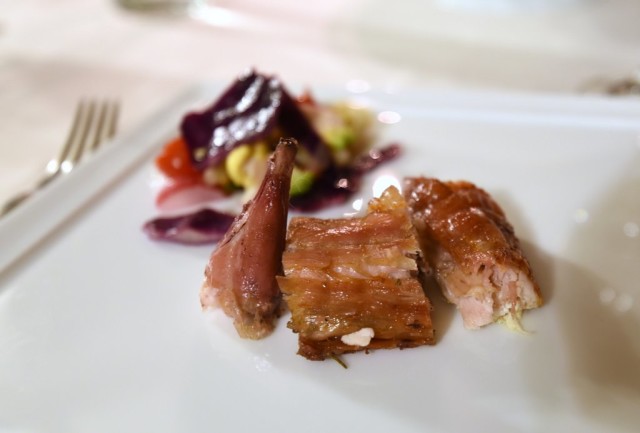
cameron-italy-tuscany-roberto-rabbit

Our evening in Robert’s kitchen might seem like an unrealistic goal for the casual tourist. But, like the cooking class in Mama Laura’s home, these sorts of experiences are perfectly accessible to anyone who’s willing to do a little homework and make the arrangements. Hanging out for a couple of hours with Roberto, then dining in his restaurant, probably cost us just a few euros more than dining in the restaurant alone. And we came home with a renewed appreciation for how a top-end kitchen — and a top-end chef — masters the art of pleasing diners.

Recipe for Marta’s Simple Tomato Sauce

Looking for an easy, timeless, and delicious Tuscan tomato sauce recipe? Look no further.

Tuscany is synonymous with great food. And I’ve been fortunate to have taken a variety of cooking classes there — from hanging out in the kitchen of a Michelin-star chef, to joining Mamma Laura in her home kitchen, to hand-rolling pasta at my favorite agriturismo.

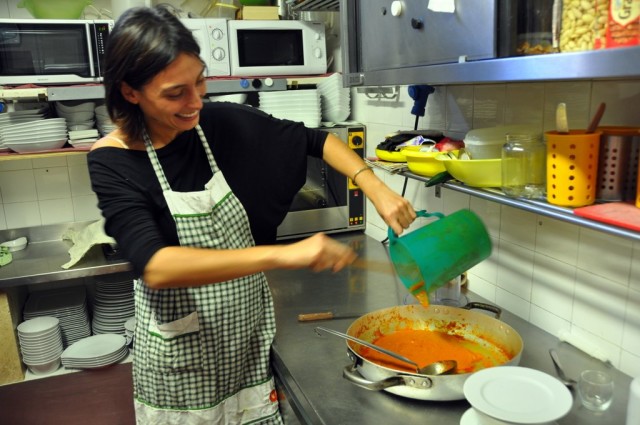
I’ve brought home several of these recipes, but my favorite culinary souvenir is  this simple tomato sauce. My wife and I joined Chef Marta (the daughter of Mamma Laura) in her restaurant kitchen, where she taught us how to make the best tomato sauce I’ve ever tasted. This versatile, explosively flavorful sauce — which is fantastic with all kinds of pasta, or can elevate just about any dish — immediately became a go-to recipe for my extended family. We call it “Marta’s simple tomato sauce.” (That’s “simple” in the best possible sense: easy, unfussy, and delicious.)

cameron-italy-tuscany-marta

Ingredients

Ample extra virgin olive oil, 6 cloves garlic, 2 large cans of whole peeled tomatoes (San Marzano are best; in season you can use fresh cherry or Roma tomatoes); a bit of water as needed; salt, sugar, and red pepper flakes to taste. Serves about 8; the sauce freezes very well. (We usually eat half right away, and stick the rest in our freezer for later.)

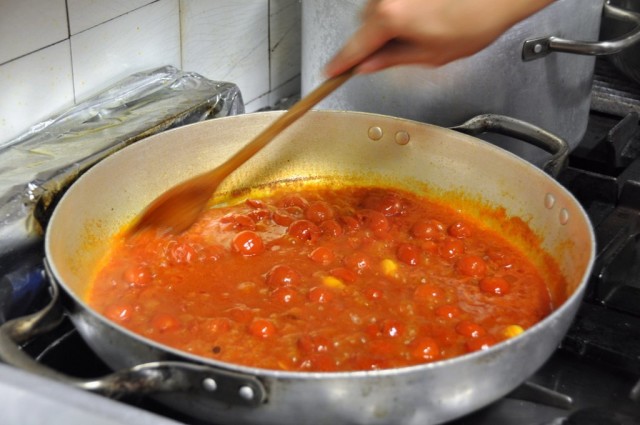
cameron-italy-tuscany-marta-sauce

Procedure

Use a pan with as big a surface area as possible. Pour in lots and lots of olive oil (about 1/2″ in the bottom of the pan). Don’t be shy…when you think you’ve used too much oil, add some more.

Drop in the garlic and heat it at high temperature until oil begins to bubble, then turn to low. Add the tomatoes, a small handful of salt, a pinch or two of sugar, and red pepper flakes to taste.

Turn the heat back to high, allowing it to sizzle and bubble, and cover it to reduce spattering. (There will be spattering.) Boil for about 10-15 minutes, until it gets “creamy” around the edges. Stir frequently, and have fun crushing the tomatoes with a big wooden spoon. (If using fresh tomatoes, cook for 30 minutes.) If it’s thicker than you’d like, you can add some water partway through the simmer (a half-cup to a cup).

When it’s done cooking, remove the three biggest garlic cloves and puree the sauce with a hand mixer (or transfer to a food processor or blender).

Enjoy!

cameron-italy-tuscany-marta-sauce-pasta


For lots more on Italy’s heartland, check out my series with 12 Tips on How to Experience the Best of Tuscany.

Waiting for Luciano’s Knock

Every night at around 9:30 or 10:00, there’s a knock on the guest room doors at Agriturismo Cretaiole. It’s Luciano — the 75-year-old farmer who owns the place — inviting people down to the veranda for a nightcap. There’s no point fighting it. Yes, you’re tired from your busy vacation. But Luciano has been working the fields all day, and he’s ready to party. You have no excuse.

Trading your pajama bottoms for blue jeans, you make your way to the glass-enclosed patio. Luciano has laid out his little plastic cups, and bottles of his three homemade spirits: grappa (grape brandy), limoncello (grappa infused with lemon rinds), and Vin Santo — the prized “holy wine” that’s made with concentrated grapes, fortified with grappa, then aged lovingly in special casks.

Luciano pours everyone their slug of choice, then puts on his Sinatra records. As the sprits flow and Frank croons the classics, Luciano nudges his guests to the dance floor. Emboldened by the Vin Santo — and by the general aura of Tuscan romance — couples who haven’t slow-danced in eons grip each other and sway to the music. Occasionally Luciano cuts in for a dance of his own.

The old man loves to talk, even though he speaks no English. Despite his guests’ protests that they don’t speak Italian, Luciano just keeps chattering away — making himself understood (more or less) with meaningful eye contact and by speaking slowly.

Recently Luciano discovered the Google Translate app. So now, when he wants to convey a more complex point, he borrows someone’s smartphone. He speaks into it with a measured, gentle ease — his velvety voice submerging the phone in Italian charisma. After a pause, the phone spits out a rough translation in Siri-speak. It’s a jarring juxtaposition. But — like the traditional-meets-modern mix of the agriturismo itself — it just works.

cameron-italy-tuscany-luciano-farm

The old man is stubbornly old-fashioned. One of his relatives joked, “Luciano’s idea of progress is getting two new sheep for the farm.” Luciano may be the paterfamilias, but his daughter-in-law, Isabella, is the business brains of the operation. By converting his farm into an agriturismo, she created a bridge between Luciano’s rustic ways and a steady stream of visitors from faraway lands. Now that he’s gotten used to it, Luciano has a newfound purpose in life: connecting with tourists, and proudly sharing his traditions. This old dog is learning some new tricks…and loving it. Well, most of the time.

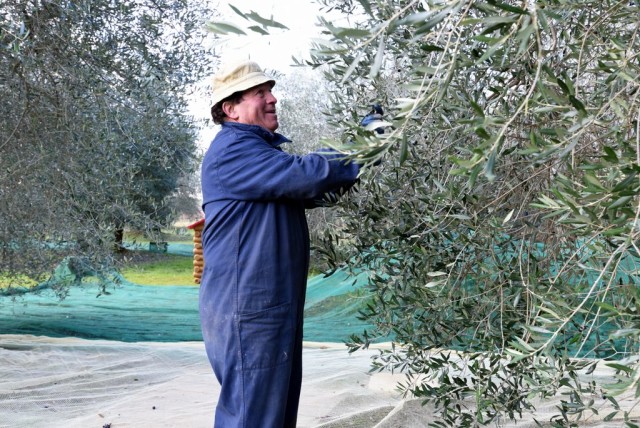
One day, Luciano invited his agriturismo guests to participate in the olive harvest. A few hardy and curious souls showed up, and put in a couple of hours’ work: spreading out tarps, gently raking plump olives off of spindly branches, then stooping over to gather them up.

cameron-italy-tuscany-cretaiole-045

At the day’s end, as the sky became a deep purple, Luciano built a roaring campfire deep in the grove. He pulled out a straw-wrapped bottle of his homemade wine, and began to cut slices of bread to toast on the open fire. He rubbed each crispy slice with garlic, drenched it in a generous dollop of his bright-green, fresh-pressed olive oil, and handed it around. “Bruschetta,” he said. “This is the real peasant cuisine.”

cameron-italy-tuscany-luciano-fire

Luciano’s exhausted work crew of tourists huddled around the fire and crunched into our reward for a hard day’s work. But Luciano wasn’t quite as impressed with us as we were with ourselves. “Here’s the thing about this agriturismo business,” he muttered to me with a wink. “It’s an awful lot of turismo and not much agri.”

While people come to Cretaiole for the food, wine, scenery, and cultural activities, I think that when all is said and done, some of their most prized memories come from their time with Luciano. Yes, things would be easier if Luciano learned some English. But I sure hope he never does.