My co-author and frequent collaborator, Cameron Hewitt, is well-traveled, smart, and insightful. And, while he and I are in perfect sync in our travel styles and priorities, he gives voice to the next generation of "Rick Steves travelers." Join me in enjoying his reports right here. —Rick

How to Drive Iceland’s Ring Road: The Ultimate 800-Mile Road Trip

Europe’s best road trip circles Iceland, from Reykjavík to Reykjavík, on the 800-mile Highway 1 — the Ring Road. Along the way, you’ll see a thrilling chunk of Icelandic countryside, from volcanoes to glaciers, and from charming seafront villages to jagged, lonesome fjords.
Most visitors to Iceland squeeze in a layover of just a few days to get a quick taste. But if you can spare more time, it’s worth investing a full week (or more) in driving the entire Ring Road. Our Rick Steves Iceland guidebook includes an in-depth chapter on the Ring Road, with all of the logistical details, a self-guided driving tour of the full route, historical (and geological) background on the sights you’ll see, and lots of recommendations for our favorite accommodations, restaurants, and services all along the way. Here’s an overview to get you started.

The Ring Road is an 800-mile loop. If you drive at a reasonable pace and take a few worthwhile scenic detours from the main Highway 1, plan on about 30 hours of driving. Divide that total by the number of days you have, and it becomes clear that attempting the Ring Road in fewer than five days will be regrettable in retrospect. A week is a more comfortable minimum; a few more days lets you slow down and make time for some longer hikes and other unique experiences.
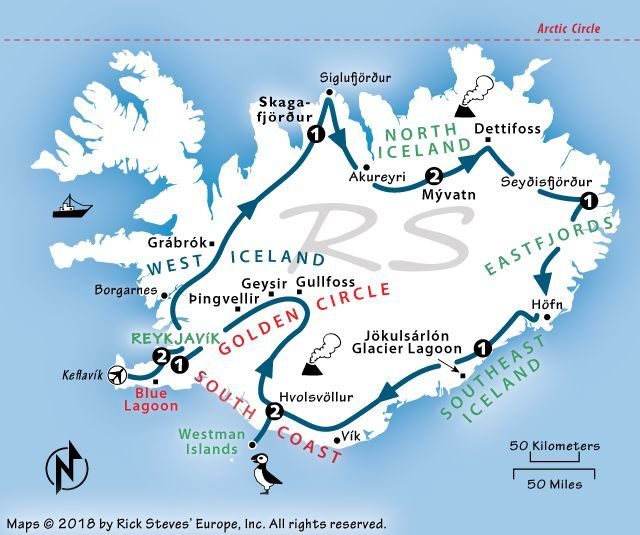
You can circle the island either clockwise or counterclockwise. While both approaches have their advantages, I prefer the clockwise route — which begins with more modest scenery before crescendoing into the most glorious stretches.

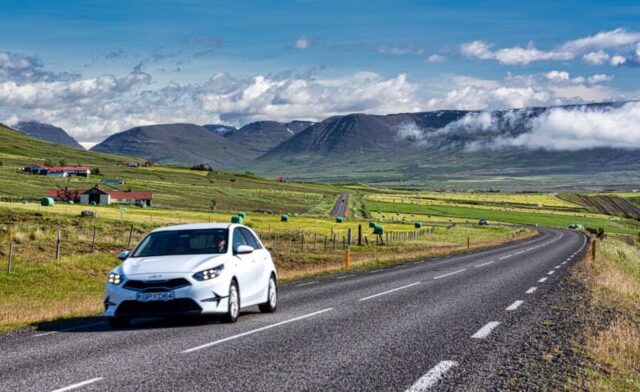
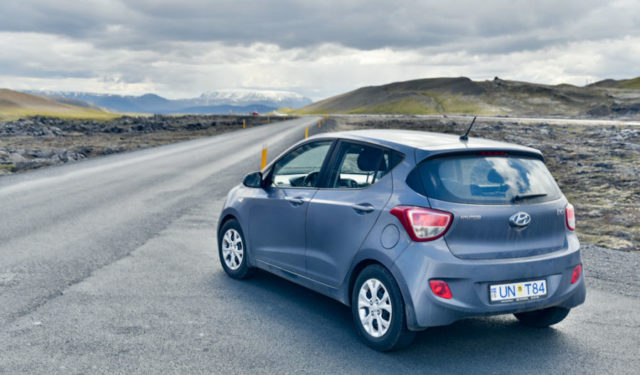
The vast majority of Highway 1 is a paved, two-lane road. There are a few, very brief unpaved stretches, and you’ll cross many one-lane bridges (where you’ll pause and take turns with oncoming cars — if there are any). The entire route, and the most appealing detours, can easily be done with a two-wheel-drive car. Unless you want to trailblaze across the interior Highlands, don’t splurge on four-wheel drive. I’ve done the entire Ring Road — twice — in a dinky Hyundai and never felt unsafe or underpowered.
Demand outstrips supply, so it’s smart to plan your route in advance and book your accommodations around the Ring well ahead — especially in peak season (mid-June-mid-September). Certain areas — such as Lake Mývatn and glacier country in the Southeast — have an especially limited number of beds, which can be sold out months ahead.

Another solution is to camp your way around the Ring. Several companies rent campervans for roughly the cost of a car rental plus basic accommodations. While Iceland has a permissive approach to camping, ask locally to be sure you’ve chosen an appropriate place. Formal campgrounds are your best bet, since they offer services such as bathrooms, showers, and laundry.
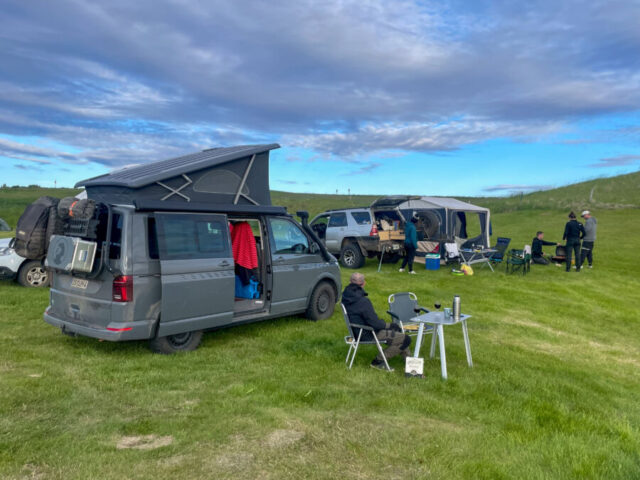
Try to break up the drive with overnights spaced about five hours apart. On a quicker loop, plan on several one-nighters in a row. Zipping around the Ring from Reykjavík, I’d overnight in the Skagafjörður area; near Lake Mývatn; along the Eastfjords (ideally in Seyðisfjörður); somewhere in the Southeast (in Höfn, near the Glacier Lagoons, or near Skaftafell National Park); and along the South Coast, somewhere between Vík and Hvolsvöllur. That’s a speedy-but-satisfying six-day, five-night express plan.

With a little more time, I’d add a night to Mývatn, and consider additional nights on the South Coast (freeing you up to linger there, or for a side-trip to the Westman Islands) and in the Southeast (if you want more time for glaciers and hiking). You might also add a night or two on the way north from Reykjavík for a spin around Snæfellsnes — a scenic Iceland-in-miniature peninsula that’s not officially on the Ring Road, but is an easy add-on.
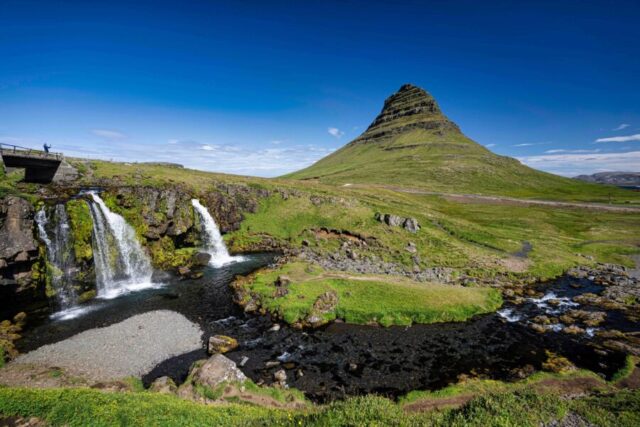
Here’s a quick overview of the Ring Road highlights, traveling clockwise from Reykjavík. Buckle up!

Heading north from the capital, it’s just an hour to the dramatically set town of Borgarnes — facing the steep scree slopes of Hafnarfjall mountain — and its fine little Settlement Center, telling the story of the Viking Age settlers who crossed the North Sea from Scandinavia to create a new home in Iceland.

Continuing north, let yourself be tempted to climb to the top of the crater called Grábrók, with sweeping views across a desolate landscape. Then make good time continuing north, then east, to the Skagafjörður region.

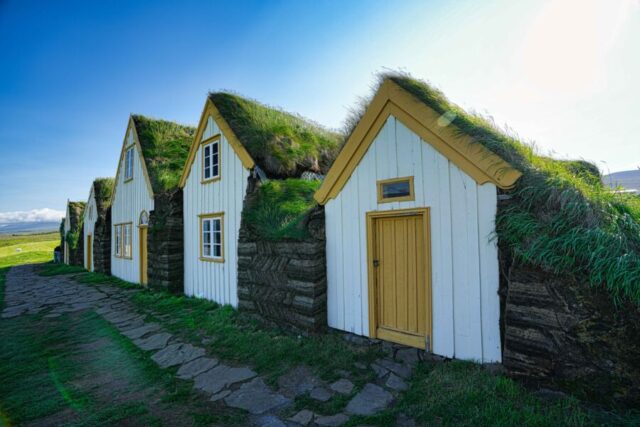
Skagafjörður — a fertile valley leading up to a yawning fjord — has several good countryside, farmhouse B&Bs for an overnight, as well as the charming small town of Hofsós (with its Emigration Center — telling the story of Icelanders who fled to Manitoba and the Dakotas in the hardscrabble late 19th century — and a small but inviting thermal swimming pool overlooking the fjord). But the main sightseeing draw in this swath of Iceland is the excellent Glaumbær open-air folk museum, where you can explore the sod-lined halls, storerooms, and sleeping quarters of a traditional Icelandic turf house.
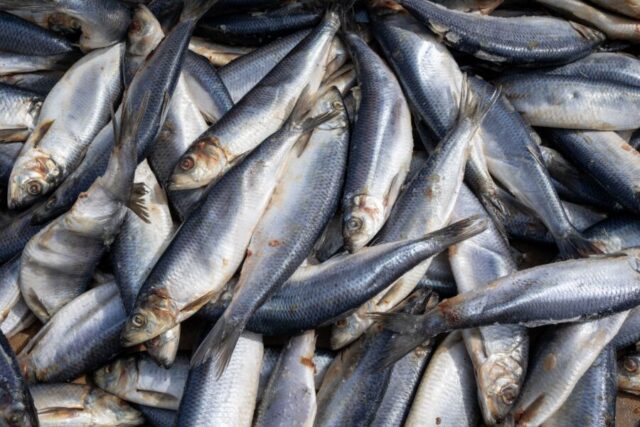
The quickest way to continue the Ring is to zip an hour east on Highway 1 to Akureyri. But one of the Ring Road’s most worthwhile scenic detours is the Troll Peninsula (Tröllaskagi), which loops around the headlands past the end of the Skagafjörður. You’ll enjoy desolate coastal scenery, and some long tunnels, before popping out at one of Iceland’s most pleasant small towns: Siglufjörður, with its excellent and oddly riveting Herring Era Museum. Tröllaskagi adds a couple of hours’ driving (plus whatever time you spend sightseeing and enjoying Siglufjörður), but that’s time very well spent.
Your next Ring Road stop is Iceland’s second city, Akureyri. With just 18,000 souls, Akureyri would rank as a tiny town in most countries — but in Iceland’s desolate North, it feels like a metropolis. This “mini-Reykjavík” is the place to gas up, stock up on groceries, and — if time allows — see the town church (by the same architect who designed Reykjavík’s landmark Hallgrímskirkja) and take a dip at the town’s lively, sprawling thermal swimming pool complex.

But if you’re doing the Ring in a hurry, keep your Akureyri errands brief, then carry on out of town to the east. After an hour and a half’s drive (stopping midway to see the Goðafoss falls), you reach the shore of Mývatn, a giant, languid lake that anchors a region of intense volcanic activity — past and present.
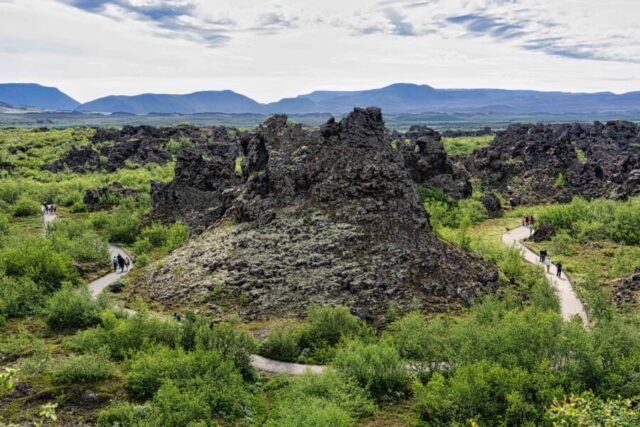
Mývatn is one of the most enjoyable places in Iceland to simply joyride and explore, hopping out to hike through otherworldly lava formations, see a geothermal power plant, wander a bubbling and steaming field, and simmer in the Mývatn Nature Baths — the simpler, half-price, but just-as-enjoyable cousin to the famous Blue Lagoon. With so much to do here, Mývatn is the Ring Road stop most deserving of a second night (or longer).

Before continuing eastward along the Ring, consider a detour 45 minutes (each way) from Mývatn north, to the pleasant waterfront town of Húsavík. This little town is a popular base for whale watching, and its northerly position increases the odds of seeing more exotic species — such as humpbacks. The fine Whale Museum displays giant skeletons of whales that have washed up on Icelandic shores.

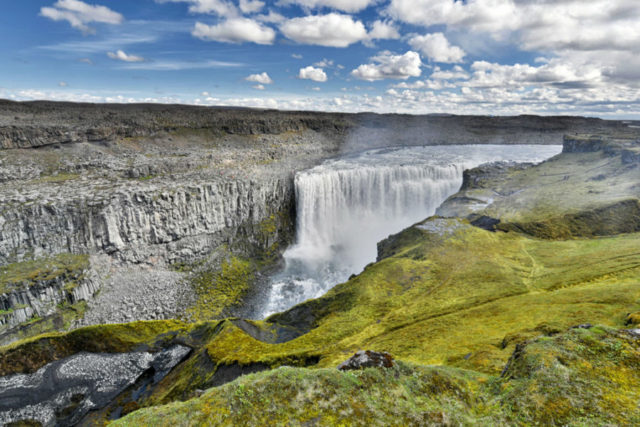
From Mývatn, it’s a long (two-hour) and lonely trek eastward across the Highlands to the Eastfjords. Break up the journey with a detour to one of Iceland’s most spectacular waterfalls, Dettifoss. Seeing Dettifoss takes about two hours (including the time to drive off the main road, and the short but scenic hike out to the falls). But it’s a worthwhile investment of your time to stand before a yawning chasm cut deep into a basalt landscape, showered by mist and rainbows.

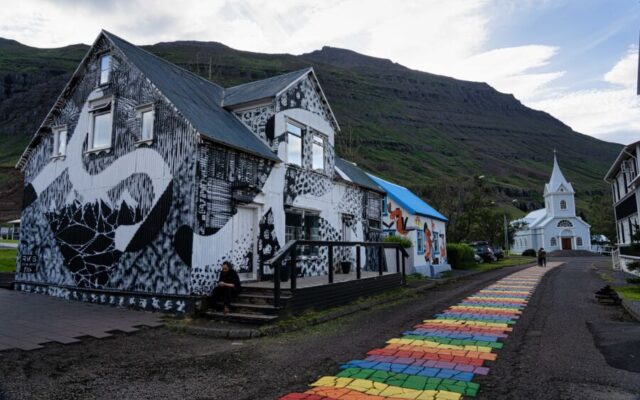
Arriving at the Eastfjords, spend the night to recharge and prepare for tomorrow’s long drive. While the provincial town of Egilsstaðir is right along the Ring Road and offers a decent range of hotels and services, it’s well worth a 30-minute detour from Highway 1 to reach the most appealing stop on the Eastfjords: Seyðisfjörður. This artsy town, sitting at the apex of a dramatic fjord, has a surprising variety of accommodations and restaurants, and oozes with personality — and it’s accessed by one of the most scenic mountain passes along the entire Ring Road, Fjarðarheiði.
The Eastfjords, while majestic, represent the most tedious part of the Ring Road drive. One fjord is breathtakingly scenic. A half-dozen of them, all in a row, begin to get a little repetitive. No tunnels or bridges speed your progress, so you’ll spend the day rounding a headland into a fjord, looking across to the road on the other side of the fjord’s mouth, then driving a half-hour all the way up one side of the fjord, then back down the other. And then repeat. Again. And again. And again.
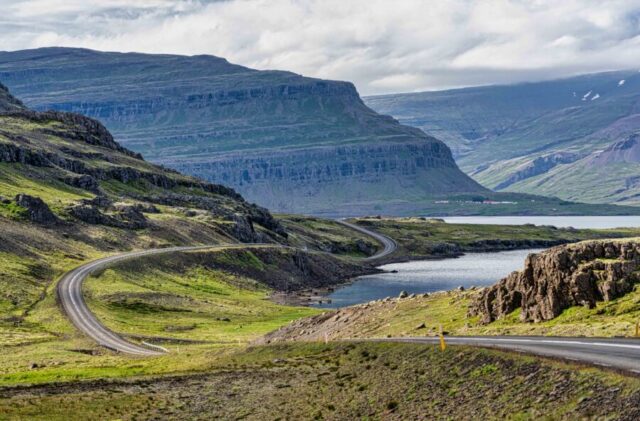
Curling out of the last fjord, you’ll soon hook around Hvalnes point. A miles-long spit of chunky pebbles — arcing as far as the eye can see across a rugged bay — welcomes you to Southeast Iceland…glacier country.

From here, the road is bullied between vast glacier-topped mountains and the North Atlantic. For the next few hours, you’ll get glimpses of Vatnajökull — Iceland’s largest glacier, which drapes over the southeastern quadrant of the country, with a surface area bigger than the state of Delaware and as much water by volume as Africa’s Lake Victoria.

There’s not much civilization in the Southeast, so don’t miss the chance to stop off in the pleasant village of Höfn, filling a peninsula with a busy port and several restaurants specializing in the local delicacy, humar (langoustine — like a giant prawn or a miniature lobster). You could sleep in Höfn, or — to make tomorrow’s drive a little shorter — carry on westward, where good countryside accommodations are strung along about a two-hour stretch of Ring Road.

About an hour west of Höfn is one of the most striking sights in all of Iceland: the glacier lagoon called Jökulsárlón, where glacier tongues dip down into a lagoon and calve off bobbing icebergs. This vast, serene pool puts the “ice” in Iceland, offering an up-close look at chunks of 500-year-old ice on the final leg of their journey to the sea.

And another stunning sight is a one-minute drive away: Diamond Beach, where (when conditions are right) those icebergs wash up on a black-sand shoreline before being swept out to the Atlantic. This majestic sight — still a five-hour drive from Reykjavík — is enough, on its own, to make you glad you budgeted time for the full Ring Road.

Just a few minutes’ drive farther is a second glacier lagoon, Fjallsárlón — also well worth a look. While you can do boat trips out onto either lagoon, I prefer the less crowded Fjallsárlón.

About a half-hour farther is the turnoff for Skaftafell National Park, offering a variety of hikes. And just past that is the mangled wreckage of a bridge that was swept away in 1996. This is a sobering reminder that all of these glaciers sit on top of volcanoes. And when things heat up, the ice melts, creating giant mountaintop reservoirs of hot water — which can come rushing down the mountain with destructive force. (This is why so many bridges in the Southeast are wimpy one-laners….easy to replace.)

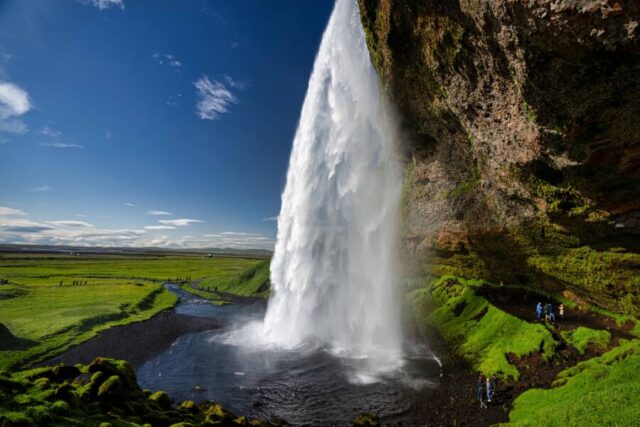
About two hours farther west, at the town of Vík, you approach the craggy, bald, grass-covered mountains of the South Coast — the last leg of the Ring Road, and a popular day trip in its own right from Reykjavík. Along here you can stroll along the black-sand beach at Reynisfjara, hike up to see a glacier at Sólheimajökull, tour the open-air folk museum and see a fine waterfall at Skógar, get a good look at Eyjafjallajökull (the volcano that famously erupted in 2010, halting European air travel), and ogle the stunning Seljalandsfoss waterfall — where (wrapped in a good rain jacket and waterproof shoes) you can actually hike around behind the thundering spray.
You could blitz these sights, then carry on bleary-eyed the last two hours or so to Reykjavík. Better yet, spend a night on the South Coast to allow time for lingering. With more time, you could side-trip to the Westman Islands (ferries leave from Landeyjahöfn). Or consider a more roundabout, scenic return to Reykjavík by way of the Golden Circle sights.

Phew! You made it. Clearly, the Ring Road is an unforgettable drive, and a remarkable opportunity to sample the very best that Iceland has to offer. For all of the details — including mile-by-mile commentary, detailed sightseeing and geological explanations, and our favorite hotels and restaurants all the way around — be sure to check out the Ring Road chapter in our Rick Steves Iceland guidebook.

Happy travels! Góða ferð!

Lake Mývatn: North Iceland’s Geothermal Wonderland

Few visitors to Iceland get beyond its southwestern region, around Reykjavík. And that’s a shame, because one of the most spectacular corners of Iceland is in the North. Our Rick Steves Iceland guidebook co-author, Ian Watson, told me I’d love the Lake Mývatn area. And he was right. Continuing my Iceland blog series, here’s a recap of perhaps the most memorable day I’ve spent in Iceland.

The midges are swarming. They don’t bite. But they do get stuck in your nose.

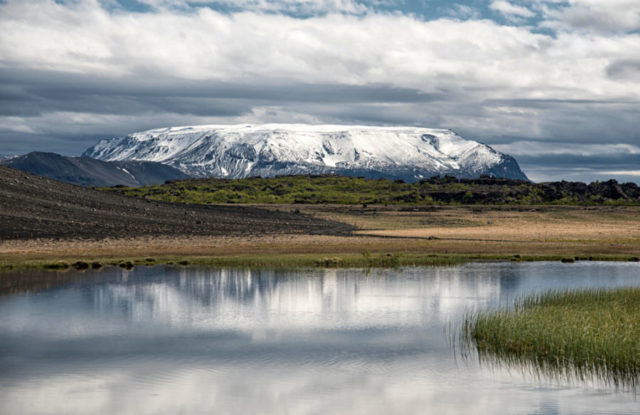
Mývatn — literally “Midge Lake” — fills an expansive plain ringed by flat-topped, snow-capped mountains in the north of Iceland, about a seven-hour drive from Reykjavík. Mývatn sprawls along the fissure between the North American and Eurasian tectonic plates, infusing the area with tremendous geothermal energy (and, consequently, some of the most breathtaking volcanic landscapes in Iceland).

Within a short drive — never straying farther than about a half-hour from the lakeshore — you can hike through a valley of lava pinnacles, summit two different craters, eat sweet rye bread baked in the hot earth, wander a neon-yellow plain of hissing fumaroles and bubbling hot pots, take a shower in the middle of nowhere, visit a geothermal power plant, and simmer in naturally heated hundred-degree water among steaming lava rocks. It feels like someone gathered up a half-dozen great American national parks and tucked them into one little corner of North Iceland.

The other thing you’ll see here —  like it or not — are midges, distant Nordic cousins of the miniature mosquitoes that terrorize the Scottish Highlands (called “no-see-ums” by some Americans). Mývatn’s broad, still, relatively warm expanse of water is just right for a bug spa. Fortunately, Mývatn’s midges don’t leave itchy welts. But if you’re near the lakeshore in the summertime, they do swarm relentlessly in your nose, ears, eyes, and mouth. Local shops sell mosquito nets to drape over your head. Budget travelers appreciate the free protein.

From Iceland’s second city of Akureyri, I drive an hour and a half east, through an uninhabited expanse. Eventually signs direct me to turn off and loop around the south shore of Mývatn. I’ve been primed by several Iceland aficionados (including our book’s co-author, Ian Watson) for Mývatn to blow me away. But at first glimpse, I don’t get it…it’s just a big lake.

Soon I reach my first lakeside stop, Skútustaðir, and step out of the car into a swarm of midges. Brushing them aside, my eyes zoom out to take in a series of pseudocraters extending out into the lake. A well-marked, half-mile trail leads around these giant popped bubbles of molten rock. So maybe there’s something to this Mývatn place, after all.

Continuing 10 minutes farther, I reach Dimmuborgir. True to its name — “Dark Castles” —  this area feels like an otherworldly Monument Valley, where petrified vampires lurk in the cracks and crevasses. Here again, easy nature trails offer a choice of hikes, from 15 minutes to two hours. Strolling between chunky formations that rise up from the earth like mighty stalagmites, I begin to understand why so many science-fiction epics are filmed in this part of Iceland.

Back in the car, it’s just another 10 minutes to the turnoff for Hverfjall, a volcanic crater with loose, pebbly slopes. I don’t have time for the hour it’d take to hike up to the summit and back…but I make a mental note to budget more time for Mývatn on my next visit.

I’m hungry. And, sure enough, I’m minutes away from one of the region’s most appealing eateries: Cowshed Café. The country-cutesy restaurant, serving a menu of modern and traditional Icelandic dishes, shares a building with an actual cowshed, just a few steps from the lakeshore. I dig into a plate of the sweet, dense, local rye bread topped with smoked arctic char. “This bread is baked in the ground,” the server explains. “Pardon?” “It’s what we call Geysir bread. You find a hot spot in the ground, bury a pan of raw dough, and dig it up once it’s done.”

I ask about the rooms at the adjoining Vogafjós Guesthouse. “Oh, yes. We used to have 10 rooms, but we’ve just finished building 15 more. ” Throughout Iceland — even in remote Mývatn — there simply aren’t enough beds to meet the exponentially growing demand. But can-do businesses are scrambling to accommodate their guests.

Before leaving, I get directions for the famous “Game of Thrones Cave”: “Just head back the way you came, take the first left, let yourself in the gate, and follow the gravel road until you see the tour buses.” Sure enough, another 10 minutes’ drive takes me to this middle-of-nowhere spot just in time to see a crowd of tourists pile back onto their bus. I make my way down a steep crevasse into Grjótagjá — a cave filled with naturally heated water. Most of what you see “north of the Wall” on Game of Thrones was filmed in Iceland. And this was the cave where Jon Snow and Ygritte, ahem, violated the oath of the Knight’s Watch. In an effort to curb reenactments, swimming in the cave’s pool is strictly prohibited. But that’s no problem, because a much better opportunity is just around the corner.

The Blue Lagoon, near Reykjavik, is Iceland’s most famous thermal bathing experience. But my personal favorite is Mývatn Nature Baths — roughly the same concept as the Blue Lagoon, but smaller, simpler, less pretentious, and half-price. For about $50, you can luxuriate for as long as you want in its murky, blue-green waters.

At the entrance, the clerk warns me, “Don’t wear your glasses in. The natural minerals in the water are a great exfoliant, but they’re hell on lenses.” I change, step outside into the lunar landscape, and walk the plank down into the serene lagoon. Almost instantly, I recover from a busy day of driving, hiking, and guidebook-scouting. The pebbles on the floor of the lagoon massage my feet, while the hundred-degree water takes care of the rest.

The lagoon is filled with just the right number of people, all enjoying a languid midafternoon paddle.  Slowly making my way over to the edge of the lagoon, I hang out for a while, using the panoramic views over the entire Mývatn region to visually retrace my route between uncanny landmarks. There’s a very slight sulfur smell, but it’s easy to ignore…and it keeps away the midges.

Recharged, I leave the Nature Baths and follow highway 1 east, where I twist my way on a serpentine road over a low pass. At the summit, a pullout offers sweeping views over the baths, and the nearby geothermal plant that supplies it, all in the shadow of the Hverfjall crater.

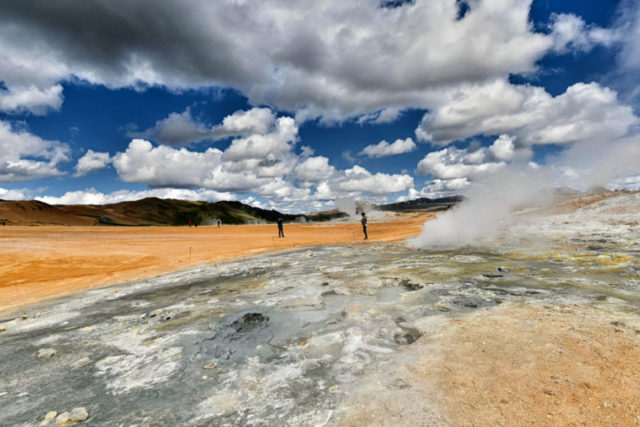
Descending the other side of the pass, the terrain levels out and becomes completely barren. It feels like Iceland’s “big sky” country. I pull off at the sign for Námafjall — an intensely geothermically active field that Mother Nature has painted an unnatural shade of bright yellow.

Opening the door of my car, I’m nearly knocked over by the eye-watering stench of sulfur. I regroup, plug my nose, and push on through, following the scantly marked trail through a Martian landscape. Giant, steaming pools of grey sludge sluggishly bubble like a great witch’s cauldron. Pointy cairns of yellow rock — called fumaroles — hiss like angry teakettles, venting volcanic energy from deep beneath the earth’s crust. On the horizon, a trail climbs up a naked, steaming hillside to a viewpoint overlooking the entire plain. Never have I stood somewhere that feels so little like my home planet.

A few fellow awestruck travelers wander slack-jawed around me. I notice a Swiss tourist getting closer and closer to a steaming fumarole. She seems mesmerized…like a midge drawn to a bug zapper. Finally, my breath catches in my throat as she plants herself right next to the fumarole and reaches her hands out to touch the rocks. And then…nothing. Turns out those particular rocks are not as hot as they look. She laughs the giddy giggle of someone who just played Russian roulette with Iceland, and won.

Reeling from the mind-bending (and pungent) setting, I continue a few more minutes on highway 1 to the turnoff for the Krafla Valley, which saw live volcanic activity as recently as the 1980s. Heading up the valley road, I swear that I see — out of the corner of my eye — a random showerhead sticking up in the middle of a bare field.

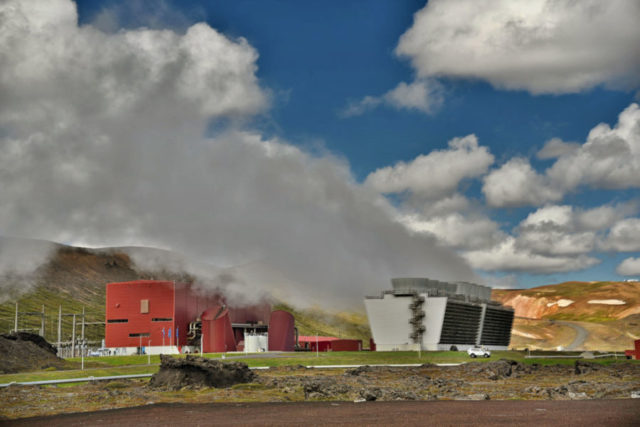
Writing it off as a sulfur-induced hallucination, I continue up the valley to a steaming geothermal plant, where the modest visitors center hands out free coffee as an enticement to sit through a brief film detailing how Iceland has harnessed its geothermal power. I’m no engineer, so I can’t really follow the process. But I’m duly impressed. And, since the visitors center has the last bathrooms for at least two hours to the east, I’m very appreciative.

From the power plant, I continue up the valley, passing the parking lot for Leirhnjúkur — a volcanic cone that was formed in the 1980s eruption, and is now popular with hikers for its steaming rocks and simmering pools. From there, the road twists up to a grand overlook of the valley, and finally terminates at the crater called Víti (literally “Hell”) — a strangely turquoise-colored lake filling yet another spectacular crater, formed by volcanic activity in the 1720s. Noting yet more once-in-a-lifetime hiking opportunities at both of these places, by now I’m really kicking myself that I did not budget more time for Mývatn.

Speaking of time…it’s getting late, and I have a long drive ahead of me. I retrace my route back out of the Krafla Valley, keeping my eyes peeled for that mysterious showerhead. Sure enough, I slam on my breaks when I see it — and the bearded backpacker using it to take a shower, stripped down to his skivvies and standing in the middle of nowhere. (Looking this up later, I learn that the showerhead appeared years ago, presumably to take advantage of all that natural thermal water for hikers who can’t afford the Mývatn Nature Baths.)

Leaving the Mývatn area behind, I carry on toward the Eastfjords. After just 15 minutes, I turn off to see one last spectacular sight in North Iceland: the epic waterfall called Dettifoss.

From the parking lot, a one-mile hike leads through a chunky field scattered with jagged, dark canyons of petrified lava. Finally, I emerge at a grand canyon filled with a thundering cascade. The violent thrust of the water sends a cloud of mist high in the air, casting rainbows across the wasteland.

On my way back to the parking lot, a short detour takes me farther up the river to yet another waterfall, Selfoss. From here I have a better view of the broad river — flowing from the north edge of Vatnajökull, Iceland’s largest glacier, to the Greenland Sea — that carves a path through a basalt landscape, creating these magnificent cascades.

The churning water is milky with glacial grit, which washes up on riverbanks here and there to create inviting little black-sand beaches. The basalt ledges that frame the mighty scene are trapped in a slow-motion process of sloughing off. Change is the status quo in this always-changing Icelandic landscape.

The epic Dettifoss is a fitting grand finale for my visit to the Mývatn area. As I head two hours through the desolate Highlands toward the Eastfjords, I’m confident that this area will be what I remember most vividly and fondly after my trip around the country. If Mývatn were two hours from Reykjavík, it’d be mobbed. But it’s halfway across the country…so it still feels largely undiscovered. And best of all, I’ve already forgotten all about those midges.


Mývatn is about a seven-hour drive from Reykjavík (non-stop on highway 1). It works best for those driving the entire 800-mile Ring Road loop around the country; of all the stops around the Ring, Mývatn is the one most deserving of two nights. Another option is to fly from Reykjavík up to Iceland’s second city, Akureyri, on Air Iceland Connect. From there, it’s about an hour-and-a-half drive to Mývatn — you can rent a car or take a tour.

All of the details for visiting the Mývatn area — including our top picks for hotels and restaurants, a self-guided driving tour connecting everything mentioned in this post, and even more area attractions — are covered in the Rick Steves Iceland guidebook.

How to Enjoy Iceland’s Thermal Baths: The Blue Lagoon and Beyond

Iceland’s Blue Lagoon spa is famous. But it’s just the tip of the country’s thermal-bathing iceberg…as I enjoyed discovering while working on our new Rick Steves Iceland guidebook. This post (part of my Iceland blog series) is a roundup of the many hot-water opportunities around Iceland. Special thanks to our co-author, Ian Watson, who taught Rick and me everything we know about Iceland’s thermal bathing culture.

The volcanic island of Iceland sits atop vast reservoirs of naturally superheated water. And, in a sparse land with few natural resources, the Icelanders have expertly figured out how to harness that water to create electricity, to heat their homes…and to have fun. If you’re visiting Iceland, be sure to check out its many opportunities to soak in naturally heated water, starting — but certainly not ending — with the famous Blue Lagoon.

The Blue Lagoon

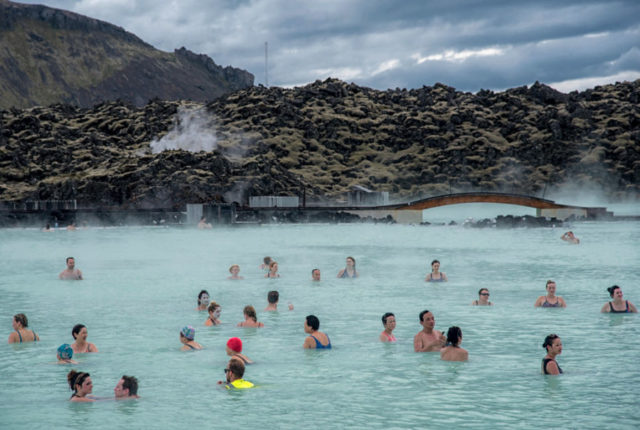
In some ways, the Blue Lagoon is the ultimate expression of Icelandic thermal bathing culture: a top-end spa with steaming, murky-blue water filling a lava-rock basin. It’s pricey…but, for many visitors, well worth it. I love the Blue Lagoon, and can’t imagine a trip to Iceland without it.

On the other hand, some travelers — especially those on a tight budget — find that the Blue Lagoon doesn’t live up to its hefty price tag (about $100 to get in, slightly cheaper if you go early or late) or the inconvenience (reservations are required). Critics also point out that the only Icelanders you’ll meet at the Blue Lagoon are working there. (Icelanders understandably favor their own neighborhood swimming pools, at a tenth the price. More on those later.) While the Blue Lagoon is hedonistic bliss, it’s far from an “authentic Icelandic experience.”

That said, those who decide that the Blue Lagoon is right for them are in for a memorable experience. From the parking lot, you’ll walk up a jagged canyon to the entrance. Find your locker, get changed, head outside, lower yourself to the vast, relaxing pool…and simply float. You can paddle over to the bar to buy an overpriced microbrew or skyr smoothie. You can cruise beneath the little footbridges (where you’ll find water fountains). You can plant yourself under a thundering mini-waterfall for an aqua-massage. And you can get a sample of the slime that builds up on the walls of the lagoon — a natural exfoliant — and smear it all over your relaxed face.

Once your face is all oozed up, consider this: You’re simmering in industrial waste. The Blue Lagoon got its start when a geothermal plant was built in the middle of a petrified lava flow. The water they pumped up from deep underground wasn’t pure enough to pipe into area homes. However, it was hot enough to heat other water. Once that’s done, they simply dumped vast volumes of still-pretty-hot water into the nearby rocks. Locals discovered this as a secret spot for a memorable dip. Eventually developers took note, turned it into a top-end spa…and now you’re spending a hundred bucks for the pleasure of bathing in byproduct.

I tease. The Blue Lagoon experience is a memorable one — and the water is incredibly inviting, and perfectly clean and safe. (And opaque. Don’t drop anything while you’re in the lagoon, or you’ll never find it. Leave your glasses in the locker room.) By the end of my soak at the Blue Lagoon, I was already strategizing how to fit a five-hour layover into my next European flight plan.

A few practical considerations: Remember that reservations are required (www.bluelagoon.com). And notice that the Blue Lagoon is 45 minutes from downtown Reykjavík, but quite close to the international airport, Keflavík. The most efficient plan is to combine your Blue Lagoon visit with your arrival to or departure from Iceland. (All other things being equal, it makes sense to hit the lagoon on your way home, so you’re relaxed for the flight. But your flight schedule will likely dictate which option works best.) Airport-transfer companies make it very easy to splice in the Blue Lagoon, and there’s easy baggage storage right at the parking lot.

Beyond the Blue Lagoon

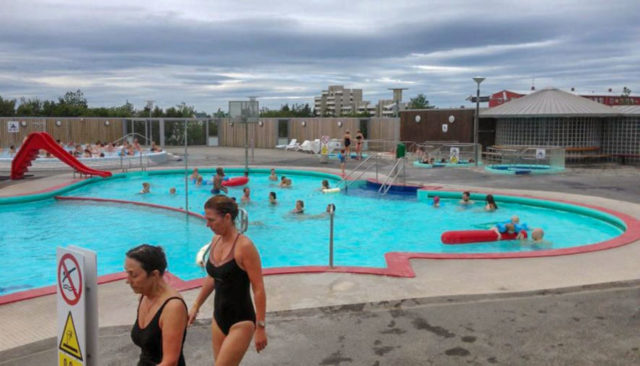
While almost every tourist in Iceland goes to the Blue Lagoon, very few of them dive into even one of the more than 120 municipal swimming pools all around the country (including about a dozen in the Reykjavík area alone). It seems that every little Icelandic community of just a few hundred people has managed to scrape together the funds to build a top-notch municipal pool (sundlaug). This is where Icelanders come with their families, after work and after school, to hang out in the hot water and catch up with their friends and neighbors.

Icelandic swimming pools can range from tiny one-poolers to sprawling suburban complexes, with indoor and outdoor sections, saunas, waterslides, and full cafeterias. And most of them cost less than $10 to enter (even cheaper if you get a shareable multi-visit card). Various resources list all of your options, including www.swimminginiceland.is, www.hotpoticeland.com, or the Thermal Bliss brochure downloadable here.

Visiting an Icelandic swimming pool comes with a very specific procedure, which we’ve explained in detail in our Rick Steves Iceland guidebook. The gist: Remove your shoes outside the locker room. Get naked and shower (yes, naked — it’s a hygiene thing, and locals might hassle timid tourists who try to shower in their swimsuits). Slip into your swimsuit, head out to the pools, and enjoy.

While the ambience is unmistakably “suburban swimming pool,” the water is luxuriously warm — lap pools at 85 degrees, other pools around 100 degrees — and the whole experience is quintessentially Icelandic.

Beyond the municipal swimming pools, Iceland has several other ways to go for a soak. A variety of “premium” baths offer a more upscale, tourist-oriented experience. Two options sit about an hour from Reykjavík (Laugarvatn Fontana to the east, on the Golden Circle route; and Krauma, to the north, near Borgarnes).

But my favorite premium bath in Iceland is Mývatn Nature Baths, in North Iceland (about a seven-hour drive from Reykjavík, or a two-minute detour from the Ring Road). Nestled in a rocky landscape overlooking Lake Mývatn, this spa has a Blue Lagoon ambience at about half the price.

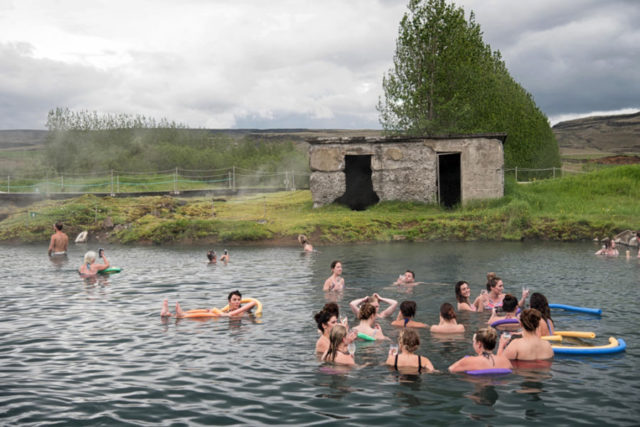
Another popular bath experience, just off the well-trod Golden Circle route, is the not-so-“Secret Lagoon,” where you can splash and soak in what claims to be Iceland’s oldest swimming pool, surrounded by steaming chasms and busy greenhouses. While convenient for Golden Circle day-trippers and popular with younger travelers, the Secret Lagoon is pricey for what you get and can be crowded; it’s wise to reserve ahead. (It’s also just one of four entirely different thermal bathing experiences near the Golden Circle; to help you choose, we’ve outlined each one in the Golden Circle chapter of our Rick Steves Iceland guidebook.)

Yet another option is to go natural: bathing in the wide-open Icelandic nature. If you’re rugged and low-maintenance, you can hike to a variety of thermal hot springs. Don’t expect many services — you’ll need to haul in your suit and towel, and changing rooms and bathrooms are limited or nonexistent. One popular choice is Reykjadalur (literally “Steamy Valley”), just above the town of Hveragerði between Reykjavík and the South Coast. Here you can park your car and hike about an hour up to a warm, knee-deep stretch of river where you can lie back and soak. Be warned, though, that hiking or bathing in a geothermal landscape comes with a risk of getting burned — watch your step and stay on marked trails.

Ready for a Soak

It’s been a long day. From the little fjordside village of Borgarnes on the west coast, I’ve driven 150 miles on rugged, one-lane roads through Icelandic splendor and drizzle. What could have been a three-hour drive stretched to about ten, with dozens of guidebook-scouting stops en route at farmhouse B&Bs, open-air folk museums, truck-stop cafeterias, climbable volcano craters, and Icelandic horse-riding ranches. Kissing frogs for a new guidebook is exhausting work.

In yet another little fjordside village —  Hofsós — I close down the fine little Emigration Museum and retreat through the increasing rain to my car. There I sit, my glasses fogging up, as I flip through my notes and try to rally one last time for the 45-minute drive back to my (reportedly haunted) hotel across the Skagafjörður.

But then, I remember: Hofsós has a municipal pool. And, from what I’ve heard, it’s a great one. Driving through town, sure enough, I spot the blue-and-white, head-poking-above-the-waves sign that I’ve seen in every town between here and Reykjavík. It’s 6 p.m., nothing awaits me at my hotel but angry Viking ghosts and a pile of work, and it’ll be light out for another six hours at least. Might as well take a dip.

Stepping into the pool’s lobby, I’m told the good news and the bad news. The good news: the pool is still open for another two hours. The bad news: the smaller hot pot is closed for maintenance. But they’ve cranked up the temperature in the main lap pool to compensate. Shrugging, I insert my credit card in the chip-and-pin machine to pay the $9 admission, stick my shoes in the cubbyholes at the entrance to the locker room, shower, and head out into the drizzle.

The Hofsós pool is simple, but delightful: One big, welcoming infinity pool perched on a bluff overlooking the fjord. It’s a steamy, turquoise oasis shrouded in a gloomy landscape that sent a generation of villagers in search of a better life in Manitoba and the Dakotas. Easing myself into the hundred-degree water, my decision is instantly validated. It’s just me and the fjord.

I float, feeling the stress of a long day leach out of my pores and joints. I came to Iceland to see fjords and lava flows and glaciers and geysers. What I hadn’t bargained for was that, tucked around every corner, I’d also find a pool like this one to recharge and warm up.

Whether you’re enjoying a basic municipal pool overlooking a misty fjord, soaking in a thermal river deep in the countryside, or splashing out with a deluxe soak in a lava-rock lagoon, make sure to take advantage of Iceland’s hot water.

The Westman Islands: Volcanoes and Puffins in Iceland’s Undiscovered Gem

My favorite underappreciated corner of Iceland is the Westman Islands — the no-longer-secret discovery of our Rick Steves Iceland guidebook co-author, Ian Watson. This installment of my Iceland blog series explains why, if you want to escape some of the tourists — and can flex with unpredictable weather — the Westman Islands are worth fitting into your Iceland itinerary.

In Iceland, it seems every traveler is in the same two- to three-day rut. (It’s a glorious rut…but it’s a rut.) That’s why I was thrilled that our co-author, Ian Watson, insisted on including the Westman Islands in our new Rick Steves Iceland book. Because the Westman Islands — which sit just eight miles off the South Coast — are Iceland’s undiscovered gem.

The Westman Islands (“Vestmannaeyjar” in Icelandic) are worth considering for an overnight, but they’re made to order for a day trip from either Reykjavík (by plane) or Iceland’s South Coast (by boat). However, the main reason the islands are less visited is that the transportation connections linking them to the mainland can be unpredictable in questionable weather. (For details, see the end of this post.)

Weather caveats inside, once you arrive on the Westman Islands, you’ll be glad you came. There are eight islands, but only one — called Heimaey — is inhabited. The town itself, while quite functional, has a pleasantly workaday charm. But you’re not here for the town — you’re here for the glorious setting, the recent volcanic history, and the evocative sights.

Blessed with a fantastic natural harbor — hemmed in by steep sea cliffs — Heimaey is kept afloat by its thriving fishing industry. Other Icelanders call people from Heimaey “islanders.” Islanders are known for their skill at free-climbing vertical sea cliffs to harvest sea bird eggs. One islander I met demonstrated a training wall above a grassy lawn, where young kids learn how to scramble up sheer cliffs, and use thick ropes to swing back and forth across the cliff face like Nordic Tarzans. “If they fall off the training wall, they just break some bones,” he explained, matter-of-factly, as he swung to and fro. “But if they fell off a real sea cliff, they’d land on sharp rocks and probably die.”

If you’ve heard of the Westman Islands, it’s probably because of the 1973 eruption of the Eldfell volcano. In the middle of one dark, frigid January night, the islanders awoke to the thunderous sound of a volcano erupting overhead, shooting geysers of lava 500 feet into the air. Heimaey was evacuated, and for the next several months, the world watched as a slow-creeping wall of lava gobbled up part of the town, enlarged the island’s size by one-fifth, and threatened to seal off the harbor.

Eventually Eldfell — meaning “Hill of Fire” — fell dormant, and the islanders moved back to dig out of the ash and tephra.  Today, as you walk on the craggy bluff over town, it suddenly dawns on you that you’re standing 50 feet above what was, not that long ago, a busy residential street.

The best volcano-themed museum in Iceland is called Eldheimar, which is built around an actual family home that became stuck in lava in 1973. You can peer into the house and see the family’s possessions right where they left them as they fled. All around, high-tech exhibits track the progress of the eruption.

You can even climb all the way up to the summit of Eldfell, which is still warm to the touch. It’s about a 30-minute hike up from the museum. On the way up, you enjoy higher and higher views over the dramatic islandscape, and pass technicolor chunks of volcanic rock.

You can see most of Heimaey’s main sights on foot. And if you bring your rental car onto the ferry, exploring the rest of the tiny island is a snap — you can drive from one end to the other in about 15 minutes. But for a more complete and informative look at the island, I enjoyed a two-hour minibus tour with Ebbi from Eyja Tours. Ebbi offers a local perspective, while making sure you get to see the big natural-rock amphitheater that hosts a popular summer music festival, good views of the smaller islands offshore, and rolling hills dotted with lambs.

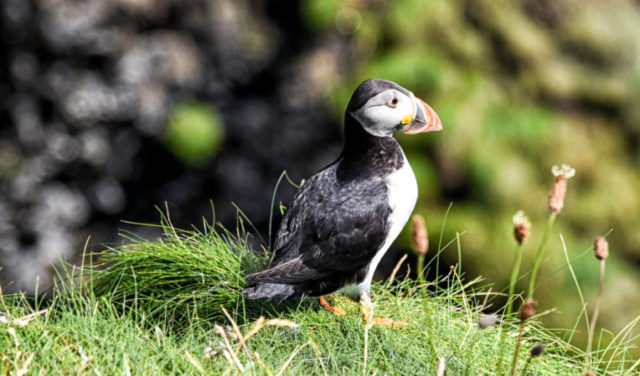
Best of all, in summer (usually early June-late Aug), you’ll likely see puffins. While puffins are the unofficial mascot of all of Iceland, the Westman Islands have the biggest puffin population in the world. A baby puffin is called — wait for it — a puffling. And at the end of each breeding season, the freshly hatched pufflings take off for the first time. Some of them get confused by town lights and wind up crash-landing in the streets. Local kids take them in and nurse them back to health. But occasionally, a puffling can’t quite be rehabilitated — so they’re taken in by the Westman Islands aquarium, called Sæheimar.

One of these puffins, named Tóti, is the museum’s mascot and star attraction. Visitors can’t pet Tóti (because of the delicate oils in his plumage), but it’s a goofy thrill to watch him waddle around the exhibits, followed by earnest staffers who scoop up his runny droppings.

Intrigued? Here are the logistics for reaching the Westman Islands: You can fly on Eagle Air from Reykjavík’s handy domestic airport (near downtown), making it easy to do a one-day round-trip. Or you can take the ferry from Landeyjahöfn on the South Coast, which takes about 40 minutes each way, and carries both walk-ons and cars. But here’s the catch: in bad weather, either the plane or the boat — or both — can be cancelled. If planning a trip to the Westman Islands, have a Plan B in mind.

If you’re based in Reykjavík and the flight is grounded, simply choose another side-trip. But the best plan may be to schedule two overnights (and the better part of two days) for the South Coast. As the date approaches, keep an eye on the weather forecast, and devote the better-weather of your two days to the Westman Islands, saving the drearier day for the South Coast (which is plenty spectacular in any weather).

While planning a visit to the Westman Islands comes with an element of unpredictability, flexible travelers who make the trip are rewarded by one of Iceland’s most delightful, undiscovered corners.

Just tell Tóti I said hi.

Welcome to Iceland: A Stroll Through Reykjavík

For most visitors, Reykjavík is their first look at Iceland. And for our brand-new Rick Steves Iceland guidebook, I enjoyed getting acquainted with this pint-sized capital. This post kicks off my Iceland blog series — stay tuned for lots more. Special thanks to our co-author, Ian Watson, who taught Rick and me everything we know about Iceland.

Boarding my Icelandair flight in Oslo, I realize I’m about to fly east to west over the North Atlantic — a thousand miles across a frigid sea — to touch down in Iceland…just like those first Viking Age settlers, 11 centuries ago. My guidebook work with Rick Steves’ Europe has taken me to more than 40 countries — but Iceland is a first. And I’m stoked.

On the plane, I enjoy reviewing the excellent work of our co-author, Ian Watson. A longtime Reykjavík resident, Ian’s savvy insights embolden me to feel like an old pro before the plane comes to a full and complete stop. For the next three weeks, as I follow Ian’s work around Iceland, I’ll be hearing his voice in my head (soon to be followed by an army of Rick Steves guidebook readers).

Touching down on the petrified lava field at Keflavík Airport, I make my way to the baggage claim and find an ATM, pulling out about $300 worth of the colorful local krónur. As a rank novice in Iceland, I don’t yet believe everything I’ve heard about how every transaction here — no matter how small — uses plastic. Flash forward a few weeks, and I’ll be trying to unload these same krónur at every transaction. (On the bright side, blowing through $300 is a snap in Iceland.)

On the 45-minute drive into Reykjavík, our minibus driver regales his passengers with a steady monologue of Icelandic clichés. The gang’s all here: “While you’re in Iceland, you have to try the fermented shark!” “Icelanders believe in ‘hidden people.’ They even get clairvoyants to negotiate with the elves when building a new road!” “If you buy one thing in Iceland, make it a stuffed puffin. If you buy two things, you have to get an Icelandic sweater. It’s expensive — but warm!”

With each cliché, I imagine our co-author Ian— who relishes debunking questionable “tour-guide history” and tourist-bait gimmicks — rolling his eyes vigorously. But our driver’s enthusiasm is infectious. And I must admit, as a first-timer looking out the window at a lunar landscape of chunky lava rock blanketed with a gentle yellow-green moss…I’m more than willing to roll with it.

Soon we’re driving through the mid-rise suburban sprawl of Reykjavík, then along the shore of the little lake called The Pond, and finally we pull up at the address of my Airbnb. I let myself in with the key code I was sent, and find the apartment just as I expected: spartan but comfortable, with a large living room and fully equipped kitchen. My Reykjavík pad costs about as much as a single room with shared bath in a guesthouse — a bargain in this notoriously expensive land.

I unpack hurriedly and splash some water on my face. But when I turn on the hot water, it comes out scalding and stinky. The faint sulfur odor reminds me that in Reykjavík, hot water is piped in directly from boreholes deep in the volcanic countryside. Like other tourists, burning myself is a rite of passage that I’ll only do once. But, also like other tourists, I’ll never quite get used to the smell. After a shower, the bathroom smells like the aftermath of a chili cook-off.

I dig around in my bag and pull on every layer I can find. It’s early summer, and Oslo — where I woke up this morning — just endured its hottest May temperatures on record. Iceland is not so fortunate. Looking out my window, I see people wearing fashionable parkas with their fur-lined hoods pulled up tight.

Heading out to join them, I confirm my hopes that my apartment’s location is ideal: Just two blocks from the historic center of Reykjavík, but buffeted by enough big buildings to keep the nightlife hubbub at bay.

And then, it happens — that moment I look forward to anytime I visit a new place. Looking around at the colorful houses, feeling the frigid breeze blowing off the nearby harbor, hearing the cry of seagulls, and surrounded by fellow travelers with fur-fringed faces, it hits me: Hey! I’m in Iceland!

I walk past a row of eye-pleasing old houses. Looking closer, I notice they’re clad in corrugated metal painted in bright, cheery colors. Throughout Iceland, this siding is a popular choice: Durable enough to stand up to the howling wind and sideways rain, and convenient for a country with few trees or other natural building materials. Each windowpane comes with a smaller, inset sub-window, which is  almost always propped open. Reykjavík homes are heated with that same natural thermal water that just deep-fried my hands. It’s cold out here, but toasty warm in there. And heating costs are low enough that, when it gets stuffy, the easiest solution is simply to crack a window.

I turn up Aðalstræti — Reykjavík’s first street — for a peek at Iceland’s parliament, the Alþingi (pronounced “all-thingy”). Icelanders are justifiably proud to have what’s sometimes billed “the oldest parliament in the world” — which has survived, off and on, since the great clan gatherings of the Settlement Age (A.D. 930). Facing the Alþingi stands a statue of Jón Sigurðsson, who — a thousand years after those first settlers — advocated for full Icelandic independence from Denmark. (They finally got it, in 1943.)

Suddenly I recognize this square as the setting of news reports during the global economic crisis of 2008. When Iceland’s bubble of false affluence burst and their economy collapsed, Icelanders turned out on this square to protest. Ultimately the government appointed special prosecutor Ólafur Þór Hauksson, a small-town cop-turned-international folk hero. His team convicted and imprisoned some two dozen bankers, who were held accountable for their greedy actions. (Imagine that.)

That 2008 crisis marked the first of several recent attention-grabbing events in Iceland. In 2010, the volcano called Eyjafjallajökull erupted, sending a great plume of ash over Europe that briefly halted air travel. Some Icelanders believe that the “E15” eruption reminded travelers about the existence of this fascinating, volcanic island nation in the North Atlantic. And that — combined with the popular “stopover” deals on Icelandair — boosted Iceland’s brand as a tourist destination. Thanks to enthusiastic word of mouth and the power of Instagram, visits have grown exponentially over the last few years. And in 2016, for the first time, more Americans visited Iceland than the number of people who live in Iceland.

Circling back down to the main drag, Austurstræti, I notice a mass of construction cranes between here and the harbor. Reykjavík is taking advantage of its rebounding economy and tourist boom to undertake a “big dig” along its waterfront. Venturing toward the mess to explore, I stumble upon a parking lot with a hot dog stand, surrounded on three sides by ripped-up sidewalk and scaffolding.

Aha! It’s Reykjavík’s famous hot dog stand. When former president (and notorious junk-food connoisseur) Bill Clinton visited in 2004, he wound up having a hot dog right here, at Bæjarins Beztu Pylsur. Ever since, standing in line for a dog has become a must for many Reykjavík visitors. Not quite ready to spend 20 minutes waiting for a hot dog, I make a mental note to circle back later. (When I do, I discover that in Reykjavík, $6 buys you a pretty good, but in no way memorable, hot dog.)

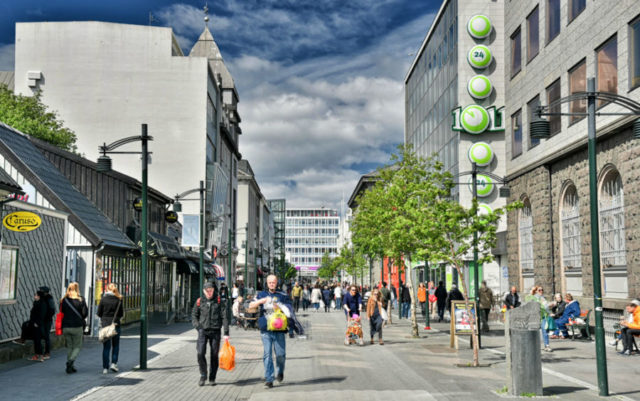
Back on the main drag, I make my way across a busy street, then angle uphill. I soon find myself on Reykjavík’s main walking, shopping, dining, and nightlife street: Laugavegur.

Low-key and slathered with street art, Laugavegur is an inviting place to simply wander and browse. I do just that, making a slow lap past tacky “puffin shops,” microbrew pubs, inviting cafés, indie bookstores, heavenly bakeries, boutiques selling top-end Icelandic sweaters, thrift and vintage shops selling those same sweaters — gently used — for half-price, and lots of enticing restaurants.

As I walk, I appreciate the whimsical street art. Icelanders have learned that if you leave a wall blank, it’ll be tagged with ugly graffiti. So instead, they commission murals by talented street artists. These help beautify the cityscape and deter taggers. Peeking down side-streets and noticing lots of vivid murals, I already know that exploring the back streets will be a highlight of my visit.

Reaching the end of Laugavegur, I pull a U-turn and head back the way I came. A colorful little blob on the top of a parking sign grabs my eye. Upon closer inspection, I see it’s an action figure. Some mystery street artist — nicknamed “the Toyspreader” — sneaks around town gluing tiny toys to signs. Local authorities, correctly seeing this as a harmless citywide scavenger hunt, have decided to look the other way.

At the intersection with the steep, picturesque street called Skólavörðustígur, I look up to see Reykjavík’s hill-capping landmark church, Hallgrímskirkja. I feel drawn there now, but I’m sure I’ll have a chance to circle back later. Hallgrímskirkja’s spire is the needle around which the record of Reykjavík spins.

I’m famished. I could grab a quick, “cheap” $15 bite at a fast-food stand. But this is my first night in Iceland — why not splurge? It’s prime dining time, but I figure I’ll take my chances at a high-end restaurant called Grillmarkaðurinn (“Grill Market”).

Stepping inside, the whole place smells like charcoal and mesquite. It feels trendy, yet accessible. Periodically, a smoke-filled cloche is lifted theatrically off a dish, releasing another tantalizing puff of sweet smoke into the air.

I put on my best puppy-dog eyes and ask the host if they have any tables for one. “Do you have a reservation?” he asks in that stern way that usually means, “Ha!” But then, scanning the restaurant, he spots a lone place setting at the counter facing the kitchen. Just my luck. Sometimes being a solo traveler is a plus.

He seats me at a counter made from a split tree trunk, next to a Japanese hipster with a man bun poking out from under his furry hat. We exchange the courteous nod of two singletons who suddenly find themselves dining together, and I turn my attention to the menu.

Icelandic cuisine has a reputation for its oddball “hardship” foods — such as the notorious fermented shark, or the head of a lamb on a plate. But every single item on this menu sounds delicious. It’s the perfect melding of international know-how and distinctly Icelandic ingredients — lamb, puffin, minke whale, humar (langoustine), rhubarb, skyr, licorice.

I place my order and enjoy watching the chefs scurry around the kitchen. I pull out my camera to photograph the sous chef blowtorch-searing a hunk of minke whale on its own little hibachi. My neighbor is also snapping a photo. To break the ice, we compare cameras. And soon, we’re debriefing each other on our Iceland trips. Both of us are celebrating special occasions: I’m on my first night in Iceland, and he’s on his last, after three weeks of camping and skiing his way around the country. He came from Tokyo, by way of Helsinki…and he has a long way to travel home tomorrow.

My order — a rack of Iceland’s famously delicious lamb — arrives. it’s incredibly tender and flavorful, with dipping sauces made of yogurt and rhubarb jam.

As the lamb melts in my mouth, I ask my fellow traveler what his favorite place in Iceland was. “I don’t remember what it’s called, but it’s a very long name” he begins, quoting every traveler who’s ever been to Iceland. He draws his hands apart as he says it, to emphasize just how staggeringly long the name is. “But it was a wonderful little town on a fjord on the north coast. You drive north from a large town along a fjord. You go through a very long tunnel. Then more fjord. And then you drive through a shorter tunnel. And that’s where this town is.” He pulls out his laptop to show me photos. He’s skiing down a steep mountain with a little village in the distance, and the sun on the horizon…at 11:00 p.m. (Later I’ll figure out which town he was talking about — Siglufjörður. And it’s one of my favorites, too.)

We watch in silence as the chefs plate little creatures on chunks of rock and glassy lava. Soon my dessert comes: lemon meringue with salted licorice. I’ve learned that some people love licorice, and some people hate it. And those who love licorice, really love salted licorice. I adore it. I’m going to feel right at home in Iceland.

Bidding bon voyage to my dinner companion, I head back out into the chill of the evening. It’s 10 p.m., but it’s lighter outside than it was when I came into the restaurant. It dawns on me that I won’t see real darkness until I fly home in three weeks.

I waddle my way back up the main drag to my Airbnb. It’s been a marvelous first evening in Iceland, but I need to get some rest. I have a very busy few weeks ahead of me. All tucked in, catching the faint whiff of sulfur on my just-washed face, it’s hard to fall asleep. I love the adventure of being at the start of a journey in a new place. And for this traveler, Iceland is as new as they come.


This blog post is partly inspired by the “Welcome to Reykjavík” self-guided walk on page 68 of our Rick Steves Iceland guidebook (thanks again to co-author Ian Watson). Our book includes plenty of restaurant recommendations, including options more affordable than Grillmarkaðurinn (though if you’re splurging, I stand by that choice).

Stay tuned for the next installment of my Iceland blog series, including a trip to the famous Blue Lagoon, as well as several simpler, less expensive thermal bathing opportunities around the country.