Gimmelwald — that perfect alpine village, perched on a meadow-draped cliff facing a panoply of cut-glass peaks — is a sleepy time warp…most of the time. But as summer nears its end, Gimmelwald snaps to life. By the second half of September, the cows are about to come down from the high alpine pastures…and there’s lots of work to be done.
My visit to Gimmelwald actually begins in the next village over, mile-high Mürren. I cross the street from my hotel and hop on the Allmendhubel funicular, which zips me in less than four minutes up to 6,200 feet and grand views of the Eiger, Mönch, and Jungfrau peaks.

I thought I was just coming up for a quick peek. But now that I’m here, I start paging through our Rick Steves Switzerland guidebook (which I’m here to update, for our upcoming tenth edition). It turns out that one of Rick’s favorite hikes — the North Face Trail — begins from right where I’m standing. It’s mid-afternoon, and my work is done for the day…why not?

Following the book’s instructions — and the blue North Face Trail signs — I gingerly let myself through the electrified cattle gate and head down into Blumental…the “Valley of Flowers.” In the early summer, this meadow bursts with wildflowers. But today the flowers are mostly gone, the cows have chewed the grass down to the nub, and fall is nearly upon us.

Over my head, a packed-to-the-seams cable car silently makes its way up to the Schilthorn. Seeing all those excited faces pressed against the cabin’s windows, selfie-sticks glancing off the scratched and smeary glass, I realize there are far few people in this entire meadow than there are in that one little cable car.

I rode that cable car up to the Schilthorn earlier today. It’s hard to be cynical about the Schilthorn — it’s a spectacular alpine panorama. But it’s also commercialized to the hilt, making the utmost of its connection to the James Bond movie filmed there 50 years ago. This theming — once just a kitschy footnote to a visit — is getting out of control. The cable car itself is emblazoned with a hot-pink 007 logo, the observation deck is scattered with George Lazenby cut-outs to pose with, and “Bond Girl” silhouettes shimmy on the bathroom stalls.
For my part, I’m very happy to be out in a pristine meadow, rather than inside that cable car. Taking in a deep breath of thin-and-fragrant alpine air, I make my way across the meadow to the rustic little hut called Suppenalp.
This is a proper “alp” — a high-mountain meadow where cows spend their summers grazing. In the interest of preserving this traditional bit of culture, the Swiss government subsidizes this work to the tune of about $5,000 per cow. In many rural communities, parents fret over the next generation leaving for the bright lights of the big city. But here, they have the opposite problem: Kids fight over who gets to take over the family herd.

The cows’ owners hire cowhands to tend the herd for 100 days each summer in the high alps. The cowhands get up every morning at 5 o’clock to milk the cows and take them out to pasture, and then bring them back and milk them again in the afternoon. Because it’s impractical to haul heavy cans of milk down the mountain, they make the Swiss mountain cheese right here. For these cowhands, it’s a lifestyle choice: spending summers at 6,000 or 7,000 feet — working hard, yes, but ensconced in alpine splendor, while steering entirely clear of the modern rat race…a high-altitude summer sabbatical.
At this alp, the cows are in their pen, contentedly munching and mooing, but the hut itself is closed so the cowhands can take a much-needed rest day. Monntag und Diesntag Ruhetag, says the chalkboard. No cheese samples for me…yet.

From the hut, I head up a steep, rocky path, curving around the midsection of a ridge toward an alpine pasture that my book tells me is just around the next bend. Another crammed cable car sails over my head as I head for a new row of snow-covered peaks. I pass through a little stretch of alpine forest before breaking through into a pristine pasture, stretching like an infinity pool toward the sheer granite cliffs on the far side of the valley. Someone has positioned a split-log bench just so to take in the panorama.

Crossing this alp, at what feels like the top of the world, I make my way down to a humble gathering of huts called Schiltalp. This is where the majority of Gimmelwald’s cows spend their summers. But summer is nearly over, and very soon — when the last of the summer sun fades and the autumn clouds close in — the cowhands will herd their charges together, strap big ceremonial bells around the cows’ necks, bedeck them with pretty wildflowers, and parade them back down through town to their barns for the winter.
You never know exactly when the cows will come down, but I was lucky enough to see this spectacle years ago, in the super-traditional village of Appenzell. It remains one of my all-time favorite Swiss memories: an impromptu folk-life parade where the bovine grand marshals were cheered like returning war heroes.

But for today, the cows remain up on the alp. I can tell they’re still here before I see them, because those big ceremonial bells are still hanging high from the roof beams of the biggest hut. The Schitalp hut has a little “self-service” fridge, where visitors like me are welcome to leave a few coins in exchange for a bottle of water or beer, or a little wedge of alpine cheese.

The outdoor tables are enjoying some late-afternoon sun, but the only people sitting there are four extremely rough and grizzled old-timers nursing beers, giving me suspicious looks. I’ve clearly crashed some local party.
Trying to break the ice, I experiment with the local Schwyzerdütsch greeting: “Grüezi!” After 20 years of traveling to Switzerland, I’m still trying to master the pronunciation: “GREWT-see!” In Swiss cities, that does the trick. But in the countryside, singsongy Swiss German gets even singsongier. And up here, each village — or even each farmhouse — has its own idiosyncratic greeting.
As usual, the four old-timers respond with what — to my ears — are four entirely different ways of saying the same word:
“GRÜÜÜÜÜ-zeh!”
“Khhruh-suh!”
“Grut. [pause, pause, pause] Si!”
“Khhhhrew-tzee!”
They return to their beers, making it clear that our conversation is now complete.
I drop a few coins in the jar and help myself to a wedge of mountain cheese. It has a pungent aroma but is still soft: not quite fresh, not quite aged, and speckled with little bubbles.

I saw a little chunk off of the slab, mount it on a hunk of rustic bread, and take a bite. The texture is as smooth and creamy as the flavor is sharp and searing — filling my mouth with the taste of hay and wildflowers and a tannic kick and deep, deep Swiss tradition. Strange as this may sound, it marries well with the aroma of freshly cut hay and day-old manure that hangs heavy in the air…in a good way, I swear to you. It’s easily the best cheese of my trip, if not my life.
I munch my way through the slab of cheese, savoring each bite. When it’s gone, craving just one last taste, I whittle a curl of delicious cheese off the rind and pop it in my mouth…the dairy equivalent of sucking the meat off the bones. The flavor will linger on my palate for hours.
Recharged, I bid my fellow alp hut patrons a cheery Adieu! and head on down the path.
Within moments, I’m immersed in a bucolic landscape of grassy hills, wooden barns, and mooing cows. And then, in the distance, I hear cowherds hooting and whistling. The mooing becomes more agitated. The cows are on the move.

Riveted, I watch as the cowherds crest the undulating land and come into view. It’s a family — dad, mom, and a couple of kids — working together to bring their herd in for the night. They’re dressed in modern clothes — shorts, T-shirt, trucker hat — but they enact a timeless routine of man and beast: insistently moving huge animals, many times their own size, with nothing more than insistent yelps and a big stick.

And then, all of a sudden — I’m surrounded. Cows on all sides of me, cowherds behind them, trying to move them up the gravel road I’ve just come down. A little frightened by the thousands of pounds of agitated beef headed my way, I stand still — a rock in a stream of livestock.
Once the cows have passed, I carry on down the path, leaving the slow-motion stampede behind me. I’m buzzing from the moment I just experienced — one of those beautiful travel serendipities where it feels like every decision I made today conspired to put me in the perfect place, at the perfect time.

Continuing on down the path, I pass through yet another alp settlement — Spilbodenalp — where the cowherd is also out, wrapping up a busy day’s work, while a few lazy cows doze in the front yard.

From here, I make my way steeply down on a switchbacked trail through a thick forest, then down precarious steps carved into a cliff to slip under the thundering waterfall called Sprutz. Grabbing the metal cable drilled into the cliff, I climb back up the other side, then make my way up through another thick forest until I finally emerge at the top of a near-vertical meadow. Below my cow pie-scuffed shoes are the rooftops of an idyllic alpine village: Gimmelwald.

I make my way steeply down through the pasture toward the tiny settlement — following narrow ruts, barely wider than my shoes, through the lush green grass toward the rustic rooftops. The fields around me are alive with farmers, out harvesting hay they’ll use to feed those cows when they come back to earth from the high alps a few days from now.
Crossing a narrow, paved road high above town, I dodge out of the way of a tractor as it zips past — racing to wrap up chores before they lose the sun. Scanning the rooftops below me, I can see that this little village — normally sleepy — is a beehive of activity. A visit to Gimmelwald just before the cows come back teaches you what they mean when they say, “Make hay while the sun shines.”
Finally I reach Gimmelwald’s upper road, where I’m greeted by four perfectly positioned benches — gazing across the gaping chasm of the Lauterbrunnen Valley, to the black-and-brown-streaked, deeply pitted face of the Schwarzmönch mountain across the way.

Just up the road, I swing by the Hotel Mittaghorn — also known as “Walter’s,” for the Swiss gentleman who has run the place since, I have to assume, the last Ice Age carved out the Lauterbrunnen Valley. Nothing ever changes at Walter’s — he makes darn sure of that. If it was good enough 30 or 40 years ago, it’s good enough today.

Out on the front porch sits perhaps the only relaxed person in Gimmelwald: Tim, the Englishman who’s been Walter’s trusty right-hand-man for the last 20 years or so. I sit and chat with Tim for a while, getting the latest gossip on this Gimmelwald institution. Tim tells me that Walter is now 95 years old, and opens his hotel only three months a summer — when Tim can be here to essentially run the place for him. They close the hotel more or less when the cows return; the cooler weather that brings the cows down from the alps also keeps the sun-seeking tourists away.
While Tim and I are chatting, the relentless bleating of goats in a pen next door intensifies. One of the goats finally jumps the fence and starts wandering around in the road. Tim, the good neighbor, hops up to herd the goat back home. I try to help, but I’m even less of a shepherd than he is. All I can do is hold the little gate open while Tim grabs the goat and bullies him back into the pen.
“Those two goats are sick,” Tim explains. “That’s why they keep them down here while they take the rest of the herd up to the upper meadows during the day.” He explains that, while the cows are way up at the high alps, they keep the goats closer — simply to provide local families with fresh milk through the summer. Sure enough, a few minutes later, our conversation is interrupted by a chorus of bleating and tinny, off-key bells as a couple of village kids march several more goats down the path to join their two sick friends in the pen.
Before I move along, I head into the hotel kitchen to say hello to Walter — still with that same twinkle in his eye, all these years later. Many, many years ago, Rick Steves’ Europe Tours spent the night at this dusty, rustic firetrap of a high-mountain hotel. The only way we could fit the entire group was to squeeze six couples — that’s 12 paying adults, close to half the group — into one big sleeping loft in the attic. They shared a toilet and a coin-op shower…not just down the hall, but down the stairs. (Our tour guides mastered the art of identifying which dozen people were best equipped to tolerate, or even enjoy, that experience.) Understandably, our tour members came to expect a higher level of comfort, and about 20 years ago we stopped using Walter’s. But, I swear to you, the tour members who stayed here absolutely adored the experience. When they talk about it, they get a twinkle in their eye…just like Walter’s.
I bid farewell to Walter and Tim and head into town. Across the street from Walter’s, steps lead down into the heart of Gimmelwald: the main intersection with the overly enthusiastic directional signs, the two little guesthouses, and the youth hostel and cable-car station just around the corner.

I go for a lazy lap through town, following the main street past busy barns, log-cabin-style homes, perpetually flowing faucets that fill carved-tree-trunk cow troughs, lovingly tended flower boxes, and bazillion-dollar views.

The people of Gimmelwald are firewood artists — stacking a winter’s worth of fuel with the precision of a master engineer. But I also see piles of just-split wood, waiting to be stacked.

At one point, as I’m lost in the glorious views across the valley, a towheaded, cherry-cheeked teenager pops up over a hill in front of me, pulling a giant tarp filled with freshly scythed grass. He dumps the grass by the front door of his house, theatrically wipes his brow with a handkerchief, then grabs the empty tarp and heads back down over the hill for another load. If Norman Rockwell were Swiss, he’d paint what I just saw.
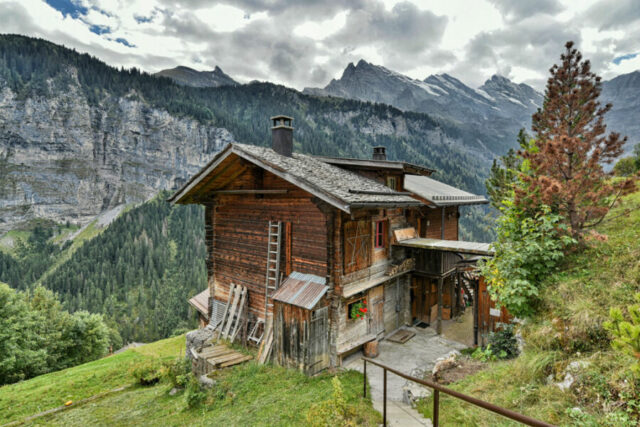
I head back through town, fantasizing about living in a cliff-hanging cabin, filling my bottle at the fountain, and dodging a couple more tractors that come rumbling up the road. Back at the cable-car station, I watch the lift arrive from the Schilthorn high above. Dozens of day-trippers pour out of the cabin and cross the platform — blowing right through this sweet, intoxicating village — in their rush to the connecting cable car back down to the valley floor, and their awaiting tour buses.
I think back on those entirely unpopulated high-alpine meadows, those stunning mountain views savored all alone, and the feeling of being the only non-Swiss human being out on a vast and lonesome alp, entirely surrounded by cows. And I wonder why someone would pay a hundred bucks to squeeze into a tiny box and ascend to a James Bond-themed revolving restaurant, instead of experiencing what I just experienced…for free.
The cable-car door closing jolts me awake, and I look down as I fly over the rooftops of Gimmelwald and the steeply switchbacked trail tethering it to Mürren. I catch one last glimpse of Walter’s rooftop just before I’m swallowed up by the Mürren cable-car station.
Update, March 2021: I wrote this post in 2019 while I was working on our Rick Steves Switzerland guidebook — where you’ll find all the details about visiting Gimmelwald, hiking to a remote alp, and even — if you choose — heading up to the Schilthorn (with tips for avoiding the crowds).
Or, once it’s safe to travel again, consider joining us on a Rick Steves’ Europe tour. Our Best of Switzerland in 12 Days Tour is ideal for those wanting a full itinerary of experiences like this. But we also spend time in this part of Switzerland on several other tours: Best of Germany, Austria, and Switzerland in 14 Days; Best of Europe in 14 Days or 21 Days; Best of Family Europe: London to Florence in 13 Days; and My Way Alpine Europe in 12 Days. (Come to think of it, it’s hard to find a tour that doesn’t stay in this part of Switzerland.)
While this was an idyllic late-summer/early fall visit, I also had a wonderful Christmas in this part of Switzerland once with my family.