Postcards from Madrid

I just spent a week in Madrid, working on the next edition of our Rick Steves Spain guidebook. And, as always, I snapped lots of photos and took careful notes. Enjoy these “postcards” from my trip — and please share your own Madrid travel stories in the comments below or over on Facebook. Happy travels! —Cameron

Madrid, Spain

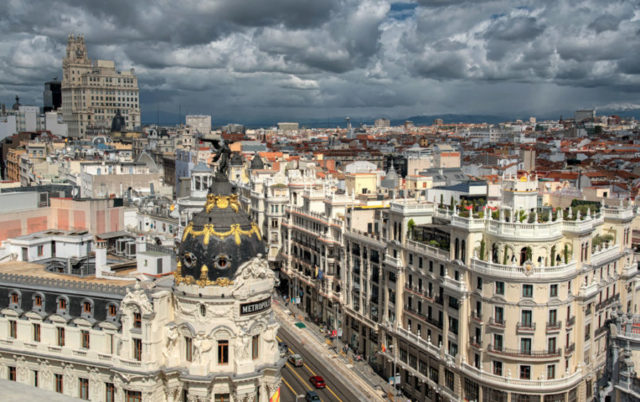
Spain’s bustling capital has a surprisingly compact and manageable historical core. It almost feels like a big village. But just a short walk away, you know you’re in a European metropolis. The main boulevard — Gran Vía — is undergoing an extensive renovation that will widen the sidewalks and reduce traffic congestion.

Breakfast in Madrid

Most hotels in Spain don’t include breakfast in their rates…and some don’t even offer it at all. No hay problema. That just creates a great excuse to head to a neighborhood bar and dig into a Spanish-style breakfast: hearty wedge of tortilla española (potato omelet), crusty roll, fresh-squeezed orange juice, and café con leche. At around €5, this almuerzo de campeones keeps me going through a late lunch.

Prado, Madrid

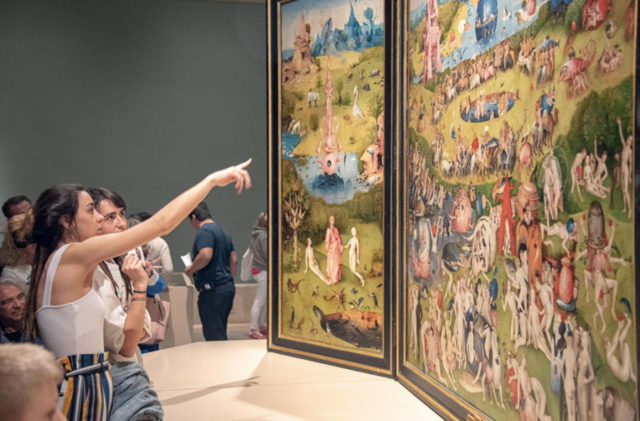
Madrid is home to the magnificent Prado (arguably Europe’s best museum of Old Masters). I toured the museum at a fairly busy time — late morning, just before lunch — and for the most part, I could see all of the paintings I wanted to, despite the crowds. But the one bottleneck was Hieronymus Bosch’s detail-packed The Garden of Earthly Delights. Art lovers camp out here for 10, 15, 20 minutes at a stretch, unpacking the many details. Who can blame them? If I were on vacation, rather than working, I might bring a folding chair and binoculars and really settle in.

Calle del Arenal, Madrid

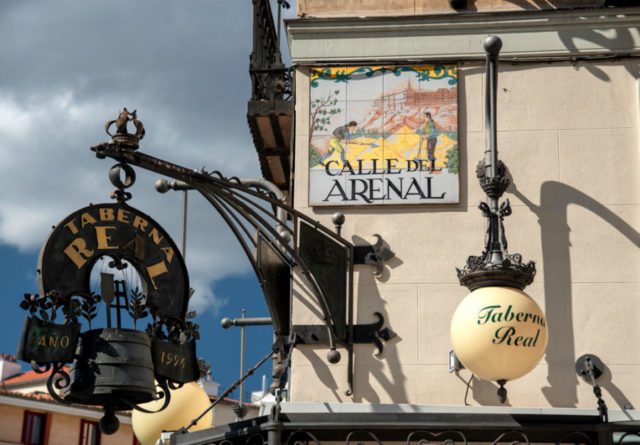
I appreciate how the streets in Madrid’s historical center are all marked with colorful illustrations. In this case, Calle del Arenal is named for the sand (arena) that was stockpiled along here during the construction of the city.

Mickey Meth

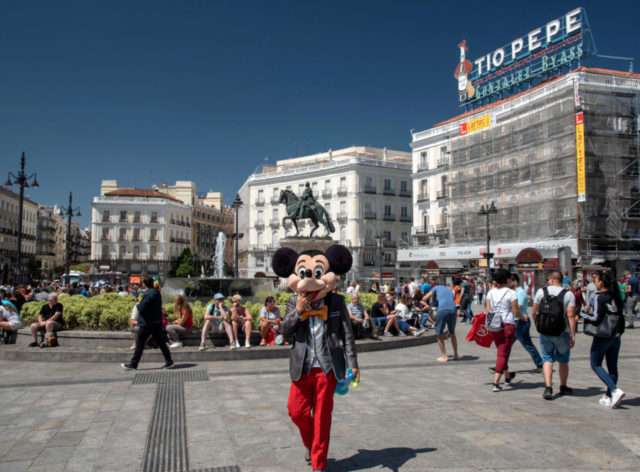
In Madrid’s high-traffic, touristy areas, you’ll see hucksters dressed up in cut-rate costumes of Mickey Mouse, paunchy Spider-Man, and off-brand Minions. They prey on little kids — approaching them with a hug, then forcing the parents to pay for a photo. A local explained to me that these are down-on-their-luck people who have been left unemployed by the recent economic crisis (which Spain has been very slow to recover from). While I have sympathy, taking advantage of visiting children seems sleazy to me. I came to think of these characters as “Mickey Meths.”

Madrid's Mercado de San Miguel

Foodie tourists are attracted to Madrid’s Mercado de San Miguel, just outside of the Plaza Mayor, like a bug zapper. This old market hall was recently renovated and filled with quality eateries. It sounds great…and it is. But it’s also extraordinarily crowded (especially on a holiday weekend, as when I was in town). I kept circling back to try to find a quiet time to graze, but it was always jammed. Oh, well. Next time…


I was in Spain to scout out additions and updates to our Rick Steves Spain guidebook.

If you’re more interested in the culinary side of Spain, here’s a rundown of my favorite Madrid tapas experiences from this trip.

Postcards from Central Spain

I just wrapped up two busy weeks traveling around the central plain of Spain — Toledo, Segovia, Salamanca, and more — updating the next edition of our Rick Steves Spain guidebook. And, as always, I snapped lots of photos and took careful notes. Enjoy these “postcards” from my trip — and please share your own Spain travel stories in the comments below or over on Facebook. Happy travels! —Cameron

We’ll begin in Toledo, Spain’s cultural (and historical) capital.  About an hour south of Madrid, Toledo is a delight — and packs in more than its share of top-notch sightseeing.

It’s understandable why many Spain aficionados believe that Toledo has the country’s finest cathedral — including this exquisite gilded altarpiece. Holy Toledo, indeed! Times like this, I’m glad I bother to haul around the good camera.

In addition to its majestic cathedral, one aspect of Toledo that intrigued me was the strong Mudejar influence — the work of Muslim craftspeople who stuck around after the Reconquista made Toledo Catholic again in the 11th century. If you can’t make it to southern Spain (where the Moors hung around for another 400 years), you can get a good taste of this style in Toledo — such as here, at the Santa María la Blanca Synagogue-turned-church.

I have to admit…even after more than 18 years living in Seattle, I’m still a Buckeye at heart. And I still get a kick out of the street called “Calle de Toledo de Ohío”…complete with the official seal of my home state, in the upper-left. O-H!

Just outside of Madrid is El Escorial, a fortress-like monastery built as the country residence (and final resting place) for Spain’s austere Habsburg monarchs, as well as the headquarters for the Inquisition. The palace — like the people who built it — doesn’t have much personality. But the library, filling a vast hall with the collected knowledge of 16th-century Spain, is a highlight.

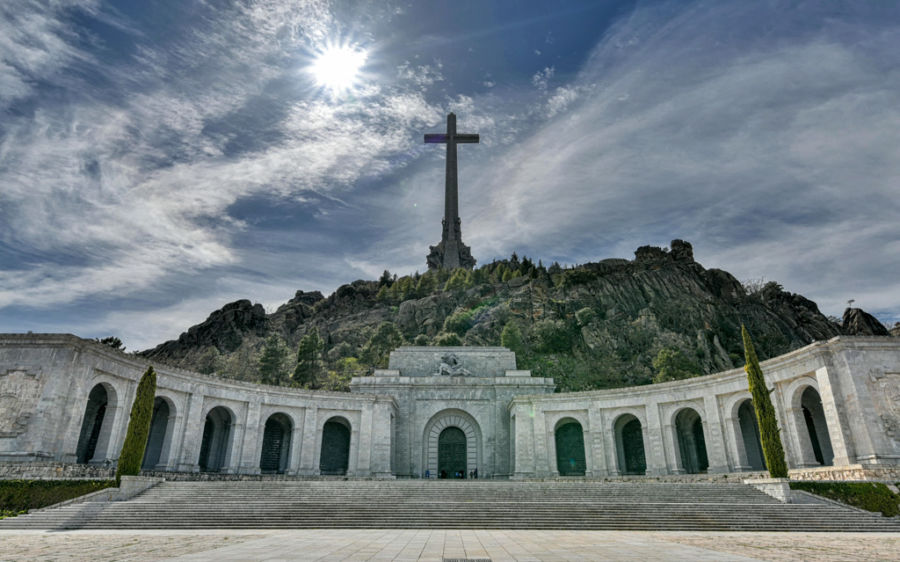
Spain’s devastating Civil War ended more than 80 years ago (dooming Spain to 40 years of Francisco Franco’s rule). And yet, the topic is still controversial in Spanish contemporary life. It’s surprising how few sights or museums relating to the Civil War you see in Spain. History museums tend to gloss over that topic, to avoid offending anyone on either side. (I spend a lot of my time in Germany and in Eastern Europe, where many people are willing to grapple with gruesome realities that took place far more recently.) For this reason, I share Rick’s affinity for the Valley of the Fallen, the massive, Franco-built monument and mausoleum for the victims of the Civil War (just up the road from El Escorial). While its architecture and its origins are unmistakably fascist, today it’s considered a rare monument to the darkest days of Spain’s 20th century.

I love Segovia. This was my first visit to this small city, just outside Madrid, and I was enchanted by the gigantic, fully intact Roman aqueduct that runs through the middle of town, as well as by its fine cathedral and its fanciful, Romantic Age castle (which I came to think of as the “Neuschwanstein of Castile”).

I finished my swing through Spain in the place where it all began: Salamanca, where I first set foot in Europe as a college student in 1996. This was my first visit back since my semester abroad here, and I was blown away by how elegant this fine old sandstone university city is…just as I remembered, but even better.

I was so excited to step into Salamanca’s Plaza Mayor — Spain’s finest main square — after all these years. But when I did, I was a little disappointed to see it cluttered with kiosks for a book show. (Don’t you just hate when that happens?)

Still, the space is grand — especially after dark, when floodlights twinkle on, the sky turns a murky blue, and everyone in Salamanca is out strolling.

Speaking of which, one vivid memory from my student days was what night owls Salamantinos (and all Spaniards) are. On my first weekend staying with my host family, I returned to the apartment around one o’clock in the morning. The next morning at breakfast, my host mother asked me worriedly, “Are you not feeling well? Why did you come home sooo early?” I recall seeing families out strolling with their little kids around midnight. Over the years, I convinced myself that I was exaggerating this memory. But on my Saturday night in Salamanca, sure enough, I snapped this blurry photo of a family out with their preschooler at 11:30 p.m. Some things never change.


You can read about my student days in Salamanca in this post about a visit to my host family’s farm.

I was in Spain to scout out additions and updates to our Rick Steves Spain guidebook. The 2019 edition will be available this December.


Madrid: A Paradise of Tapas

The crock of gambas al ajillo is still sizzling when it hits my table. The tiny pink shrimp, hazy with the aroma of garlic, spit little flecks of oil. It smells like heaven. But on past visits to Madrid, I’ve learned my lesson the hard way: If you dig right in, you’ll scald the roof of your mouth…leaving your taste buds tenderized for the rest of your trip. So I wait, patiently, until it’s cooled off. Suddenly I hear a sharp sizzle. Under the monstrous copper flame hood in the corner, a row of squid shimmy on the griddle.

Finally, my shrimp have cooled enough — but even then, I’m careful of the second hazard of gambas al ajillo: a shirt spotted with garlicky oil, a stain you’ll never get out (or stop smelling). Careful as I am, somehow I still manage to drizzle a stripe of oil on my shirt. I try, fruitlessly, to wipe it away with the tissue-paper napkins, which I toss into the marble trough at the base of the bar. Oh well. Sometimes you have to sacrifice a shirt for a good meal. This may be only my first bite, but already I know that — on this trip to update our Rick Steves’ Spain guidebook — I’m going to really enjoy Madrid’s tapas scene.
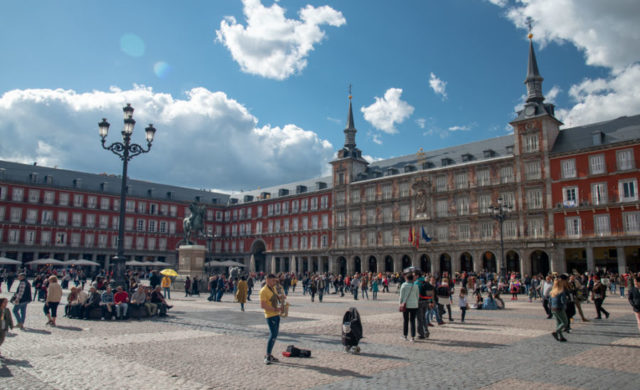
The Spanish capital is also the melting pot of Spanish cooking. Within a few steps of Madrid’s Plaza Mayor, you’ll find eateries showcasing jamón from Castile, manchego from La Mancha, sardines from Santander, paella from Valencia, gazpacho from Andalucía, octopus and sprightly white wine from Galícia, mar i muntanya (“surf & turf”) dishes from Catalunya, and wildly creative Basque-style pintxos — each one perched on a slice of rustic bread. Madrid may not be Spain’s best culinary destination (that title would go either to the Basque Country or Catalunya). But it’s certainly a handy one-stop-shop for sampling everything Spain has to offer.

Let’s begin with a touristy extreme. Dropping into Rick’s favorite bullfighting bar — La Torre del Oro Bar Andalú, right on the Plaza Mayor — I belly up to the bar and order a beer…basically as a cover charge to hang out and take pictures of the grotesque bullfighting decor. The actual bulls’ heads might haunt a vegetarian’s dreams, but the many photographs of too-bold matadors being graphically gored make it clear that Spain’s national pastime has no real winners.

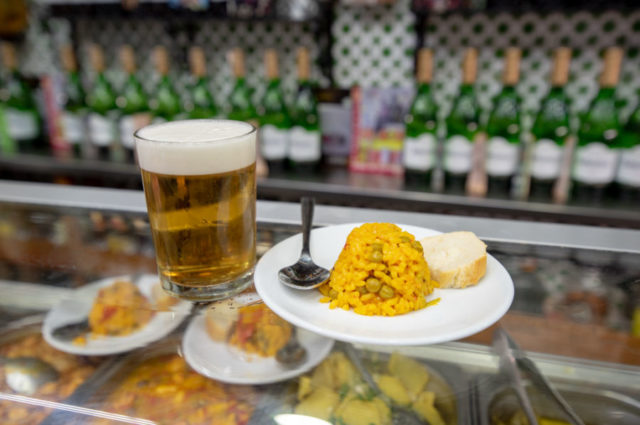
When my beer comes, it arrives with a tidy little pile of paella on a saucer. Always suspicious of tourist-gouging tricks, I confirm that it’s free. It is indeed. They’re staying true to the spirit of the “tapa,” which originated as a free bite of food to accompany a drink. (The little plate the bite comes on can act as a tapa — a “lid” on top of your drink.) A good paella is hard to come by; most restaurants serve microwaved portions with dreary, muted flavors. But this one seems fresh: it’s a shellfish risotto, richly flavored and colored with intense yellow saffron, tasting unmistakably of the sea.
I’m tempted to order another drink just to get the other free tapa I notice them handing out: a mini-mug of the garlicky cold tomato soup, gazpacho. But I’ve got other places to be, and I’ve had my fill of the bulls’ glassy stares (and the vintage photos of bulls’ horns piercing madators’ groins and chins). When I ask for the bill, I’m charged a total of €2…so much for ripping off tourists.

A few steps away, I see a cluster of Madrileños lined up at Café Rúa — famous for its bocadillo de calamares. This simple street food — Madrid’s answer to a Chicago hot dog or a Naples pizza — is a hunk of French bread filled with hot, greasy, crispy, fried calamari. Less than €3, this squid-wich is sold all over town — but Café Rúa is a classic.

These are all touristy choices…handy for people exploring Madrid’s compact core, looking for a bite between posing with colorful statues of flamenco dancers. But the Rick Steves Spain guidebook also recommends some areas with a more appealing mix of Madrileños and outsiders. And I find these much more fun to check out.

Over near the Prado runs Calle de Jesús, where — in one three-block stretch — you can take your pick of a dozen different tapas bars. I have the good (or bad?) fortune to reach Calle de Jesús at prime tapas time: Saturday night, 10 p.m. Each bar is overstuffed, with would-be patrons outside peering into foggy windows, waiting for someone to leave, in the hopes of bushwhacking a path to the bar.
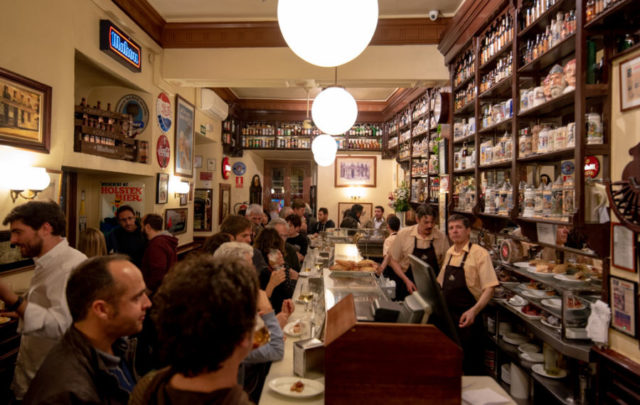
Surveying my options, I’m drawn in by one in particular. Inside, an excited weekend hubbub bounces off the colorfully tiled walls. Madrileños stand in little clusters, precariously perching their plates and glasses on narrow counters, waving their arms in conversation…it’s a miracle glassware isn’t flying everywhere.

Behind the bar, five uniformed bartenders scurry to and fro. It’s peak-of-peak, and they’re in the weeds, but they are a well-oiled machine. They’re remarkably well-coordinated and efficient, shouting instructions to each other as they toss plates like frisbees to hungry diners. Just watching one bartender expertly fling two ice cubes each into four glasses held in one hand, in a matter of seconds, is like watching a pitcher land a split-fingered fastball at the bottom crease of the strike zone. If you’re an indecisive diner who appreciates when the server helps explain your choices…well, then, Jesús help you on Saturday night in Madrid.

As somebody leaves, I make my move to squeeze in the door and shimmy along the bar to the far end, hoping to find a spot to claim for my own. I never do, but the procedure allows me to survey the complete lineup of canapés (little sandwiches) under glass and make my selection. I wave my arm until the bartender takes note. He points me all the way back down to the other end of the bar, where he’s spotted a space that just opened up.

Once positioned, he gives me a quizzical look — a “whaddaya want?!” sneer, pulling back his top lip to reveal questioning teeth — and I rattle off my order: open-face salmon sandwich and a banderilla. Named for the fancy stakes the bullfighter jabs into the fleshy neck of his victim, this is simply a variety of pickled items pierced with a toothpick. But it turns out I’ve upset the delicate order of things: There are two kinds of banderillas under that counter, each with a subtly different type of preserved fish peeking out between chunks of pickle and pepper. Which one do I want, for God’s sake? We don’t have all night here! I point to one at random, and within moments my food is before me.

It’s delicious. The salmon is incredibly tender. And the banderilla is an explosive pop of vinegar and salt, with a slight anchovy finish. It’s so good, I order a second.

Surveying the hubbub, I think of some of my friends back home who would love this…and even more who would absolutely hate it. Tapas are a full-contact sport, and not for everyone. You’re diving headlong, as a rank beginner, into a very specific culture that you can’t possibly understand.

Checking out dozens of Madrid tapas bars for our guidebook, a few things become clear: All of them are supremely tempting. But not one of them is what you’d call user-friendly. Posted menus are rare, and ones in English are almost nonexistent. You can survey the few items they have ready to go, under glass at the bar. But then, after you order, you’ll notice delicious, piping-hot, and (frankly) much better-looking plates coming out of the kitchen…ordered by in-the-know locals who understand that what’s at the bar is only the tip of the iceberg. A menu?! How were you to know there was a menu?
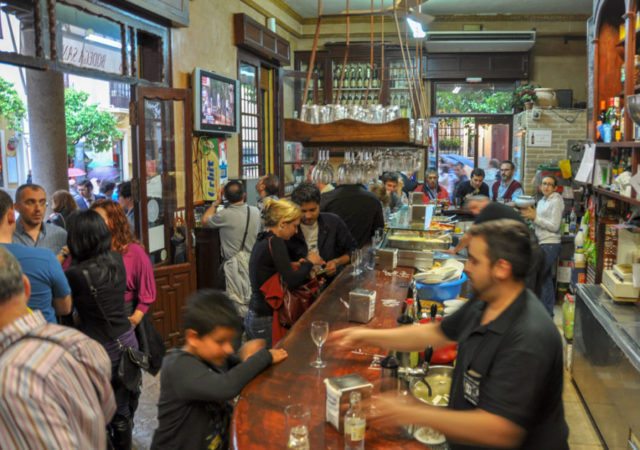
My best tips: Be patient. Don’t expect attentive service. It’s nobody’s job to make things easy on you. Do a little homework — be aware of what each bar is known for (especially if it’s something you have to order from a menu). And while you’re getting up to speed, don’t be afraid to show up early with the rest of the tourists, at around 8 p.m., when things are still quiet. If you wait until 10 p.m., like the Spaniards, you’ll be swimming with sharks. (For even more tips, see my post on “The Trouble with Tapas.”)

Another great strip of tapas bars — hitting that elusive sweet spot between touristy and local — runs a couple of blocks south of the Plaza Mayor, along Calle Cava Baja. While the bars on Calle de Jesús run to more traditional choices, Calle Cava Baja mixes in some boldly innovative variations.

This is a great strip for checking out trendy Basque-style tapas bars, which many first-timers find more enticing and accessible than the old-school ones. In a Basque bar, the counters are lined with eye-catching, typically wildly creative bites — making it easier to understand exactly what you’re getting. Along Calle Cava Baja, Txakolina Pintxoteca Madrileña (at #26) is a great example of this.

But this trip’s best Madrid tapas experience took place just beyond the far end of Calle Cava Baja, where the bar called Juana la Loca overlooks a lonely square. Named “Juana the Mad” (for the 16th-century Spanish queen), it feels like a more sophisticated, more civilized alternative to the standard tapas bar. It’s crowded, but not crazy. Like at most tapas bars, you can try to show up a little earlier to snag a table, or stake your place at the counter and peruse your options — which, here, run to creative, updated Spanish classics and experimental “fusion” dishes.

Their signature dish — and the best €4 value in Madrid — is a tortilla de patatas. It’s a creative variation on the typical tortilla española (egg and potato omelet), but it’s jammed full of heavenly caramelized onions — giving it a sweet, slightly bitter, intensely satisfying flavor.

Ultimately, the Madrid tapas scene is like Spanish cuisine generally: It’s not delicate, and it’s not subtle.

Spanish cooking is Spanish culture — bullfighting and flamenco and Picasso — on a plate: Bold. Uncompromising. Unrelenting. Aggressive. Spanish food is about choosing a flavor profile, then doubling and tripling down on it. The chef wants to slap the eater across the face with flavor…challenging them to turn away. If French cuisine is about technique and nuance and subtlety and surprises, Spanish cuisine is the opposite. It’s a firehose of flavor. (I like to half-joke that a Spanish chef never met a vegetable he didn’t want to submerge in olive oil and garlic. And maybe sauté, too.) For this reason, Spanish cooking could be accused — not unfairly — of being one-note. But there’s no question it’s flavor-forward.

Personally, it can overwhelm my palate. After a few days in Spain, I need to detox my taste buds with something different. But for now…I might just have to circle back for another portion of gambas al ajillo.


Every single tapas place mentioned here is recommended in the Rick Steves Spain guidebook. I wrote this post in 2018 while I was in Madrid updating that book — but I found that I couldn’t improve on Rick’s great picks.
The tapas scene is intimidating. And that’s why, after a previous trip to Spain, I wrote a blog post all about the procedure for making the most of Spanish tapas, rather than being overwhelmed by it.

While in Madrid, I also bumped into a few Rick Steves’ Europe Tours in Spain…who were navigating Spain’s culinary scene with the expertise of a top-notch guide. It made me a little jealous, I must admit. We make things so easy on our tour members…

Acorns and Corncobs: Looking Back at my Semester in Spain

Studying abroad can be a life-changing opportunity for any student. It certainly was for me. The first time I ever set foot in Europe was when I arrived in Spain to spend the next three and a half months in the historic university city of Salamanca. I recently returned to Salamanca (for the first time in 22 years!), and I found myself mentally replaying one of my favorite experiences from that trip — one that got this bumpkin from Ohio thinking in a whole new way about the beautiful and often surprising interplay of culture and food.

Midway through my semester abroad in Salamanca, on a drizzly Saturday morning in November of 1996, my host family announced at breakfast: “Moisés, today we’re going to la granja!”

Moisés — my middle name — is what I go by in Spanish (because “Cameron” is perilously close to camarón — “shrimp”). And la granja was, it turns out, the family farm. The idea that my host family owned a countryside property was hard to fathom. Shoehorned into a tight, seventh-floor apartment in the urban jungle of Salamanca, they seemed pure urbanites. Piling in the family car — and jamming three of us in the tiny backseat — they explained that la granja was a family property, going back generations.

When you leave Salamanca, there’s no sprawl. It’s just ten-story concrete apartment blocks one minute…and then, abruptly, the endless and lonesome expanse of the Castilian Plain the next. After about an hour driving through sun-parched husks of humble crops, we pulled up a gravel driveway to a time-passed farmstead.

My host brother, Fran, took me on a walk around the grounds. Leaves crunching beneath our feet, we passed through an oak grove. Fran rustled around in the crinkly leaves and pulled out an acorn.

“Ah, bellota!” he said with pride. “The bellota is so important to this part of Spain. We feed bellotas to the very best jamón — jamón iberico de bellota.” Spaniards are aficionados of their air-cured prosciutto — jamón. And even in my brief stay in the country, I’d already learned that jamón iberico de bellota was the connoisseur’s choice: made from black-footed pigs, freely roaming the forests of western Spain, and feasting on a diet of top-quality acorns.

“The bellota is perfect nutrition,” Fran continued. “Even people even eat it!” Noticing my failure to hide my disgust, Fran took a big, toothy bite of the acorn, finally managing to sever, chew, and swallow a tough little chunk. “Delicioso,” he said through a wince. He offered me a bite. Gamely, I bit into the nut, which flooded my mouth with an astringent cocktail of intense bitter and sour. All I could muster, through clenched teeth, was, “Sí, fuerte!

Heading back toward the farmhouse, we passed a bin full of corn cobs. “Do you ever eat this?” I asked. Fran grimaced and laughed a little bit. “Corn? Of course we don’t eat corn. That’s animal feed!” He shook his head and muttered to himself again, “Corn…” Having grown up in Central Ohio — with its sultry summers producing towering stalks of corn — I consider sweet corn on the cob one of this planet’s great gourmet delights. I’ll admit, I was a little hurt…maybe similar to how Fran felt when I balked at his acorn.


Then I thought about the castañas that vendors had just started roasting in rusted metal bins on the sidewalks of Salamanca. Back home we call them “buckeyes” and slap them on football helmets. It would never occur to me to try eating one. But here, castañas are the roasted chestnuts of Christmas-carol fame…filling the air with a pungent seasonal aroma. And, unlike that acorn, they’re delicious.

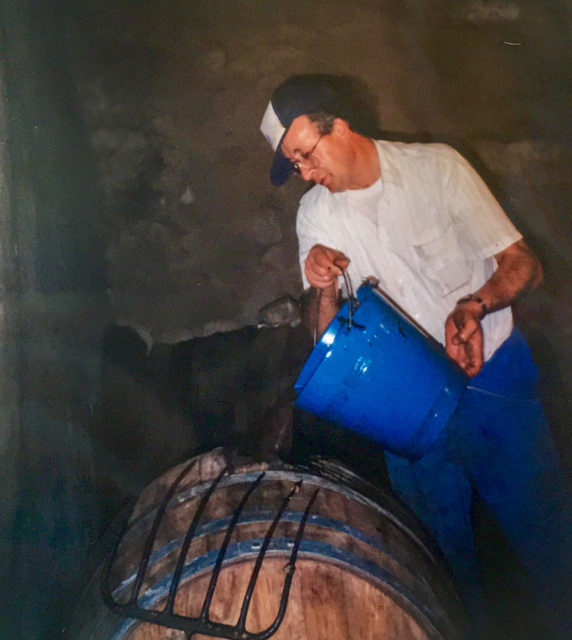
Returning to the farmhouse, my host father announced he was ready for our help with the winemaking. He had pulled on a pair of wine-stained denim overalls and a cockeyed trucker hat. He opened the big, swinging door to a rustic (and, let’s be honest, far from sanitary) barn with a poured-concrete tub in the corner. My host family was far from affluent, but wine in unlabeled bottles always flowed freely at their dinner table. They had told me the wine was casero (“homemade”) — but until now, I had not realized they were the ones who made it.

Fran pulled on a pair of rubber galoshes and climbed into the tub. His father began pouring in buckets of grapes, and Fran squashed them underfoot. Watching my host father make wine — using a method clearly handed down across the generations, relying more on instinct than on science — I suddenly recognized in him the soul of a farmer.

“Moisés, now it’s your turn!” I was hesitant at first, but I pulled on those boots and started stomping. Watching the liquid trickle from the mash of skins and stems out the little concrete spout and into a plastic bucket felt gratifying…productive.

When the bucket was full of mosto (grape juice), Fran’s father lugged it over to an eons-old wooden cask and poured it lovingly into the hole in the top. When all the grapes were stomped, the cask was corked and we headed back to the car. “Now the grape juice ferments,” my host father explained. “We’ll come back next week to check on it.”

Returning home at the end of a long day at la granja, we were in a festive mood. After a light dinner, Fran turned to me and said, “Do you want to do shots?” The question surprised me — it was the first time they’d suggested this (and I’m not much of a drinker). Noticing my puzzled expression, Fran said, “It’s something special. It’s a like a sweet liqueur — but it has no alcohol.” This only made me more confused. “It was a gift from Melanie.” This drew excitement and fond nods from the family around the table. “Sí! Sí! Melanie! Qué buena chica! Melanie was one of our host students, from el estado de Vermont.”

Still not quite sure what kind of sweet, non-alcoholic liqueur I was agreeing to, I watched Fran go to the liquor cabinet and return with a leaf-shaped bottle. “Delicioso,” he promised with a wink, as he opened the bottle and poured the  viscous, amber liquid into a few shot glasses. We all picked up our glasses, raised them in a toast, and slugged them down. Lifting the glass, a familiar sensation filled my mouth: maple syrup.

Uf! Me repite,” Fran said, wheezing and burping a little after his shot — as if he’d just slammed a slug of aguardiente. I stifled a laugh, then started to gently explain that people don’t usually drink maple syrup straight. But quickly, I realized that it doesn’t matter what Americans do with maple syrup. My Spanish family’s improvised custom brought them great joy. Who was I to tell them they were wrong? (And how could I even begin to explain what a pancake is?)

Going to a place where people eat acorns, only animals eat corn-on-the-cob, and a family celebrates with shots of maple syrup challenged my preconceptions about the world I live in. And today, more than two decades later, I realize how I was shaped by those lessons walking with Fran through la granja.


What did I find when I went back to Salamanca so many years later? Read my report on that visit, and on other parts of Spain. Spoiler alert: I must have enjoyed Salamanca, since I included it in my 10 European Discoveries for 2019.

For more on Spanish cuisine, check out my tapas tips for novices and join me on a memorable tapas crawl through Madrid.

If you’re heading to Salamanca, pick up our Rick Steves Spain guidebook, which includes several new restaurants gleaned on my recent research trip.

What are your favorite study abroad memories?

The Trouble with Tapas: 8 Tips for Enjoying Spain’s Tapas Scene

Recently, my wife joined me on her first-ever trip to Spain. Before we arrived, she couldn’t wait to dive into the fabled tapas scene: an endless array of bite-sized baguette sandwiches, deep-fried sea creatures, grilled veggies soaking in garlic-infused olive oil, and toothsome tortilla española. We arrived late one rainy Friday evening in Bilbao. By the time we’d checked into our hotel, it was around 9 p.m. — prime tapas time. This was going to be fun.

But then…it wasn’t. The bars were jammed. We could barely get inside. And when we finally managed to muscle our way to the bar, we couldn’t get served. I’ve spent several months in Spain, dating back to a semester abroad in college — and even I was overwhelmed by the experience. On a busy Friday night, Spanish tapas are a full-contact sport…an eat-or-be-eaten world.

Americans who are used to “small plates” restaurants back home might underestimate the cultural hairiness of the true tapas experience. Don’t get me wrong: Tapas are quintessential Spain. What’s not to like? You get culinary variety and an authentic encounter with Spanish culture for reasonable prices. But wading into a claustrophobic mosh pit of tapas aficionados is no fun for nervous novices. Here are my top tips for navigating tapas bars with the savvy of a local.

Don’t be shy — stake your claim at the bar.

If you walk in and see a wall of people, don’t bother looking for the end of the line. There is no line. Instead, tuck your elbows up like chicken wings and plow through the melee until you reach the bar. If you smile demurely, wait patiently, and expect to be waited on…waiting is exactly what you’ll do. The onus is on you to get the bartender’s attention. Introverts starve, and the person who makes the biggest fuss gets served first. When you’re ready, wave your hand, make eye contact, and boldly say, “Por favor!” or “Perdón!”  (Observing the dominance displays required to get fed, it suddenly makes a little more sense that the national pastime involves the ritual slaughter of an innocent animal.)

Survey the options on the bar, but don’t overlook the menu.

Most tapas bar line up a few ready-made dishes on the counter, or in a glass display case. But these have been sitting out for who-knows-how-long. And at many tapas bars, the most interesting options can only be ordered from a menu. In more traditional places, you’ll squint at the handwritten menu, hung in low light at the back of the bar. Even if it were in English, it’d be next-to-impossible to read.

You can try asking for a printed English menu. But even if you get one, your choices can be far from straightforward. (Trendy eateries have a penchant for naming their dishes creatively. Is “Flavors from the Briny Depths” some sort of seafood salad? Paella? Dredged sewage with a seaweed garnish?) You can ask the bartender for some clarification, but don’t overdo it (see the next point).

When I go for tapas, I pack along a sense of culinary adventure: If I can identify roughly what the key ingredients might be, and it sounds good, I’ll give it a chance. Sometimes it’s delicious. Other times…not so much. But one thing’s for sure: It’s always different from back home. To increase your odds of getting ostras (oysters) instead of orejas (pig’s ears), equip yourself with a list of key food terms. An extensive menu decoder designed precisely for this purpose is a major feature of the Rick Steves Spanish Phrase Book. The Google Translate app also works well, but isn’t tailored specifically to menu decoding.

Be ready to order.

The bartender’s job is not to chitchat. She’s not there to conduct a nuanced dialogue about the provenance of various ingredients, or the pros and cons of each dish. And forget about substitutions. Just watch how hard the bartenders work — a perpetual-motion machine of order-taking, drink-pouring, and cashiering — and you’ll understand why they seem rushed.

So, be prepared: Once you get the bartender’s attention, cut to the chase — clearly and succinctly. (“Glass of vermouth, glass of beer, grilled beef loin, tortilla española. Por favor.”) On rare occasion, you may luck into a bartender who has the time and language skills to explain your options. But it’s safest to assume you’re pretty much on your own.

Know the specialties.

A dozen bars on a given street might do serviceable gambas a la plancha (garlic-sautéed shrimp) — but discerning locals know which one does it the best. And that place might do another dish the worst. Octopus (pulpo) can be rubbery and gross at one place, then tender and delicious at the next. Some tapas bars are hip, trendy, foodie, and fusion; other places are old-school, serving just the classics to appreciative traditionalists. If you’re an “A+” eater, do some homework to find out not only which tapas bars to try, but what to try at each one.

Order sparingly, and share everything. Then repeat.

With so many temptations all lined up, it’s hard to resist overdoing it at your first stop. But  Spaniards would never eat an entire meal at one bar. The whole point is to assemble a moveable feast. People stroll from bar to bar, running into different friends and neighbors at each place. And at each bar, they order a drink, and a plate or two to share. Everything is family-style by default — don’t even try to order a tapa just for yourself. (That’s why many places serve plate-sized raciones alongside the bite-sized tapas. And in many cases, the tapas are designed to lure you in the door, but the raciones kick things up a culinary notch.)

This works even better in a small group, which allows you to maximize the number of raciones you can sample. Try to see how many different dishes you can taste without getting stuffed. To pace yourself, alternate between hard drinks and soft drinks (for this very reason, most bars have cerveza sin alcohol — N/A beer — on draft; just say “thervetha seen”).

“Basque-style” self-service tapas bars are more user-friendly.

The Basque Country has a more streamlined, self-service approach: The bar is lined with a wide variety of bite-sized tapas, each one pieced with a toothpick. Just grab whatever looks good, leaving the toothpicks in a little pile on the plate as you graze. At the end, flag down the bartender to tally the toothpicks and give you your bill. This “Basque approach” is also beginning to catch on in other parts of Spain, especially Barcelona; look for eateries with the name “euskadi” (the Basque word for “Basque”).

For a less intense experience, go earlier in the evening.

Spaniards eat notoriously late — dinnertime begins around 9 p.m. (When I was a student in Salamanca, I would marvel at families taking their kids out for a walk after midnight.) While this might seem mystifying to outsiders, the siesta-then-a-late-dinner tradition perfectly suits Spain’s blazing-hot climate.

However, most bars are open all day long, and start to lay out their tapas for early birds at what approximates a reasonable dinnertime back home — say, 7 or 8 p.m. — to catch office workers for a bite on their way home. If it’s your first time experimenting with tapas, get your bearings at an off-time, when it’s far less crowded. As you master the tapas tango, you can start nudging your dinnertime later and later, eventually achieving the all-in, late-night, fully authentic Spanish tapas experience.

Take a tapas food tour.

All of this might seem bewildering. And, for many travelers, it is. But these days, most Spanish cities have tour companies offering fully guided, thoughtfully curated culinary walks that link up a representative sampling of tapas bars. (I took a great one with Mimo San Sebastián; others are listed in our Rick Steves Spain guidebook.) Food tours know which bars specialize in which dishes, and offer cultural context that brings meaning to your munching.

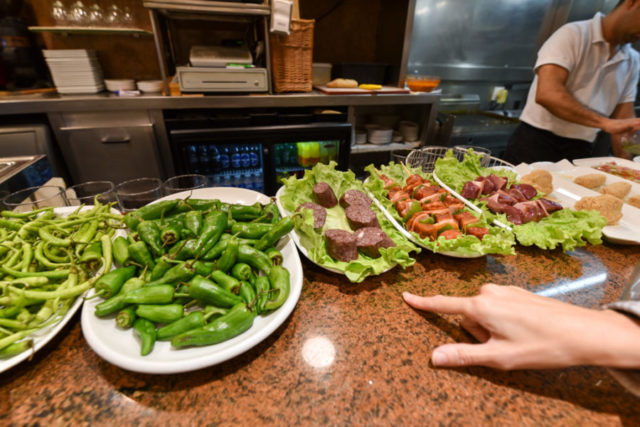
You guide can point out, for example, that if you walk past the premade tapas in front, there’s a grill counter in back where they’ll cook up a fresh dish for you while you wait. And without a guide, you might order a delicious plate of pimientos de Padrón —miniature green peppers, flash-fried and coarsely salted — and discover the hard way that a random number of the peppers on that plate are jalapeño-hot. Doing a tapas tour early in your trip provides an ideal crash course in how the whole scene works, emboldening you to delve into a swarming tapas bar with the confidence of a local.

Just a few days after her baptism by fire, my wife was already an old pro. And she’s already looking forward to her next trip to Spain. Armed with these tips, being steep on the learning curve in a Spanish tapas bar is fun rather than frustrating. Dive in!