Having conversations with strangers — dozens of times each day — is the most interesting part of my guidebook-updating duties. And over the last couple of years, I’ve spent many weeks doing just that in Scotland and Ireland. Usually I’m on the hunt for specific information: prices, hours, new exhibits, planned closures. But the real joy of traveling in the Celtic lands is simply chatting…about something, about nothing, about everything.
Last summer, I came to appreciate how the Scots are master digressers. They’re smart, they’re funny, they’re sharp observers of the world, they always have interesting takes on this and that, and their accent is a delight to listen to. “Meander” sounds like it could be a town in Scotland, and it’s certainly a state of mind there.
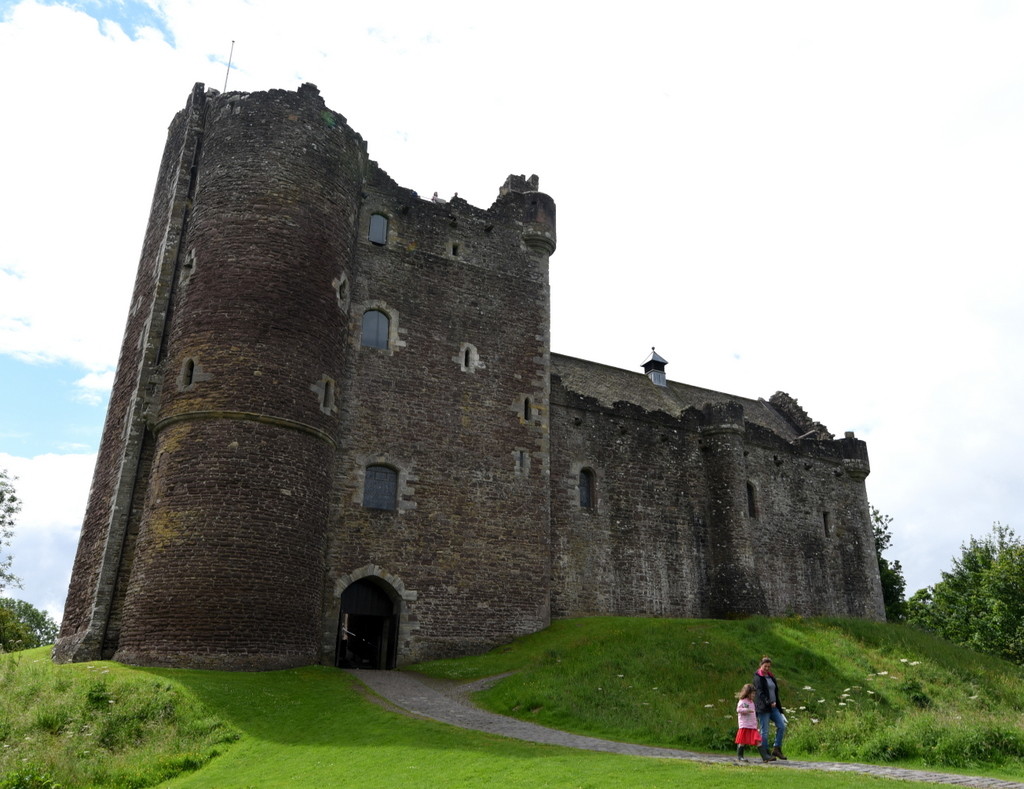
After a busy day of updating Stirling Castle — the gateway to the Scottish Highlands — I wandered downhill through town, ticking off more items on my list. I’d just closed down the tourist information office and the Old Jail, when I crossed the street to drop in on Alan, who runs Stirling Bagpipes.
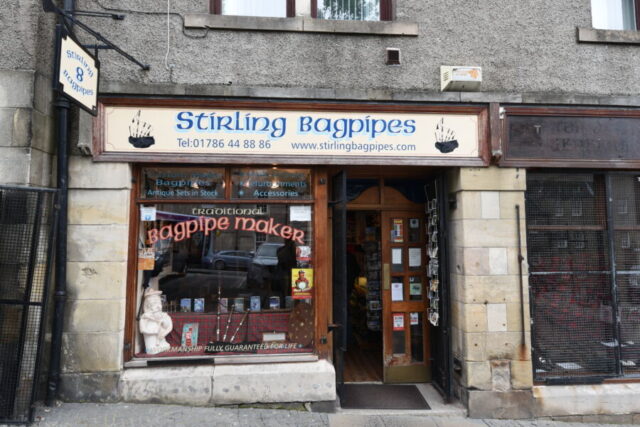
Alan completely, and wonderfully, shattered my momentum. He’s been making and repairing bagpipes for nearly 30 years. Alan loves to talk about bagpipes. And I love to listen to Alan talk about bagpipes.
Alan has bagpipes that go back, literally, centuries. A whole rack of priceless antique practice chanters were stacked in one cluttered corner. He proudly showed me the bags that he’s taught his 15-year-old daughter to hand-sew…to make a little money of her own.
Alan also showed me an amazing work of art that he created several years back. Working with a local historian in the city archives, he found proclamations from centuries past, in which communities like Stirling would establish “burgh pipers” — an official city bagpiper, paid for by civic funds, like today’s garbage collectors or EMTs. He worked with a local artist to create a limited-edition print with the text from those old proclamations, surrounded by illustrations of historical bagpipers. He proudly explained that this print appears in the homes of many of Scotland’s top bagpipers, and music lovers worldwide. And he keeps track of where each print winds up, which he uses to quiz his daughter on world geography.

And then, somehow, we got to chatting about the differences between rugby and American football. I explained some of the rules of my favorite sport, and between us we figured out that “scrimmage” and “scrummage” must be closely related.
(“It’s interesting how people shorten words, innit?” Alan said. “The real word is ‘scrummage,’ but most people say ‘scrum’ for short. Did you know what ‘pram’ is short for, like a baby carriage? ‘Parambulator.’” He sounded it out syllable-by-syllable, swaddling each one in his baby-blanket-soft accent.)
At one point, a couple from Hull, England, wandered into the shop. They spoke with a thick Yorkie accent of their own, which I almost couldn’t understand…it made Alan’s gentle burr sound like the King’s English. A lively conversation ensued about bagpipes and regimental dress, as Alan showed them his kilts and beret-style bonnets. I can’t tell you how much I enjoyed simply being a fly on the wall for that conversation.
(This reminded me of a different time, on a trip years earlier, when I was updating our details at a hotel’s front desk in Glasgow. The receptionist had one of the thickest Glaswegian accents I’ve heard. After I’d collected all my required information, I kept asking him more questions… just to hear him talk. And then another bloke walked in, from Liverpool. He had an incredibly thick Scouse accent of his own. Imagine, if you will, Billy Connolly and Paul McCartney engaged in an animated tête-à-tête. And so I stood there, captivated, as the Glaswegian and the Liverpudlian parried back and forth with two of the most distinctive and pleasurable-to-the-ears accents in the English language.)
I could go on and on about this wonderful bagpipe conversation with Alan. Suffice it to say, at a certain point I realized that I still had a lot of work to do — and that my rental car, which I’d parked up at the castle, was going to get locked in overnight if I didn’t run up and claim it soon. And I’d kept Alan open a half-hour later than the closing time posted on his door.
But he didn’t seem to mind. He told me how much he enjoys all the visitors who pass through his shop. He said he did a tally once, and he estimates that something like 150 times a day, tourists wandering by Stirling Bagpipes pause to take a photo through the window. (“I doubt there’s another shop anywhere that gets so many photos taken.” I said, “Maybe the café in Edinburgh where J. K. Rowling wrote Harry Potter?” “Yeah, it’d ha’ to be somethin’ like that,” Alan agreed.)
Speaking of visitors, Alan has noticed that, for reasons passing understanding, visitors from the same place tend to come in clusters. One week, he seems to get a bunch of people from Southern California. Another week, North and South Carolina. Just last week, he said, he sold practice chanters to two entirely unrelated people from Utah, on different days.
But I digress. And so does Alan. And what I’m getting at is this: The digression is the point.
§ § §
Across the Irish Sea, things are much the same. Having spent over a month this year updating guidebooks on the Emerald Isle, I’ve come to dearly appreciate the Irish, even if they can sometimes be…let’s say “evasive”…when it comes down to brass tacks. A straightforward yes-or-no question — for example, “Is this restaurant open on Mondays?” — might be met with, “Well, sometimes ’tis and sometimes ’tisn’t, if ya know what I mean.”
In one town, I asked the woman at the tourist information office, “How soon do you think the new museum will open?” She chuckled and raised an eyebrow. “How long is a piece of string?”
On Inishmore, I asked an Aran Islander exactly how to get to a hard-to-find landmark. He gazed off to the horizon for a moment, stroked his chin, and said, “Well, see, first ya have to go down that lane over there. You go to the eighth gate on the lane. Ya have to count ’em, ya know: One, two tree… And then, when you get to that eighth gate — you’ll know it’s the one, because it’s got a big ‘no trespassing’ sign on it — well, then, ya hop over that gate and walk across an unmarked field. Then ya just sort of, ya know, look for it.”

Most of the time, I manage to get the answers I need…eventually. And very often, I get a lot more besides. Just like last summer in Scotland, this fall in Ireland, I keep finding myself sucked into countless utterly delightful conversational vortexes, which deposit me far from where I began. The Irish, of course, have a special word for this: craic — lively, pleasurable, smoothly flowing conversation.
In Kilkenny, I joined Sharon on a walking tour along that city’s deeply historic “Medieval Mile.” And while I learned plenty of Anglo-Norman history, some of the most memorable moments were Sharon’s insightful digressions.

We paused at the former Smithwick brewery, famous for its red ale. “A lot of Americans, they’re used to lighter lagers and pilsners,” Sharon said. “And our beers can be a bit much. But here are a few tips. First, a Guinness comes out with that thick head, and visitors think you’re supposed to slurp it from the top, like a milkshake. But the head is bitter, and the beer beneath it is sweet. That’s why you drink past the head — even if you wind up with a ‘moustache.’ You can tell someone’s enjoyed their Guinness, properly, if all that’s left in the bottom of the glass is that head.”
“Of course,” Sharon continued, “Smithwick’s famous red ale is a bit more challenging… even more of an acquired taste. Here’s a tip: For your first Smithwick, ask the bartender to add a dash of strawberry lemonade. This cuts the bitterness and makes it easier to get used to. For Guinness, sometimes they add a dash of blackcurrant syrup. Kind of like training wheels for your beer.”

A few days later, I stopped off at the Blennerville Windmill outside of Tralee — one of many roadside attractions on my list that day.
It seems every sight in Ireland, no matter how minor or remote, comes with two things: First, a 10- to 15-minute film (which the Irish insist on calling an “audiovisual”): either an extremely dense and dry history lesson, or an eye-candy scenic slideshow set to music. And second, a 45-minute guided tour that makes an otherwise dull sight spring to vivid life. (These tours are, almost without exception, billed as 45 minutes — as if the Irish association of museum curators has conducted extensive empirical research to arrive at that optimal duration. Any yet, anytime I confirm that length-of-tour at the front desk, the ticket seller winks knowingly and says, “Well, it usually goes more like 50 minutes, probably more, if ya know what I mean.”)
In the case of the Blennerville Windmill, I did not have particularly high hopes that it would be a blockbuster sight. But as is so often the case, the tour guide, Donal, made it captivating.

Gracefully and conversationally — as if catching up on the latest town gossip — Donal wove together the American Revolution and the Great Famine, which sent a million Irish people across the Atlantic to our shores, escaping starvation.
With the loss of its American colonies in the late 18th century, Donal explained, Britain turned to Ireland as a much closer and more convenient colony to exploit. Hundreds of wind- and watermills were built around Ireland, primarily for the purpose of grinding and supplying grain to England — which was also concerned by the rise of Napoleon and the need to feed its troops. At that point, it was no burden on Ireland — which had been made robust by the success of the potato — to be a breadbasket for Britain. But when circumstances changed with the Great Famine, the Irish continued to fulfill their obligation to ship what could have been life-saving grain from windmills like this one across the Irish Sea to England. While England ate Irish grain to power its Industrial Revolution, the Irish farmers who grew that grain starved.
Without skipping a beat, Donal was on to the next topic: “Have ya ever heard of a dust explosion? Flour is flammable, so with all that powder floating around in the air, the miller had to be extremely careful. That’s why windmills have windows: because they need light, and it was too dangerous to use candles in here. But the windows don’t open, because of course, that would just kick up more dust. And if ya notice, you’ll never find metal touching metal in the gears and levers of a windmill. They alternate between wood and metal. That way…no sparks.”
And then Donal dropped several commonplace phrases that have their origins in windmills: “Run of the mill” and “daily grind” are obvious. But who’d have guessed windmills were behind “four sheets to the wind” and even “damsel in distress”? A damsel, in this case, refers to a broad chute that poured grain evenly into the grinding element. In heavy winds, the damsel might begin to jump around and make a chattering noise. Hearing a damsel in distress, the miller knew to make some adjustments.
The fact that millers called this chattery piece of equipment a “damsel” — in other words, named it after a motormouthed, unmarried maiden — suggests both their unabashed chauvinism, and also their utter lack of self-awareness. In this culture, where people of all genders, ages, and walks of life seem to talk until they’ve run out of things to say, then just keep talking, it’s a bit rich to call out young women as flibbertigibbets. This is, after all, the land of flibbertigibbets.
Again, I digress. Actually, Donal digresses. And there again — that’s the point. If ya know what I mean.
§ § §
Later that same night, deep in County Clare, I made my way to a pub for some traditional music. The talented trio — accordion, guitar, banjo — provided a soundtrack as happy craic filled the bar.
At one point, an elderly gentleman with one leg crutched his way up to the musicians’ table and joined the band to belt out some tunes.
The lyrics were tales of lost loves that might have been; the girl whose father never took a liking to her young suitor; and a troubled locomotive that left Ennis and plodded its way across the county, making slower and slower progress, casting doubt on whether it would ever reach its destination. (“Do ya think that you’ll be home before it’s light?”)

Listening to these songs, I realized that one of the most beautiful aspects of traveling in these Celtic lands — the traditional music — is also rooted in an embrace of digression. Traditional folk songs have no “point,” per se. They are simply tall tales, witty observations, and mournful laments, set to music, to pass the evening hours enjoyably, with good company and good drink. Craic set to music.
The singer returned to the bar, and the trio continued churning through their tunes. Even without lyrics, I could now hear that sense of digression in each note.
Traditional Celtic music just keeps surging forward, always much the same, always a little different, looping back again and again to where it started. And then, just when you think it’s wrapping up, it launches into another giddy lap.
The music, like the craic, is all digression. It’s propulsive, circuitous but not repetitive, and never boring. It’s about the journey, not the destination.

And, just as with conversation, not every note struck pleases every listener. Sitting through a trad session, rather than enjoying one number, and disliking the next, I find moments in each round that thrill me and sections that bore me. Trad music is like Irish weather is like Celtic conversation: If you’re not enjoying it…just wait a few minutes.
That’s the beauty of the flow. Within their planned framework, the jamming musicians discover those digressions…and follow them to see where they go. Because they understand, intuitively, that the digression is the point.
§ § §
Back home, it feels like our society has little patience for digression. A pandemic-born culture of video calls and work-from-home killed the art of the water-cooler conversation. Cursory text messages have derailed the custom of longform letters, emails, and phone calls. We get our news in bulleted headlines and scrolling chyrons, and our entertainment in crisp little reels on social media. A person “talking too much” ranks somewhere between a severe character flaw and a mild mental illness, and saying that someone “likes the sound of their own voice” is a withering insult. Our economy prizes productivity above all else: We encourage concision, precision, and an utter lack of personality. To do anything else is a shameful waste of time.
Similarly, as a writer, I’ve trained myself to weed out digressions — before clicking “Publish,” I go through each piece with a fine-toothed comb to ruthlessly excise all the little asides and parentheticals that clutter up otherwise “clean” copy. At the bottom of each piece, I have a scrap pile labeled “JESTAM” where I’ve discarded some of my personal favorite little side-observations.
But I’m inspired by the conversationalists that I encounter in the Celtic lands. So for this blog post, I’ve decided to keep in more of those tangents. (A keen-eyed editor would quickly snip out my little digression about the Glaswegian and the Liverpudlian having a beautifully lyrical conversation. Admittedly, it’s probably a “you hadda be there” moment. And yet, it’s truly one of my all-time favorite travel memories…and I’ve never written about it before.) Just this once, in the spirit of my Irish and Scottish interlocutors, I’ve decided not to pluck those flyaway hairs.
So then, perhaps all of this explains some of the appeal that we Yanks find in traveling to places like Ireland and Scotland. In Celtic lands with the gift of gab, where craic is a lifestyle and “meander” is a way of being, people still practice the lost art of rambling aimlessly, in vast, swooping, circuitous conversations — like a bird swirling through choppy air, or a carefree child spinning through a field of wildflowers, or a sheepdog corralling her flock in a rocky landscape — that wrap themselves up like a tidy little bow at the last second.
Places, in other words, where the digression is the point.