Rosslyn Chapel: When Great Sights Transcend Pop Culture

For many people, popular culture is an enticing “in” to their travels. When visiting a new city, a strong homing instinct pulls us to the landmarks we’ve seen on TV or in the movies. (On my first visit to New York City, I just had to check out the coffee shop from Seinfeld.) Working on our guidebooks, I could just dismiss the locations attached to famous movies or TV shows. But let’s face it: In Scotland, people are as every bit as interested in seeing the Hogwarts Express viaduct or the Outlander castle as they are in the more “serious” sights.

Of course, pop culture ebbs and flows. Right now, Outlander is on the upswing. Harry Potter has plateaued. And The Da Vinci Code books and DVDs are gathering dust in bargain bins. A decade ago, in the hubbub surrounding Dan Brown’s page-turner, we added a few Da Vinci Code landmarks to our guidebooks. Updating our Edinburgh material on this trip, I came across a listing for the Rosslyn Chapel (where the climax of the novel and the film are set). And, given the declining interest in the Da Vinci Code, I almost took it out of the book without another thought.

But thank goodness I made the trip out to see it. Sitting in the countryside about a half-hour outside of Edinburgh, the Rosslyn Chapel is a riot of carved iconography. It was built in the mid-15th century as the personal burial chapel for the aristocratic St. Clair family. Master stonemasons were brought in to slather the building, inside and out, with a stunning mishmash of Christian, pagan, family, Templar, and other symbolism. While romantics and historians have always been fascinated with Rosslyn, the docent told me that annual visits more than quadrupled after the publication of The Da Vinci Code (funding, among other things, extensive restoration works and a slick new visitors center).

Exploring the carvings, you’ll see everything from the seven deadly sins and the seven acts of mercy to a puffy-cheeked angel playing bagpipes, serenading a skeleton dancing with its human form. The family’s symbol (an “engrailed,” or serrated, cross) is everywhere, as are more than a hundRosslyn Chapelred “green men” — chubby faces with leaves and vines growing out of their orifices. This paradise/Garden of Eden theme is enhanced by a smattering of exotic animals (monkey, elephant, camel, dragon, and a lion fighting a unicorn) and some exotic foliage: aloe vera, trillium, and corn.

Of all the chapel’s fanciful carvings, it’s that last one — the lowly corn — that really captured my imagination. (I wasn’t allowed to take a photo of the corn, but you can find plenty of pictures if you do a Google Images search for “Rosslyn corn.”) These carvings date from the mid-to-late 15th century, certainly well before Columbus sailed the ocean blue, at a time when corn was unknown in Europe. So how did it wind up here? Some claim that the father of the chapel’s builder explored the New World before Columbus. That seems like a stretch. Other theories are more feasible: The St. Clairs were of Norman (Viking) descent, with strong ties to the Orkney Islands (which were part of Norway throughout the Middle Ages). Perhaps some depiction of corn from the Viking explorations of the New World (around A.D. 1000) remained a part of family lore, until it was immortalized in this chapel. The most practical solution: Maybe it’s not corn at all — maybe it’s just stylized stalks of wheat.

Is the Holy Grail, some great Templar treasure, or anything else hidden in a secret underground vault at Rosslyn, as Dan Brown and others have speculated? I don’t know — and don’t care. I just want the skinny on that corn.

Pondering mysteries like this, it’s clear why Rosslyn Chapel still grabs the attention of historians, novelists, and tourists. It also reinforces my feeling that there’s no point being a snob about pop culture, because in many cases, it succeeds in pointing travelers to worthwhile (and otherwise underrated) sights. Just keep in mind that a film or TV appearance is just one more little blip in the centuries-long history of a fascinating place. If you use pop culture as an excuse to travel, that’s wonderful…but let it be a starting point, rather than an end in itself.

The B&B Shuffle

This morning in Edinburgh, I enjoyed one of my favorite research duties: I walked through a neighborhood dense with B&B signs, going door-to-door to update the ones listed in our guidebook. (Every town in Great Britain has a street or a neighborhood like this one.) And after checking in with 14 different B&Bs in about four hours, two things were clear: B&Bs are like apples and oranges. And we’re as lucky to have all of them listed in our guidebook as they are to be listed.

It takes a rare combination of skills to run a good B&B. First, it requires exceptional social skills: You’re opening your home to a motley crew of travelers from around the world. You need to make them feel welcome and comfortable, but still give them some privacy. You must be organized enough to run a complex small business — managing reservations, juggling check-ins and check-outs, and keeping the place spick and span — yet relaxed enough not to stress out when people show up late or make a mess of their rooms. I have a lot of empathy for B&B owners — I’m pretty sure I couldn’t handle that job — but as a guidebook writer, I’m also an advocate for their customers.

Fortunately, the B&B owners in Edinburgh make things easy on me. They “tick all the boxes” (as they like to say here) of what we look for in a good B&B. And yet, each one does it in their own unique way.

One thing that struck me this morning is how the various B&B owners are at different life stages. For example, there’s the young couple, with a toddler and a five-year-old, who’ve taken over and fixed up an old property. The plastic toys scattered around the garden are a bit distracting, but the enthusiasm and hard work the family has put into renovating the place — with welcome splashes of contemporary style, and a younger generation’s take on food, design, and contemporary life — more than compensate.

Then there’s the middle-aged couple who’ve hit their groove. They might have a teenager about to head to university. They’ve got their system down to a science. For example, they set out little slips of paper each evening so every guest can notify them ahead of time exactly what they’ll want for breakfast, and when they’ll be eating.

Edinburgh B&BNext, the empty nesters are slowing down a bit, and the furnishings are getting a bit worn and dated. But they’re such old pros that nobody much minds. They know they’re not the freshest thing on the block, so they price their rooms accordingly, and everybody’s happy.

And finally, every so often you get the aging B&B owner who just isn’t up for it anymore. Sweet but exhausted, these folks don’t have much left in the tank. They still offer fine rooms at a good price, but there are more dust bunnies than there should be. “You can keep me in the book for one more edition,” they’ll say. “But after that, I just don’t know…” Occasionally, I’ll talk with somebody who clearly can’t hack it anymore but doesn’t want to admit it — to themselves, much less to me. And on those rare occasions, I have to make the tough call that it’s time for them to go from the book.

On a lighter note, several B&B owners have their well-rehearsed “when I met Rick” stories: “I still recall the day, 14 years ago. We’d just had all of our rooms check out on the same morning. We were scrambling ’round the ‘ouse, trying to get all the rooms ready. There came a knock at the door. A tall chap was outside and asked to see a room. I had no idea who he was, of course. After I showed him ’round, he explained he was writing a book, and said we’d be in it. I didn’t think much of it at the time. But several months later, suddenly I started getting all of these calls…” These stories often come with the awe and reverence of a born-again story. (And, for many small businesses struggling to survive in Europe’s dog-eat-dog tourist industry, being listed in our books can be the turning point that allows them to flourish.)

As I’m expanding the Scotland material for our new Rick Steves Scotland guidebook, I’m checking out several new accommodations to add to the book. The funny thing is, because Rick’s books aren’t well known in the UK, most people who aren’t already listed in our book haven’t the foggiest idea who Rick is. (I can’t tell you how many times people have said to me, “Oh, right, Rick Stein,” thinking of a British celebrity chef. “Is he doing books now?”)

Since our books are an unknown commodity, the first response of people I visit is quite telling. Most say, “Right! Do come in,” and I’m off on the right foot. Others glance at me nervously and say, “Oooh, sorry, now really isn’t the best time. Can you ring back tomorrow?” Given how tightly I’m scheduled, it’s almost never possible to ring back tomorrow…so those folks just missed their shot at being in an influential guidebook. Years ago, I used to reason with them: “It’ll only take a few minutes. This is a very popular book in the US and Canada…” But in recent years, I’ve gotten a bit more fatalistic: If they don’t answer the door, or don’t want to show me around, then perhaps they’re just not meant to be in the book. It’s not my job to talk them into it. Thanks to the abundance of great accommodations in Britain, it’s easy to take this”plenty of other fish in the sea” attitude…because there really are.

Sometimes B&B owners regard me with suspicion, asking to see some ID. That’s understandable. Apparently there have been a few widely reported scams where people would show up at a B&B claiming to work for a guidebook, but in fact were just casing the house for a later burglary. Far more common are “guidebooks” that inspect a B&B, then ask the proprietor to pay a fee in order to be listed. I’ve been told that this is the way virtually every listing in Britain works. And, of course, B&B owners also pay a very hefty commission to be booked through sites such as Booking.com and TripAdvisor.

Apparently these days, the Rick Steves guidebook is the only source of truly free promotion for B&Bs. Once they’re in the book, even in the age of TripAdvisor, they still tell me it makes a huge impact on their business. The only thing we ask in return is that they treat our readers well. As Rick always says to hoteliers around Europe, “If my readers are happy, I’m happy.”

Scots Sweets at Lickety Splits

I love visiting a shop that takes something humdrum and — because the shopkeeper is so passionate and knowledgeable — elevates it to fascinating new heights. Edinburgh has some fine kiltmakers and great whiskey shops, but my favorite store in town sold candy — or “sweets,” as they say here.

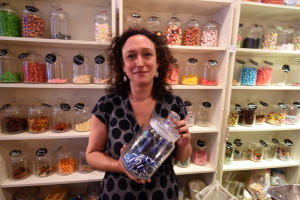
Sweets ShelvesNaomi runs Lickety Splits — just a few doors off the Royal Mile — as a nostalgic throwback to Scottish childhood. Stepping inside, you’re greeted by a wall of glass jars filled with brightly colored treats. But if you take a few minutes to chat with Naomi, you’ll learn that each one has its own unique — and often fascinating — backstory. While England may be the land of Cadbury and Willy Wonka, the Scots seems to have a special knack for sweets.

Take Chelsea Whoppers. These little strips of chewy fudge dusted with cocoa powder were originally manufactured in Helensburgh, Scotland. Naomi loves to explain how, through a scandalous and still-grating series of events, it morphed into the Tootsie Roll in the US. Today, Scots who grew up on Chelsea Whoppers come to specialty stores like this one to track down the originals.

Another fascinating sweet is the Lucky Tattie, a flat, super-sweet disc dusted in cinnamon (resembling a potato — hence the name). Naomi explained that these are so packed with calories that long-distance runners eat one to get an extra boost. When you eat one, it’s like chugging an energy drink.

Sweets JarThe list goes on and on. I love unusual flavors, and Naomi introduced me to several: Hard candies (called “rock”) that taste like clove, ginger, or rhubarb. (She has to keep the rhubarb jar closed, because otherwise it makes her whole shop smell like marijuana.) Little orange-and-blue-streaked candies that taste like Irn-Bru, the soft drink that’s unaccountably beloved throughout Scotland (and nowhere else). Saltire rock, a blue hard candy with a white Scottish flag. And “Edinburgh rock,” a more crumbly candy (like after-dinner mints) with its own wildly creative array of flavors.

And speaking of Willy Wonka, Scottish sweets makers really know how to name their treats: Parma Violets. Acid Drops. Humbugs. Soor Plooms. Fizzy Fangs. It makes “Milky Way” and “Twizzlers” seem dull in comparison.

Naomi is also a fascinating person — she clearly has her finger on the pulse of the neighborhood, and filled me in on the inside scoop behind touristy Edinburgh. For example, it’s well-documented that J.K. Rowling worked on her earliest Harry Potter books at The Elephant House, a café a few blocks south of the Royal Mile.  But knowing the neighborhood, Naomi can see where she drew lots of inspiration from that little corner of Edinburgh. In the Greyfriars Cemetery a block away (made famous by the “Greyfriars Bobby” tale of a loyal dog) are headstones with the names McGonagall and Tom Riddell. The posh George Heriot’s School, a Gothic-turreted showcase just over the cemetery’s fence, was clearly an inspiration for Hogwarts. And a couple of blocks away is a street called…Potterrow. (Cue Harry Potter theme music.)

Sweets NaomiLickety Splits also has a small art gallery. In the back room, Naomi makes broaches, pendants, and other jewelry from maps. Through her work with maps, she’s gotten to know places very well. When I told her I grew up in Central Ohio, she could visualize the state.

Leaving Naomi’s sweets shop with a bag of Scottish goodies, I realize I’ve done my favorite type of shopping: Affordable. Culturally broadening. And delicious. For the rest of my trip, each time I pop a clove hard candy or a sour ball into my mouth, I’ll remember Lickety Splits — and know I’m in Scotland.

The Thistle and the Rose

The more things change…the more they stay the same. Centuries ago, William Wallace and Robert the Bruce fought the English king to ensure Scottish independence. Generations later, the Jacobites struggled agains the crown to put a Scottish monarch back on the throne. And in our own age, the tension between Scotland and England persists. Less than a year ago, Scotland voted to remain part of the United Kingdom…for the time being.

Scotland has a lot in common with England. But, having traveled extensively in both places, I also see stark differences. For starters, look at the national symbols. England’s official flower is the rose: classic, romantic, and idealized. Scotland’s is the thistle: wild, prickly, and beautiful in its ruggedness.

At the bottom of Edinburgh’s Royal Mile, two more symbols of England and Scotland face each other across the street. Touring both to gather information for our new Rick Steves Scotland guidebook, I found the differences striking — and maybe bit too on-the-nose.

The Palace of Holyroodhouse has been a royal residence for centuries. Many monarchs — including the current Queen — have preferred staying here to windblown Edinburgh Castle. Holyroodhouse, a classic sandstone palace, is set back from the road, protected by several layers of stout gateways and wrought-iron fences, and surrounded by meticulously landscaped gardens. The clear message: This is the monarch’s space, and you are merely visiting…should you be so lucky. (When I asked if I could take a look around for free, as is standard operating procedure at most sights for guidebook researchers, they told me, “You’d have to call Buckingham Palace to formally request permission.” I’ve never been told to call Buckingham Palace before. It was fun.)

Queen Gate

Once inside the pristine grounds, you follow a carefully prescribed, one-way route dictated by a buttoned-down audioguide. I didn’t ask, but I imagine the Queen wouldn’t tolerate loiterers or picnickers cluttering up her lawn or rose garden.

Holyroodhouse Courtyard 2

Although the Queen publicly supported the creation of the Scottish Parliament, I imagine it drove her a bit batty when they started building the place across the street. Open since 2004, the building seems like the purpose-built antithesis of Holyroodhouse.

Scottish Parliament

It was designed in boldly contemporary style by Enric Miralles from Catalunya (a nation with separatist sentiments of its own). All signs appear both in English and in Gaelic, the prehistoric Celtic tongue of the Scots.

Parliament Sign

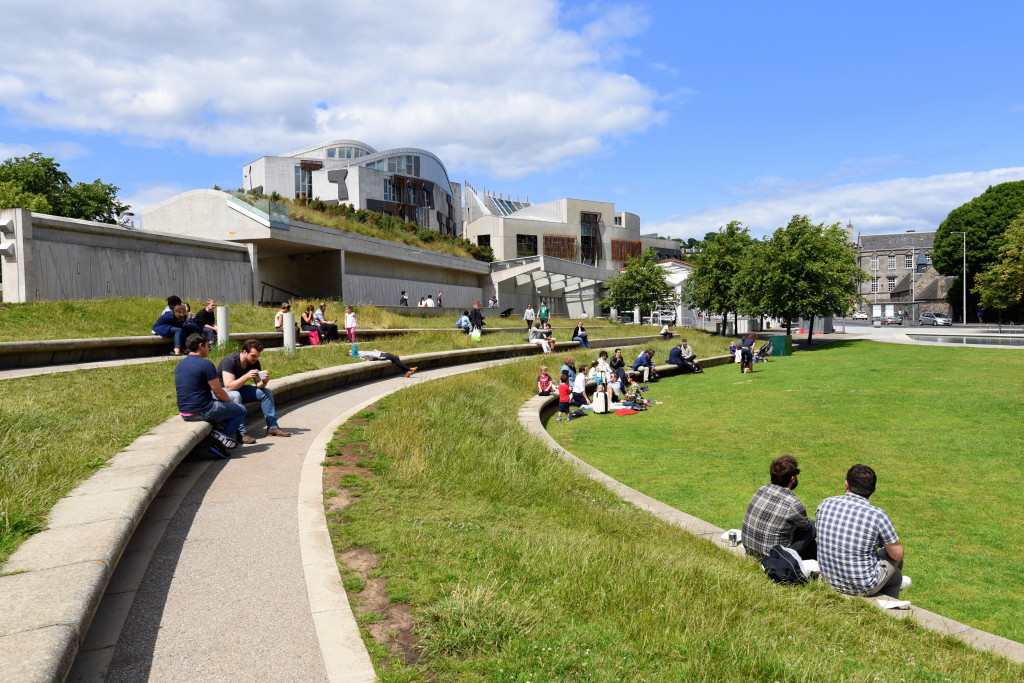
Once through the security checkpoint, access is entirely unfettered — I had the sense you could simply wander the halls to your heart’s content, though helpful attendants are standing by to direct you to the main attraction, the Debating Chambers. Out front is a snazzy, angular plaza, with big pools and fountains, ample seating, and sprawling rugged gardens — filled, of course, with highland grasses and vibrant purple thistles.

Thistle

It’s a communal place. On a sunny day, people are out enjoying their parliament complex as if it were a public park. I imagine the Queen pulling back her drapes and peering at the riffraff filling her neighbor’s front yard. What’s next, a car up on blocks?

Parliament Park

And yet, to the grand old dame’s eternal credit, she lets it happen. While the differences between these two places are jarring, let’s not forget the even more striking fact that they coexist so peacefully to begin with. Given the history of bloodshed between these two lands, I’m heartened to see the “you do it your way, and we’ll do it our way” spirit embodied in stone and steel at the bottom of the Royal Mile. It gives me hope that nations can evolve, mature, and find ways to fit better into a diverse world. What’s happened between England and Scotland in recent years seems to suggest that the overall trajectory of a nation’s evolution is toward peaceful coexistence.

Will Scotland remain part of the UK? After getting to know this place well, I have a strong feeling about what the answer should be. But isn’t it nice that we can have the conversation with the knowledge that whatever happens, we can be confident that it will be peaceful and respectful?

The Other Side of Edinburgh: The Georgian New Town

Edinburgh’s New Town, across a big valley from the Royal Mile, was purpose-built to allow the city to expand in the 18th century. As if city planners were overcompensating, it’s as rigidly regimented as the Old Town is higgledy-piggledy. Many travelers get Royal Mile tunnel vision and miss the New Town altogether — which is a shame, since this neighborhood offers a glimpse of a very different and (marginally) less touristy side of Edinburgh.


New Town View

The New Town was carefully planned and plotted, right down to the way its main cross-streets coincide with viewpoints that make the city’s landmarks line up — in this case, combining a museum, an old tenement building, and a church tower into one mega-Gotham City vista.


New Town Rose

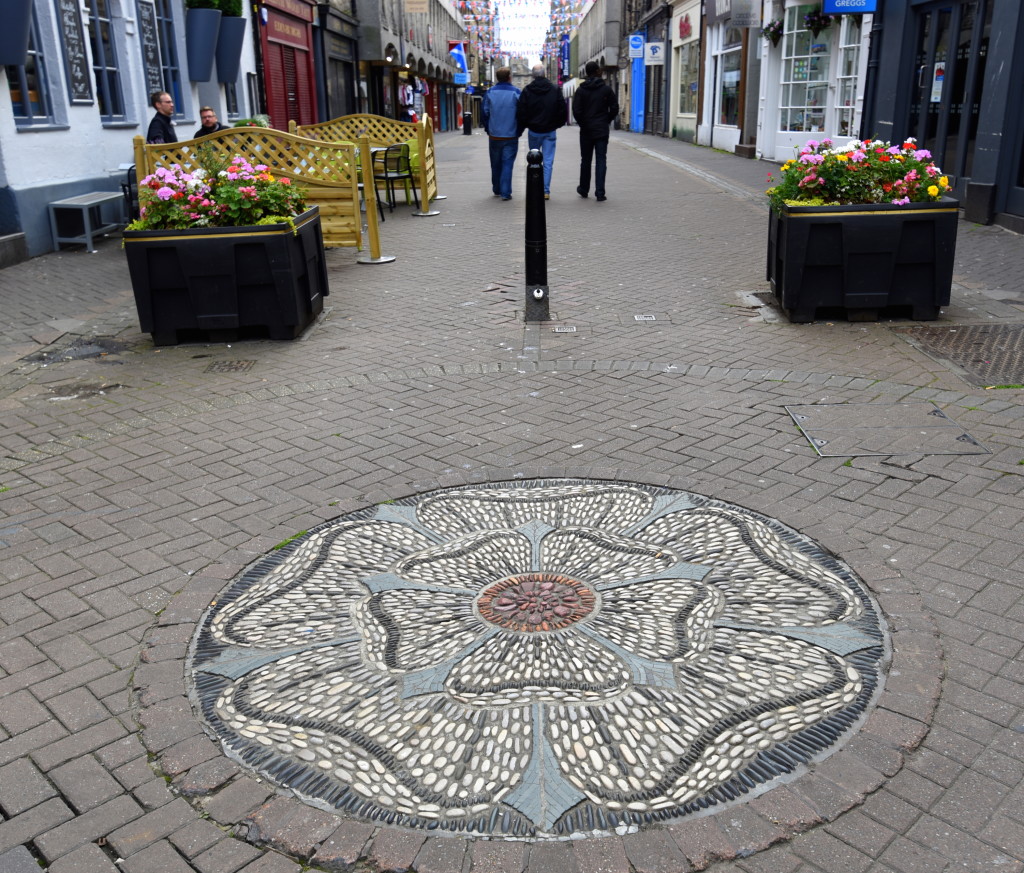
The New Town plan was designed to suck up to English royalty. (It came about just 20 years after the failed Jacobite rebellions that attempted to topple the English crown and re-install a Scottish monarch.) The main drags are named “George Street” (for the king), “Queen Street,” “Princes Street,” and so forth. Here on Rose Street, the sidewalk is even embedded with a giant Tudor rose — the symbol of the English monarch. Come on, guys, we get it. Enough is enough.


Royal Mile Georgian

The architectural style of the New Town is Georgian. British for “Neoclassical,” the style is named for the kings who ruled during that age. The best museum in the New Town is the Georgian House, where you can go inside one of these elegant town houses and see how the upper crust lived during the 18th century. By the way, as I work on our new Scotland guidebook, I find myself comparing every aristocratic manor house to Downton Abbey. As a travel writer, it’s dangerous to rely too heavily on one comparison point…but that show really does a perfect job of capturing the upstairs, downstairs life behind these genteel facades. (I’m sure that once I get to the Highlands, it’ll be all about Outlander.)


New Town Concert

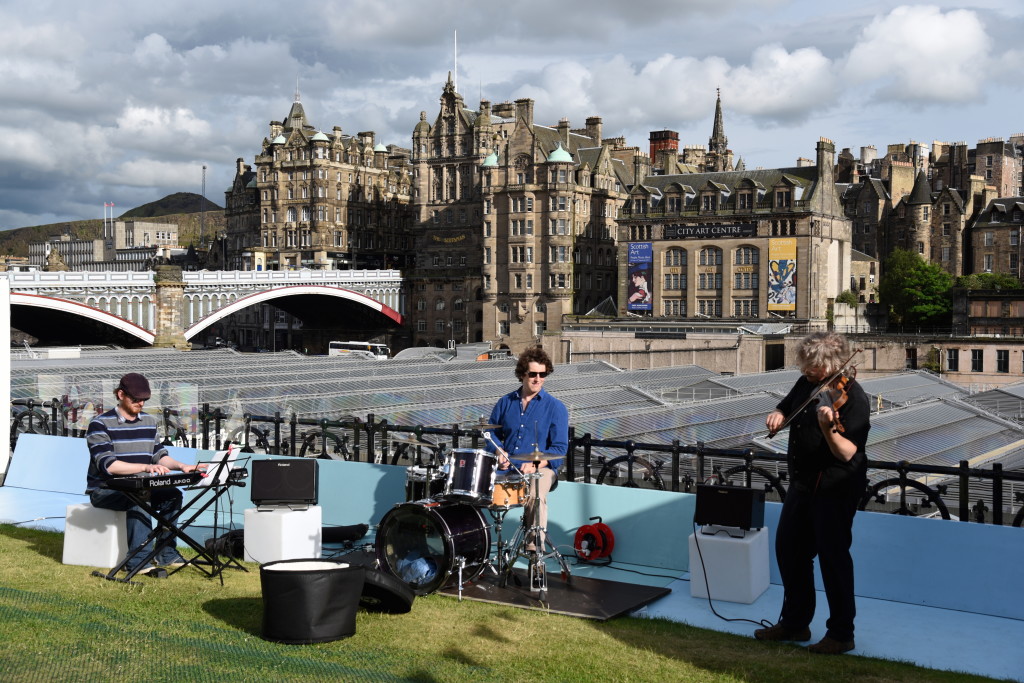
While back home in Seattle, Pacific Northwesterners are enjoying the warmest summer in a generation, here in Scotland it’s the opposite. I was told that in Scotland, the month of June was the coldest in 43 years. But even in an unseasonably chilly summer, Edinburgh is carrying on with its slate of outdoor activities. Heading from the New Town back toward the Royal Mile, I stumbled upon a row of food trucks, a beer garden, and a casual outdoor stage where a talented trio was playing modern Celtic music with a stunning Edinburgh backdrop…howling winds and dark clouds be damned.