The more things change…the more they stay the same. Centuries ago, William Wallace and Robert the Bruce fought the English king to ensure Scottish independence. Generations later, the Jacobites struggled agains the crown to put a Scottish monarch back on the throne. And in our own age, the tension between Scotland and England persists. Less than a year ago, Scotland voted to remain part of the United Kingdom…for the time being.
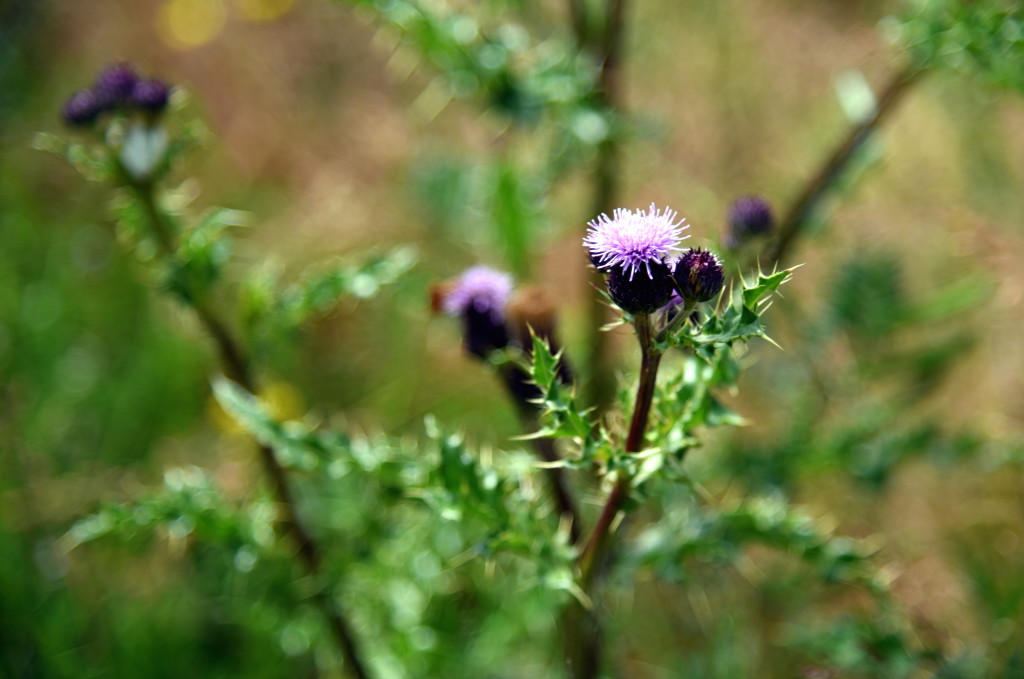
Scotland has a lot in common with England. But, having traveled extensively in both places, I also see stark differences. For starters, look at the national symbols. England’s official flower is the rose: classic, romantic, and idealized. Scotland’s is the thistle: wild, prickly, and beautiful in its ruggedness.
At the bottom of Edinburgh’s Royal Mile, two more symbols of England and Scotland face each other across the street. Touring both to gather information for our new Rick Steves Scotland guidebook, I found the differences striking — and maybe bit too on-the-nose.
The Palace of Holyroodhouse has been a royal residence for centuries. Many monarchs — including the current Queen — have preferred staying here to windblown Edinburgh Castle. Holyroodhouse, a classic sandstone palace, is set back from the road, protected by several layers of stout gateways and wrought-iron fences, and surrounded by meticulously landscaped gardens. The clear message: This is the monarch’s space, and you are merely visiting…should you be so lucky. (When I asked if I could take a look around for free, as is standard operating procedure at most sights for guidebook researchers, they told me, “You’d have to call Buckingham Palace to formally request permission.” I’ve never been told to call Buckingham Palace before. It was fun.)

Once inside the pristine grounds, you follow a carefully prescribed, one-way route dictated by a buttoned-down audioguide. I didn’t ask, but I imagine the Queen wouldn’t tolerate loiterers or picnickers cluttering up her lawn or rose garden.

Although the Queen publicly supported the creation of the Scottish Parliament, I imagine it drove her a bit batty when they started building the place across the street. Open since 2004, the building seems like the purpose-built antithesis of Holyroodhouse.

It was designed in boldly contemporary style by Enric Miralles from Catalunya (a nation with separatist sentiments of its own). All signs appear both in English and in Gaelic, the prehistoric Celtic tongue of the Scots.

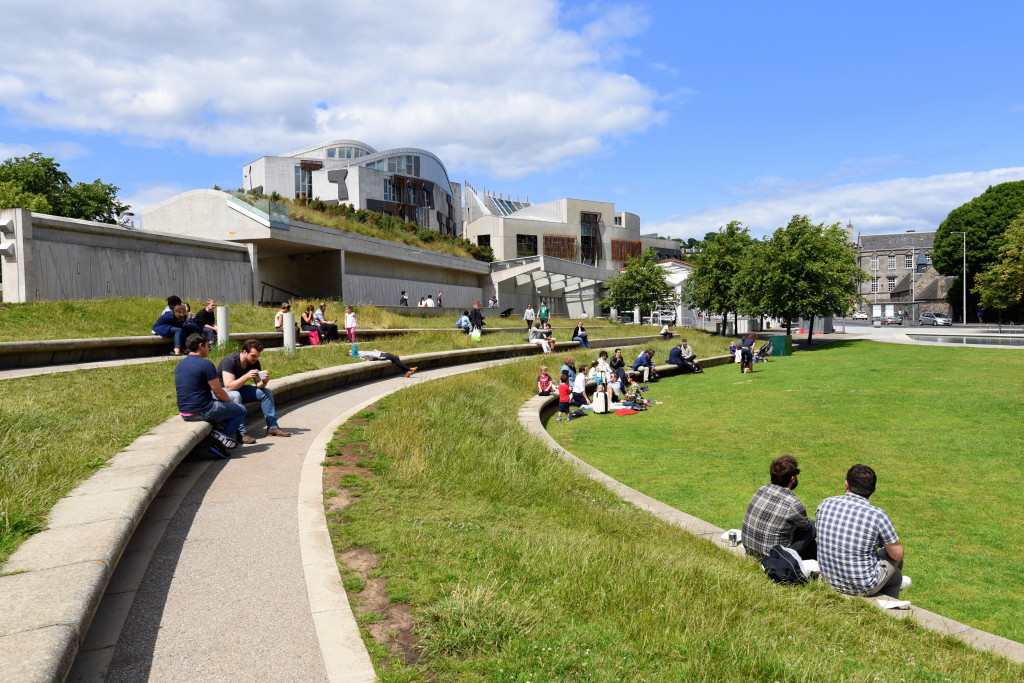
Once through the security checkpoint, access is entirely unfettered — I had the sense you could simply wander the halls to your heart’s content, though helpful attendants are standing by to direct you to the main attraction, the Debating Chambers. Out front is a snazzy, angular plaza, with big pools and fountains, ample seating, and sprawling rugged gardens — filled, of course, with highland grasses and vibrant purple thistles.
It’s a communal place. On a sunny day, people are out enjoying their parliament complex as if it were a public park. I imagine the Queen pulling back her drapes and peering at the riffraff filling her neighbor’s front yard. What’s next, a car up on blocks?
And yet, to the grand old dame’s eternal credit, she lets it happen. While the differences between these two places are jarring, let’s not forget the even more striking fact that they coexist so peacefully to begin with. Given the history of bloodshed between these two lands, I’m heartened to see the “you do it your way, and we’ll do it our way” spirit embodied in stone and steel at the bottom of the Royal Mile. It gives me hope that nations can evolve, mature, and find ways to fit better into a diverse world. What’s happened between England and Scotland in recent years seems to suggest that the overall trajectory of a nation’s evolution is toward peaceful coexistence.
Will Scotland remain part of the UK? After getting to know this place well, I have a strong feeling about what the answer should be. But isn’t it nice that we can have the conversation with the knowledge that whatever happens, we can be confident that it will be peaceful and respectful?
The Palace of Holyroodhouse is Scottish, not English. In no way is it a “symbol of England”. It was built by the monarchs of Scotland, the ruined Abbey was endowed by them, both before union, and in any case the Queen is not the Queen of England, but the Queen of the United Kingdom (and she is half Scottish through her mother). To define the palace as a symbol of England is just plain wrong. If you are going to opine on Scottish and English history, please do your research first, and please don’t put the same view in your guidebook. And I expect that Queen wasn’t driven too batty at have a Parliament over the road – after it, it replaced a brewery. Finally, given that the Queen was a mechanic during the war, who knows, she might enjoy the sight of a car up on blocks!
Simon, thanks for reading and for your insightful comments. You’re absolutely right that Holyrioodhouse was originally a Scottish palace, built and maintained by Scottish kings and queens. However, there’s no question that today, it’s managed–and viewed by locals–as an enclave of English (i.e., royal) authority in the heart of Scotland’s proudest city. What struck me, visiting both, was how starkly different they feel for visitors today. And I stand by those observations. According to my research, the Queen feels no more affinity for her Scottish roots than for her German roots; as her country’s designated “head traditionalist,” I’m certain she has ambivalent feelings about devolution. And given the old-fashioned royal trappings she surrounds herself with, I can’t imagine she’s a fan of the wildly modern architecture (or the symbolism) of the new parliament. Let’s agree to disagree on this point. Thanks again for reading.