March is Women’s History Month, and March 8 is International Women’s Day. So let’s talk about women’s history in the context of European travel.
As a (male) guidebook writer, I’m keenly aware that women are, so often, underrepresented when telling the story of Europe.
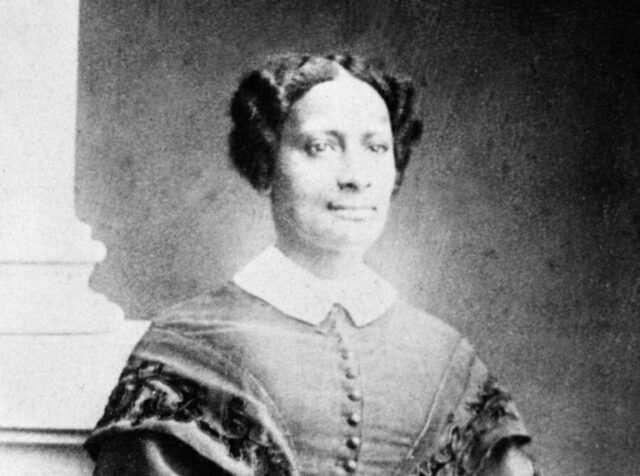
On a recent research trip, I received a welcome reminder of this when I posted on Facebook about the Protestant Cemetery in Rome, and told the stories of some of the fascinating men buried there. A Facebook account called Herstorical Monuments pointed out that many even-more-fascinating women are also interred at that cemetery, and suggested I look into one in particular: Sarah Parker Remond (1826–1894), a Black woman born free in Salem, Massachusetts, who traveled to England to gather support for the abolition of slavery and eventually became a physician in Florence, Italy. I appreciated the nudge, and Remond is now mentioned in our Rick Steves Rome guidebook.
As I’ve worked on our guidebooks across Europe since then, I’ve kept this important mission in mind. The stories of great women can be difficult to track down — all too often, you have to work to uncover them. But if you travel with this goal in mind, you realize that Europe’s history has been shaped by many exemplary women.
For example, in Glasgow, I dug deeper into the story of Margaret Macdonald Mackintosh (1864-1933). While known primarily as the “wife of Charles Rennie Mackintosh,” Margaret was a talented artist in her own right — collaborating with her husband on many of his best-known works, often contributing their defining features. And she did not just influence her husband. One of the most famous works of Austrian artist Gustav Klimt, the Beethoven Frieze, bears a striking resemblance to a work of Margaret Macdonald’s that Klimt had seen at a show in Vienna.

In Budapest, I learned the story of Hannah Szenes (1921-1944), a Jewish woman who became part of an elite paratrooper unit during World War II. Szenes dropped behind enemy lines, where she was captured and tortured, refused to give up her comrades, and was ultimately executed by the Nazis. In addition to being a war hero, Szenes was also a poet; one of her poems — called “Eli, Eli” (or “A Walk to Caesarea”) — provided the lyrics to a beloved song that’s sung around the world in remembrance of the Holocaust. (You can read Szenes’ full story in our Budapest guidebook.)
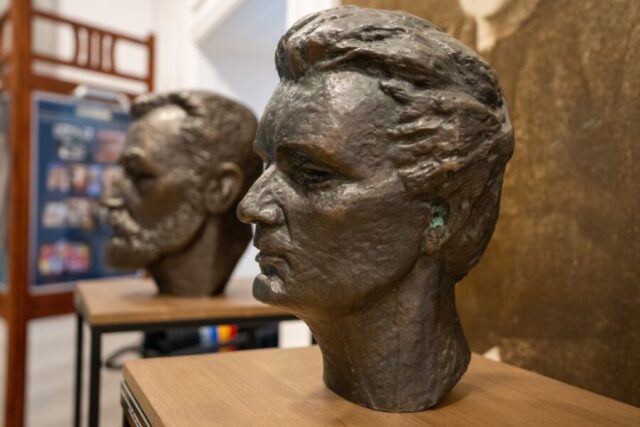
In the world of science, few figures loom larger than Madame Curie — born in Warsaw as Maria Skłodowska (1867-1934). She traveled to study in Paris, where she met her husband, Pierre. They were the first to identify and explain the phenomenon of radioactivity, and they discovered two new elements: Polonium (which Marie named after her native land) and Radium. They were awarded the Nobel Prize in Physics; later, Marie won a second Nobel Prize in Chemistry, making her one of just two scientists who’ve been awarded Nobels in two different disciplines. After Pierre died, Marie took over his professorship at the Sorbonne and continued their research; among other accomplishments, she founded the Radium Institute, which still carries out important cancer research. (Her full story is told in our Central Europe guidebook.)
And in Dublin, on a visit to the sobering Kilmainham Gaol, the tour guide passionately told the story of Constance Markievicz (1868-1927), an Irish woman who took up arms during the Easter Rising. As one of the rebellion’s leaders, she was convicted and sentenced to death, but that sentence was later changed to life in prison, solely because she was a woman. (A regretful Markievicz said, “I do wish your lot had the decency to shoot me.”) Later released, she was elected the first-ever female member of the British House of Commons; soon after, she became Minister of Labor — the second woman in all of Europe to hold a cabinet position.
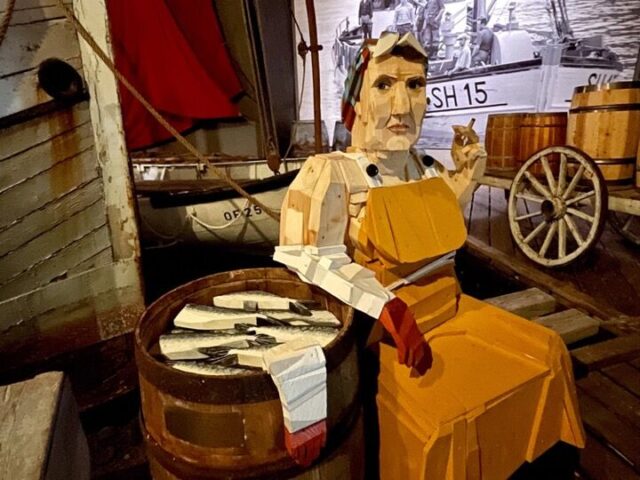
Often, women change history collectively and anonymously. For example, in the tiny fjordside village of Siglufjörður, at the northern tip of Iceland, the Herring Era Museum explains how the abundant shoals that were caught and processed here powered Iceland’s economy through the early 20th century. The hard work of cutting and salting the herring was done by women, who worked 20- or even 30-hour shifts. These workers were known as “herring girls” — a term that today’s local women have embraced with a Rosie the Riveter verve. Make no mistake: The “herring girls” were the muscle behind Iceland’s economy during a critical period, arguably empowering it to become fully independent from Denmark.
And in Derry, Northern Ireland, a wonderful mural honors the thousands of women who worked sewing machines at Derry’s shirt-making factories (the biggest was Tillie & Hendersons). These original “Derry Girls” powered the economy; often served as the primary breadwinner for their family; and held the fabric of the town’s society together.

Probably my favorite often-overlooked great woman of history should rightly be the patron saint of solo women travelers. I stumbled upon her at, of all places, a souvenir shop in the Slovenian capital of Ljubljana. Perusing a stack of coffee mugs decorated with the faces of great Slovenes, I scanned the familiar (male) names — Plečnik, Prešeren, Trubar — and came across one that was unfamiliar: Alma Karlin.
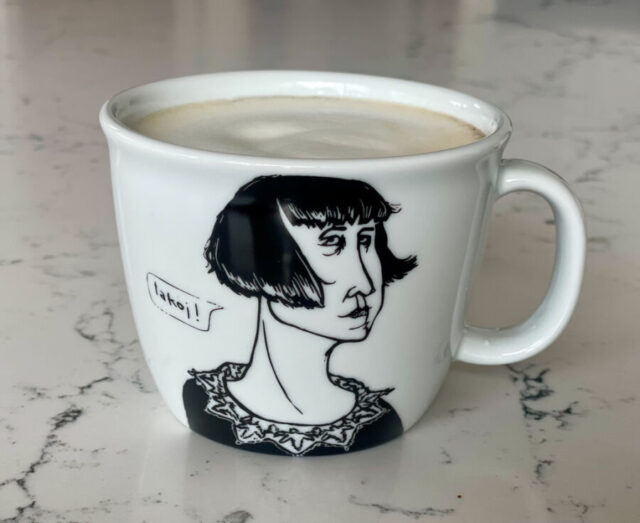
I asked the clerk for more information. “Oh, yes, Alma,” she said, as if talking about a dear old friend. “She was a great traveler and an amazing woman! Went all over the world by herself.”
Needless to say, I bought the mug. And I went back to my hotel and did some research on this fascinating human being for my Slovenia guidebook. And so, in honor of International Women’s Day, here’s the complete story of Alma Karlin:
Alma Karlin (1889-1950): Slovenia’s Greatest Traveler?
Slovenia is a land of great travelers. And perhaps the greatest was Alma Karlin, considered the first European woman to travel around the globe independently (with no outside financial support). Karlin was also a polyglot, ethnologist, iconoclast, prolific writer — and iconic Slovenian woman.
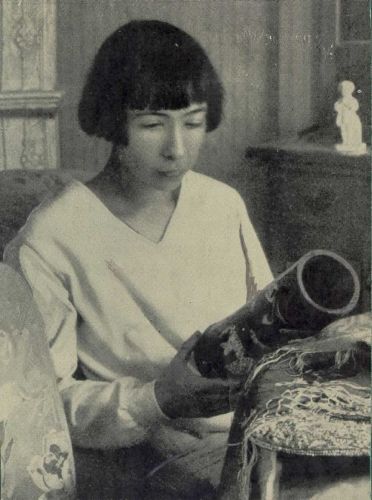
Karlin was born in 1889 in the city of Celje, then the Austro-Hungarian burg of Cilli. Her father, a retired military officer, once sparked young Alma’s imagination by telling her that if she left home toward the west and just kept going, eventually she’d wind up right back where she started. But Karlin had a challenging childhood, with a drooping eye and a slumping shoulder, which her mother attempted to correct in painful and humiliating ways.
After her father’s death, Karlin escaped her overbearing mother by studying in both London and Paris, then fled to Sweden and Norway during World War I. Karlin slowly mastered what eventually amounted to more than 10 different languages, and also discovered a passion for writing and traveling. Returning home after the war, she taught language classes until she had saved enough money for a ’round-the-world journey.

Karlin departed Celje in November 1919, carrying a single suitcase containing a few items of clothing, a typewriter, and a 10-language dictionary she had written herself. She headed west, loosely following the route her father had outlined: first to South America, then to North America, and eventually to Asia, Australia, and Oceania. Finally, in 1928, at the request of her ailing mother, Karlin returned home to Yugoslavia. Back in Celje, Karlin entered a deep depression (possibly resulting from malaria) and never left home again. But that did not mean she remained unhappy: Karlin met and fell in love with the German painter Thea Schreiber Gamelin, who eventually moved to Celje so they could live together.
Karlin had already amassed many lifetimes’ worth of experiences in those eight years on the road. Over the next two decades, she wrote extensively about her journeys (starting with her travelogue The Lonely Journey, in 1929), as well as novels, short stories, and plays, eventually gaining an international following. Her works include closely observed details and tales of her own misadventures, written with wit and honesty. She also became fascinated with spirituality and mysticism — having been exposed to many different faiths in her journeys.
Originally Karlin wrote in German — which was her first language — but later, in protest of Nazi Germany, she switched to other languages. When the Nazis occupied this part of Slovenia, they banned Karlin’s books, arrested her, and sentenced her to a concentration camp; only Thea’s intervention saved her. Karlin spent the rest of the war, in failing health, living either under house arrest in Celje or in exile. She died in 1950 and is buried next to her beloved Thea in the Svetina village cemetery just outside Celje.
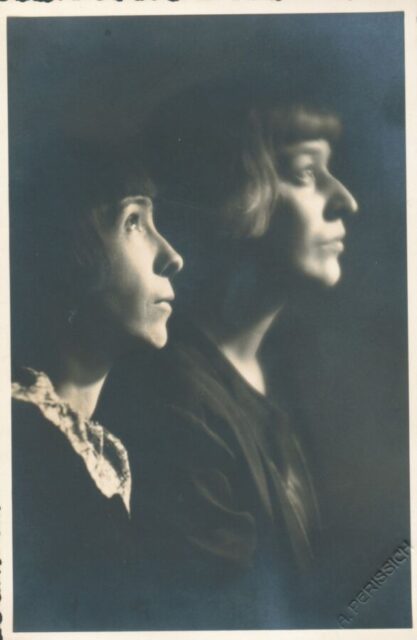
While Karlin has been until now a footnote in Slovenian history, interest in her travels and her work is finally catching up. Hopefully, as her status as the proto-“solo woman traveler” becomes better known, more of her writings will be translated into English. In the meantime, if you’d like to learn more about Karlin, you’ll find an exhibit about her at the Regional Museum in Celje. And, quite fittingly, a statue of Karlin toting her suitcase greets arriving travelers in front of the Celje train station.
Who is your favorite unheralded woman in the story of Europe? And also: Who’s your favorite solo woman traveler?
Thank you so much for your efforts to acknowledge the contributions of women in the human story. :-) I know you have tours in France. Do you know of any monuments to Marie-Madeleine Fourcade, La Patronne of the Alliance, the largest French resistance movement during WWII? Lynne Olson, author, wrote a nonfiction book in 2023, Madame Fourcade’s Secret War: The Daring Young Woman Who Led France’s Top Spy Network Against Hitler, which details much of Marie-Madeleine’s life, the Alliance and other resistance movements.
I enjoyed this article, very informative.
Mildred C Scott, Delaware, Ohio. Author of “Jams Are Fun”. Referred to in your book, “The Temporary European “.
My favorite female solo traveler is Nellie Bly, the young reporter for Pulitzer’s World newspaper, who in 1889 traveled solo around the world to beat the time of Jules Verne’s fictional Phileas Fogg–80 days. Many know about her, but not as many know that another woman–Elizabeth Bisland–also traveled around the world in the opposite direction, racing Nellie Bly. It was a close call, wonderfully recounted in a book called “Eighty Days” by Matthew Goodman. Here’s to solo women travelers! I’ve been one my whole life.
Love this!
Thanks Rick, for this tremendous and fascinating information.
Constance Markievicz was indeed elected the first-ever female member of the British House of Commons, but refused to take her seat, and when she became Minister of Labor it was in the newly independent Ireland.
Thank you, Cameron, for this wonderful article! Truly informative. Belated recognition for stellar female lives, but a shimmering start.
Thank you for providing us with two “must see” places for our future trip to Dublin, Ireland and Derry, Northern Ireland.
Thank you for this article! May I add Marianne North (1830-1890), writer, painter and botanist who traveled the world alone painting and discovering plants. Her paintings are exhibited in the North Gallery in Kew Gardens, England.
I had the honor of meeting you in Hallgrims church, Reykjavik. To my surprice and joy you mention the “Herring-girls” here! You certainly have an eye for things.
Lerning about Alma Karlin is new and very interesting to me.
Maybe you want to read the book “High Albania” by M. Edith Durham, who after journeys to the Balkans and Makedonia went for 8 months to the mountains of Albania. This was around 1908 and the Highland was a closed book for everyone. I read this just before visiting Thethi in High Albania a few years ago, just two years after the jeep road was built.
Her writing is a gem.
Irene Sandler was a brave, heroic woman in European history. Please, Rick, if you haven’t heard of her impact on saving many WWII children in Poland from death, check her out. Thank you for posing this question as you have many grateful,
independent women traveler followers.
Gertrude Bell (born July 14, 1868, Washington Hall, Durham, Eng. —died July 12, 1926, Baghdad, Iraq) was an English traveler, administrator in Arabia, and writer who played a principal part in the establishment in Baghdad of the Hāshimite dynasty. She is simply fascinating.
My favorite female European traveler is myself. After my first trip “abroad”,” to London with a horrid guy, I knew I wanted to see more. So I bought Europe through the Back Door and the RS France guidebook, and off I went the following year, clutching my college French textbook.
That was about 1995. Thanks to Rick, I have wandered through quite a few countries, primarily by myself. The basics hold true today: You don’t have to be rich to travel “the Continent.” but like Rick, I’m a bit older and like a bit more comfort.
So thanks to Rick, and also now Cameron, I willl keep on travelin.’
Favorite solo traveler: Lady Jane Digby. She was a feisty woman!