This post was written in February of 2017, immediately after President Trump imposed a travel ban on seven predominantly Muslim countries.
The past week has made it clear that there’s still a lot of fear and mistrust when it comes to Muslims in America. As a patriot and a humanitarian, this makes me sad. And as a traveler, it perplexes me. In several visits to the Muslim world, I’ve had nothing but positive experiences.
I’m not naive. I realize that some Muslims do terrible things. But judging an entire faith based on the actions of a tiny fanatic fringe is insulting at best, and dangerous at worst. When you travel, you realize that the vision of Islam presented by Donald Trump and Steve Bannon is highly selective. Meeting Muslims face to face comes with rich opportunities to connect with a different slice of humanity, and to learn.
The Muslim country I’ve spent the most time in is Bosnia. On my last visit to Sarajevo, my local friend Amir invited me out for coffee. Not just coffee — Bosnian coffee.
“Here in Bosnia, coffee is not just a drink,” Amir explained. “It’s almost a way of life.” Unfiltered, potent Bosnian coffee (which you probably think of as “Turkish coffee”) is the linchpin of a complex social ritual that captures this culture’s deliberate, stop-and-smell-the-tulips approach to life.
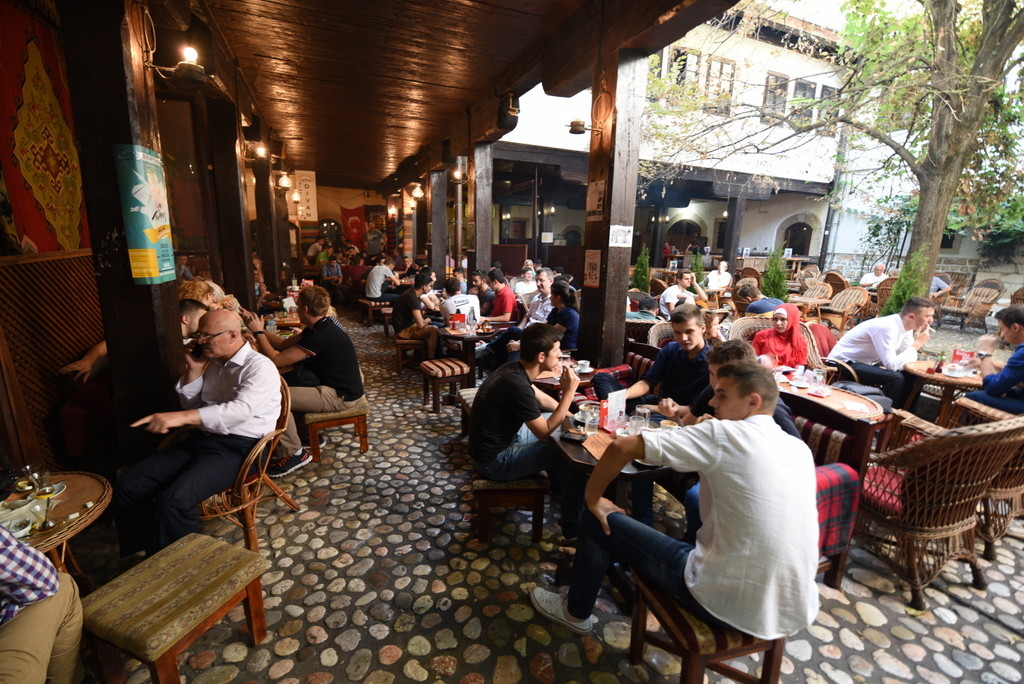
We settled into a rickety table in a cozy, cobbled caravansary courtyard. When the coffee arrived, I was ready to slam it down. But Amir reminded me that Bosnian coffee punishes those in a hurry…with a mouthful of gritty grounds.
He patiently talked me through the procedure — and, more important, the philosophy — of Bosnian coffee. “There’s no correct or incorrect way to drink Bosnian coffee. People spend lifetimes perfecting their own personal ritual. But one thing everyone agrees on is that coffee isn’t just about getting caffeinated. It’s about relaxing. It’s about being with people you enjoy. Talk to your friends. Listen to what they have to say. Learn about their lives. Then take a sip. If your coffee isn’t strong enough, gently swirl your cup to agitate the grounds. If it’s too strong, just wait. Let it settle. It gives you more time to talk anyway.”

Reaching the bottom of my cup, I remarked that the grounds had left no residue at all. “When it’s done properly,” Amir said, “you’ll never taste the grounds. If you find a layer of ‘mud’ in the bottom of your cup, it means that someone — either you or the person who made the coffee — was in too much of a hurry.” (So I guess that technically, there is an incorrect way to drink Bosnian coffee.)
Looking around the courtyard, Amir said, “This is a good examples of merak. Merak is one of those words that you cannot directly translate into English. It’s more of a concept. It means, basically, enjoyment. This relaxed atmosphere among friends. It’s when you’re nursing a cup of coffee with nowhere in particular to go — savoring the simple act of passing the time of day.”
Amir explained that the Bosnian language is rife with these non-translatable words. Another example: raja. “Raja means a sense of being one with a community,” Amir said. “But it also means frowning on anyone who thinks they’re a big shot. It’s everyone knowing their place, and respecting it.” In American terms, Raja is what prevents you from being the jerk who shows up in a convertible and a tux to your high school reunion.

But my favorite Bosnian word of all is ćejf (pronounced “chayf”).
Ćejf is that annoying habit or ritual you have. It’s the unique little quirk that drives your loved ones batty. And yet, it gives you pleasure. No, not just pleasure: deep satisfaction. In traditional Bosnian culture, ćejf is the idiosyncratic way someone spins his worry beads, the way he packs and smokes his pipe, or the very particular procedure she has for preparing and drinking a cup of Bosnian coffee.
In American culture, we have ćejf, too. We just don’t have a word for it. Maybe you have an exacting Starbucks order that mystifies your friends, but tastes just right. (“Skinny one-pump vanilla split-shot latte, extra hot.”) Or every weekend, you feel compelled to wash and detail your car, or mow your lawn, or prune your hedges…just so. Or maybe it’s the way you keep your desk organized, according to a special logic that only you fully appreciate. My own ćejf is probably the way I tinker with my fantasy football lineup. (Should I start Jordan Howard or Latavius Murray this week?) Or the way I chew gum when I’m stressed out: Exrta Polar Ice flavor, always two sticks…never just one.
In our culture, people call this behavior “fussy,” or “O.C.D.”…or, simply, “annoying.” We’re expected to check our ćejf at the door. But in Bosnia, they just shake their head and say, “What are you gonna do? That’s his ćejf.” You don’t have to like someone’s ćejf. But — as long as it’s not hurting anyone — you do have to accept it. Because everyone has one. What’s your ćejf?
Another Muslim moment that sticks with me came in Morocco. I had just sailed over from Spain to Tangier, setting foot in Africa for the first time. My tour guide, Aziz, brought me to a restaurant where we sat down to a hearty lunch. I’m self-conscious about the very clumsy, very American way I use my knife and fork: Grip the knife in my right hand to cut, then drop it and pick up the fork to eat. I’m jealous of my suave European friends, who deftly use their left-handed fork and right-handed knife, in concert, to eat like pros.
But here in Morocco, Aziz watched me very closely as I ate, a smile slowly spreading across his face. Finally, he blurted out, “I love the way you eat! So respectful.” In Aziz’s culture, the left hand is considered dirty — traditionally used for cleaning yourself — while the right hand is used for eating. By transferring my fork to my right hand, I was — unknowingly — being a very good Muslim.
Traveling in the Muslim world has changed me. And not just by opening my eyes to a beautiful faith — in little ways, too. Thanks to Islam, I force myself to slow down a bit when I get coffee with friends. I’m more forgiving of my loved ones’ little quirks. And I unapologetically grab my fork with my right hand.
When you travel, you figure out where your minuses become pluses, and vice-versa. You pick up new ideas and discover that you fit better into a larger world. With the stroke of a pen, President Trump just made connecting with Muslims much more difficult. Let these stories be a gentle reminder that the world can be an immeasurably rich place…but only if we’re open to it.
God bless America. And may peace be upon us.
What a beautiful and profound example of the many beautiful ways travel changes us for the better. Thank you for sharing your experiences.
Thanks for sharing your experiences, Cameron. I haven’t traveled to a Muslim country yet and your positive perspective inspires me. Your encouraging words are a welcome relief from the mean-spirited focus this week.
Thank you Cameron for a wonderful piece – both on coffee in Bosnia and the tragedy of narrow-mindedness. I am so looking forward to my Adriatic Tour this Fall followed by a week of visiting Montenegro and Sarajevo.
When we traveled in Turkey and Malaysia, 2 Muslim countries, albeit very different, we had very positive and wonderful experiences.
I am refusing to sink into despair about what is going on in our Nation, rather I see it as hopefully a wake up call for us to be more involved to bring about a greater awareness of all things that we share as human beings, regardless of race, color, religion, or nationality. Basically what traveling is best for!
What a good article. I have had positive experiences visiting both Egypt and Turkey In 2010. Like most facets of life when you show respect for Muslim customs such as Ramadan you in return are treated with respect. The world needs more of this.
Thank you so much for this article. It reinforces my belief that people on mainstreet and backstreets around the world just want life, liberty, and the pursuit of happiness regardless of race, religion, national origin, and culture. We can learn new things from all these people.
Makes me want to get on a plane today!
Interesting article, Cameron. I use Rick Steves travel books whenever I travel in Europe. The books are excellent!
I completely disagree with your assertion that “Donald Trump’s vision is highly selective”. There can be no dispute that on 9/11 we were attacked by radical Muslims. The San Bernardino shooters were also radical Muslims. The common denominator here is that neither group was truly “vetted”. How do you vet someone who comes from a country with a government in complete disarray (Syria)? How do you vet people coming from nations that do not have the equivalent of our NSA?
I have traveled extensively in eastern Europe – most recently in Kosovo and Serbia. I have also been deployed with the US Army to the combat zones of Kuwait and Afghanistan. I have had the opportunity to interact with many Muslim folks – 98% of which are great people.
Our current President, unlike his predecessor, takes security seriously. I completely disagree with folks who label his efforts “mean-spirited”, “narrow minded”, etc. They are none of those. Guess what people? There are people from other parts of the world who wish to kill us simply because we are not like them!!
I will continue to travel to eastern Europe and elsewhere. However, I am proud that we are taking steps to protect Americans
Chris, thank you very much for your comments. I honestly respect someone who can offer a thoughtful response (and informed by a life of actual on-the-road experience, no less!) to a hot-button issue. Your thoughts are well-reasoned and constructive. (Sadly, many Trump/ban supporters quickly default to name-calling, which accomplishes nothing.) So I’d like to respond to your comments with a similar thoughtfulness and respect:
I agree wholeheartedly that the US can, should, and must protect its citizens. And yes, absolutely, I am not naive to the fact that many people outside our country (including some Muslims) wish us harm.
I’m offended by the ban because, first, I think it accomplishes exactly the opposite of “keeping us safe” (can you imagine a more effective recruitment tool for ISIS?). And second, it’s structured in an utterly bizarre way for something designed to prevent terrorism. The seven countries it covers (Iran, Iraq, Libya, Somalia, Sudan, Syria, and Yemen) simply don’t line up with available evidence about the sources of greatest threat. You mention San Bendardino. One of those terrorists was born in the United States of America. The other was born in Pakistan. This ban would not have prevented San Bernardino. Nor would it have prevented 9/11–not a single one of those terrorists was from any of these seven countries. In fact, not a single American has been killed on American soil in any terrorist event committed by someone from one of these seven countries. (And by the way, Syrian refugees are already subject to a staggeringly thorough, 20-step vetting procedure before being allowed to set foot in the United States.) Also, I’m sure you are aware that Rudy Giuliani bragged on Fox News about how Trump had asked him how he might legally enact a Muslim ban. So you’ll forgive me for being suspicious of Trump’s true motives here. Is this ban “keeping us safe”? Or is it part of a campaign to trump up anti-Islam paranoia in the USA, setting the stage to escalate into even more drastic measures?
By the way, according to some experts, Americans are several times more likely to be murdered by white supremacists and militant nationalists than they are by Islamic terrorists. (One of them shot up a congregation of people praying in Charleston, South Carolina. Another just opened fire at a mosque in Quebec.) If President Trump really worried about keeping Americans safe, he’d send the FBI on raids into known white supremacist terror cells.
That’s what I mean by “highly selective.” The president is selecting to focus on Muslims as a threat to Americans; he’s selecting an extraordinarily narrow view of Islam’s role in the world; and he’s even hand-selecting seven Muslim countries (to which, coincidentally or not, he has no business ties).
Keep America safe? Yes, absolutely! I’ll sign up for that in a heartbeat. But if you study the facts, this measure is not the way to do it.
The sad thing about this for me–and the point of my article here–is that many Americans have not had personal experiences with Islam, so they are taking the word of President Trump (a man who has repeatedly proven himself wholly untrustworthy). I honestly believe that if more people spent time in a Muslim country, it would humanize the people that our president is so cynically demonizing.
Lest you forget, Chris, it was President Obama’s team, including Secretary of State, who caught the criminals. Most of us get along. Try to remember this is not a competition, but life.
Cameron, and Rick by extension, I really appreciate your ‘We’re all in this together’ attitude. My family traveled all the time we were growing up, and I’ve always had friends of multiple backgrounds. Life would be rather boring were we all the same. Unfortunately, I cannot convince some members of my family. I keep hope because I’ve met so many good people and intend to keep traveling for the rest of our lives.
Cameron, thank you for your thoughtful and thought provoking article. I really believe you captured the spirit of why we love to travel regardless of your political affiliation. My wife and will be traveling to Croatia and Bosnia this year and plan staying in Mostar. I must admit I was somewhat concerned about staying in a Muslim country but your experiences have put me more are ease. I wholeheartedly believe that as a nation we need to be diligent about security but also not be afraid to explore and learn about other cultures.
Dan, glad to be of help. You should have no concern whatsoever about traveling in Bosnia. One of the great ironies of these recent events–where the USA has become so inhospitable to Muslims–is that in Muslim culture, a visitor possesses a place of honor as a gift from God. I find Muslim countries (including the Muslim areas of Bosnia) to be some of the most hospitable and welcoming places anywhere. Happy travels!
It is a privilege to be able to travel to other countries with different customs, histories and religions from my own. My trip to Turkey included being seated next to a blonde Jewish lady from Istanbul. In Egypt our guide was Muslim with very strong political views that he freely expressed to his American travelers. The children we met all wanted to practice their English and were very respectful. As a Christian I have friends of different faiths and we owe it to all of us Americans to be as positive as we can of the history and backgrounds of those who wish to immigrate here. We should not have an open door policy. Realistically and historically we realize there are people who wish to come to America to harm us, to change our values and customs and to harm and/or destroy us. Our country needs to be secure for all its CITIZENS.
I think Chris’s post is the most lucid and intelligent argument for “the other side” of the travel ban argument that I’ve seen yet, although I would take issue with some of the conclusions. No doubt the vetting process has some loopholes and probably needs serious re-thinking. However, would it be that attractive to terrorists looking to infiltrate the country via the refugee route given that there’s an extensive vetting process, however faulty that may be, already in place for them to contend with? Certainly there are easier ways to get into this country. And the fact is that the great majority of refugees are the victims of terrorism, not the perpetrators. I think Trump’s views on this subject amount to nothing more than “fear mongering”. He would like you to believe that if it wasn’t for this travel ban, a bunch of “bad dudes” would suddenly be able to rush into the United States. He knows very well it does not work this way. I think we probably all agree that more steps need to be taken to protect the safety of the America public, but are these the right steps? Home grown terrorism presents a far greater threat than that of ISIS operatives infiltrating through refugee ranks. As such, does it not play right into the hands of ISIS by instituting what is widely perceived not only by the US but by the entire world as a “Muslim ban”, regardless of the spin the White House tries to put on it? Heck, they even recently told us not to call it a “ban” at all. Does such a ban not do more harm than good in fostering that dangerous “us vs them” mentality in poorly assimilated Muslim communities in the US that may be more vulnerable to the threat of radicalization? It is primarily for those reasons that I see the ban as dangerous, ineffective, and an altogether inadequate means of addressing the underlying reason for radical Islamic terrorism in the US that we face today.
Thank you! Wonderful article!
yes, through traveling, we can learn and understand more about each other’s culture and to bring us to live a more peaceful world in our planet.
Cameron,
Would you address what you saw, heard or felt regarding the Muslims you encounter and their thoughts on Israel? I read many accounts of signs reading Death to Israel throughout the the Muslim world. How rampant is that feeling amongst the average Muslim?
I guess I’m not a good enough person to warrent an answer to my question.
Hello Malinda. No worries. I am sure you’re a sufficiently good person…I just haven’t checked my comments in a while.
To answer your question: Nobody I have met in the Muslim world has specifically criticized Israel to me. However, I have no doubt that there is a general sense of frustration with the way that Israel treats its Palestinian population (as there is in much of the rest of the world). The “Death to Israel” signs you may hear about are an extreme example of that sentiment. After filming a TV show in Iran, Rick realized that “Death to…” is a fairly standard, not necessarily literal curse in Muslim culture. It’s the way people regard something that angers them, over which they have no real power to change. (Like when you say, “Damn those teenagers!”, you don’t literally want them to burn in hell for eternity…just turn down the music.)
So, yes, I have no doubt that there is a general anti-Israel sentiment in many Muslim places. But I don’t think it’s driven by, or drives most people to, violence. And in my experience, it’s not something that people think about 24/7–just a background irritation, the way we may have resentment for a political figure or a rival sports team. And of course, if you really want to understand it, it’s worth asking why that sentiment exists.
Let’s be intellectually honest here…. Trump did NOT issue a BAN! It is a 90 day ‘pause’ so that the Fed’s can get their s#1t together on establishing meaningful criteria for people coming from these countries. Furthermore, 95% of Muslims in the world are completely unaffected by this! If you want to spin, I suggest getting in your clothes dryer!
Semantics, Mike. Donald Trump’s press secretary initially referred to a “ban” and that is the way it is widely perceived. He has even been taken to task for referring to it that way when later on the administration rejected the term. Frankly, I don’t think it matters one bit what anyone calls it. It effectively serves the same purpose whether it’s got a more politically correct label on it or not. The perception by the majority becomes the reality. I’m all for scrutinizing the measures we now have in place to protect against any threat, however slight, that radicalized Muslims will attempt to enter the country through this route, as long as it is done effectively, thoughtfully, and avoids the potential of doing more harm than good. That dangerous “us vs them” mentality here at home breeds the evil we are trying to stamp out. We just need to be careful, thorough, and cautious about what we do and say here. These are three attributes that one cannot, after 30 days in office, reasonably assume that Trump is possessed of.