In early 2020, I was very excited: We were going to make travel TV in Iceland!
For the first time, Rick Steves’ Europe was set to film two brand-new episodes on the land of ice and fire, for the upcoming Season 13. Rick and I had worked hard on the script, brainstorming wonderful little Icelandic experiences — both grand and intimate, from cinematic glaciers to cute puffins, and from steaming volcanoes to funky back-streets Reykjavík. Producer Simon Griffith was hard at work making arrangements and getting filming permissions from the national tourist board. And camera operator Karel Bauer was all lined up to join us for the two-and-a-half-week Icelandic road trip. It was sure to be an epic adventure…and a fantastic show.
And then, of course, it didn’t happen.
All through COVID, when Rick and I would check in, we’d promise each other that we’d head to Iceland as soon as we could. But it took some time: There was a pandemic to weather; a travel company to keep alive; and then, when things finally opened up, two years of backlog to catch up on.
But finally, in early 2023, the time came to resurrect our Iceland plans. Rick and I dusted off the script, Simon began to reach out to our Icelandic contacts, and Karel started practicing his drone skills. At long last, we were heading to Iceland.
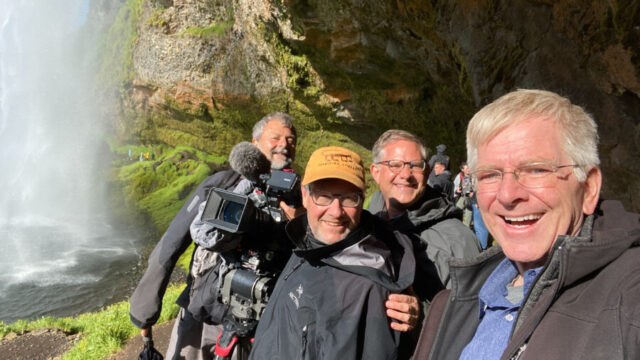
Pre-Production: “It’ll All Work Out”
But first, we had to make arrangements. And if I’m being honest, Iceland didn’t make things easy. It may be a tiny island — with fewer than 400,000 residents, about the population of Honolulu or Cleveland — but it’s extraordinarily popular. We’re a scrappy little public television crew of four people, making the most of a modest budget. But Iceland is accustomed to multi-million-dollar Hollywood productions, with casts and crews in the hundreds: Game of Thrones, various Star Wars installments, and anytime producers need someplace desolate to stand in for a faraway planet (Prometheus, Interstellar, and so on). It quickly became clear that even if Iceland is a fairly small pond, we were minnows… not whales.
For our July shoot, we figured making plans in January would give us plenty of lead time — which it would be, for any other location. But Iceland’s tourist season is as short as it is intense, and we were landing right at its busiest point. Even several months out, we struck out finding three or four available hotel rooms in some of the remote corners of the Island. Scrambling a bit, we eventually managed to secure accommodations…just barely, in some cases booking the last few beds we could find online.
Iceland’s tourist board connected us with a wonderful local fixer, Sunna, who began reaching out to the many locations where we hoped to film. But progress was slow…too slow. As the shoot approached, we voiced our concerns to Sunna and other Icelandic contacts: Would it all fall into place in time?
With a striking consistency, they all told us the same thing: Don’t worry! It’ll be fine in the end. Sunna explained that this is something of a national motto: Þetta reddast…literally, “It’ll all work out.” I had heard this phrase from time to time during previous visits to Iceland. But now we were living it.
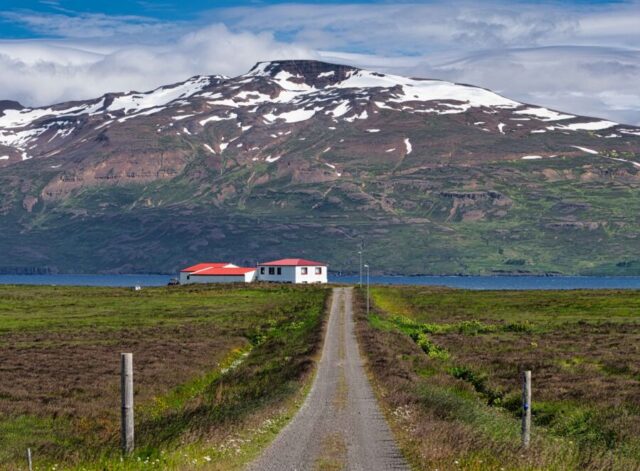
And it makes sense: Iceland has always been a true frontier. The elements are harsh; the winters are long and unforgiving; the landscape itself is constantly trying to kill you, with volcanoes or hissing steam vents or glacier avalanches or sneaker waves.
And yet, the Icelanders — those quintessential pioneers, descended from Viking Age settlers who took it upon themselves to tame an uninhabited, seemingly un-inhabitable land — have learned to persevere. Icelanders have no choice but to be flexible, to take things as they come, and to help each other out as needed. One way or another, things work out.
Simon and I — after many stressful weeks of false starts and hurry-up/wait — tried to take this assurance to heart. And in the end, Iceland rewarded our leap of faith. Things did work out, wonderfully. We appreciated this motto, and philosophy, so much that we made sure to film one of our Icelandic friends explaining it to Rick: Þetta reddast.
Reykjavík: I’m Soakin’ Local!
In the waning days of June, we convened in Reykjavík to begin filming our Iceland special: producer Simon, camera operator Karel, and (soon after) Rick. We used our first couple of days, before Rick’s arrival, to run around the city — and into the countryside — to film some b-roll: footage to illustrate what we described in our script.
On our night of arrival, howling rain flung frigid rain sideways, instantly soaking head-to-toe anyone foolish enough to set foot outside. It was instantly, painfully clear: Even being here in the “peak of summer,” working around the weather would be our biggest challenge.
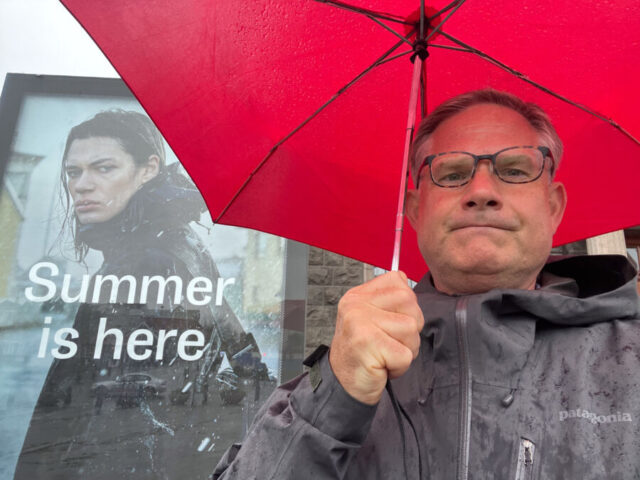
I got so drenched on my first day in town, I headed to an outdoor outfitter for some extra rain gear. The sales clerk patiently explained (as he clearly had to hundreds of tourists before me) that that “waterproof” is a spectrum, not a binary. A proper pair of truly weatherproof rain pants would cost me upwards of $250. (Instead, I bought an $80 pair, figuring it was better than nothing.)
We scrambled around Reykjavík, chasing sun breaks in a desperate attempt to make this wet city look as pretty as possible. We lucked into a rare bit of blue sky to show off the landmark Hallgrímskirkja and Iceland’s parliament square — only to have dark clouds close in just as we were wrapping up shooting.
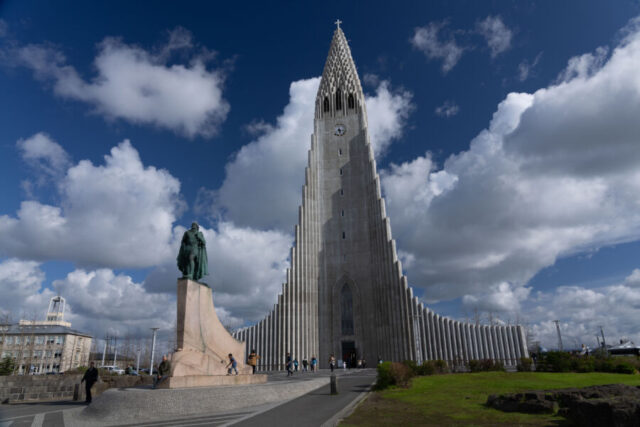
At one point, when sunbeams gave way to a deluge in a matter of 30 seconds, Simon muttered, “Forget about four seasons in one day…this is four seasons in one block!” This resulted in one of my favorite sequences in the show, as Rick says, “This is Iceland in July” (showing people sunbathing in lawn chairs). “…And so is this” (showing wet people miserably bundled up in Gore-Tex parkas).
Once Rick arrived, we continued our do-si-do around the weather. We scouted scenic locations where Rick could film his “on-cameras” (talking directly to the viewer).
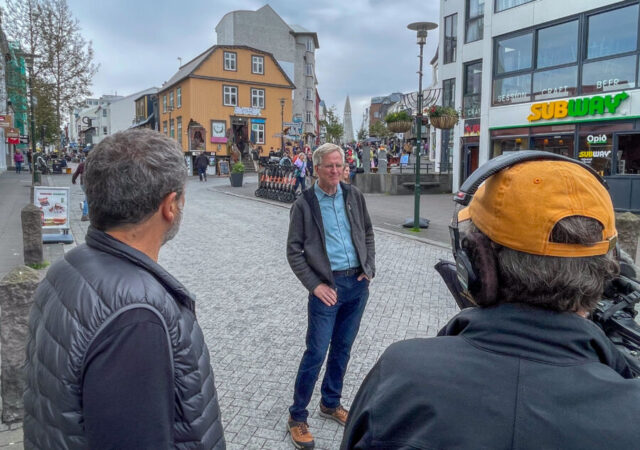
We also planned to film a segment with a local guide, who could help Rick (and our viewers) better understand the distinctive lifestyle. Our goal was not simply to wallow in well-trod Icelandic cliches, but to offer real insight into what makes Icelandic culture unique.
Saga, who runs a tour company called Viking Women, joined us on a Saturday morning to guide Rick through the downtown flea market. When she showed him some Icelandic sweaters, his enthusiasm seemed hammed-up for the cameras. But it turns out, it was totally genuine; he even bought a sweater to take home (which left Simon’s jaw on the floor, as Rick almost never buys souvenirs). Rick explained that he has fond childhood memories of visiting relatives in Norway, which left him with a lifelong affinity for Nordic woolens — especially ones with pewter buttons.
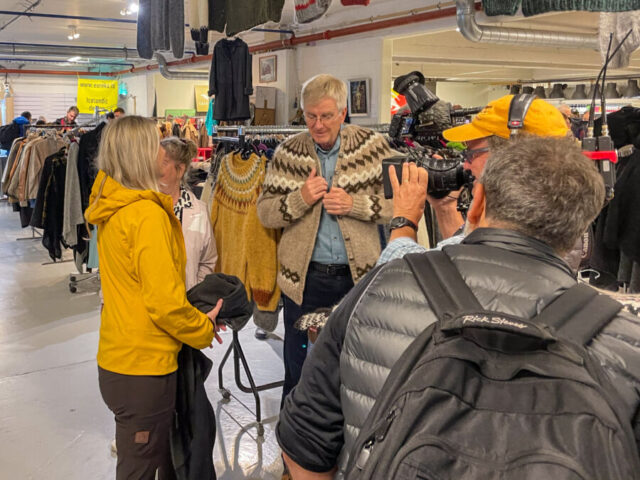
Then we headed to the fish counter, where Saga encouraged Rick to sample some local specialties: dried-cod jerky (harðfiskur) and, of course, Iceland’s notorious fermented shark (hákarl) — which tastes like rotten fish with a pungent, lingering ammonia aftertaste. From behind the camera, Simon, Karel, and I were astounded, knowing that Rick had just the night before suffered through a nasty stomach bug…and now was going back for second and third takes on a bite that’s hard to choke down even when you’re feeling tip-top. He’s a true pro.
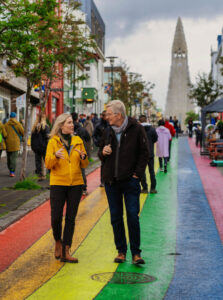
Then Saga and Rick strolled together through the back streets of Reykjavík. Hitting each point on our “wish list” for this interaction, Saga taught Rick a little Icelandic; showed off some street art, a Reykjavík specialty; explained the brightly painted, corrugated “iron” cladding that Icelanders wrap their homes in; and pointed out the many propped-open windows, which Icelanders use to keep the air moving when things get stuffy (thanks to the abundant natural geothermal energy they use for heating). It wound up being one of the best — and longest — segments in the show.
One item that didn’t work out quite as planned was the Blue Lagoon. That famous lava-rock spa is a touristic icon of Iceland. But we were torn: While the Blue Lagoon is an unforgettable experience, it’s also extremely expensive and almost entirely frequented by tourists. In our Iceland guidebook, we explain that most Icelanders skip these fancy “premium” spas and instead go for a dip at their community swimming pool — fed by natural thermal springs, just as hot as the Blue Lagoon, more fun and interactive, and about one-tenth the price.
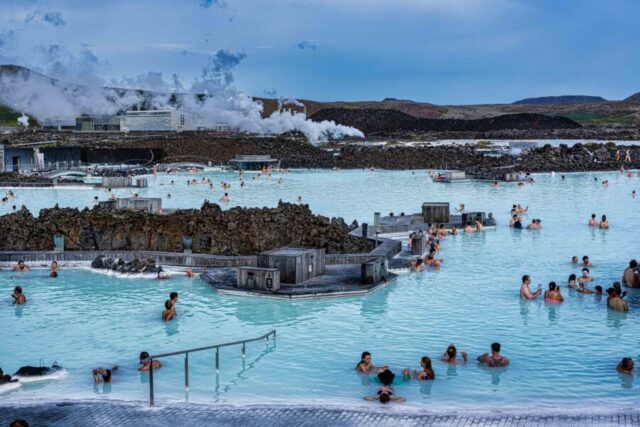
Originally, we thought we’d film Rick in both settings, to illustrate the range of options. But the Blue Lagoon turned out to be the most restrictive location on our list. When they finally responded to our many requests for permission, they were (understandably) concerned about the privacy of their many paying customers. Therefore, Rick could be swimming in one distant corner of the Blue Lagoon, cordoned off and with zero interaction with other bathers.
Meanwhile, we’d also made plans to film Rick at a very local-feeling pool in suburban Reykjavík, called Árbæjarlaug — my favorite of the half-dozen or so pools I’ve tried in the area. (TV scouting is hard work…but someone has to do it.)
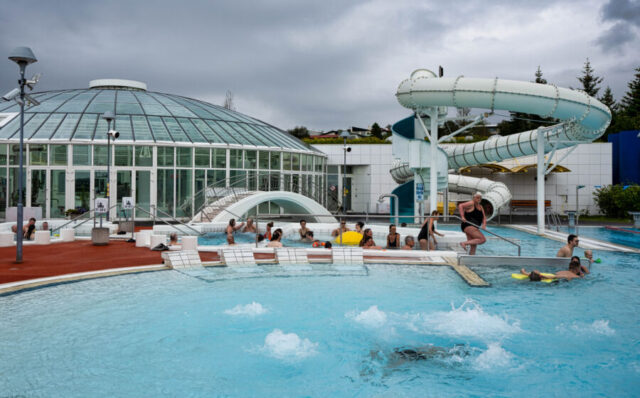
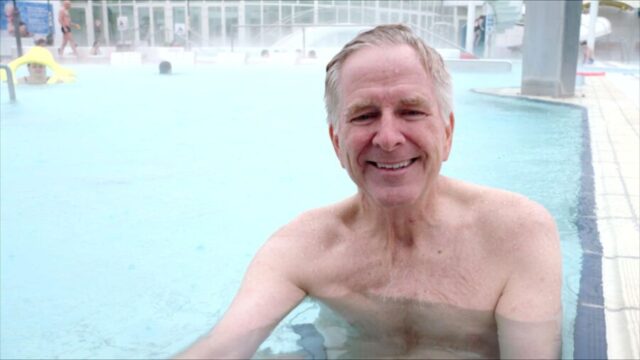
Upon arrival, it was clear that we were the only out-of-towners at the pool — not just that afternoon, but very likely the entire week. It was ideal for showcasing this unique facet of Icelandic life: Rather than heading to the neighborhood pub after work to gather with friends and family, Icelanders convene at a thermal pool. Rick and I got in, splashed around, and made some new friends, while Simon and Karel dutifully filmed. (As if on cue, just as Rick and I slid into the hundred-degree water, the skies opened up in a frigid, pouring rain. Imagine the contrast: Rick and I, swimming around with the Icelanders…piping-hot and soggy; Simon and Karel, huddling under a giant umbrella, desperately trying to keep the camera dry…freezing cold and soggy. We definitely owed them one.)
To cap this experience, Rick came up with a line to say into the camera — submerged up to his shoulders, positioned next to a waterslide with giggling kids. He explained the difference between premium spas (like the Blue Lagoon) and the neighborhood-pool option, finishing with the line, “And today, I’m soakin’ local!” (“I’m soakin’ local!” instantly joined Þetta reddast as our official motto for the shoot.)
With all of this wonderful interaction in the can, we realized we didn’t really need to show Rick luxuriating in the Blue Lagoon after all. We’re not shills for private attractions; rather, we’re advocates for travelers, equipping them with a sense of their options so they can make the best decision for their time and budget. So, one evening, we zipped out to the Blue Lagoon to shoot it from a distance, just to acknowledge it, but kept most of our coverage focused on the local pools. In the end, things worked out for the best. As they say… Þetta reddast.
Into the Countryside: Golden Circle, South Coast, and the Westman Islands
Work done in Reykjavík, it was time to head for Iceland’s big draw: its stunning countryside. Up until this point, we’d been dodging bad weather; if you watch Rick’s back-streets Reykjavík tour with Saga, you’ll notice they’re both drenched to the bone. While not ideal, this was acceptable for in-city sightseeing. But we were counting on bright, sunny skies to properly showcase Icelandic natural beauty at its finest. And on that count, we got very lucky: Right around the time we left the capital, the weather shifted, bathing us in sunshine for nearly the entirety of the shoot.
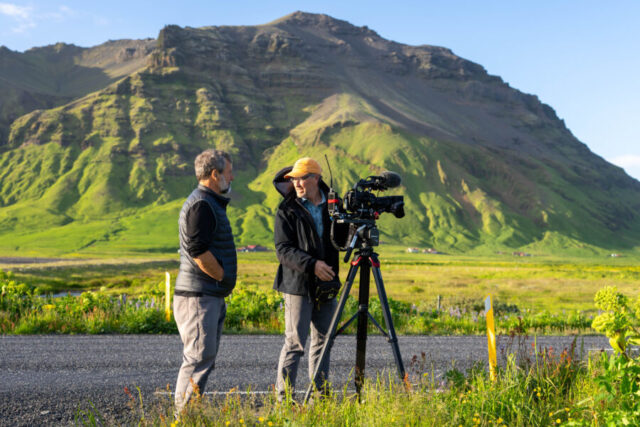
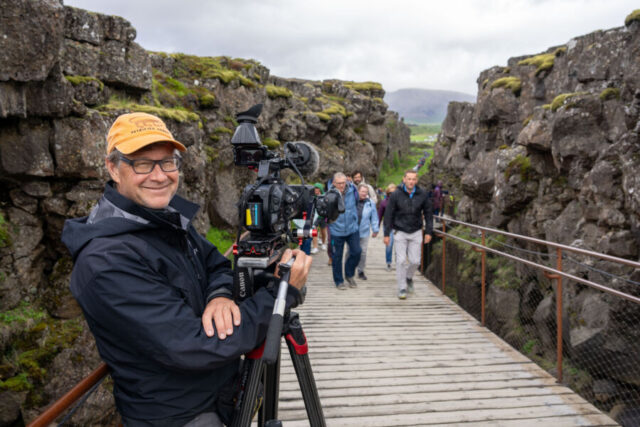
We drove the full Golden Circle (Reykjavík’s most popular side-trip) twice, on two separate days, to cover it well: the national park at Thingvellir (with a gorge that illustrates the tectonic fissure between Europe and North America); the simmering geothermal field at Geysir; and the thundering waterfall, Gullfoss.
Gullfoss was also the location of a particularly memorable mishap. We knew that Karel’s drone would be a must — to capture that epic scenery from a bird’s-eye view. We’d dutifully jumped through the administrative hoops (with Sunna’s help) to make sure we were legal. Before the trip, I read several warnings about the difficulty of using a drone in Iceland, due to the near-constant high winds. But we’d figure it out… right?
We wrapped up a very long day filming the Golden Circle at the epic Gullfoss waterfall, which tumbles into a narrow, dizzyingly steep gorge. This seemed the perfect occasion to get some aerial views using our drone. Karel set it up and took off, zipping high up to capture unbelievably dramatic footage looking down over the falls and canyon.

But then, within moments, the controller began to fire off multiple, simultaneous warnings: First, a “High Wind Warning” popped up on the screen. And then the “low battery” signal began to beep insistently. “Hm, that can’t be right,” Karel said, as Simon and I looked on nervously. “The battery was at 100% when I sent it up.”
To keep the camera steady, the drone makes constant, minute adjustments for the wind. And in Iceland, the wind blows so hard, and so erratically, that the drone’s battery was being drained at a dizzying rate simply to stay stable and airborne.
“Can you get ‘er back?” Simon asked, calmly as he could.
“Maybe,” Karel said. “She’s fighting me.”
We watched helplessly, holding our breath, as the distant, blinking light in the sky struggled to return to us — now heading directly into the battering wind. As the “low battery” alarm reached a critical point, Karel said, “It won’t make it back here, but I think I can drop it on the far side of the gorge.”
Yes, the gorge. We were on one side of the gorge below Gullfoss. And our drone was quickly descending on the far side.
“It’s down,” Karel said, finally. “But I think it’s OK.” We squinted through the waterfall mist and spotted a couple of twinkling lights, in the distant scrub. It was the drone. Not here with us, unfortunately. Not being rushed away by the waters of the Hvítá river far below us, fortunately. But on the opposite side of the gorge…quite inconveniently, just a few hundred yards right in front of us, but possibly unreachable.
“Can we get over there?” Simon asked. I was already on it, panning-and-zooming on Google Maps on my phone. It did appear that we could drive along one bank of the gorge; cross over to the other side; drive back on unpaved roads along the far side; and maybe… possibly… conceivably get to a place where we could park and hike to where we thought the drone had landed. I dropped a pin at its presumed location, we headed back to the car, and we set out.
The drive itself took close to 30 minutes — much of which was along unpaved, jagged gravel roads that pressed our two-wheel-drive car to its limits. We parked where the road ended and headed out on foot toward that dropped pin at the edge of the gorge, with the waterfall’s mist rising from the horizon.
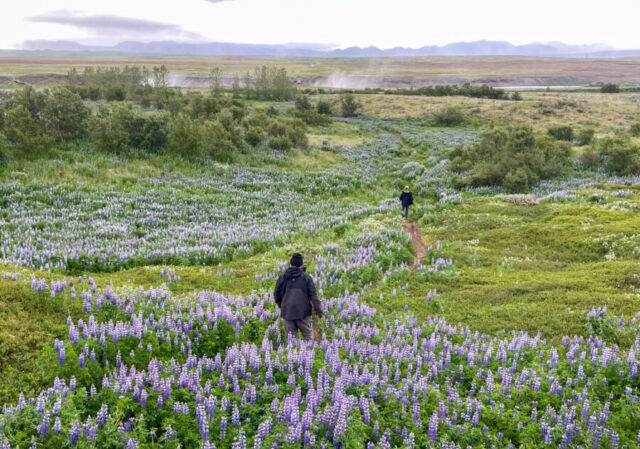
And as we walked, something beautiful happened: We realized we were traipsing through a stunning corner of unspoiled Icelandic nature. We were following a very old, virtually unmarked footpath — one that, clearly, exceedingly few hikers used. It curved between gloriously colorful fields of purple lupine flowers, over rocky but passable terrain, under a big sky.
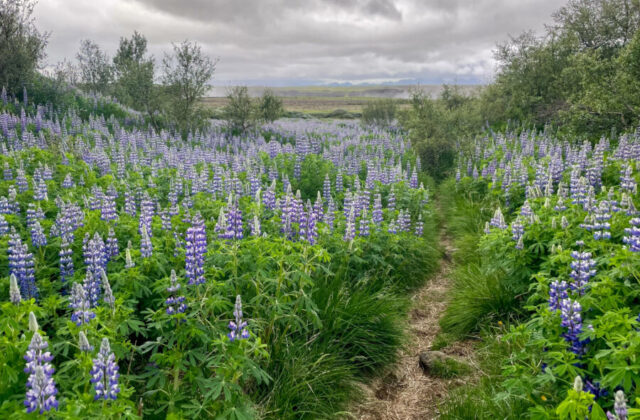
We’d had a very long day’s work, so we were tired — but that also came with a sense of deep satisfaction. Whether or not we retrieved the drone, it had been an amazing day. And this unplanned hike through a stunning landscape was a bonus, which may or may not terminate at a treasure. It felt like a true adventure.
As we approached the edge of the gorge, Karel’s pace quickened. He began to almost run. And then, sure enough, hidden among rocks, there it was: the drone, intact, in one piece, battery depleted but fully functioning.
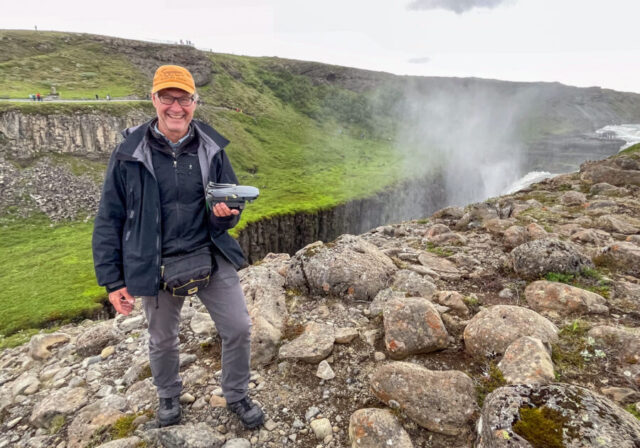
Better yet, we were standing directly across the gorge from where we’d started, a good 45 minutes earlier — enjoying a completely different view of Gullfoss and its canyon that 99.9% of tourists will never see.
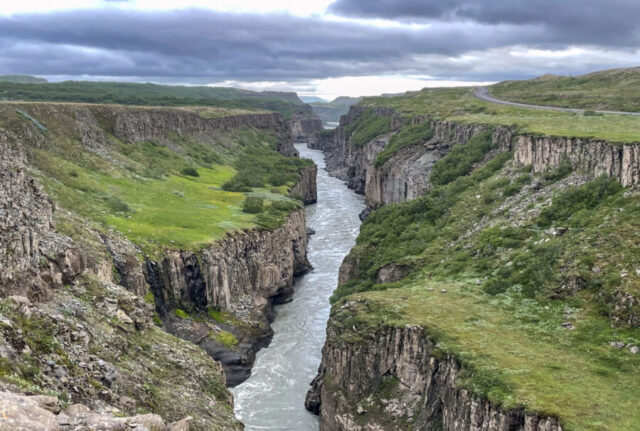
That experience taught us a few things about filming in Iceland. First, you must respect nature, here as nowhere else. We attempted to use the drone a few more times, and each time, the “low battery” light would kick on much faster than we expected. (And on future flights, Karel was much quicker to bring ‘er on home.)
But it also reinforced the idea that things work out as they should. We hadn’t planned for that extra drive and hike at the end of an already very long day. We returned to our hotel much later than we’d have liked. But in the end, we came away with a glorious memory. Once again… Þetta reddast.
The errant drone was the biggest of just a few bumps we’d encounter on what turned out to be, by and large, a smooth shoot. The weather began to cooperate, and Rick and I had the wonderful experience of turning all of those big ideas about how to share Iceland with our viewers into reality.
One thing Rick was especially excited for was Thórsmörk (literally, “Thor’s Woods”) — a stark glacial valley accessible only by Super Jeep. We loaded into a monster truck, and our driver expertly forded several glacial rivers as we bounced around in our seats. It is, I believe, the first and only “off-road” experience ever filmed for Rick Steves’ Europe.
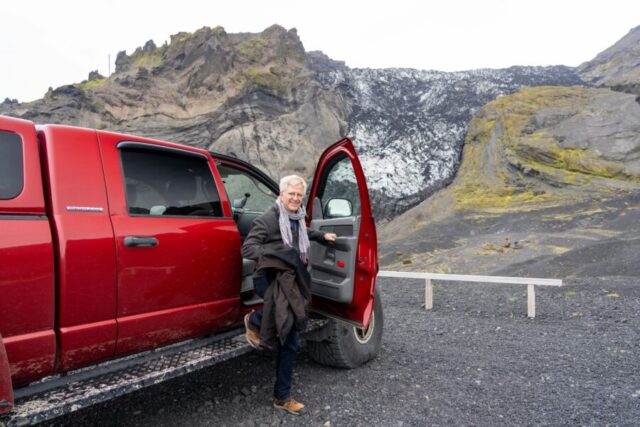
We visited the stunning Seljalandsfoss, Iceland’s most glorious bridal-veil waterfall, on a particularly fine day — with bright blue skies and sunbeams casting rainbows on the mist. And we filmed at the famous black-sand beach of Reynisfjara, just before howling winds kicked up a sandstorm.

On our final day with Rick, we enjoyed an epic all-day trip to the Westman Islands — a volcanic archipelago just off the South Coast. While Iceland is well discovered, these islands are the closest thing to a “Back Door” — frequented by a manageable number of in-the-know travelers, and within day-tripping distance of the capital (by plane) or South Coast (by boat).
In one very busy day, we wanted to tell the Westman Islands’ volcanic story — a dramatic 1973 eruption just above the main town — and show off its abundant bird life, especially puffins. Our guide and sidekick was Ebbi, who along with his wife, Íris, runs a local tour company, Eyjatours. With Ebbi’s and Íris’ help, we were able to pack everything in.
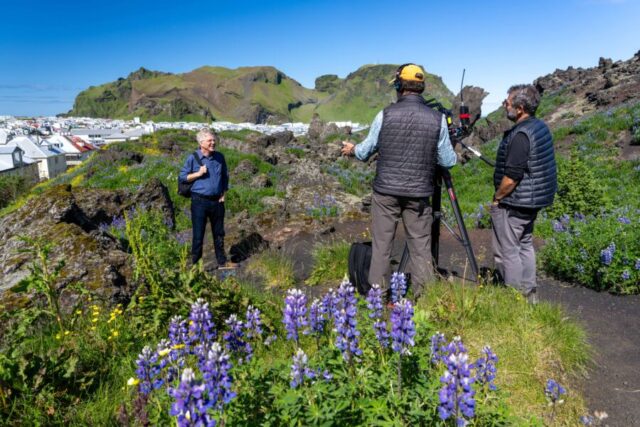
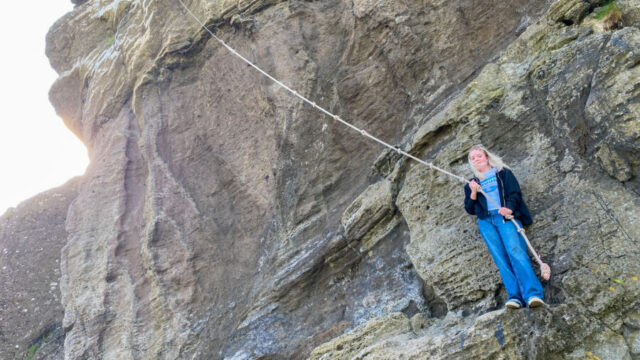
We wanted to show how islanders climb and swing on long, dangling ropes to reach bird nests perched in the crags of sheer cliffs. Ebbi normally demonstrates this for his tours, but we asked if he knew any local kids who might enjoy showing off their skills. Íris contacted a teenager named Aðalbjörg, who met us at the cliffs. Ebbi explained how islanders traditionally used these ropes to harvest sea bird eggs — a rare source of nutrition on this very sparse island — while, in the background, we watched Aðalbjörg swinging back and forth like Tarzan. It’s worth stressing that she was not “performing” for our cameras; young islanders are raised to swing on these ropes…even if, these days, it’s more for cultural heritage than for the eggs. In fact, while we were filming, a few young boys rode up on their bikes and — entirely unprompted by us — began swinging around on a smaller nearby cliff, just for fun.
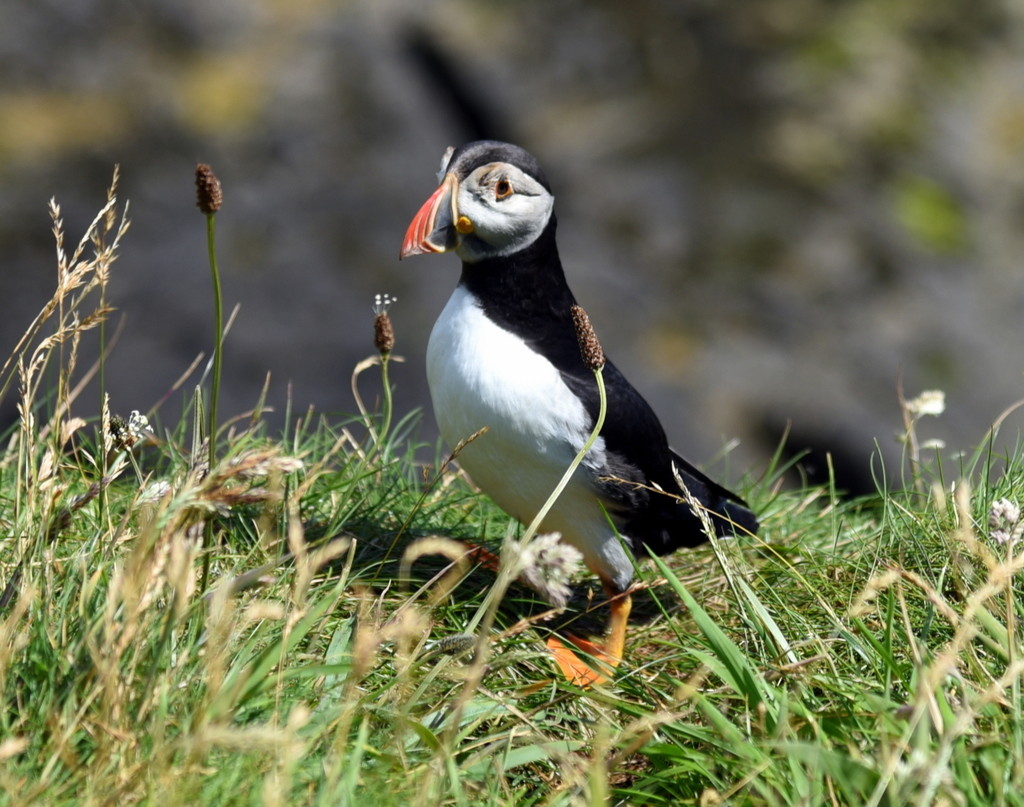
Then we drove out to the far edge of the island, to a green hillside where puffins roost. We sat on the grassy, hummocky hillside — looking out over the Atlantic — as Ebbi lovingly explained how migratory puffins spend their summers in vast numbers on these islands. We watched as adorable puffins careened through the air above us, then came in for an awkward landing.
“These hills are full of burrows, where puffins build their nests,” Ebbi explained. And just then, I heard a strange, almost otherworldly growling noise coming from below my butt.
“Ah,” Ebbi said. “I think you’re sitting on a burrow. There’s a puffin in there. I imagine he’s not happy.” Sheepishly, I scooted over a few feet, having had the new-to-me experience of irritating a puffin.
Returning to our mainland rental cottage late at night, we were thrilled at having captured the Westman Island and South Coast on film. And now, it was time to head out on the rest of the Ring Road.
The Ring Road: Europe’s Most Epic Road Trip
Back when we were planning this journey, we knew that — given the long distances, and our ambition to cover Iceland completely and thoughtfully — it would be a longer-than-usual shoot. For most 30-minute TV shows, Rick and the crew spend six days filming. For Iceland, we’d film two such episodes, which would also be combined into a one-hour special. But rather than the standard 12 days, we’d need closer to three weeks.
Rick is a very busy man. And much as he’d have enjoyed doing the entire trip, that was more Iceland than he had time for. Early on, we came up with a plan: He’d join us in Reykjavík and its key day trips, including the South Coast and Westman Islands. And then, for the rest of the Ring Road — driving all the way around Iceland — Simon, Karel, and I would set off on our own.
The question was: How could we explain this to viewers? Wouldn’t they notice that Rick simply disappears three-quarters of the way through the show? Or should we try to “fake it” — film some on-cameras in places that resembled the far corners of Iceland? (This practice is standard for some “travel” TV shows. I’ve been told that at least one host films all of their on-cameras in their own backyard, while the crew does the rest of the filming on location…hostless. But that’s not Rick’s style.)
Simon came up with a solution: We’d be up-front with our viewers, explaining that Rick was heading out — and instead, they’d be following along with me as I did my guidebook-researching rounds. (You’ll notice that, in every shot I appear in, I’m clutching my little black notebook and scrawling notes — a subconscious reminder of why I’m there.)
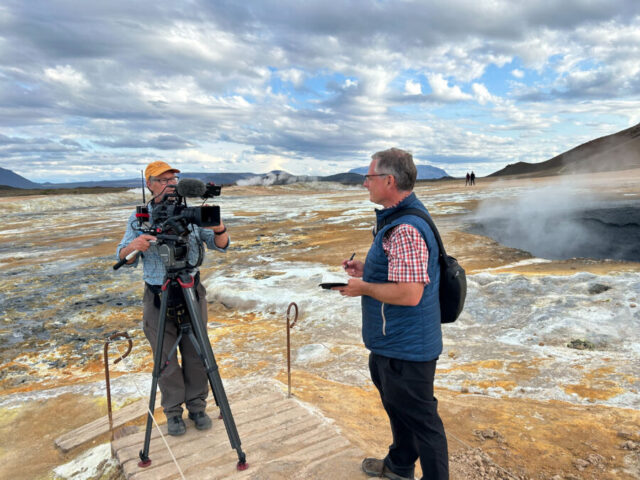
I was, naturally, extremely nervous about taking on this assignment — including having the camera pointed at me. But Þetta reddast, as always: It worked out beautifully, thanks to Rick’s generous and insightful coaching, and working with the best imaginable crew in Simon and Karel.
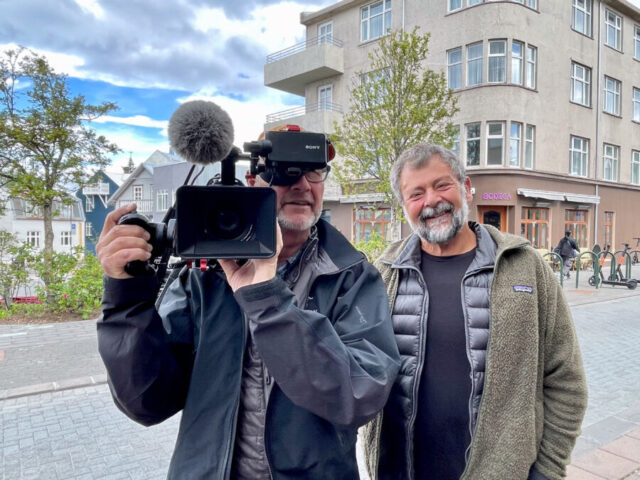
The three of us waved goodbye to Rick and hit the road, circling the entire island counterclockwise on the Ring Road. With Rick, we’d already covered over 100 miles of the Ring, from Reykjavík to Vík. That left nearly 700 miles to go — which we covered in six days. We had many four- or five-hour driving days in a row, interspersed with frantically busy bursts of filming natural wonders and fascinating folk museums, with mostly one-night stays en route.
This being early July, daylight was endless — making it easier to work and drive late into the evening, but all too easy to not even realize how tired we were getting until we were flat exhausted. Often we’d pull into a hotel at 9 or 10 at night — still broad daylight — only to be told that every restaurant within an hour’s drive was already closed. On multiple occasions, dinner consisted of a trio of hot dogs at the nearest gas station.

That said, it was a fantastic road trip — fitting for the wondrous Ring Road. Each stop, each day, and each turn in the road was more stunning than the last.
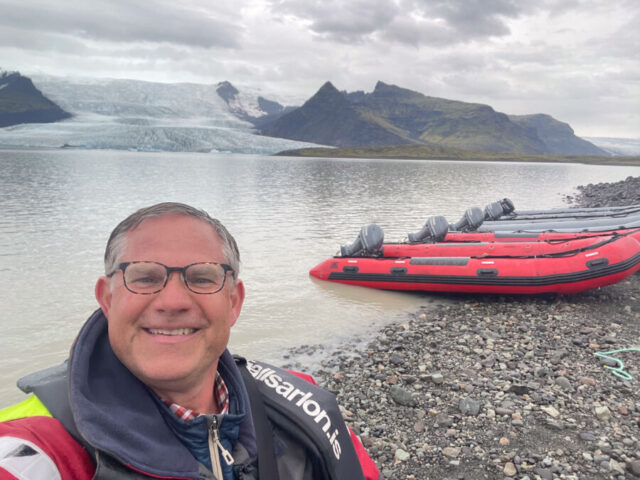
In the Southeast, we hopped on an inflatable boat for a cruise between icebergs in a glacier lagoon. It was the one stop on the entire Ring where we had rotten weather…and it was still gorgeous. (The family who joined us on the boat were doing the same itinerary as us, but in the opposite direction…and told us they’d had rain and cold every single day.)
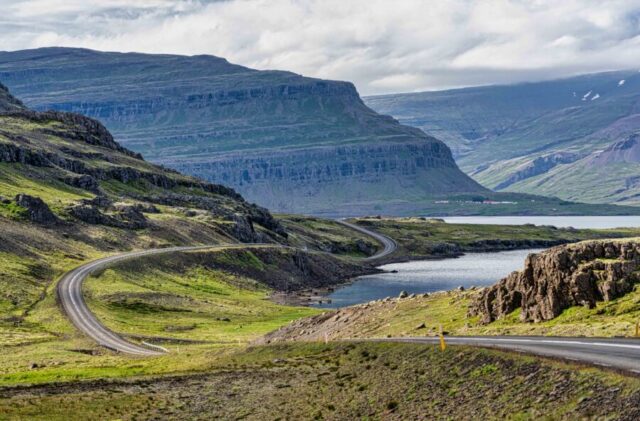
Driving up the east coast — along the Eastfjords — we had to be choosy about where we pulled over to shoot the dramatic landscape. Coming around each bend, Karel’s eyes would pop out of his head. “Wow, Simon. That’s a great shot.” Simon, steady behind the wheel and knowing we had a tight schedule to stick to, would give it a quick assessment. If he agreed, we’d pull over and set up the camera. But more often than not, he’d keep on driving… knowing that an even better view was likely to unfold soon. Through a little trial-and-error — and having a clear sense of exactly what we were hoping to capture on film — we developed a good instinct for which views were worth braking for, which merited a U-turn, and which were skippable.
Reaching the northeast corner of Iceland — as far as you can get from Reykjavík without a boat — we rounded the bend and looped back west along the North Coast, stopping at Mývatn — a giant lake surrounded by mind-bending geological formations…Iceland’s answer to Yellowstone.

We took a short detour up to Húsavík, famous for its whale-watching industry. We were greeted by a dynamo named Orly, who serves as a one-man chamber of commerce for his tiny town. Orly explained how the traditional fishing fleet of Húsavík has been transformed into whale-watching boats, as we filmed people gearing up and chugging out to look for orcas and breaching humpbacks.
Húsavík is also familiar to some travelers as the setting of the Will Ferrell/Rachel McAdams Netflix movie about the Eurovision Song Contest — which was nominated for the Oscar for Best Song. In fact, Orly himself produced the live performance of that song, right here in Húsavík, that was broadcast globally during the Oscars ceremony. He took us to a fine viewpoint over the harbor, which also happened to be the location of a surprisingly good museum about the movie and the contest, and the Jaja Ding Dong Café, inspired by the film. The owner and proprietor of all this? Orly, of course.
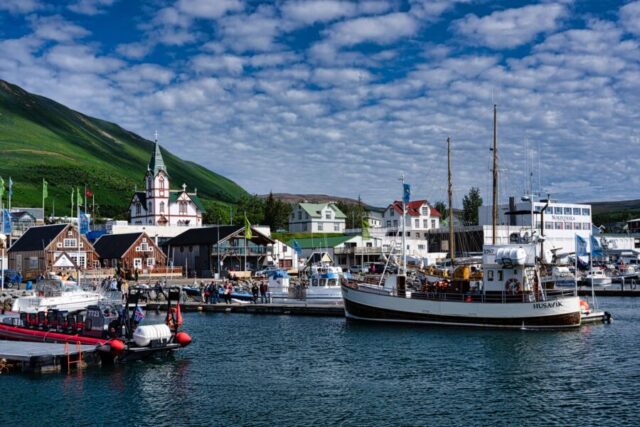
While most of this (aside from the whale watching) was beyond the scope of our show, it illustrates the many fascinating and wonderful Icelanders we met as we toured their island. Even so far from “civilization,” this is a welcoming, endlessly entertaining place. (And I was able to graft some of what got left on the cutting-room floor into the new edition of our Rick Steves Iceland guidebook. That’s only fair, considering that the bulk of our Iceland coverage was shaped by working on that book, over many years.)
One segment that did make the cut was our visit to the Herring Era Museum, in the fjordside village of Siglufjörður. On a previous visit, I was captivated by the story of how, from 1903 to the 1960s, salted herring powered the Icelandic economy… representing fully one-half of Iceland’s total export income, and arguably leading to financial independence and full sovereignty. Our wonderful local guide Edda met us out front to show us the cutting and salting stations, then brought us inside to tour the dorms where the “herring girls” spent their time, waiting for the fishing boats to arrive so they could do their work. When filming travel TV, it’s so important to include local voices. And hearing Edda bring this obscure-to-us history to life, proudly describing the Rosie the Riveter-style herring girls, made it a segment to remember.
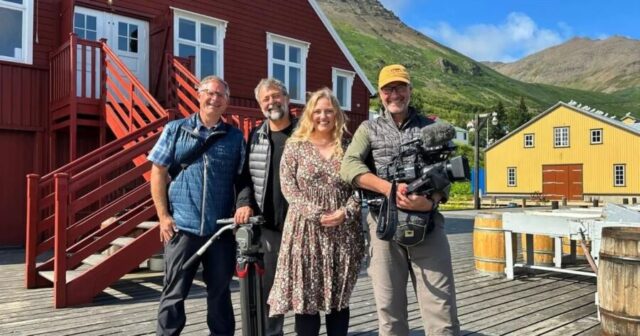
On our way back to Reykjavík, completing the Ring Road loop, we made a few more stops — including the turf houses at Glaumbær, and the glorious scenery of Snæfellsnes Peninsula.
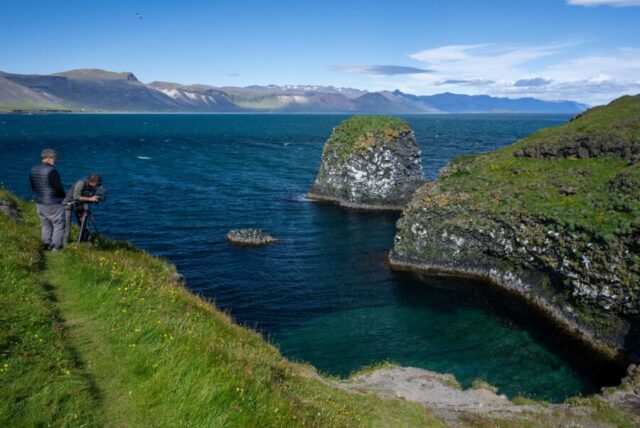
Our shoot was nearly finished. But Iceland wasn’t quite finished with us. Way back when we began in Reykjavík, we were already hearing news reports of small, mostly undetectable earthquakes shaking the western half of the island. It seemed that the slumbering volcanoes beneath the Reykjanes Peninsula — south of the capital, near the Blue Lagoon and international airport — were about to awaken.
As we drove around the Ring Road, we kept an eye on the news for the imminent eruption. And a few days before our trip wrapped up, sure enough, the earth opened up and began to spew molten rock. By that time, we were hundreds of miles away; even as our loved ones back home reached out to make sure we were OK (frightened by the “Iceland in Flames!” headlines), we knew that the eruption was distant, isolated, and effectively harmless.
As we entered the home stretch back to Reykjavík, finishing up our 800-mile journey, we kept our eyes peeled on the horizon. And sure enough, as the skyline of the capital came into view, beyond it we noticed a strange-shaped “cloud” that wasn’t a cloud at all…but a smoke plume from that volcano.
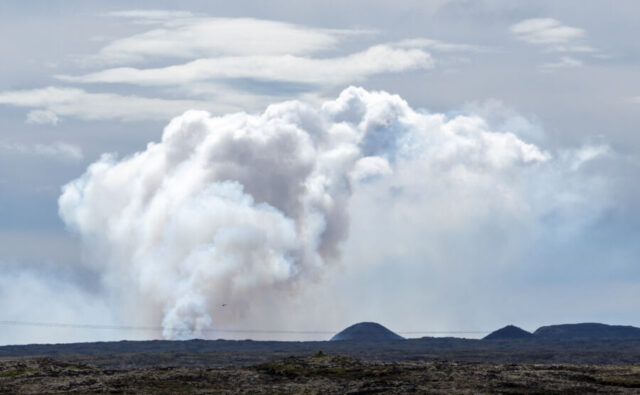
On our final night in Reykjavík, we watched the distant eruption from our hotel window, about 20 miles away — and marveled at how, even being so close, we felt totally safe. And the next day, our drive to the airport took us within a few miles of the smoldering eruption. Pulling over to get some footage, we realized it wasn’t that exciting, after all…just some distant smoke. It was a good reminder of how, even when an event grabs international headlines, the reality on the ground can be far less dramatic. And it left us with one last example of that motto: Þetta reddast…it always works out.
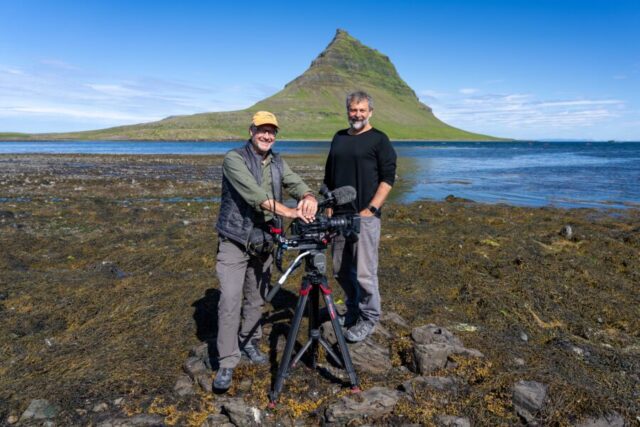
After our return, our ace editor Steve Cammarano stitched together that two-and-a-half weeks of footage into a tight and compelling one-hour tour of Iceland. The rough cut broke a record… tipping the scales at more than six minutes too long. But with a few judicious trims, and Steve’s editorial mastery, we wound up with a show that’s exactly the right length. And later, Steve whittled all that Iceland down even more to create the first two episodes of Rick Steves’ Europe Season 13.
In the end, we are thrilled to have captured a well-rounded look at this remarkable hunk of Europe, adrift in the North Atlantic — from volcanoes and glaciers, to puffins and whales, to fjords and mountains, to a fascinating and endearing Nordic heritage shaped by a hardscrabble history. This is Iceland. And I truly hope that you enjoy experiencing it on your screen as much as we enjoyed making it.
Rick Steves’ Europe Season 13 — starting with those two episodes on Iceland, then Poland, cruising on a Burgundian barge, and the great cities of London, Paris, Rome, and Istanbul — airs in the fall of 2025 on public television stations nationwide (and streaming on PBS Passport).
Or you can check out the one-hour Rick Steves Iceland in its entirety.
Planning a trip of your own? Pick up our bestselling Rick Steves’ Iceland guidebook.
I’ve written tons of other blog posts, all about my travels around Iceland.
And if you enjoy these behind-the-scenes stories, pick up a copy of my memoir, The Temporary European — with a chapter about making our Romania TV show with Rick, Simon, and Karel.