Have you ever spent Christmas in Europe? I was fortunate enough to have that experience several years ago, when my family and I spent the holiday season in Swiss Alps.
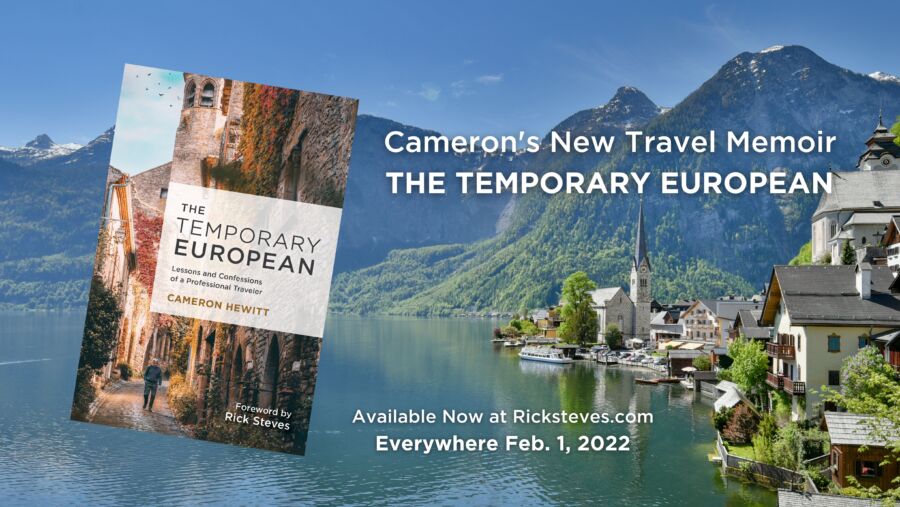
More recently, I wrote about that experience for my travel memoir, The Temporary European: Lessons and Confessions of a Professional Traveler. Except…that chapter didn’t make the cut. Just before I turned in the manuscript to my publisher, it was still a smidge over my word-count limit. I’d spent weeks polishing my story of a wonderful Christmas spent in Switzerland many years ago. But it wound up being the very last chapter I had to cut to get my book to the right size.
Even so, I love the nostalgic feeling of this piece — it’s my very own version of A Christmas Story, if you replace the Red Ryder Carbine Action BB Gun with a pot of bubbling fondue and live candles on a Christmas tree. So here’s a special Christmastime look at a deleted chapter from The Temporary European. I hope it helps transport you to a beautiful, carefree, snow-flocked place during a season of peace and joy.

Soon after they were married, my parents lived for a year and a half in Switzerland. The holidays they spent high in the Swiss Alps left indelible impressions on their notion of Christmas — and, because this is how these things work, also on their kids’.
When my sister and I were growing up, our Christmases took on a Swiss flavor. Our tree decorations included handmade, vintage straw ornaments — including our tattered treetop angel, a veteran of decades of holiday seasons. When we would indulge him, my father would read us the story of the Nativity in German. And our it-just-isn’t-the-holidays-without-it Christmas Eve tradition is a pot of cheese fondue.
Every December, my parents would get around to telling the story of one of their all-time favorite memories: attending a Christmas Eve service in a small village church high in the Swiss Alps. The Christmas tree by the altar had candles pinned precariously to its boughs. At the start of the service, ushers with long poles carefully lit each candle. One usher remained stationed next to the tree, so that if a candle set the branch above on fire, he could grab a stick with a wet sponge lashed to the end, swing it up, and slap it out with a wet SMACK!
With each retelling of this tale, the melodrama increased: The usher was dozing off in his chair as the congregation hissed “Feuer! Feuer!” He awoke with a start, leapt to his feet, whacked the offending branch with his sponge, then went back to his nap. And the stoic Swiss congregation behaved as if nothing had happened.

Likely because of these experiences, my family has always approached holidays with a spirit of adventure (straw ornaments and cheese fondue notwithstanding). When I was three years old, we spent Christmas in Mexico. Instead of shivering in moon boots and parkas in the Ohio snow, my sister and I wore flip-flops and tank tops as we followed the posada procession door-to-door through a workaday Cuernavaca neighborhood. One Thanksgiving, I traveled with my in-laws to Tuscany for a hybrid American-Italian feast with pillowy sweet potato gnocchi and turkey drizzled with just-pressed olive oil. And for Easter in Greece, it’s slow-roasted lamb instead of foil-wrapped chocolate eggs.
Holiday traditions are powerful, and some people can’t imagine doing anything different. But those who are willing to bust out of their rut are richly rewarded. And never once have I regretted what I was “missing out on” back home. If holidays are fundamentally about surrounding yourself with the people you care about, you can do that anywhere. Your traditions will always be there, back home, waiting for you…next year.
My favorite holiday travel memory of all came several years ago, when my family spent Christmas in Switzerland. My parents were newly retired and eager to relive one of their most formative holidays with their adult children. We were aware that attempting to rekindle past magic is courting disappointment. But we gave it a shot.
§
A few days before Christmas, we landed in Zürich and rode the train to the Berner Oberland — the dramatically scenic heartland of German-speaking Switzerland. We’d chosen to stay in the village of Wilderswil, filling a sleepy valley just outside the busy transit hub of Interlaken.

Workaday Wilderswil has few claims to fame. (Not long before our visit, the town’s big play to put itself on the map — its “Mystery Park” — opened to much fanfare, then quickly closed in disgrace, and is now recalled as a regrettable boondoggle.) But Wilderswil’s nondescriptness suited us. Sleepy and effortlessly charming, it’s a split-shingle community of bulky chalets that crowd along streets dating back to horse-and-buggy days. The village — just big enough to have a well-stocked Migros grocery store, but small enough to escape most tourists’ itineraries — turned out to be an ideal home base. From our cottage, a short walk took us to the train station, connecting us to all of Switzerland.
Determined to make the most of our railpasses, we fanned out across the country on scenic day trips. One day, we rode the Golden Pass route south, through a Christmas-card landscape of hibernating farms snoozing in valleys and cuckoo-clock villages blanketing white hillsides. Chugging our way past ski resorts, we crossed the linguistic and cultural border from German to French Switzerland. The terrain softened and thawed, replacing evergreens with vineyards and wooden chalets with handsome stone homes. On the shores of Lake Geneva, we strolled the chic streets and enjoyed a bistro lunch.

On other days, we took full advantage of the Christmas markets that were in full swing across the country. Bern — Switzerland’s mellow seat of government, filling its promontory with warm arcades — was all decked out with garlands, giant illuminated stars, and cheery mood lighting. Bundled up against the chill, we sipped hot spiced Glühwein and munched on chestnuts roasted by street vendors, which filled the streets with their Christmas-carol aroma.

Basel — with its fire truck-red city hall — sits at the nexus of Western Europe, where Switzerland, Germany, and France touch. One of the town’s landmarks is Jean Tinguely’s Carnival Fountain — a cyberpunk playground with “robots” that spray and splash water at each other. But on this day, each robot was a chunk of solid ice, draped in thick icicles. The many Christmas trees decorating Basel’s downtown core were elegant in their organic, tasteful restraint: towering evergreens strewn with twinkle lights and just a few unglitzy ornaments.
At Basel’s Christmas market, a vintage locomotive — belching cotton-candy billows of steam — chugged along tram tracks through the main square, offering wide-eyed, cherry-cheeked cherubs rides around town. Window displays were explosions of red velvet, tinsel, and greenery. Inviting faux-log-cabin market stalls — draped in garlands and twinkle lights — offered fragrant wreaths and greenery, wooden children’s toys, handwoven baskets, giant wheels of cheese, neatly stacked jars of preserves, handmade crèche figures, garlicky sausages, bouquets of dried flowers, and a rainbow of ornaments. We stocked up on some new straw ornaments to (finally!) retire our antique ones.

Seeking snow, we rode some lifts high into the mountains. From Wilderswil, trains trundle up to the touristy gingerbread village of Grindelwald. This was where intrepid 19th-century English mountain climbers based themselves when first conquering this region’s harrowing 13,000-foot summits. To gain some altitude — without the sweat or the danger — we hopped on a gondola, stepped out at the mid-station, and went for a walk in the snow. Even in late December, the mile-high sun was intense. We hiked past woody mountain lodges, their outdoor terraces jammed with sunbathing skiers — cheeks and noses rosy from frigid air, warm sun, and schnapps.

§
Finally, December 24th arrived. Now, just try to imagine the decades of pressure piled upon our Christmas Eve plans. How could it possibly live up to my parents’ gauzy memories of the village church and the live candles and the usher with a sponge on a stick?
After much research, speculation, and discussion about which village church would be graced with the honor of our visit, we shrugged and went with the most obvious choice: Kirche Gsteig, the humble old church over a covered wooden footbridge from the Wilderswil train station, and just a few minutes’ walk from our house. It wasn’t quite the remote mountain church of our Swiss Christmas fantasies. But we figured we’d make it easy on ourselves. (That said, if there were candles…well, we wouldn’t exactly complain.)

We spent most of Christmas Eve side-tripping to Christmas markets. And as our train approached Wilderswil, after days of a brown landscape, it finally began to really snow for the first time. After the sun set (at 4 p.m.), as the town’s holiday lights twinkled on, we made our way between plump snowflakes and across the covered footbridge to the tiny community of Gsteig.
On our way through town, the church bells began to toll. Other villagers emerged from their homes and joined us in an impromptu procession. Everyone was out — all the Whos down in Whoville were heading to church. Our hearts grew three sizes that day.
Plain and white on the outside, tidy and stony inside, the Gsteig church’s walls are decorated with a few faint frescoes from the 14th and 15th centuries. On this Christmas Eve, those simple halls were decked, and very tastefully. The arched alcoves lining the nave were filled with Advent wreaths on tall wooden stools. The congregation wore cheery red sweaters and green scarves. And there, by the altar, stood a sparse but elegant Christmas tree — with candles pinned to its branches, ready to be lit.
A hush settled over the crowd as ushers stood and began to light those candles, one by one, with long poles — just like they had in all those years of stories. It was a beautiful moment of serene silence, as the entire congregation appreciated the arrival of this holy light into their world. Everything was precisely as we’d always imagined. My parents’ eyes danced with the joy of treasured memories, old and brand-new, coming together.

The Swiss live their lives in dual linguistic worlds: In official contexts, at school and in the workplace, and in most radio and TV, they speak High German (or, as they call it, Schriftdeutsch — “written German”). But at home, at the pub, and among friends, they switch to their own language, Schwyzerdütsch. Germans and Austrians say “Fröhliche Weihnachten,” while the Swiss greet each other with “Guëti Wienachtä!” In big-city Swiss cathedrals that night, the Fröhliche Weihnachten service would have been in High German. But here in the humble Gsteig village church, the sermon was proudly in Schwyzerdütsch. As the only out-of-towners in the pews, we felt honored to be observers at this intimate Guëti Wienachtä gathering.
After church, we mingled with the ruddy-cheeked villagers of Gsteig and Wilderswil. Outside the church, at the fellowship hour, we made some new friends, nursed Styrofoam cups of Glühwein, and caught fat snowflakes on our tongues. Shimmering red lights drew us around the side of the church, to the graveyard. The villagers had decorated the graves of departed loved ones with tasteful garlands and red votive candles, inviting generations past to join in the celebration.
Then we headed back through the flurries — which were beginning to stick on the roof shingles — to our family Christmas Eve tradition: fondue.
§
Swiss fondue is elegantly simple: cheese liquefied in wine. But making the perfect fondue is equal parts art and science, mastered over a lifetime. You need the right kind of cheese, the right kind of wine, the right kind of bread, the right equipment, and the right technique. In my family, we are insufferable fondue snobs. And being in Switzerland on Christmas Eve, we were in our element.
Earlier in the day, we’d stopped by the Wilderswil Käserei (cheese shop). When we make fondue back home, we improvise on the cheese: usually half Emmental and half Gruyere, all grated into one big fluffy pile. But a real Swiss Käserei sells a Fonduemischung engineered for perfect fondue — usually about half Gruyere, and one-quarter each Appenzeller and Fribourger. Real Swiss cheeses are majestically funky, so pungent you can taste them through your nose. Appenzeller in particular smells like a festering toe fungus…and yet, somehow, once melted, it washes the taste buds with a nutty, tangy, rich flavor. There’s nothing else that smells so wretched, but tastes so delicious.

Cheese in hand, we stocked up on the other ingredients: a couple cloves of garlic; ground nutmeg; white wine; a pinch of cornstarch; and Kirschwasser — cherry schnapps. Our rental cottage, of course, came with a ceramic pot specifically designed for fondue — right down to the Swiss cross on the side — and a stand with a Sterno-can burner for keeping it warm at the table.
Oh, and you need the perfect loaf of fresh, mixed-grain bread — crusty on the outside, soft and spongy on the inside. We cut the bread into bite-sized chunks, about one-inch square. Each chunk — and this is very important — should have some crust, to pierce with the skinny fork. Otherwise, the bread instantly becomes unmoored when it hits the cheese, lost in the bottom of the pot.
Ingredients assembled, we began by rubbing the inside of the pot with cross-sections of garlic cloves, then filling it with white wine. Then we heated it up on the stovetop…not to hot, and not too fast, never boiling, or even simmering.
Soon — after 10 minutes or so — a haze rises from the surface of the wine, like fog clinging to the surface of a glassy lake at dawn. It’s time to start mixing in the cheese. But this, too, should not be done too quickly. Grab a scant handful of grated cheese and sprinkle it in. Stir until it’s dissolved into the wine. Then mix in another handful. Then another. Wait until the previous sprinkling of cheese has fully melted before adding more. The whole time, never stop stirring. Just keep whirling the wooden spoon in a smooth, continuous, mesmerizing figure-8 motion.

If done correctly, the fondue becomes an opaque liquid, without individual strands of cheese. That’s when you mix in a glug of the Kirschwasser, premixed with a bit of cornstarch and a smidge more wine. Add a pinch of ground nutmeg and some fresh-ground pepper. And keep stirring. Once the mixture begins to thicken, carefully transfer the pot to the tabletop burner.
At a certain point — seamlessly — you stop stirring with the spoon, and start stirring with a long, skinny fork affixed to a chunk of bread. Take turns stirring and eating — someone should always have their fork swirling around in the pot. To really get the party going, the Swiss sometimes dip their bread in Kirschwasser before stirring it into the cheese. But we are not nearly that hardcore.
A good fondue is life-altering. What’s not to love? Fresh bread, melted cheese, and wine. We always have our fondue with a side salad. It’s comforting to imagine the lettuce settling into the stomach, creating a leafy buffer between the layers of cheese.
The best part is the charred cheese that coats the bottom of the pot at the end. Usually, we let my wife and my sister debate which of them gets the intensely satisfying (and delicious) task of gently peeling off the skin of browned cheese with their fork, then popping it in their mouth.
Settling into our Christmas Eve tradition, still buzzing from the impossible-to-plan-for serendipity of our day, we jabbed our forks into the bubbling cheese and planned our Christmas Day.

§
On Christmas morning, we awoke to glorious sunshine, with deep-blue skies over white-fringed fields. We piled onto the train in Wilderswil and rode into Lauterbrunnen. As we made our way up the valley, the slight increase in elevation took us through higher and higher snowbanks. Snow clung to the evergreen boughs, tracing pretty piney patterns on either side of the train tracks. The fresh coating of white, as far as the eye could see, was lit up so brightly by the midwinter sun that we had to squint. It felt like a vast blank canvas on which to create new memories to build on last night’s perfect Christmas Eve.
In Lauterbrunnen, we transferred to a bus — even on Christmas Day, coordinated with flawless Swiss efficiency — to the far end of the valley, where we stepped onto the Schilthornbahn cable car. We rode it up, up, up, feeling our ears pop as we ascended through a landscape painted by winter.
Stepping out at 12,000 feet, we surveyed that classic lineup of cut-glass peaks on the far side of the Lauterbrunnen Valley: the Eiger, Mönch, and Jungfrau. Aspirational yellow arrows pointed in every direction, suggesting hardy summertime hikes down into the valley far below. But not today. On this Christmas morning, giddy skiers were strapping on their skis for the long, blissful glide back to civilization.

Escaping the bitter chill into the warmth of the revolving restaurant, we noticed a special “early bird” offer for brunch, and quickly changed our plans for a picnic. We settled into a table and watched the peaks slowly crawl past for an hour as we dug into heaping plates of Rösti (Swiss hash browns) slathered in creamy mountain cheese, with chunks of potato and bits of bacon.

Having dispensed with the need to ever consume food again, we waddled back to the cable car and rode it down the mountain to Mürren — perched on a snowy lip over the valley — where we began a long, scenic stroll through the village.
Bright sunshine spotlit rustic wooden homes, revealing precisely stacked piles of firewood under rugged eaves, assembled with Swiss precision by farmers who were engineers at heart. Skiers — just completing their eye-popping journey down from the Schilthorn — shuffled past us on the snow-covered streets. Everyone was in a festive mood. Even the cable-car operators were uncharacteristically jolly.

Reaching the end of Mürren, we decided to extend our hike (and burn off more of that Rösti). Circling back through town, we continued 30 minutes gently downhill to the hamlet of Gimmelwald. Warmed by the sun and the just-right exertion of plodding through snow, we peeled off our jackets.
The steep trail switchbacked down past frozen little waterfalls, soon depositing us at the upper flanks of Gimmelwald — marked by Walter’s classic old Hotel Mittaghorn. From there, we continued past farmers’ houses buried in snow banks and frozen water troughs for stabled cows. Reaching the edge of the bluff that faces the Jungfrau — looming across the valley, so close, yet a deep chasm away — we walked out to a barn clinging to the lip of the cliff.

Panning up once more to survey 360 degrees of Swiss peaks, we realized we were having a very merry Christmas, indeed. Trying to capture Christmas magic is a risky business. We got lucky. Or maybe it’s just that Switzerland makes it seem easy.
I hope you’ve enjoyed this little trip to Switzerland. Maybe it’ll inspire you to spend the holidays far from home someday yourself. And if you like this, please consider picking up a copy of my travel memoir, The Temporary European, which has lots more stories that didn’t wind up on the cutting-room floor. It’s the perfect book for stoking those post-holiday travel dreams, as it’s packed with vivid stories about exploring Europe and getting to know its wonderful people.
I hope you all have a happy holiday season and a very happy New Year!