Imagine Every Woman’s a Nun

For many Iranians what Americans would call “family values” trumps democracy and freedom. They choose a “Revolution of Values.”
Enlarge photo
Imagine a society where all the women are nuns…and all the problems like Maria.
Enlarge photo

As I settled into the plane flying us between two Iranian towns, the pilot announced, “In the name of God the compassionate and merciful, we welcome you to this flight. Now fasten your seatbelts.”

The Islamic Revolution is a “revolution of values.” People here tell me they support it because they want to raise their children without cheap sex, disrespectful clothing, drug abuse and materialism, believing it erodes character and threatens their traditional values. To conservative Iranians, America stands for all of the above. The people I’ve met here don’t want their culture to be like America’s. It threatens them as parents. It seems to me they willingly trade democracy and political freedom for a society free of Western values (or lack thereof), that it’s more important to have a place to raise their children that fits their religious values. I believe they would even endure a shock-and-awe–style American bombing for this — something tough for our leaders to get their heads around.

(Of course, there’s plenty of drug addiction, materialism and casual sex in Iran, but the sex and drugs are pretty well hidden, and the forces in power are fighting these vices the best they can.)

Sometimes you don’t see an excess in your own world until you find a different world without that excess. Traveling in Iran, it’s clear to me that in the US, our religion is freedom…and materialism. Just about everywhere we look, we are inundated by advertising encouraging us to consume. Airports are paid to drone ads on loud TVs. Magazines are beefy with slick ads. Sports stars wear corporate logos. Our media are driven by corporate marketing. In Iran the religion is Islam. And — at the expense of the economy — billboards, Muzak, TV programming, and young peoples’ education preaches the teaching of great Shiite holy men.

Still, I am impressed by how unreligious this famously religious place is. Unlike other Muslim cities I’ve visited, such as Istanbul and Cairo, there are almost no minarets breaking the skyline, and there’s no call to prayer. I’ve barely heard a call to prayer since we arrived.

In this theocracy, the women must stay covered. Trying to grasp this in Christian terms, I imagined living in a society where every woman is forced to be a nun. Seeing spunky young Muslim women chafing at their modesty requirements, I kept humming, “How do you solve a problem like Maria?” Pondering the time Pat Robertson ran for president — and had millions of supporters — I wondered what our own country would look like if he had won and dominated Congress. Many people would have been ecstatic, and many would have been oppressed. It seems to me that’s the state of Iran today under Ahmadinejad.

I asked my guide if, in Iran, you must be religious. He said, “In Iran you can be whatever religion you like, as long as it is not offensive to Islam.” Christian? “Sure.” Jewish? “Sure.” Bahá’i? “No, we believe Mohammad — who came in the seventh century — was the last prophet, and the Bahá’i prophet (Bahá’u’lláh) came in the 19th century. The Bahá’i faith is offensive to Islam. Except for that, we have religious freedom.”

I asked, “But what if you want to get somewhere in the military or government?” My guide answered, “Then you better be a Muslim.” I added, “A practicing Shiite Muslim?” He said, “Yes.”

No Urinals in Iran

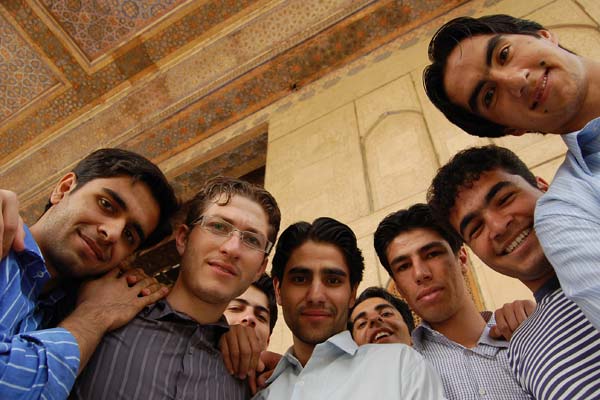
I was greeted by smiles. When I explained where I was from, the smiles got bigger. Hooking fingers seemed to be human nature—we can be friends and can get along.
Enlarge photo
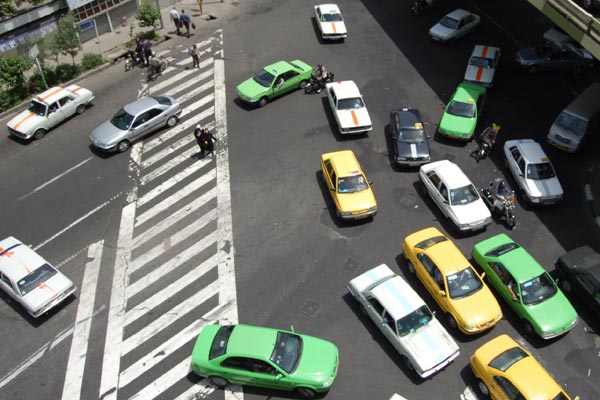
Cars merge through major intersections without traffic lights as if that’s the norm. And, surprisingly…it works.
Enlarge photo
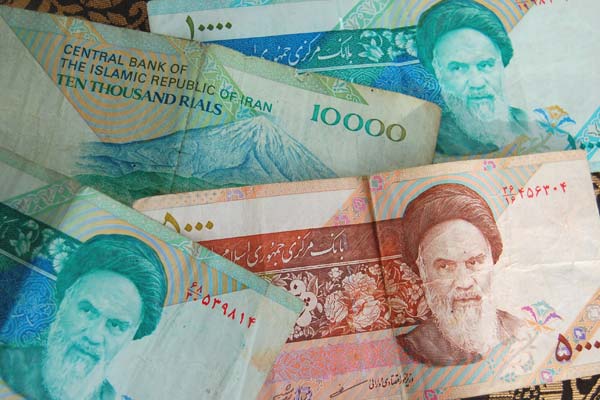
10,000 rials is worth a dollar. While Washington made it on our one dollar bill, Khomeini made it on every denomination here.
Enlarge photo
Women are covered yet beautiful. In a land where there is no cleavage, a wisp of hair can be ravishing.
Enlarge photo
Locals find me quite interesting. Routinely I’ve looked up from my note-taking and seen people gathered, curious, and wanting to talk.
Enlarge photo

After a few days in Iran, I can’t help but think how tourism could boom here if they just opened it up. There are a few Western tourists (Germans, French, Brits, Dutch) but they all seem to be either on a tour, with a private guide, or visiting relatives. Control gets tighter and looser depending on the political climate, but basically American tourists can visit only with a guided tour. I meet no one just exploring on their own.

Tourists are so rare and sights are so few and obvious that you bump into the same people day after day. Browsing through picture books and calendars showing the same 15 or 20 images of the top sights in Iran, I’m impressed by how we’ve managed to see, or are scheduled to see, most of them. The Lonely Planet guidebook dominates – it seems every Westerner here has one. It’s good.

Our guide makes sure we’re eating in comfortable (i.e. high-end) restaurants (generally in hotels). They say tap water is no problem, but I’m sticking with the bottled kind. I wasn’t wild about the food on my first trip. It’s much better now…but still ranks about with Norwegian cuisine in terms of excitement value.

Driving is hair-raising. For several days now we’ve been zipped smoothly around by Majid, our driver. To illustrate how clueless I am here, for three days I’ve been calling him “Najaf.” And whenever a bit of filming goes well and we triumphantly return to the car, I give him an enthusiastic thumbs up. Finally today he and our guide explained that I’ve been confusing his name with a city in Iraq…and that giving someone a thumbs up in Iran is like giving them the finger.

Majid drives our eight-seater bus like a motor scooter, weaving in and out of traffic that flows down the street and between lanes like rocks in an avalanche. At major intersections there are no lights – everyone just shuffles through. It works differently here than it would at home – people are great drivers here, and, somehow, it works. I think I’ll actually drive more aggressively when I get home. Adding to the chaotic traffic mix are the pedestrians, doing their best to navigate a wild landscape. Locals say when you set out to cross a big street, “you go to Chechnya.” I’m told that Iran loses 30,000 people on the roads (in cars and on foot) a year.

The money is complicated. There are about 10,000 rial in a dollar. (If you exchange $100 dollars you are literally a millionaire here.) Ten rial is called a tuman, and some prices are listed in rial, others in tuman…a tourist rip-off just waiting to happen. (I had a shirt laundered at the hotel for “20,000.” Was that in rial, i.e. $2? Or was the list in tuman, which would mean the service cost $20? It was hard to tell.) There are no coins and no state-issued large bills. Local banks print large bills to help local commerce. To tell a counterfeit, you rub the number with your finger – if it’s the real deal, the warmth makes the numbers disappear just momentarily.

Women are required to cover their hair with a scarf. Local women are expert at wearing them to show just enough hair to grab the eye. In a land where showing cleavage is essentially against the law, a tuft of hair above the forehead becomes the exciting place a man’s eye tends to seek out. Tourist women are also required to wear scarves. After appreciating the art of local women being provocative with their hair and scarves, the tourists’ efforts seem quite clumsy.

There are no urinals anywhere. I did an extensive search: at the airport, fancy hotels, the university, the fanciest coffee shops. No urinals in Iran. I was told that Muslims believe you don’t get rid of all your urine when you urinate standing up. For religious reasons, they squat.

Neckties are rarely seen, as they’re considered the mark of a Shah supporter.

Restaurants use Kleenex rather than napkins; there’s a box of Kleenex on every dining table. There is absolutely no booze or beer in public. While I keep ordering a yogurt drink (similar to Turkish ayran), our guide and driver enjoyed “malt beverages” – non-alcoholic beer that comes in beer bottles or cans.

Many times, while I’ve been sitting in the shade quietly reading or writing while the crew got the shots they needed, people have come up to me and curiously asked where I’m from and what we’re doing. I chatted with one young man who didn’t look as if he was particularly in compliance with the revolution. After we said goodbye, he thought about our conversation, returned and said, “One present from you to me please. You must read Koran. Is good. No politics.” The Islamic Revolutionist government has been in power for 30 years now; this man’s generation knows nothing else. But then, why should an evangelical Muslim be any more surprising/menacing/annoying than an evangelical Christian?

Tehran: Heavenly Pistachios…and a Pinch of Valium?

American journalist mugs with Revolutionary Guard.
Enlarge photo
Tehran, a mile-high metropolis of 14 million people.
Enlarge photo
Cameraman Karel gets photographed for his press pass.
Enlarge photo
Our welcome included building-sized anti-US murals showing American flags with Stars of David and dropping bombs painting the stripes.
Enlarge photo

I was hesitant to tell anyone about this trip until it was actually happening. One day into this experience, we are definitely here. Revolutionary Guards who can be coaxed to smile, four-lane highways intersecting with no traffic lights, “Death to America” posters, and big warm welcoming smiles…Iran is a fascinating and complex paradox.

Tehran is a mile-high metropolis of 14 million people. With one day of filming down, I’m in a fancy hotel on the 14th floor, enjoying a view of a vast city at twilight, lights twinkling right up a snow-capped mountain. I’m munching the best pistachios I’ve ever tasted (and I am a pistachio connoisseur) from an elegant woven tray and nursing a tall glass of pomegranate juice. I cruise the channels on my TV — CNN, BBC, and lots of mood-setting programming — perfect for praying… One channel shows the sun setting on Mecca, with its kaaba (the big black box focus of pilgrim worship), in real time. In an urban jungle like Tehran, life can be so good — if you have money.

Our local guide (who doesn’t want to be called a “government minder”) is a big help and very good. Today we dropped by the foreign press office to get our press badges. There a beautiful and properly covered woman took mug shots for our badges and carefully confirmed the pronunciation of our names in order to transliterate them into Farsi.

Filming is complicated on the streets of Tehran because there is no single authority in charge — many arms of government overlap and make rules that conflict with each other. Permissions to film somewhere are limited to a specific time window. If we have permission to film a certain building, it doesn’t mean we can film it from the balcony of a teahouse that we don’t have permission to film in, or from any angle that shows a bank — as those are not to be filmed. When we film a shop window, a security guard is on us immediately. Our guide/minder is kept busy asserting himself when someone representing some different branch of government puts up a road block. He makes it all possible. People here like to say, “Iranian democracy: You are given lots of options…and then we make your choice for you.”

We can talk to whomever we like — but it reminds me of my early trips to the USSR, when only those with nothing to lose would risk talking openly to us (at least when our “guide” was present). So many who’ve commented on the blog have assumed I am not troubled by the lack of freedom here. Civil liberties for women, religious minorities, and anyone who chooses not to embrace this self-described “revolution of values” are, to me the mark of a modern, free, and, I believe, sustainable democracy. Those both for and against my trip here all agree with that. A key word here is sustainable. I believe — given time and a chance to evolve on their cultural terms — the will of the people ultimately prevails. For now, this country is not free (and no one here claims it is). A creepiness that comes with big government pervades the place. I wonder how free-minded people cope. I am excited to sort this out as our trip goes along.

At the Shah’s palace — a museum since he was overthrown in 1978 — an old aristocratic woman came up to me and said, “We are united and we are proud. When you go home, you must tell the truth.” Iranians believe that Western media makes their culture look menacing, and never shows its warm, human and gracious side. I assured her that we were here to show the people of Iran rather than its bombastic government.

I understand well-employed people here make $5,000 to $15,000 a year, and pay essentially no tax. It seems to me that the economy doesn’t need to be very efficient, and taxes don’t matter much to a government funded by oil. Measuring productivity at a glance, things seem pretty low-energy. While the Islamic Revolution is not anti-capitalism, there seems to be a lack of incentive to really be efficient.

I can tell from our first day that the people of Iran will be the big joy of our visit — everyone’s mellow, quick to smile, very courteous. It’s almost like the country’s on valium. (But then, perhaps Iranians are just not driven as we are by capitalist values to work hard and enjoy material prosperity.)

In a bookstore a woman patiently showed me fine poetry books. As we left, she gave me a book for free. At the Shah’s palace, the public toilet was far away and a guard winked and slipped me secretly to a staff toilet — I imagine used by the Shah’s lackeys. The folks at the travel agency who set up our tour gave us each a platter of lemony pistachios…the best I’ve ever had. (My lips are puckered with them now as I type, as they are my standard bedside snack.)

I step out onto my hotel-room balcony to hear the hummm of 14 million people and marvel at fresh snow whitening the mountain above the ritzy high-rise condos of North Tehran. Looking straight down, the hotel’s entryway is buzzing with activity, as the hotel’s hosting a conference on Islamic unity. The circular driveway is lined by the flags of 30 nations. (Huge collections of flags seem to be common here — perhaps because it provides a handy opportunity to exclude the Stars and Stripes. Apart from being featured in hateful political murals, I haven’t seen an American flag.)

A van with an X-ray machine is permanently parked outside the entrance. Everyone who enters the hotel needs to pass their bags through this first. It’s interesting to see that Iran, a country we feel we need to protect ourselves from, handles security the same way we do.

The Pilot Said, “This Plane Is Heading for Tehran” … and Nobody Was Alarmed

Flying from Istanbul’s Ataturk Airport to Tehran’s Khomeini Airport, I considered airports others on the flight had used: Reagan, DeGaulle…four great leaders in recent history who have left their mark on entire nations. I was entering a society 30 years into the Islamic revolution of the Ayatollah Khomeini. The lives of 70 million people in the Islamic Republic of Iran have been shaped by this man. More than half the country has no memory of living under anything but a theocracy.

Buckling my seatbelt, it occurred to me that someone could come on the plane’s loudspeaker and say, “We’re taking this plane to Tehran” and no one would be alarmed. The plane was filled with Iranian people — their features were different from mine, but they dressed and acted just like me.

These people were well off — well dressed, healthy. It was horrible to think of fighting them in a war. Then I wondered if it is easier to bomb a society ground down by years of sanctions. Are scruffy, poor looking people easier to shock and awe? As we all settled into the wide-body jet, I wished the big decision-makers of our world weren’t shielded from an opportunity to share an economy cabin with people like this.

I made this same Istanbul-to-Tehran trip 30 years ago. Last time it took three days on a bus and the Shah was on his last legs. Wandering Iranian towns in 1978, I remember riot squads in the streets and the Shah’s portraits seeming to hang tenuously in market stalls. I also remember being struck by the harsh gap between rich and poor in Tehran. I was 23 years old. I believe that was the first time in my life I was angered by economic injustice.

The trip is quicker this time — three hours rather than three days. And now every main square and street that was named Shah is named Khomeini. Back then all denominations of paper money had one face on them…like today. At the Khomeini International Airport the only hint of the Shah was the clientele (many of those flying in were likely his supporters who’d fled Iran for the West in 1978 and who were flying in today to visit loved ones).

As the pilot began the descent, rich and elegant Persian women put on their scarves. With all that hair suddenly covered, I noticed how striking long hair can be, how it really does grab a man’s attention. Looking out the window at the lights of Tehran, the sight reminded me of flying into Mexico City at night. Tehran, with 14 million people, is more populous than all of Greece (where I was just traveling).

I’m starting this trip a little bit afraid. I don’t know what’s in store for us. We are anticipating a challenging and extremely productive 10 days here.

Mission: Understand Iran

A friend from the Washington State chapter of the United Nations Association called me six months ago and asked what I could do to help them build understanding between Iran and the US, and to defuse the tension that could be leading to war. I answered, “The only powerful thing I could do would be to produce a TV show on Iran.”

I remember when the bombs first fell on Baghdad, thinking I’d missed an opportunity to make a travel show that could humanize Baghdad and give “collateral damage” a face. I didn’t want to miss an opportunity to do this for Iran. My government would let me go. The Islamic Republic of Iran actually wanted the publicity. I threw together a proposal for a TV show — no politics, just travel. The working title: Iran: Its People and Culture, Yesterday and Today.

After months of fitful applications and negotiations, we were given visas and the government’s support for our mission: a 10-day shoot in Iran — Tehran, Isfahan, Shiraz, and Persepolis. The permissions were so slow in coming that the project was only a certainty last week when we picked our visas up in Athens. (I had a contingency plan for filming in Istanbul.) Like parents-to-be who want to tell the world but hold back until everything looks okay, I couldn’t announce our plans until we knew for sure the trip was a go.

In the US (where our current policy is not to talk with enemies), the only way we could communicate with Iran was indirectly, via the Pakistani consulate. (The US has more diplomatic dialogue going with North Korea than with Iran.) In Greece, it was strange to go into a relaxed, almost no-security Iranian embassy…and then walk out with visas. We were on our way.

As I prepare to fly to Iran (from Athens via Istanbul) it occurs to me that this is a huge, time-consuming, and expensive headache. Pondering my motivation, I keep thinking of those strong-hearted Americans who enlisted in our military in the days after 9/11. What motivated them? Love, revenge, freedom, a deep-seated male thrill to kill, patriotism? While the fire in my gut is just as hot and the concern in my heart just as real, my choice of weapons is different. Like them, I don’t care about my safety, the cost, or the work…I want to do this. I have to do this.

I know almost nothing about Iran — and it’s still a lot more than the average American knows. With something as tricky as US-Iran relations, the foundation of wisdom is to be aware that we can’t know the truth from news coverage. Just like I had to actually visit the USSR in 1978 and Nicaragua in 1988, I need to visit Iran in 2008. If war is at stake, I want to know the truth. Because, as I’ve said before, as an American taxpayer, I believe that every bullet that flies and every bomb that drops has my name on it.

Preparing for this adventure, I’ve been thinking about the similarities between three countries that are, or have been, notorious thorns in America’s side: Nicaragua, Cuba, and Iran. In each of them, we supported an American-business-friendly dictator who was ultimately thrown out by the poor people in that country: Somoza, Battista and the Shah. Then we proceeded to demonize the dictator’s successor and traumatize their people with economic embargos and noisy saber rattling. In the next 10 days, I hope to learn more about why Iranians chant “Death to America.”

I travel to Iran with plenty of anxiety and questions. How free will we be? Will the hotel rooms be bugged? Is there really absolutely no alcohol — even in fancy hotels? Will crowds gather around us and then suddenly turn angry? We have a good Persian-American friend on our crew with family in Iran. We want to be free-spirited, but don’t want to abuse the trust of the Iranian government and possibly cause problems for our Persian friend’s loved ones.

I’m nervous — we considered leaving our big camera in Greece and just taking the small one. I even made sure all my electrical stuff was charged up. Will the food be as bad as my memory from a 1978 backpacker trip through Iran, back in the last days of the Shah?

You might wonder why Iran is letting us in. They actually want to boost Western tourism. I would think that since Western tourism would bring in unwanted ideas (like those which threatened the USSR, which prompted its government to keep tourists out), Iran would see no point in allowing tourists in. But they want more visitors nonetheless.

They also believe the Western media have given their society an unfair image. They did lots of research on my work, and apparently my politics gave them faith in my motives. They don’t like Fox News or CNN, but say they’ve had good experiences with PBS crews in the past. (I heard we’ll get the same minder that Ted Koppel got for his Discovery Channel shoot.)

I want to show the state of Iranian women and this will be very delicate. Cafés that allow crews to show women breaking modesty regulations lose their license.

It’s a cash society. Because of the 26-year-old American embargo on Iran, Western credit cards don’t work there. No ATMs for foreigners.

I am tired after 24 relentless days of work (in Portugal — eating, drinking, sightseeing and embracing life there while updating that guidebook; and in Greece — producing two new TV shows). I need to be fresh and quick-minded on camera for interactions with people on the street (we hope for lots of this in Iran) and simply to stay healthy. I’ll lose a night’s sleep as we fly in, arriving at about 4 a.m.

Simon (director), Karel (cameraman) and I vowed to be respectful and keep a professional mindset. We must do nothing cute, clever or flip. (For instance, when our visas were printed with the wrong dates, we couldn’t resist calling it a “clerical error.”) Once in Iran, however, it’s serious business. The tourist board is part of the Department of Guidance.

Who’s paying for this production? Me. I figure this adventure will cost me roughly what each household in the US is already paying for Iraq. If I can help avert an extra war — even just a little bit — this will be a brilliant personal investment — and lots of people will owe me big-time. (Do the math: $3,000,000,000,000 divided by 300,000,000 US citizens; cut the zeros = $10,000 per person…that’s about $40,000 per family. Care for another war?)

This will be a journey of discovery for me. We have a very sketchy script to start with. It will evolve over the next 10 days. Each day, after a long day of shooting, I’ll massage what we’ve shot and learned into the script, print out a new version and come up with a shooting plan for the next day. My hunch: By Day 10, we’ll have a fine show.

I’ll try to send a blog report about every two days. I hope you can travel along.

[Interesting development: U.S. Defense Secretary Robert Gates urges more nongovernment contacts with Iran — Reuters, 5/15/08]