Clipped Wings Only on Campus in Tehran

The woman in the bookstore gave me a free book.
Enlarge photo
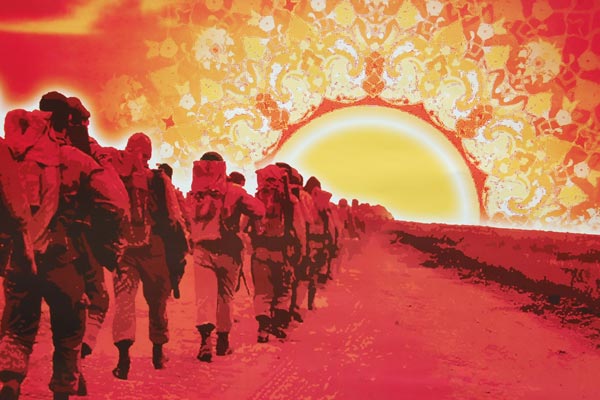
Martyrs walking heroically into the sunset of death for god and country.
Enlarge photo
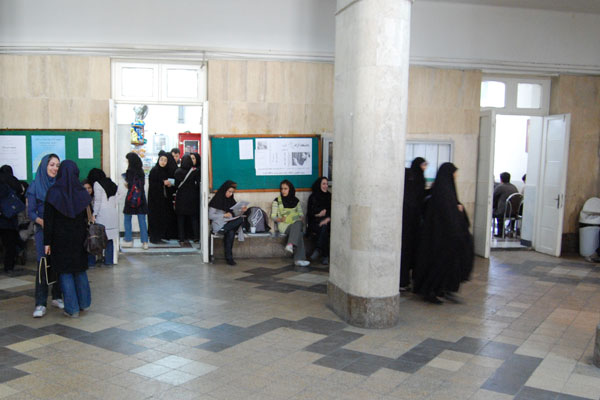
In the university there’s a lounge for boys…and one for girls.
Enlarge photo

After traveling through Iran, my notebook is filled with quirky observations. Reading the comments readers share on my blog is also thought-provoking. The whole experience makes me want to hug people and scream at the same time. It’s intensely human.

One moment, I’m stirred by propaganda murals encouraging young men to walk into the blazing sunset of martyrdom. The next, a woman in a bookstore serves me cookies and offers me the book I admired for free.

My friends are worried about my safety, and even progressive people have adopted the post-9/11 phrase “be safe.” (Hearing that makes me want to do something dangerous.) Safety is the least of my concerns in Iran. The only danger I could imagine during my visit would be something explosive falling from an American airplane high above.

And I learn that after the JFK assassination, there was a popular song here that was a standard among grade-school children. They sang, “Oh, God, what would the world be like if Kennedy were brought back to life?”

I marvel at some example of inefficiency in this society…and then see an old man with a beautifully carved walking stick ingeniously designed with a small flashlight in its handle to light the way home through his poorly lit village late at night.

In our TV filming, I was excited to visit the University of Tehran in hopes of showing highly educated and liberated women and an environment of freedom. Conformity on any university campus (in the USA or Iran) saddens me. You conform once you are parenting or paying off a house or climbing the corporate ladder, but university is where you run free…barefoot through the grass of life, leaping over silly limits just because you can. I assumed I’d find a free spirit at the biggest university in Iran. But the University of Tehran made BYU look like Berkeley. There was a strictly enforced dress code, no non-conformist posters, top-down direction for ways to play, segregated classrooms and cantinas…and students toeing the line.

Hoping to film some interaction with students, I asked for a student union center (the lively place where students come together on Western campuses), but there was none. Each faculty had a cantina where kids could hang out, with a sales counter separating two sections — one for boys and one for girls. In the USA, I see university professors as a bastion of freedom (understandably threatening to people who are against freedom). In Tehran, I found a situation where the theocracy was clearly shaping the curriculum, faculty, and the tenor of the campus. It was the saddest and most disheartening experience of my Iranian visit. I only visited one campus, but I was told it was the biggest and most prestigious in the country.

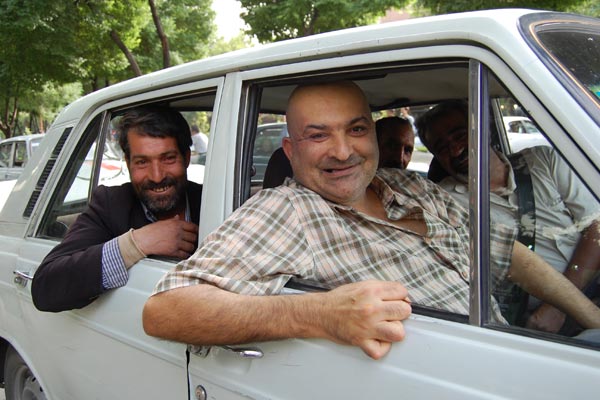
While the traffic is crazy, it is not noisy. Because of a history of motorcycle bandits and assassinations, only small (and therefore quieter) motorcycles are allowed. While traffic is enough to make you scream, people are incredibly good-humored on the road. I never heard angry horns honking. Once, while stalled in Tehran traffic, people in the neighboring car saw me sitting patiently in the back of our van: a foreigner stuck in their traffic. They rolled down their window and handed my driver a bouquet of flowers with instructions to give it to the visitor. When the traffic jam broke up, we moved on — with a bouquet from strangers in my lap.

Rick’s Iran Slideshow

Our trip through Iran has given us a glimpse of a paradoxical world where the murals are mean, yet the people are friendly. Here is a little slideshow of some of the people, places and moments that have delighted me on this trip, strictly from a traveler’s point of view.

View Slideshow >>

Persepolis: 2300 Years Ago, Iran Was Omnipotent

Persepolis is pharaoh-like in its scale. Emperor’s tombs are cut into the neighboring mountains.
Enlarge photo
2500 years ago, subjects of the empire (from 28 nations) would pass through the Nations’ Gate bearing gifts for the “King of Kings.”
Enlarge photo
The tarmac laid for an aristocratic “tent city,” set up by the Shah to celebrate 2500 years of Persian empire, still survives — reminding visitors where their revolution came.
Enlarge photo
Locals — quick to smile for the camera of a new American friend — visit Persepolis to connect with and celebrate their impressive cultural roots.
Enlarge photo
With the sun low and the colors warm, Simon, Karel, and Rick are enjoying a great day of filming. I would say this is your PBS pledge dollars at work … but this shoot’s on me.
Enlarge photo
Under a blistering sun, the rocks share the cool of the night.
Enlarge photo
Europeans enjoying the greatest sight between the Holy Land and India.
Enlarge photo
While the tourist women may have looked gawky in their scarves, I looked worse under my “script sun hat.”
Enlarge photo

The sightseeing highlight of our ten days in Iran was the ancient Persian capital of Persepolis, what I’d consider the greatest ancient sight between the Holy Land and India. Arriving there in the middle of a vast and arid plain was thrilling. This was a rare place that actually exceeded my high expectations. My main regret in traveling through Iran on my first visit (back in 1978) was not trekking south to Persepolis. Now I’ve experienced it.

I wanted to include Persepolis in our TV special because it’s a powerful reminder that the soul of Iran is Persia, and that predates the introduction of Islam by a thousand years. Persepolis merited 450 words out of our 5400 word Iran script. Here’s my take on Persepolis as told in a bit of the rough script (hence the sequence numbers) from our upcoming TV special, which will air in early 2009. As I reread this, I can see some of the most stunning high-definition video we’ve ever shot:

[78] A 40-mile drive from Shiraz takes us to Persepolis, the dazzling capital of the Persian Empire back when it reached from Greece to India. For nearly two hundred years, from 518 BC to 333 BC, this was the home of the “King of Kings.” It was built by Darius and his son Xerxes the Great around 500 BC.

[79] It’s a big complex of palaces of the greatest kings of the day. They were so strong, no fortifications were needed. Still, 10,000 guards were permanently posted here.

[80] This is the “Nations’ Gate,” where dignitaries from the 28 nations subjugated by Persia passed in “we’re not worthy”-style to pay their taxes and humble respect to the “King of Kings,” as the emperor was called.

[81] Cuneiform inscriptions from 500 BC say the same thing in three languages. Roughly: the king is empowered by god. Submit totally to him for the good of Persia. All nations can live in peace if you are compliant.

[82] The palace of Xerxes, called the Columned Palace because it once had 72 columns, each with the uniquely Persian capital, had a precious roof of Lebanese cedar carried here all the way from the Mediterranean. Xerxes the Great defeated the Greeks and burned and pillaged Athens in 480 BC.

[83 reliefs] Beautiful carved reliefs survive throughout the ruins of Persepolis. Supplicants gracefully climb the same steps we do, bringing offerings to the king. Lions were a symbol of power. They represented the king and even the power of the seasons. In this reoccurring scene, a lion kills a bull, symbolizing spring killing winter and bringing new life. Today, Iranians still celebrate their new year on March 21, the first day of spring.

[84] The figure on the eagle’s wing, that Zoroastrian symbol, is a reminder that the king’s power came from Ahuramazda — the Zoroastrian god.

[85 Rick On Camera] Imagine this place at its zenith: the grand ceremonial headquarters of the Persian Empire. Coming here you have high expectations. Being here, they are exceeded. Iranians visit with a great sense of pride. For an American, it would be like having Monticello, Cape Canaveral, and Mount Rushmore all rolled into one magnificent sight.

[86] Grand royal tombs, the scale of Egyptian pharaohs — or Mount Rushmore — are cut into the adjacent mountainside. The awe-inspiring tombs of Darius and Xerxes come with huge carved reliefs featuring ferocious lions: even in death, they’re reminding us of their great power.

[87] But no empire lasts forever. In 333 BC Persepolis was sacked and burned by Alexander the Great, the Macedonian Greek who turned the tide against Persia. Ending Persian dominance, he spread his Greek culture all the way to India. Persepolis has been a ruin ever since.

We arrived after a long day of driving — just in time for that “magic hour” before the sun set. The light was glorious, the stones glowed rosy, and all the visitors seemed to be enjoying a special “sightseeing high.” Iranians were savoring this reminder that their nation was a huge and mighty empire 2500 years ago.

The temperature (as it does in the desert when the sun goes down) dropped dramatically. I pressed my body against the massive stone walls to feel the warmth stored in the stones. (The next morning, under a blistering sun, I hugged the same wall to catch the cool of the night that it still shared.)

I was impressed that the approach to this awe-inspiring site was marred by a vast and ugly tarmac with 1970s-era light poles. This is left from the Shah’s party celebrating the 2500 year anniversary of the Persian Empire — designed to remind the world that he ruled Persia as a modern-day Xerxes or Darius. The Shah flew in dignitaries from all over the world, along with dinner from the finest restaurants in Europe. Iranian historians consider this arrogant display of imperial wealth and Western decadence the beginning of the end for the Shah. Within about a year, he was gone and Khomeini was in. I think it’s left here so visiting locals can remember who their revolution overthrew.

I saw more Western tourists visiting Persepolis than at any other single sight in the country. They were from all over Europe and Australia — all with local guides, most with the Lonely Planet guidebook to Iran, and everyone marveling at how Iran has great tourism potential. (After the elegant way local women wear their scarves, I can’t help but notice how gawky many tourist women are in their scarves.)

Persepolis has the majesty of Giza or Luxor in Egypt. And I was most struck, not by the international tourists, but by the local people who travel here to connect with their Persian heritage. Wandering the sight, you feel the omnipotence of the Persian Empire and get a strong appreciation for the enduring strength of this culture and its people.

Death to Israel…Death to Traffic

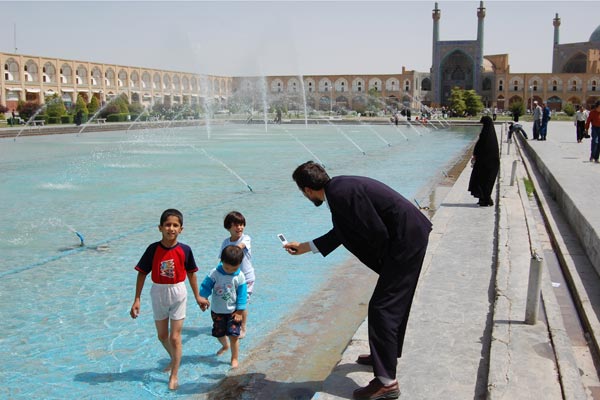
After prayer service at the mosque, a proud dad grabs a photo of his children with his cell phone.
Enlarge photo
Thirty years later, the former American embassy is still lined with political posters struggling to provide Iranians with an enemy.
Enlarge photo
Being an American makes you the most popular kid in the village.
Enlarge photo
Iranians see a world dominated by the USA and are told not to like it.
Enlarge photo
“Death to Traffic!”
Enlarge photo

I’m working in Iran, part of the “axis of evil” (as defined by my president) in a land whose own president leads chants of “Death to America.” This has me thinking about bombast and history.

Of course the word “axis” conjures up images of the alliance of Hitler, Mussolini and Hirohito that our fathers and grandfathers fought in WWII. Many locals in each country believe that each president maintains his power only by his ability to stir the simplistic side of his electorate with such bombast.

Bombast hogs the headlines, skewing understanding between the mainstream in each country. If the typical American knows anything about the Iranian president, Ahmadinejad (whose name I cannot pronounce), it’s his recent comments about gays and the Holocaust (which, I would imagine, was designed to shore up his political base). The buzz lately in Iran about the American election is what McCain (who famously rewrote the lyrics of the Beach Boys classic song, “Barbara Ann,” to become “bomb bomb bomb, bomb bomb Iran”) or Hillary (who recently said she would annihilate Iran if it attacked Israel) would do if elected president.

And as I explore and experience this country, I can’t avoid the hateful images and slogans. Like our children start each school day pledging “allegiance to one nation under God,” Iranian kids chant hateful slogans against the Great Satan and its 51st state, Israel. Rather than marketing products to consume, billboards sell a political/military/religious ideology. They glorify heroes who died as martyrs, taunt the US, show the stars and stripes of Old Glory made of Stars of David and falling bombs, and so on.

I try to make sense of the fearmongering and billboard hate, which mixes with huge smiles and welcomes. People greet me with a smile. Invariably, they ask where I’m from. I often say, “You tell me.” They guess and guess, running through 9–10 countries before giving up. Finally I say “America” and they are momentarily shocked, thinking, “I thought Americans hate us. Why would one be here like this?” Their smile leaves their face. Then a bigger smile comes back as they say “Welcome!” or “I love America.”

In a hundred such interactions in ten days in Iran, never once has my saying “I am an American” resulted in anything less than a smile or a kind of “Ohhh, you are rich and strong,” or “People and people together no problem, but I don’t like your president.” It’s clear to me that Iranians like our president as much as Americans like Iran’s.

It’s ironic that in most countries these days, Americans find they’re better off keeping a low profile. But here, in a country I’m told hates me, my nationality has been a real plus — absolutely everywhere I’ve gone. By the way, our government guide has not stopped me from going anywhere or talking to anyone. We haven’t been able to film just anywhere, but I’ve been free to roam about on my own without him and have fun connecting with locals. And I have absolutely never traveled to a place where I had such an easy and enjoyable time connecting with people. Young, educated people speak English. Locals were as confused about and fascinated by me as I was about them.

I think that, from an Iranian perspective, Iran is to Hezbollah as the US was to the Contras. (Supporters of Israel and the Sandinistas would find both Hezbollah and the Contras evil.) Everyone here understands that the Iranian president is more extreme than their supreme leader, Khamenei (the Ayatollah Khomeini’s successor). However, the supreme leader is more powerful than the president. All over town, you see posters and quotes from Khamenei…never the president.

The Iranian president has a kind of Hugo Chavez notoriety around the West for his wild ideas: “Death to Israel,” and “The Holocaust didn’t happen,” and “We have no homosexuals” and so on. He is an ideologue. His ideas make sense to him as does his bombast. He believes that since Germany killed the Jews, Germany should now house them. He doesn’t see the rationale of displacing Palestinians to provide Israel a homeland because of Germany’s genocide against the Jews.

In our hotel last night, I saw a short news documentary on Al Jazeera. Even without understanding the language, the images spoke powerfully. They showed the towering American-funded wall being built today in Palestine concrete block by concrete block…literally blocking the sunshine from Palestinian communities and making them look and feel like corralled animals. Anyone watching this with an empathy for Palestinians (i.e. the entire Muslim world — a billion people) would be charged with angry emotions.

While the Iranian president solidifies his political base by saying “Death to Israel,” his unwavering policy is that when Palestine accepts the existence of Israel, Iran will too.

We stop at the former US Embassy, which hosted the 444-day-long hostage crisis still so profound in the minds of many Americans. (For many who are angry with me for visiting our “arch enemy,” that 30-year-old media circus remains the defining event in their mindset toward Iran. It seems that because of this national humiliation, they consider it unpatriotic for a citizen like me to come here as an ambassador of understanding and goodwill.)

Our guide is almost proud to let us walk the long wall of anti-American murals. He encourages us to film it, making sure we know when the light is best for the camera.

As a gang of revolutionary students captured the world’s attention by insulting the US, this was a great moment for Iran. But that was 30 years ago — and today, most Iranians weren’t even born yet, and they seem happy to let the murals fade in the sun.

As we were struggling to drive away in a horribly congested street, our guide made a telling aside. He declared, “Death to traffic.” Then he said, “Because we can do nothing about this traffic, we can all say ‘Death to Traffic’.” Did he mean kill all those drivers that were in our way? Does Iran really mean death to the US and Israel? Or is it a mix of international road rage, fear, frustration — and the seductive clarity of a catchy slogan? This quirky cultural trait might be worth looking into and trying to understand.

All I’ve got to say is, “Death to hatred and militarism based on misunderstanding, fear and national pride.”

(By the way, I was in Iran for ten days earlier this month and have so many ideas to report on that my entries are lasting longer than my trip. While I will continue reporting my Iranian experiences for a few more days, I am no longer there. From Iran, I flew to Italy to continue my research trip, which will be followed by Germany and Paris before flying home in mid-June. Thanks for traveling with me via this blog. — Rick)

Friday: Go to Prayer

As everyone bowed in prayer, they revealed security soldiers and a Death to Israel poster.
Enlarge photo
Isfahan’s great Imam mosque is both a tourist attraction and a vibrant place of worship.
Enlarge photo
After the service, the cleric was eager to talk with us.
Enlarge photo

We were in Iran for one Friday, the Muslim Sabbath, and made a point to go to a prayer service.

Filming in a mosque filled with thousands of worshippers required permission. Going behind the scenes at the mosque to explain our needs with administrators there, it hit me that this Islamic Revolution was the equivalent of a communist takeover. (It seemed power was maintained by placing partisans in key positions.) But the ideology they were protecting was not economic (as in the days of the USSR), but religious.

President Mahmoud Ahmadinejad (who, like the artist formerly known as Prince, has a name I cannot pronounce) has inspired a fashion trend in Iran — simple dark suit, white shirt, no tie, light black beard. To get permission to film, we entered a mosque administration office where all the men we encountered dressed the part and looked like the president.

To video the service — which was already well under way — we were escorted in front of 5,000 people praying. I felt self-conscious, a tall blond American tip-toeing gingerly over the little stones men place their heads on when they bend down to pray. As my brain wandered (just like it sometimes does at home when listening to a sermon), I felt all those worshippers were looking at me rather than listening to their cleric speaking. Planting our tripod in the corner, we observed and filmed.

I closed my eyes and let the smell of socks remind me of mosques I’d visited in other Muslim countries. I pulled out my little Mecca compass, the only souvenir I’ve purchased so far. Sure enough, everyone was facing exactly the right way. Watching all the worshippers bow and stand, and chant in unison, at first seemed menacing to me. Then I caught the eye of a worshipper having a tough time focusing. He winked. Another man’s cell phone rang. He answered in a frustrated whisper as if saying, “Dang, I should have turned that thing off.” The mosaics above — Turkish blue and darker Persian blue — added a harmony and calmness to the atmosphere (just as our guide had explained earlier).

I realized that the Muslims I’d seen worshipping on TV may have been edited by film teams with an agenda to make the fervent worship of non-Christians look threatening. I made a point to see it as if it were my own church just north of Seattle.

What was intimidating was the need for soldiers to stand guard, standing like statues in their desert-colored fatigues. When the congregation stood, you didn’t notice them, but when all bowed, the soldiers remained standing, a reminder that the world was dangerous…especially in mosques. I asked our guide what a brightly painted mural above the worshippers said. He answered, “Death to Israel.” (The topic of my next entry.)

Except for the troubling injection of politics, I was struck by the similarities of this worship service: the too-long sermon, the “passing of the peace” (when everyone greets the people around them), the convivial atmosphere just after when people line up to shake the hands of the cleric, and the fellowship as everyone hangs out in the courtyard. On our way out, I shook the hand of the young cleric — short, slight build, trim Islamic Revolution—style beard with a tight white turban, big teeth and a playful smile.

In the courtyard, a man hit the branches of a mulberry tree with a pole as kids scrambled for the treasured little berries. The cleric with the big smile engaged me in a conversation—we joked about separation of mosque and state, and how it might help if his president went to my town for a prayer service and my president came here. Esfahan TV was televising the prayer service. Their crew saw us here and wanted an interview. It was exciting to be on local TV. They asked why we were here, how I saw people, why did I figure there was a US-Iran problem (I pointed to the “Death to Israel” poster for starters). They fixated on how I’d spin my footage and if it would actually be aired. Throughout our trip, we found people assuming we were collecting images to be edited in a negative way to show Iran as scary.

Leaving the mosque, we considered the clips we just shot and pondered how they could be cut and edited to appear either menacing or heartwarming — depending on our agenda. We considered how what we had just shot could be edited with guerillas leaping over barbed wire and so on to be frightening, and how our film crew would instead focus on the men with warm, cute faces praying with their sons at their sides, and the children outside scrambling for mulberries.

It occurred to me that the segregation of the sexes — men in the center and women behind a giant hanging carpet at the side — contributes to the edginess of it (and the fear and anger many Western Christians feel toward Islam). Then I considered how male-led Christian services could also be edited to look threatening. At important Roman Catholic Masses you’ll see a dozen priests — all male — in robes before a bowing audience. The leader of a billion Catholics is chosen by a secretive, ritual-filled all-male gathering of guys in strange hats and robes with chanting and flinging of incense. It could be filled with majesty or menace…depending on what you want to show and what you want to see.

When we visited this huge mosque the day before, all I had seen was a lifeless shell with fine tiles for tourists to photograph. An old man stood in the center of the floor and demonstrated the haunting echoes created by the perfect construction. Old carpets were rolled up and strewn about like dusty cars in a haphazard parking lot. Today the carpets were rolled out, cozy, and lined with worshippers. By the time we left, they were rolled up and strewn about again.

After the prayer service, we set up to film me across the vast square from the mosque. My lines were memorized and I was ready to go. Then, suddenly, the cleric with the beaming smile came toward us with a platter of desserts — the local ice cream specialty — like frozen shredded wheat sprinkled with coconut. I felt like Rafsanjani had just interrupted my work to serve us ice cream.

Enjoying his treat, we continued our conversation. He said Khomeini had charisma and if he walked into a room even me, a non-Muslim, would feel it. His successor, today’s supreme leader of Iran (whose power trumps the president’s) has much less of an impact on the people. Shiite Muslims might miss Khomeini like Catholics miss John Paul II.