Naples: Blood for a Dying Baby and the Ultimate Sandwich Show

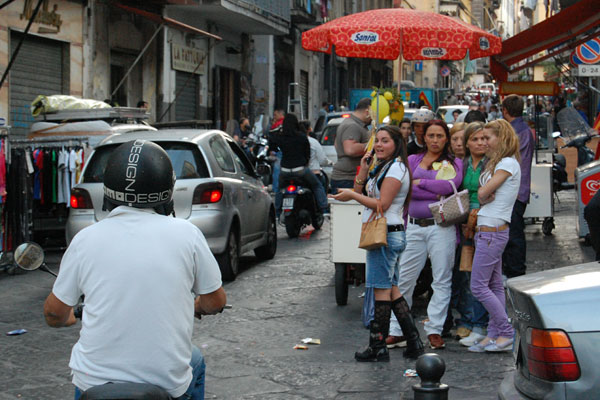
Girls flirt with passing motorcyclists in Naples’ Spaccanapoli District.
Enlarge photo
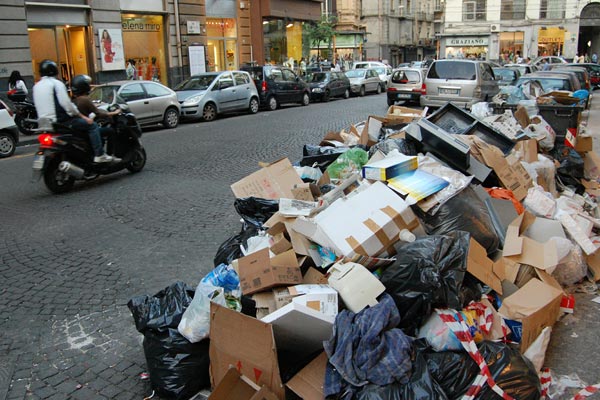
Garbage takes up valuable parking real estate.
Enlarge photo

All my life, Naples has been the symbol of chaos, stress, and culture shock for European travel. I remember my first visit (as a wide-eyed 18-year-old). Gene and I stepped off the train into the same vast Piazza Garibaldi that 35 years later still strikes everyone who visits as a big paved hellhole. On that first visit, a man in a white surgeon’s gown approached me and said, “Please…we need blood for a dying baby.” Gene and I made a U-turn, stepped back into the station, and made a beeline for Greece.

Now I’m flying here from Iran (after a quick change in Paris). And, coming from Tehran, Naples is a model of order and sanity.

But coming from anywhere else in Europe, Naples remains uniquely thrilling. One of my favorite sightseeing experiences anywhere in Italy is simply wandering the streets of Naples. I spent an hour and probably a hundred photos just observing the teens on motorcycles in the vertical neighborhoods of the Spaccanapoli district.

Every few steps, a couple of James Dean-cool guys lean against lampposts while three or four girls straddling the same motorbike would cruise by as if playing Neapolitan Idol.

Everyone who knew I was going to Naples seemed to be obsessed with the garbage strike. Minibus-sized mountains of garbage were parked on the curb every couple blocks. It’s easy to make a big newspaper stink about it, but locals seemed to just hold their noses and know that someday this little piece of Naples chaos, too, would be dealt with. I smelled nothing.

In the spirit of finding cheap eats near major sights for my guidebook readers, I walked behind the Archaeological Museum in Naples and met exuberant Pasquale — owner of the tiny Salumeria Pasquale Carrino. Rather than do the cheapskate “how much?” question, I just let fun-loving and flamboyant Pasquale make me his best sandwich. He turned making a sandwich into a show, and I watched, enthralled.

Demonstrating the freshness of his rolls as if squeezing the Charmin, laying a careful pavement of salami, bringing over the fluffy mozzarella ball as if it were a kidney transplant, slicing a tomato with rapid-fire machine precision, and then lovingly pitting the olives by hand and then hanging them like little green paintings on a tasty wall, he finished it all off with a celebratory drizzle of the best oil. Five euros (less than $8) and a smile later, I had my cheap lunch. Saying goodbye to Pasquale, I tried to explain to him that he’d be giving this sandwich show to lots of American visitors next year, and stepped outside to look for a suitable bench upon which to enjoy my lunch.

(Salumeria Pasquale Carrino is 100 yards from the Archeological Museum–as you leave take two rights and a left to Via Salvator Rosa 10, tel. 081-564-0889, closed Sun.)

Tight Pants, Necklines, Booze…and Freedom

Enlarge photo
Enlarge photo
Enlarge photo
Enlarge photo
Enlarge photo

For some reason, planes leave Iran for the West in the wee hours. My departure was at 3 a.m. My crew caught a flight two hours earlier. My guide went home. I was groggy and all alone. While eager to leave, I was savoring every last impression before flying exactly the opposite route the Ayatollah flew as he returned home to toss out the shah.

Walking down the jetway to my Air France plane at Tehran’s Ayatollah Khomeini Airport, I saw busty French flight attendants — hair flowing freely — at the plane’s door. It was as if they were pulling people symbolically back into the Western world. As though the plane were a lifeboat, people entered with a sigh of relief. Women pulled off their scarves…and suddenly we were all free to be what to us was so “normal.”

For ten days, I was out of my comfort zone in a land where people live under a theocracy — a land that found different truths to be god-given and self-evident. I tasted not a drop of alcohol (Islam is dry). I never encountered a urinal (Islamic men squat). Women were not to show the shape of their body or their hair (they were beautiful nevertheless). And people took photos of me, as if I were the cultural spectacle.

On my first day back in Europe, I noticed hair, necklines, and tight pants like never before. I sipped wine as if it were heaven-sent. And, standing before that first urinal, I was thankful to be a Westerner.

Paris seemed designed to accentuate the cultural differences. When I saw a provocatively dressed woman — tattooed breast barely covered by a black-lingerie top — I kind of missed the thrill of a little extra hair on the forehead of a chador-clad woman. University students sat at outdoor cafés, men and women mingling indiscriminately, discussing whatever hot-button issue interested them. Out of Iran and back in the West, I felt an energy and a volume and an efficiency that is cranked up. People — not on the valium of a revolution of values — are free to be “evil.”

Of course, I would never choose to live according to the Islamic Revolution. But I gained a respect for people who are living what they call a ‘values revolution” — a respect that I could only understand by actually traveling there. And I overcame a fear that plagues many who’ve yet to visit Iran.

What do I conclude from this experience? If I were to make any judgment on their theocracy, it would be to point out the irony of a society that is aggressively theocratic, yet actually seems less spiritual than a neighboring, secular Muslim nation — Turkey, where five times a day it’s hard to walk down the sidewalk because mosques are overflowing with people praying.

All the “death to America” and “death to Israel” posters Westerners fixate on are impossible to defend. But I will say they seemed very incongruous with the people I met. It made me wonder if the penchant for Iranians to declare “death” to so many things is not so different from Westerners who exclaim “damn those French” or “damn those cowboys” or “damn this traffic jam.” Even though this actually means “die and then burn in hell”…of course we don’t mean it literally.

There’s a lot of debate between our two nations about who’s right and who’s wrong. Many who comment on this blog seem to know. Some issues (such as the wrongness of denying the holocaust) seem clear-cut. But, as I leave Iran, I’m not convinced that everything is so straightforward. Politicians come and go…but people are here to stay. I leave thankful that I don’t live in Iran. Yet I believe the vast majority of Iranians — regardless of what they think of their current government — would choose to live nowhere else.

After this experience, I’m reminded of the fundamental value as well as the simple fun of travel. When we travel — whether to a land our president has declared part of an “Axis of Evil,” or just to a place where people yodel when they’re happy or fight bulls to impress the girls or can’t serve breakfast until today’s croissants arrive — we enrich our lives and better understand our place on this planet. It’s my hope that with people-to-people connections, we can overcome our fear and mistrust of each other, and, at a minimum, learn to co-exist peacefully. And that gives me and my partners here at ETBD meaning in our work. Thanks for traveling with me via this blog through Iran. I hope you enjoyed the journey.

Martyrs’ Cemetery: Countless Deaths for God and Country

In Iran, every city has a martyrs’ cemetery.
Enlarge photo
The tombs of the unknown soldiers give mothers whose sons were never found a place to grieve.
Enlarge photo
How has the loss of this boy’s father shaped his world view?
Enlarge photo
Could be anywhere: A mother and her son.
Enlarge photo

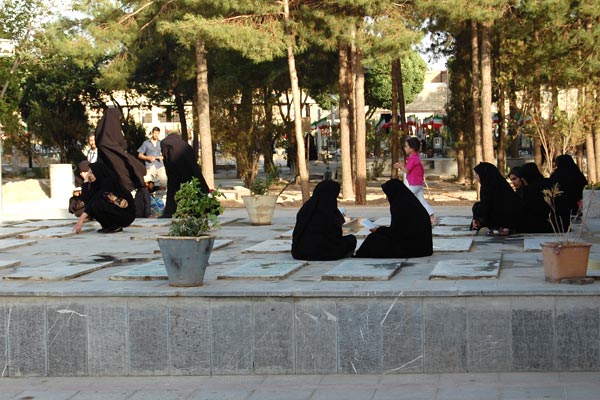
One of the most powerful experiences of our Iranian trip was a visit to a martyrs’ cemetery. War cemeteries always seem to come with a healthy dose of God — as if dying for God and country makes a soldier’s death more meaningful than just dying for country. That is certainly true at Iran’s many martyr cemeteries. While there are no solid figures, most estimates are that there were over a million casualties in the Iran-Iraq War. Each Iranian city has a vast martyrs’ cemetery.

Iran considers anyone who dies defending the country a martyr and a hero. At the Esfahan cemetery, tombs seemed to go on forever, and each one had a portrait of the martyr and flew a green-and-red Iranian flag. A steady wind blew on the day of our visit, which added a stirring quality to the scene. And the place was bustling with people — all mourning their lost loved ones as if it happened a year ago rather than twenty. The cemetery had a quiet dignity, and — while I felt a bit awkward at first (being part of an American crew with a big TV camera rolling) — people either ignored us or made us feel welcome here.

We met two families sharing a dinner on one tomb. (One of the fathers insisted we join them for a little food.) They met each other twenty years ago while visiting their sons — who were buried side by side. They became friends, their surviving children married, and they come regularly to share a meal on the tombs of their sons.

A few yards away, a long row of white tombs stretched into the distance, with only one figure interrupting the visual rhythm the receding tombs created. It was a mother cloaked in black sitting on her son’s tomb — a pyramid of maternal sorrow — praying.

Nearby was a different area — marble slabs without upright stones, flags, or photos. This zone had the greatest concentration of mothers. My friend explained these slabs marked bodies of unidentified heroes. Mothers whose sons were never found came here to mourn.

I left the cemetery sorting through a jumble of thoughts:

  • How oceans of blood were shed by both sides in the Iran-Iraq War — a war of aggression waged by Saddam Hussein and Iraq against Iran.
  • How this mighty and historic nation’s national museum of archeology in Tehran was so humble (when I asked about this, the curator explained that the art treasures of his country were scattered in museums everywhere but in Iran).


  • How an Iranian woman had crossed the street to look me in the eye and tell me, “We are proud, we are united, and we are strong. When you go home, please tell the truth.”


  • How this society — all the delightful little shops, young people with lofty career aspirations, gorgeous young adults with groomed eyebrows and perfect nose jobs, hope, progress, hard work, and gentle people I met over ten days in Iran — could so easily and quickly be turned into an Iraq-style hell of dysfunctional cities, torn-apart families, wailing mothers, newly empowered clerics, and radicalized people.


My visit to the cemetery drove home a feeling that had been percolating throughout my trip. There are many things that Americans justifiably find outrageous about the Iranian government — from denying the Holocaust and making threats against Israel; to oppressing women and gay people; to asserting their right to join the world nuclear club.

And yet, no matter how strongly we want to see our beliefs and values prevail in Iran, we need to understand the 70 million people who live here. What if the saber-rattling coming out of Washington (and the campaign trail) doesn’t coerce this country into compliance? In the past, other powerful nations have underestimated Iran’s willingness to be pulverized in a war…and both Iran and their enemies have paid the price.

In the coming months and years, I believe smart and determined diplomacy can keep the Iranians — and us — from having to build giant new cemeteries for the next generation’s war dead. That doesn’t mean “giving in” to Iran…it means war is a failure and we need to find an alternative. If this all sounds too idealistic, or even naive…try coming to Iran and meeting these people face-to-face.

Snippets from Our Iran Script

Our shooting is finished, our crew is home, and now we set about to editing all the footage into a one-hour TV special. Without telling you all the details of our show, here are some excerpts from the script that (especially if you can imagine the gorgeous footage we captured to illustrate these words) I hope will give you that Iranian sense of place:

[1 OC (on camera)] Hi, I’m Rick Steves — in what just might be the most surprising and fascinating land I’ve ever visited. We’re in Iran — here to learn, to understand, and to make some friends. Thanks for joining us.

[3 OC] Like most Americans, I know almost nothing about Iran. For me, this is a journey of discovery. What’s my hope? To enjoy a rich and fascinating culture, to get to know a nation that’s a leader in its corner of the world (and has been for 2,500 years), and to better understand the 70 million people who call this place home.


[9 with POVs from car, motorcycle taxi, pedestrian crossing] Traffic is notorious here. Drivers may seem crazy, but I was impressed by their expertise at keeping things moving. Many major streets actually intersect without the help of traffic lights. It’s different…but it works. Helmet laws are ignored. To get somewhere in a hurry, motorcycle taxis are a blessing. But wear your helmet. I’d rather leave a little paint on passing buses than a piece of scalp. Pedestrian fend for themselves. Crossing the street is dangerous. Locals say it’s like “going to Chechnya.”

[10 general chaos cut-aways] Just wandering the teeming streets here is fascinating and endlessly entertaining. And having survived Chechnya, I’m ready to celebrate with a refreshing local treat.

[11] This isn’t just any ice cream sandwich — it’s got rose water, saffron, and pistachios…a Persian specialty.


[14, face montage] Of Iran’s 70 million people, about two-thirds are under 30. People are mostly Persian. While there are minorities, we’ll focus on Persian population. The local ethnicity reflects the turmoil of its 2,500-year history. Local blood comes with Greek, Arab, Turkish, Mongol, Kurdish, and Azerbaijani influence. These are not Arabs, and they don’t speak Arabic. They are Persians and they speak Farsi. This is an important issue with the people of Iran — don’t call them Arabs. Each face seems to both tell a story and beam with warmth…especially when they see a film crew from the USA. We found that the easiest way to get a smile was to tell people where we’re from.

[16 OC] Another communication challenge: people here need to keep track of different calendars: Persian and Muslim (for local affairs), and Western (for dealing with the outside world). What’s the year? It depends: After Muhammad — about 1,390 years ago, or after Christ — two thousand and some years ago.


[23] Walking the streets of any city here, it’s clear that Iran is ruled by a theocracy. They may have a president, but the top cleric, a man called “the supreme leader,” has the ultimate authority. His picture — not the president’s — is everywhere. Religious offering boxes are on every street corner. The days when the shah’s men boasted Iranian mini-skirts were shorter than those in Paris are long gone.

[24] While the Islamic Republic of Iran is a theocracy rather than a democracy, I was surprised at the general mellowness of the atmosphere compared to other Muslim countries. I barely heard a call to prayer. Skylines aren’t broken by minarets. And — except for women’s dress codes and the lack of American products and businesses (because of the US embargo on Iran) — life on the streets here is much the same as in secular cities elsewhere.


[41 Isfahan] Isfahan, with 1.6 million, is a showcase of ancient Persian splendor. One of finest cities in Islam and famous for its dazzling blue-tiled domes and romantic bridges, the city is also just plain enjoyable. I’m not surprised that in Iran, this is the number one honeymoon destination. Isfahan is the cultural heart of Iran. School groups come from all over the country to appreciate their roots. Iranians come to connect with their heritage and celebrate it.

[43] The Chehel Sotoun Palace is a vivid reminder that Isfahan was the capital of Persia 400 years ago. With its reflecting pool, fine gardens, and portico of twenty delicate wooden columns, this gives you a sense of Persia’s 16th- and 17th-century Golden Age.

[44] Stepping inside, you are struck by the elegance and grace of Persia at its zenith. Tender dancers, flowing hair, dashing moustaches, and sumptuous riches, it comes across in these fine paintings.

[45] Frescoes in its grand hall tell how the shah maintained, defended, and expanded his empire. Here the shah and his troops quell a revolt against his rule by the Uzbekis. Then, defending his empire, the shah battles the Ottoman Turks — with their frightening new artillery — and manages to stop their eastward juggernaut. Waging what I would imagine was very high-powered diplomacy, the shah threw extravagant banquets in this very palace. Here Turkmans, of today’s Turkmenistan, were treated to wine, women, and song — with traditional Persian instruments. The dancing girls that worked up a thirst…and a refreshing watermelon. And in this banquet, the shah of Persia welcomed the emperor of India with a similar lavish banquet…and then, a century later, the shah invaded India anyway.


[53 cemetery] Whatever the root causes — faith or nationalism — the Sunni and Shiite Muslims share a bloody past. And the killing continues. Like cities throughout Iran, Isfahan has a cemetery dedicated to the 400,000 martyrs — as anyone who dies in a religious or national war is called — of the Iran/Iraq War. All the portraits and all the dates are from 1980 to 1989. Over two decades later, the cemetery is still very much alive with mourning loved ones. While the United States lives with the scars of Vietnam, the same generation of Iranians live with the scars of their war with Iraq — a war in which they, with one quarter our population, suffered six times the deaths.

[54] We meet two families sharing a meal at a grave site. They each lost a son in the war. They met here at the cemetery nearly twenty years ago and became friends. Their surviving children married. And they’ve shared memorial meals together here at the tombs ever since.


[88] Traveling through Iran teaches many things. This ancient land is a complex center of many civilizations through the ages. All along the way we met people: warm hospitality, spontaneous, gregarious, and curious. While they generally didn’t like our government, they seemed inclined to genuinely like Americans. Just like my country, there’s a dominant ethnic group and a dominant religion, with plenty of ethnic and religious diversity at the same time. And just like my country, there’s a not-always-graceful synthesis of influences: modern and traditional, liberal and conservative, secular and religious. Like in my hometown, people of great faith are threatened by people of no faith or a different faith. And, as with my neighbors, in the interest of being close to God, people of great faith treasure their time-honored rituals as a defense against the onslaught of modern materialistic society that threatens the moral fabric of their society.

[89 OC] I came to Iran a little nervous. I leave struck more by what we have in common than by our differences. I’ve overcome my fear by getting to know the Iranian people. Granted, there’s no easy solution to the problems confronting our two nations. But surely getting to know this culture is a step in the right direction. I’m Rick Steves. Happy travels…and as they say here, “May peace be upon us.”
Making Friends with my Iranian Guide

My reach is longest as two narcissists burn under the Persepolis sun. And wait, what’s that camera in the background?
Enlarge photo
Whenever we filmed a place of commercial or religious importance a plain clothes security guard would appear. Seyed would earn his pay by explaining who we were and what we were doing. It wasn’t always easy as different branches of the Iranian government don’t work entirely in sync (perhaps like different branches of American intelligence).
Enlarge photo
Seyed was expected to follow that big camera wherever it went. Zipping through the chaotic traffic to show the “point of view” of Rick on a motorcycle taxi? Hang on tight and follow that bike.
Enlarge photo
Our government guide, Seyed, documents our shoot on his tiny camera.
Enlarge photo

Here is a short email back-and-forth I had with our Iranian government guide, which I thought might be of blog interest. Seyed must be the top Iranian government guide (he accompanied Ted Koppel on his recent Iranian shoot). He was with us from start to finish. I wish you could hear his voice (as I can) in his writing:

To: Rick Steves Subject: Thanks from Tehran Iran, Seyed is sending you his best wishes

Dear Rick, I hope you and your family are well. I am following your web blog and I enjoy your comments and also the comments of your fans. I am so glad you had the interest in Iran and writing and caring about my country, Iran.

I am going to take my group to Italy next month so I meant to ask some of your advice if possible please. Unfortunately we do not get much American tourists at the moment, but I hope after your video about Iran comes out, then more American people will decide to come to Iran so that I myself will have more jobs and also all my colleagues will have jobs and Iranian people, not Iranian government, will enjoy the benefit of it.

I hope that people who comment on your web blog get and understand the reality that I as a tour guide have never misled you or misinformed you. As you saw, I have been honest and loyal to you and have answered all your questions according to my knowledge and plus that as I have said before I am not a government guide. But if you insist on calling me your government guide then go ahead please, no problem, call me as you wish.

I hope that some day I can come over to America and give some speeches in some universities and tell American public more facts and reality about Iran, so that we can have more understanding from each other.

My best wishes for you and your family and Simon and Karel and Abdi. It really was a great honor for me to be able to work with you and learn from you. As you said when you were in Iran, we have our differences, but it does not mean we have to change each other, but we can have respect for one another. Thanks for your friendship.

Yours,

Seyed

Seyed Rahim BATHAEI


Hi Seyed,

Thanks for the kind email. I have been so inspired by my learning experience with you in Iran. I am glad you are following the blog. It is interesting…so many the comments! People have strong feelings. I am thankful for your help and I agree you never misled us. In fact, you were the one who opened so many doors. I hope we can stay in communication. Would it be okay with you if I put your email on my blog?

Rick


Dear Rick,

Thanks for your so kind and so fast e mail. I think you are a superman and I am jealous of you how hard you work and how you take your job seriously and I think that is why you are a successful businessman and producer. That is something I like about Americans, the hard work. I did not tell you that once some years ago I tried to start a small business, but later I became bankrupt because I could not work hard enough and my mind was not a business wise mind so I failed. But I learnt some good lessons from you this time.

About putting my email in the blog, as you know my answer always is yes, as you saw I like publicity. I am so open for socializing with people and talking to people and even getting criticized and listen to criticism. It is OK to show my pictures and video and name and email and everything. As a mater of fact, some of my American tourists who have come to Iran and I have been their tour guide had seen your blog and noticed my picture there and they emailed me about it.

Even I know some of the commenters in the blog. And as we talked about my big wish is to become a commentator in the US TV morning shows and talking about politics. Of course I only mentioned I want to be in Hollywood which was a joke, but in fact I like to talk on TV shows, which I am working toward by appearing in documentaries, thanks to your video too, I will be one step closer.

I hope some day you start your tours to Iran and I can be the tour leader for your groups to Iran. My best wishes for you and your family.

Yours,

Seyed