Anglican Ritual, Snuff, and Meat Loaf in Bath

Shaking off my umbrella, I stepped into my room exhausted after a long day in Bath, England. Blowing my nose, I noticed a spray of red dirt on the Kleenex…and I remembered the snuff.

Paul, who runs the Star Inn — the most characteristic pub in town — keeps a tin of complementary snuff tobacco on a ledge for customers. I tried some, and — while a drunk guy from Wales tried to squeeze by me holding two big pints of the local brew over my head — I asked Paul about it. He said English coal miners have long used it because cigarettes were too dangerous in the mines, and they needed their tobacco fix. Paul wanted me to take the tin. I put it back on the ledge and said I’d enjoy it the next time I stopped by.

Walking home through the English mist, I reviewed my day backwards. I was pleased that even by just researching B&Bs, restaurants, and pubs in one of the most cutesy and touristy towns in Britain, my day was filled with memories.

School’s out and, while I’m heading home, the streets are filled with young kids partying. English girls out clubbing wiggle down the street like the fanciest of fish lures — each shaking their tassels and shimmying in a way sure to catch a big one. As one passed me, eyeing a gaggle of guys smoking outside a pub, I overheard her saying, “No spray, no lay…no cologne, you go home alone.”

The rock star Meat Loaf was playing a big concert in the park, and during his performance, much of Bath rocked with him. While the concert was sold out, I gathered with a hundred freeloaders craning their necks from across the river for a great view of the stage action.

The musical highlight of my day, however, was a worship service at the Bath Abbey. Earlier I had logged onto www.bathabbey.org, and — bam! — the day’s schedule was right there: Sung matins service at 11:00, visitors welcome.

I’ve noticed that any on-the-ball B&B or guesthouse these days provides free Wi-Fi for guests, and more and more travelers are carrying laptops or handheld computers to get online. I need to be better about using the Internet — it’s how today’s travelers book and buy things like train tickets while on the road.

The Anglican service was crisp, eloquent, and traditional. I was struck by the strong affirmation of their Catholic heritage, the calls for sobriety, and the stress on repentance (repeated references to how we are such wretched sinners). “Knife violence” (by gangs in the streets), which has replaced fear of terrorism as the main threat to communities in England, was a subject of prayers.

The Anglican worship ritual is carefully shuttled from one generation to the next. That continuity seemed to be underlined by the countless tombs and memorials lining walls and floors — worn smooth and shiny by the feet of centuries of worshippers. With the living and the dead all present together, the congregation seemed to raise their heads in praise as sunlight streamed through windows. (Bath’s particularly bright church is nicknamed “the Lantern of the West” for its open, airy lightness and huge windows.)

Glowing Bath stone columns sprouted honey-colored fan vaulting fingers, and cherubic boys in white robes and ruffs (old-time ruffled collars) filled the nave with song — making it a ship of praise. The church was packed with townsfolk, proper and still. Sitting among them, I was no longer a tourist. The scene felt timeless. I gazed at the same windows for the same inspiration that peasants sitting on these pews centuries ago sought.


Local volunteer guides still bring the wonders of Bath to life.
Enlarge photo

The sermon was about Christian servanthood. The pastor’s stern comment about the USA took me by surprise: “If, after 9/11, that great Christian nation, the USA, took its responsibility to be a servant among nations seriously, how different our world would be today.” When he was finished and the offering plate was passed, his gentility also caught me off guard: “If you’re a visitor, please don’t be embarrassed to let the plate pass. It’s a way for our regular members to support our work here at the Bath Abbey.”

After the choir paraded out, the huge central doors — doors I didn’t even realize existed — were opened. Indoors and outdoors mingled, as the congregation spilled out onto the main square.

Bath is an expensive town in an expensive country. A young couple hired to manage an elegant Georgian guesthouse I recommend told me they took the gig just to live in Bath. (“Work-a-day English can’t really afford to live here.”) They have an apartment in the basement, but enter through the grand front door just to marvel at the elegant building they live in and manage.

I started my day joining a gaggle of curious visitors in front of the Abbey, where five of a club of 60 volunteer guides divided up the gang and proceeded to take them on a free town walk. My guide, a retired schoolteacher, explained that in 1930 the town’s mayor — proud of the charms of his historic town — took the first group gathered here on a free town walk…and “the mayor’s honorary corps of volunteers” has been leading free walks daily ever since.
Spanking Each Other’s Lederhosen Shiny

After a few months of denial when it comes to the impact of our weak dollar on travel, I have to admit that I’m finding fewer Americans on the road. And at many sights that were notorious for crowds and delays, visitors no longer have to be as concerned about how to get in without a long wait. As I update my guidebooks, I find myself deleting related tricks and warnings (such as recommending booking tickets to Mad Ludwig’s castles in advance). Part of the reason is fewer crowds. The other is smarter systems to move the masses through these popular sights.

It’s fun to see tourism evolving with our age. When I started traveling, the elegant nighttime “son et lumiere” (sound and light) shows were a huge deal. People would bundle up, pay a steep price, and sit under the stars on folding chairs. They’d watch colored spotlights light up the ruined arches of static, old sights, as a cast of grand and evocative voices thundered the history of that place.

Whether listening to the spirit of King Henry at a château on the Loire, Napoleon at Paris’ Les Invalides, great Greeks at the base of the Acropolis, the pharaoh at Giza, or Quetzalcoatl at the pyramids outside Mexico City, we would thrill to the sounds and lights bringing those stones to life. Nearly all those shows are now long gone.

In this fast-paced age, where special effects make “sound and light” shows as exciting as watching paint dry, traditional music shows are endangered as well. It’s much tougher than it used to be to find quality Norwegian or Scottish folk shows. Only in Ireland has traditional folk music stayed strong in pubs. And a good evening of slap dancing and yodeling in the Tirol is going the way of the hokey-pokey.

Rather than spanking each other’s lederhosen shiny, the people of Reutte, the town I often call home in Austria’s Tirol, seem more focused in maintaining their community for their families. As an example of how committed the town is to maintaining its character, real estate there can be sold only to those using it as a primary residence. The people of Reutte saw that many other formerly vibrant Alpine towns made a pile of money, but lost their sense of community, by becoming resorts. These towns allowed wealthy foreigners — who just drop in for a week or two a year — to buy up everything. Now streets of these towns are shuttered up and dead for most of the year, and these towns have forever lost their real vibrancy.

Boys and Castles

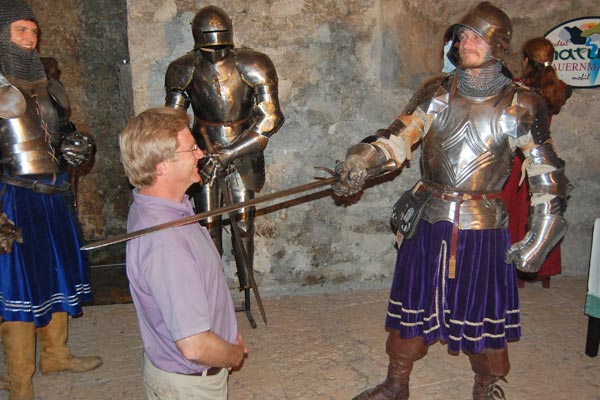
Sir Rick, the first knight of Ehrenberg
Enlarge photo
The sword of Sir Rick in its museum display case, Reutte, Austria
Enlarge photo
Architect Armin and guidebook writer Rick celebrate atop newly excavated and restored castle ruins
Enlarge photo
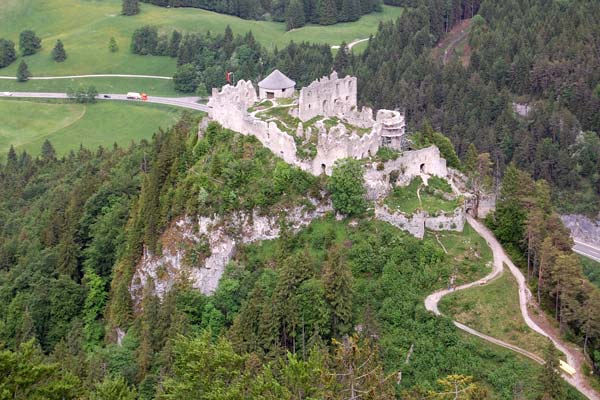
The Ehrenberg castle ensemble once guarded the Tirolians from the Bavarians
Enlarge photo

I was in Hohenschwangau. It was “Mad” King Ludwig’s dad’s castle — Ludwig’s boyhood home. The walls were all painted in 1835 by a single artist, giving the place a Tolkien-romance-fantasy feel. Ludwig became king as a boy. And rather than live with the frustrations of a modern constitution and feisty parliament reigning him in, he spent his years lost in romantic literature and operas…chillin’ with Wagner as only a gay young king could.

Nymphs lounged on his circa 1835 walls. Stars twinkled from the ceiling over his bed. A telescope was set up in Ludwig’s bedroom, trained on a pinnacle on a distant ridge where he could watch Neuschwanstein, his castle fantasy, as it was being constructed.

On my last visit, I peered through that telescope at Neuschwanstein– the castle that inspired another boy named Disney. I could relate to this busy boy king. Bound by schoolwork and house rules, and with a stretched-out turtleneck and zits rather than crowns and composer friends, I, too, built a castle.

What I had that Ludwig lacked was a father who imported pianos. They came from Germany, encased in tongue-in-groove pine, sealed in a thick envelope of zinc sheeting. My treehouse was my castle: no parents reining me in, walls decorated with romantic circa 1968 magazines, nails sticking down through the ceiling just long enough to keep out bullies taller than me. With my sliding tongue-in-groove panels, I could see who was coming. With a shiny zinc roof, it was the envy of other little kings. There was no tree house like it.

On my first independent trip to Europe, I was 18. It was just after someone had purchased the vacant lot next to our house, and I had to tear down my tree house (epic bad day). I toured “Mad” King Ludwig’s Neuschwanstein — a medieval castle dream. Then, just over the border in Austria, I found the Ehrenberg ruins–a medieval castle reality.

Just a mile outside of Reutte, Austria, are the brooding ruins of four castles that once made up the largest fort in Tirol — Ehrenberg. This impressive castle ensemble was built to defend against the Bavarians and to bottle up the strategic “Via Claudia” trade route that cut through the Alps here as it connected Italy and Germany.

One castle crowned its mountain like an ornery barnacle. The others were lost in a thick forest. I hiked up into the misty mountain of meaningless chunks of castle wall pinned down by pixie-stix trees and mossy with sword ferns. It inspired yet confused me. The barnacle castle was below. The ruins were on the bluff above. Like a big, hungry starfish sits on its food, this rotten military fantasy was being eaten by the forest.

A decade ago I met Armin Walch — a Reutte man with a vision. He was born the same year as me and pursued his project like the Indiana Jones of castle archeologists. Today — with European Union funding — he’s cut away the hungry forest, revealed and renovated what he calls the castle ensemble, created an interactive museum, and is open for business as countless children with medieval fantasies can, in turn, leap from rampart to rampart…sword ferns swinging. (See www.ehrenberg.at for details and photos.)

With my 2008 visit, we celebrated. The Reutte hoteliers and tourism folks gathered in the castle like some old-time city council. We ate rustic cheese and smoked game with coarse bread. We swilled wine and clinked pewter mugs.

I was honored for bringing so many visitors to this remote corner of Austria, and gave a magnanimous impromptu speech about the wonders of Americans climbing through history far from home. I knelt before a man in a coat of mail who drew a shiny sword with my name etched upon it and was knighted — Sir Rick, first knight of Ehrenberg. (With uncharacteristic modesty and characteristic insistence on packing light, I requested that my sword stay in the museum as a special exhibit to the former castle-loving boy who brought American tourism to Reutte with his guidebooks.)

On the way back to my hotel, Armin begged me to stop by his house for a drink. Behind his humble old town facade, this dynamic architect hid a sleek, futuristic, and creative pad. It was a royal domain for Armin and his family — two kids cozy on the carpet and a strikingly beautiful wife who Armin bedazzled at the university in Vienna and took to remote Reutte with promises of a princely life and a bitchin’ castle.

With a schnapps from local herbs — unique to Reutte — in hand, we climbed boyishly to his rooftop, where Armin had designed and built a viewing perch. The floodlighting was on. The mountain overlooking his town was crowned by a castle that, in his youth, almost no one knew even existed. With his pretty blond wife suddenly romantic wallpaper, Armin took me to his telescope. We marveled at his castle ensemble.

Munich, Where They Say Being Thirsty Is Worse Than Feeling Homesick

For several years, I’ve marveled at how Berlin has eclipsed Munich in urban energy. I was just in Munich, and now it seems to be comfortable just being itself rather than trying to keep up with Berlin.

After the last couple of years — with the elevation of Joseph Ratzinger (the local archbishop) to the papacy, Pope Benedict’s wildly successful visit, and hosting the World Cup — Munich seems revitalized and on a natural high.

And tourists love Munich. Legions of young expat tour guides are in a brutal battle for the tourist dollar. Here in the beer capital of Europe, tours start late — giving backpackers a chance to sober up. Feisty small walking and biking tour companies train guides who then split off and offer tours for free (and just ask for tips at the end of the gig).

I’ve tuned into bike tours in Europe this year, and I like them more than I thought I would. That’s partly because of competition driving prices down to literally zero. A guy named Lenny offers free tours every day from Munich’s main square — and he’s a fine guide. In general, the guides dumb down their lectures with lots of silly legends, and refer to the beloved Frauenkirche as the “church with the Pamela Anderson domes.” But they are introducing many visitors to a facet of Bavarian culture beyond its famed beer.

My favorite local guide joined me for an evening of restaurant visits. Heading for the Hofbräuhaus, I mentioned I’d love to give it some meaning. He thought that was funny and quoted Freud: “Sometimes a cigar is just a cigar.” We climbed to the beer-stained top floor hall where tour groups gather to pay €20 for an all-you-can-stomach buffet of traditional food and a yodel show. I did find some culture downstairs in the main and noisiest hall. The smoke-stained ceiling, repaired and repainted after WWII bomb damage, was an evocative mesh of 1950s German mod — Bavarian colors, chestnuts, food, drink, and music themes. And a slogan arcing across the ceiling above the oom-pah band read, Durst ist schlimmer als Heimweh(Thirst is worse than homesickness).

Wandering through the legions of happy beer-drinkers in the Hofbräuhaus, it occurred to me that, unlike with wine, more money doesn’t get you a better beer. Beer is truly a people’s drink, and you’ll get the very best here in Munich. Connoisseurs have their favorite brews — and to get it, they don’t pay more…they simply go to the beer hall that serves it.

Beer halls always impress me with their ranks of urinals. Munich had outdoor urinals until the 1972 Olympics and then decided to beautify the town by doing away with them. What about the people’s needs? The new law: Any place serving beer must admit the public (whether customers there or not) to use their toilets.

I struggled for a smooth transition from beer-hall toilets to a new synagogue and failed. Sorry.

Munich’s striking new synagogue is locked tight to the public, but it’s still worth a look for its powerful exterior — its lower stones are travertine, like the famous Wailing Wall in Jerusalem, and the upper part represents a tent that held the important religious ware during 40 years of wandering through the desert until Temple of Solomon was built, ending the Exodus. Today (because Germany has agreed to accept religious refugees from the former USSR), the Jewish population of Munich has finally reached pre-Nazi levels — 10,000. And Munich’s Jewish community is understandably enthusiastic about its impressive new center, with a synagogue, school, and museum.

The Pharaoh’s Buying Out the Nudists and Freak Waves Kill Tourists

Enlarge photo
Enlarge photo

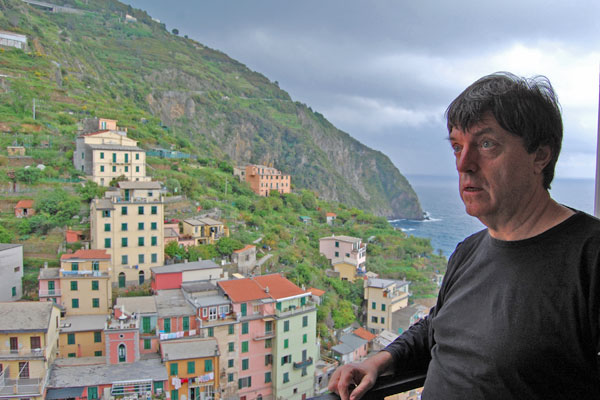
Sleeping on the train from Salerno to the Cinque Terre, I couldn’t stop thinking what a great job I’ve got: I was on a natural high after enjoying a wonderful guided tour of the Greek ruins at Paestum (which will be hugely helpful in next year’s edition of my Italy guidebook), and I was about to wake up on my favorite stretch of Mediterranean coastline.

One of the joys of running my own company is that I get to choose my research chores each year. This year (along with my TV production work) I get to update the guidebook chapters on all of Portugal (except the Algarve), Naples/Sorrento/Amalfi Coast, Cinque Terre, Munich/Bavaria/Tirol, Paris, Amsterdam/Haarlem, Brussels, Bruges, Edinburgh, York, Bath, and London.

While the Cinque Terre is a huge favorite for my staff, no one wants to update the Cinque Terre guidebook chapter because the people here are so aggressive about staying in, getting in, or getting back in to the book. Every two years I grab the assignment, and it’s about my favorite four days of the season.

And with each visit, I meet with the director of the Cinque Terre National Park, a man nicknamed “the Pharaoh” for his grandiose vision and heavy-handed effectiveness. When I refer to him in passing by his nickname to people of the region, they do a double-take as if they never expected to hear this insider’s term uttered by a foreign tourist.

After hiking to the top of Riomaggiore, I sat in the Pharaoh’s grandiose office. It’s littered with plans for park development, awards, and tourist promotion gadgets. He surveys me and I survey him, as we each matter to the other’s work. I explain to him that the region would enjoy more overnight visits (to the profit of struggling local seniors and the benefit of euro-stretching visitors) if the chaotic apartments-for-rent business were coordinated by village clearinghouses. He tells me of a school in the village of Corniglia that’s being renovated to house a big new hostel for 2009. I compliment the wonderful manager of the Manarola hostel. I complain of the ridiculous fines train conductors levy on innocent tourists who board a Cinque Terre train not knowing to sign their park transit passes first.

The Pharaoh takes me out onto his big balcony, and with a sweep of his hand, we survey his domain. Seeing a tourist lugging a backpack across the way, I shame him into promising that next year the park will provide a place for day-trippers to check bags for a more comfortable visit.

A big question for the region is the future of the Cinque Terre’s quirky nude Guvano Beach. The Pharaoh, like many locals, considers Guvano an embarrassment for the region. He said the park has the legal right of first refusal for the purchase of any land that goes up for sale, and they hope to buy the beach and end the nudity in 2009. Hiking the trail from Riomaggiore to the next town, I’m nagged by the difficulty I have believing that my son could have hiked the entire trail from town #1 to town #5 in just over an hour and a half (as he claims, and I recount in my book). With several hikers I meet making the case that this would need to be done at a steady run without any other hikers congesting the trail, I decide to take out the reference. But Andy insists it’s true.

With this visit, I reinstate my sentimental first-ever recommended pension in the region — Pension Sorriso. I stayed here on my first visit in the mid-1970s. It was one of the very few places to sleep back before tourism hit the region. I’ll never forget the place, run by a family of huge people who seemed to spin and fill the kitchen like gears spin and fill an old-fashioned wristwatch. Dinners were a beggar’s banquet of fresh fish and cheap white wine.

For 15 years, Pension Sorriso was the home of our tours in the Cinque Terre. Then, after a too-honest write-up in my guidebook, Sr. Sorriso’s wife decided to hate me. She hated me with a fiery venom like no one else in Europe hated me. In my favorite little magic wonderland in Europe, their place was a 20-meter stretch of lane I dreaded passing. We took our tour business elsewhere, and she demanded to have her hotel’s listing deleted from my guidebook.

Only after Sr. Sorriso died did I learn that for 20 years I was calling him Sorriso, when that word (which means “smile”) was simply the name of his hotel. For two decades I greeted him with a name that only I called him…and he just smiled.

Now their children — who are so cool they remind me of Sonny and Cher — run the hotel. I drop in (making sure I won’t encounter their mom) and we click. We share some old stories, make some agreements for how they’d welcome my readers, and bam — I list 19 more good budget rooms in my book ($125 to $155 per double with breakfast, www.pensionesorriso.com).

That night I enjoy Miky’s, my favorite Cinque Terre restaurant in Monterosso, and the town doctor drops by to meet me. He’s beloved for happily hopping on his one-speed bike — with a virtual doctor’s clinic in his bag — and making house calls. He suggests I make a warning to tourists that freak waves kill. (In 2007, an American woman was swept from the top of a rocky breakwater to her death by one such wave.) I normally resist filling my guidebooks with motherly advice: be careful on the breakwater; don’t be on the trails after dark; don’t trust strangers; and so on. But this tip goes in.

After one of the best dinners of my trip and a quick blitz of the nightspots in Monterosso, I stroll back along the harborfront promenade to my hotel. There’s one soul still out. It’s Miky, the owner/chef of Miky’s. Still wearing his little white chef’s hat, he’s enjoying a cigarette and sipping a White Russian. Both of us are capping an exhausting yet gratifying day of work.