Tuscany Votes for Obama

As the US presidential election nears, I am inundated with emails from Europeans telling me they will be ecstatic if Obama wins. I know that alone is enough to drive many proud Americans to vote for McCain.

I’ve been pondering the different ways Americans are received in Europe. When our current president visits a city, the place is literally shut down and his motorcade races through ghostly streets. When Obama visited Berlin, he was greeted by 200,000 Germans waving American flags. Impressively, the McCain campaign turned that into a negative, and Obama’s advisors decided not to gloat about his popularity among Europeans.

On my recent visit to Capitol Hill — where I talked with Members of Congress and their aides about American relations with the rest of the world — people from both parties were really into the concepts of “soft power” (creating goodwill, letting the ideals of America shine and inspire to complement our “hard power,” in which our military might forces compliance) and the “brand of America” (which all agreed needs some serious fixing for the good of our export trade…people just don’t want to “buy American” when it symbolizes torture, pre-emptive war, and a go-it-alone approach to the world).

While most of the European correspondence I’ve received simply begs us to elect Obama, this letter, from an American woman who married local guide Roberto Bechi in Italy, shares more introspectively the European sentiment about our election. (I have never encountered anything from a European favoring McCain over Obama, so I can’t be balanced here.)

27 October, 2008

Dear Editor,

I am a long-time Virginian, raised in Richmond and Harrisonburg. I graduated from D.S. Freeman High School in Richmond, hold two degrees from UVA, and am the (tax-paying) owner/employee of a small business based in Harrisonburg which promotes tours to Tuscany, Italy, my current residence. I am writing in hopes of contributing a bit of international perspective for those who are still undecided as to whether to vote for Senator Barack Obama or Senator John McCain in the presidential race Nov 4th.

America is and always will be my beloved homeland, despite the fact that I now live abroad. Therefore I have been greatly disheartened and dismayed by the changing attitude towards my country, seen first-hand in the comments and questions of my Italian neighbors. Ten years ago, I was the object of curiosity and admiration: upon meeting me, people proudly listed even distant relations in the USA, asked questions both about my culture and how one could visit or work there, and on occasion even marveled at my decision to move here. Alas, that is no longer the case.

Over the past eight years my neighbors’ questions have taken on an increasingly worried tone. They wondered aloud why my country consistently ignored the opinions of other nations in the events leading up to the invasion of Iraq. They asked, preoccupied, whether I really agreed with the use of preventative strikes, and wondered why even the massive public outcry against the war had no effect on public policy. The re-election of Bush made some ask whether all Americans were more concerned with terrorism than prosperity at home or abroad. The flouting of the Geneva conventions at Guantanamo Bay Naval Base further increased that impression…were Americans perhaps so obsessed with “security” that they preferred it to justice itself? It’s important to underline the fact that after 9/11, I was direct witness to an unbelievable outpouring of love and sympathy for my country even from perfect strangers who, upon hearing me speak in English, would stop to express their solidarity. The fact is that we have squandered that good will.

I don’t receive many inquiries about studying abroad in the USA anymore, despite the weak dollar. Our country is not seen to be as welcoming as it once was, for one thing: even if students wish to study in the USA, visas are much more difficult to come by. Furthermore, the attitude of the Bush administration has clearly shown that the US government prefers arms to education, and supports a quasi-religious zealotry over scientific research.

I can assure you, as an American living abroad, that we have lost our moral authority. Where we were once seen as yes, ambitious, but also thrifty, honest, and defenders of the poor, we are now seen to be a nation at once self-centered and overbearing. Europeans no longer count on us to side with projects for the greater good after our willful disregard for the U.N. and refusal to sign on to international agreements like Kyoto.

The moralizing of this administration, particularly regarding issues like human rights and the “right-to-life,” is seen as hypocritical. Why? This is in light of our own human-rights violations, among which can be counted the use of torture at undisclosed locations, our continuing use of the death penalty (illegal in most of the civilized world, and abolished here in Tuscany in 1786!), and now-well-known issues like the fact that 58 million Americans are without healthcare. While Italians are hardly unaccustomed to comical politics with a figure like Berlusconi at the helm, the nomination of Sarah Palin to the McCain ticket has inspired a mixture of amused disbelief and horror. (“Is it true she could not name a single newspaper?”)

I still believe that the United States of America can be a force for good in the world. Despite the current economic mess, we wield great economic and military power. My neighbors here in Italy have not lost faith in their neighbor across the Atlantic. But do not doubt that the world is anxiously awaiting our decision, and desperately hoping that we will turn the page, and move towards collaboration rather than bullying, generosity and outreach rather than withdrawal and protectionism, and healthy growth rather than dangerous, unrestrained greed. Like him or not, Senator Barack Obama is the president who has the best chance of healing our nation and its relationship with the rest of the world. I know — I live there.

Yours sincerely,
Patricia Robison Bechi
Siena, Italy

The Pharaoh’s Buying Out the Nudists and Freak Waves Kill Tourists

Enlarge photo
Enlarge photo

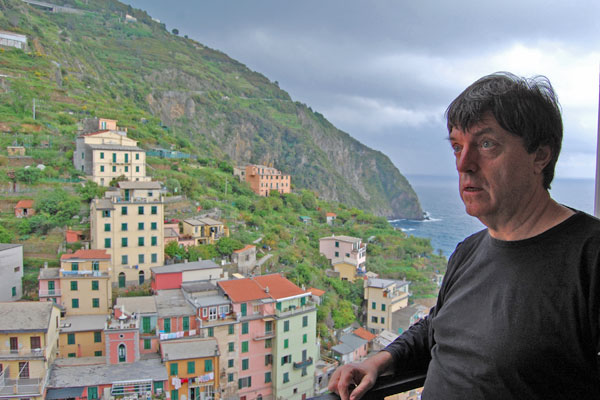
Sleeping on the train from Salerno to the Cinque Terre, I couldn’t stop thinking what a great job I’ve got: I was on a natural high after enjoying a wonderful guided tour of the Greek ruins at Paestum (which will be hugely helpful in next year’s edition of my Italy guidebook), and I was about to wake up on my favorite stretch of Mediterranean coastline.

One of the joys of running my own company is that I get to choose my research chores each year. This year (along with my TV production work) I get to update the guidebook chapters on all of Portugal (except the Algarve), Naples/Sorrento/Amalfi Coast, Cinque Terre, Munich/Bavaria/Tirol, Paris, Amsterdam/Haarlem, Brussels, Bruges, Edinburgh, York, Bath, and London.

While the Cinque Terre is a huge favorite for my staff, no one wants to update the Cinque Terre guidebook chapter because the people here are so aggressive about staying in, getting in, or getting back in to the book. Every two years I grab the assignment, and it’s about my favorite four days of the season.

And with each visit, I meet with the director of the Cinque Terre National Park, a man nicknamed “the Pharaoh” for his grandiose vision and heavy-handed effectiveness. When I refer to him in passing by his nickname to people of the region, they do a double-take as if they never expected to hear this insider’s term uttered by a foreign tourist.

After hiking to the top of Riomaggiore, I sat in the Pharaoh’s grandiose office. It’s littered with plans for park development, awards, and tourist promotion gadgets. He surveys me and I survey him, as we each matter to the other’s work. I explain to him that the region would enjoy more overnight visits (to the profit of struggling local seniors and the benefit of euro-stretching visitors) if the chaotic apartments-for-rent business were coordinated by village clearinghouses. He tells me of a school in the village of Corniglia that’s being renovated to house a big new hostel for 2009. I compliment the wonderful manager of the Manarola hostel. I complain of the ridiculous fines train conductors levy on innocent tourists who board a Cinque Terre train not knowing to sign their park transit passes first.

The Pharaoh takes me out onto his big balcony, and with a sweep of his hand, we survey his domain. Seeing a tourist lugging a backpack across the way, I shame him into promising that next year the park will provide a place for day-trippers to check bags for a more comfortable visit.

A big question for the region is the future of the Cinque Terre’s quirky nude Guvano Beach. The Pharaoh, like many locals, considers Guvano an embarrassment for the region. He said the park has the legal right of first refusal for the purchase of any land that goes up for sale, and they hope to buy the beach and end the nudity in 2009. Hiking the trail from Riomaggiore to the next town, I’m nagged by the difficulty I have believing that my son could have hiked the entire trail from town #1 to town #5 in just over an hour and a half (as he claims, and I recount in my book). With several hikers I meet making the case that this would need to be done at a steady run without any other hikers congesting the trail, I decide to take out the reference. But Andy insists it’s true.

With this visit, I reinstate my sentimental first-ever recommended pension in the region — Pension Sorriso. I stayed here on my first visit in the mid-1970s. It was one of the very few places to sleep back before tourism hit the region. I’ll never forget the place, run by a family of huge people who seemed to spin and fill the kitchen like gears spin and fill an old-fashioned wristwatch. Dinners were a beggar’s banquet of fresh fish and cheap white wine.

For 15 years, Pension Sorriso was the home of our tours in the Cinque Terre. Then, after a too-honest write-up in my guidebook, Sr. Sorriso’s wife decided to hate me. She hated me with a fiery venom like no one else in Europe hated me. In my favorite little magic wonderland in Europe, their place was a 20-meter stretch of lane I dreaded passing. We took our tour business elsewhere, and she demanded to have her hotel’s listing deleted from my guidebook.

Only after Sr. Sorriso died did I learn that for 20 years I was calling him Sorriso, when that word (which means “smile”) was simply the name of his hotel. For two decades I greeted him with a name that only I called him…and he just smiled.

Now their children — who are so cool they remind me of Sonny and Cher — run the hotel. I drop in (making sure I won’t encounter their mom) and we click. We share some old stories, make some agreements for how they’d welcome my readers, and bam — I list 19 more good budget rooms in my book ($125 to $155 per double with breakfast, www.pensionesorriso.com).

That night I enjoy Miky’s, my favorite Cinque Terre restaurant in Monterosso, and the town doctor drops by to meet me. He’s beloved for happily hopping on his one-speed bike — with a virtual doctor’s clinic in his bag — and making house calls. He suggests I make a warning to tourists that freak waves kill. (In 2007, an American woman was swept from the top of a rocky breakwater to her death by one such wave.) I normally resist filling my guidebooks with motherly advice: be careful on the breakwater; don’t be on the trails after dark; don’t trust strangers; and so on. But this tip goes in.

After one of the best dinners of my trip and a quick blitz of the nightspots in Monterosso, I stroll back along the harborfront promenade to my hotel. There’s one soul still out. It’s Miky, the owner/chef of Miky’s. Still wearing his little white chef’s hat, he’s enjoying a cigarette and sipping a White Russian. Both of us are capping an exhausting yet gratifying day of work.

Naples: Blood for a Dying Baby and the Ultimate Sandwich Show

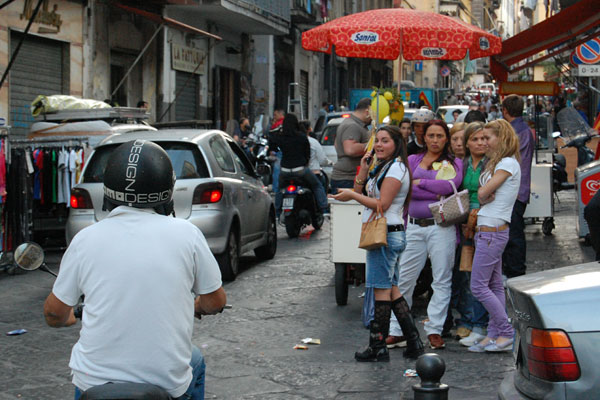
Girls flirt with passing motorcyclists in Naples’ Spaccanapoli District.
Enlarge photo
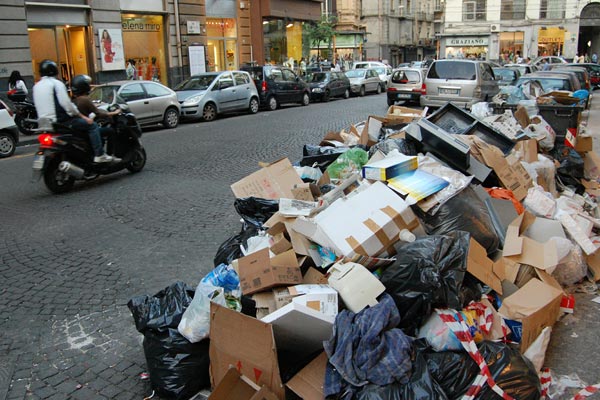
Garbage takes up valuable parking real estate.
Enlarge photo

All my life, Naples has been the symbol of chaos, stress, and culture shock for European travel. I remember my first visit (as a wide-eyed 18-year-old). Gene and I stepped off the train into the same vast Piazza Garibaldi that 35 years later still strikes everyone who visits as a big paved hellhole. On that first visit, a man in a white surgeon’s gown approached me and said, “Please…we need blood for a dying baby.” Gene and I made a U-turn, stepped back into the station, and made a beeline for Greece.

Now I’m flying here from Iran (after a quick change in Paris). And, coming from Tehran, Naples is a model of order and sanity.

But coming from anywhere else in Europe, Naples remains uniquely thrilling. One of my favorite sightseeing experiences anywhere in Italy is simply wandering the streets of Naples. I spent an hour and probably a hundred photos just observing the teens on motorcycles in the vertical neighborhoods of the Spaccanapoli district.

Every few steps, a couple of James Dean-cool guys lean against lampposts while three or four girls straddling the same motorbike would cruise by as if playing Neapolitan Idol.

Everyone who knew I was going to Naples seemed to be obsessed with the garbage strike. Minibus-sized mountains of garbage were parked on the curb every couple blocks. It’s easy to make a big newspaper stink about it, but locals seemed to just hold their noses and know that someday this little piece of Naples chaos, too, would be dealt with. I smelled nothing.

In the spirit of finding cheap eats near major sights for my guidebook readers, I walked behind the Archaeological Museum in Naples and met exuberant Pasquale — owner of the tiny Salumeria Pasquale Carrino. Rather than do the cheapskate “how much?” question, I just let fun-loving and flamboyant Pasquale make me his best sandwich. He turned making a sandwich into a show, and I watched, enthralled.

Demonstrating the freshness of his rolls as if squeezing the Charmin, laying a careful pavement of salami, bringing over the fluffy mozzarella ball as if it were a kidney transplant, slicing a tomato with rapid-fire machine precision, and then lovingly pitting the olives by hand and then hanging them like little green paintings on a tasty wall, he finished it all off with a celebratory drizzle of the best oil. Five euros (less than $8) and a smile later, I had my cheap lunch. Saying goodbye to Pasquale, I tried to explain to him that he’d be giving this sandwich show to lots of American visitors next year, and stepped outside to look for a suitable bench upon which to enjoy my lunch.

(Salumeria Pasquale Carrino is 100 yards from the Archeological Museum–as you leave take two rights and a left to Via Salvator Rosa 10, tel. 081-564-0889, closed Sun.)

Love Fest in a Roman Stadium

I’ve always wanted to go to a football (“soccer” to Americans) game in Europe. But it takes the better part of a day, and my research and filming schedule has never allowed it. Last Sunday, my son Andy and I finally got to see a game…courtesy of Stefano (who runs Hotel Oceania). It was Rome against Florence.

Converging on the stadium, Stefano parked on a curb (tipping a couple of thugs to watch — or maybe just not vandalize — the car). I find Rome’s stadium evocative: surrounded by Mussolini-era statues (each a stern and glorious fascist hero), and mosaics still heralding “il Duce” and showing the fascisti(“bundle of sticks” — so much stronger than a single, easy-to-break one).

They’re cracking down on football fan violence all over Europe, and real progress is being made at taming the stands. Stefano said this particular game was considered high-risk for violence, so a single purchaser could only buy three tickets, and they wouldn’t sell seats together (something he’d never encountered). In order to lower the provocative police presence at stadiums, legions of security “stewards” are posted everywhere. You must show ID to buy a ticket, each ticket has your name on it, and you must show ID proving the ticket is yours to get in.

As it turned out, it was a tame game. But the spirit in the stadium is almost comically mean-spirited. At American college football games, when a player is down on the field, silence falls over the stands as players get down on one knee and pray. In Italy, when someone’s injured, they chant, Devi Morire! — “You must die! You must die!” Then, when the injured player is carried off, they sing, “You’re coming back, you’re coming back…in B division.” Why? Injuries are routinely faked.

The area beyond the goal is filled with the cheap seats designed for the most avid fans — they stand and sing the entire time, waving huge flags and tossing firecrackers that sound like a cannon firing. Every so often, the loudspeaker reviews the various financial, criminal, and team penalties that come with violent actions and racist and outlawed slogans.

Stewards surrounded the small contingent of Florence fans like a riot squad. After the game, they stayed in their seats while the Rome fans departed. Then the Florentines were escorted safely to their awaiting buses to return home (in this case, sad after a 1-0 loss).

Landing a Prizewinning Tuna…in Rome

I just spent a great week in Rome. Our son, Andy, is there for a semester abroad, and Anne, Jackie, and I dropped in for a peek at his experience. Andy and his schoolmates — most in their third year at Notre Dame — are becoming citizens of the world. As twenty-year-olds would, they have a different focus than older travelers. But even so, their lives are being enriched.

With Andy and his mates, I enjoyed seeing Rome through a different lens. I learned Italian clubs welcome the American kids with hip-hop. Then, well into the wee hours, when they’re ready for the tourists to head home, they switch over to techno. Several of the students came for a semester and (apparently undeterred by the techno) decided to spend the rest of their school days here. Rather than spring break in Fort Lauderdale, they head for Sharm El Sheikh — I never imagined all that MTV hormone activity on the Red Sea in Egypt!

The kids muscle three days of travel fun out of each weekend, hopping a plane (Andy just landed a $30 round-trip ticket to Sofia, Bulgaria) or sleeping on a train for someplace new.

It’s fun for me to see the budget traveler and tour organizer showing itself in my son. Last month, he led a gang of six friends to Gimmelwald, borrowing ski gear from our friend Olle and sleeping on his floor (and working to keep the one higher-maintenance kid happy). As soon as school’s out, Andy and his gang have their sights set on hiring a small boat with a captain for a low-budget Aegean cruise. He explained to me how eight kids sharing the rental cost is no more expensive than settling into a cheap hotel in Athens.

These are mostly Midwestern kids whose worlds — because they’ve traveled — are suddenly broader. They are insisting on fresh garlic for their bruschetta, marveling at how Italians are cynical and fatalistic about their politics (bringing back Berlusconi), and drinking tap water to afford a better wine. The boys celebrate, as if winning the lottery (at first I wrote “landing a prizewinning tuna,” but that seems a little crass), when they come home with the phone number of an Italian girl.

Andy says the rigor of the class load here is light. But as a dad — paying the tuition — I’m thrilled with the education he’s getting (and a bit envious that I never had a study-abroad experience in my college days).