Convalescing with Schmaltz

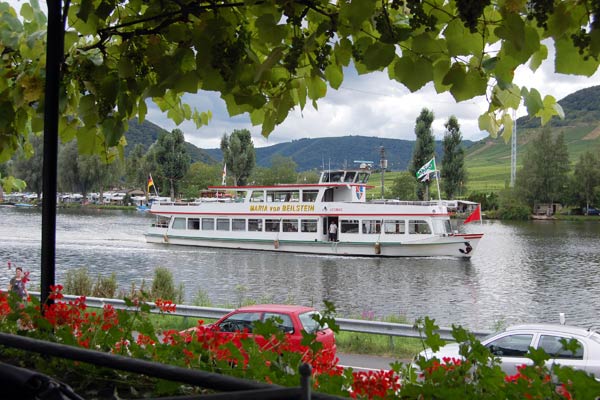
Need a good place to recharge? Try the terrace of the Hotel Lippmann, overlooking the Mosel River in Beilstein, Germany.
Enlarge photo
Jonas Lippmann made sure I took things slow and easy for a couple days. But I refused to wear his van Gogh hat.
Enlarge photo

I’m feeling a bit burned out. Researching a string of big cities (Bergen, Oslo, Stockholm, Helsinki, and Tallinn) is physically and mentally exhausting, and it’s frustrating because there’s just never enough time to do the job I want to do.

I gave myself a week to simply travel in Germany. Stepping off the plane in Berlin, I remember feeling strangely like I had just been let out of prison. I was entering a new country without a long list of hotels, restaurants, and museums to check. I was free.

But I was also just spent. Knowing I had my TV crew flying to meet me in a week, I needed to rest.

For my big-city German stops, I let the tourist board arrange hotels and guides for me. In each city, I had local guide for half a day and a big business-class hotel. These were splurges I wanted to try (but not pay for), and places, it turns out, I’d never recommend. Each time I plopped onto a new hotel’s bed, I reaffirmed my belief that a hotel’s personality and location trump its glitziness.

These places, while fancy, had no personality (too big for any of the employees to have any idea who owns the place that employs them) and were in lousy locations (designed for conventioneers, people with cars, or those who didn’t think twice about hopping into a taxi to go anywhere). For me, to be in a hotel where I can’t just step out the door and immerse myself in the charm of my destination is a disaster. I expect to be in a glassy high-rise surrounded by freeway interchanges in Houston, but not Germany.

My Köln hotel was distant from the cathedral and old center. At first I was disappointed about it. I was so tired, I needed to just take a slow walk. Strolling aimlessly among cars, trees, sky, and pavement, I realized the bad location was a blessing in disguise. I was in Germany, and it was as mundane as suburban Anytown, USA: the same humble people, same ethnic mix, same feeling that everyone was struggling together to make it.

To make time for a longer walk, I paid extra at the launderette for the attendant to wash, dry, and fold my clothes. I returned a bit early and just watched her lovingly fold my shirts and tuck my socks into themselves, and slide it all back into my rumpled plastic bag. She did this work all day long with grace. Next door was an empty phone and Internet shop — where foreign laborers come to call home cheaply. The Turkish man who ran it stood outside his door staring at the traffic and the blocky architecture built on the cheap in the 1950s after WWII bombings.

Feeling solitary and pensive, I stepped into a church for a quiet moment. Like everything else around me here in Köln, it was rebuilt after World War II. It was concrete with fake mortar painted on to make it look like the fine stone original. Only a little of the original medieval glass survived, leaving the once-vivid Biblical messages fragmented — mostly replaced by drab, Tupperware-colored glass with no story to tell. The church seemed almost dead. With the lack of religiosity in Germany today, I wondered if the bombings occurred now, whether anyone would care enough to rebuild the place.

From Köln, I felt like I needed to actually convalesce. I’ve never felt so fried. In fact, I almost vowed to schedule a weekly day of rest in my future travels. (We’re not designed to ignore that commandment.)

When I think convalesce in Europe, certain places come to mind: Ærøskøbing in Denmark, Walaker Hotel on Norway’s Sognefjord, Varenna on Italy’s Lake Como, Hallstatt in Austria’s Salzkammergut Lake District, and Beilstein on Germany’s Mosel River.

The nearest of those places: Beilstein — just two hours away by train. Beilstein is the Mosel River’s “Sleeping Beauty town.” Without good road access until recently, it never really got any modern development. Today it’s just grape vines, cobbles, fancy door knockers, the smell of dank back alleys, and Mosel River views. Midday, its charm is trampled by too many tourists. But early and late, it’s a dream…just right for convalescence.

I spent an hour before dinner on the terrace of Hotel Lippmann. Sipping my sprightly white wine, I gazed at the tiny two-car ferry sliding on its cable back and forth across the river. Its slow, monotonous rhythm and the peaceful bikers that came and went with each landing were mesmerizing.

Jonas, who runs my hotel, serves wine and not beer. He explained that people who would stay away because there is no beer are people they don’t want anyway. He serves homemade bread with tubs of Schmaltz (greasy pork lard). I asked him if he knew Barry Manilow. He said yes. I said, “Schmaltz is to butter what Barry Manilow is to music.” Jonas said, “Ja,schmaltzy.”

My room, which faced the river, had a small terrace. A rumble shook my room, waking me on my first morning. Stepping outside, I saw a massive barge filled with coal lumbering by. In a moment, it was gone, and I was left with the peaceful essence of the Mosel: across the glassy river, the little ferry was parked. Above it a church spire stuck like a slate spike through a hill cloaked in a green corduroy of vineyards. As if animating some symphony to the direction of a cosmic conductor, a huge and orderly flock of black birds sloshed back and forth like sound waves across the fields and around the spire. That kicked off a soothing Beilstein day.
Berlin’s Jackbooted Punk Bands

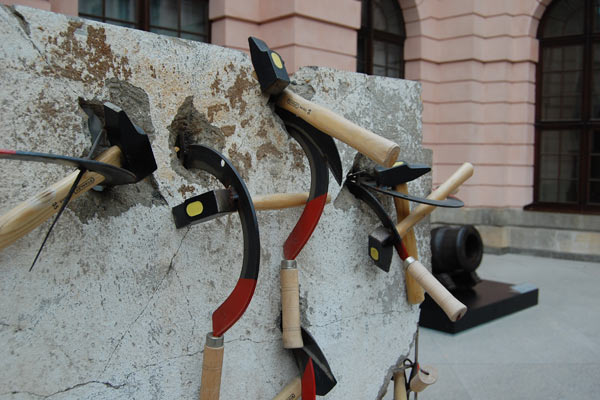
Art helps us ponder the twentieth anniversary of the fall of the Berlin Wall. Here, hammers and sickles are buried in a slice of Berlin Wall concrete.
Enlarge photo
Thinking “Hitler” back in the 1930s, this little girl sings, “You really gotta hold on me.” Sadly, the hateful power of Nazism is not entirely dead.
Enlarge photo

The Berlin Wall fell twenty years ago. Tourists seem to care more than locals. I asked how the East Berliners have integrated into the Western ways of united Germany. Local friends told me the East Berliners were a people educated not to ask questions, not to control their destiny, and to pride themselves in manual labor.

While Westerners lived with non-Germans, Eastern Berlin didn’t live with foreigners. With freedom, the least trained among them found themselves competing at the low end of the workforce with Turks and other immigrants. Their fear of foreigners and their own lack of economic hope and opportunity make the less-educated, working-class Germans from the former East more skinheady–more prone to cling to racism and support far-right-wing political parties.

While neo-Nazis are a tiny fringe in Germany, there is a smoldering fascist element in German society. I was told it’s led (Lyndon LaRouche-style) by older men who spearhead young movements via websites and music. Neo-Nazis listen to hateful music with forbidden themes by forbidden bands. These jackbooted punk-style bands have nostalgic, patriotic names like “Rheingold” and sing patriotic themed tunes that evoke the 1930s.

In Germany, there is freedom of speech…except against Jews. Children can tell Norwegian jokes all they want. But if they say racist things against Jews, they can actually get their parents in legal trouble. Germans are dealing aggressively with their fascist ghosts. While there are rowdy skinhead gatherings on Hitler’s April 20 birthday, there are almost always much larger counter-demonstrations at the same time, effectively drowning out the neo-hate.

A friend told me that because they grew up not allowed to travel, former East Germans are the ones who “travel like hell.” While West Berliners holiday elsewhere in Germany or in the Netherlands, people from the DDR (East Germany) travel to places farther away, like Egypt.

The importance of being free to travel is a recurring theme in my travels this year. The citizens of the former Yugoslavia fondly remember how they were always free to travel. They were free to travel because they always came back, and they always came back because they were free to travel. Citizens of the DDR risked their lives to escape the country that wouldn’t let them leave. Now they “travel like hell.”

Hohenzollerns Suck as City Planners

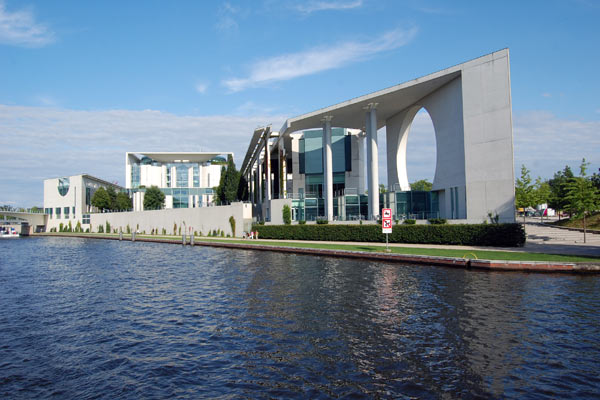
Berlin’s Spree River boat tours are suddenly a major attraction as the riverfront is lined with glorious, modern, governmental architecture. You’ll glide by buildings like the Chancellery — Germany’s grandiose answer to our White House.
Enlarge photo

I just spent three days in Berlin. Of any place in Europe, this city is a work in progress…a place you need to be in every couple of years to see how it’s developing.

The city center is blossoming. In fact, the big change in my guidebook: I now recommend the Spree River Boat Tours simply to glide by all the stunning new governmental architecture lining the river. And, while the Hohenzollerns built their buildings right up to the river (a Prussian snub against its people), today’s government seems determined to make the riverbank through Berlin a delightful park. New buildings are set back, beachy cafes come with summery lounge chairs, and the river that once had metal nets and barbed wire to keep people from crossing it to freedom now makes you want to walk a dog and hug someone.

On the down side, locals are complaining that the Berlin government is deeply in debt — $25,000 per person. Many parks are unkempt. Scaffolding is stuck in place as many building projects are on hold. The rest of Germany says that’s the price Berlin should pay for its grandiose building schemes of the last decade.

Locals are concerned that the city is coping by selling itself to foreign investors. Russian mafia types invest here because they need a solid place to put their black money. They expect crazy-high interest rates (as they’d get in corrupt Russia) and are frustrated when they don’t get them.

While Berlin is cheap by big city standards in Europe, and really happening if you are creative and edgy, it’s not the greatest if you’re filthy rich. You just can’t find the super-elite social clubs you find in Munich or Hamburg. And local elites complain that their fanciest club (China Club, $40,000 per year membership fee) is becoming overrun with Russian members.

Harley can’t get up. What about Stalin?

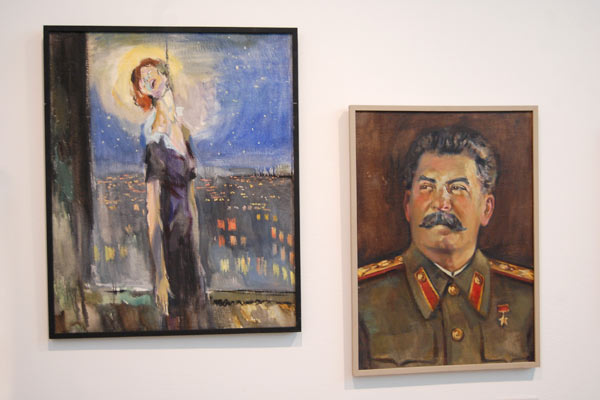
These paintings in Tallinn’s KUMU museum are a reminder that Stalin said, “Death solves all problems. No person…no problem.”
Enlarge photo

Germans love their powerful motorcycles and black leather road gear. Twice on this trip I’ve helped a big, strong German right his tipped motorcycle. They seem so ominous in their gear on their big bikes, and then so humbled when the bike tumbles in a parking lot and they can’t lift it up without help. It reminds me of a big, strong medieval knight who’s fallen off his horse and can’t get up.

Being in Western Europe, you think a lot about Hitler. Being farther east, you think of Stalin. He was evil beyond words. One of his favorite sayings: “Death solves all problems. No person, no problem.” While it seems Hitler is universally considered the worst person ever, there’s no question Stalin killed millions more than the German dictator.

Traveling through Germany, you’re really aware of the collective guilt the German people feel for the Holocaust. I don’t get that feeling from Russians about the atrocities in their history. But were the Russians collectively any less responsible for bringing us the horrors of Stalin? It seems people don’t blame the Russians for Stalin like they blame the Germans for Hitler, perhaps because Russians were victims of their own dictator more than Germans. But Stalin couldn’t do it alone any more than Hitler.

Euro Experiences from NW to SE — Part II

Enlarge photo

Enlarge photo

Enlarge photo

Let me stoke your travel dreams by sharing some of my favorite European experiences, roughly from northwest to southeast. Maximizing the experience is a dimension of smart budget travel that’s just as important in challenging times as saving money. Imagine these…

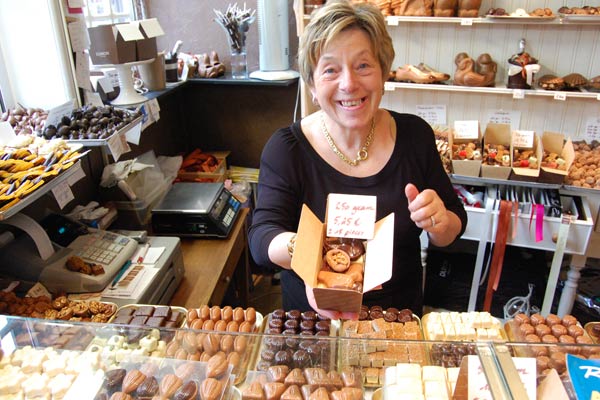
Nobody does chocolate like the Belgians. There’s something elegant about dropping in on the most expensive chocolate-maker in town—there’s one in every Belgian burg. Find a place that’s family-run, where locals buy their chocolate fresh, and people expect the shop to close on hot days because quality chocolate can’t survive the heat. Skip trendy “gourmet chocolatiers” who serve their chocolates with gimmicky flavors from gorgonzola to ginger—go for the purists.

A big percentage of American tourists visit Belgium as pilgrims…beer pilgrims, traveling all the way to that country to savor its plush and creamy beer. Hang out with devotees for a few nights and became a believer. My favorite Belgian evening is spent in an upscale pub, savoring a monk-made Trappist Blauwe Chimay (for example) with a rustic plate of bar food with locals who are both patriotic and evangelical about their Belgian brew.

In Holland, the “pilgrims” are more likely focused on the marijuana scene. Even if you’re not interested in smoking, drop by a “coffeeshop” for a whiff of its ambience. Baristas are patient in explaining to awkward Yankees how things work. Then, make an education out of the experience—talk to a local policeman, getting his take on why the Dutch stopped arresting pot smokers in 1976 and why this approach works. (I know, I just can’t pass up an opportunity to talk drug policy. To see the interesting “America’s Top Ten” list I just made in Coed Magazine, click here).

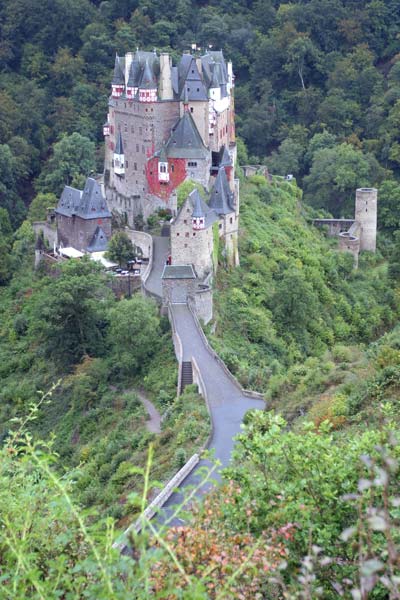
In Germany, my favorite castle experience is at Burg Eltz. Nestled in an enchanted forest just above the Mosel River, the Eltz castle is lovingly cared for by the aristocratic family that has called it home for centuries. The noble lady still puts out fresh flowers for her many visitors. Hike in from the train station and the experience gains a kind of magic. After an hour climbing under gentle trees through an ancient forest where you’d expect Friar Tuck and Martin Luther to be hiding out, the castle of your fantasies suddenly appears.

Every traditional German beer hall or Bierstube has a table for regulars—just look for the Stammtisch sign. To sample German conviviality at its best, make friends with the Stammtisch gang and get invited to join them at their table. Alternate between sniffing snuff (snorted from the “anatomical snuffbox” created by lifting your thumb high above your first finger) and drinking local schnapps. Before you know it, you’re leading the gang in a rousing rendition of “Country Roads.”

While perhaps the most touristy thing to do in Germany’s most-touristy town, following Rothenburg’s Night Watchman around on his evening rounds is a medieval hoot. Walk the town’s dark and evocative back streets with Georg Baumgartner, the wildly entertaining character whose delivery makes you forget what century you live in. While mobbed with tourists in mid-day, Rothenburg empties at night, when its flood-lit ramparts are all yours.

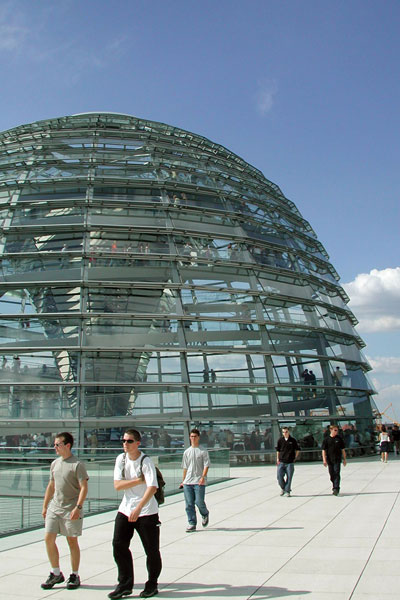
Climb the shiny glass dome that now caps the Reichstag (parliament building) in Berlin—for me, the most energizing thing to do in Germany’s most-energized city. From the top, look down on Germany’s legislators at work. You’re surrounded not by tourists but by Germans, who are determined to get politics right from now on.