 |
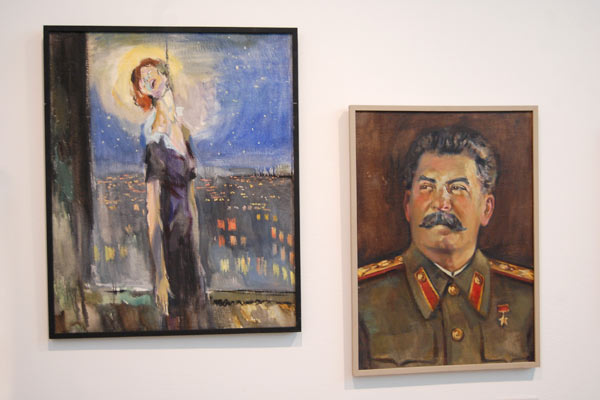
| These paintings in Tallinn’s KUMU museum are a reminder that Stalin said, “Death solves all problems. No person…no problem.” Enlarge photo |
Germans love their powerful motorcycles and black leather road gear. Twice on this trip I’ve helped a big, strong German right his tipped motorcycle. They seem so ominous in their gear on their big bikes, and then so humbled when the bike tumbles in a parking lot and they can’t lift it up without help. It reminds me of a big, strong medieval knight who’s fallen off his horse and can’t get up.
Being in Western Europe, you think a lot about Hitler. Being farther east, you think of Stalin. He was evil beyond words. One of his favorite sayings: “Death solves all problems. No person, no problem.” While it seems Hitler is universally considered the worst person ever, there’s no question Stalin killed millions more than the German dictator.
Traveling through Germany, you’re really aware of the collective guilt the German people feel for the Holocaust. I don’t get that feeling from Russians about the atrocities in their history. But were the Russians collectively any less responsible for bringing us the horrors of Stalin? It seems people don’t blame the Russians for Stalin like they blame the Germans for Hitler, perhaps because Russians were victims of their own dictator more than Germans. But Stalin couldn’t do it alone any more than Hitler.
Rick…..Germany is a favorite country on my trips……looking forward to new tips and back doors from there……
Stalin has always gotten a better press than Hitler due to the left wing bias in our news media. This dates back to the 1930’s when the American left loved Stalin. There is also a cultural bias in that we were shocked that Hitler could occur in a supposed Western, Christian nation like Germany. Also since American forces never reached into Russia in 1945 we were less able to document Communist atrocities than German ones. Consequently left wing Hollywood has never made any movies about Stalin. I am pleasantly surprised that a left winger like yourself is able to admit that Stalin was worse than Hitler.
Perhaps the Soviet Union and violence had a greater relationship. In terms of public awareness, Stalin wasn’t readily demonized in the US – being an ally and everything. By the point all was uncovered, maybe the US was to embarassed to spread the gossip. One also hears little about the rape of Nanking – to the full extent – other than being a catchphrase. I seem to recall the Japanese executing evil experiments equal to or far exceeding those of the Germans. What also of the United States’ evils. The US did, kinda, you know, firebomb hundreds of thousands of Japanese civlians, then threw in a few nuclear bombs. See Errol Morris’ The Fog of War for a better description. I don’t think anybody is going to walk away from WW2 feeling guiltless and heroic.
Is there an intended correlation between the motorcycle mention in the first paragraph and the next two, which deal with despots? I may be slow, but I don’t see why two otherwise-unconnected observations would share such a small blog entry. If there is a connection, would you explain it to me?
One perspective lost to history… yes, Stalin was an ally of the US during WWII… but he was also an ally of Hitler before Operation Barbarosa. The Nazis and Soviets split Poland between themselves, and each did their best to purge Poland of any potential opposition (intellectuals, politicians, soldiers and prominent businessmen were massacred by both the Soviets and Nazis). While Hitler was busy supporting Mussolini in the Balkans, Stalin devoured the Baltic Republics and attempted, unsuccessfully, to annex Finland… all with Hitler’s approval.
Good blog.Caused me to reminisce about the well-dressed motorcyclists buzzing by our windows in Germany and Switzerland on their fancy BMW two-wheelers. Very affluent ! And it was sad how hard my 40 year-old Munich hostess tried to dissuade me from seeing Dachau – “because I wasn’t Jewish.” All ages feel the angst it seems. I explained that Dachau was one of the most notorious locations in modern history and you don’t have to be Jewish to understand the horror and make sure it doesn’t happen again.
Love your observations of the motor cycle riders. My husband and I thought of them as modern day gladiators all suited up. Have shared B and B’s with the bikers in Germany and Austria. They were a fun group to meet.
I share your observation about the Germans feeling a collective guilt. I made my first trip to Germany in June. I was amazed how almost every heritage site was viewed through the perspective “since the War.” I didn’t see the Germans in terms of the World Wars before visiting there. I thought of music, food, work ethic, Grimm’s Fairy Tales. The Germans brought me the War perspective. Sad, really.
http://www.kevinmacdonald.net/SlezkineRev.pdf http://www.sobran.com/friends.shtml http://jkalb.freeshell.org/rants/forgiven_holocaust.html There’s no mystery if you do the work of digging out the truth about who the Communists really were (still are by other names) and who own all forms of media–controlling what people think, say and do. Why can’t Solzhenitsyn’s 200 Years Together get published in English? You shouldn’t have to ask.
Hi Rick. Just wanted you to know how much I enjoy your intelligence! Love your writing…and your shows. Looking forward to one of your trips next year. Thank you for the excellence. Pam Indiana
Why the holocaust in Germany vs other killings? Other cases of mass killings and genocide had some goal that was believed to be of value to the leader. The killings were done with the usual weapons of war for the purpose of advancing the mission of the leader. In Germany a special mechanism was developed for an industry dedicated to killing. Not only did it not contribute to the mission of the leader, it used resources that could have gone into the war effort. The killings were like a separate almost religious mission. In addition the Jewish scientists would have helped the German war effort. I think that the fact that this happened in a cultured, civilized western country adds to the uniqueness of the holocaust.
I’ve been to Dachau twice, both times leading a group of American college students. I was struck by the grim atmosphere that still hangs over the place, and the sense of regret that the people of Munich still feel about the place. However, they are a very joyous people despite the pall that Dachau represents for them. Next time you’re in Munich, go to the open market. I went in January, and the diversity of goods was overwhelming. There is much more to Munich than Dachau. Didn’t see any toppled Harley’s, just a few toppled Munchener’s.
I have to conclude that if you never sensed the deep German shame about the Holocaust, you’ve never talked to a German person at any length. Rick, I think your observation about the contrast between Hitler and Stalin is perceptive. Another contrast I’ve noticed is between the difference between the responses of Germany and Austria to the Holocaust. Germany has done deep soul-searching, memorials, and more. Austria likes to pretend they have no idea whatever this “holocaust” might be. They remain more xenophobic, right-wing, and nationalistic than Germany.
The Germans I’ve met certainly do feel guilt, even the young ones. When I went on a bus tour of Eastern Europe a few years ago, one of the loudest, most talkative and friendly people on the bus was a young German man. The day we visited Auschwitz, he was a completely different person: quiet, distanced, reserved. I didn’t hear a peep out of him the entire day. He told me later he was deeply ashamed of the camp’s existence and what it represented. I’ve heard similar sentiments from other Germans.
Perhaps the reason we in America hear so much more about the evils of Hitler than that of Stalin is that the U.S. has never had to fear a domestic communist threat, but from Joe McCarthy through Reagan through the Gingrich “revolution” and the propagandists like Rush Limbaugh and Fox news and the rhetoric we heard from the right during the last presidential campaign and since, unprecedented in its vitriol against a president who happens to be the first nonwhite leader of the United States, we have had a persistent threat of neo-fascism in America. The threat of a new Hitler is much more realistic given the right-wing slant of the corporate-controlled media, and the millions of dollars spent in PR by hard-right think tanks in this country. If only there were a level playing field in the media and a genuine liberal media to counter the right-wing echo chamber which broadcasts over AM radio and cable, not to mention the Sinclair-owned TV stations and Fox “News”.
There is no left-wing conspiracy in giving Stalin a pass. And I won’t even get into the non-sequitor of a thread about the right-wing conspiracy and fox news. It has nothing to do with the topic at hand.
The reason Stalin’s evil is more overlooked within the context of WWII is most likely because he was on our side during the war. And as Tom mentioned above, often lost in history is that Hitler and Stalin had a pact — it was only after Stalin realized Hitler wasn’t going to stop at Poland that the murderous coward joined the right side. It was for nothing more than his own preservation. The allies took him in because France was conquered and England was on the ropes.
The only other comment I have for Rick and this blog entry is: Amen. I also think the French need to own up to the shame of Napoleon, rather than honor him at his burial place in Paris.
After touring the Nazi Documentation Centre in Nurnberg, I read the guestbook. I was struck sick to realize that it was more than just I who horrifyingly shared the same sentiment that so many visitors from the United States felt! This is the same exact right-wing, fascist path our country is venturing down. It’s terrible to ponder the scapegoats this time.
In the small town of Winnweiler in Southern Germany there is a very stirring memorial to their own who were lost in both of the World Wars. There is no mention of politics or right or wrong. Just a tribute to those loved ones. My son in law’s mother pointed out last names she recognized. People who lived and died long before she was born. Small towns are pretty much alike everywhere.
Patrick, writing above, believes “the U.S. has never had to fear a domestic communist threat.” Familiarize yourself with the scholarly, peer-reviewed work of Harvey Klehr and John Earl Haynes and never again will you utter such a perniciously ignorant statement. Some links: http://www.amazon.com/Denial-Historians-Communism-Espionage/dp/159403088X/ref=sr_1_3?ie=UTF8&s=books&qid=1251356083&sr=1-3 http://www.amazon.com/Venona-Decoding-Soviet-Espionage-America/dp/0300084625/ref=sr_1_4?ie=UTF8&s=books&qid=1251356083&sr=1-4 http://www.amazon.com/Soviet-World-American-Communism-Annals/dp/0300071507/ref=sr_1_6?ie=UTF8&s=books&qid=1251356083&sr=1-6
After spending much of the last 3 summers in Lithuania, all I can say is, “Oh so complicated!” Eventually I will be able to say (and write) more about this topic but the complexity of the issues, particularly in Eastern Europe, are almost beyond comprehension. The more I learn about it, the less I seem to be able to get a handle on it.