The Brandenburg Jig 2011

Before flying to England to meet our TV crew, I had a great couple of days in Berlin. This simple little video expresses the joy I feel in Berlin when I’m there. (It just occurred to me that joy is probably a major reason why I like Berlin so much.)

There is so much potential for horror and violence in our world. Yet the vast majority of the time, in the vast majority of places, and for the vast majority of people, we live with peace, opportunity, and affluence (relative to any time in history)… even though we are taught not to be content.

These young musicians are playing uplifting music in the shadow of Berlin’s Brandenburg Gate, on ground that was once a nightmarish no-man’s-land. They are playing under warlike chariots on a gate that once called a mighty nation (Germany) to battle, then symbolized an ideological divide that denied hundreds of millions their freedom, and now calls for peace.

Today, when we sit at home and let the media shape our worldview, bursts of sadness can cloud our understanding of just how happy our world is. Politicians, talking heads, and angry neighbors can say America is broken and the rest of the world is even worse. They can say we are in crisis. They can be threatened by forces that don’t even exist. It’s as if that’s their livelihood or purpose in life. The boring truth is: Things are really good, if we let them be.

Of course, there are serious problems that must be dealt with. But most of us — especially Americans — are richly blessed. While we have our distribution challenges, there’s more than enough goodness, energy, love — and stuff — to keep everyone happy.

And here on what was the Berlin Wall, with young people making beautiful music, for the same reason a baby yelps with joy, I just want to take a moment to say let’s embrace the world constructively and positively, remembering how much is not wrong.

If you can’t see the video below, watch it on YouTube.

Rail Wonks

A particular joy of my job is collaborating with people who really love their work. We employ 70 people at ETBD, and they amaze me with the passion they have for their niche in our travel-teaching machine. Russ goes to Asia to be sure work conditions are right for the people making our bags. Dave draws maps for our guidebooks, and in his free time, draws maps to people’s homes so everyone can get to the party. Laura is so excited about the new Central Europe Triangle railpass. And Julie won’t rest until the handouts for our next Turkey class are right up-to-date.

In Europe, I work with people who have that same passion. My guide friends can’t simply walk down the street — they have to explain to me why the plaster is being peeled away to show the old wattle-and-daub, or how the church spire is so low because the Soviets wouldn’t let it be higher than their war memorial. And Alan, who runs the EurAide desk at the Munich main train station (a great service to anyone traveling by rail), can’t wait to fill me in on the latest train news.

Alan is the ultimate rail wonk. For twenty years, I’ve dropped by when updating my Germany guidebook… and for twenty years, he’s been passionately helping travelers, one by one, catch the right train for the right price. It exasperates him that I just drop in unannounced, but that’s how I work in Europe. Last week I popped in, and there he was, patiently getting a Korean backpacker with a German railpass a ticket from the German-Czech border to Prague. He said, “Come back at noon, and I’ll take you to a great beer garden for lunch — one you can put in your book.” (We have an ongoing joke that he only takes me to his favorite places on the condition that I don’t tell anyone.)

At noon, we walk a few blocks to the Park Café beer garden. It’s so hot in Germany that literally no one is eating indoors. If your restaurant doesn’t have outdoor seating, you might as well not open up. The Park Café, with a sprawling beer garden and a little fake beach complete with sand and lounge chairs, is thriving. Alan calls it “Little Berlin,” as Berlin is really into fake beaches. (This is a big trend throughout Europe. Cities with no beaches — from Paris to Copenhagen to Vienna — now have sandy summer “beaches” dumptrucked in. These are a hit for Europeans city-bound in the heat of summer.)

I’m not a Radler (beer with 7-Up) type of guy, but this light refresher is the choice for both of us on this hot day. After we each guzzle about a third of our liter mugs and zip through a little small talk, Alan gets right down to his wonk-ish passion: rail news.

Pulling out a packet of questionable Eurailpasses, he tells me that the big news this year is how dishonest rail travelers may be the doom of traditional railpasses as we know them. Alan holds up one pass and says, “This is the pass of Mr. Chen. He came to me, I looked at his pass, and I knew it wasn’t his. I said, ‘You’re not Mr. Chen’…and he ran out of my office, leaving me with this doctored-up pass.”

Alan tells me that unscrupulous railpass-users — especially Australians and Asians — are erasing and re-writing the dates on their flexipasses in epidemic numbers. The European train officials are trying to counter this by requiring everyone to keep the pass in its original jacket and log each journey on the itinerary page attached. But no one obeys. Travelers in Germany know that cops here — shy about being considered “Gestapo-like” — are reluctant to enforce things too harshly. So in Germany, these new railpass regulations go completely unenforced.

Leaving Alan, I continue my research. My staff organizes and distills the mountain of feedback our readers send us, and I spend a lot of time running down places to eat and sleep that our travelers recommend. I eat dinner at a nondescript neighborhood bistro next to my hotel because someone reported that the food is great, and Youssef and Monika — who run the place — are charming. The place seems unexceptional. Skeptical, I give it a whirl…then the food comes. It’s delicious. Monika has such a pleasant way. When Youssef (the chef from Tunisia) finishes his last order, he sits down at my table and we get into a discussion. I’m loving the place — conviviality-plus. I surprise Monika and Youssef by calling them by name. They wonder how I knew. I tell them about my work, and how someone ate here and recommended them. I get out my pencil to write it up…until Monika says, “But we are closing in two months.” Heartbreak. (If you happen to be in Munich before the end of August, check out Das Kaffeehaus, near the train station at Pettenkoferstrasse 8.)

I’ve had people in the States ask me for reassurance that Europe won’t become Muslim in a generation (as some fear-mongers are saying). I say that’s nonsense, and don’t give it a second thought. But, while at Youssef and Monika’s restaurant, I see lots of extremely conservative Muslim women clad in black. I ask them about it. Youssef says Dubai and Yemen are on holiday, and people there love to vacation in Germany. Two moms — draped in black on this hot evening — drop into the restaurant. They’re making an ice-cream run with their kids. I start up a conversation with the 10-year-old boy and ask him, very clearly, “Do…you…speak…English?” He looks at me like I’m nuts and says, “Of course I do.”

Being on the road humbles me. It connects me with our world. It’s where I get my news. It makes me feel good about humankind.

Munich: German Flags and Georg

Enlarge photo

I love my times with Munich local guide Georg Reichlmayr — pronounced like a bad guy on Rat Patrol. Rrrrreichlmayr. We got together recently, just after Germany had beat Argentina in the quarterfinal in the World Cup, and everyone was out, going crazy. I enjoy seeing Germans wave their flag, which — with their difficult 20th-century history — they only do for football victories.

Marveling at the chaos in the streets, Georg says, “We won the game…lock up the cats!” I joke that people who were patriotic in the 1930s might be rummaging around in attics and basements, muttering, “There must be a flag around here somewhere.”
I’ve got a long list of restaurants to check for my guidebook. Post-Fussball victory, it’s not a great night for that, as everyone’s partying and it’s tough to get a fair gauge on the normal energy of the place. I complain that I have an imbalance of restaurants, with too many beer gardens and beer halls. Georg admits that’s a problem in Munich — it has an abundance of great beer halls and a shortage of fine restaurants without the noise and suds.

We pop into the Heilig-Geist-Stüberl — literally the “Holy Ghost Pub.” I always read my description before entering a place, then stow the book and see if it rings true. In my guidebook, it’s described like this: “Heilig-Geist-Stüberl is a funky, retro little hole-in-the-wall where you are sure to meet locals (the German cousins of those who go to Reno because it’s cheaper than Vegas, and who consider karaoke high culture). The interior, a 1980s time warp, makes you feel like you’re stepping into an alcoholic cuckoo clock.”

Georg cracks up about the last three words. Stepping inside, it’s perfectly described. It’s hard to get out, but I have to be very disciplined — one drink can kill your research momentum.

We pass an Apple Store — open late and thriving, just like those in American malls. Then we see a bookstore with big reading lounges. Georg says these are all the rage here. I say, “Bookstores providing a ‘third place’ have long been popular in the US.”

A few blocks later, a guy at a curbside table hollers at me. He’s a US soldier stationed at Grafenwöhr. He says they give everyone landing there from the States a copy of the Rick Steves issue of Smithsonian magazine as a welcome gift and encouragement to get out and see Europe while they’re here. I tell him sales have been great (Smithsonian thinks they will sell out of their double-sized print run), but I didn’t realize we were getting distribution at US military bases in Europe. It’s a great bit of news.

Talking with the soldier gets Georg going on Germany’s involvement in Afghanistan. He muses, “What are we doing in Afghanistan? Let’s give the baby a name” (a wonderful German phrase for our “Let’s call a spade a spade”). I say, “You’re there to make America your friend.” He says, “Of course. We’re not defending Oktoberfest. The Taliban is no concern of ours. This last Oktoberfest came with extreme security — the most I saw. Why? Because Germany is in Afghanistan.”

A bit later, seeing someone walk by with a T-shirt reading, “Costa Rica: no army since 1948,” Georg says, “I think America would be more a super power without an army. With no army at all. Think of what you could do with your money instead.” I explain to Georg that you cannot seriously discuss that issue in the USA. He says, “Yes, I know. We have a long history of important families like Krupp making vast fortunes on armaments.”

With our work about done, we stop by Georg’s favorite beer hall, Der Pschorr. At the Hofbräuhaus, they have a big wooden keg out on display, but draw beer from huge stainless-steel dispensers. At Der Pschorr, every few minutes you hear a whop! as they tap a classic old wooden keg. Hearing this, every German there knows they’re in for a good fresh mug.

Enlarge photo

In a beer garden, you’re surrounded by big women in uplifting dirndls. Georg confirms that German men don’t favor petite women. These famously low-cut outfits seem designed for German Rubenesque tastes. With the euphoria associated with the World Cup games, there are flags flapping everywhere. A beermaid with German flags painted above her cleavage joins us to take our order. I can’t resist saying, “Nice flags.” I don’t think…it just comes out. Nice flags. She looks at Georg and says, “Warum sagen alle Männer das Gleiche?” (Why do all men react the same?). Georg says, “Weil du sie genau dort trägst” (Because you put them right there).

I ask if they sell half-liters. Georg says, “This is a Biergarten, not a kindergarten”…and he orders us each the standard full Mass, or liter glass (about a quart, nearly what we’d call ein pitcher — but for one person).

Conversation flows like the beer in these beer halls. I mention that Austria just went smoke-free in restaurants this month. Georg thinks they’ll fight it. I marvel at how many people still smoke despite the comically blunt “smoking kills” warnings on cigarette packs. And he can’t resist commenting on America’s love affair with guns. “In European eyes, this America and private guns is something very funny. In the supermarket, kaboom, you defend yourself with a gun.” He doubles over in laughter. Recovering, he admits, “In a different aspect, we are mad, too. In Germany, every man has the right to go as fast as he wants on our roads. All Europe has a speed limit except in Germany. That’s our gun. Not even the Social Democrats dare to have speed limit discussion. Only the Greens do. It’s guns for you, speed for us, and smoke for Austrians. And Italians…they vote for Berlusconi. Berlusconi just bought a Botticelli. Like Mussolini owning a Rafael. They shouldn’t let it happen.”

To Georg, having guns everywhere and the death penalty seems incongruous. He marvels, “You have the death penalty and you give people the right to have a gun. To join the EU, you can’t even talk about the death penalty. It is so fundamental. The state does not kill people. That’s one reason why Turkey can’t get in to the EU. But we kill ourselves without guns. On a night like this, when Germany wins a World Cup match…tomorrow we read about more dead on our roads. The Autobahn is safe. It’s the countryside roads — they are suicide.”

Then, whop! Another keg is tapped as this night of German flags, high-volume conversation, and Georg’s favorite beer seems to be just starting.
Baden-Baden: Globalization and Leaky Borders

Enlarge photo

To commemorate the Smithsonian Presents Travels with Rick Steves magazine — now on sale online, and at newsstands nationwide — Rick is blogging about the 20 top destinations featured in that issue. One of those destinations is the German spa resort of Baden-Baden.

Germany’s spa town of Baden-Baden is a fun and relaxing place to splash around in a thermal bath. But, as with many resort towns, a more substantial history bubbles just beneath the surface. And, in the case of Baden-Baden, that history still has ripples today.

After the czars banned gambling, many Russians flocked to Baden-Baden, creating their own little Russian enclaves. (Many lost their fortunes, borrowed a pistol, and did themselves in on the so-called “Alley of Sighs.”) While the Russian expat community dwindled for a while, in recent years (after the end of communism), ultra-wealthy Russians have sought out safe property investments all over Europe…and Baden-Baden has re-emerged as a favorite destination. Russians have bought up property here like crazy. You’ll see Russian on multilingual signs around town. On my last visit, the lady who ran the launderette spoke German and Russian…but no English.

This is worrying to locals. The mayor — saying his town must either take action or let itself become essentially Russian-owned — recently declared that Russians were no longer allowed to purchase Baden-Baden real estate.

With immigration a persistent and complex issue in the USA, it’s good to remember that we’re not the only nation struggling with how to handle the realities of race, class distinctions, foreign investment, and use of government services. I see the same challenges all over Europe.

A vast suburb of Tallinn, Estonia, is filled with Russians. They were planted there during Soviet rule, and — although Estonia is now its own independent nation — they still refuse to embrace the local language, Estonian. They live as a separate, Russian-speaking community within Tallinn.

Norwegians — who pride themselves on not being racist — are upset with unemployed Pakistanis living in their country who, they say, don’t share the Norwegian work ethic, but take advantage of the luxurious Norwegian welfare state. I sense that Norwegians don’t know how to discuss this issue comfortably.

I was just in Gibraltar, and the buzz there was about a $20 million mosque built with money from the Middle East for the humble local community of 900 Muslims workers.

Just as people with less money go to work in wealthy lands, people with more money turn their vacation and retirement funds into maximum joy and comfort in cheaper places. I have a friend who’s a retired postman living very comfortably on his meager pension in southern Portugal. A Venetian friend of mine is excited about her new holiday home in Tunisia. No crowds, great beaches, very cheap — she said Tunisia is all the rage among Italians. Belgians have staked out their enclave in Spain’s Costa del Sol — just one more community where the stray Spaniard complains that some eateries don’t offer menus in Spanish. Americans are buying fixer-uppers in droves in rural Italy. And they’re doing it with the encouragement of a government that appreciates the economic boost these romantic Frances Mayes-wannabes bring to regions that need expat newcomers to keep from withering.

There are immigration issues everywhere you travel. Second-generation Turkish Germans can honestly say “Ich bin ein Berliner.” Construction work throughout France would slow to a trickle without Polish builders. While many are now careful to refer to Gypsies as “Roma,” there’s still not enough money to build a Holocaust memorial in Berlin to this group, which suffered a genocide that was comparable, in many ways, to what happened to the Jews.

Like the Swiss are afraid of minarets, the French are afraid of women with covered heads, and America is afraid of a leaky southern border, a lot of anxiety is driving current legislation in all these countries. In Europe, as in the USA, it’s hard to talk about immigration and race issues for fear of offending people. But one thing is clear: Race and immigration concerns are not unique to any one country, and they are here to stay.

While travel may not give us answers, it does give us perspective and a clear sense that we will all ultimately live together…whether we like it or not. The other day, a frightened white woman asked me to sign a petition, saying, “We’ll soon be in the minority.” As a traveler, I know “we” already are in the minority on this planet…and that’s fine with me.

Prague Trumps Rothenburg

Enlarge photo

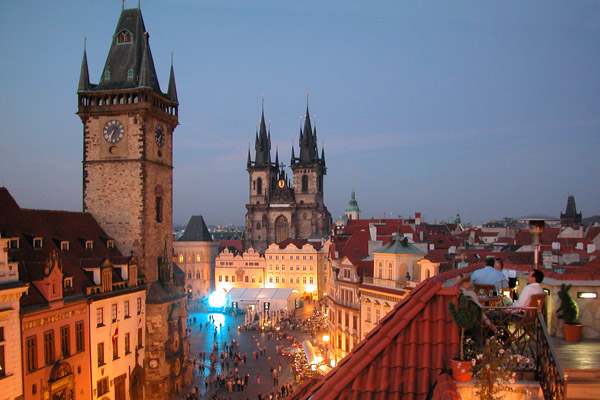
To commemorate the Smithsonian Presents Travels with Rick Steves magazine — now on sale online, and at newsstands nationwide — Rick is blogging about the 20 top destinations featured in that issue. One of those destinations is Prague, Czech Republic.

I’m currently on a Central European swing, updating my guidebooks: Budapest, Prague, Vienna, Munich. Being back in Prague reminds me of how that city first broke down the Iron Curtain in my guidebooks many years ago.

On a research trip back in the 1990s, I was on a train heading to Rothenburg to update the ultimate medieval town in Germany, as I did nearly every year. For a decade, I’d been diligently visiting to check the woodcarvings, walk the old wall, visit the toy museum and the medieval crime-and-punishment museum, and check in with old friends who run the hotels and restaurants that serve the town’s hordes of tourists. The work was almost mechanical. Socially, it was a happy homecoming. The ramparts and cute lanes were filled with my readers, who cheered me on. I loved going to Rothenburg.

This was just a couple of years after the end of the Cold War. The obvious new frontier of European tourism was the mysterious East. The former Warsaw Pact countries were now wide open and eager to welcome Western travelers. I knew that sooner or later, I’d tackle the region and expand my guidebook coverage there. But it was overwhelming, and, psychologically, it was easy to just keep redoing the Rothenburgs of Western Europe. I was daunted by the job — a bit lazy…dreading the unavoidable truth that if I was to cover Europe, I would now need to stretch east.

I was rattling down the tracks in the direction of Rothenburg, when I realized the very train I was on would end its run in Prague. I started comparing the value of spending the next three days in Rothenburg versus doing a groundbreaking research stint in Prague. I stayed on that train and didn’t get off until the Golden City of a Hundred Spires. I jumbled my itinerary a bit to accommodate the new job, and what followed was one of the most exciting and rewarding weeks of research I can remember. I left with Prague now in the realm of what we covered.

That first Prague chapter needed a home, and the only home we had for it was splicing it into our existing Germany, Austria & Switzerland guidebook. What was called “GAS” in my office would now be “GASP.” (Over the years, GASP became GAS, then GA…until finally there were separate guidebooks for each of the four destinations, including Prague.)

With the beautiful co-author partnership of Honza Vihan (our good friend and super guide from Prague), Prague joined the elite league of cities that merited their own Rick Steves guidebook (along with London, Paris, Venice, Florence, and Rome). Cameron Hewitt took this Czech nucleus and expanded into another five countries (which I termed the “Louisiana Purchase” of Europe) — Poland, Slovakia, Hungary, Croatia, and Slovenia — co-authoring my Eastern Europe guidebook, and then two others (on Croatia & Slovenia and Budapest). Today Eastern Europe is fully integrated into our Europe-wide program, with four different guidebooks and six different bus tour itineraries.

And it all started in that year when Rothenburg went unresearched and a seed was planted in Prague.