Keeping Young People Traveling, Writing, and Engaging with Our Wider World

I was just at the NAFSA: Association of International Educators convention in Houston — a gathering of 8,000 university administrators, teachers, and advisors who coordinate the foreign study industry in the USA (both for inbound foreigners, and for Americans going out to the rest of the world). I enjoyed the honor of giving a 90-minute plenary talk to a huge and packed auditorium, sharing my take on the importance and value of foreign study — now more than ever.

That experience — combined with my recent 20-cities-in-20-days road trip, and my upcoming commencement address at the Evergreen State College in Olympia, Washington — has connected me with the excitement of exposing the next generation to the wonders, complexities, and challenges of our world firsthand.

One thing I always encourage young travelers to do is to keep a journal. Along with writing countless postcards (which were ultimately gathered together to make running accounts of my early travels), I diligently filled “empty books” with 200 pages of tiny handwriting from  each of my first ten adventures in Europe and Asia. Of course, these days, kids blog. My kids, Andy and Jackie, have each enjoyed blogging, as has my niece, Nicolina, on her recent street art mission in Brazil.
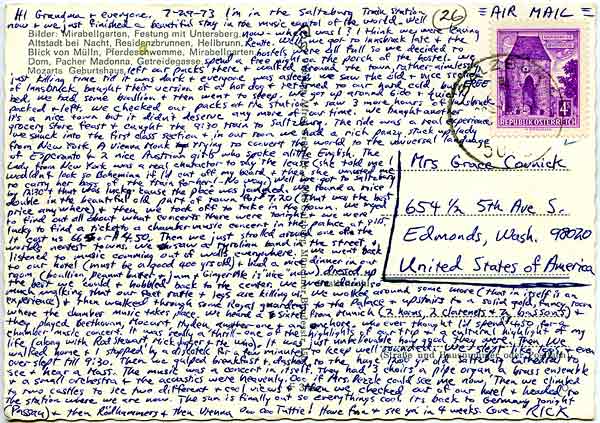
At age 18, I wrote this postcard to my grandmother from Salzburg. Austrian beer halls were filled with one-legged reminders of WWII, Franco ruled in Spain, it took about nine hours to travel from London to Paris, bars were filled with smoke, pizzerias were considered ethnic restaurants in northern Italy, a two-month Eurail pass cost about $200, travelers would gather at AmExCo offices to share information and collect mail from loved ones back home, and cell phones, euros, and ATMs were unknown. But the magic of European travel was the same then as it is today.

During my March lecture tour, I met John Paul Gairhan, a 15-year-old in Conway, Arkansas, who was excited to be planning his first European adventure. John just began his trip, and following his blog reminds me of the thrilling mix of fun, fear, and fantasy of my first trip at his age. I promised John if he shared an insider’s look at the thrill of a 15-year-old kid from Arkansas enjoying Europe for his first time, I’d send him lots of readers. So travel along with John on his blog.

Another highlight of my lecture tour was in Omaha, where I was ambushed by an enthusiastic band of high-school German students. I just received this email from their teacher:

Hi Rick,

I’m the German teacher at Millard North High School you met here in Omaha.  I wanted to thank you again for all that you do.  When I was in college, your travel books and videos were an extremely positive influence on me and how I organized my trips to Europe.  More importantly, I was inspired by and followed your advice that wise travelers remove as many barriers as possible between themselves and the culture they came to visit.

Outside of the classroom, I don’t think there’s any better way to educate oneself but through travel.  I became a German teacher just in the past year and I do my best to teach my students not only an appreciation for other cultures but also a strong wanderlust.  I want them to see life as an adventure for which they must boldly write their own personal script.

Throughout the year, we’ve used your videos on Germany, Austria & Switzerland as a teaching tool.  In fact, you’ve achieved a quasi-cult status amongst my students. I invited my students to attend your lecture here last March and thirty showed up.  Although they were a bit raucous at times, you were kind enough to invite us all on stage for this photograph. Thanks again for coming to Omaha and speaking to our community.

Best Regards,

Jason Pitt and the German language students of Millard North High School
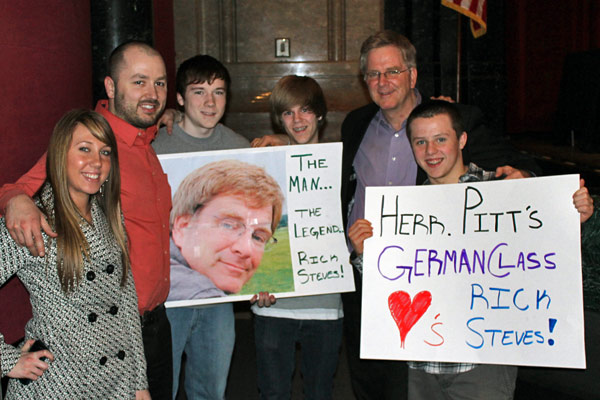
Backstage in Omaha in March, I met this gang of high-school German students, who have a lifetime of travel adventures ahead of them.

Flying with a View…and We Have a Winner!

Our Mykonos flight was on Air Berlin, a discount airline filled with Germans who fly two hours on a cheap flight from Munich directly to Mykonos for a nice break. That’s a handy setup for German sun-worshippers. From Munich, we enjoyed Lufthansa luxury over the Atlantic. While we no longer had our own stateroom with the wonderful little view balcony, I did manage to enjoy a little privacy and wonderful views out my window at 30,000 feet.

By the way — I lost one pound in two weeks of cruise gluttony. Using the stairs on board, eating plenty but in small portions, not going back for seconds, and lots of running around on shore and dancing after dinner enabled me to consume a lot of calories — yet burn off even more. Jason Ree correctly guessed my post-cruise weight at 211 pounds. Congratulations! We’ll be in touch to send you your autographed copy of Rick Steves’ Mediterranean Cruise Ports and the Mediterranean Mosaic DVD.

If you can’t see the video below, watch it on YouTube.

The Rhine River — Raging with History

Maybe I’ll spend my old age just gazing out windows from evocative perches in my favorite European villages. While researching the Rhine River Valley recently for the new edition of our Germany guidebook, I enjoyed a corner room with a mesmerizing Rhine view. I’d wake up and find myself captivated by the river scene — and then realize I was less dressed than was appropriate for that conservative little burg.

Putting on a shirt and continuing to enjoy the scene, it occurred to me that I was enthralled by more than the pretty view. It was the rhythm of the mighty Rhine — so bustling with shipping and history — combined with the environment: black slate cut from plains above; terraced vineyards zigzagging up hills — forlorn in the modern economy but still absorbing sun and stocking grapes with sugar; husks of ruined castles, standing as monuments to class warfare, greed, and war; and stoic spires of stone churches slicing vertically through townscapes. The quiet, deep-grey power of the river flows as steadily as time itself, a dance floor where ferries, barges, and sightseeing boats do their lumbering do-si-do past fabled and treacherous rocks.

It was here that the ancient Romans decided to call it an empire and draw the line that defined their vast holdings — a line that separated barbarians from the civilized world, just as it separates Protestants and Catholics today. It was here, on New Year’s Eve in 1813, that Prussian General Field Marshall Gebhard Leberecht von Blücher, a local hero, used an innovative pontoon bridge to cross the Rhine and flank Napoleon’s forces (on their way back from a disastrous Russian campaign). And it was also along this stretch of river that US General Omar Bradley’s troops found a bridge still standing (at Remagen) to push past the natural barrier the Rhine has always provided Germany against invaders, and ultimately take the war into Hitler’s heartland.

A monument below my hotel window remembering Germany’s dead from various wars still has an unused panel. My hunch is that it’ll never be used. Germany, mighty today without the help of its military, has a profound distaste for wars. Like so many nations, it rose by the sword…and then fell.

Pondering sweeping armies and the rise and fall of great powers (along with my own country’s place in the march of history), I think of all the nations in Western Civilization that at one time rose to be dominant powers, then settled back down — either because of military defeat, economic malaise, or both — and realize life goes on just fine without all that responsibility. Think about it: Rome, Spain (under Charles V), Austria (under the Habsburgs), France (under Napoleon), Germany (under Hitler), Victorian Britain (upon which “the sun never set”), as well as Portugal, Sweden, Poland, the Netherlands, and, I’m sure, many others.

Then, with the political and economic frustration at a rolling boil back home in the USA — which just a decade or so ago was celebrating its status as “the world’s only superpower” — an interesting thought hit me. Had we known that “the Arab Spring” was just around the corner and managed to be patient (as we were to let the USSR rise and fall without a hot war), Saddam Hussein would have been swept away by his own people. The Iraqis surely would have done to their dictator what the Egyptians did to Mubarak and the Libyans did to Gaddafi. The USA would be a couple trillion dollars better off, and Iraq — rather than becoming a client state of the United States — may have created a homegrown democracy on its own terms.

Peep Show in a Cute Rhine Village

Bacharach is a German town as cute as a Hansel-and-Gretel fantasy. The back lanes of this most delightful town on the Rhine take cuteness to Pixy Stix heights — with half-timbered homes reminding me of elves and a stream that babbles like a fairy tale. Then, I come upon a lurid peep show. I have to look.

If you can’t see the video below, watch it on YouTube.

Rain on the Rhine

It’s been a rainy summer in Europe. I remember summers when I brought a jacket and sweater…and only wore them on the chilly, air-conditioned flight home. Not this year.

We’ve made nine new TV shows this year (that’s a record for us) and have been dogged by rain during several shoots. The shows end up fine, but it takes every waking minute to get things as bright and perky as possible.

When I’m not filming, I hardly care about the weather. As you’ll see in this video clip, while I was researching my Germany guidebook, the rain actually put me in an almost giddy mood. Join me on the Rhine River in my favorite little town of Bacharach one evening for a torrential rainstorm.

If you can’t see the video below, watch it on YouTube.