Boys and Castles

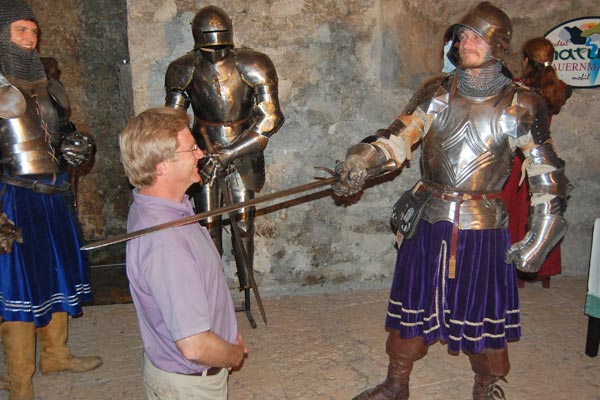
Sir Rick, the first knight of Ehrenberg
Enlarge photo
The sword of Sir Rick in its museum display case, Reutte, Austria
Enlarge photo
Architect Armin and guidebook writer Rick celebrate atop newly excavated and restored castle ruins
Enlarge photo
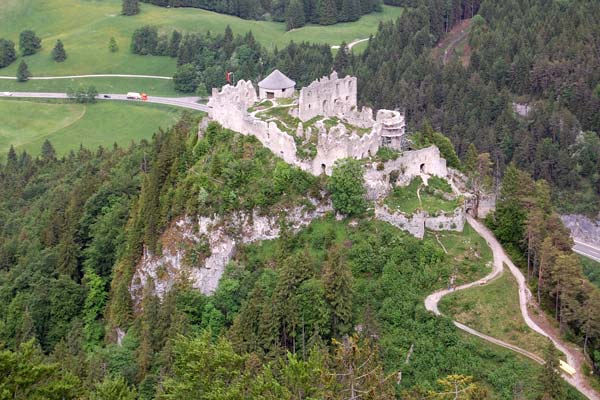
The Ehrenberg castle ensemble once guarded the Tirolians from the Bavarians
Enlarge photo

I was in Hohenschwangau. It was “Mad” King Ludwig’s dad’s castle — Ludwig’s boyhood home. The walls were all painted in 1835 by a single artist, giving the place a Tolkien-romance-fantasy feel. Ludwig became king as a boy. And rather than live with the frustrations of a modern constitution and feisty parliament reigning him in, he spent his years lost in romantic literature and operas…chillin’ with Wagner as only a gay young king could.

Nymphs lounged on his circa 1835 walls. Stars twinkled from the ceiling over his bed. A telescope was set up in Ludwig’s bedroom, trained on a pinnacle on a distant ridge where he could watch Neuschwanstein, his castle fantasy, as it was being constructed.

On my last visit, I peered through that telescope at Neuschwanstein– the castle that inspired another boy named Disney. I could relate to this busy boy king. Bound by schoolwork and house rules, and with a stretched-out turtleneck and zits rather than crowns and composer friends, I, too, built a castle.

What I had that Ludwig lacked was a father who imported pianos. They came from Germany, encased in tongue-in-groove pine, sealed in a thick envelope of zinc sheeting. My treehouse was my castle: no parents reining me in, walls decorated with romantic circa 1968 magazines, nails sticking down through the ceiling just long enough to keep out bullies taller than me. With my sliding tongue-in-groove panels, I could see who was coming. With a shiny zinc roof, it was the envy of other little kings. There was no tree house like it.

On my first independent trip to Europe, I was 18. It was just after someone had purchased the vacant lot next to our house, and I had to tear down my tree house (epic bad day). I toured “Mad” King Ludwig’s Neuschwanstein — a medieval castle dream. Then, just over the border in Austria, I found the Ehrenberg ruins–a medieval castle reality.

Just a mile outside of Reutte, Austria, are the brooding ruins of four castles that once made up the largest fort in Tirol — Ehrenberg. This impressive castle ensemble was built to defend against the Bavarians and to bottle up the strategic “Via Claudia” trade route that cut through the Alps here as it connected Italy and Germany.

One castle crowned its mountain like an ornery barnacle. The others were lost in a thick forest. I hiked up into the misty mountain of meaningless chunks of castle wall pinned down by pixie-stix trees and mossy with sword ferns. It inspired yet confused me. The barnacle castle was below. The ruins were on the bluff above. Like a big, hungry starfish sits on its food, this rotten military fantasy was being eaten by the forest.

A decade ago I met Armin Walch — a Reutte man with a vision. He was born the same year as me and pursued his project like the Indiana Jones of castle archeologists. Today — with European Union funding — he’s cut away the hungry forest, revealed and renovated what he calls the castle ensemble, created an interactive museum, and is open for business as countless children with medieval fantasies can, in turn, leap from rampart to rampart…sword ferns swinging. (See www.ehrenberg.at for details and photos.)

With my 2008 visit, we celebrated. The Reutte hoteliers and tourism folks gathered in the castle like some old-time city council. We ate rustic cheese and smoked game with coarse bread. We swilled wine and clinked pewter mugs.

I was honored for bringing so many visitors to this remote corner of Austria, and gave a magnanimous impromptu speech about the wonders of Americans climbing through history far from home. I knelt before a man in a coat of mail who drew a shiny sword with my name etched upon it and was knighted — Sir Rick, first knight of Ehrenberg. (With uncharacteristic modesty and characteristic insistence on packing light, I requested that my sword stay in the museum as a special exhibit to the former castle-loving boy who brought American tourism to Reutte with his guidebooks.)

On the way back to my hotel, Armin begged me to stop by his house for a drink. Behind his humble old town facade, this dynamic architect hid a sleek, futuristic, and creative pad. It was a royal domain for Armin and his family — two kids cozy on the carpet and a strikingly beautiful wife who Armin bedazzled at the university in Vienna and took to remote Reutte with promises of a princely life and a bitchin’ castle.

With a schnapps from local herbs — unique to Reutte — in hand, we climbed boyishly to his rooftop, where Armin had designed and built a viewing perch. The floodlighting was on. The mountain overlooking his town was crowned by a castle that, in his youth, almost no one knew even existed. With his pretty blond wife suddenly romantic wallpaper, Armin took me to his telescope. We marveled at his castle ensemble.

Munich, Where They Say Being Thirsty Is Worse Than Feeling Homesick

For several years, I’ve marveled at how Berlin has eclipsed Munich in urban energy. I was just in Munich, and now it seems to be comfortable just being itself rather than trying to keep up with Berlin.

After the last couple of years — with the elevation of Joseph Ratzinger (the local archbishop) to the papacy, Pope Benedict’s wildly successful visit, and hosting the World Cup — Munich seems revitalized and on a natural high.

And tourists love Munich. Legions of young expat tour guides are in a brutal battle for the tourist dollar. Here in the beer capital of Europe, tours start late — giving backpackers a chance to sober up. Feisty small walking and biking tour companies train guides who then split off and offer tours for free (and just ask for tips at the end of the gig).

I’ve tuned into bike tours in Europe this year, and I like them more than I thought I would. That’s partly because of competition driving prices down to literally zero. A guy named Lenny offers free tours every day from Munich’s main square — and he’s a fine guide. In general, the guides dumb down their lectures with lots of silly legends, and refer to the beloved Frauenkirche as the “church with the Pamela Anderson domes.” But they are introducing many visitors to a facet of Bavarian culture beyond its famed beer.

My favorite local guide joined me for an evening of restaurant visits. Heading for the Hofbräuhaus, I mentioned I’d love to give it some meaning. He thought that was funny and quoted Freud: “Sometimes a cigar is just a cigar.” We climbed to the beer-stained top floor hall where tour groups gather to pay €20 for an all-you-can-stomach buffet of traditional food and a yodel show. I did find some culture downstairs in the main and noisiest hall. The smoke-stained ceiling, repaired and repainted after WWII bomb damage, was an evocative mesh of 1950s German mod — Bavarian colors, chestnuts, food, drink, and music themes. And a slogan arcing across the ceiling above the oom-pah band read, Durst ist schlimmer als Heimweh(Thirst is worse than homesickness).

Wandering through the legions of happy beer-drinkers in the Hofbräuhaus, it occurred to me that, unlike with wine, more money doesn’t get you a better beer. Beer is truly a people’s drink, and you’ll get the very best here in Munich. Connoisseurs have their favorite brews — and to get it, they don’t pay more…they simply go to the beer hall that serves it.

Beer halls always impress me with their ranks of urinals. Munich had outdoor urinals until the 1972 Olympics and then decided to beautify the town by doing away with them. What about the people’s needs? The new law: Any place serving beer must admit the public (whether customers there or not) to use their toilets.

I struggled for a smooth transition from beer-hall toilets to a new synagogue and failed. Sorry.

Munich’s striking new synagogue is locked tight to the public, but it’s still worth a look for its powerful exterior — its lower stones are travertine, like the famous Wailing Wall in Jerusalem, and the upper part represents a tent that held the important religious ware during 40 years of wandering through the desert until Temple of Solomon was built, ending the Exodus. Today (because Germany has agreed to accept religious refugees from the former USSR), the Jewish population of Munich has finally reached pre-Nazi levels — 10,000. And Munich’s Jewish community is understandably enthusiastic about its impressive new center, with a synagogue, school, and museum.

Dresden’s Wettins Rule

Enlarge photo

At exactly 11:15 in the courtyard of the royal palace in Dresden, forty Meissen porcelain bells began a sweet three-minute melody. I left the shelter of my guide’s umbrella to get a closer look at the bell tower. Squinting into a mist, I could just see the porcelain bells vibrate when hit. I was mesmerized by this little royal trick. Then I wondered why I was so thrilled. Several groups of sturdy Russian tourists who crowded the same square didn’t seem to be that impressed.

Then I realized I was on a Dresden high. In an eastern German town I’ve known for just a few years, I had enjoyed new insights and great new sights — newly restored and newly open to the public.

The Wettin Dynasty ruled Saxony from Dresden for 800 years. Their Louis XIV-style big shot was Augustus the Strong. They say he could break horseshoes with his bare hands and fathered 365 children. He loved being portrayed with the rose of Luther (symbol of the Protestant movement in Germany) being crushed under his horse’s hoof.

The Wettins taught the rest of Europe’s royal courts the art and importance of having their own porcelain works. The Wettins’ Meissen was the first. I thought I knew the best crown jewels…until I saw the Wettin jewels in Dresden’s “Historic Green Vault” — newly opened and requiring an advance reservation to see. They’re absolutely dazzling, and a clear reminder that those Wettins were something in their day.

Then, after pausing to enjoy several street musicians (ever since Romania was admitted to the EU, there has been a flood of street musicians in this part of Europe), I went out to see Volkswagen’s “Transparent Factory,” where visitors are welcome to watch fancy new models actually being assembled. The factory is so politically correct that parts are brought in by “Cargo Trams” — which congest the city’s traffic less than trucks.

Finally, the highlight: the newly restored Frauenkirche. Dresden’s 310-foot-tall Church of Our Lady was destroyed during the massive bombings one night in 1945. With a huge international effort, the heart and soul of the city was put together like a massive jigsaw puzzle — using as much of the original stone as possible. Today it’s open once again. The interior is stunning: pastel to heighten the festive nature of the worship, curvy balconies to enhance the feeling of community, and with seven equal doors — to welcome all equally and send worshippers out symbolically to all corners to share their enthusiasm for their faith.

My Dresden visit started rocky. Riding the express train into town, I figured it would just stop at the main station. The train pulled into Dresden Neustadt — the New City of Dresden. Okay. Most of the passengers got out. So did I. The train took off. I walked and walked with my bag, really sweating, in a confused fog. I must have walked twenty minutes as my denial that I had gotten off on the wrong station slowly faded. After circling the big block and pretty embarrassed at my mistake, I pondered cutting my losses and just taking a taxi to my hotel. But another train was leaving in minutes for what must be the central station. I hopped on. Five minutes later we arrived. I hopped out at Dresden Mitte. The train took off and I stepped outside the station again, and it slowly sunk in: I made the same mistake again. Another train came in a few minutes. I got on it and finally made it to my intended station: Dresden Hauptbahnhof — a block from my hotel. As I tell travelers in lectures: “Many towns have more than one train station.”

One of my best skills — extremely helpful in my line of work — is the ability to make mistakes…with gusto. After a day in Dresden, the frustrating start was a distant memory. And I had a new appreciation of a city that just 60 years ago lay in smoldering rubble, just 20 years ago was in a USSR-imposed economic hole, and today seems to have caught up with Western Germany.

After the masses of Americans I saw in Berlin and Rothenburg, I saw barely one during my entire Dresden visit. Hey, travelers — check out Saxony. Those Wettins rule.

The Characters of Rothenburg

Why do I still love Rothenburg? Everyone in the town makes their living off tourism. The place is stampeded midday with visiting tour groups. The town even created its own traditional pastry — the Schneeball(“snowball”) to compliment all the faux-traditional Christmas ornaments it sells. Yet when I pass through its medieval gates, I feel like a kid who just got a three-day pass for all the rides at Disneyland.

I used to think I liked Rothenburg for the medieval lifestyles on display in Germany’s best-preserved medieval town. The ramparts are intact — complete with arrow slits. The fish tanks next to the water fountains still evoke the days when marauding armies would siege the city, and it would survive on the grain in its lofts and the fish in its tanks. The night watchman stokes his lamp and walks wide-eyed tourists through the back lanes, telling stories of hot oil and great plagues. The monastery garden still has its medicinal herbs. And the crime and punishment museum shows graphically how people were disciplined back when life was nasty, brutish, and short.

But on my last visit, I realized why I like Rothenburg so much (in spite of its Schneeballs, obnoxious tour groups, and Christmas trinkets). It is a community of real characters…and a small enough community that all the characters know each other. And as a return visitor, I’ve learned the social scene.

Enlarge photo

Norry — the man whose guesthouse was so creepy and whose moustache was so droopy that I had to sing the “Addams Family” theme song with each visit — invented a cross between a trombone and a saxophone. He calls it the Norryphone, and now with each visit I boogie on his honky-tonk piano while Norry improvises.

“Herman the German” has spent a thousand Wednesdays at Mario’s “Old Franconian Wine Stube” hosting the English Conversation club (where Germans hang out with tourists, sharing slang, “tongue-breakers,” and beer). Mario — a bohemian chef Gene Wilder look-alike — fastidiously checks each plate as it leaves his kitchen.

Marie-Therese sells kitschy German knick-knacks so enthusiastically that when she takes me home for dinner, her house feels like the innards of a cuckoo clock — and it doesn’t surprise me.

Reno the Italian married into the town and runs a great little hotel-restaurant. For a generation his daughter, Henni, has caused travelers to dream in German. Spry Klaus, who runs a B&B above his grocery store, takes travelers jogging with him each evening at 7:30. Every time I walk under her house, I still remember the old woman who lived in the wall who loved showing off her WWII bullet wound. She’s gone now.

George, the night watchman, is the envy of his neighbors for his lucrative gig — taking a hundred English-speaking tourists around each night for $8 a head on a one-hour tour. Then he does it again in German. (He collects for the English tour at the end. But for the German-speaking crowd, he needs to collect at the beginning…since, otherwise, they’d melt away just before collection time.)

On my last evening in town, everyone seemed to be at Mario’s. Herman the German was holding court with his table of American travelers, there for the English Conversation Club. He gave me a tiny business card that said, “If I had some of your business, I could afford a bigger card.” Norry was playing chess with Martin the potter at the next table. I was enjoying a beer with Henni and Klaus. Mario jokes that it’s impolite for me to not have my hands in sight above the table. He sits down, and the four of us make a square with our stretched left hands — thumbs touching little fingers — and he sprinkles a little snuff tobacco in the “anatomical snuff boxes” we make where our thumbs hit our wrists. “For good health,” we sniff together.

After my nose stops wiggling, Henni tries to impress upon me how sick she thinks it is that American tourists are so nervous about their children having to share a double bed. She keeps repeating, “This is sick in head, krank im Kopf.Never would a European family ask for twin beds for brother and sister. Never. Why Americans? Why they insist?”

George, looking like one of the Bee Gees in his flowing hair and billowing white shirt, is done with his tour and joined by his hippie girlfriend. They dream of their next trip to Thailand. He’s chained to the town to do his tours every night for six months…then he’s free to travel.

In a small town, everyone knows everything. People get along impressively well. The only gang universally not liked seems to be the cartel of farm boys who take tourists on horse-and-buggy rides — apparently they are about as charming as their horses.

I told Henni of a wonderful new hotel I found run by Herr Baumann. I tell her he reminds me of the Wizard of Oz enjoying a relaxed retirement. She concurs, and marvels at how I am able to uncover the characters of the town.

I marvel at — in Rothenburg — how easy that is. For travelers, the challenge is to find places where you can be a part of a quirky yet lovable community…and find a way in. As a returning guidebook reseracher I have an advantiage. But I see lots of travelers having the same fun.

Naked Cartoon Characters in Germany

Yesterday, in two hours, I saw more penises than I’ve seen in the last two years. All extremely relaxed…and, I must say, I was struck by the variety.

Since the Roman emperor soaked in the mineral waters of Baden-Baden, the German spa town has welcomed those in need of a good soak. And it’s always naked. In the 19th century, this was Germany’s ultimate spa resort, and even today the name Baden-Baden is synonymous with relaxation in a land where the government still pays its overworked citizens to take a little spa time.

I happened to be here when one of our tour groups was in town. I told the guide what a great opportunity for her group to enjoy the spa. She said, “No one’s going. They can’t handle the nudity.”

It’s long been a frustration with me as a guide — getting Americans into spas with naked Europeans. My first time was with my wife and some German friends — a classy, good-looking young couple. We were swept into the changing area with no explanation. Suddenly they were naked and I felt like Road Runner just beyond the cliff’s edge. Then — we eased up, and got naked. It’s not sexy…simply open and free.

Whether on a Croatian beach, in a Finnish sauna, a Turkish hammam, or a German spa (I can’t come up with an English example), a fun part of travel can be getting naked with strangers. (Am I right here? What travel memories can you share?)

For me, there are delightful road bumps in my intense research schedule–wonderful God-sent detours where I put away the schedule and notes and simply enjoy the moment. The Friedrichsbad in Baden-Baden is one of those fine little breaks. And today, I needed it: city after city, still reeling from Berlin, with lots of inputting into my laptop. I don’t care how far behind I am in my writing. Now it was spa time.

Wearing only the locker key strapped around my wrist, I weighed myself — 92 kilos. The attendant led me under the industrial-strength shower — a torrential kickoff pounding my head and shoulders…obliterating the rest of the world. He then gave me slippers and a towel, ushering me into a dry heat room with fine wooden lounges — slats too hot without the towel. Staring up at exotic tiles of herons and palms, I cooked. After more hot rooms punctuated with showers came the massage.

Like someone really drunk, going for one more glass, I climbed gingerly onto the marble slab and lay belly-up. The masseuse held up two brillo-pad mitts and asked, “Hard or soft?” In the spirit of wild abandon, I said “hard,” not even certain what that would mean to my skin. I got the coarse brillo-pad scrub-down.

I was so soaped up, he held my arms like a fisherman holds a salmon so I wouldn’t slip away. As if my body was any different to him than the dozens he rubs down every day, funny thoughts went through my mind. It was still extremely relaxing.

Finished with a Teutonic spank, I was sent off into the pools. Nude, without my glasses, and not speaking the language, I was gawky. On a sliding scale between Mr. Magoo and Woody Allen, I was everywhere. Steam rooms, cold plunges…it all led to the mixed section.

This is where the Americans get uptight. The parallel spa facilities intersect as both men and women share the finest three pools. Here, all are welcome to glide under exquisite domes in perfect silence like aristocratic swans. Germans are nonchalant, tuned into their bodies and focused on solitary relaxation. Tourists are tentative, trying to be cool…but more aware of their nudity. Again, there’s nothing sexy about it…just vivid life in full flower.

A beautiful woman glides in front of me. Like a female flotilla, her peaceful face and buoyant breasts cruise by, creating barely a ripple. It occurs to me that I wouldn’t mind talking to her. But you don’t really just start up a conversation with a naked stranger. What would you say–“Nice domes”? Then she starts walking into the men’s section. Perfect. I whisper to her, “Excuse me, that’s the men’s section.” She was from Texas…and appreciative.

The climax is the cold plunge. I’m not good with cold water — yet I absolutely love this. You must not wimp out on the cold plunge.

Then, the attendant escorted me into the “quiet room” and asked if I’d like to be awoken at any time. I told him at closing time. He wrapped me in hot sheets and a brown blanket. No, I wasn’t wrapped…I was swaddled. Warm, flat on my back, among twenty hospital-type beds — only one other bed was occupied…he seemed dead. I stared up at the ceiling and some time later was jolted awake by my own snore.

Leaving, I weighed myself again: 91 kilos. I had shed 2.2 pounds of sweat. It would have been more if tension had mass. Stepping into the cool evening air, I was thankful my hotel was a level two-block stroll away. Like Gumby, flush and without momentum, I fell…slow motion onto my down comforter, big pillow puffing around my head like the flying nun. Wonderfully naked under my clothes, I could only think, “Ahhhh. Baden-Baden.”