Finally returning to Europe to update our Rick Steves guidebooks, I was expecting to find lots of changes due of the pandemic. But the biggest trend is something I didn’t see coming: In just two years, Europe has made huge advances in technology. It used to be, there were two ways of doing things: the tech-savvy way, and the old-fashioned way. Now the two options are “get with the tech” or “get left behind.” If you’re heading to Europe soon, it’s time to get comfortable with technology.
This may sound intimidating. Fortunately, the technology — from “contactless” payments, to e-tickets for museums, to buying train tickets on an app — has also become much more user-friendly. Yes, there’s a learning curve. But the “new way” of doing things is easier than ever. And it comes with a bigger payoff.

Contactless Payment
The prime example of this trend is “contactless” or “tap” payment, for purchases both big and small. This technology has already had a stealth rollout in the USA over the last couple of years. About a year ago, my bank sent me — unsolicited — a new “tap” credit card. At first, I thought, “Why? I don’t need that.”
Now that I’ve traveled in Europe, I understand: Yes, I really do need that. Not just on the road; it’s also a great convenience at home. (Surprisingly, many vendors in the US don’t even realize they accept tap payments. This has happened to me several times: A cashier says, “OK, you can insert or swipe your card.” Instead, I tap my card against the terminal. The cashier says, “No, you have to insert…” BEEP! “Oh, it worked.”)
While some of you may be up to speed on “tap” payment, many Americans haven’t quite fully adopted it. And those people are in for a rude awakening when they land in London or Amsterdam and find that, in very many cases, “contactless” is the only way to pay for purchases.
To get ready for contactless, you have two options:
First, check with your credit card company to see if they offer a “tap” version of your card. They may be able to send you one immediately. Or check the card you already have; it may, heretofore unnoticed by you, have the four curved lines indicating that it works for “tap” payment. Since you’ll be using this in Europe, start trying it out at home before you go.

But what if it’s too late to get a tap card? No problem. You can set up contactless payment on your smartphone. For example, if you have an iPhone, you can link any credit card to your Apple Wallet. (In the “Settings” menu, look for “Wallet & Apple Pay,” then “Add Card.” Here’s more information for Apple devices, and for Google Pay on Android.) When it’s time to pay, just move your phone toward the pay pad and click the side button twice. It’ll scan your face (or ask for your passcode)…and Bob’s your uncle!
I don’t want to overstate the “cashlessness” of Europe. In many places, cash is still widely used. For example, in three weeks in Italy, I could have paid for just about everything with cash…had I wanted to. But if you pay with plastic, you’ll be paying by tap (rarely by inserting or swiping your card).
That said, in some places, cash is effectively extinct. In London, I was surprised how many businesses — big and small — simply refused to accept it. Whether paying for a nice dinner, buying a pack of gum, or booking a theater ticket, everyone just wanted me to tap. When I landed at Heathrow, I withdrew £200 from an ATM — assuming, as on past trips, that I’d pay for things with a combination of cash and card. I still have about £180 taking up space in my money belt. (Fortunately, I’m heading to Scotland later this summer, where I will work harder at unloading those bills.)
Here’s a sign of the times: At the City of London tourist office, I was told that they tried to go cashless last year. But then, Americans began to return — and they kept showing up with cash. So the TI had to quickly figure out how to go back to accepting cash payments. (Of course, other businesses aren’t so accommodating.)
If visiting a place where contactless is dominant — such as London — simply take out less cash on arrival. Or wait a day or two, to be sure you really need it. You may never get around to it.
Once you get used to this change, it’s frankly wonderful. Tap payments make things so easy. Gone are the days of worrying if the European machine would accept your American PIN, or figuring out whether you have to insert or swipe. With contactless, it’s just tap and go.
Museum Changes: Reservations, E-Tickets, and the End (?) of Audioguides
Technology has also altered the way that museums operate. The ability to make online reservations for major sights is old news. But through the pandemic, that process has been streamlined and simplified, and now even smaller museums offer this option. This began primarily as a crowd-management measure. Now that occupancy limits have been lifted, most sights seem to be keeping those systems in place for the convenience of their visitors (or, more likely, because they like the way it helps them track attendance data).

Here’s the catch, though: Just because a sight offers reservations, doesn’t mean they are actually helpful for every traveler. Pre-reserving online takes time and makes your day’s structure more rigid. (In Italy, it also usually costs a couple of euros extra to book ahead.) It’s worth doing some homework to establish whether it’s really worth reserving ahead. I find that for popular museums, at busy times, prebooking saves time and stress. But otherwise, I’d rather keep my schedule flexible.
By the way, some sights that used to just recommend reservations now require them. In Rome, I showed up one morning at the Colosseum without a reservation. It was not too busy at other big sights, so I figured I could just buy a ticket and go inside. However, at the turnstile I was informed that all of the ticket windows had been closed during COVID; the only way I could gain entry was by prebooking online. The good news: There were time slots available almost immediately. The bad news: To book one, I had to stand around in front of the Colosseum for 10 minutes, struggling with a buggy website on my smartphone. It worked. But I wished I’d done it back in the comfort of my hotel room.

Will this be the case from now on? Good question. As we update our guidebooks, we’re learning that museum policies are still in flux. Some of my “fresh” Rome updates from just one month ago are already out-of-date. It could well be that, as crowds increase through the summer, some of the Colosseum’s in-person ticket desks will reopen. (Though in that case, you’d still want to reserve ahead, to save time.) To be clear on the latest policy, check the sight’s website for official word before you visit.
When you do book online, it’s easier than ever to enter the sight. Major attractions now have separate entrances for ticket holders. After you book your ticket online, you’re emailed a QR code; just show this at the appropriate turnstile, and you’ll be scanned right in. And that’s it…no need to print anything, or to exchange a voucher or a virtual ticket for a paper one. It’s wonderfully simple. (Some sights, of course, still do have security lines.)
Here’s a handy “travel hack,” straight from Rick Steves: It can be a pain to scroll through old emails to find your ticket, once you arrive at the sight. Consider taking a screenshot of the QR code when you receive it, so it’s easier to find quickly in your camera roll. (Good one, Rick!)
The other trend I noticed was the decline of audioguides. This makes sense: During a pandemic, who wants to press their face against a device that was recently pressed against a stranger’s face? Many museums have replaced physical audioguides with apps that you download and listen to on your own phone. It’s hard to predict anything these days, but now that these apps are in place, I have a hunch that many sights will never go back to physical audioguides (a technology that was already feeling old-fashioned).

As I made these discoveries, I was glad to work for a company that produces our own top-quality audio tours of Europe’s top museums. This sounds like a gratuitous plug, but it’s simply a smart, honest travel tip: As the availability of good museum information is in flux, there’s never been a better time to take advantage of Rick’s entirely free audio tours, which you can download and use via our Rick Steves Audio Europe app.
In London, many museums have also integrated maps into their free apps…and, therefore, have done away with paper maps. Again, this largely began as a “touch-free” COVID measure. But now that they’ve innovated this alternative, museums are figuring out how much it saves them in printing costs. And at museums where they rearrange the collection frequently (such as the Tate Britain and the Tate Modern), digital maps are easier to update, too. I suspect that, for some museums, paper maps will not return. If you don’t want to download the museum app, here’s a tip: Just take a photo on your phone of the map posted in the lobby.

Train Tickets, Getting Online, and Other Technology Issues
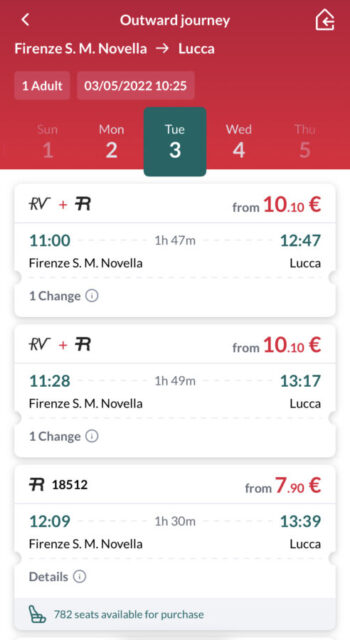
On this trip more than ever before, I booked intercity train tickets on apps. In Italy, I used the official Trenitalia app; in Britain, I used the Trainline app. In both cases, I could look up schedules, choose a departure, and book a ticket with just a few taps on my phone. Gone are the days of arriving at the station early to stand in line or grapple with self-service ticket machines. You can just book your ticket over breakfast, or in the taxi on your way to the station. Scan your QR code to enter the platform turnstiles, and keep track of the train’s schedule (including delays updated in real time) right on the app.
I also used apps to hail taxis. In Rome, I used the “Free Now” app to get a regular Roman taxi, for the regular rates, on request, without having to make a phone call or find a taxi stand. And it made it simple to pay and tip with my credit card. (Uber works in Rome, but only at the pricier “Uber Black” level — making a regular taxi more affordable.)
Of course, many of these technology advances require an Internet connection. This can be simple, or an expensive headache, depending on your provider at home. I use T-Mobile, even though their service where I live can be very frustrating, because they offer free (if slower) Internet access in Europe. Some of my relatives use Verizon, which requires buying a special plan to use in Europe. (Here’s an article explaining some of this.)
Even a few years ago, for someone on a casual vacation, I might have advised them not to bother setting up their phone to get online in Europe. Free Wi-Fi hotspots are plentiful, and you’re usually not far from a place to get online. However, with the technological leaps I observed on this trip, getting online abroad is increasingly worth the hassle. While you can still probably get away with skipping it, these days you’re more likely to encounter situations where you’ll be glad you did.
If you just hate dealing with technology, all of these changes may sound demoralizing. I’d flip that logic around: It’s empowering to know that these changes are afoot, so you have time to get used to them and learn the new system. What would be “demoralizing” would be landing in Europe, unaware that these options are out there…and being constantly frustrated by them. It’s amazing how fast the “new standard” gets set when the world changes. And it’s time to get on board.
I was in Europe updating our Rick Steves guidebooks for our brand-new, post-COVID editions. Those will begin to arrive on bookshelves later this summer.
I’m heading out again soon for another trip to Europe. In the coming weeks, I’ll be in Poland, the Netherlands, Belgium, and Scotland. If you’d like to hop in my rucksack, I’ll be posting occasionally to this blog. But for all the latest updates, be sure to follow me on Facebook. Happy travels!









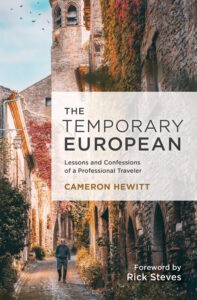 During the pandemic, I took some time off to write a travel memoir, The Temporary European: Lessons and Confessions of a Professional Traveler. It’s a collection of my favorite travel tales from my 20-plus years working with Rick Steves, plus inside looks at what it’s like to write guidebooks, make travel TV, and guide tours. You can order it from your favorite local bookseller; get it at the