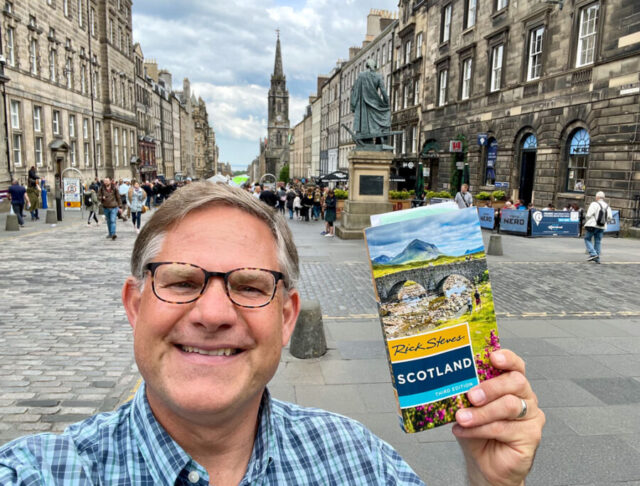
My co-author and frequent collaborator, Cameron Hewitt, is well-traveled, smart, and insightful. And, while he and I are in perfect sync in our travel styles and priorities, he gives voice to the next generation of "Rick Steves travelers." Join me in enjoying his reports right here. —Rick

Celebrating Women’s History Month

March is Women’s History Month, and March 8 is International Women’s Day. So let’s talk about women’s history in the context of European travel.

As a (male) guidebook writer, I’m keenly aware that women are, so often, underrepresented when telling the story of Europe.

On a recent research trip, I received a welcome reminder of this when I posted on Facebook about the Protestant Cemetery in Rome, and told the stories of some of the fascinating men buried there. A Facebook account called Herstorical Monuments pointed out that many even-more-fascinating women are also interred at that cemetery, and suggested I look into one in particular: Sarah Parker Remond (1826–1894), a Black woman born free in Salem, Massachusetts, who traveled to England to gather support for the abolition of slavery and eventually became a physician in Florence, Italy. I appreciated the nudge, and Remond is now mentioned in our Rick Steves Rome guidebook.

As I’ve worked on our guidebooks across Europe since then, I’ve kept this important mission in mind. The stories of great women can be difficult to track down — all too often, you have to work to uncover them. But if you travel with this goal in mind, you realize that Europe’s history has been shaped by many exemplary women.

For example, in Glasgow, I dug deeper into the story of Margaret Macdonald Mackintosh (1864-1933). While known primarily as the “wife of Charles Rennie Mackintosh,” Margaret was a talented artist in her own right — collaborating with her husband on many of his best-known works, often contributing their defining features. And she did not just influence her husband. One of the most famous works of Austrian artist Gustav Klimt, the Beethoven Frieze, bears a striking resemblance to a work of Margaret Macdonald’s that Klimt had seen at a show in Vienna.

In Budapest, I learned the story of Hannah Szenes (1921-1944), a Jewish woman who became part of an elite paratrooper unit during World War II. Szenes dropped behind enemy lines, where she was captured and tortured, refused to give up her comrades, and was ultimately executed by the Nazis. In addition to being  a war hero, Szenes was also a poet; one of her poems — called “Eli, Eli” (or “A Walk to Caesarea”) — provided the lyrics to a beloved song that’s sung around the world in remembrance of the Holocaust. (You can read Szenes’ full story in our Budapest guidebook.)

In the world of science, few figures loom larger than Madame Curie — born in Warsaw as Maria Skłodowska (1867-1934). She traveled to study in Paris, where she met her husband, Pierre. They were the first to identify and explain the phenomenon of radioactivity, and they discovered two new elements: Polonium (which Marie named after her native land) and Radium. They were awarded the Nobel Prize in Physics; later, Marie won a second Nobel Prize in Chemistry, making her one of just two scientists who’ve been awarded Nobels in two different disciplines. After Pierre died, Marie took over his professorship at the Sorbonne and continued their research; among other accomplishments, she founded the Radium Institute, which still carries out important cancer research. (Her full story is told in our Central Europe guidebook.)

And in Dublin, on a visit to the sobering Kilmainham Gaol, the tour guide passionately told the story of Constance Markievicz (1868-1927), an Irish woman who took up arms during the Easter Rising. As one of the rebellion’s leaders, she was convicted and sentenced to death, but that sentence was later changed to life in prison, solely because she was a woman. (A regretful Markievicz said, “I do wish your lot had the decency to shoot me.”) Later released, she was elected the first-ever female member of the British House of Commons; soon after, she became Minister of Labor — the second woman in all of Europe to hold a cabinet position.

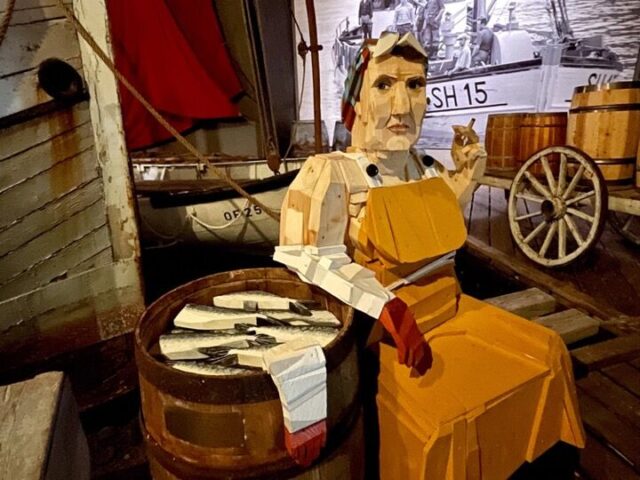
Often, women change history collectively and anonymously. For example, in the tiny fjordside village of Siglufjörður, at the northern tip of Iceland, the Herring Era Museum explains how the abundant shoals that were caught and processed here powered Iceland’s economy through the early 20th century. The hard work of cutting and salting the herring was done by women, who worked 20- or even 30-hour shifts. These workers were known as “herring girls” — a term that today’s local women have embraced with a Rosie the Riveter verve. Make no mistake: The “herring girls” were the muscle behind Iceland’s economy during a critical period, arguably empowering it to become fully independent from Denmark.

And in Derry, Northern Ireland,  a wonderful mural honors the thousands of women who worked sewing machines at Derry’s shirt-making factories (the biggest was Tillie & Hendersons). These original “Derry Girls” powered the economy; often served as the primary breadwinner for their family; and held the fabric of the town’s society together.

Probably my favorite often-overlooked great woman of history should rightly be the patron saint of solo women travelers. I stumbled upon her at, of all places, a souvenir shop in the Slovenian capital of Ljubljana. Perusing a stack of coffee mugs decorated with the faces of great Slovenes, I scanned the familiar (male) names — Plečnik, Prešeren, Trubar — and came across one that was unfamiliar: Alma Karlin.

I asked the clerk for more information. “Oh, yes, Alma,” she said, as if talking about a dear old friend. “She was a great traveler and an amazing woman! Went all over the world by herself.”

Needless to say, I bought the mug. And I went back to my hotel and did some research on this fascinating human being for my Slovenia guidebook. And so, in honor of International Women’s Day, here’s the complete story of Alma Karlin:

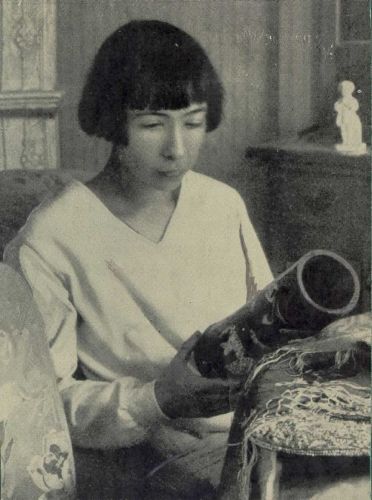
Alma Karlin (1889-1950): Slovenia’s Greatest Traveler?

Slovenia is a land of great travelers. And perhaps the greatest was Alma Karlin, considered the first European woman to travel around the globe independently (with no outside financial support). Karlin was also a polyglot, ethnologist, iconoclast, prolific writer — and iconic Slovenian woman.

Karlin was born in 1889 in the city of Celje, then the Austro-Hungarian burg of Cilli. Her father, a retired military officer, once sparked young Alma’s imagination by telling her that if she left home toward the west and just kept going, eventually she’d wind up right back where she started. But Karlin had a challenging childhood, with a drooping eye and a slumping shoulder, which her mother attempted to correct in painful and humiliating ways.

After her father’s death, Karlin escaped her overbearing mother by studying in both London and Paris, then fled to Sweden and Norway during World War I. Karlin slowly mastered what eventually amounted to more than 10 different languages, and also discovered a passion for writing and traveling. Returning home after the war, she taught language classes until she had saved enough money for a ’round-the-world journey.

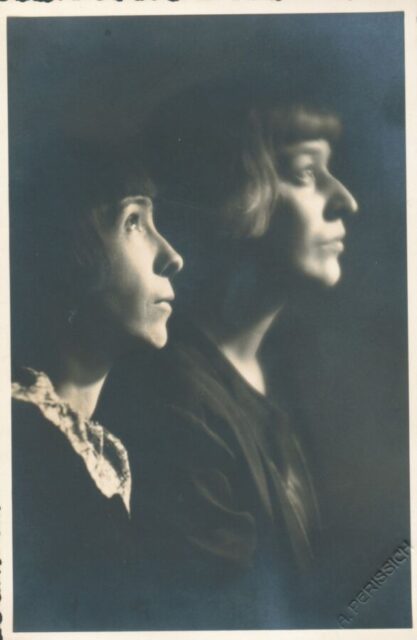
Karlin departed Celje in November 1919, carrying a single suitcase containing a few items of clothing, a typewriter, and a 10-language dictionary she had written herself. She headed west, loosely following the route her father had outlined: first to South America, then to North America, and eventually to Asia, Australia, and Oceania. Finally, in 1928, at the request of her ailing mother, Karlin returned home to Yugoslavia. Back in Celje, Karlin entered a deep depression (possibly resulting from malaria) and never left home again. But that did not mean she remained unhappy: Karlin met and fell in love with the German painter Thea Schreiber Gamelin, who eventually moved to Celje so they could live together.

Karlin had already amassed many lifetimes’ worth of experiences in those eight years on the road. Over the next two decades, she wrote extensively about her journeys (starting with her travelogue The Lonely Journey, in 1929), as well as novels, short stories, and plays, eventually gaining an international following. Her works include closely observed details and tales of her own misadventures, written with wit and honesty. She also became fascinated with spirituality and mysticism — having been exposed to many different faiths in her journeys.

Originally Karlin wrote in German — which was her first language — but later, in protest of Nazi Germany, she switched to other languages. When the Nazis occupied this part of Slovenia, they banned Karlin’s books, arrested her, and sentenced her to a concentration camp; only Thea’s intervention saved her. Karlin spent the rest of the war, in failing health, living either under house arrest in Celje or in exile. She died in 1950 and is buried next to her beloved Thea in the Svetina village cemetery just outside Celje.

While Karlin has been until now a footnote in Slovenian history, interest in her travels and her work is finally catching up. Hopefully, as her status as the proto-“solo woman traveler” becomes better known, more of her writings will be translated into English. In the meantime, if you’d like to learn more about Karlin, you’ll find an exhibit about her at the Regional Museum in Celje. And, quite fittingly, a statue of Karlin toting her suitcase greets arriving travelers in front of the Celje train station.


Who is your favorite unheralded woman in the story of Europe? And also: Who’s your favorite solo woman traveler?

What Makes a Good Guidebook…a Good Guidebook?

“I love using Rick Steves books! I take them along on every trip. In fact, it’s challenging when I go someplace that Rick doesn’t cover. Everything’s just so much harder.”

I hear this a lot when I bump into fellow travelers in Europe. Many are fiercely loyal to their Rick Steves books…maybe even to a fault. (Some B&B owners grouse that our readers refuse to consider their personal, carefully curated restaurant recommendations…just because they’re not “in the book.”)

And the flipside of loving Rick Steves books is getting frustrated when you don’t have one. I just got back from a vacation to one such place, New Zealand. And struggling with travel information that felt like it was nibbling around the edges of actually being helpful, while leaving me with more questions than answers, got me thinking about what makes a good guidebook…a good guidebook. And so, from the perspective of someone who’s spent more than 20 years working on the Rick Steves books, here’s my take on the “secret sauce” of what sets them apart.

I brought along four different guidebooks to New Zealand, hoping to cover as many bases as possible. And I found some great tips, leads, and advice in each one; all of them earned their weight in my rucksack, at one point or another. But at the same time, all of those books spent more time in my bag, or in the backseat of my rental car, than in my hands. They were useful to a point, but they weren’t indispensable; they didn’t give me the feeling of actually traveling with a knowledgeable friend. Why? What’s missing?

One of the biggest problems with many other guidebooks is that they strive to be comprehensive, which forces them to skimp on depth. You know: “Jack of all trades, master of none.” A typical publisher’s book on New Zealand assumes an obligation to cover any city or town in the country over a certain size — regardless of how visit-worthy it may be — which spreads resources and word count too thin.

Conversely, you could rightly ding Rick Steves books for not covering enough places. Travelers are sometimes aghast that we don’t include Bologna in our Italy book, or Geneva in our Switzerland book, or Valencia in our Spain book, or Bordeaux in our France book. And if you’re going to those places, your disappointment is understandable. However, years ago, Rick determined that being selective was key to providing solid guidebook coverage. So, if a place is covered in our books, it’s covered completely. But that means we can’t get to everything.

Which leads into the next feature of those less-satisfying guidebooks: They assume that travelers are independent spirits who don’t want or need detailed, prescriptive information. Surely there are travelers who fit this description. And those travelers would probably find Rick Steves books too hand-holding, even pushy.

But the fact is, when most travelers are going to a new place, deep down they really want someone to help them shape their trip, whether it’s a trusted globetrotting friend, an Instagram or TikTok influencer whose travel style matches their own…or a good guidebook.

That goes double for us Americans, who have the shortest vacations in the rich world. (It feels borderline-subversive that my wife and I took two whole weeks for our New Zealand trip.) We American travelers need to be efficient and smartly use our time, even if some of what we’re using that time for is just relaxing. After all, some places are better for relaxing than others…and we’d like to know which are which.

That’s why a hallmark of Rick Steves guidebooks is that we’re opinionated. We’ll tell you, unapologetically, our idea of the best way to plan your time, and we’ll rank sights (using our “pyramids” system) based on our highly subjective opinion about which are the most worthwhile.

That said, if you read between the lines of our books, you’ll notice that only a select few favorites are presented as unmissable. Rather, for the vast majority of our listings, we try to describe them with precision, clarity, and actionable details — knowing that a specific place is not for everyone, but hoping to steer each traveler in the right direction. When we describe a hotel, a restaurant, a museum — really anything — our guiding principle is to give the reader enough information to make their own decision about whether it’s worth their time. We want to help them knowledgably distinguish among their many choices.

For example, let’s get back to that “relaxation” goal, and specifically beaches. If you’re in an area with several beaches, our job is to help you sort out which one suits your style. Are you a boogie-boarder or a snorkeler? Do you like gentle wading or splashing in surf? Sand or pebbles? Family-friendly, mellow, or rollicking beach bars? Shade or sunshine? Best for long walks or for sunbathing?

Taking the time to parse these kinds of choices also helps make our books feel personal, handcrafted, and approachable, rather than stuffy and generic. Often, one of our biggest challenges when training new researchers or editors is convincing them that the quirky takes, memorable turns of phrase, offbeat sense of humor, flashes of informality or even irreverence…these aren’t “bugs” in our books; they’re features. They remind the reader that there are real people hiding out between those pages, leading you by the hand through Europe.

Your narrator “Rick” (whether or not Rick personally wrote it) prides himself on taking you to a little hole-in-the-wall tavern where you can sample the local firewater, or a bakery to nibble a favorite pastry. Along the way, he’ll fill you in with gossipy tangents about the neighborhood you’ll be calling home for the next few days. He’ll introduce you to the owner of the place, and point out all the quirky decor plastered to the walls. That kind of intimacy is risky, and it’s rare — and it’s why people love our books.

So often, using those other books on my trip, I felt like they were scattering a few sparse breadcrumbs for me to connect myself. For example, on New Zealand’s Coromandel Peninsula, one of the top attractions is Cathedral Cove, a dreamy beach surrounded by rocky pinnacles. But you can’t just drive right to Cathedral Cove, hop out of your car, and walk five minutes down a well-marked path. Rather, there are at least three different ways to get there by foot — all of them requiring a lengthy, moderately strenuous hike — plus there are options by taxi boat, kayak, and RIB (rigid inflatable boat) tour from a nearby beach town.

Bits and pieces of that intel was scattered across the various guidebooks I was using; the rest of the picture was filled in by some online research. Sorting through the basic question of how to get there — to this iconic location that’s on the to-do list of virtually everyone visiting the Coromandel  — probably consumed at least half an hour of my precious vacation. All the while, my “guidebook author” instincts kept screaming inside of me: Why can’t one of these guidebooks come up with a section called “Getting to Cathedral Cove,” with a clear, strategically organized list rattling off my choices, with pros and cons for each?

When we write our guidebooks, our goal is to anticipate what the traveler needs to know, just before they realize they need to know it. The people who write, update, and edit Rick Steves guidebooks are travelers ourselves: We’ve been in those very situations, and we know the questions and challenges we faced as someone trying to smartly use our time. When updating our material, Rick’s top admonishment is to “live the book” — even if you’ve done this or that a dozen times before, follow the instructions laid out in the book as if it’s your first time…and then fill in any gaps you find along the way. This requires time, energy, an affection for the reader, and an affinity for problem-solving.

And that’s another hallmark of Rick Steves books: We update our books lovingly, frequently, and in person. Now, I don’t want to make any unsubstantiatable claims about other guidebook publishers. I honestly don’t know how, or how often, they update their material. But my strong suspicion is that the frequency and rigor of our update schedule far exceeds anyone else’s.

This is based mainly on feedback from the businesses we list in our guidebooks — hoteliers, restauranteurs, museum ticket-takers, and so on. On each research trip, I generate double-takes on the part of Europeans who recognize me from a previous visit, and are borderline-shocked that I’ve returned already to check things again. “You’re back!” they say as I walk in the door. “Weren’t you just here?” Then they pull me in close, dart their eyes conspiratorially, and whisper, “I haven’t seen anyone from that other guidebook in eight or nine years.”

The proof is in the pudding, and that generous, on-the-ground research really distinguishes our books. All of that travel not only ensures that our guidebooks are the most accurate and up-to-date on the market. It also feeds into all of the other features I’ve outlined here — making our books a rare breed that are created by travelers, for travelers…by traveling.

So then, why don’t we cover more of Europe? Or, for that matter, so many other places? It’s a fair question. And I’ll be honest with you: I’m number one in line suggesting a Rick Steves New Zealand guidebook.

But no matter how many times I ask, Rick will say no. And he’ll be right. He figured out a long time ago that it’s better to do one thing, and do it exceptionally, rather than expand beyond your means. We could slap the Rick Steves name on hundreds of guidebooks, ranging from Disney World and Las Vegas to Down Under…but they’d lose that personal touch. (These days, this trendy concept is called “scaling.” Rick has never used that word…but it’s been his instinctive ethos for decades.)

In the meantime, let’s compare notes on suitable alternatives for places Rick doesn’t cover. Personally, I find the big brands can be decent, but they tend to be hit-or-miss; some titles are spot-on, while others are disastrous. Often the best books are by someone (like Rick) with a tight focus and a longstanding passion. For example, Andrew Doughty’s Hawaii Revealed series is my trusted companion anytime I’m traveling to the Hawaiian Islands; they have a depth of hard-earned wisdom, and an endearingly informal personality, that make them the “next best thing” to a Rick Steves Hawaii book. On a visit to Costa Rica a few years back, I enjoyed using James Kaiser’s Costa Rica: The Complete Guide, which has a similar approach.

Moving beyond paper guidebooks, the GyPSy Guide audio driving tours — covering many national parks and other scenic drives across the US and Canada — are outstanding. I’ve followed every single one of their tours in Hawaii, and I actually get excited when I’m going somewhere new that they cover. Just like a Rick Steves book, they seem to intuit when you’re getting hungry and suggest just the right place to pull over for a sticky slice of banana bread.

Other “non-guidebook” sources I trust include Katie Parla, an American expat who offers well-researched, insightful, playfully opinionated advice about where to eat in Italy. And Rick and I have both been relying more heavily on Michelin Guide’s “recommended” or “Bib Gourmand” restaurants — less expensive and more accessible than the big-ticket “starred” choices — when looking for nice places to eat.

What about you? Any others you can suggest?

And while we’re on the topic: Am I missing anything? What makes you enjoy using the Rick Steves books? Or am I off-base on any of the above?


Speaking of fresh guidebooks, 2022 was a huge year for getting all of our books fully up-to-date after a lengthy, unplanned pandemic hiatus. Most of those brand-new editions are either available now, or coming in the next few weeks. With all the changes brought about by COVID — and the simple passage of time — it’s essential to get your hands on the newest material if you’re heading to Europe this year. You can find all of our titles in the Rick Steves Travel Store, or wherever books are sold.

Top 10 Italian Food Experiences

From eating with the seasons to enjoying an aperitivo, from devouring a pizza in Naples to grazing the street markets of Palermo, and whether hunting for truffles or the best possible gelato, Italy boasts an abundance of ways to experience one of the world’s most beloved cuisines.

We’re celebrating the arrival of our newest book, Rick Steves Italy for Food Lovers — available now. During the pandemic, I worked closely with Rick and co-author Fred Plotkin to assemble this comprehensive handbook for the traveler — teaching visitors how to fully experience the joys of eating and drinking in Italy, and to think about food the way Italians do. And now that the book is finally out, I’ve been dreaming about the many wonderful food experiences I’ve savored all across Italy. Here’s my selection of 10 amazing Italian food experiences — which, I hope, will inspire you as you plan your own travels.

Of course, this is just one traveler’s list. What are some of your favorite Italy food experiences? Share yours in the Comments.

Eating Local: Culinary Campanilismo


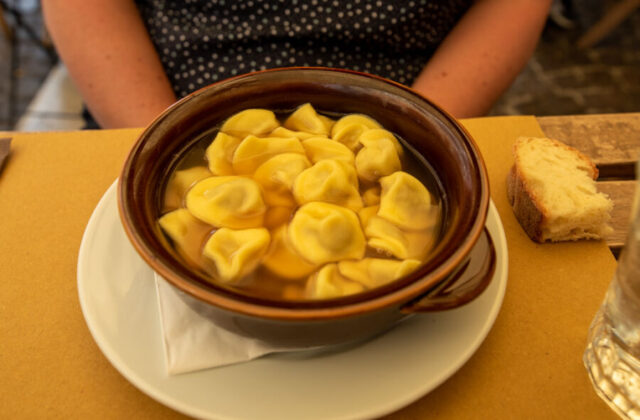
Recently I posted about some of the excellent foods I’ve had in Emilia-Romagna — including a bowl of what I identified as tortellini in brodo. In the Comments, a stickler called me out: “Sorry for you but these aren’t tortellini.” So I looked it up. And, sure enough, Parma (where I enjoyed this dish) has its own version of tortellini, which the parmigiani call anolini. If you lined up 100 non-Italians, at least 99 of them would be hard-pressed to explain the difference between tortellini and anolini. Does it really matter?

Yes, it does. And I was wrong.

 Campanilismo is the fierce loyalty Italians feel to their immediate community… literally, the people who live within earshot of the same bell tower (campanile). And Italian cooking, too, is exactingly local.

As my wife and I explored Piedmont last September, we were struck by how similar menus were from place to place. Each dish was a piemontese specialty we’d rarely seen elsewhere. Tajarin (skinny, vivid-yellow, egg-yolk noodles) were smothered in a variety of sauces. When it comes to Castelmango cheese, with a decadent texture and a wipe-a-tear pungency, a little goes a long way. And several meals ended with bonèt, similar to a chocolate flan. 

We used “eating local” as an excuse to stretch our culinary boundaries. Normally, we’d give a pass to vitello tonnato — veal with a creamy tuna-caper sauce — based on the description alone. But knowing it was a local forté, we tried two very different versions. And both were excellent.

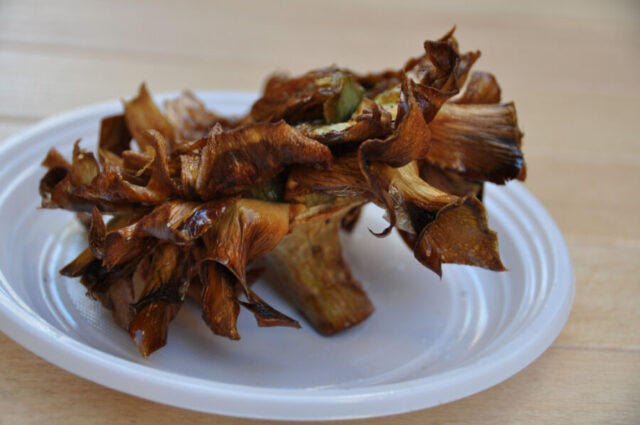
It’s not just regions. These localized specialties often come down to the town…or even the neighborhood. In Rome’s historic Jewish Quarter, signs advertise carciofi alla giudìa — “Jewish-style” artichokes. Taking the hint, I ordered an item that looked like some crispy-crunchy alien appendage. And it was a memorable, and delicious, treat.

Don’t head to Italy with a “bucket list” of foods that you’ll demand to eat while there. Instead, let the locals tell you what they are excited to feed you

Eating with the Seasons

Italians brag that if you show them a menu from any restaurant in Italy, they can identify not only where it comes from…but what time of year. That’s because the best food is not only local — it’s highly seasonal.

Speaking of artichokes, I happened to be in Rome last March, when artichokes were absolutely everywhere: piled in neat pyramids in grocery store windows, on restaurant menus, and so on. Walking through the Testaccio Market, I saw piles upon piles of those beautiful vegetables, with their artful ombré of green and purple. It felt like the city was having one big artichoke party.

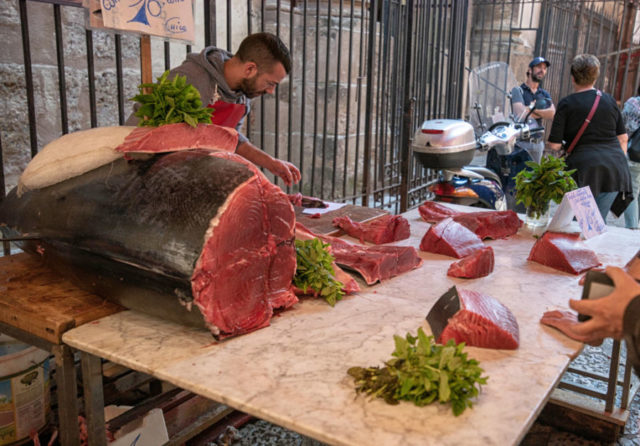
Italians know the rotating calendar of seasonal specialties, and they track those annual cycles with a special verve. On a springtime visit to Palermo’s street markets, a flurry of activity engulfed a table displaying gigantic slabs of bright-pink tuna, just caught. The fishmongers set out little sprigs of delicate spring mint, symbolizing that tuna season had begun. During the brief window when the tuna is this fresh, you eat it virtually rare — barely kissed by flame, then onto your plate.

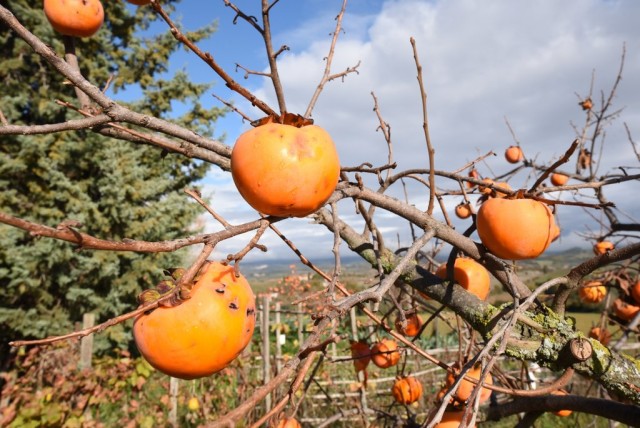
One fall in Tuscany, the hillsides were mostly bare except for the neon-green fuzz of winter wheat. Trees were naked; bushes were brown. But on a few spindly branches dangled plump orange fruits: persimmons. One of the best dishes I had on that trip was a dessert consisting of chestnut mousse with persimmon purée. It tasted like a Tuscan autumn.

One dish my wife and I did not have on that trip to Piedmont? Truffles. Even though it’s a truffle-crazy region, we were just a dozen days or so too early to enjoy that delicacy in its prime. And so, it was notably absent from local menus.

We Americans are used to getting what we want, when we want it. But when we do that, we sacrifice quality. Recently, at my local supermarket, I bought some tomatoes and strawberries. And, because it’s winter, they tasted almost indistinguishable.

Italians have patience. They know good things are worth waiting for. And when you have an ingredient or a dish just once a year, its flavor is that much more special.

Indulging in Passeggiata, Aperitivo, and Apericena

When visiting Italy, let yourself get swept up in the passeggiata — that special hour or so each evening when the entire community does lazy laps around the city center. And as you stroll, don’t miss a parallel custom happening along the fringes of that street: the aperitivo, an after-work, pre-dinner drink enjoyed among friends. People meet up to have a cocktail, socialize, take a little break from their evening constitutional…and enjoy their beautiful cityscape.

At aperitivo time, Italians people-watch from café tables, or stand around in little clusters, engrossed in conversation. In every hand is a bright-orange glass of Aperol spritz. It’s all so…civilized.

Some bars throw in a small snack — a basket of potato chips, or a little bowl of nuts. Others lay out a delectable antipasti spread to lure in passersby. For the cost of a cocktail, you can fill up a small plate with munchies. Places with especially substantial snacks sometimes call this apericena — a pun combining aperitivo and cena (dinner). And, while it’s bad form to take this too literally and assemble a full dinner from the buffet, if you’ve had a big lunch, the snacks that come with a couple of drinks may tide you over until morning.

Cooking with the Locals

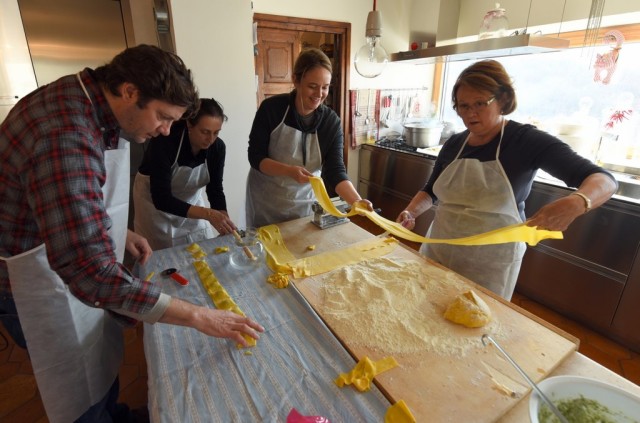
Taking a cooking class is a wonderful way to connect with Italian food culture, and to pick up a new skill. But a “cooking class” can take many different forms.

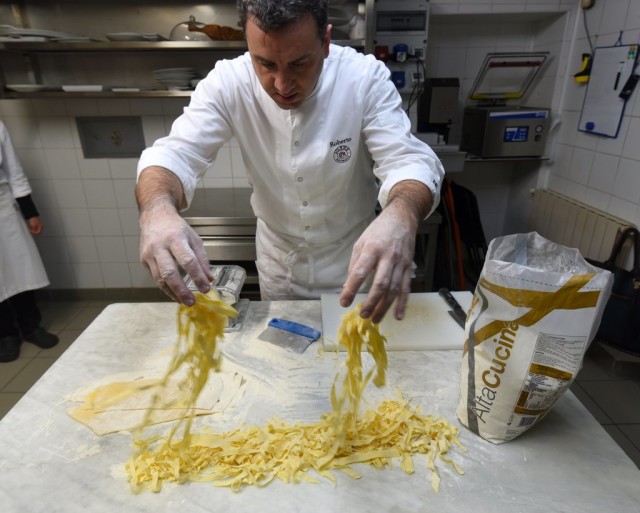
On a mist-enshrouded hilltop, a Michelin-starred chef invited visitors into his kitchen for an unforgettable lesson in olive oil, risotto, roasting meats, and, of course, making pasta. He began by rolling out sheets of pasta, then attacked each one with his knife to instantly trim it into textbook specimens of different noodles: “Papardelle,” he said, chopping thick ribbons. “Tagliatelle” — this one was thinner. “Capellini.” Thinner still. With each batch, he grabbed the wad of newborn noodles and tossed them gently in the air.

On a nearby hillside, Mamma Laura masterfully orchestrated a meal for her eager students. She’d demonstrate the task at hand — chopping up chunks of squash, packing ingredients into little pouches of cabbage, rolling out long sheets of pasta dough — then turned us loose to try it out. Ingredients would disappear into an oven or pot or blender, then reappear when it was time for the next step. Miraculously, everything was finished at exactly the right time. And it was all delicious.

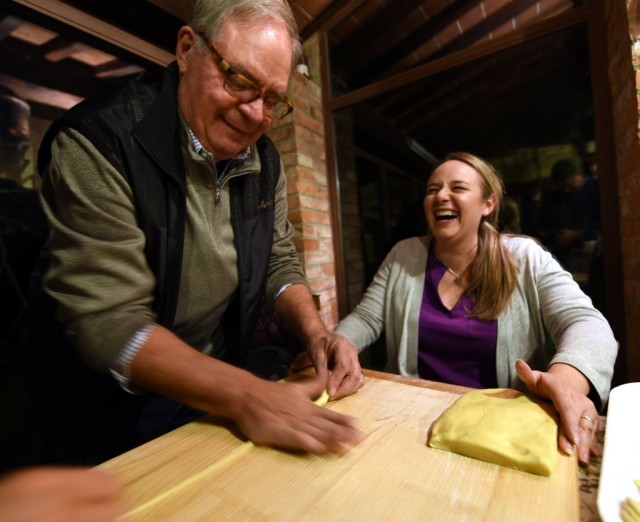
At a rustic country hotel, every Thursday night is pasta-making night: All of the guests gather on the veranda, and Isabella walks everyone through how to make the local, hand-rolled pici noodles — from a little “volcano” of flour with raw eggs in the caldera to a delicious feast. Everyone gets in on the action: Grandparents and little ones all challenge each other to roll out the perfect noodle.

Because Italian chefs are more impressed by top-quality ingredients than by complicated technique, many dishes are relatively easy for beginners to replicate at home. (The hardest part can be finding those premium ingredients; once you do, the cooking is a snap.) One of the mainstays in my family’s menu planning is an outrageously delicious tomato sauce we learned from a restauranteur named Marta. It requires just a few ingredients: tomatoes, garlic, olive oil, salt, pepper, and — if you like a little kick — red pepper flakes. Each time we make it, it transports us back to some of our favorite travels. (Pssst! You can find the recipe here.)

Browsing a Palermo Street Market

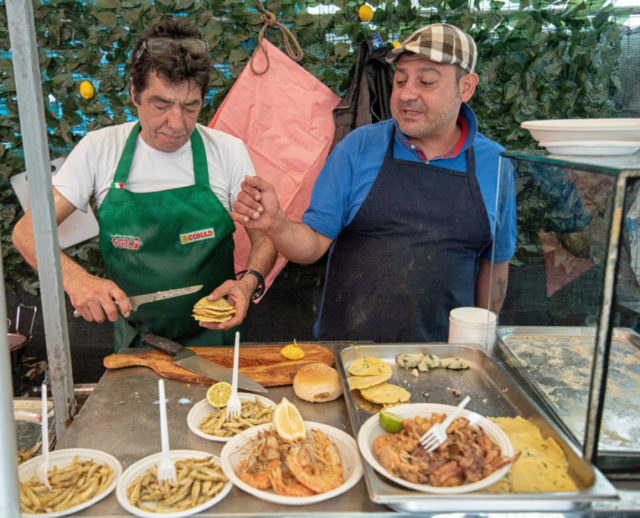
Spleen sandwich? Fried-up leftovers of veal cartilage and organs? An entire tiny octopus, boiled to tender perfection in inky water?

Say what you will about these dishes…there’s no doubt they’re some of the most memorable things I’ve eaten in Italy. And I ate them all within a few hundred yards of each other, in the street markets of Palermo.

Palermo’s three sprawling street markets — Ballarò, Capo, and Vucciria — let you delve into gritty Sicilian culture. Joining a food tour (I did one with Marco from Streaty) makes the experience far more accessible, ensuring that no weird food goes untasted.

Many items here are delicious by any standard: arancina, a deep-fried ball of saffron rice and meat sauce; sfincioni, French-bread-style “Sicilian pizza,” grilled up to order; and, of course, cannoli, a crispy pastry tube that’s filled to order with luxurious ricotta.

Others put you precipitously steep on the street-food learning curve: frittula — basically the leftover parts of veal (cartilage, intestines, little bits of bone) all chopped up, griddled, and seasoned with generous salt and lemon juice; or pani ca’ meusa — a pillowy bun stuffed with spleen, lung, and other organ meat. These bites challenged my ethic of always being willing to try a local dish…once.

The best tours also teach you how to think about the market like a Sicilian. Marco prodded us to hear the echoes of Sicily’s historic connections to North Africa in the melodic sales pitches of today’s vendors, and challenged us to view vendors with slippery pricing through a lens of good-natured gamesmanship.

Best of all, the whole time you’re browsing these gut-bombs, you’re fully immersed in the energetic hubbub of Sicilian urban life — watching the palermitani greet old friends, listening to the urgent musicality of those vendors’ patter, and smelling all that sizzling and frying goodness (plus a full spectrum of other odors).

Slamming Down un Caffè While Standing at a Counter

The Italian stand-up coffee counter has a special allure. Both efficient and social, this experience comes with a practiced ritual: First, you tell the cashier what you want, and you pay. They hand you a little slip of paper that you take over to the counter, where you get the barista’s attention. Once the drink is prepared, you stand there just long enough to down it. Maybe you make conversation with your fellow patrons or the staff. And then, within a matter of minutes (maybe less)…you bid everyone a cherry Ciao, grazie! and head on your way.

This is just what the doctor ordered when you’re fresh off the plane — disoriented and jet-lagged — to jump-start that wonderful feeling of “Hey! I’m in Italy!” The experience delightfully bombards all your senses: The smell of fresh-ground coffee as you walk through the door. The sound of the hissing steamer and the glockenspeil-like clink-clink-clink of teensy spoons against teensier ceramic cups. The mesmerizing, machinelike efficiency of the baristas’ practiced motions, a conveyer belt of full and empty cups, doing their perpetual loop from espresso machine to counter to dishwasher. And, of course…the coffee itself.

This ritual is also highly satisfying at breakfast time. Last year, I made a point to skip out on my hotel’s paltry buffet to enjoy stand-up breakfasts among the Italians in Siena, Rome, Trieste, and many other places. There’s something joyful about standing still and getting caffeinated while you watch the town wake up. Instead of strolling tourists, the narrow streets are filled with delivery people pushing hand trucks.

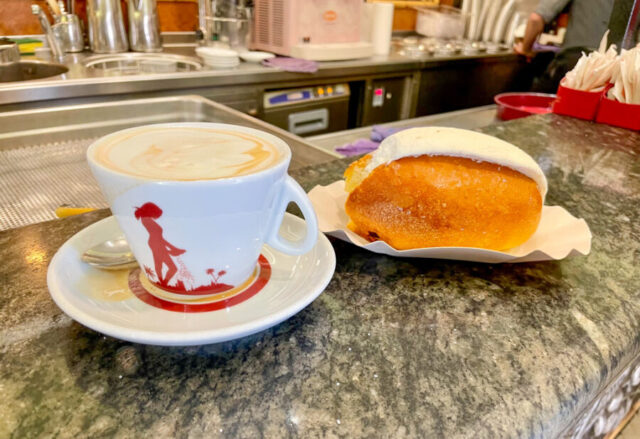
And often, there’s a special local pastry to try. One morning in Rome, I noticed everyone was ordering the local version of a “breakfast of champions”: A cappuccino and a maritozzo (puffy brioche roll filled with whipped cream). I would never be able to stomach this sugar-bomb back home…but in Rome, it just felt right.

Eating Pizza in Naples

Even when a food is available worldwide — maybe especially in those cases — it’s a rare treat to have it in its birthplace. The first time I went to Naples, I was skeptical that the pizza would really be all that different than the myriad versions I can get in my foodie hometown. Rarely have I been so wrong! In Naples, even a basic pizza is a revelation.

I met up with a Neapolitan friend, Vincenzo, who couldn’t wait to take me to his idea of the best pizzeria in town. Choice of toppings? Psssh. Here you have just two options: marinara or Margherita. Like In-N-Out Burger back home, this pizzaiolo understands that when you achieve perfection, you keep things simple.

When the pizza hit our table, Vincenzo took a bite and rocketed into performative ecstasy. “Aha! You taste that? The perfect crust. Thin, soft, a leetle sour. You don’t even need to chew it. You just put it in your mouth and…” He pantomimed a delicious glob of pizza sliding down his esophagus, ending with a big smile.

Watching me gingerly nibble at my slice, Vincenzo said, “This is the correct way to eat pizza.” He cut out a wedge, rolled it up into a bundle, sawed off a crosswise chunk, and jammed it into his mouth. I tried it. And in one perfect bite, I got the gooey middle, the singed crust, and a squirt of tomato sauce — all in just the right proportions.

Neapolitans, you see, are pizza perfectionists. And after spending some time there, you’ll be in danger of becoming a pizza snob, too.

Hunting for Truffles (and Other Food Experiences)

Some of the most vivid food experiences in Italy don’t even involve eating — but rather, learning about where your food comes from. This can be a tour of a facility that produces Parmigiano-Reggiano or pecorino cheese; a walk through vineyards and wine-production facilities; or a trip to the community olive press. Or it can involve walking through the woods.

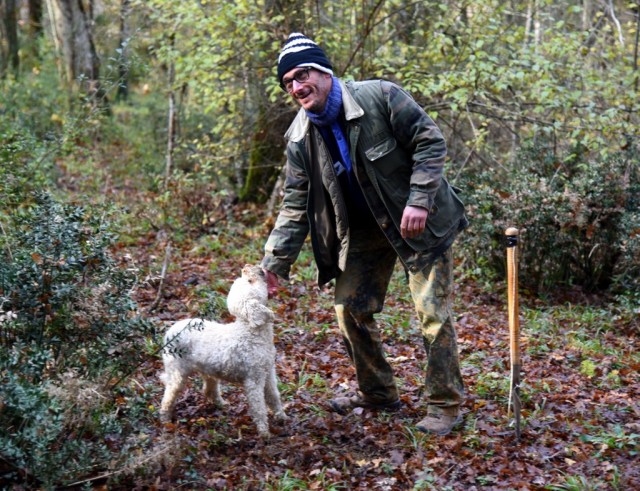
One chilly November morning in the hills of Tuscany, I met a professional truffle-hunter, Paolo, and his trusty assistant, Milli. Milli — who, it seems pertinent to note here, is a dog — skittered off into the underbrush, nose twitching, tail wagging, in hot pursuit of those mysterious deposits that hide a few inches underground.

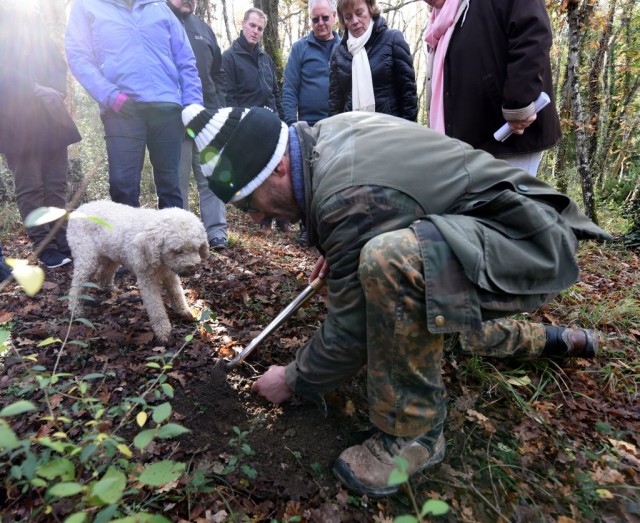
As we chased after her, Paolo explained that you can’t actually “plant” truffes — all you can do is cultivate the land to create an ideal habitat, scatter a few spores…and hope. And then, when they truffles begin to release their unmistakable aroma, Milli does the rest. Paolo began training her when she was just 10 days old — feeding her tiny bits of truffles to develop her palate. Teaching her how to find the truffles was the easy part, he said. The hard part was getting her to stop eating them.

As if on cue, Milli began excitedly pawing a particular spot in the ground. Paolo rushed over, held her back, and used his special shovel, with a surgeon’s precision, to extract the nugget from the damp earth. As I inhaled that pungent scent, Paolo beamed and Milli flapped her tail proudly. With that mental image, truffles are even more delicious.

Finding the Very Best Gelato

On a visit to Florence, I asked my friend Virginia: What are some clues for finding the best possible gelato? I got a gelato lesson I’ll never forget. As we walked through those Renaissance streets, surveying both great gelaterie and terrible ones, Virginia offered some tips:

“You want a place that makes all of their gelato fresh, on the premises, ideally that same day. That’s why you should look for words like artigianale — artisanal; or fatto in casa — homemade.”

She warned me to avoid big mountains of brightly hued gelato, which is designed to attract children. The best has muted colors — ones that occur in nature — and is often kept in stainless-steel covered tubs, until someone orders it.

Pausing at a promising-looking place, Virginia — quite strategically — asked to sample the pistachio. She explained: “Did you ever notice that every gelato flavor costs the same to buy? But, of course, they cost different to produce. And the most expensive flavor to do properly, using real nuts, is pistachio. If the pistachio is good, it’s a sign that the gelateria owner is committed to making quality gelato over profits.” This place had a tasty pistachio…and, sure enough, top-quality gelato.

This experience reminded me that the more you know about something, the better you’re able to appreciate it.

Having a Zero-Kilometer Meal

We’ve already seen how Italians are locavores. For the ultimate expression of this ethic, seek out a zero-kilometer meal: one where all of the ingredients originate from less than a kilometer away. This experience takes “farm-to-table” to painstaking extremes.

At Santa Giulia farm, about an hour south of Siena, I joined Gianluca Terzuoli and his wife, Kae, for such a meal. After walking through the hut where Gianluca air-dries his prosciutto, we sat down for our zero-kilometer feast. As we sampled Brunello di Montalcino wine and bread drizzled with olive oil, Gianluca gestured to the neat rows of vines and the gnarled trees where he harvested the grapes and olives. (Forget “kilometer” — these are centimeters apart.)

Then came the prosciutto and salami, made with the meat of free-range pigs. When I popped a delicate slice into my mouth, it washed my palate with salt-and-umami flavor, then gradually vaporized on my tongue. Also on the table was pecorino, made with the milk of ewes that I could hear bleating in the distance.

When I pressed Gianluca on the point of whether it’s all truly from right here, he sheepishly waved a hand toward the woods and said, “Well, the pigs free-range over there…500 meters away.” “Yes, but that’s still within a kilometer,” I pointed out. Gianluca beamed in agreement.

“When you eat this food, you want to really taste the animal,” Gianluca says. This old Italian saying translates awkwardly, but it contains great wisdom: You know that ingredients — whether prosciutto or pecorino — are top-quality when the flavors linger on your palate. Processed prosciutto and pecorino are overly salted as a preservative and to boost the flavor; the faint flavors are immediately washed away. Quality goods like Gianluca’s linger on your taste buds for a long, long time.

Thanks for joining me on this brief culinary tour of Italy. What are some of your top Italian food and wine experiences?


This list was inspired by our brand-new travelers’ handbook to eating and drinking in Italy: Rick Steves Italy for Food Lovers, co-authored by Fred Plotkin. If these stories whetted your appetite…I promise, you won’t regret digging into this book.

And for more travel tales about great food, consider picking up my memoir, The Temporary European: Lessons and Confessions of a Professional Traveler. Inside you’ll find expanded versions of my stories about grazing at a Palermo street market, learning from Virginia about how to find the best gelato, hand-rolling pici pasta with Isabella, and much more.

Croatian Changes in 2023: New Currency, Open Borders

I spent much of 2022 traveling all over Europe, tracking the many changes as I updated our guidebooks. Some of the biggest came in Croatia — in fact, starting today!

Croatia joined the European Union back in 2013. Europe wonks (my people) know that EU membership is a multi-phased proposition…which is why some countries, who’ve been in the EU for nearly 20 years, still don’t use the euro.

A decade after becoming an EU member, Croatia just hit two huge benchmarks at the same time: As of January 1, 2023, Croatia no longer uses its traditional currency, the kuna. And it has joined the Schengen open-borders zone — meaning no more stopping as you drive between Croatia and Slovenia or Hungary.

Goodbye, Kuna…Hello, Euro!

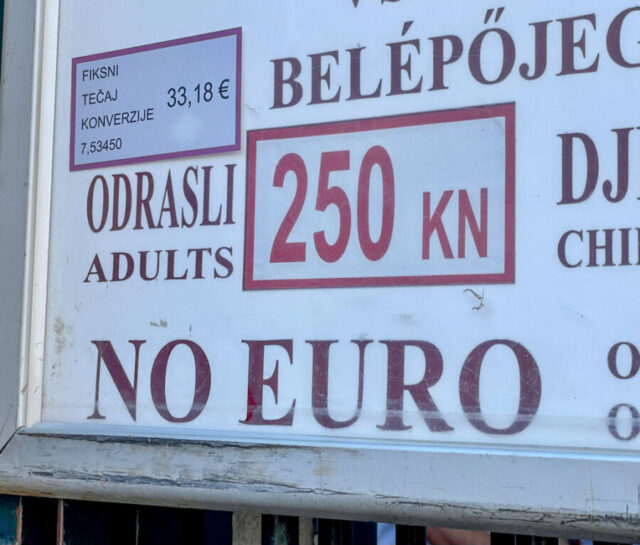
The arrival of the euro is a particularly big deal for the day-to-day lives of the Croatians (and their visitors). Traveling in Croatia just a few weeks ago, I sensed that many Croatians were still in denial about the new currency. For years, they’ve stubbornly stuck with their kuna against a rising tide of international tourism. It’s become a defiant, knee-jerk, almost patriotic sentiment: Euros are, adamantly, not the legal tender. Even in October, I still saw “No Euro, Only Kuna!” signs taped to cash registers.

When I’d ask Croatians about the upcoming change, the answer seemed to be unanimous: “We’re worried.” Over the last few years, they’ve already seen prices rise dramatically — not just for “tourist things,” but also for everyday groceries, fuel, and so on. Some of this has simply a byproduct of greater societal affluence. And maybe just a bit of it is tourist price-gouging that’s gotten out of hand, and blown back on locals.

Not to mention, there’s a huge amount of anxiety about winter heating expenses throughout Europe, where many places are reliant upon Russian fuel. “Standing up to Putin” and his invasion of Ukraine — which most agree is the correct course of action — comes at a very high cost, literally, in the form of very expensive energy prices.

On top of all that, Croatia now also faces the switch to a new currency. And when other countries have adopted to the euro — going all the way back to when it first appeared, in 2002 — it has often come with a big jump in prices.

Italians love to relive the drama of January 1, 2002. I’ve heard this story told perhaps a dozen times in the two decades since, all over Italy: “An espresso used to cost 1,000 lire. That should be about 50 euro cents. But when the euro came, it jumped all the way on one whole euro! Overnight, EVERYTHING COST DOUBLE!” (And it’s at this point that my Italian interlocutor, red-faced, always begins waving their arms.)

The “EVERYTHING COST DOUBLE!” espresso example is, obviously, drastically overstated. But it contains a kernel of truth, which is that if there’s ever a time to goose prices, it’s when you’re switching currencies…so people are less likely to notice. (Or, in some cases, will very much notice, and then still be complaining about it a quarter-century later.)

To combat this fear, there’s been much talk in Croatia about the “ethical transition” to the euro; authorities strongly recommend (but do not enforce) keeping prices equal. At a minimum, for the first year, companies are required to list their prices in both euros and kunas. That will not prevent price hikes, but it will make them more transparent.

One of my Croatian friends uses an informal “ice cream barometer” to track the dual impact of inflation and the euro. She explains that, before the COVID pandemic, most ice cream shops charged 8 kunas (€1.06) per scoop, or maybe 10 kunas (€1.32) for “premium” flavors. By 2022 — post-COVID, and with inflation booming — that 12 kuna price point had become standard even at the most basic places, with fancier shops charging closer to 15 kunas (€1.98). Many Croatians gravely speculate that €2 will simply become the default per-scoop price after the euro transition, with fancier places pushing the €2.50 or even €3 barrier. This may not seem like such a high price, but when compared to 2019, that would represent an 89 percent increase for a standard cone…in less than four years.

Selfishly, all of the unknowns about the euro transition really complicated my guidebook-updating work. I collected my information in Croatia back in October; we’re just about to send those files off to our publisher for printing, a little too late for a comprehensive double-check on the new prices. My only option was to get the updated prices in kunas for 2022…then immediately have to estimate what it should be in euros for 2023. (Legally, businesses were supposed to list the euro price next to the kuna price, using the official exchange rate: one euro equals, and will always equal, 7.53450 kunas. However, this is one of the most-ignored rules in all of Croatia.)

So, when updating my book, let’s say I was quoted the price of 55 kunas for an intercity bus ticket. Officially, that’s exactly €7.29975. So I guess they’ll round that up to €7.30?

Actually…almost certainly not. More likely, it’ll round up to €7.50 next year. Or — who knows? — €8. Or maybe they’ll get greedy and make the jump to €10.

Only time will tell what this change does to Croatian prices. For my part, I’m rounding up fairly aggressively as a “best guess” for our 2023 edition. I’ve already started double-checking some key prices for 2023 in euros (where they’re available), and sure enough, most places are not doing a one-to-one conversion; things are going up 10, 15, even 20 percent.

While this is stressful, I find that older Croatians — who have lived through more change in their lives than we Americans could possibly imagine — are taking it all in stride. “Meh, it’s hardly the first time I changed currencies,” one local said to me, referring to the Yugoslav dinar, then the Croatian dinar.

One thing I won’t miss about the demise of the kuna: the whacko exchange rate. After two decades of dividing every price by seven in my head, I’ll be relieved for my next visit to Croatia to require less arithmetic.

Rating Croatia’s Euro Coins

Another consequence of this change is that Croatia will be minting a fresh new batch of euro coins, with proudly Croatian designs on one side. This is big news for coin collectors, or for anyone who enjoys checking their change anytime they’re in Europe to see if any Estonias, Greeces, or Slovakias have slipped in among the Italys and Germanys.

Here’s my critique (as a “Croatia insider”) of where they landed with those new coin designs, which are rolling out today. Keep in mind that in Croatia, things tend to get complicated…and there’s often more to the story than what’s on the surface.

Two-Euro Coin: Croatia

The two-euro coin is sharp and logical: It’s simply a map of the country, with its checkerboard flag and the name in the local language: HRVATSKA. It’s a bit rare to have a map on a euro coin (Estonia is the only one I can think of), but I imagine the Croatians see this as an opportunity to do a little educating within the European community. Also, it’s hard to deny that Croatia’s swooping, angular boomerang, with all those little islands scattered offshore, is one of the most bitchin’ European shapes.

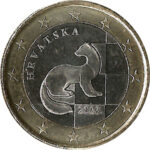
One-Euro Coin: The Kuna

I was hoping we wouldn’t entirely lose the “kuna” theme with this change. So I was relieved to see that the one-euro coin features the kuna prominently.

Croatia has one of the most interesting “origin stories” for its former national currency, which is both cute…and a bit sinister. A kuna is a marten — a foxlike animal whose pelts were a valuable trade commodity in olden times. (It also honors Croatia’s respect for the natural world.) And the stylized kuna design they’ve chosen for their euros is particularly adorable.

But there’s a dark underbelly to the kuna: During World War II, Croatia was a Nazi puppet state ruled by a local fascist movement called the Ustaše. This was the first time since about the 11th century that Croatia was ostensibly “independent” — and it was the Ustaše who first designed the kuna as their currency. A half-century later, when Croatia declared its independence from Yugoslavia, they harkened back to some of those earlier symbols of “independence” (read: Ustaše times)…including the kuna. This was a provocative act to the many Serbs living in breakaway Croatia, whose ancestors were victims of the Ustaše.

My sense is that most of this is water under the bridge. Over the last three decades, the kuna has been rehabilitated as a symbol of present-day, truly independent, democratic, (mostly) non-fascist Croatia. It’s understandable that they would want to preserve that symbol of their modern nation. Still, for those who know its full history, it’s just a smidge problematic. (Ah, but who can resist that cutie-pie kuna?)

10, 20, and 50 Cents: Nikola Tesla

It’s with these coins that Croatia’s choice is far more provocative than the casual tourist might realize.

There’s no argument whether the great scientist Nikola Tesla (1856-1943) was a brilliant mind. There is, however, some disagreement as to whether he was “Croatian.”

Tesla was born in the village of Simljan, which at the time was part of the Austrian Empire, and today is part of Croatia. And, in fact, Tesla was a Serb. A “Croatian Serb”…but a Serb. His parents were ethnic Serbs. His father was an Orthodox priest. His Wikipedia page describes him as a “Serbian-American inventor.” And if you go to Belgrade, you’ll see that the Serbs are very proud of, ahem, their great inventor.

You could make a case that Austria has as much right to put Tesla on their coins as Croatia does — since when he was born, his birthplace was part of Austria. But that would be a little preposterous, right?

I appreciate the impulse to honor Tesla. But make no mistake: by choosing to “honor” Tesla on its euros, Croatia is also trying to stake claim to his legacy…at the expense of the Serbs. And what better propaganda for convincing Europe Tesla is “Croatian” than putting his image, with the word HRVATSKA, on coins that will be jangling in hundreds of millions of pockets from Tallinn to Lisbon, and from Palermo to Dublin?

Hmmm…

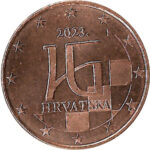
1, 2, and 5 Cents: Glagolitic Alphabet

Finally we come to the little “coppers.” Here Croatia has opted for characters from the Glagolitic alphabet — specifically H and R, for “Hrvatska.” I love this choice, because it’s exactly what a wonky Croatia geek would go with.

What is the Glagolitic alphabet? OK, this is pretty dense stuff, so before your eyes glaze over, I’ll just give a quick, oversimplified recap: Way back in the ninth century (no, seriously! stick with me!), the Byzantine missionaries Cyril and Method came to the realm of the Slavs to convert the people to Christianity. They invented an alphabet, Glagolitic, to translate the Bible into the local Slavic language. Glagolitic eventually mingled with the Roman (our) and Greek alphabets to become the Cyrillic alphabet, which is still used throughout Eastern Europe — Bulgaria, Serbia, Ukraine, Russia, and so on.

The original Glagolitic alphabet gradually disappeared, except in some corners of Croatia. And when Croatia declared its independence from Yugoslavia in 1991, they reached back to this chapter of their history and revived interest in Glagolitic as, in a sense, Croatia’s “own” alphabet. (In those heady days, there was even a very short-lived movement to adopt Glagolitic as the official alphabet of modern Croatian. Fortunately for all but the most ardent historians, this never went anywhere.)

So, while — like virtually all of their other coins — the use of Glagolitic characters evokes (to those who know the full history) Croatia’s separation from Serbia in the 1990s, I think it’s a fitting, and undeniably educational, choice for the little euro coins.

Looking back at all of these choices, I’m impressed by how much complex symbolism has gone into these selections. Some of them are a tinge nationalistic for my tastes. Of course, many countries have opted for national symbols on their coins, from Dante and Leonardo’s Vitruvian Man for Italy; to Germany’s stoic, angular eagle; to Slovenia’s beloved Mount Triglav. Most are not quite so packed with provocative subtext…or maybe they are, and I just don’t realize it. But in the end, this is Croatia’s choice, and this is what they’ve chosen.

What do you think of Croatia’s euros?

Open Borders and a New Bridge

The other big news as of January 1, 2023, is Croatia’s membership in the Schengen open-borders zone. For travelers, this means you won’t need to stop when crossing a border between Croatia and its fellow Schengen countries, such as Slovenia and Hungary. (And, for those who spend a LOT of time in Europe — like some of my colleagues — it also means that you can’t take a little vacation in Croatia to “reset” your clock of 90 days out of every 180 that you’re allowed visa-free in the Schengen zone.)

However, you’ll still have to stop and show your passport at borders with non-Schengen countries, including Bosnia-Herzegovina and Montenegro (which are both popular side-trips from the Dalmatian Coast). There was already a potential for long lines at some of these borders, as people day-tripping from Dubrovnik to Mostar or the Bay of Kotor all tend to show up there around the same time each morning…and then again each afternoon, on the way home.

This will, potentially, be even more of an issue in 2023, especially early on, as those borders are also now the outer borders of Schengen.

When I asked locals about this, I got a variety of answers. Some pointed out that Croatia has already been essentially Schengen-compliant for years now, to earn the right to join — so this may not be such a big change. (Not to mention, there’s a lot of money flowing over those borders, which neither country wants to hamper.) Others say that, given how bureaucratic Croatia tends to be, they’re not so convinced it will be seamless. On average, the answer to the question of “How will Croatia joining Schengen affect its border crossings?” is the favorite Croatian response to any and every question: ¯\_(ツ)_/¯

There is one piece of optimistic news, for those who don’t like waiting at borders. In July of 2022, Croatia circumvented a centuries-long loophole that gave neighboring Bosnia-Herzegovina control over a short five-and-a-half-mile stretch of coastline just north of Dubrovnik. For years, traffic on the main intercity highway through Dalmatia would get clogged up as each vehicle had to enter, then exit, the Bosnian town of Neum.

After decades of lofty promises, deliberations, and false starts, in 2019 the European Union provided funding to build a new bridge connecting the base of the Pelješac Peninsula to the coastline north of Neum — allowing the main road to entirely bypass Bosnia. The 1.5-mile-long Pelješac Bridge cost $500 million, 85 percent of which came from the EU. It was built mostly during the COVID-19 pandemic by a Chinese construction company, which imported workers from China to complete the project on budget and ahead of schedule.

When the first cars rolled across the Pelješac Bridge in July of 2022, it was seen as a victory for Croatian unity. But questions linger. The Bosnians who eke out a living around Neum are understandably less enthusiastic about the bridge, which turned their little resort into a veritable ghost town. Environmentalists worry about the impact the bridge may have on the delicate ecosystem of the Bay of Mali Ston, where lucrative shellfish farms depend upon just-right conditions to thrive. Ston, Mali Ston, and wineries in the Ponikve area — once off the beaten path — are seeing a surge of new visitors. But the main change is something you’ll notice only if you traveled here in pre-bridge days: It’s simply much faster now to get from Dubrovnik and Pelješac to anywhere else in Croatia.

That’s a lot of changes for one day, in one little country. But if you’re headed to Croatia in 2023, these are all great to know about.

10 European Discoveries for 2023

In 2022, as travel resumed, I made it back to lots of famous places: London, Rome, Amsterdam, Dubrovnik. The Matterhorn, the Scottish Highlands, the hill towns of Tuscany. But, as usual, many of my favorite experiences came in lesser-known corners of Europe — underappreciated places that exceed expectations when it comes to creating beautiful memories.

As a refresher: My annual “Discoveries” list is one traveler’s arbitrary rundown of places I’ve been to recently (mainly in 2022) that may not already appear on many itineraries. These are just ten of the hundreds of such places, all over Europe — meant not as any sort of definitive “best of” list, but simply to inspire you to go beyond the Londons, Parises, and Romes when planning your 2023 travels. In fact, I’d love it if you shared your own favorite finds in the comments.

And if you’d like to see previous years’ lists, here are the Discoveries for 2018, 2019, 2020, and 2021 — all still great choices. (I skipped the Discoveries in 2022…not wanting to jinx what, a year ago, felt like a tenuous time to travel.)

Sarajevo, Bosnia-Herzegovina
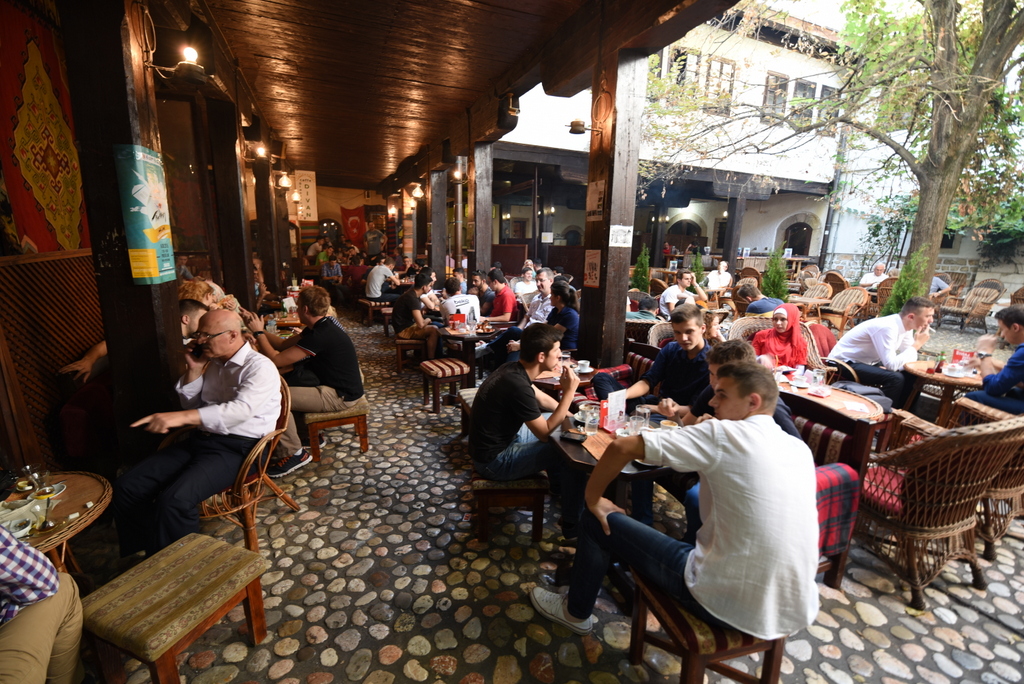
Imagine a bustling city in a stunning setting — tucked in the deep valley of a gurgling river, surrounded by green hills. It has a dynamic history as a crossroads of civilizations, where you can visit a Catholic church, an Eastern Orthodox church, a mosque, and a synagogue, all within a couple of blocks. One part of town feels like a Turkish bazaar, with riverstone cobbles underfoot, the sound of tapping coppersmith hammers, the smell of sweet hookah smoke, and the haze of grilling meat hanging heavy in the air. And then, just a few steps away, you enter a tidy Habsburg street plan with proud turn-of-the-century architecture, parks, and boulevards.

This city also has a delicious culinary tradition of delectably seasoned meats, decadently spreadable cheeses, and crispy savory pastries cooked under a metal baking lid covered with hot coals…not to mention unfiltered coffee and honey-soaked treats (think baklava). Oh, and the locals are incredibly welcoming, easygoing, and quick to befriend visitors, and they have fascinating life stories to share.

Now imagine that this place has next to no American tourists.

This is not a fantasy; it’s Sarajevo. With each return visit, I simply can’t fathom why so few travelers have discovered what may well be the most underrated capital city in Europe.

Returning this fall, I discovered a new hole-in-the-wall shop on the main drag that specializes in just one perfect dish: First, they pull a puffy lepinje flatbread pocket straight out of the oven. Then they slather it with the soft cheese kajmak, which begins to melt and fill in all the little grooves. You can pay a bit extra to stuff it with flavorful smoked beef…a delicious mobile feast. Walking down the street, munching one of my favorite meals of the trip (if not the year), it occurred to me that, on top of everything else, Sarajevo might be one of the best “street foodie” destinations in Europe.

Sarajevo has a new fancy hotel downtown, and it recently opened a cable car that trundles visitors to the mountaintop high above town for sweeping views. Those are nice upgrades, but they’re just gilding the lily of what’s already one of travel’s great cities. Someday Sarajevo will start to get the attention it deserves. But in the meantime, it’s cheap, uncrowded, and endlessly rewarding.

Richmond, London, England

During the dark days of the pandemic, like a lot of people, I took solace in binge-watching TV. One of the shows I found most uplifting was Ted Lasso, the story of an insistently upbeat American football coach transplanted to the UK to manage a soccer squad. Richmond may not be a real team, but it absolutely is a real place — a sleepy bedroom community just outside London. And on a sunny weekend in February, I went to Richmond on a lark, just to see if I recognized anything from the show. Sure enough, I found myself standing on that adorable, perfectly British square, with a pair of red telephone boxes; a classic half-timbered pub with sturdy picnic tables out front; narrow, shop-lined alleys leading every which way; and facing an expansive green packed with people out for a stroll. During the pandemic, when I closed my eyes and dreamt of being back in Britain…this was the place I imagined.

It was a small thrill to find the door to “Ted’s apartment,” and to step into his local pub. But if I’m being honest, I quickly forgot all about that fictional world…and enjoyed exploring the real one. One of my all-time favorite moments of 2022 was simply sitting on a bench at Richmond Green, watching dogs chase tennis balls.

For me, Richmond illustrates two things: First, Britain has hundreds of charming little communities that are worth poking around for an hour or two. This one just happens to star on a TV show. And second, I just love it when I go someplace for some random reason — in this case, because I saw it onscreen — and wind up loving it for its own sake. So on your next trip, make a point to find “your” Richmond… whether or not it’s actually Richmond.

Upper Engadine and Nearby Scenic Rail Lines, Switzerland

To be clear: I’m not saying that the Upper Engadine is somehow better than, say, the Berner Oberland, or Zermatt and the Matterhorn. But this remote, rugged corner of Graubünden, in the southeast corner of Switzerland, was perhaps the biggest (and nicest) surprise of my late-summer guidebook research trip. The most famous place here is the glitzy, soulless, skippable resort of St. Moritz. Instead, stay in nearby Pontresina and have a grand ol’ time riding lifts to lofty panoramic perches (Piz Nair, Muottas Muragl, Alp Languard) and exploring stony traditional villages (like Samedan).

The Upper Engadine’s other claim to fame is its position at the intersection of two world-famous scenic rail journeys, the Glacier Express and the Bernina Express. I did both of those trips, too. And if I’m being honest, eight-plus hours — even a super-scenic train — is a lot. Here’s a pro tip: Based in Pontresina, you could do only the very best bits of both journeys, a couple of hours in each direction, then come right back home. This efficient approach lets you conquer two of the most astonishing high-alpine rail lines in the world, each a feat of late-19th-century engineering: the Bernina Pass (to the south, toward Italy) or the Albula Pass (north, toward Chur). With stone bridges that soar hundreds of feet above yawning valleys, ingenious circular viaducts that loop 360 degrees to dispense with the need for cogwheels, and peek-a-boo views of snowcapped, 14,000-foot peaks and receding glaciers, Pontresina gives you easy access to what may be the most stunning train trips in Europe, mile per mile.

As a bonus, for those on a tight budget, most Upper Engadine accommodations provide a sightseeing card that covers all local transport — including those thrilling (but pricey) mountain lifts. This basically doubles the value of what you pay for your lodgings (but make sure they include it before you book). Maybe this is yet another reason why most of my fellow hikers were active Swiss retirees rather than the Insta-glam jet set.

The Jordaan, Amsterdam, The Netherlands

In the middle of an intense, seven-week trip of tour guiding and guidebook research, I had a three-day weekend to relax and recover. The place I chose was Amsterdam — and specifically, the Jordaan, a residential neighborhood of tidy grid-planned blocks, traditional skinny houses, funky shops, and local restaurants. I found the perfect apartment, in the attic of a family home — with crooked, creaking funhouse floors and dramatically angled rafters. To reach my room, I had to climb two staircases so steep they were practically ladders. And when I opened the window and saw a pair of bikes brrrring-brrrring-ing past on the idyllic street scene below, I knew I’d found the perfect getaway.

One morning, I woke up to discover an utterly delightful weekend street market (two of them, actually) sprawling through the lanes and squares near my apartment. Another time I rode a tram to Vondelpark and rented a bike to pedal with the Amsterdammers in a lush, green oasis. On several occasions, I window-shopped the delightful nearby restaurant streets (with the even-more-delightful names Eerste Anjeliersdwarsstraat and Tweede Anjeliersdwarsstraat) and took my pick from the incredible variety of places to eat.

One thing I did not do, a single time, on this visit to Amsterdam? Complain about the touristy crowds. Because the Jordaan let me avoid them entirely.

Trieste, Italy

The Italian port city of Trieste has an identity crisis like no place else. Today it’s part of Italy — but just barely, connected by an umbilical cord of land just wide enough for a railroad and a highway. It’s almost entirely surrounded by Slovenia, whose parched karstic cliffs rise up like a stone curtain just behind the city. Complicating matters, most of today’s Trieste was built not by Italians or Slovenes, but by Austrians and Hungarians, who transformed this humble settlement into their primary trade port and shipbuilding center…with grandiose buildings that would feel more at home on Vienna’s Ringstrasse or Budapest’s Andrássy út, rather than a few steps from Adriatic embankments. This is the kind of place where you need a conspiracy-type diagram, with red yarn crisscrossing thumbtacked photos and maps, just to figure out who controlled it, and who lived here, and when, and why.

And yet, all of that complexity melts away when you actually set foot here. Trieste is hard to characterize, but the main thing is that it’s simply lovely: a grand, imperial-feeling city with a sunny seafront embankment, shot through with faded elegance (from fin-de-siècle coffee houses to aristocratic villas), and with more than its share of fascinating history. Choosing between Austrian pork cutlets, Italian pastas, and Slovenian jota (turnip stew) and potica nut-roll cakes on the same menu, you know you’re at a nexus of history. As someone with a passion for Habsburg history, for Slovenia, and for Italy, I knew I’d find Trieste interesting. But I wasn’t prepared to enjoy it as much as I did.

Side-note: I’m not entirely sure whether I went to Trieste because I read Jan Morris’ riveting Trieste and the Meaning of Nowhere, or if I read her book because I was going to Trieste — but either way, it reminded me how “bringing along” a great author or historian with you, on any trip, immeasurably deepens your appreciation of a place. And Trieste is a twofer, since James Joyce lived here while writing most of Ulysses (as documented in a lovable local museum). This is fitting, when you consider how a cacophony of languages and cultures fills the streets of Trieste — just like in the pages of that masterpiece.

Glasgow, Scotland

Every time I go back to Glasgow, I like it even better. And this summer, I had plenty of time to think about why…when I got stuck there for several extra days after contracting COVID. But actually, I can think of few better places to just sit around and recover.

I owe this — and my general good feelings about the city — to the Glaswegians. They’re kind and generally good-natured, but also wicked-smart and fiendishly funny. They have a penchant for knocking important city leaders down a peg by crowning their statues with orange traffic cones. The city has some of the most beautiful, most wildly creative, most satirically incisive street art I’ve seen anywhere.

As an indication of how endearingly salt-of-the-earth Glasgow is, its single best museum (in a city with lots of great ones) may just be the old tenement house whose resident moved out in 1975 after not having changed a thing in five decades — and they’ve left it perfectly preserved to this day, a fascinating time warp of midcentury, middle-class lifestyles.

Sure, the city center lacks the Old World romance of Edinburgh. (It reminds me of Cincinnati or Indianapolis, with fewer high-rises, more interesting architecture, and an infinitely more entertaining accent.) But I’m drawn to the West End, the posh yet hip residential district that’s a short bus, subway, or taxi ride away. Surrounding the U. of Glasgow campus are green parklands, lively traditional music pubs, and cozy streets lined with endlessly browsable restaurants and shops. On this visit, stepping off the subway, I bumped into a fascinating mural celebrating the many different people who call this corner of Scotland home. Mesmerized, I couldn’t pull myself away for about 15 minutes.

The next time I wind up getting stuck in Europe…I hope it’s in a place as nice, and as engaging, as Glasgow.

Pelješac Wine Country, Dalmatian Coast, Croatia

The Pelješac (PELL-yeh-shawts) Peninsula is a long, skinny spit of land poking out into the Adriatic Sea just north of Dubrovnik, on Croatia’s Dalmatian Coast. It’s always been an off-the-beaten-path destination for wine lovers who’ve done their homework. But in 2022, Pelješac came closer to the mainstream overnight, when they finally opened a brand-new bridge that routes most traffic right along its base.

In October, I spent a fun and fascinating day with a local wine expert (Sasha Lušić, who runs the D’Vino Wine Bar in Dubrovnik) to get my guidebook coverage up to snuff for the coming onslaught of visitors. We visited Ston to ogle its beefy fortifications and vast salt pans; we pulled over along a sleepy bay to slurp fresh oysters, pulled straight from the Adriatic, and washed down with a local sparkling white wine; and, best of all, we dropped in on a half-dozen different wineries, lovingly handpicked by Sasha.

I was especially charmed by Anto Grgurević, who holds advanced degrees in viniculture. Anto is determined to combine academic research with hands-on sweat equity to advance the art of Croatian winemaking. He has reintroduced some classic traditional vines — once used extensively here, but long since forgotten — even as he experiments with doing old things in new ways. (He’s the first in the region to make an amber wine, using a naturally occurring “albino” grape.)

After our tasting, Anto said “Follow me,” hopped in his car, and drove us deep into the peninsula’s interior to his family’s vineyard. Donning a comically large sombrero to shield himself from the glaring sun (good for the grapes, less so for the eyes), he walked us through the vines, pointing out the different types of grapes here and there, each matched perfectly to the precise microclimate of that patch of land.

Looking out over the hillsides where his ancestors toiled, Anto grew philosophical. “I’ve only got about 25 vintages in my life,” he said. “That really only gives me a few years to experiment and figure out how to make the best possible wine. Then I’ll spend the rest of my life cranking it out.”

Then he said, with a wink: “The best vines, you plant for your kids and your grandkids.”

Oh, and the wines? The wines are sensational.

Toruń, Poland

This gorgeous, red-brick town — cute as a fairy tale, and famous for its gingerbread and for native son Nicholas Copernicus — has always been a personal favorite. But I’ve always suspected my affinity for Toruń was somehow idiosyncratic, because I almost never see (non-Polish) travelers here.

Then, this May, I headed up a team of Polish guides to lead the first-ever departure of our new Rick Steves Best of Poland tour…and I’ll be darned if every single person in our group didn’t utterly fall in love with Toruń, too. The next morning, as we were pulling out from our one-night stay, there was practically a mutiny on the bus to call off the rest of our itinerary and just stick around Toruń.

Toruń has no world-class sights. There aren’t many, if any, museums or churches worth entering. But I’ve rarely been to a place that’s more delightfully strollable. It has cozy red-brick buildings, grand interlocking squares, broad traffic-free promenades, stately churches with prickly spires…and the whole city smells like gingerbread.

After our hands-on gingerbread-making demonstration, we oriented our group for their free evening. Our best advice: “Just walk down this street until you run out of pretty things to look at. Then come back.” A couple of hours later, I followed my own advice and went for a twilight stroll. Reaching the far end of the Old Town, I heard a raucous echo through an otherwise empty square…and followed that noise to an outdoor restaurant where about half of our tour group was having their favorite meal of the trip.

And that’s the kind of place Toruń is: Not much to see. Not much to do. But a wonderful place to simply be.

Modena and Emilia-Romagna, Italy
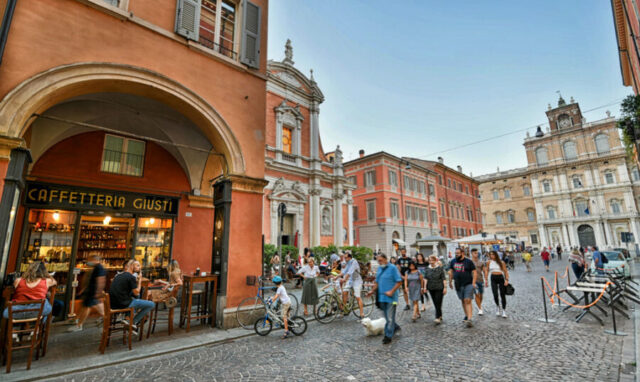
Italian food is, of course, delicious. But what if I told you there was a place in Italy that Italians — from the scalps of the Alps to the toe of the “boot” — unanimously agree has the best food anywhere?

Back in 2021, I spent much of the year putting together an ambitious project: a brand-new, full-color, region-by-region handbook to Italian cuisine called Rick Steves Italy for Food Lovers (which just hit bookshelves everywhere). One of the hazards of that project was that our co-author, renowned Italian food expert Fred Plotkin, makes foodies like me desperately want to visit every corner of Italy.

In particular, I got caught up in Fred’s enthusiasm for the region of Emilia-Romagna. This is where you find some of the most quintessentially delicious Italian foods: luxurious pastas, especially filled ones; some of Italy’s top salumi, from mortadella to prosciutto di Parma; and, of course aceto balsamico tradizionale and Parmigiano-Reggiano cheese — don’t you dare call them “balsamic vinegar” or “parmesan.”

After months of salivating at my desk, I just had to see this place for myself. So when my wife and I finally returned to Europe in the fall of 2021, we included a couple of days in Emilia-Romagna. We had world-class meals in Bologna, Parma, and Ferrara, and we spent two nights in Modena. The food was, if possible, even better than promised. The tortellini in brodo at that sidewalk café in Parma immediately shot to the top of our “best pastas ever” list, even as it redefined what pasta could be.

But we also adored the livable cities, which combined a certain elegance with a user-friendly unfussiness. And Modena in particular got under our skin, as the perfect home base. There are no important sights in town; to be honest, I never set foot in a museum or church. But we never tired of exploring its streets and squares.

And, of course, Modena also provided many memorable meals. One Sunday evening, I kept striking out when my first through fifth choices for dinner were closed. My “last resort” — a desperation play — wound up providing me with one of my best meals of the trip.

That’s Modena…and Emilia-Romanga. It’s no wonder that Tuscans, Romans, Lombards, and Sicilians all love to eat here.

Stopping to Listen to the Church Bells…Anywhere
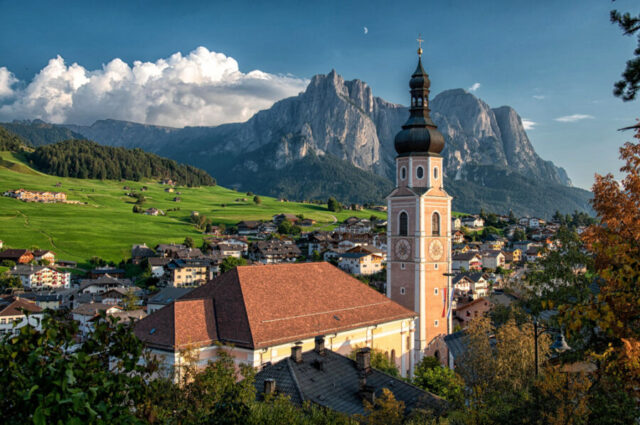
Looking back on 2022, this was a year when I simply enjoyed being back in Europe — anywhere, doing anything, often doing nothing at all. During those two long years stuck at home, I had plenty of time to reflect on what I love best about travel — especially as I was assembling my travel memoir, The Temporary European. In that book, I explain the conclusion I reached: The best experiences in Europe are, so often, not the big sights and famous attractions. Rather, they are those precious moments in between that stick with you long after you’ve returned home.
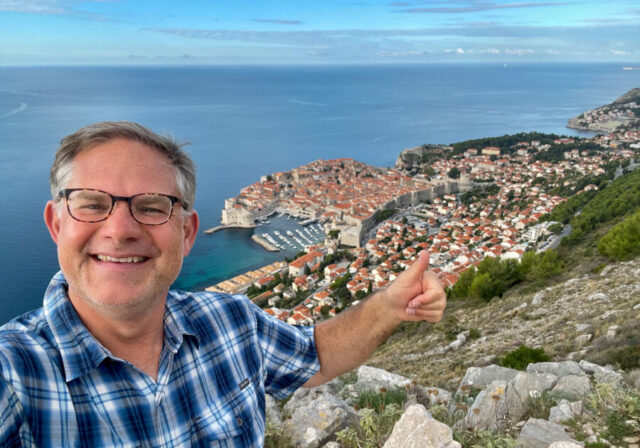
I present this in terms of “stopping to listen to the church bells” — no matter how busy you are. But it can take many other forms. Maybe it’s sitting on a park bench on Richmond Green, watching people and their dogs enjoy a sunny day. Chatting with a Croatian vintner about his ancestral responsibility and his contemporary passion. Doing a little “street grazing” in Sarajevo. Getting lost in the heavenly gingerbread allure of Toruń. Browsing an Amsterdam street market.

Where are you going in 2023? It doesn’t matter. Go where you like. But when you get there, don’t spend your time racing from place to place, adhering to an ambitious itinerary. Make a point to stop — literally stand still — and, even if for just a moment, take it all in. Notice the little details of everyday life you’ve always missed. Eavesdrop on conversations…and if you have something to add, interject. Imagine what it might be like to actually live in that place. And if you hear the church bells chime…listen.

Where are you headed in 2023? Any favorite discoveries from 2022 you’d like to share?


If you enjoyed this list, and would like to browse some others, check out my Discoveries for 2018, 2019, 2020, and 2021.

Most of my travels in 2022 were to update our Rick Steves guidebooks. Many of those new, fully-updated-post-COVID editions (including Italy, London, Scotland, and many more) are now available at our Rick Steves Travel Store; the rest are coming soon in 2023.

If you enjoy these stories, check out my travel memoir, The Temporary European: Lessons and Confessions of a Professional Traveler. You can find it at your favorite local bookstore, online at the Rick Steves Travel Store, or as an e-book (such as the Kindle edition).