My co-author and frequent collaborator, Cameron Hewitt, is well-traveled, smart, and insightful. And, while he and I are in perfect sync in our travel styles and priorities, he gives voice to the next generation of "Rick Steves travelers." Join me in enjoying his reports right here. —Rick

Loving the French (What’s Not to Love?)

I’m always a little intimidated when first arriving in France. I suspect living in America has programmed me — against the sum total of my actual life experience — to think of French people as being stuffy and snooty and unkind to outsiders. With each visit, I have a million mini-epiphanies about how wrongheaded that is. And then I go home and forget all that I’ve learned.

On this trip, it didn’t take me long to remember how much I love this place — and especially its people. French folks aren’t rude and abusive. They’re reserved, and a bit formal. They believe in a certain orderliness to social interaction. They just want to be respected, and if you respect them, you’ll get more than your share of respect in return.

The typical “Howzit goin’?” American cowboy stampedes all over the French social order. We Yanks pride ourselves on our independence, on bucking convention, on being on an instant first-name basis with every stranger we happen to ride the elevator with. And, in their place, those can be wonderful qualities. But the fact is, it clashes with the French worldview.

One of my colleagues, who guides our tours all over Europe, recently confessed to me that she finds France one of the hardest places to bring Americans to. It’s not because the French are unpleasant; it’s because we Americans aren’t always the most adaptable when on someone else’s terms. And the French do expect us to respect their turf.

A few years ago, a Parisian shop clerk explained this dynamic to me with a sublime simplicity: “In France, we don’t want to be defined by our work. We want to be acknowledged as a human being first, and only then as a provider of services. So just say bonjour before telling us what you want from us. Treat our shop the way you would our living room. Would you walk into my house without saying hello?”

And that’s really all there is to it. When you interact with any French person, first acknowledge their humanity. It’s easy: Just say, “Bonjour!” Everyone can say that, without even practicing. For extra credit, throw in a Madame or a Monsieur. And when you leave, say “Au revoir!” If you do this, the French will instantly warm to you.

Another thing to keep in mind is that we Americans are always in a hurry. Time is money, and impatience is a virtue. But in France, they’ve mastered the art of fine living — and that means savoring the moment. Slow yourself down to their pace (or, at least, meet them in the middle). They’ll appreciate it…and you’ll likely find that it’s more enjoyable for you, too.

And here’s yet another way to think about it: France is a country of introverts. As an introvert myself, I can appreciate how extraverts sometimes come on too strong — getting in my face with an aggressive chumminess that, to me, feels fake and exhausting. As a country that values extraverts, we need to empathize a bit with the French. Don’t bowl them over with your enthusiasm; give them a gentle smile and a kind greeting, and they’ll be on your side.

Putting this approach into practice, I’ve had exactly zero terrible interactions with French people. After two straight weeks of traveling in France — and talking to dozens of people each day to update our guidebook — I honestly can’t recall a single difficult moment. (In fact, I find the French much warmer than most of their neighbors.)

And what about that language barrier? Wait, what language barrier? I speak no French, beyond a few pleasantries, but it’s pas de probleme. I find more and better English spoken in France than in Spain or Italy. People here can be a bit shy. When I ask locals if they speak English, many say to me, “A little bit. I will try.” What a nice way to put it. And by the way, many of those who are “trying” express a mastery of English that eludes some native speakers.

Even when they don’t speak English, they listen patiently, with a sweet smile, while I mangle their precious language in front of them, as if stomping on a delicate carpet with muddy boots. (I accomplish this by speaking Spanish with a French accent. Yeah, I’m that guy…and they still seem to like me!)

If there’s one caveat to this, it has to do with Paris. Look, it’s a big, busy city. And, like New York, London, or Tokyo, it’s a mix of kindhearted people and  troubled cranks. Some Americans go only to Paris, have a couple of awkward interactions with surly Parisians, and extrapolate those to the entire country. I’ve met my share of grumpy Parisians, too. But overall, I’ve had many, many more positive experience there than negative ones.  (When standing on a street corner puzzling over a map, I’ve been approached by helpful locals offering directions far more in Paris than anywhere else in Europe.)

I recently ran into one stubborn American who embodies this cultural disconnect. Perhaps a closet Freedom Fry-er, he clearly came here with a massive chip on his shoulder — tightly wound and ready to pounce. Over breakfast, I was enthusing about how friendly the French are, and how well they speak English, when he cut me off. “Oh, yeah?” he snapped. “If their English is soooo great, then why do I have to tell everyone bone-joor all the time?” While his wife — a francophile who clearly had been coaching him on this — died a silent death next to him, I replied, simply, “To be polite. Is it really that hard to say bonjour?”

What I was thinking, though, was this: To not get along with the French, you pretty much have to be a jerk.
Duck Duck Goose: Dining in the Dordogne

Here in France’s Dordogne River Valley, every menu begins and ends with waterfowl: duck, duck, goose.

Sarlat RestaurantThe most prized poultry product are the livers of force-fed geese who fill the farms around the Dordogne — better known as foie gras. Duck meat is very popular, too. Ordering the basic €20 three-course menu at restaurants in Dordogne, the first course is invariably a choice between foie gras or duck gizzard salad.

I’m not a huge fan of foie gras — more on that later — so on my first night in Sarlat, I went with the latter. Now, my Grandma, raised in the Great Depression, always eagerly snatched up the gizzards that came with our Thanksgiving turkey. I’ve never had the nerve to eat a gizzard. But tonight, I figured, what the hey? If I like gizzards anywhere, it’ll be in Sarlat.

The salad came: a nice bed of lettuce, lightly dressed, with slices of flavorful smoked duck breast and some still-sizzling gizzards. My first bite of gizzard came with that metallic pang of organ meat. Not my favorite (I’m not that hardcore of a foodie). But not entirely objectionable, either. Mixing the different parts of the salad — greens, smoked duck breast, and gizzards — gave each forkful a more palatable balance, and by the time I was a third of the way through my salad, I had forgotten that this was a new culinary frontier. Will I order the gizzard salad the next time I go to a French bistro in Seattle? Eh, no. But I’m glad I tried it.

Then came the main course: sautéed duck breast, very flavorful, served on a bed of stewed “coriander” (cilantro) with a side of wok vegetables, giving it an Asian spin. Delicieux!Duck Dinner

But perhaps the best part of the meal was the side of pommes de terre sarladaises — “Sarlat-style potatoes.” Thin slices of potatoes are fried up in duck fat, and loaded up with an abundance of garlic and salt. Now that’s something I could eat every day.

As for that foie gras: Here in the Dordogne, it’s only a matter of time before you have some. I’ve tried it several times, prepared many different ways. And even though I realize this will cost me my foodie cred, I have to be honest: I’m just not that into it. No matter how good it is, it always has that distinctive liver taste that hits my palate wrong.

I have a theory that, just like people either love or hate the taste of cilantro, there’s a “liver gene” that some of us have, and others don’t. Guiding our Rick Steves tours in Eastern Europe, I especially enjoy taking our groups to a family-style dinner on our first night in Hungary (Europe’s most underrated culinary destination…but that’s a topic for another time). Our tour members dig into a huge spread of Hungarian specialties, and without exception, they declare it the best meal of the trip.

Confit de canard is one of those French foods that sound bizarre, but taste delicious. It's literally a duck in a can: processed and preserved in its own fat, and later cooked in that same fat. I had one of the best confit de canard I've ever had at a humdrum rest stop in the Dordogne.
Confit de canard is one of those French foods that sound bizarre, but taste delicious. It’s literally a duck in a can: processed and preserved in its own fat, and later cooked in that same fat. On this trip, I enjoyed one of the best confit de canard I’ve ever had, at a humdrum rest stop in the Dordogne.

But something interesting always happens: As the plate of goose liver circles the table, people either cringe and pass it on, or dig in for seconds and thirds. It’s clear to me that liver is a rare food that is not an acquirable taste: Either you love it or you hate it. And since I hate it, that means it’s wasted on me…so I’m happy to let someone else have my portion, while I stick to the duck.

The one silver lining in my distaste for foie gras is that I get to sidestep the brouhaha. Foodies get self-righteous about eating foie gras, animal-rights activists get self-righteous about condemning it, and everyone comes away with hurt feelings. Rick’s take on this resonates with me: If you hate factory farming and are opposed to the way animals are mistreated to provide human beings with food, you’re perfectly justified to rail against foie gras. But if you’re fine eating scrambled eggs or drinking milk, protesting foie gras is a wee bit hypocritical. People eat animals. If you’re OK with that, you’re OK with foie gras; if not, foie gras falls somewhere on the list of abuses of humans against animals.

It’s Market Day in Sarlat

Twice a week, the normally traffic-free lanes of Sarlat are clogged with a human traffic jam of shoppers. Wednesday and Saturday are the town’s market days. And in all my travels, I’ve rarely seen a market better than Sarlat’s.

Sarlat Market OV1

As the day dawns, Sarlat’s sun-baked streets are jammed with tables, each one a cornucopia overflowing with Dordogne Valley products. Produce is delicately arranged on a rickety wooden table — little more than a rough plank resting on sawhorses, groaning under the weight of lettuce, artichokes, leeks, potatoes, garlic, onions, carrots, tomatoes, eggplant, cucumbers, and radishes.

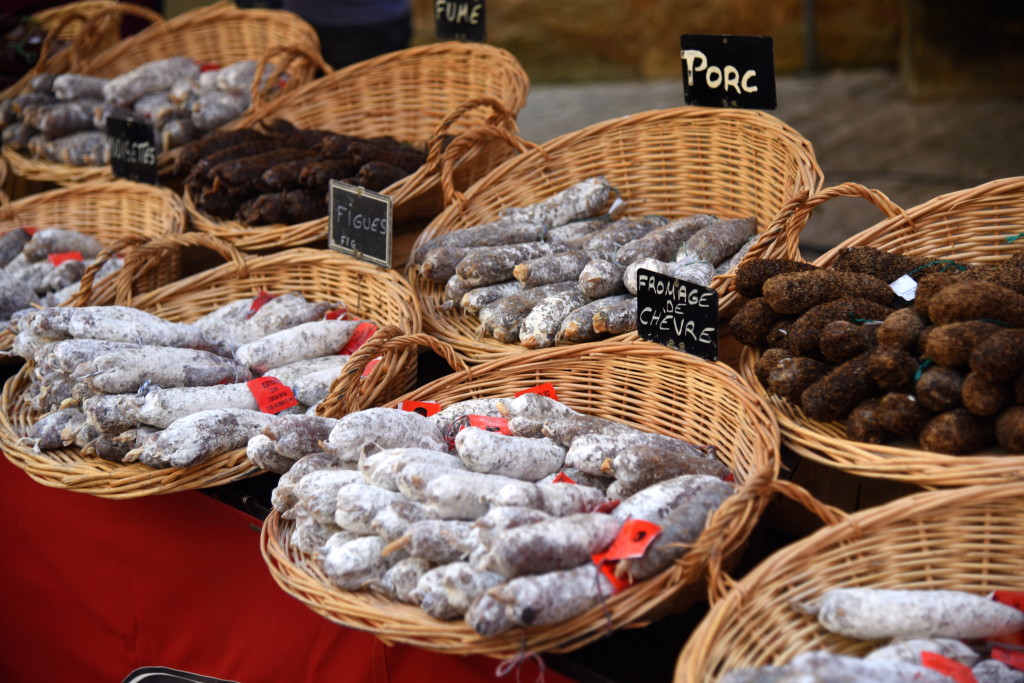
Plunging deeper, I’m immersed in a vibrant world of sights, smells, and sounds: Baskets neatly filled with oddly shaped sausages. Mountains of olives. Carefully sealed bags of dried mushrooms. Loaves of rustic breads. Refrigerated trucks displaying meats, fish, and tiny wheels and pyramids of goat cheese. A vivid festival of flowers. Tree stump-sized wheels of mountain cheese. Kitchen tools, from newfangled walnut crackers to a huckster demonstrating the sharpness of his kitchen knives. Snail shells already pre-filled with garlicky-green butter, ready for escargot. Mammoth hunks of nougat the size of car tires. Tidy rows of jams, jellies, preserves, and walnut oil. A young, dreadlocked farmer selling more different varieties of onions than I realized even existed. Bowls of colorful, intensely flavored tapenades. Giant slabs of fruitcakes — nut, orange, fig — waiting to be sliced up and sold by the weight. A rainbow of colorful little beanies used to cover your fruit or bread basket. And, of course, cans of artisanal foie gras and other duck and goose products. (Confit de canard may be the most delicious thing you’ll ever eat from a can.)

Sarlat Olives 1

Sarlat Sausages

Sarlat Cheese

CH15MaySarlat_130

Sarlat Covers

The longest line is at the strawberry stand — a good sign. You smell the strawberries before you see them. I try to stake my claim in the queue, but quickly learn that no-nonsense French grannies are shameless about butting in line. Elbows up! I trudge patiently to the front and am given a choice: charlotte or gariguette? I splurge on the pricier, rounder, more pungent charlotte style, at €3.50 a basket, instead of the cheaper, torpedo-shaped gariguette style, at €2.50.

It’s a good thing I got my shopping in early. Shortly after the noon bell tolls, everyone starts packing up. Shoppers disperse — instantly filling up the town’s many al fresco café tables — while merchants crate up unsold goods for tomorrow’s market in Domme. They’ll all be back in Sarlat on Saturday — just like they have been, twice a week, for decades. By then, I’ll be in Normandy, halfway across the country. But I’ll still be tasting those strawberries.

Sensational Sarlat, My Favorite Town in France

Steve Smith, who co-authors our France guidebook with Rick, favors the word “sensational.” I don’t tend to describe things as “sensational,” but if ever a town deserves that superlative, it’s my favorite town in France: Sarlat.

For a traveler, Sarlat ticks all the boxes: It’s beautiful and idyllic, but still feels real. It’s tourist-friendly without being objectionably touristy. It’s just the right size — about 10,000 people — but because it’s a population center for the most scenic stretch of the Dordogne River Valley, it has the bustling metabolism of a city double its size.

Sarlat Market OV2

Sarlat is built out of a soft-focus, distinctly hued limestone that’s perfectly described in our France guidebook as “lemony.”  The only other place I’ve seen that’s so liberally brushed with this palette is England’s Cotswold villages…putting Sarlat in pretty good company. (In this photo, Sarlat is busy with its twice-weekly market. More on that in my next post.)

Sarlat Market Hall

Sarlat decided to convert this old church into a market hall. The Jurassic Park-sized doors are cracked open each morning, when the vendors inside are selling local products.

Sarlat Tower

Sarlat sweetly fills a valley with its stony homes. The church/market hall is equipped with an open-air glass elevator that zips sightseers up, Willy Wonka-style, to this viewpoint. The worthwhile trip comes with a little English commentary. My guide explained that the town’s full name, “Sarlat-la-Canéda,” represents the two communities — Sarlat and the much smaller La Canéda — that merged into one. (No connection to the Great White North, however.)

Sarlart Geese

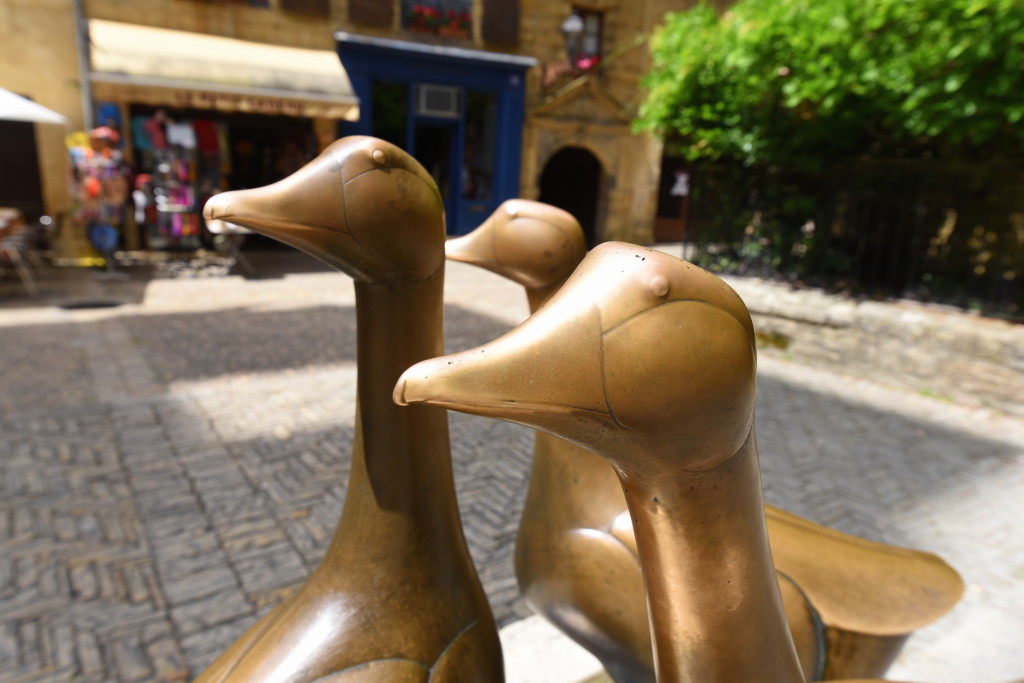
This statue — on the “Square of the Geese” (Place des Oies) — makes it clear who butters Sarlat’s bread: the buttery livers of force-fed geese, better known as foie gras.  In American foodie circles, chefs emphasize taking great care with ingredients as a way to show respect to the animal who made the ultimate sacrifice to please your taste buds. While that’s a relatively new (and still minority) view in the US, Sarlat is way ahead of the curve — literally putting its favorite food on a pedestal. (I discuss the Dordogne Valley’s “duck, duck, goose” approach to cuisine in this post.)

Sarlat Mansion

With so many gorgeous mansions, Sarlat had me wondering what life was like behind those yellow facades. I found my answer at Manoir de Gisson, a noble townhouse-turned-museum just steps from the goose statue. This fortified spiral stairwell connects its four period-decorated floors. Although the English descriptions were pretty dry, the space itself stoked my imagination; I enjoyed daydreaming about what it would be like to live in this splendid burg a century or five ago.

And, just because I’m so head-over-heels about this town, here are a few more pretty pictures of sensational Sarlat:

Sarlat Shops

Sarlat Church


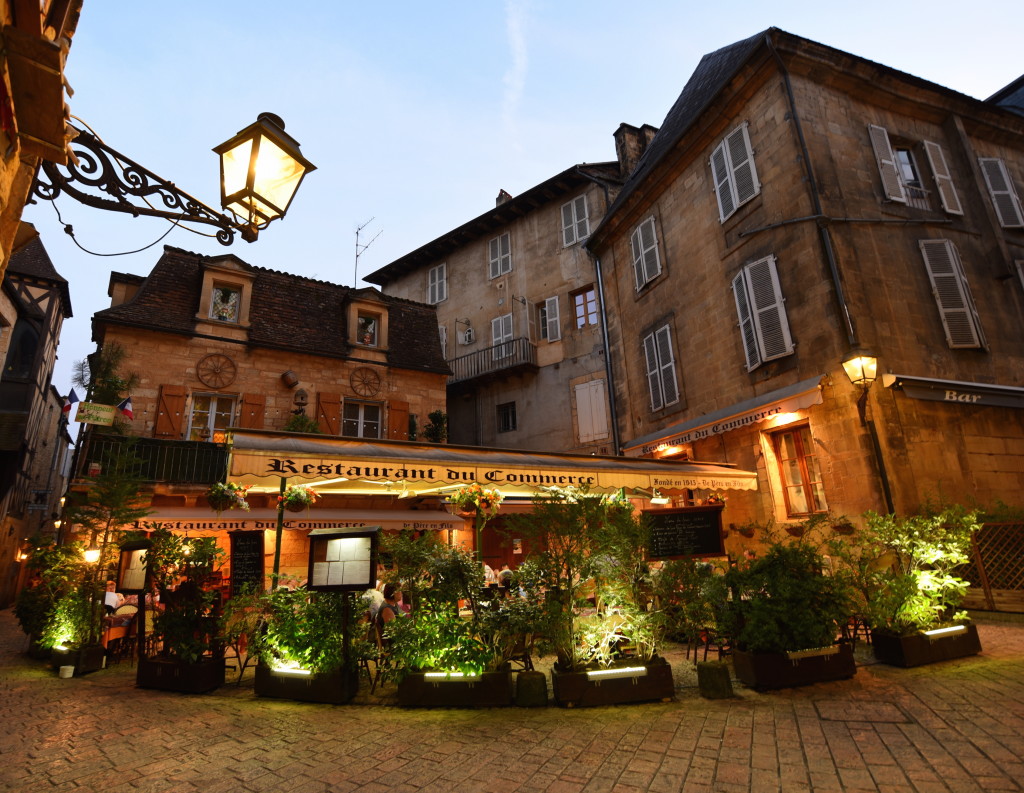
Sarlat Night Square

Endearing Encounters with French Innkeepers

Travelers tell me that they find Rick Steves guidebooks unusually accurate, thoughtful, and practical. There’s a reason: We still update all of our books in person, either every year (if there’s a year printed on the front cover) or every other year (if there’s an “edition” printed on the front cover). And when I’m updating a book, yes, I really do visit every single hotel, restaurant, museum, train station, tourist information office, laundromat, and so on — all in person.

French hoteliers, so proud of what they do, display guidebook endorsements like merit badges.

That personal touch shines through even more, I believe, in our co-authored books, where one expert handles the update each edition (in constant collaboration with Rick, of course). I do this in Eastern Europe, but here in France, I’m on Steve Smith’s turf. And it’s quite touching to see the personal connection that many businesses in our book feel with Steve. They ask after him like he’s a friend they haven’t seen in a year…because that’s essentially what he is. Steve has handpicked — and carefully cultivated relationships with — each and every business that appears in Rick Steves France. That level of dedication and intimacy really comes through in our readers’ experience.

I’m always pressed for time when researching, but here in France, updating the hotels is particularly demanding. French hoteliers are so proud of their properties, they want to show me every square inch. And Steve’s accommodations aren’t just cookie-cutter; they have real character.

I had one particularly lengthy, but very enjoyable, interaction at a countryside hotel near the Dordogne River Valley, called Moulin de Fresquet. The owners, Gérard and Claude, have converted an ancient mill into an idyllic retreat. Gérard greeted me in the driveway and proceeded to show me each of their five rooms — all of them different, but all of them equally well cared for. He told me about the ghost who haunts the mill, showed me a copy of the innkeeper’s memoir he wrote and published (unfortunately, so far available only in French), and took me on a guided tour of the lush, parklike grounds. The place is less a hotel than an enchanting fantasyland.

Dutifully checking the details in our book, I asked Gérard about the duck pond that our listing mentioned. His eyes fell. “Sadly,” he said, “we no longer have ducks in our pond. A hawk moved in and began picking them off, one each day, until they were all gone. Now we just have a few passing ducks who rest here briefly.”

When I was leaving, Gérard asked me, “Excuse me. Do you know what happened to Karen Brown?” It took me a moment to realize who he meant. In the 1990s and early 2000s, Karen Brown wrote a series of guidebooks highlighting romantic, upscale, characteristic inns. (Back then, Rick used to say, “My splurges are Karen Brown’s slums.”) She had a very devoted following, but her niche became one of the casualties when printed guidebooks were eclipsed by online sources.

Genuine affection filled Gérard’s voice as he described how Karen would come personally to visit and update her guidebook each year, and even brought her entire family on holiday once. This wasn’t just a business relationship; it was a friendship. “I wrote a letter to her several months ago and never heard back,” Gérard told me. Since Karen and I are both in the guidebook biz, he figured maybe I knew her. (Karen, if you’re reading this, get in touch with Gérard and Claude! You know, they worry.)

Accommodations with personality are increasingly rare in our mass-produced, crowdsourced age. Most people want to quickly find a hotel online, book it instantly, and tick it off their list. But visiting this and so many other lovingly run accommodations throughout France, I feel proud to be part of an organization that still values people-to-people connections…even if we’re a bit old-fashioned. I can only hope to have enough of an impact that many years from now, my friends in Gdansk, Dubrovnik, or Budapest will ask themselves, “I wonder whatever happened to that Cameron guy from Rick Steves?”