My co-author and frequent collaborator, Cameron Hewitt, is well-traveled, smart, and insightful. And, while he and I are in perfect sync in our travel styles and priorities, he gives voice to the next generation of "Rick Steves travelers." Join me in enjoying his reports right here. —Rick

“You Have My Dream Job!”  —  How I Became a Travel Writer

I just got home from one of the most memorable and meaningful trips I’ve had in years: My alma mater, Ohio Wesleyan University, invited me back to campus to talk about how my college experience prepared me for my job as a travel writer. I get a lot of strangers telling me, “You have my dream job!” But now I had to sit down and really think hard about how I got to where I am, and what it means to create a meaningful career doing something you love.

How do you distill 20 years of travel into a one-hour talk? Come to that, how do you get to be a travel writer? Beats me. But I can tell you how I became one, and throw in a few tips for anyone who’s just starting out. Since I’m in a nostalgic mood, first I’ll tell the story of how I got to where I am. Then I’ll zoom out to offer some advice that worked for me…and might just work for you, too.

My Travel Writer Origin Story

Travel runs deep in my family. Before I was born, my parents lived abroad — in North England and in Switzerland — for four years. This was at a time when long-distance calls were so expensive that they could only afford to talk to their parents twice a year: on Christmas and on Mother’s Day. Other than that, it was letters — written on crinkly, blue-and-red-striped “aerogram” stationery. Back then, “living abroad” meant being entirely cut off from your home culture. It required a deep cultural immersion that sent you home with a funny accent. (Returning to small-town USA, my parents were informed by friends — much to their surprise — that they had started talking like Brits.)

When I was in high school, my father — a professor at a theological school — set up a language-study program for his graduate students in Oaxaca, Mexico. He invited me to tag along and work on my rudimentary Spanish. Sensing that this was an alternative to getting a menial summer job, I said, “Sure.” I wound up spending one month each of the next three summers living with a wonderful host family, becoming fluent in Spanish, having my hometown blinders pried open, and — most important — discovering a deep affinity for the everyday adventure of travel. My sepia-toned world had suddenly been colorized.

When it was time for college, I attended Ohio Wesleyan University, in my hometown of Delaware, Ohio. (A generous scholarship trumped the fact that it was just 15 minutes from my parents’ house.) I majored in English, and I decided to take a break from Spanish and tackle German. Eight semesters later, I had a second foreign language — and a second degree — under my belt.
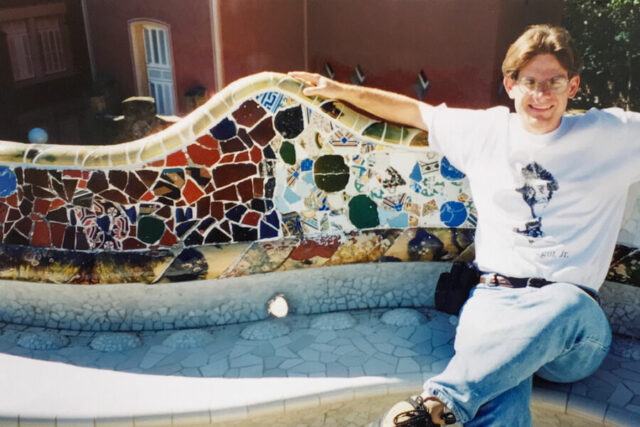
For a semester abroad, I took a “sabbatical” from my German classes to join Ohio Wesleyan’s esteemed program in Salamanca, Spain. The first time I set foot in Europe, I stepped off a plane in Madrid, boarded a bus, and rode across the sun-baked Castilian Plain to be introduced to my host family. I took classes at the Universidad de Salamanca, got acquainted with one of Spain’s finest small cities, stomped grapes to make wine at the family farm, and traveled to places like Galícia, Toledo, and Barcelona.

Returning home, I completed my studies and graduated valedictorian, Phi Beta Kappa, summa cum laude. Clearly, I had the world by the tail!

Except…I truly did not. In fact, I had no earthly idea what to do next. I had spent too much time striving to get straight A’s, and not nearly enough time considering what I’d do with that flawless transcript.

Thus began what I think of as “The Wilderness Years.” As if to scream to the world just how rudderless I felt, I grew a deeply unfortunate scraggy beard.

For the next couple of years, I floated through life like a cork in a river. Feeling drawn to the Pacific Northwest — where I had many relatives —  I drove cross-country to the Oregon Coast. Upon arriving, I realized I had no clue what to do out there, either. After a couple of months, I drove home, moved in with my parents, and got a job at the local movie theater…just to hang out with my friends who also worked there. Thinking I might want to become a teacher, I did some substitute teaching — but that wasn’t for me, either. A lone bright spot was when I got a gig writing weekly movie reviews for my hometown newspaper, at $25 a pop. I considered going to film school, because clearly another $100,000 in debt and another marginally useful degree would be the answer to my prayers.

Obviously, I was waiting for something — anything — to inspire me. And what do you do when you can’t figure out anything else to do? You go to Europe! My high school sweetheart, Shawna, suggested we take a trip to Great Britain. And then, I decided, I’d stick around and do some solo backpacking around the Continent.

We had no idea where to begin planning our trip. Around this time, the local public TV affiliate was airing a show called Travels in Europe with Rick Steves every evening around dinnertime. It became my family’s tradition to watch this goofy American, in his leather jacket and aviator glasses, work his way around Europe. We had a stack of Rick’s free travel newsletters on our coffee table, too. One night, my mom said, “I think Rick also writes guidebooks.” I suggested to Shawna that she check it out. A couple of days later, she called me and said, “I got that Rick Steves book out of the library. Now I know exactly what to do on our trip.” (Clearly, Shawna was very astute. But I must have been even more astute…because I wound up marrying her.)

We had a wonderful time in Britain…guided each step of the way by our Rick Steves guidebook. We still speak fondly of the “chirpy attic room” in Keswick, and the many other just-right places Rick directed us to.

Shawna went home (for, you see, she actually had a job) and I was left alone in England…again rudderless. So I got in touch with my friend Trevor, who had graduated with me and immediately entered the Peace Corps, stationed in Slovakia. His sister Abby was coming to travel around Eastern Europe with him…would I like to come join them?

I was staying with family friends on the moors of South England, and Trevor wanted to meet up in Poland — which felt very, very far away. But, in possession of a Eurail pass and lacking other options, I decided to make the two-day trek: boat to France, train to Paris, night train to Munich, train to Berlin, another night train to Kraków. Walking bleary-eyed from Kraków’s train station to the main square, I marveled that this crazy plan might have actually worked. And a few minutes later, when Trevor popped into view at the far end of the square, I was hooked. (You can read my full account of the journey at the bottom of this post.)

Trevor, Abby, and I spent a week traveling around Eastern Europe: Kraków, Prague, Dresden, Budapest, and back home to Slovakia. And I was flabbergasted by this corner of the Continent. Something about Eastern Europe got under my skin. I continued on the rest of my trip with a renewed energy, hitting my groove as I traveled through several more countries, eventually running out of money in Ireland and flying home.

Back in Ohio, I returned to the throes of The Wilderness Years. But something was different. I was more at peace, while also more excited. I had seen a glimpse of a world that felt like it would become important to me in some way. I just had to figure out how.

But first, I decided I should write a thank-you letter to Rick Steves. The letter ballooned to several pages, as I waxed poetic about the glories of Eastern Europe that were inexplicably not included in his guidebooks. C’mon, Rick, I chided — why no Budapest? No Kraków?!

At the end of the letter, I figured I might as well throw in my resume and mention that I was looking for work. I dropped the letter in the mail and got right back to the important business of not having a job. Somewhere in there, my mom said, “Cameron, you’ve got to take some initiative and figure out what you want to do. It’s not like Rick Steves is just going to call you up and offer you a job!”

A couple of days later, the phone rang. A familiar voice said: “Hi, is this Cameron? This is Rick Steves.”

After an embarrassing exchange in which Rick repeatedly assured me that he was actually Rick Steves, and not my mischievous friend Andy, we had a great conversation. He liked my letter. He agreed that he could do better in Eastern Europe. And, by the way, was I serious about coming to work for him?

It was November — the slowest time of year in the travel business — and Rick wasn’t hiring just then. But, he said, if I was ever in the Seattle area, I should drop in to meet him. I hung up the phone and called my Grandma in Portland, Oregon. “Grandma — I’m coming for a visit!”

I flew out to the Pacific Northwest and made the rounds with my relatives, working my way north toward Seattle. A couple of days before I was to be in town, I called Rick to be sure he knew I was coming. He answered, and I told him that I was on my way to see him.

There was a long, awkward pause. “Um, who is this again?”

You know — Cameron Hewitt. That guy from Ohio. The one who wrote you a letter. You said I should come out to meet you.

Rick ended the call with a very noncommittal, “Well, I still have no idea who you are. But if you want to come to my office, I guess I’ll talk to you.”

I could have — probably should have — hung my head and flown home to Ohio. But I’d come this far…and, frankly, I didn’t have a lot of other prospects. So I made the lonely drive north on I-5 to Seattle, and showed up on Rick’s doorstep.

At first, Rick eyed me suspiciously. But, relentlessly, I recapped our previous conversation — and finally he remembered. We had a lively conversation and hit it off. It was clear that our travel styles were perfectly in sync. He said they may be hiring in a few months and took me to meet the HR manager. She was just arriving at her desk for the day — still wearing her jacket and holding her car keys — and she looked at us like a deer in headlights.

A few months later, they were indeed hiring — and I got the job. In March of 2000, I moved to Seattle and started working at Rick’s Travel Center, where customers can come to buy our luggage and guidebooks and get advice on their trips. I worked hard there for two years, and when an editorial position came open in our guidebook department — which was my target all along — I became a guidebook editor and researcher. I continued to work hard. And I never stopped. Over the last two decades, I’ve been spending three months each year in Europe, contributing to guidebooks in more than 40 countries, from Iceland to Sicily. (Here’s a partial summary.)

(tl;dr: Overachiever-turned-loser goes to Europe, writes Rick Steves a letter, and winds up with his dream job.)

While my story is extremely specific (and, upon reflection, nothing short of bizarre), I find that many people’s stories have their own twists and turns. It’s hard to give universal advice to someone just setting out, but here are what I consider the takeaways from my journey. While these tips may not be relevant to everyone, they’re what I wish someone had told me on graduation day.

Someone has to do your dream job…so why not you?

OK, try this: Picture your dream job. Close your eyes and imagine what you would consider the coolest thing you could get paid to do. Got it?

Here’s the thing: Somebody does that job. Somebody has to. So why shouldn’t you be that somebody?

This isn’t to say that you deserve that job just because you want it. You’ll have to earn it. But why not be the one who earns it?  If it’s something you have a passion and an aptitude for, why not dedicate yourself to working tirelessly, proving yourself indispensable, and being the person who gets to do what you dream of doing?

The big caveat here is that your dream job is probably much harder (and much less glamorous) than you imagine. I realize that I will never get one ounce of sympathy from any of my friends, but…my job is very hard work —  with long, tedious days, exhausting assignments, and unforgiving deadlines. And I would imagine any career considered a “dream job” would be commensurately more challenging.

But if you don’t shy away from hard work, give it a shot. It might take a long time. You’ll be precipitously steep on the learning curve as you pay your dues. And it will require patience and persistence. But why not you?

A career is like a trip: have a plan, but remain flexible.

I help a lot of friends and acquaintances plan their trips to Europe. (Occupational hazard.) And I find that the people who have the best approach are those who know what they want to do, without being too rigid about it.

Some travelers have every single hour plotted out. I have seen itineraries that read like they were designed by aeronautical engineers (because, well, they were): “Day 10, at 10:00: Visit the Accademia to see Michelangelo’s David. 10:35: Ponder humanity’s place in the universe and relationship with God; if time, also see Michelangelo’s Slaves. 10:45: Coffee break in museum cafeteria. 11:00: Walk 15 minutes to the Uffizi for our reservation there…”

These people invariably have troubled trips. They can’t possibly live up to their own rigid standards, small setbacks derail their precision plans, and spontaneity suffers.

I have also seen “itineraries” that barely qualify: A sketched-out list of places that might be in the cards, and a reluctance to book even a single night in a hotel. These entirely spontaneous trips may work for some people, but my sense is that they miss out on things they may have loved, simply because they didn’t do any homework. They waste a lot of time improvising — for example, calling around to find a room when they stumble into a town that’s unexpectedly jammed with a big convention — and less time experiencing Europe.

For me, a good trip has a general plan: I book overnights and a few can’t-miss experiences (like a museum that requires reservations, or a world-class restaurant), but leave the specifics of each day wide open to flex with the weather, surprise opportunities, and unplanned setbacks. Sometimes everything works out perfectly — as if I’d plotted it out, hour by hour, months before. But other times, I’m glad I built in wiggle room to deal with changing circumstances.

Nobody setting out on a career path can know exactly what lies ahead. Saying to yourself, “I have to get my first job by August, become a senior manager in three years, and make partner within ten” is a recipe for disillusionment. Beware the bullying “Bucket List,” especially one with deadlines baked in. On the other hand, having no direction is a great plan for winding up nowhere at all. But if you have a general sense of roughly what you’re aiming for, that will keep you on track.

To that end…

Figure out what you’re passionate about.

During my Wilderness Years, I had skills and motivation, but no direction. All of that changed with a trip to Europe that lit a fuse in me. I knew that travel — and specifically Eastern Europe — had to be a big part of my future, even if I didn’t know yet exactly how. My aimless and halfhearted job search narrowed considerably, setting me — eventually — on the course that brought me to here.
Your passion is your compass — it’s what keeps you on track. Even when you don’t know exactly where you are or what’s around the next bend, it reassures you that you are, at a minimum, heading in the right direction. (In this analogy, your “career plan” is like a map. But if a bridge is washed out or a new path has been laid out, your compass makes it easier to improvise.)

I love the famous quote by Howard Thurman: “Don’t ask yourself what the world needs. Ask yourself what makes you come alive and then go do that. Because what the world needs is people who have come alive.”

A few years ago, when I started my blog, I sought advice from a trusted colleague: Is there a structure that works best? What’s my target word count? How long is too long? How many pictures should go in each post? What kinds of topics will interest people?

She said essentially the same thing as Howard Thurman: People want to read things written by someone who’s passionate about what they have to say. What they don’t want to read is a rigid template that’s been half-heartedly filled in. There’s so much soulless clickbait masquerading as “content” out there. You may have to do some of that to pay the bills, but make sure you’re also making time to create something that’s fresh, personal, and bursting with enthusiasm. Write what you’re excited about, period. And people will enjoy reading it.

Find an organization that matches your values.

When I first started working at Rick Steves’ Europe 20 years ago, I noticed a funny thing: Although it’s a for-profit business, the organization had a distinctly non-profit philosophy. My co-workers would talk about “our mission” and “our travelers” and the importance of helping people have great trips to Europe…but nobody seemed the slightest bit preoccupied with the bottom line.

It turns out that Rick Steves’ Europe was way ahead of its time. Today, every jobless (or underemployed) millennial dreams of finding work at a “values-driven company.” They don’t just want to be paid well to work hard — they want it to mean something. They want their work to draw an income, but also to make the world a better place.
I see now that we were “values-driven” long before it was trendy. And we’re just as obsessed with it today as we ever were. We take every opportunity to remind each other that we are travel teachers first. At a recent leadership retreat, Rick reiterated his longstanding philosophy that what matters most isn’t gross revenue, but what he calls “gross travel happiness created.” We succeed when we make one more person’s trip better. (This works like a charm. Turns out, when you channel all of your energy into creating top-quality content and getting it into the hands of people who need it, the money will follow. Who knew?)

Back in 1999, this scraggly-bearded backpacker recognized that I was dealing with a company that did a great job at accomplishing its mission (i.e., helping me have a better trip). I took a gamble to come work here, because I had a sixth sense that I was more likely to find a meaningful career here than I would somewhere else.

When I loaded up my Honda Civic and drove from Ohio 2,400 miles to Edmonds, Washington — ahem, to sell backpacks — my friends must have thought I was nuts. But it was worth the gamble. My hunch paid off.

If you find an organization that feels like a good fit, take a chance on it. It might not pan out. But, then again, it might.

Once you get your foot in the door, work hard to prove yourself.

I realize “paying your dues” seems hopelessly old-fashioned these days…but I’m living proof that it works.

Here’s a deep, dark secret that nobody wants to tell you: An organization’s top priority is not ensuring that you feel challenged or fulfilled. A good organization does care about this…somewhat. But they care even more about whether you’re making an impact and earning your keep. Are you contributing to the mission and/or the bottom line enough to justify what they’re paying you?

When I started at Rick Steves’ Europe, I desperately wanted to work on guidebooks — but I was perfectly happy, instead, to work in the Travel Center for what turned out to be two years. I could have spent that time complaining that I was being underutilized or asking about when my dream job posting would come available. But I didn’t. I put my nose to the grindstone and worked hard every day to get to know our content and our customers, while making sure that the company was getting more out of me than I was getting out of it. I volunteered for every task and did it with pride. If someone needed to dress up like a Viking for the Travel Festival, I was their guy.

Here’s another secret: “Paying your dues” isn’t just about proving yourself to someone else. It’s an essential boot camp for understanding what the organization is all about. In retrospect, those two years I spent in the Travel Center were far from wasted; they were an invaluable opportunity to understand every corner of our business and to really get to know the people who do business with us. To this day — 18 years after I left the Travel Center — I still think back with gratitude on that opportunity. And I believe that I still “get” our customers better than many of my colleagues do, because it was my job to interact with them all day, every day. I know what makes them tick. It’s the foundation the rest of my career is built upon.

If you’re an aspiring writer, “paying your dues” means actually writing. It’s great that you have an English degree. Now show the world what you can do with it. When young people ask me how to break into the travel writing field, my answer is simple: Travel. Then write about it — a lot. Start your own blog. Build a real portfolio. This helps you develop your skills. And it demonstrates not just that you want to be a travel writer, but that you are a travel writer.  When I first met Rick, I showed him the stack of yellowed movie reviews that I’d written for my newspaper. It wasn’t “travel writing,” but at least he could see that I knew how to produce content on a deadline.

Patience, grasshopper. Later on, you’ll be very glad you did this. Have you ever heard a successful person say, “Boy, I sure wish I hadn’t paid my dues”?

Tackle big challenges like eating an elephant: One bite at a time.

Part of paying your dues is stepping up when someone needs to tackle a big, imposing job. And that can be intimidating. But you just have to begin with that first step.

The first guidebook chapter I ever updated was Lausanne, Switzerland, in May of 2001. And I was terrified. By this time, I knew that working on  guidebooks was my ultimate goal — and I desperately wanted to do it well. But I’m naturally shy, and a perfectionist, so I spent the weeks leading up to the trip tying myself in knots about whether I’d be able to pull it off.

I rode the train into Lausanne, my heart thumping in my ears, my mind racing. And then, around the time that train pulled into the station, an unexpected calm washed over me. It was go time, and the only thing left to do was what they had taught me to do: Go to the first hotel on my list and ask the first question. And then the next question. And then the next question. And when I was done at that hotel, I’d go to the next hotel. And the next one.

So that’s what I did. And by the end of the day, almost without noticing it, I had updated the entire chapter. And I did the same the next day, in Murten. And the next day, in Bern. And a couple of weeks later, I flew home with an updated guidebook.

A few years later, Rick accepted my pitch to co-author a brand-new guidebook to Eastern Europe. It was, in retrospect, a foolishly ambitious task (at the time, Rick likened it to the Louisiana Purchase). But I flew to Warsaw, went to that first hotel and that first museum and that first restaurant, and gradually worked my way south, all the way to Dubrovnik. I came home with a new guidebook, which is now a bestseller in its 10th edition.

Sometimes corny cliches contain deep wisdom. When faced with a daunting task, my father-in-law says, “How do you eat an elephant? One bite at a time.” Writing a book about Eastern Europe wasn’t easy. But each individual task, out of the ten thousand tasks it took to complete the project, was doable. And so…I did them, one at a time.

Play to your strengths, and collaborate with smart people who play to theirs.

You’re not good at everything. But you are good at something. The secret is figuring out what that “something” is — and then working with people whose somethings are complementary.

If I had to pick my single favorite thing about working at Rick Steves’ Europe, much to my surprise, it would not be all of the travel. Nope, it’s the wonderful people I get to work with. Everyone does their job well and proudly, we are all passionate about our mission, and we all understand that the strange and beautiful alchemy we create works because we do it together.

A lot of people never get to meet their idols. I am incredibly lucky, because I get to work with two of mine. Rick Steves…and Gene Openshaw, whose prose about Europe’s art and history sparkles with razor-sharp clarity, profound understanding, and wipe-a-tear beauty. (Gratuitous plug: Check out Gene and Rick’s stunning, brand-new book, Europe’s Top 100 Masterpieces.)

Gene and I have collaborated on several guidebooks, including our titles on Greece, Barcelona, and Berlin. Gene writes eloquent self-guided tours of great archaeological sites, museums, and neighborhoods. If you’ve taken these, you know Gene’s unmatched gift for taking the traveler by the hand and introducing them to exactly what they came so far to understand. (The best part of my job is when I have privilege of being the first person on earth to follow one of Gene’s new tours. I feel like I’m a friend of the Beatles, and they’re playing me a demo just before laying down the final track.)

When Gene’s done his part, he hands the book off so I can do what I consider “the fun part”: Filling in the edges of what he’s built, fleshing out the restaurants and nightlife, writing up the minor sights and quirky sidebars and side-trips. In the Greece book, for example, Gene wrote the tours of the Acropolis, Agora, Oracle of Delphi, Ancient Olympus, and so on, while I did the street food and street art tour in Psyrri, plus Mykonos and Santorini.

Next, when Gene and I are both done with our work, we hand our contributions over to a crack team of editors and mapmakers. And then…we never have to worry about them again, knowing they are in excellent hands.

If there’s one thing I wish for anyone starting out on their career path, it’s that they find a collaborative environment that hums like a happy machine.

Relax! Celebrate serendipities. Because jams are fun.

Standing on stage in front of students at my alma mater — who sat in the same chairs where I sat 22 years ago — I could remember exactly what it felt like to be in their shoes: Enjoying “the college experience,” excited about my studies, but deep down terrified about what would come next. From the moment you get to college, an imaginary stopwatch begins ticking over your head — relentlessly counting down to the moment when you have to enter The Real World.

It’s easy for me to say, “Relax! It’ll work out!” But if I could talk to myself 22 years ago, I would say exactly that. Not that it would always be perfect. Not that there wouldn’t be Wilderness Years, or that I’d get exactly what I wanted, when I wanted it. But that all those twists and turns do wind up taking you somewhere. And while you’re worried about that “somewhere,” don’t forget to enjoy the twists and turns. Memorable problems and delightful serendipities may feel like road bumps and distractions — but they’re the good part.

Have you ever noticed that when someone gets home from a trip, and you ask them how it went, almost invariably they begin telling you about something that went wrong?

My wife’s Great-Great-Aunt Mildred is my travel role model. A single woman to the end of her days, she traveled the world far and wide — long before such a thing was common. Near the end of her life, Aunt Mildred wrote a memoir of her travels. The title: Jams Are Fun.

After seeing so much of the world, it wasn’t the cathedrals and the museums and the grand views that Aunt Mildred remembered most fondly. It was those moments when everything went sideways, obstacles had to be overcome, and the trip was more memorable for it. (Like, say, when you call up Rick Steves for your big job interview…and he has no clue who you are.) Aunt Mildred understood that jams make wonderful memories…and dealing with them makes you a better traveler.

If you’re embarking on a career — and I know this is very easy for me to say — try to relax, lean into it, and enjoy. You’ll wind up in some interesting places, but I certainly hope that your journey isn’t without challenges and “problems.” Because, after all…jams are fun.

Remembering the Lost on Slovenia’s Day of the Dead

While the USA is busy celebrating “All Hallows Eve,” the main event in Slovenia is All Hallows Day, November 1.  As the last of the autumn leaves tumble from the trees and winter gloom descends, the Slovenes observe their Day of the Dead (Dan Mrtvih) — pausing to look back on the generations who went before. And just when most of North America is waking up and combating their candy corn hangover with a pumpkin spice latte, Slovenes head to their cemeteries, arms full of candles and flowers, to honor lost loved ones.

Slovenia is one of many Catholic countries that observe the Day of the Dead  (also called All Saints Day, All Souls Day, or Remembrance Day). The best-known variation is Mexico’s Día de Muertos, with its colorful skeletons on parade. But Slovenia’s Day of the Dead is a more subtle affair — all the more poignant for its understatedness.

Several years ago, the Day of the Dead found me in Slovenia’s capital, Ljubljana. At the edge of downtown is one of the most beautiful final resting places I’ve seen: Žale Cemetery, designed by the great Slovenian architect and urban planner Jože Plečnik. (For those who appreciate European cemeteries, Žale is worth a visit any day of the year.)

I first stopped by Žale Cemetery on the afternoon of October 31 — All Hallows Eve. Stepping through its grandiose arcaded entrance, I was met with a deeply moving sight: Slovenes were busy tending the graves. Each plot had been painstakingly weeded and scrubbed to a high shine, with not a pebble out of place. And each tomb was an artfully composed ensemble of candles, flowers, and mementos.

While back home, store shelves are stocked with plastic jack-o-lanterns, superhero costumes, and fun-size candy bars, Slovenian shops are doing a brisk trade in moss remover and headstone polish. Inside the cemetery, rickety green tables groan under the weight of red votive candles stacked on top of each other — two euros a pop. And for florists — who set up tents just outside the entrance — the Day of the Dead is their “Black Friday.”

Slovenes feel an obligation to tidy up the grave of each and every loved one. Cousins compare notes about who’s going to look after Uncle Janez’s grave, and who’s responsible for Aunt Marija. If you have a big family, you have a very busy week. My Slovenian friend said, good-naturedly, “I loved growing up as the only child in a big extended family. But these days, it makes the last week of October extremely busy.”

November 1 is a national holiday — everything is closed and quiet. But returning to Žale Cemetery, I found it overflowing with people. Everyone was wearing their Sunday best, as if attending the wedding of the year. I squeezed along the gravel lanes between elegant tombs decorated like parade floats — each one trying to outdo the next. Around mid-day, a priest appeared and began blessing the graves, and the crowd fell silent. After the ceremony, families departed to share a meal of remembrance, celebration, and fellowship.

Later that night — as the sky turned from overcast white to deep blue to inky black — Žale Cemetery was again full of people. Underfoot, leaves crunched and half-sheathed chestnuts skittered. Thousands upon thousands of flickering candles filled the gloomy cemetery with soft, dancing, deep-red light. Even when it began to rain, people still filled the cemetery. Old friends and distant cousins bumped into each other — for the first time in ages — at the grave of a shared loved one. Families huddled together under umbrellas, their tear-streaked faces shimmering in the candlelight, laughing together at treasured memories.

While this was in the capital’s most prominent cemetery, similar scenes play out in every graveyard, big and small, across Slovenia. After prepping the graves of their own relatives, Slovenes do the rounds to pay their respects to cherished friends, as well. A Slovenian friend counted about 15 different graves — spread over seven cemeteries — that her family tries to visit each November 1. And at each one, she leaves a candle or flowers. (She enjoys bringing her young boys along, if only to take in the spectacle.)

While Slovenia celebrates the Day of the Dead with a special reverence, similar observances take place in many Catholic countries in Europe. For example, recently a Palermitano told me that many Sicilians give gifts to children from their deceased ancestors. For a young child, stories about people they’ve never met can be hard to relate to. But presents? I mean, come on — presents make things real. Getting that toy they’ve been wanting from their deceased Great-Grandma helps a child feel connected to their roots.

Reflecting on these beautiful European traditions, I’m sad that American culture, all too often, doesn’t set aside time for this kind of remembrance. We have national holidays to give thanks and to honor our presidents and to celebrate trees, but not to recall lost loved ones. (The closest thing we’ve got — Memorial Day, honoring fallen veterans — is, for most Americans, the unofficial start to summer and time for a big golf tournament in Ohio.) Perhaps we just have an uneasy relationship with mortality. While Europe looks back with nostalgia and respect, America races forward, as if escaping our past.

As a true-blue American, I can’t remember the last time I actually visited my family graves. Slovenia’s poignant Day of the Dead inspires me to carve out some time in my busy life to just remember…and be thankful.

In Rome, You Can Never Get a Taxi When It Rains

Visitors (and even Romans) often describe Rome in terms of “chaos.” That strikes me a little unfair, because I so often experience great hospitality and kindness in the Eternal City.

But then it rains, and everything goes straight to hell.

I’m finally going home, after a long six-week journey through Europe. My grand finale is Rome. And on the morning of my departure, I pack up my bag and head downstairs to hop in a cab to the airport. It’s Saturday morning, about nine o’clock.

When I tell the receptionist I’ll be needing a taxi, a flash of quickly suppressed panic crosses his face. Feigning competence like a champ, he quickly gets on his computer and requests one for me. “It’ll just be a moment. Once they confirm, I can give you the name and the time of arrival.”

A few minutes pass. I’m relaxed, but he’s growing noticeably agitated. Finally, he tries calling, and is put immediately on hold.

Enough time goes by for me to recall how, the day before, I overheard a fellow guest ask to order a taxi for the next day. They were assured it was not necessary — “Just tell us when you’re ready to leave, and we’ll call one. It will be here in five, ten minutes maximum. No problem.”

The night before, I double-checked and got exactly the same response: “Five, ten minutes, no problem.”

But this morning — a mere 10 hours later — the receptionist’s quest to order a taxi is entering its eighth minute.

He looks at me apologetically. “In Rome, when it rains, it becomes very hard to get a taxi.” Apologetic shrug.

I glance outside, at bright sunshine gleaming off wet cobbles. “But…it’s…not raining.”

“Huh. Well, yes, now. But thirty minutes ago…” Big shrug.

He glances over at the bellhop, who smiles and returns the big shrug.

We stand there, waiting, serenaded by the taxi dispatcher’s schmaltzy hold music. He clicks feverishly on his keyboard. Noticing the “four stars” sign above his head, I begin mentally subtracting stars.

Finally, after 10 or 12 minutes, the phone muzak is abruptly disconnected.

“Well,” he says, “It seems that we may not be able to get you a taxi.” Big shrug.

Three stars.

“But,” I say. “I was told that it wasn’t necessary to order one ahead. That you could just call one.”

“Huh, yes, well, normally,” he shrugs. “But it’s raining, so you understand, there are no taxis available.” Shrugging, he repositions his computer screen toward me, so I can see for myself that his online request, too, has twice been declined.

“Don’t you think, maybe, you could have told me that when I asked about this yesterday? You could have said, ‘It’s no problem unless it rains, in which case you need a little more time’?”

The idea is preposterous to him, and he explodes with laughter. “Ha! Well, sir, of course you can’t expect us to predict the weather, now can you?” He laughs heartily at his own zinger and glances over to the bellhop for backup. The bellhop looks up from what he’s doing to return a generous chuckle, with a side of shrug.

It takes the bellhop a moment to respond because — and I swear I am not making this up — at this precise moment, he is talking to a rather unpleasant American guest who has been loudly complaining about the weather. To egg her on, he is showing her the many rainclouds in the weather app on his phone.

Two stars.

Also — and I apologize if I’m pressing the point too much — but it’s not like we’re in the Gobi Desert here. It rains in Rome. It has rained four of the last five days in Rome. In Rome, it rains — on average — something like 70 days every year. If you work at a Roman hotel, and it’s a rainy week, and you are aware that it’s impossible to get a taxi in the rain, don’t you think you might provide this information when a guest specifically asks about it?

It dawns on me that perhaps this supremely talented duo thinks that my taxi trip this morning is an optional one. Maybe it’s just, you know, a passing fancy. A joyride. Skippable. “Oh well, no matter. I could use the brisk walk anyway!” But I have a 5,000-mile journey ahead of me. And the first step of that journey is getting to the frickin’ airport.

“So then,” I say. “What do you suggest? Am I supposed to walk to the airport?”

The receptionist gives me an “oh you’re still here?” look, then theatrically shrugs three times — the first, presumably, for the Father, the second for the Son, and the third for the Holy Spirit.

“Well, there is a taxi stand. It’s next to the Zara, across the piazza and to the left.” He gestures with an exquisitely unhelpful vagueness toward the front door.

The bellhop nods vigorously as if to say, “Yeah, yeah, taxi stand, yeah.”

“But if you can’t call a taxi, why should I expect that there will be one just sitting there, waiting for me?”

Trapped in an impenetrable cage of logic, our antagonist can only offer a big shrug in response. “Well, we only work with certain companies. But there are many companies. So…maybe…one of the other companies…has taxis there?” While he’s shooting for reassurance, it’s clear that he’s making this up as he goes, and he achieves exactly the opposite.

This guy may not have been the star of his hospitality school class, but I’ve gotta hand it to him: He’s the living embodiment of ¯\_(ツ)_/¯. Also, you have to admire his chutzpah. I have seen a lot in my travels, but I have never, ever had a hotel flatly and unapologetically refuse to help me get a taxi.

One star. We’re talking bathroom-down-the-hall territory here. Peeling wallpaper. Though, to be fair, my room at this particular “four-star” hotel already has peeling wallpaper. (I predict a 90 percent chance of downgrades in the next edition of Rick Steves Rome.)

I know when I’ve been beat, so I sigh theatrically — the only meaningful response to the Roman Shrug — and try to get more precise directions to the (quite possibly hypothetical) taxi stand across the piazza. The bellhop halfheartedly offers to accompany me there, but at this point it will be a tremendous relief to simply cut ties entirely with the crack staff of the Grand Hotel Shrug. (Do they even give zero stars? Is that a thing?)

I trudge through brilliant sunshine across the piazza and make my way to Zara. The taxi stand has but one taxi. But one is all I need. Friendly Fabrizio hops out, loads my bag in the trunk, and rattles my fillings mounting a curb to catch a yellow light — getting me to Da Vinci Airport in record time. Grazie, Fabrizio!

As for the security line at the Rome airport…well, that’s another story, for another day.


This post is part of my “Jams Are Fun” series — designed for those who savor the Schadenfreude of hearing about good trips gone bad. Like that time I ran out of gas on Scotland’s remote north coast? Or that time I was stuck on a cruise ship during a massive storm in the North Sea? Or the time I became embroiled in a gelato feud in a small Italian village? Or, really, the entire experience of driving in Sicily.

In-Your-Face Italy: Traveling as an Introvert in a Land of Extroverts

It’s always so tempting — and so reductive — to paint entire cultures with a broad brush. Usually, I resist. But in this case, I’m going all-in: Italy is a land of extroverts. As an introvert, I both love it…and, on rare occasions, hate it.

Recently I flew home from London on British Airways. Normally those nine-hour flights are a sedate affair, but this time was different. The plane was loaded up with a big group of Italians, heading to Seattle for an Alaska cruise. They rolled onto the plane with fanfare, jamming bags every which way into the overhead compartments, gesticulating wildly, really making a meal out of finding their seats. A couple of hours into the flight, I couldn’t get to the bathrooms because a half-dozen people were jamming the aisles. At first, I thought they were all waiting for the lavatory. Nope…they were simply socializing after dinner.

I’m sure Italy has plenty of introverts. I’ve met some shy, retiring Italians. But not many. To be fair, I suspect that Italian introverts have to adapt to their outgoing society, so they learn to do a good impression of extroverts. (I live in Seattle — a.k.a. Introvert City, USA — where it’s very easy to give yourself over to your loner instincts. Italians don’t have that option.)

For evidence that this is an extrovert’s paradise, you need only walk down the street — any street, anywhere in Italy — at about 6 or 7 p.m. What you’ll find is entire neighborhoods out and about, strolling, greeting each other warmly, sharing an ice cream cone or a cocktail. In Italy, every night is a party. It’s no wonder those Italians on my flight got so fidgety somewhere over Iceland.

Italian culture and society are organized around social interaction. The centerpiece of any Italian town is the piazza — the community living room and meeting place. German towns are organized around the Marktplatz — the market square, a place of commerce. But Italian squares are not designed strictly for commerce. They’re designed for socializing. After dark, the Martkplatz is closed up tight and completely dead. But the piazza is just waking up.

Among Italians, social intelligence is off the charts. I have Italian friends who can size me up and intuit exactly what I’m thinking with one quick glance. They have a sixth sense for people. They get it. I love doing guidebook research in Italy, because what is often the hardest part of my job in other places — explaining that I’m updating a book and just need to ask a few questions — is instantly understood and accommodated.

Have you ever been in Italy, and someone starts talking to you in fast-paced Italian, and you protest that you don’t understand — and they keep going? The more you apologize for not understanding, the more you realize that…no, wait…you do, in fact, somehow understand. Not everything, but a little. Just enough. It’s not that Italians don’t realize that you don’t speak their language. It’s that they don’t care. Because they instinctively grasp that communication is about more than words.

Charmed as I am by Italy, I’ve gotta be honest: It can be tough to be an introvert here. In a big, boisterous gathering, I feel like a fish out of water. From time to time, I need to escape to my hotel room (the introvert’s final refuge). The problem is, in Italy, you can usually hear everything going on in adjacent rooms — thanks to minimal soundproofing, paper-thin doors, and echoey hallways. For years I chalked this up to cheap construction. But on a recent trip, trying to get to sleep around midnight and hearing an animated conversation echoing through the stone staircase just outside my room, it dawned on me: Perhaps, out of a deep-seated drive to be among others, Italians don’t mind hearing other people. Perhaps they find it…comforting.

For an introvert, this can be wearying. Simply put, it’s hard to feel like you’re ever alone here. (This may seem like no big deal to extroverts…but my people understand.)

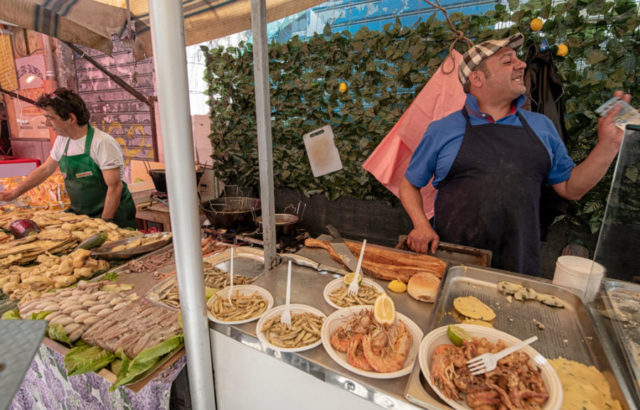
Street food stand

On the other hand, I’ve come to appreciate the way Italy forces me to stretch my boundaries. Italians have a gift for getting you out of your shell — which I don’t mind doing, even if I need a little encouragement. Rick (a classic extrovert) has a mantra: “Extroverts have more fun. If your trip is low on magic moments, kick yourself and make things happen. ” Easy for him to say. However, I have taken those words to heart since my first big European backpacking trip in 1999. And I find that in Italy, becoming a temporary extrovert comes very naturally. And, sure enough, it’s more fun.

At the end of the day, Italy is a package deal — you take the bountiful good with the occasional bad. And the extraversion of Italy’s wonderful people is something I’ll very happily accept as part of that package. It’s right up there with great art, great pasta, and great gelato: great people.

All Alone in the Alps: Hiking with the Cows High Above Gimmelwald, Switzerland

Gimmelwald — that perfect alpine village, perched on a meadow-draped cliff facing a panoply of cut-glass peaks — is a sleepy time warp…most of the time. But as summer nears its end, Gimmelwald snaps to life. By the second half of September, the cows are about to come down from the high alpine pastures…and there’s lots of work to be done.

My visit to Gimmelwald actually begins in the next village over, mile-high Mürren. I cross the street from my hotel and hop on the Allmendhubel funicular, which zips me in less than four minutes up to 6,200 feet and grand views of the Eiger, Mönch, and Jungfrau peaks.

I thought I was just coming up for a quick peek. But now that I’m here, I start paging through our Rick Steves Switzerland guidebook (which I’m here to update, for our upcoming tenth edition). It turns out that one of Rick’s favorite hikes — the North Face Trail — begins from right where I’m standing. It’s mid-afternoon, and my work is done for the day…why not?

Following the book’s instructions — and the blue North Face Trail signs — I gingerly let myself through the electrified cattle gate and head down into Blumental…the “Valley of Flowers.” In the early summer, this meadow bursts with wildflowers. But today the flowers are mostly gone, the cows have chewed the grass down to the nub, and fall is nearly upon us.

Over my head, a packed-to-the-seams cable car silently makes its way up to the Schilthorn. Seeing all those excited faces pressed against the cabin’s windows, selfie-sticks glancing off the scratched and smeary glass, I realize there are far few people in this entire meadow than there are in that one little cable car.

I rode that cable car up to the Schilthorn earlier today. It’s hard to be cynical about the Schilthorn — it’s a spectacular alpine panorama. But it’s also commercialized to the hilt, making the utmost of its connection to the James Bond movie filmed there 50 years ago. This theming — once just a kitschy footnote to a visit — is getting out of control. The cable car itself is emblazoned with a hot-pink 007 logo, the observation deck is scattered with George Lazenby cut-outs to pose with, and “Bond Girl” silhouettes shimmy on the bathroom stalls.

For my part, I’m very happy to be out in a pristine meadow, rather than inside that cable car. Taking in a deep breath of thin-and-fragrant alpine air, I make my way across the meadow to the rustic little hut called Suppenalp.

This is a proper “alp” — a high-mountain meadow where cows spend their summers grazing. In the interest of preserving this traditional bit of culture, the Swiss government subsidizes this work to the tune of about $5,000 per cow. In many rural communities, parents fret over the next generation leaving for the bright lights of the big city. But here, they have the opposite problem: Kids fight over who gets to take over the family herd.

The cows’ owners hire cowhands to tend the herd for 100 days each summer in the high alps. The cowhands get up every morning at 5 o’clock to milk the cows and take them out to pasture, and then bring them back and milk them again in the afternoon. Because it’s impractical to haul heavy cans of milk down the mountain, they make the Swiss mountain cheese right here. For these cowhands, it’s a lifestyle choice: spending summers at 6,000 or 7,000 feet — working hard, yes, but ensconced in alpine splendor, while steering entirely clear of the modern rat race…a high-altitude summer sabbatical.

At this alp, the cows are in their pen, contentedly munching and mooing, but the hut itself is closed so the cowhands can take a much-needed rest day. Monntag und Diesntag Ruhetag, says the chalkboard. No cheese samples for me…yet.

From the hut, I head up a steep, rocky path, curving around the midsection of a ridge toward an alpine pasture that my book tells me is just around the next bend. Another crammed cable car sails over my head as I head for a new row of snow-covered peaks. I pass through a little stretch of alpine forest before breaking through into a pristine pasture, stretching like an infinity pool toward the sheer granite cliffs on the far side of the valley. Someone has positioned a split-log bench just so to take in the panorama.

Crossing this alp, at what feels like the top of the world, I make my way down to a humble gathering of huts called Schiltalp. This is where the majority of Gimmelwald’s cows spend their summers. But summer is nearly over, and very soon — when the last of the summer sun fades and the autumn clouds close in — the cowhands will herd their charges together, strap big ceremonial bells around the cows’ necks, bedeck them with pretty wildflowers, and parade them back down through town to their barns for the winter.

You never know exactly when the cows will come down, but I was lucky enough to see this spectacle years ago, in the super-traditional village of Appenzell. It remains one of my all-time favorite Swiss memories: an impromptu folk-life parade where the bovine grand marshals were cheered like returning war heroes.

But for today, the cows remain up on the alp. I can tell they’re still here before I see them, because those big ceremonial bells are still hanging high from the roof beams of the biggest hut. The Schitalp hut has a little “self-service” fridge, where visitors like me are welcome to leave a few coins in exchange for a bottle of water or beer, or a little wedge of alpine cheese.

The outdoor tables are enjoying some late-afternoon sun, but the only people sitting there are four extremely rough and grizzled old-timers nursing beers, giving me suspicious looks. I’ve clearly crashed some local party.

Trying to break the ice, I experiment with the local Schwyzerdütsch greeting: “Grüezi!” After 20 years of traveling to Switzerland, I’m still trying to master the pronunciation: “GREWT-see!” In Swiss cities, that does the trick. But in the countryside, singsongy Swiss German gets even singsongier.  And up here, each village — or even each farmhouse — has its own idiosyncratic greeting.

As usual, the four old-timers respond with what — to my ears — are four entirely different ways of saying the same word:

“GRÜÜÜÜÜ-zeh!”

“Khhruh-suh!”

“Grut. [pause, pause, pause] Si!”

“Khhhhrew-tzee!”

They return to their beers, making it clear that our conversation is now complete.

I drop a few coins in the jar and help myself to a wedge of mountain cheese. It has a pungent aroma but is still soft: not quite fresh, not quite aged, and speckled with little bubbles.

I saw a little chunk off of the slab, mount it on a hunk of rustic bread, and take a bite. The texture is as smooth and creamy as the flavor is sharp and searing — filling my mouth with the taste of hay and wildflowers and a tannic kick and deep, deep Swiss tradition. Strange as this may sound, it marries well with the aroma of freshly cut hay and day-old manure that hangs heavy in the air…in a good way, I swear to you. It’s easily the best cheese of my trip, if not my life.

I munch my way through the slab of cheese, savoring each bite. When it’s gone, craving just one last taste, I whittle a curl of delicious cheese off the rind and pop it in my mouth…the dairy equivalent of sucking the meat off the bones. The flavor will linger on my palate for hours.

Recharged, I bid my fellow alp hut patrons a cheery Adieu! and head on down the path.

Within moments, I’m immersed in a bucolic landscape of grassy hills, wooden barns, and mooing cows. And then, in the distance, I hear cowherds hooting and whistling. The mooing becomes more agitated. The cows are on the move.

Riveted, I watch as the cowherds crest the undulating land and come into view. It’s a family — dad, mom, and a couple of kids — working together to bring their herd in for the night. They’re dressed in modern clothes — shorts, T-shirt, trucker hat — but they enact a timeless routine of man and beast: insistently moving huge animals, many times their own size, with nothing more than insistent yelps and a big stick.

And then, all of a sudden — I’m surrounded. Cows on all sides of me, cowherds behind them, trying to move them up the gravel road I’ve just come down. A little frightened by the thousands of pounds of agitated beef headed my way, I stand still — a rock in a stream of livestock.

Once the cows have passed, I carry on down the path, leaving the slow-motion stampede behind me. I’m buzzing from the moment I just experienced — one of those beautiful travel serendipities where it feels like every decision I made today conspired to put me in the perfect place, at the perfect time.

Continuing on down the path, I pass through yet another alp settlement — Spilbodenalp — where the cowherd is also out, wrapping up a busy day’s work, while a few lazy cows doze in the front yard.

From here, I make my way steeply down on a switchbacked trail through a thick forest, then down precarious steps carved into a cliff to slip under the thundering waterfall called Sprutz. Grabbing the metal cable drilled into the cliff, I climb back up the other side, then make my way up through another thick forest until I finally emerge at the top of a near-vertical meadow. Below my cow pie-scuffed shoes are the rooftops of an idyllic alpine village: Gimmelwald.

I make my way steeply down through the pasture toward the tiny settlement — following narrow ruts, barely wider than my shoes, through the lush green grass toward the rustic rooftops. The fields around me are alive with farmers, out harvesting hay they’ll use to feed those cows when they come back to earth from the high alps a few days from now.

Crossing a narrow, paved road high above town, I dodge out of the way of a tractor as it zips past — racing to wrap up chores before they lose the sun. Scanning the rooftops below me, I can see that this little village — normally sleepy — is a beehive of activity. A visit to Gimmelwald just before the cows come back teaches you what they mean when they say, “Make hay while the sun shines.”

Finally I reach Gimmelwald’s upper road, where I’m greeted by four perfectly positioned benches — gazing across the gaping chasm of the Lauterbrunnen Valley, to the black-and-brown-streaked, deeply pitted face of the Schwarzmönch mountain across the way.

Just up the road, I swing by the Hotel Mittaghorn — also known as “Walter’s,” for the Swiss gentleman who has run the place since, I have to assume, the last Ice Age carved out the Lauterbrunnen Valley. Nothing ever changes at Walter’s — he makes darn sure of that. If it was good enough 30 or 40 years ago, it’s good enough today.

Out on the front porch sits perhaps the only relaxed person in Gimmelwald: Tim, the Englishman who’s been Walter’s trusty right-hand-man for the last 20 years or so. I sit and chat with Tim for a while, getting the latest gossip on this Gimmelwald institution. Tim tells me that Walter is now 95 years old, and opens his hotel only three months a summer — when Tim can be here to essentially run the place for him. They close the hotel more or less when the cows return; the cooler weather that brings the cows down from the alps also keeps the sun-seeking tourists away.

While Tim and I are chatting, the relentless bleating of goats in a pen next door intensifies. One of the goats finally jumps the fence and starts wandering around in the road. Tim, the good neighbor, hops up to herd the goat back home. I try to help, but I’m even less of a shepherd than he is. All I can do is hold the little gate open while Tim grabs the goat and bullies him back into the pen.

“Those two goats are sick,” Tim explains. “That’s why they keep them down here while they take the rest of the herd up to the upper meadows during the day.” He explains that, while the cows are way up at the high alps, they keep the goats closer — simply to provide local families with fresh milk through the summer. Sure enough, a few minutes later, our conversation is interrupted by a chorus of bleating and tinny, off-key bells as a couple of village kids march several more goats down the path to join their two sick friends in the pen.

Before I move along, I head into the hotel kitchen to say hello to Walter — still with that same twinkle in his eye, all these years later. Many, many years ago, Rick Steves’ Europe Tours spent the night at this dusty, rustic firetrap of a high-mountain hotel. The only way we could fit the entire group was to squeeze six couples — that’s 12 paying adults, close to half the group — into one big sleeping loft in the attic. They shared a toilet and a coin-op shower…not just down the hall, but down the stairs. (Our tour guides mastered the art of identifying which dozen people were best equipped to tolerate, or even enjoy, that experience.) Understandably, our tour members came to expect a higher level of comfort, and about 20 years ago we stopped using Walter’s. But, I swear to you, the tour members who stayed here absolutely adored the experience. When they talk about it, they get a twinkle in their eye…just like Walter’s.

I bid farewell to Walter and Tim and head into town. Across the street from Walter’s, steps lead down into the heart of Gimmelwald: the main intersection with the overly enthusiastic directional signs, the two little guesthouses, and the youth hostel and cable-car station just around the corner.

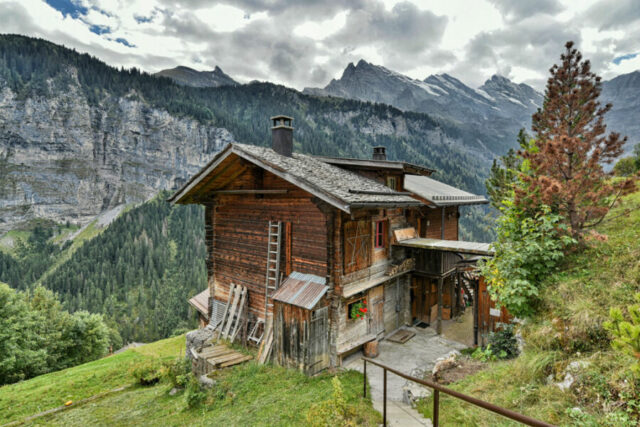
I go for a lazy lap through town, following the main street past busy barns, log-cabin-style homes, perpetually flowing faucets that fill carved-tree-trunk cow troughs, lovingly tended flower boxes, and bazillion-dollar views.

The people of Gimmelwald are firewood artists — stacking a winter’s worth of fuel with the precision of a master engineer. But I also see piles of just-split wood, waiting to be stacked.

At one point, as I’m lost in the glorious views across the valley, a towheaded, cherry-cheeked teenager pops up over a hill in front of me, pulling a giant tarp filled with freshly scythed grass. He dumps the grass by the front door of his house, theatrically wipes his brow with a handkerchief, then grabs the empty tarp and heads back down over the hill for another load. If Norman Rockwell were Swiss, he’d paint what I just saw.

I head back through town, fantasizing about living in a cliff-hanging cabin, filling my bottle at the fountain, and dodging a couple more tractors that come rumbling up the road. Back at the cable-car station, I watch the lift arrive from the Schilthorn high above. Dozens of day-trippers pour out of the cabin and cross the platform — blowing right through this sweet, intoxicating village — in their rush to the connecting cable car back down to the valley floor, and their awaiting tour buses.

I think back on those entirely unpopulated high-alpine meadows, those stunning mountain views savored all alone, and the feeling of being the only non-Swiss human being out on a vast and lonesome alp, entirely surrounded by cows. And I wonder why someone would pay a hundred bucks to squeeze into a tiny box and ascend to a James Bond-themed revolving restaurant, instead of experiencing what I just experienced…for free.

The cable-car door closing jolts me awake, and I look down as I fly over the rooftops of Gimmelwald and the steeply switchbacked trail tethering it to Mürren. I catch one last glimpse of Walter’s rooftop just before I’m swallowed up by the Mürren cable-car station.


Update, March 2021: I wrote this post in 2019 while I was working on our Rick Steves Switzerland guidebook — where you’ll find all the details about visiting Gimmelwald, hiking to a remote alp, and even — if you choose — heading up to the Schilthorn (with tips for avoiding the crowds).

Or, once it’s safe to travel again, consider joining us on a Rick Steves’ Europe tour. Our Best of Switzerland in 12 Days Tour is ideal for those wanting a full itinerary of experiences like this. But we also spend time in this part of Switzerland on several other tours: Best of Germany, Austria, and Switzerland in 14 Days; Best of Europe in 14 Days or 21 Days; Best of Family Europe: London to Florence in 13 Days; and My Way Alpine Europe in 12 Days. (Come to think of it, it’s hard to find a tour that doesn’t stay in this part of Switzerland.)

While this was an idyllic late-summer/early fall visit, I also had a wonderful Christmas in this part of Switzerland once with my family.