Recently, I made it back to my favorite spot in Norway: the tiny, fjordside, huggable village of Solvorn, perched between burly gray cliffs and the shore of the Lustrafjord.
One evening, I sat on a bench out at the little pier — where a pint-sized ferry chugs across the fjord once and hour to the oldest stave church in Norway — and found myself simply basking in fjordland splendor. When I’m working on guidebooks, I normally don’t have much time for “basking.” (And even in this moment, I had my laptop on my knees, furiously typing up a new “visual spin-tour” of this town for the next edition.) But a place like Solvorn stops even the busiest traveler in their tracks.
Looking left, I visually traced the shoreline past a diving tower at the public beach, then out along a rocky promontory, where a series of yellow and red boat sheds huddled at the base of the cliff.
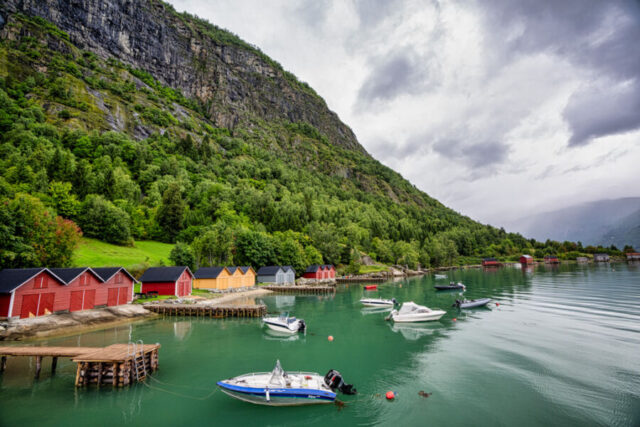
Looking right, I panned over the rooftops of the tiny, shiplap town center — which boomed here in 1860, when a road tethered it to the fertile farming uplands just behind me, and regular steamboat service commenced to Bergen. More boat sheds sat out along — and, in many cases, over — the shoreline, and behind that, a gravel path led between yet more sheds and pristine white wooden homes, each one pretty as a postcard.

And immediately behind me sat Norway’s oldest continuously operated hotel, the Walaker Hotel (now in the hands of the ninth generation). With its yellow and red wooden buildings, giant fjordside garden, and generous porches with comfy chairs, the Walaker may be the best place in Norway to simply relax.

On the distant horizon, a very small cruise ship slowly trundled past. And I realized with a start it was the first one I’d seen in a couple of days. I had just driven in from the Geirangerfjord, whose main town is about the same size as Solvorn — roughly 250 people. But Geiranger, unlike Solvorn, plays host to one or two gigantic cruise ships nearly every day through the summer — each one injecting more than ten times that many tourists into what was, until that moment, a sleepy little community.
When I quizzed the hotel’s receptionist about lunch options, she was almost apologetic about Solvorn’s near-complete lack of choices: For lunch, I’d have to drive 20 minutes to a bigger town. But she needn’t worry — Solvorn’s sleepiness is exactly what causes travelers like me to fall in love with it.
Yes, cruise ships haven’t discovered Solvorn; and in the 1950s, when the automobile became the dominant mode of transportation, the main highway 55 also bypassed this little burg. (It runs just inland from here, up a very twisty mini-mountain pass.) As is often the case, becoming a forgotten “backwater” from a transportation point of view isn’t ideal for a fledgling local economy…but in the long run, it’s ideal for creating a wonderful travel destination.

Panning around and marveling yet again at the miracle of modern sightseeing that is Solvorn, I got to thinking about other special places that give me this same feeling. Lucca, Italy. Salema, Portugal. Toruń, Poland. Sarlat, France. Gimmelwald, Switzerland. Folegandros, Greece. Delft, the Netherlands. Ljubljana, Slovenia. Modena, Italy. Collioure, France. Erfurt, Germany. Salamanca, Spain.

Some of these are little places, like Solvorn; other are big cities. And yet, they all have an intangible specialness. They’re the places I find myself dreaming about, all winter long, after the hustle and bustle of a year’s travel fades into memory.
So I started to wonder: Why? What’s so special about these places? And that’s when I came up with a very arbitrary, but telling, metric: the Charm-to-Tourists Ratio (CTR).
In essence, these special places are far less crowded than their ample charms merit. There’s lots of ways of talking about this: For decades, Rick called them “Back Doors.” Each December, I brainstorm my list of “Discoveries” — suggestions for underappreciated gems to explore in the coming year. (You can see my 2026 list here.) You could call these places “untouristy” — but no, that’s not quite right, because they do have some tourism…just not too much.
The Charm-to-Tourists Ratio is, admittedly, a subjective, intuitive, and completely arbitrary metric — and I’m as far as it gets from a data scientist. But just for grins, let’s unpack CTR and see what it might tell us:
First, the “charm.” This concept, so vague as to be a lazy cliche, actually does mean something specific, I think. To me, “charm” means an intangibly authentic European quality. It’s unique and not easy to come by, and it can’t be manufactured or faked (much as Epcot tries). Red-and-white Norwegian boat sheds on long piers over dreamy fjords: charm. Picturesque Italian hill towns, perched at the top of a chunk of rock, with a labyrinth of homes clustered around a grand piazza: charm. Higgledy-piggledy half-timbered houses: charm.

Next up: the “tourists.” Here again, this gets tricky to define, because of course all of these places have some measure of tourism. Some of the high-CTR places are actually quite crowded with tourists — but they’re domestic tourists…Norwegians or Italians or Poles who’ve discovered this wonderful little time capsule of their own past.
So perhaps it’s helpful to lean on another cliché: that old distinction between “travelers” and “tourists.” Basically, a “tourist” is casual and quick — less curious, less thoughtful, less considerate. More interested in collecting selfies and souvenirs than in learning and connecting.
Mass tourism — especially, say, cruise ships — tend to attract fewer travelers and more tourists; consequently, places with lots of cruise ships and/or big-bus tours tend to have a lower CTR.
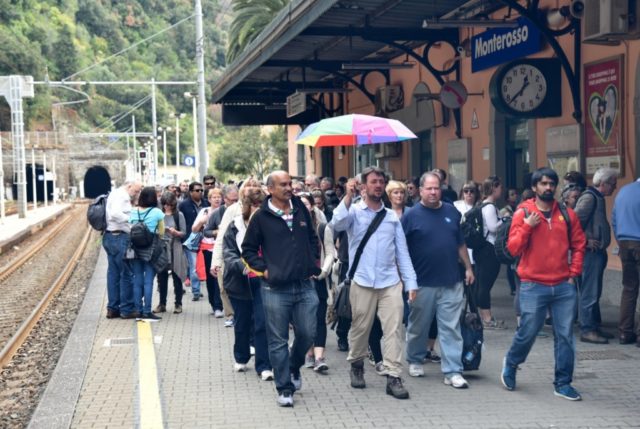
A traveler, meanwhile, lingers and learns. (If I could sum up the ethos of our Rick Steves Tours in a nutshell, it might be simply that we are using a mode favored by “tourists” — bus tours — but approaching the experience as travelers.)
So, then: The Charm-to-Tourists Ratio takes the overall charm of a place, then divides it by the number of tourists. And here’s where you get into some interesting case studies.
A high-CTR place is one like Solvorn or Lucca or Toruń: It hits the sweet spot of being extremely charming, and relatively untouristy. On paper, Solvorn should be the most overrun town in Norway. Instead, thanks to the limited accommodations options (one expensive hotel, one guesthouse with shared bathrooms, and one youth hostel) — and the fact that, by fluke of fate, it somehow hasn’t broken through into the “bucket list” of the 21st-century traveler. It’s still sleepy…almost mysteriously so.
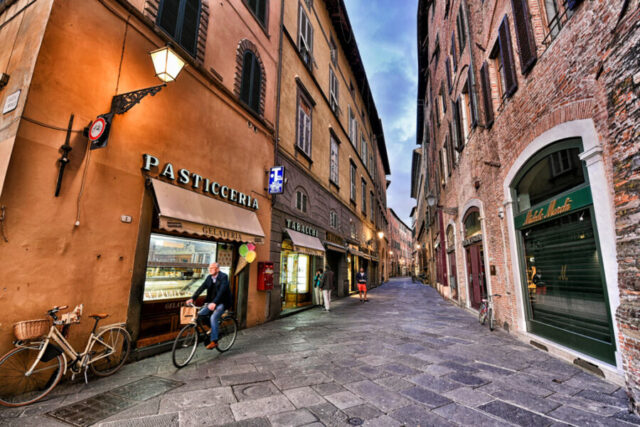
Lucca, which is off-the-charts-high on CTR, is perhaps Tuscany’s most delightful small city. Astonishingly, it’s just a half-hour away from the famous Leaning Tower of Pisa, and the mobbed beaches and trails of the Cinque Terre. On a recent visit, it occurred to me that those super-popular destinations so close by act as a distraction…pulling away tourists who might otherwise discover Lucca. It’s like putting out a little dab of honey at your picnic to attract the ants, so you can focus on the good stuff.
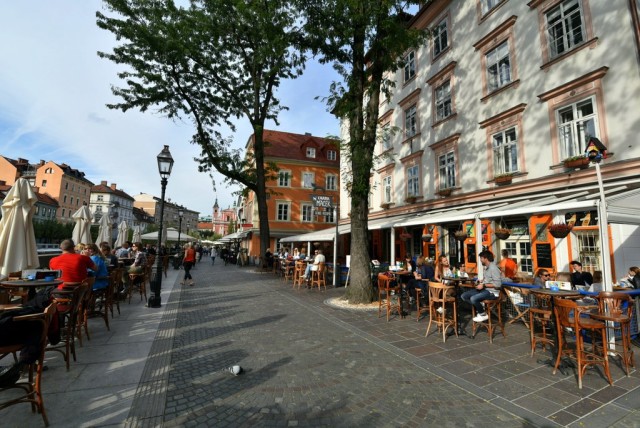
High-CTR places aren’t always small towns; even big cities can score admirably on this measure. Ljubljana, one of my favorite places in earth, is a national capital of about a quarter-million people. It’s extraordinarily charming, especially for a city. But, on a per-capita basis, it has relatively little tourism. Here again, most whistle-stop tourists in Slovenia head for Lake Bled, which is beautiful…but, increasingly, very crowded, with a CTR that drops lower with each passing year. I suspect Lake Bled is distracting lots of tourists away from Ljubljana…leaving it to us travelers.
In northern Poland, I love both the red-brick town of Toruń and the bustling Hanseatic port city of Gdańsk. Both are extremely charming. But Toruń is even just a bit more charming, and even less touristy…which, per the CTR metric, ranks it high on my list of favorite places in Europe.

A low-CTR place is one whose touristic reputation is exaggerated relative to what it has to offer. Geiranger and Flåm — the two most popular small-town cruise ports in Norway — are fine little places, with gorgeous fjordside scenery. But they are inundated by so much tourism (cruise passengers and, in the case of Flåm, “Norway in a Nutshell” day-trippers) that they can’t possibly compete on CTR. They have both lower charm and astronomically higher tourism than sweet little Solvorn.

In Greece, Santorini and Mykonos — while quite different — both perform extremely high on charm. One is perched on the lip of a crumbling volcano caldera; the other is the quintessence of a whitewashed Greek island village. Even so, both are absolutely heaving with crowds — not just from cruise ships, but also luxury jet-setters from around the globe.

Much as I’ve enjoyed my time on these two islands, they are way too small to effectively handle so many visitors…and consequently, they’re some of the most unpleasantly crowded and grotesquely expensive places on the Mediterranean. So they flop when it comes to CTR. (For the opposite — an island that ranks perhaps slightly lower on charm, but drastically lower on tourists — consider the high-CTR isle of Hydra, an often-overlooked chunk of land off the Peloponnesian Peninsula. Also high on CTR: Folegandros, a short express boat trip from Santorini; or Naxos, which you can actually see from Mykonos. Heck, on a calm day, you could probably swim it.)

Here’s another example of a low-CTR destination: Scotland’s Loch Ness. Last summer, I got into quite a bit of trouble when I proposed that Loch Ness is nowhere near as worthwhile as the vast crowds who flock there seem to think it is. Driving along Loch Ness, my heart broke as I saw the vast numbers of tourists who’d gone to considerable effort and expense to come here, only to gaze out over a not-terribly-scenic loch in search of an imaginary beast. The lakeshore of Loch Ness is a glut of tacky tourist shops and gimmicky come-ons…and it works! The place is packed. Now I realize that what bothered me so much at Loch Ness is that it has an exceedingly low CTR. I said back then, and I’ll say again: There are far, far better (high-CTR) options within an hour’s drive of Loch Ness.

And then there are those interesting case studies: Amsterdam, Venice, Prague, Barcelona, Dubrovnik. These places are incredibly, off-the charts charming. They are also extraordinarily crowded. However, the charm is so high that even the high level of tourism causes them to perform respectably on CTR…winding up comfortably in the black. In other words, some places are still well worth a visit, even if they’re touristy.

Meanwhile, there are some very big cities where the CTR is essentially meaningless. London, Paris, Rome, Istanbul, Berlin — it’s difficult to classify any of these on “charm” per se, and they’re so gigantic that tourism is diluted, having less of an impact than on, say, Flåm or Loch Ness. This is, admittedly, where CTR becomes less helpful.
You may disagree with my implementation here. But try the Charm-to-Tourists Ratio out on your own favorite places, and see how they stack up. In the Comments, I’d love to hear about your favorite places that hit it out of the park on the CTR statistic — and why?
Excellent article!!!!
Interesting article and I agree with this way of thinking about travel and place. We just returned from Norway and visited Solvorn (staying in nearby Luster) and it is charming. Wasn’t impressed with Geiranger, though the fantastic boat tour via Naerofjord makes the visit worthwhile. Unredal is another location nearby with considerable charm. Flam (we stayed in nearby Aurland) retains some charm minus the train trip tourists.
Thanks for the memories. In five decades of travel we have visited most of your highlights. Loved your analytical “CTR” characterization. We have read of and heard stories of places we had visited in bygone years that made us grateful to have visited places when we did, Venice and Ljubljana among them. It is good to know that others still exist under the crush of modern day tourism. I call tourists “gun notchers” and travelers “curious learners” Keep up the good work Cam. I am jealous of your life’s work. Getting paid to travel was part of our younger lives. Me in uniform and Connie following the ship around the ‘Med. from port to port with other Navy Ives. After leaving the Navy we kept the passion that you so aptly exhibit in your writing.
Thanks Cameron. I would say for the big cities, like Paris which I know well, you can reach that charm ratio in a couple ways — by going to “off the beaten track” neighborhoods and going off season. I travel to Paris in early spring and enjoy the city like a Parisian in the heart of centuries-old areas oozing charm you won’t find anywhere else.
I agree completely. Even though small towns are amazing, I still love the big European cities like London, Paris, and Prague, not because they are small and quaint but because they offer incredible history, culture, and architecture all in one beautiful, urban package.
Wonderful informative article and the reasons we travel!
This article was excellent
This article is a gem.
Thank you for sharing this information.
Thank you for sharing.
This is a brilliant metric that I’ll use myself in the future to evaluate our prospects!
Great article! We stumbled upon the darling town of Spello in Italy. And we also enjoyed the island of Langeoog in the North Sea, which seemed to be more local tourists rather than world travelers. Loved Lucca as well!
My husband and I stayed 5 nights in Spello in 2019 at a most charming hotel. We were stunned that there were no travelers there. We walked all over the town, got lost and as always, 2 oh so kind Italians helped us figure out our way to get on the “ travelator”. We were charmed by this town and its people.
Rick, please help people know about Spello.
I agree with your CTR choices. I have visited a few of them – Torun, Erfurt, Delft, Gdansk. I like to say these are “human size cities.” Places I have loved visiting that weren’t overly crowded: Bruges, Reims, Rouen, Paestum, Ravello, Giverny in the off-season, Bath, Bayeux. My husband and I love travelling in Europe the most by far. There is history around every corner. There are tons of beautiful cathedrals and many outstanding art galleries and museums. We did a 2-week cruise of Norway. Favourite places were Eidfjord, Bergen and Àlesund. Norway was not crowded. We were there during the month of August when the best weather can be expected. And we have found that hop-on-hop-off buses to be the best way to explore a city for the first time. It orients you so that you can go back and visit a particularly interesting site OR hop off the bus like we did to visit the Atomium in Brussels.
Rothenburg….go and stay several nights at the Burg Hotel. We spent 3 nights and it was like we were in a beautiful dream. I know Rothenburg is spoken of as run over by tourists, and there are many during the day, but one can spend part of the day in the charmingly beautiful park that overlooks Rothenburg, a postcard picture view. Walk the city wall during the day. Sleep in this most captivating village and be charmed by the Burg Hotel.
We followed your recommendation & flew into Bergen. Rented a car & headed for the Walaker Inn & the Knivtes Hotel in beautiful Balestrane.
After countless tunnels we finally arrived at the Walaker where we fell in love with this amazing quaint inn! Apple & pear trees everywhere, rooms were perfect & the food delicious. Took the ferry across to the Stave church! Sat on the front porch wrapped in a blanket sipping coffee & watched the sun rise over the fjord! One of my all time favorites!A must see & wonderful memory. Thx❤️
Well, there goes Solvorn
Sadly, I have to agree. When I visited Cinque Terre about 25 years ago, it was already practically overrun with tourists. And it is far worse now from what I hear and read. Why? I believe the reason is that it had recently appeared in a Rick Steves travel guidebook as a desirable destination. So your recommendations are welcome, but they are also a double edged sword.
Lübeck, Bremen, and Leipzig, all visited July of this year, scored high on CTR, especially for lovers of history and architecture.
Chiloe Island, Chile and Bilbao, Spain. We spent 5 nights on Chiloe Island – hiking, biking, meeting the locals, seeing the smallest deer in the world, gorgeous birds, cows, and the views were stupendous. Bilbao is my favorite city in the world. First visited on the Rick Steves’ Basque tour and knew we had to return, which we have done twice since so far. It and the surrounding area are so beautiful. We hope to return again in 2024.
Great article! As I get older the desire for the familiar becomes more attractive when I travel. I have been to Interlaken Switzerland many many times, including this summer and it is not high on the CRT scale like it was in 1990 when I first visited. I like it because I don’t actually stay in the town but rather in Unterseen across the river in what used to be called a holiday apartment, now VRBO. The transportation to all the mountain villages is great from Interlaken and the restaurants and groceries are just 5 minutes across the river from my quiet neighborhood.
Thanks, Cameron! I always enjoy reading your column. I’m also currently working my way through your “Temporary European” book, which is wonderful reading. Thanks for sharing all your travel stories, tips, and suggestions with us.
A special place I have found with what I think is a high CTR like Solvorn, is the Orkney Islands. I have been twice now, and spent almost two weeks there. There are so many islands to explore in this charming archipelago that tourism has forgotten. However, I do believe that Kirkwall, the Orkney capital port city, is facing the same challenges that Venice, the Cinque Terre, and Iceland are currently facing: how to deal with overtourism when the infrastructure does not support current levels.
When I visited the lovely island of Westray, in the Orkneys, a few years ago, I remember thinking, this place should be on the Rick Steves radar (and probably is already). But, after speaking with my local guide on Westray, they told me that their island cannot withstand any more tourism than the small amount they currently have. They simply don’t have the infrastructure. When a cruise ship does dock in their small port town, the village is overwhelmed with tourists. Many locals have to shuttle passengers around all day and it’s more than they can handle. They don’t want to be the next Cinque Terre.
But, its a charming place to visit, and quite scenic with relatively no tourists. I was there in May, and it was quiet. They have beautiful Nordic ruined castles, breathtaking scenery like the Natural Arch near Aikerness, and a lovely harbour. The lighthouse is beautiful and the cliffs along the north western coast was stunning. It’s also a great place for birding, hiking, and some delicious food.
I stayed in an old converted church community hall called Braehead Manse, which was lovely. I was the only guest, and had an entire building, complete with large room and kitchen, all to myself. The landlord even took me to the airport when I left and took me to dinner my second night there at the local chippy. Wonderful place!
My local tour guides showed me around the entire island, picking me up at the airport when I landed and taking me to my BnB at the end of our day together. The guides took me to their home for a fantastic lunch, and even shared their family recipes with me too, particularly of a delicious sweet potato and smoked bell pepper soup they made for lunch. They also brought me back later for afternoon tea, which is always a treat. It was a lovely day getting to know them and learning about their island, their culture, their food, their history, and their architecture. To me that makes it a High CTR place and one I will revisit again and again. The Londons, Parises, and Romes, are all wonderful to visit and enjoyable in their own way, but it is really nice to get away from it all and enjoy some beautiful, remote scenery and experience another unique culture, like Solvorn.
My wife and I stayed in Solvorn in 2006 and found it charming. We took the ferry to visit the stave church and were glad we did. We stayed at the Walaker Hotel and should have taken advantage of the dinner they offered. Instead we drove into the next town but didn’t find a worthwhile dining experience. We enjoyed Balustrand, splurging for a room with a balcony view of the fjord. There was a charming peninsula with benches there. We also enjoyed Bergen and a visit to Grieg’s house and composing hut.
I love your CTR rating Cameron, and will be using it on my return to Europe hopefully next year! Norwatmy and Freat Britain are high on my list.
On my past trips, friends live in various small, charming villages. For instance in the hilltop towns of Italy, friends live in Torigano where there is a wine and olive oil museum, cousins run a Derutia type ceramic shop. The Umbria region is a hidden gem and so much to explore.
In Belgium, Vilvoorde is very close to the North Sea where we have had picnics in the dunes, visited the CTR of Bruges, Venice of the North and,of course, in my opinion the often overlooked town of Brussels with the best chocolate shops and parks. They also have many unique museums including Comic Arts Myseum with comic art all around the City on various buildings. So bright and lively. Also intriguing churches to wander in to.
Outside of Zurich, Switzerland is another friend’s CTR village of Rushlikon and a stones throw away from Lake Zurich, a train to take you all around the lake right outside their door as well as a Migros grocer next door and great restaurants and walking. You can also hike up the hill, or drive, to Park im Gruene (the Green Park) that is absolutely another treasure and something for everyone. It is maintained by Migros and has an area to learn the history of Migros. https://www.parkimgruene.ch/der-park
Well I could go on and on especially more about Switzerland and beautiful Austria, and the CTR area of Velden and the Worthersee. Carinthia is a state in Austria that is magical with amazing hiking.
Velden am Wörthersee https://g.co/kgs/rudr7V
I think this is a good unofficial metric! Besides the cities and towns you mentioned, I would add some of the second- or third-tier cities in France that I’ve visited: Albi, Rouen, Lille, Montpellier, Lyon, Nancy, etc. They are relatively uncrowded and have a regional French charm or elegance (depending on the city). Visiting in the far off-season also helps for some of the places that get just trampled during the warmer months.
We loved Girona, Spain, for its very high CTR: lovely ancient streets and buildings, friendly people, and very few tourists or tourist shops! It’s only a 75 minute train trip from the Pickpocket Capital of the World a.k.a. Barcelona, and a good base for taking the 30-minute train ride to Figueres and the enchanting Dali museum for a day outing. Girona enjoyed a brief surge in tourism after the airing of Game of Thrones, as many of its buildings and narrow streets appear in the series. We found an online GOT walking tour for aficionados that took us through its ancient sights. We hope to return to Girona one day!
Loved the article. High on our CTR is Haarlem. Just a hop and a skip from Amsterdam but worlds away from the mobs. We stay there and just hop on the train for a day of sightseeing in Amsterdam or one of the other high-CTR towns only minutes away on the train, like Hoorn or Alkmaar.
A wonderful metric. Particularly for those who have already done the must sees in Europe. We loved Lucca and Torūn. Your articles are always refreshing. Thank you.
Please do NOT publicize Spello!
I love this term! Also agree with how publicizing high CTR places can lead to its demise (see: Cinque Terre). For me, the Berner-Oberland and Rothenberg have high CTR. There are plenty of tourists, but many just passing through. There are so many hikes to choose from in the B-O that you can always find a peaceful spot to enjoy the beauty and simply “be”.
Great article. Guarda, Switzerland. High CTR.
Cameron – truly excellent article! We have taken nine Rick Steves’ tours & twelve trips to Europe vagabonding on our own over a ten year period. We covered all the European countries, and towns like Lucca, Hydra, Orta san Giulio (Italy), Kardamyli (Greece), Nazare (Portugal), Lindau (Germany), Ragusa (Sicily) – to name a few – were like a dream! We have the Rick Steves’ tours & outstanding writers & guides like yourself to thank for opening our eyes to all the unique ways to be a “traveller” and not a “tourist”. Keep up the outstanding work!
I loved this concept and this article, Cameron. I would add a few from some of my Rick Steves tours: Oban in Scotland, a sleepy little fishing port that ‘spoke to me’; Hallstatt in Austria, an utterly charming village that does draw a lot of Japanese tourists since it is their sister village; Rovinj in Croatia, another charming seaside town that didn’t seem particularly crowded but oozed charm; and San Sebastian/Donostia in northern Spain (yes, busy in June when I was there but what a gorgeous beach!). I’ve also gotten ‘lost’ in big cities like London, Paris and Rome while exploring on my own, and always had fun interactions with locals who unfailingly and very kindly pointed me in the right direction. That’s when I experienced the difference between a ‘tourist’ and a ‘traveler.’ Great article, Cameron!
We are in Ljubliana now and agree that it is busy but has a high CTR. All of Slovenia is off the radar for most US tourists. An area not covered much by RS guidebooks that we enjoyed very much is Brittany. Dinan (which IS covered) is very charming but there are many others in this area of France. We stayed in Camaret sur Mer in the Crozon peninsula and loved it. Sintra, Portugal is another although that was over 5 years ago we were there and now Portugal is the new trendy country to visit. The catch-22 of a Rick Steves recommendation now though is that once it’s published it’s no longer a back door. The price of fame!
Cameron – smartly written blog as always. You should seriously consider adding the CTR score to Europe Through the Back Door in addition to rough costs per major city. I agree with you that something like CTR can be extremely subjective, but that’s ok because we look to you for your expertise. If I’m trying to decide my next travel destination, I could balance overall cost with CTR as a formula for overall value. Just consider it!
Hi Cameron. Regarding your final blog statement: on the contrary, the CTR is extremely helpful and I wholeheartedly agree with its existence! Although there are subjective differences between individuals, I’ve never been able to quantify how I feel about one place versus another. I’ve always thought there was something about, for example, Blarney Castle as opposed to the Aran Islands beyond the architecture and urbanscape but couldn’t understand how to express it in words. You appear to have the foundation of an actual scientific method! Thanks for all you do.
-Tom, Olympia WA
We found the CTR in Arras, France to be in our favor: lots of charm, not too many tourists. Beautiful Flemish homes ringing the two squares, Saturday and Wednesday markets, a tour under one square introducing us to the building materials and to where the citizens scurried during the bombing of WWII. Another tour was of the Wellington Tunnels which the New Zealanders dug to get under No Man’s Land and surprise the Germans. Smack dab in the middle of the Battle of Arras in WWI, we found memorials, battlefields, museums and cemetery upon cemetery – too many to count. The charm, the history – and we could enjoy it at our pace without being crowded.
Ljubljana, Slovenia is on our list for this spring.
As I’ve said for years to all my friends and family: I’d rather go to a “Tier 2” site/city/town/hike and have it all to myself than a “Tier 1” that’s full of people.
Too many people ruin the experience I’m looking for.
Yes, 2 tours ago, wife and I decided that the “Tier 2” cities are the best value. Hotels are far more reasonable, there are low or no crowds, and your experiences are unlike those of your friends. I will say, however, that Berlin is still high on our list
Stockholm is a big city with lots of charm. Winter walks in old town listening to the ice flows nearby are magical. In summer I found the boat taxi taking me to unknown places free of tourists but high on culture.
Someone else mentioned Bayeux. A great place to spend a couple days out of Paris for Normandy visits. It’s only a little busy but boasts a Notre Dame vintage cathredral, a couple good museums, and a great historical walking tour.
Cameron, as always, your article was excellent and I like your CTR concept. Here are our nominees for high CTR places (in addition to many places that other readers have already mentioned): Murren, Switzerland; Rovinj, Croatia; Hallstat, Austria; Conwy, Wales; St. Cirq Lapopie, France; and Lake Bled, Slovenia (despite the number of tourists).
This was a very thought provoking article by Cameron! From a country perspective, I would have to give Portugal a hight CTR. Of the countries I have not visited, I suspect Slovenia is going to be right up there. Both countries are relatively speaking “under the radar”.
Thank you, Cameron, for an interesting and imaginative viewpoint on some of the “best” destinations of Europe, vis-a-vis your CTR scoring methodology. There is a lot to be said in favor of your system, lack of academic rigor notwithstanding.
Others have previously mentioned the downside of a hearty recommendation from the Rick Steves Company (RSC). Cinque Terra and Hallstadt are two places that come to mind. (A recent article on BBC speaks to this: https://www.bbc.com/news/world-europe-66634889).
I know that the folks at RSC are cognizant of the impact of tourism travel where carbon emissions are concerned, and that a customer has the opportunity of offsetting a portion of their carbon footprint. That in and of itself is a major consideration, especially where travel by jet is concerned.
But what to do about the physical impact of hordes of tourists on a destination that does not have the capability or capacity to accommodate them? What rating system could be devised (and used internally) at RSC to determine whether or not a particular place gets a rave review? How would one balance the positive economic impact of a “must see” recommendation to the purses of the locals, against the ruination of the culture and life style those locals will want to maintain? A larger place like Lucca may be better able to handle the influx of tourists/travelers than Solvorn, Vernazza, or Hallstadt.
So what do the good people at RSC do? They are, after all, in the business of sending Americans to Europe. Their “thoughtful traveler” ideology is well-intentioned and helpful. Perhaps there is some formula that could be devised, after a few years of tinkering, that would help ameliorate the problem of excessive tourism on a specific location. Maybe it would include the opinions and desires of the local people themselves. A tough nut to crack, but one I feel needs cracking.
When in Milan last Sept 2022, we thought about “the Last Supper” but chose to not go. The CTR is very poor – you get a rushed visit to see an iconic image that was ruined by poor technique almost 500 years ago. That’s a key part of tourism – don’t bother with things that are not of interest to you, or which others say you must see.
Was pleased to read this article. I saw Solvorn in 2017, my first trip to Norway. Made a point to see this small place as it is my great great great grandmother’s birthplace. Baptized in the other village back towards Sogn – Hafslo.
Excellent article.
Sadly Hydra may imminently be slipping off your list – I made a return visit there this week & was forlorn to find a large cruise ship in port, disgorging thousands of tourists & having a massive negative impact on the charm that I’d enjoyed in previous visits. :(
Do you think you could come up with a CTR metric? I’ve been trying to nail down how I can understand what makes a place somewhere we enjoy, or not. I think your CTR may be it. Loved Voltera, didn’t love Sorento. Loved Karamyli, didn’t love Naplion. Loved Hadrian’s Wall, didn’t love York. Loved Portugal (just everything). I’ll make a note of your list!
Great article Cameron, and wholeheartedly agree! We loved Verona, low tourkst numbers, Volterra and Lucca. Arrived in Pitigliano after dark and our first view was the town all lit up perched on that incredible rock, just breathtaking. Anywhere in Umbria or Marche – two regions that are amazingly still off the tourist radar. Small charming towns in Portugal, Spain and the UK that I do not want to mention! All of which you need a car as no public transport will take you there – thus the high CTR!
Thanks Cameron. Your article was quite thought provoking and I agree with your sentiments about CTR. I love being a traveller, and the slower the better! I have been loving slow travel on foot and really experiencing the people, culture, history and landscapes. I look forward to your next article.
What a great concept. When we do find ourselves in a relatively low CTR place, we start looking for a high CTR experience. If we’re the only Americans, we’ve usually chosen well. Some are not exotic or grand or historical but all are a wonderful opportunity to see how Europeans enjoy their locations. Examples include the aquarium in Bergen where it was so fun to watch the delight of the children; a boat ride through the locks on the St. Martin canal in Paris; the Szechenyi Baths in Budapest; and the Holmenkollen ski jump outside Oslo. There were failures as well but the effort to find our way to something different was always fun.